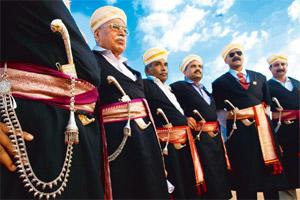
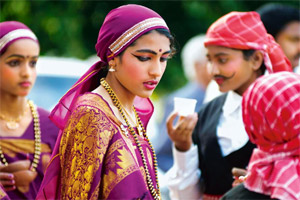
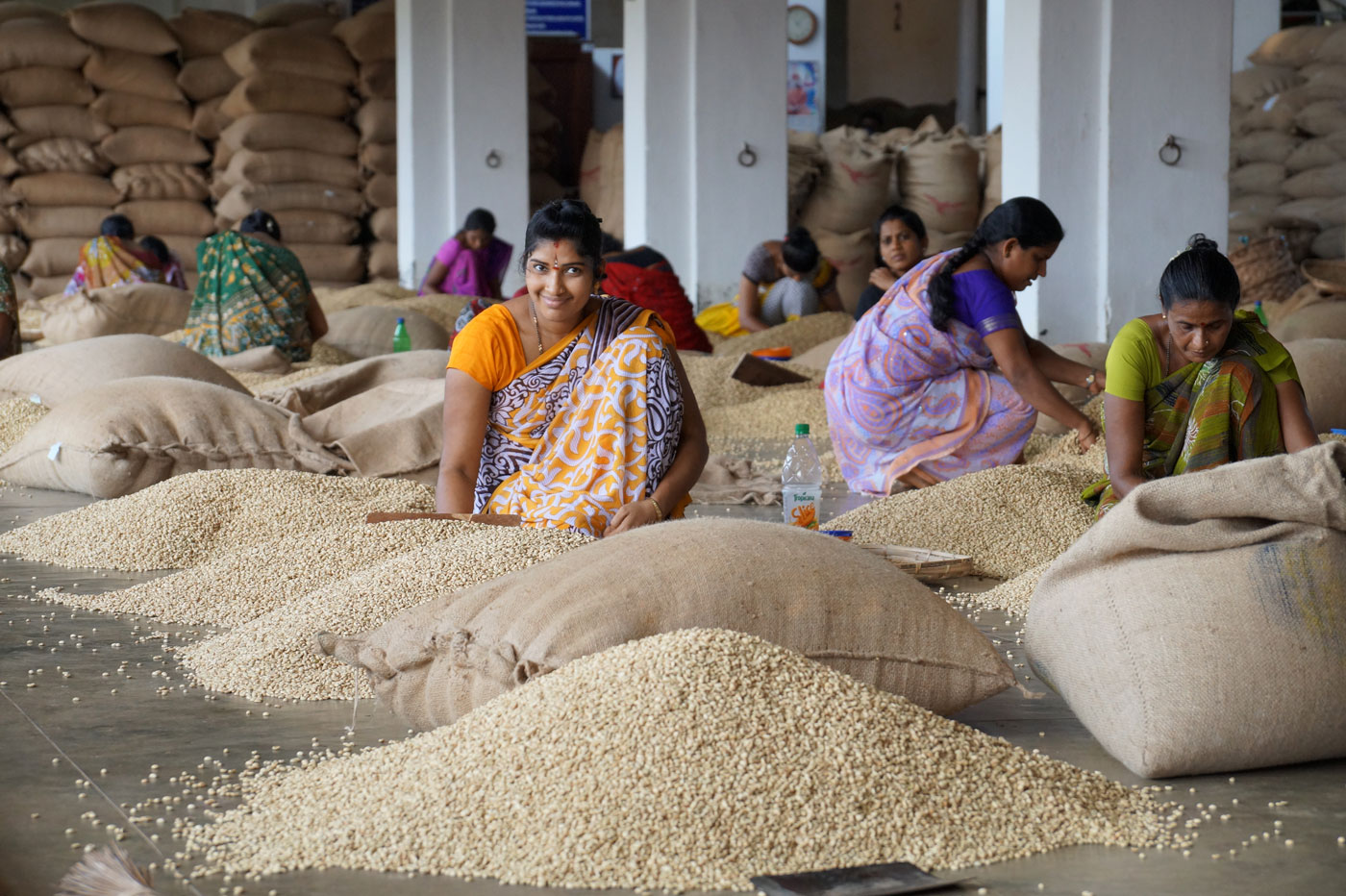
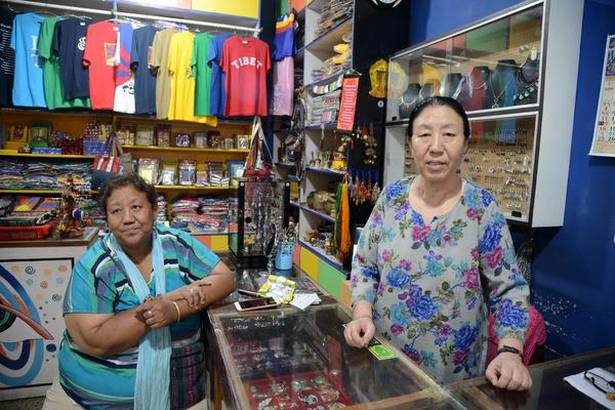
Parsis of the south: Scenes from the centenary celebrations of the Kodava Samaja Bangalore earlier this month. Photographs by Aniruddha Chowdhury/Mint.
Fair-skinned, educated and Westernized, they are the Parsis of the south. And their numbers too are declining— from 175,000 in 1992 to 125,000 in 2010 (Bureau of Economics and Statistics). Kodavas, or Coorgis, are concentrated in Coorg, Karnataka, which the British turned into a major district of coffee plantations. The land is also known for its mist-cloaked hills scented with honey, cardamom and oranges.
Kodavas are more numerous than India’s Parsis, Bahá’ís and Jews but that’s no solace. “We might vanish by 2030,” says Chepudira M. Thilak Subbaiah, president of the Kodava Samaja Bangalore that held its centenary celebrations in early November. “Young Kodavas are educated workaholics and don’t care about families. They don’t want more than one child.” According to Subbaiah, Bangalore has the largest population of Kodavas (35,000) after Coorg (70,000).
“The concern is not so much of losing at a numbers game,” says Sarita Mandanna, whose debut novel Tiger Hills was set in Coorg at the turn of the 20th century, “but the risk of losing an entire way of life, and the land as we once knew it.”
Kodavas are warrior-caste Hindus but their festivals and rituals are different. They have no priest, no holy fire and no dowry in weddings. They are great pork eaters. They worship Kaveri, the river that originates in Coorg. With a literacy rate estimated at 80%, their vocabulary is a mix of Persian, Sanskrit, Hindi, Kannada, Tamil and Telugu. Almost everyone has an estate—it could be 1 acre or 500 acres. Some say they migrated from the Kurd region in West Asia, others claim they are descendants of Alexander’s army. Traditionally a martial race, they have produced army icons like K.S. Thimayya and K.M. Cariappa. Other notable Kodavas are athlete Ashwini Nachappa and VJ Nikhil Chinappa.
Explaining the reason behind the dwindling numbers, the Bangalore-based author, Prof. P.S. Appaiah, says: “Until 1950, families had at least half a dozen children each. After the government introduced family planning, the Kodavas showed the most enthusiasm. General Cariappa himself would tell us not to go beyond two children. He said that we couldn’t afford to make India a jam-packed stadium.”
The Kodavas have been known for their well-knit joint families. “With better education and exposure, Kodavas are opting for smaller families, a trend that’s evident in most of educated India,” says Mandanna. “With land no longer jointly held within a family, but being parcelled into smaller acreages, it’s no longer viable to support a large brood of children.”
Young people are moving to cities like Bangalore, Mysore and Mumbai, where many have found their calling in the IT industry. “Many Kodavas are finding it hard to find suitable life partners within Kodavas, which forces them to marry non-Kodavas or stay as singles,” says Kishor Cariappa, moderator of KodaguCommunity.com, a site where people discuss topics ranging from marrying outside the community to Kodava cuisine.
A woman married to a Kodava is not considered a Kodavathi, but the children of the marriage are Kodavas. “Not so if a Kodava woman marries outside, in keeping with traditions observed in most of the country,” says Mandanna, whose sister married a Tamilian Brahmin. “Marrying within the community has its advantages in terms of a shared cultural background, but it is no guarantee of happiness, and I think a lot of the older Kodavas have come to recognize that.”
Despite the alarmists, there is no scare of extinction yet. “We are not going down like the Parsis,” says Mumbai-based art director Dipti Subramani, a Kodava who married outside her community. “I think we can maintain our present numbers.”
How can they be increased?
“We’re asking people to have more babies,” says Subbaiah. “Instead of criticizing young people marrying non-Kodavas, we must open our arms to people from other communities and not treat them as ‘outsiders’,” says Cariappa. However, some have other concerns. “If the Kodava population too goes up,” says Appaiah, “imagine what will be India’s fate.”
source: http://www.livemint.com / LiveMint / Home> Live / by Mayank Austen Soofi / November 25th, 2011
Following news earlier in the week that the World Coffee Championships in Dubai had been cancelled, World Coffee Events (WCE) announced it would move two of three events to Belo Horizonte, Brazil.
The Specialty Coffee Association and Dubai World Trade Centre mutually agreed on 24 May not to host the World Coffee Championships at GulfHost in September 2018.
GulfHost was to be the host event for the World Brewers Cup, World Cup Tasters Championship and World Coffee Roasters Championship.
WCE announced on 25 May that the first two events would move to International Coffee Week (ICW) in Brazil, taking place from the 7 to 9 of November, joining the World Latte Art Championship and World Coffee in Good Spirits Championship.
ICW is the largest coffee expo in Brazil. The sixth edition of the event will allow thousands of coffee producers to present the best of their harvest to buyers, roasters and international traders in Belo Horizonte, the capital of Minas Gerais State.
National coffee champions from more than 40 countries will attend ICW to compete in the four world championships.
The World Brewers Cup is the premiere event for manual coffee brewing, while the World Cup Taster Championship pits coffee cuppers against each other in lightning fast rounds. The World Latte Art Championship celebrates artistry with espresso and milk and the World Coffee in Good Spirits Championship recognizes the combination of coffee and alcohol.
The 2018 World Coffee Roasting Championship will also be moving to a new location, with details to be shared as soon as they are finalised.
source: http://www.gcrmag.com / Global Coffee Report / May 25th, 2018
Among the foods that find a place on India’s GI tag registry list is a celebrated coffee that few Indian know about but which has a loyal following in the West — Monsooned Malabar.
Recently, West Bengal’s rasgulla officially became “Banglar Rosogolla” after the coveted Geographical Indication (GI) tag was bestowed on Calcutta gentleman Nabin Chandra Das’s luscious creation — a status hitherto enjoyed by only one other sweet from the state: the Joynagar Moa.
And its not just these iconic sweets. India’s GI registry has an assortment of culinary delights that can arrest any gastronome’s imagination and are often emblematic of a place or community.
Among the foods that find a place on this prestigious list is a celebrated coffee that few Indian know about but which has a loyal following in the US and Europe — Monsooned Malabar.
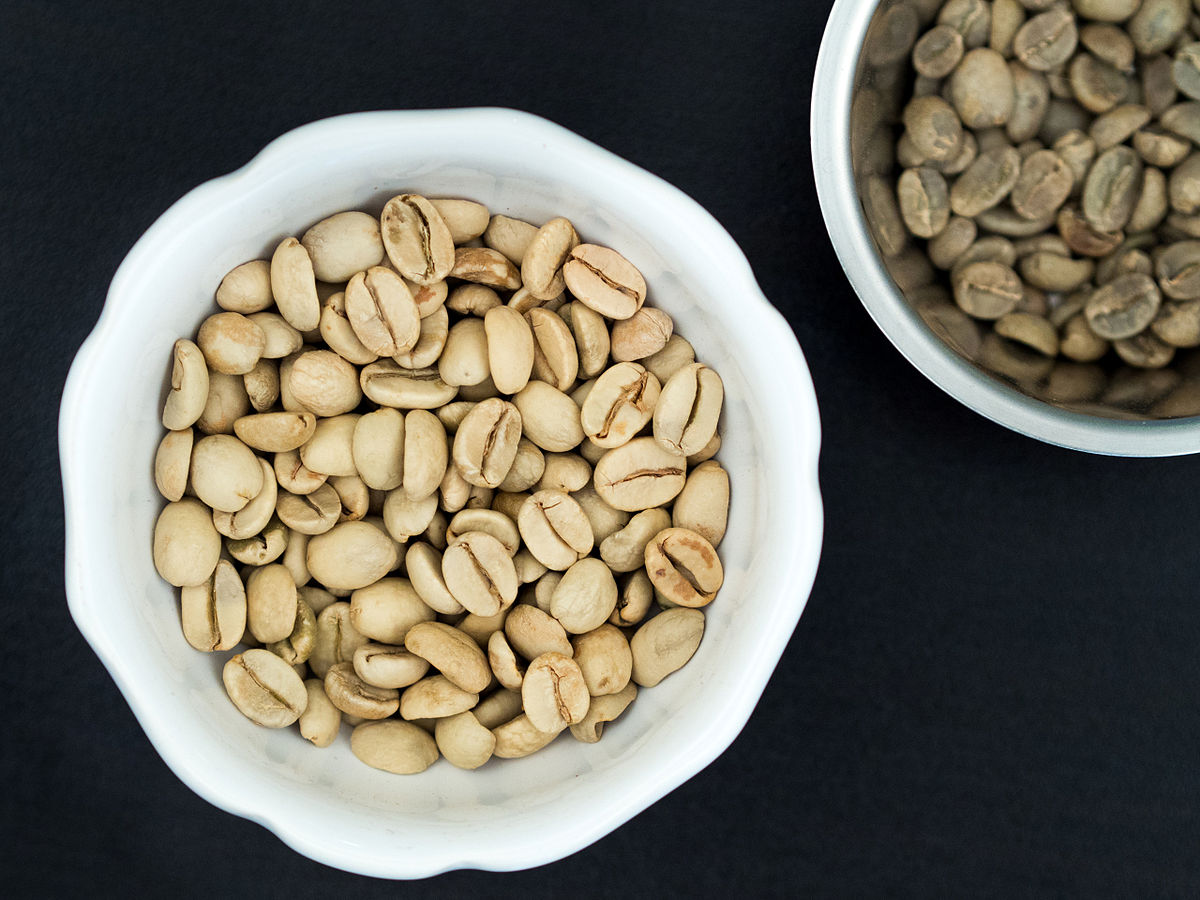
The pale-coloured Monsooned Malabar arabica, compared with green Yirgachefe beans from Ethiopia. / Photo Source
A singularly delicious coffee, the Monsooned Malabar had an accidental beginning. In the colonial era, British ships sailing to Europe around the Cape of Good Hope would find vast changes in the characteristics of their packed coffee, thanks to the salty moisture in the wooden cargo hold.
Losing their original taste and green colour during the 4-6 month long journey, the coffee beans would turn pale, attaining a brown straw-like colour and a pungent, musty flavour. Surprisingly, European coffee-drinkers seemed to prefer this heavy-bodied brew.
As transport improved with time (motorised liners began completing the journey in 20 days) and exposure to sea wins reduced, the beans began to stop changing en route. European consumers noticed that the coffee was losing the distinctive monotone flavour they were used to and asked for the aged coffee, which they thought tasted better.
So, cultivators on the Malabar coast devised a new process to simulate the conditions that produced this unique coffee. Called Monsooning, this technique involves spreading out sun-dried beans in open-sided, cement-floored warehouses.
For the first week to 10 days, the coffee beans are turned over with wooden rakes every day. Next, the beans are arranged into “windrows” i.e jute sacks filled with coffee beans stored in rows with a passage-like space in between for the monsoon wind to blow through.
The coffee is then exposed to rain-bearing tropical winds from the Arabian Sea that lash the Western Ghats between June/July to September/October. Each batch goes through this process three times before the next batch of coffee is put on the floor.
This moisture-laden air triggers slight fermentation, causing the beans to swell to double their original size, turn pale and brittle. The absorption of moisture also reduces the inherent acidity found in popular varieties such as Arabica and Robusta. The result is a bold flavoured coffee with a smooth earthiness.
After the factory opens for regular workers with the end of the monsoon season, the beans are “polished” (the outer skin is removed) and graded, before being manually sorted to remove defects,. It is then bulked, fumigated and packed for export.
Over the years, Monsooned Malabar has become a much-in-demand component in several fine espresso blends (especially in the Scandinavian and German speciality roasted blends) to which it lends weight, body and its unusual chocolatey flavour. It is also sought by major international brands such as Nestle Nespresso, Benecke Coffee and Grecof.
Interestingly, Aspinwall & Co. Ltd., owned by the erstwhile royal family of Travancore, is a major exporter of the Monsooned Malabar and processes over 3,500 tonnes of coffee this year!
So have you decided when you want to head out and have a taste of your first cup of Monsooned Malabar?
(Edited By Vinayak Hegde)
source: http://www.thebetterindia.com / The Better India / Home> Food> History> Lede / by Sanchari Pal / May 14th, 2018
If you were to take a left turn on the dusty highway that connects Mysuru to the highlands of Coorg, and trek for a kilometre and a half, the profusion of Tibetan flags, the signages in Tibetan and scores of Buddhist monks walking about, makes it appear like you have reached a new country. Prayer flags flutter in the light breeze and we can see the huge arches of the Namdroling monastery. Bylakuppe, a Tibetan settlement, has arrived. The monastery is choc-a-bloc with tourists. Its colourful murals depicting the lives and times of Buddha and his followers are a huge draw.
An abode for the believer
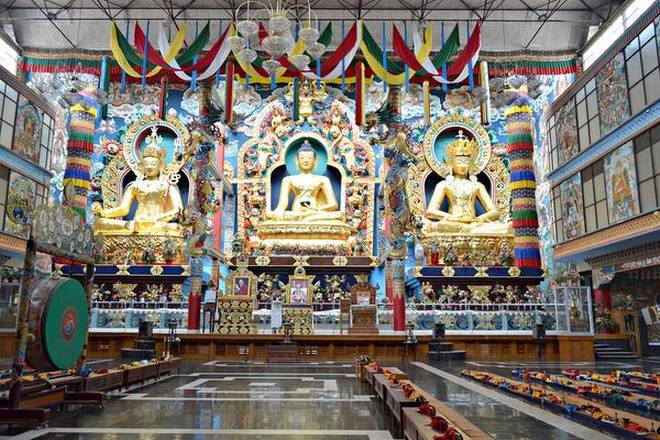
Inside the monastery are statues of the Buddha Padmasambhava, Buddha Amitayus and Buddha Shakyamuni. The Padmasambhava is also known as the Second Buddha and is believed to have played a vital role in the spread of Buddhism to Tibet and Bhutan. The Amitayus are celestial Buddhas known for longevity. Another stand-out feature is the prayer wheels situated at one end of the monastery that borders paddy fields. It is believed that rotating the prayer wheels brings good luck and prosperity. If you are confident, you can try and rotate the prayer wheels that surround the monastery compound. The wheels are believed to contain consecrated mantras and prayers, and turning them in a clockwise direction is supposed to benefit others. Although turning the wheels is considered an alternative to chanting mantras, most devotees tend to combine the two activities.
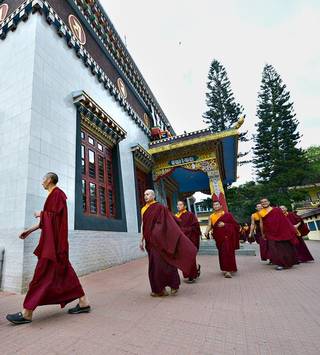
The huge complex also hosts monastic colleges and occasionally you can spot monks going about their daily routine. The monastery is massive, and the huge arches, the spinning prayer wheels and spires add to the grandeur of the complex. There are plenty of spots where one can relax and meditate. Small shops selling memorabilia from the monastery and produce from Coorg are also there. Outside the complex, I run into Prashant P, an auto driver who shares with us the history of the settlement. “This is one of the oldest settlements in the area and was set up in the late 1950s. Apart from the Namdroling Monastery, the Sera Jay monastery is also popular, where classes are held for monks. It is a bit off the tourist track.”
To find peace and quiet
We set off for Sera Jay, past paddy fields and Tibetan colonies on the hillocks and in quick time, arrive at the imposing structure. If you are looking for some peace and quiet, this is where you can get it. You can lose track of time by watching the monks. The huge verandah of the complex is beautiful, though not open to visitors. Prashant says, “It consists of two monasteries, Sera Jey and Sera Mey. The question-answer sessions and debate sessions at the monasteries are great to watch.”
No visit to Bylakuppe is complete without mentioning its food. There are fried and steamed momos sold at small stalls and the Tibetan thupka, a noodle soup served with Tibetan bread. College student Vishal Prasad comes to Bylakuppe from his college in Mysuru just to sample the food. He says, “This settlement has the best Tibetan food. It is very tough to find this food, in the rest of South India. What I like about Bylakuppe is the manner in which they have transplanted their culture in a completely new place.”
Getting there: Bylakuppe is about 87 kilometres from Mysuru and is well connected by bus. You can also get rickshaws from Kushalnagar.
source: http://www.thehindu.com / The Hindu / Home> Life & Style> Travel / by Nikhil Varma / May 24th, 2018
These coffee beans look good, but they may not be what they seem(Credit: racorn/Depositphotos)
If you’ve seen even one advertisement for premium coffee, then you’ve probably heard someone going on about “100 percent pure Arabica beans” … but does the coffee really only contain Arabicas? A new method makes it quicker, cheaper and easier to find out.
Arabica beans are generally considered to be better tasting than cheaper Robusta beans, which trade at as little as half the price. Combined with the fact that Robustas are higher-yielding and easier to grow, this makes it tempting for some companies to surreptitiously cut their Arabica-based coffee with a bit of Robusta.
Traditionally, the only way of checking the purity of Arabica coffee involves testing samples for the presence of a chemical known as 16-O-methylcafestol (16-OMC) – it has long been thought that the compound is present in Robusta beans, but not in Arabica. Unfortunately, samples need to be sent off to a lab for analysis, and processing of those samples takes approximately three days.
Now, however, researchers from Britain’s Quadram Institute have discovered that a Pulsar benchtop NMR (nuclear magnetic resonance) spectrometer made by Oxford Instruments can do the same thing on-site in just 30 minutes. The device uses radio waves and magnetic fields to obtain information about the molecular composition of a sample, and can reportedly be easily operated by non-specialists. It’s previously been utilized to detect horse meat in ground beef.
In lab tests, it was used to analyze 60 samples of supposedly 100-percent Arabica coffees gathered from 11 different coffee-growing countries and regions around the world. While 90 percent of those samples were deemed to be pure, the rest had high enough 16-OMC levels to indicate fraud.
The spectrometer can detect Robusta concentrations as low as 1 percent in blended coffees. In fact, it turned out to be sensitive enough to reveal that even Arabica beans do contain small amounts of 16-OMC. Therefore, the testing procedure had to be adapted to allow for a threshold amount of the chemical, which will be detected regardless of whether or not Robusta is present.
A paper on the research was recently published in the journal Food Chemistry.
Sources: Quadram Institute, Oxford Instruments
source: http://www.newatlas.com / NewAtlas.com / Home> Science / by Ben Coxworth / May 17th, 2018
Coffee maven Joseph Brodsky with his prized trees in Panama / Travis Horn
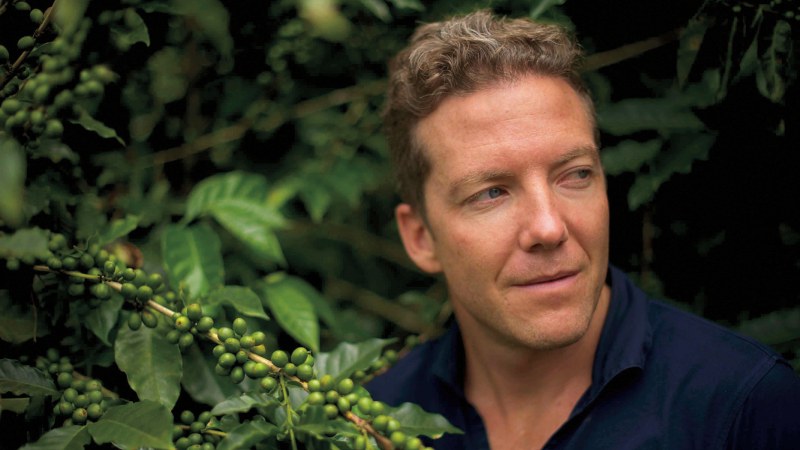
FROM OUR HILLTOP vantage point in northern Panama, Costa Rica is visible to the west and Volcán Barú, Panama’s tallest mountain, to the east. A canopy of rain forest stretches to the horizon, and it feels as if we’re walking through untamed wilderness. The only hint otherwise is a gang of coffee pickers in rubber boots, huddled together and sifting through the day’s harvest. “You can’t know this place until you know the forest,” says the farm’s founder, Joseph Brodsky, gesturing at the view before us. “This is where the flavor comes from.”
Brodsky is giving me a tour of his 450-acre coffee plantation, and the next stop is the Rio Colorado, which marks the property’s eastern border. Getting there requires descending more than 900 feet via a series of switchbacks. Brodsky, 44, carries his weight, all 142 pounds of it, in his toes, bounding over knee-high vegetation with an agility that comes from a lifetime playing soccer. Upon reaching the river, he announces that it’s chigger season, removes his shirt and pants, and jumps into the water to rinse off the noxious mites. Stripped to his boxers, he props himself up into a headstand on a flat rock just above the rapids. After 90 seconds upside down, watching the water churn around him, he lowers his feet and sits up.
“What an amazing way to view the river!” he says.
Brodsky, center, and workers survey the farm before the day’s work begins / Travis Horn
If the coffee world has an Elon Musk, it’s Brodsky. His big idea is to transform coffee beans from a basic commodity, like orange juice, into a savored luxury, like fine wine. His bluster is matched only by his ambition. The name of his company, Ninety Plus, is a reference to the Specialty Coffee Association’s 100-point scale. No one has been awarded a grade better than 97. Ninety Plus has hit that mark three times and will put out only beans that rate above 90. A pound of Ninety Plus coffee retails for an average of $48, but at an auction last year, a lot sold wholesale for a record $2,269 per pound to a roaster in Asia. At the time, basic beans were going for a dollar a pound.
“Joseph has developed a completely unique product,” says renowned roaster George Howell, who has earned a lifetime achievement award from the SCA. “With my first taste, there was this floral note that I’d never had before. I don’t even have to drink the coffee to enjoy it. I could just smell the aromatics for hours.”
NOT LONG AGO, coffee came in regular and decaf—and that was about it. Then Starbucks came along and upended the business, creating slick coffee shops with dark-roasted espresso and elaborate milk drinks. Soon a long list of specialty roasters followed suit, and consumers got used to shelling out $5 for a Venti Americano. But to this day, except in diehard circles, you rarely know more about the beans than what country they come from. Brodsky’s big vision is to turn that idea on its head, creating high-end coffees that are distinguished, and ordered at the cafe by the name of the farm on which the beans were grown, as wine is distinguished by vineyard.
“The big coffee brands that people know are roasters, like Nescafé or Starbucks,” he says. “But nobody can name a coffee producer. We can be that brand.”
Coffee has been a passion of Brodsky’s since he was a kid growing up in Madison, Wisconsin. He and his older brother—now the owner of JBC Coffee Roasters in Madison—would often roast beans in a popcorn popper for fun. Years later, when Brodsky was attending Evergreen State College, he read a book called Coffee Basics, which described a bean from Ethiopia with blueberry and lemon flavors. Intrigued, he sought out the coffee, tasted it, and suddenly knew what he wanted to do with his life. In 2000, at 26 years old, Brodsky left school to open Novo Coffee in Denver with the help of his dad and another brother. Their goal was to focus on roasting and selling those Ethiopian beans. But consistency was a problem. “I’d have to sort through 200 coffees to find maybe one that I liked,” says Brodsky.
After traveling to Ethiopia to judge a coffee competition in 2005, Brodsky decided to stay until he had a better grasp on why the beans were so variable. The move wound up being semi-permanent. Brodsky quickly discovered that farmers had no incentive to improve their products because everything was being sold for the same price, often mixed together.
“In wine, there’s a feedback loop between taste, research, and development,” he says. “Coffee didn’t have that. Most growers today still don’t know the taste of their beans.”
So Brodsky partnered with local farmers to develop beans and, for the next four years, bounced between the U.S. and Ethiopia tasting each harvest. When the coffee was good, he’d have the farmer duplicate the procedures that created it. One bean that always stood out was called “gesha,” an heirloom varietal that many farmers ignored due to its low yield. But gesha is delicious and intensely fruity, and Brodsky began growing more of it, eventually selling the beans under the name Ninety Plus.
As he was experimenting in Ethiopia, other farmers began planting gesha in Panama, and in 2009, Brodsky signed a $1.6 million loan on a cattle ranch there, just 15 miles from the border with Costa Rica. His first step was to plant thousands of castor plants and palo blanco trees, which produce no sellable crop but provide ample shade and nourish the soil. Then he sprinkled in the geshas, spacing them far apart so they wouldn’t have to compete for nutrients. It generally takes five years for coffee trees to mature, so to keep his cash-strapped farm afloat, Brodsky continued working with Ethiopian farmers while trying to woo investors. Travis Horn
“I had rejections from the biggest players in the industry,” he says. “They’d visit the farm, fall in love, but then be too scared to invest.”
Finally, in 2014, Ninety Plus Gesha Estates sold its first beans. That same year, during the World Brewers Cup, an annual event to determine who can create the best cup of joe, master brewer Stefanos Domatiotis won using Brodsky’s beans. It was the first in a series of four straight wins, an unheard-of distinction.
During my visit to the farm in December, Domatiotis, a tall Greek from Athens, was on hand to inspect the early harvest. When he caught me eyeing some samples, he offered up a cup by asking, “Washed or natural?”
“Natural,” I said.
Travis Horn
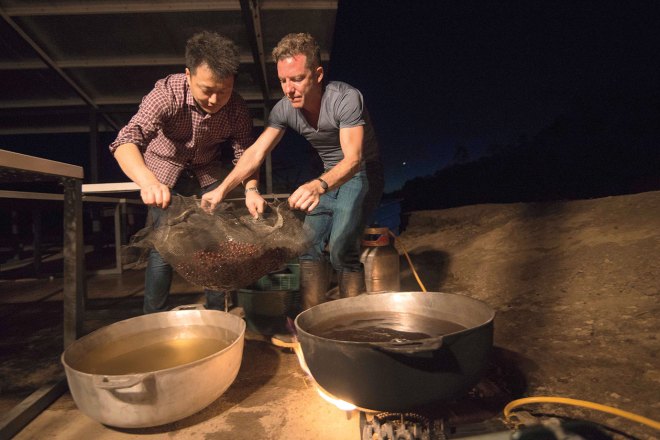
Where washed processing relies on water to rinse the cherry away from the bean (technically the seed of the fruit), natural processing allows the cherry to dry up and ferment on the bean and pass along wild flavors. Traditionally, natural processing has been used only on cheap coffee or beans grown in areas where water is scarce. But Brodsky showed that by following strict rules and controlling the environment, he could use natural fermentation to enhance the flavor—just one of his many innovations. In one of the farm’s wilder experiments, Brodsky and a visiting barista submerged beans in a 50-degree river and turned them twice daily for 10 days. “It smelled like champagne,” says Brodsky. It was probably the world’s first cold-fermented coffee, and it went on to win the 2015 Japan Barista Championship.
After brewing, Domatiotis served me a coffee that tasted like a velvety rich version of Earl Grey tea sweetened with some kind of berry. It was easily the best cup I’ve ever had.
“Too carbonic,” Domatiotis said.
“Yep,” Brodsky agreed. “With a better roast we can improve this by 15 to 30 percent.”
Travis Horn
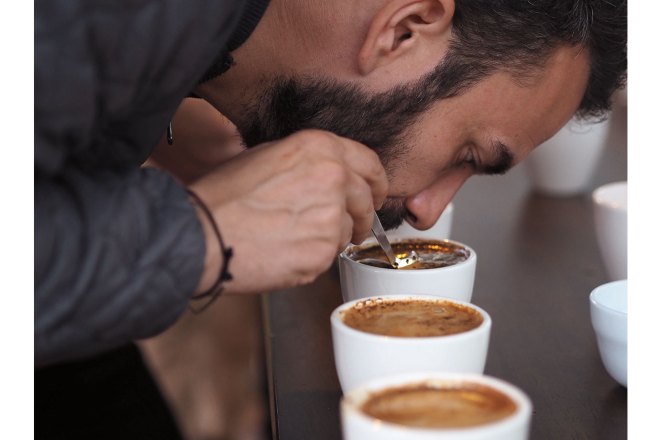
Later, Brodsky and Domatiotis began sampling the first 35 coffees harvested this season. They rattled off flavors with the cadence of auctioneers: miso, banana and carob, black pepper, avocado oil, and dulce de leche. Their ability to isolate individual flavors felt as if they were identifying cuts of steak by the sound of the sizzle. One aroma was characterized as “red pepper, but it wants to be savory and fruity at once.”
I simply nodded, stole a couple of sips, and asked, “Is ‘fucking good’ a useful descriptor?”
ON THE HEELS OF NINETY PLUS, natural-processed coffees are becoming increasingly common, and some producers, such as Colombia’s La Palma & El Tucán and the Australia-based Project Origin, are also experimenting with fermentation.
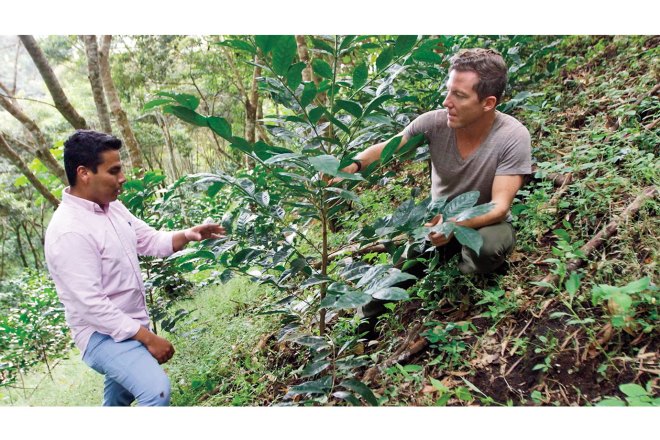
Brodsky inspects one of his gesha trees, hidden under the rain forest canopy / Travis Horn
“We live in a time when people are indulging in better-quality beverages,” says Thomas Perez, CEO of Brooklyn’s Extraction Lab, which sells Ninety Plus for $18 a cup. “And the more you learn about coffee—just like with wine or beer or whatever you like—the more it becomes about quality over quantity.”
Currently most Ninety Plus beans are sold in Asia, where a high-end tea trade has made people more receptive to shelling out for delicate flavors. Over the next few years, Brodsky plans to push hard into the U.S. and launch a new brand, Baru Gesha, for beans that are just a few points shy of the Ninety Plus name. That’ll keep the flagship product strong while providing a better entry price for curious drinkers. “We’re still infants,” Brodsky says. “When people compliment my coffee, I say, ‘Thank you, but next year will be better.’ We’re already seen as the best in the world, but we haven’t done shit yet.”
Buy Brodsky’s Beans
Most Ninety Plus coffee is sold to roasters in Asia, but here’s where to find it in the U.S.
Eccentricity Coffee, Cleveland
The large selection of Ninety Plus beans are held in cold storage and roasted to order, with prices ranging from $27 to $100 for a 12 ounce bag. eccentricitycoffee.com
Bar Nine, Culver City, California
Buy beans by the bag or through the Bar Nine home-subscription program. barnine.us
JBC Coffee, Madison, Wisconsin
The founder, Michael Johnson, is Brodsky’s half-brother and a licensed Q Grader-essentially a sommelier of coffee. jbccoffeeroasters.com
source: http://www.mensjournal.com / Men’s Journal / Home> The Coffee Freak / by Clint Carter
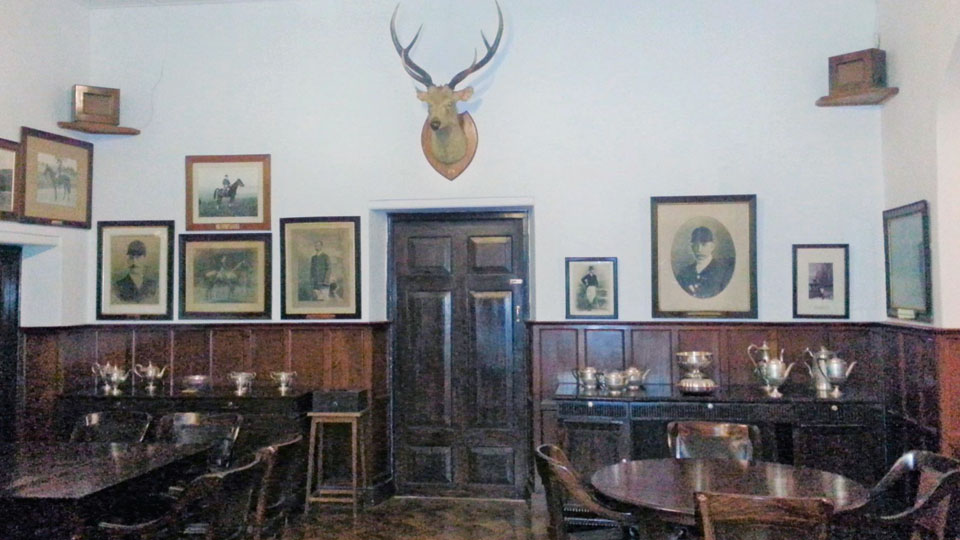
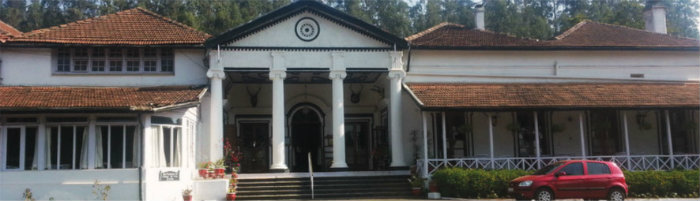
Courtesy our friends Pemmanda Jepu and Jemy Ganapathy, we spent four wonderful days at the Ooty Club, a place steeped in colonial history. The trophies, the silverware, the honour lists and the photographs of the ‘Masters of the Fox Hunt’ date back to early 1840s.
During our stay, I got an opportunity to read a well-documented book titled ‘Ootacamund – A History,’ written by Sir Frederick Price in 1908, which is otherwise kept in the safe locker. Only two copies of this book exist. I was particularly interested in the visit of Governor-General Lord Dalhousie to Ooty in 1856, few details of which I had gathered while writing about Victoria Gowramma. However, what I stumbled upon was even more interesting — Governor-General William Bentinck’s journey to Bangalore, Mysore and Ooty in 1834. This trip was primarily to coordinate the attack on the ‘problematic’ Raja of Coorg: Chikka Veerarajendra.
Chikka Veerarajendra and the East India Company were at loggerheads since 1830. Governor-General William Bentinck, who was more interested in reforming India than in annexing new territories, had to finally deal with the Raja of Coorg who had dared the British by keeping in custody one of their emissaries — Kullapalli Karunakaran Menon.
A frontal view of the Ooty Club, which was originally Sir William Rambold’s Large House.
Lord William Bentinck set out from Calcutta on 3rd February 1834 on board the Curacoa to Madras. Bentinck reached Madras on 15th February 1834 and journeyed to Bangalore via Vellore. Travel those days was by horse carriages, bullock carts, palanquins and on horseback, with frequent camping en route.
He wanted first-hand assessment of the situation in Coorg, and for this purpose, the Commander-in-Chief Sir Robert O’Callaghan was in attendance. Strategies on military action against Coorg were finalised in consultations with Sir Robert O’Callaghan while at Bangalore. The Governor-General also had administrative issues concerning Mysore to be discussed. The reason for him to visit Ooty for an extended stay was to improve his rather poor health.
Lord Bentinck stopped over in Mysore and was put-up at the precursor to the Rajendra Vilas Palace atop Chamundi Hill, which was originally built by Robert H. Cole who was the earlier British Resident at Mysore (1811-1827). Bentinck set out for Ooty and it was while camping at Gundlupet on 15th March 1834 that he officially declared war on Coorg. Col. James Stuart Fraser was in overall command. Coorg was encircled from three fronts. Chikka Veerarajendra surrendered on 10th April 1834 and Coorg was annexed by the East India Company. Incidentally, Coorg was the only province to be added to the John Company during William Bentinck’s tenure, for which he came under criticism back home in England.
Lord Bentinck’s entourage reached Ooty on 22nd March. At Ooty the only suitable accommodation for the Governor-General and his staff was ‘Sir William Rambold’s Large House.’ It was a grand hotel built in 1832 by an influential British entrepreneur named William Rambold. However, Rambold soon ran into financial difficulties. The hotel was frequently rented for extended periods of time by senior officers of the East India Company. It was in 1842 that ‘Rambold’s Large House’ became the Ootacamund Club, or the Ooty Club. During Lord Bentinck’s sojourn in Ooty, Lord Babington Macaulay arrived at the hill station on 25th June 1834. The Governor-General and Macaulay met each other for the first time at Rambold’s Large House. Macaulay chose a small cottage nearby where he lived for several months to draft the Indian Penal Code (IPC).
Governor-General Bentinck stayed on in Ooty till the end of September 1834. On his return journey he again passed through Mysore and reached Bangalore on 9th October. He sailed aboard the Curacao on 26th October from Madras and reached Calcutta on 14th November 1834.
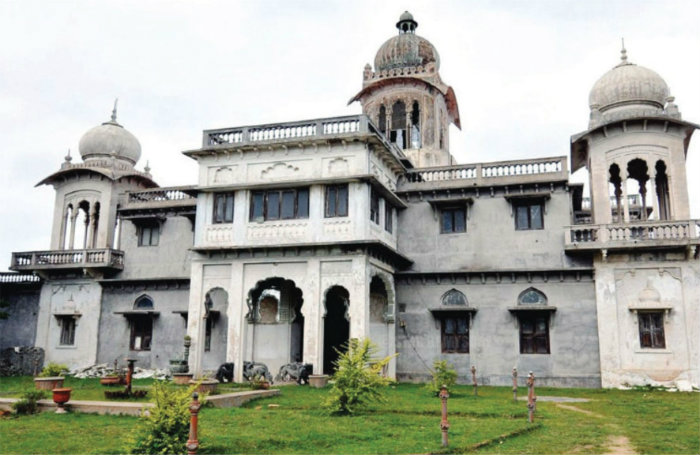
Rajendra Vilas Palace atop Chamundi Hill, Mysore.
I checked on Lord Dalhousie’s sojourn in Ooty from 7th March 1855 to 29th October 1855. Dalhousie’s visit was also for health reasons, and he was due to retire soon. However, he was not too comfortable in Ooty, and shifted to Kotagiri.
During Dalhousie’s stay in Nilgiris, one of his ADCs took permission to visit Coorg, where the ADC’s brother was a coffee planter. It was in 1852 that Dalhousie had reluctantly given permission to the ‘rascally Raja of Coorg’ to travel to England along with his daughter Gowramma.
The ADC, on his return, narrated an amusing incident to his boss. Coorg being a rather remote province, news from the outside world took time to percolate. Very often, wild rumours floated amongst the small but growing community of British planters and officers. One such rumour was that the British and their allies had lost the Crimean War, and that Queen Victoria and her family had fled to India! However, Dalhousie who had had a temporary telegraph line installed at Nilgiris had already received the news that the British and their allies had in fact wrested Sevastopol from the Russians.
On his journey back to Calcutta, Dalhousie stopped over in Bangalore during early November 1855, and was the guest of Sir Mark Cubbon. Dalhousie narrated the ‘Coorg rumour’ to the British officers, much to their amusement. After inspecting the troops, he formally announced the British victory at Sevastopol. Fast forward, 2014: Vladimir Putin has Crimea back in the Russian fold.
About the author: C. P. Belliappa, born in 1946, is a Chemical Engineer. Currently settled in Coorg, he is known for his writings on issues pertaining to Kodagu. Four of his books — Tale of A Tiger’s Tail & other Yarns from Coorg, Nuggets from Coorg History, Victoria Gowramma: The Lost Princess of Coorg, and Tongue of the Slip, have been published by Rupa Publications.
source: http://www.starofmysore.com / Star of Mysore / Home> Feature Articles / by C.P.Belliappa / March 2018
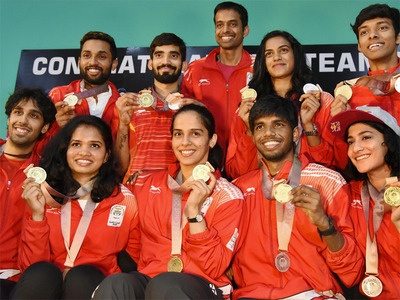
The Badminton Association of India (BAI) on Saturday handed out cash rewards to the medallists of the Commonwealth Games held in Gold Coast, Australia last month.
While Saina Nehwal was presented a cheque of Rs 20 lakh for the individual women’s singles gold medal, PV Sindhu – who lost to her in the final – was given Rs 10 lakh.
The bronze medal-winning women’s doubles specialists Ashwini Ponnappa and N Sikki Reddy were handed cheques of Rs 3.75 lakh each.
The men’s doubles team of Satwiksairaj Rankireddy and Chirag Shetty got Rs 7.5 lakh each.
The mixed team gold medal-winning squad was rewarded with a cheque of Rs 50 lakh.
source: http://www.timesofindia.indiatimes.com / The Times of India / Home> News> Sports News> Badminton News / IANS / May 05th, 2018
India, for the first time, will chair the board of International Coffee Organization (ICO) for a term of one year with Anil Kumar Bhandari, president of India Coffee Trust (ICT), getting elected as the chairman of Private Sector Consultative Board (PSCB) of ICO.
PSCB is an international coffee organisation body comprising 16 leading industry representatives from producing and consuming countries. The board’s main mission and objective is to increase the world coffee market in value and volume and also support various initiatives in the field of coffee and health.
Bhandari is the first representative from India to occupy the important position and his election is significant in the backdrop of World Coffee Conference (WCC) scheduled in Bengaluru, in April 2020.
Speaking about his election, Bhandari said, “My election as chairman, Private Sector Consultative Board of International Coffee Organization is an honour for India and India Coffee Trust. This is the first time that India has chaired the PSCB. I see this as the confidence reposed in India and ICT, going into the World Coffee Conference in 2020, which would be hosted by India and will be held for the first time in Asia. It also indicates the interest that the global coffee sector has in the Indian coffee industry and the Indian coffee market.”
The 121st Session of International Coffee Council (ICC) under ICO was held in Mexico City from April 9 to 13, 2018. ICO is an intergovernmental body of coffee buying & producing nations, having more than 72 member countries and India is one of the founding member.
It is the main intergovernmental organisation for coffee, bringing together exporting and importing governments to tackle the challenges facing the global sector through international cooperation. Its objective is to strengthen and promote its sustainable expansion in a market-based environment for the betterment of all participants in the coffee sector.
source: http://www.fnbnews.com / FnBnews.com / Home> TopNews / by FnB News Bureau, Bengaluru / April 30th, 2018
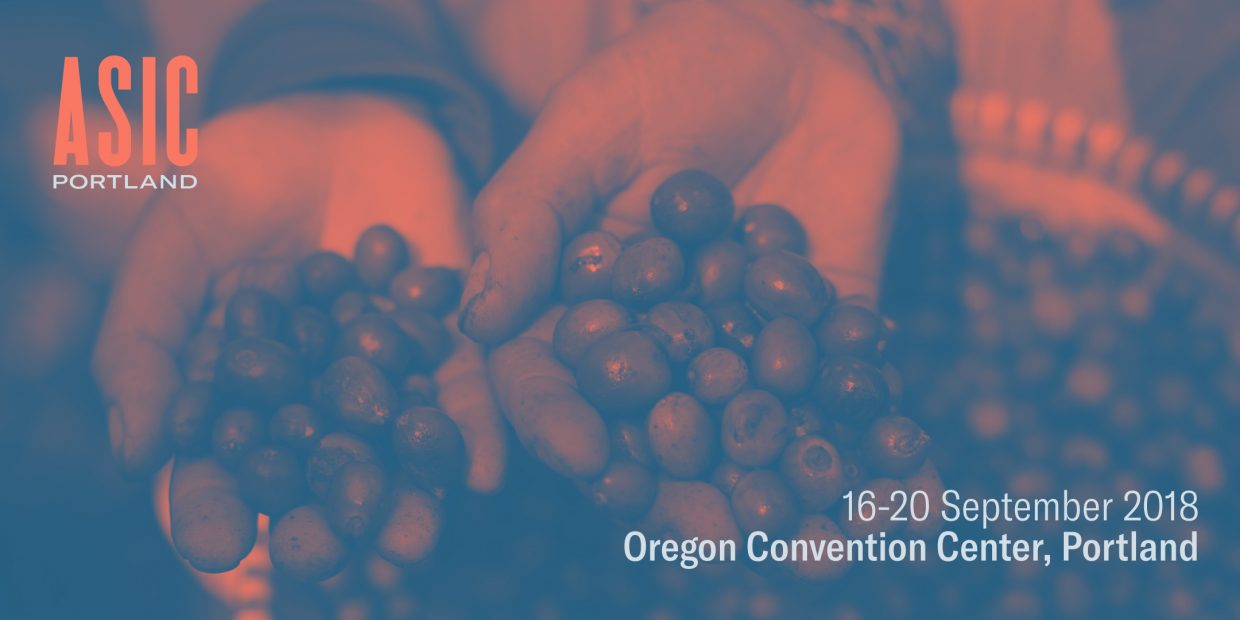
A nonprofit organization that organizes a biennial conference on the science and technology of coffee throughout the coffee value chain, the Association for Science and Information on Coffee (ASIC) is hosting its conference in the United States this year for the first time since 1991.
The 27th conference of the ASIC will be held Sept. 16-20 in Portland, Oregon, at the Oregon Convention Center in collaboration with the Specialty Coffee Association. The conference — which most recently gathered more than 400 scientists from 53 countries in Kunming, China, in 2016 — was last held in the U.S. in San Francisco.
“SCA is proud to host the ASIC conference this year in Portland, Oregon. ASIC is the world’s foremost coffee science institution, and this conference is the key place for sharing new scientific breakthroughs on coffee,” Peter Giuliano, chief research officer for the SCA, told Daily Coffee News. “Coffee science is a key part of SCA’s research mission, and we’re proud to have developed a deep collaboration with ASIC, and to share this learning opportunity with our members.”
Chahan Yeretzian is the Scientific Secretary on the ASIC board and leads the Research Advisory Council on the Board of Directors of the SCA. Photo by Yong-Gu Bae.
Chahan Yeretzian, who currently serves on the board of both SCA and ASIC, told Daily Coffee News that the two organizations have a shared goal to build bridges connecting industry and academia, along with a belief that facilitating constructive dialogue will lead to continued success and ensure the readiness of the coffee industry to recognize and address future challenges.
“The Specialty Coffee Association represents thousands of coffee professionals, from producers to baristas, all over the world, so it made sense for both of these global organizations, and leaders in their respective fields, join forces in organizing the upcoming ASIC conference,” said Yeretzian. “Portland, a booming coffee city known for its bridges, seemed to be a natural choice for a location to host the conference in the U.S.”
The conference features presentations with cutting-edge information and advanced coffee science, as well as exhibits and social events. ASIC is accepting abstract submissions through June 3 for papers to be presented on specific program topics, such as chemistry, agronomy and pest management, genomics, sustainability, physiology, coffee and health, and sensory science.
“Future success for the coffee industry will rest on solid science, technology, and innovation in breeding, post-harvest technologies, roasting, grinding, packaging, extraction, consumer understanding, health, climate change, and genomics,” said Yeretzian. “Research is moving into the spotlight, as industry leaders are becoming aware that their future depends on mastering the technologies and chemistry of coffee. We are also increasingly interested in better understanding the needs and challenges of the industry, in order to orient the efforts and resources — and connect those in the industry who will champion the implementation — of scientific insight into successful and profitable applications.”
Registration for ASIC Portland is now open, with early bird pricing available through Aug. 1, 2018.
___________________________________________________
Lily Kubota
Lily Kubota is the digital content manager of Daily Coffee News by Roast Magazine. She is based in Southern California.
___________________________________________________
source: http://www.dailycoffeenews.com / Daily Coffee News by Roast Magazine / by Lily Kubota / April 24th, 2016
WELCOME. If you like what you see "SUBSCRIBE via EMAIL" to receive FREE regular UPDATES.
Read More »