Category Archives: World Opinion

Nepal to participate at the upcoming World Tea and Coffee Expo 2017 in Mumbai

Nepal to participate at the upcoming World Tea and Coffee Expo 2017 in Mumbai

New Delhi (KNN) :

The Nepal National Tea & Coffee Development Board is looking forward to participate at the Mumbai World Tea Coffee Expo (WTCE) 2017 with the board locking up an exclusive pavilion at the 5th edition of the export scheduled for November this year.

The organizing committee in a press statement informed about the latest development.

The Nepalese Tea comprising of CTC tea (black tea) and Orthodox tea (green tea) – is among the most popular commodities in the world due to its aroma and health benefits.

Also Nepal exports more than 15,000 metric tons of tea every year to different parts of the world including India. India is the major export destination for tea from Nepal followed by Germany and Czech Republic, the release informed.

The World Tea Coffee Expo in Mumbai attracts buyers from across the country and also from different parts of the world. It also receives significant footfall from allied industries including packaging, vending solutions, equipment, machineries, flavors, retail chains, government boards, consultants and other technologies

The Expo edition for this year is scheduled from 16th till 18th of November. The previous edition of the Expo hosted around 67 companies. (KNN/ DA)

source: http://wwww.knnindia.co.in / KNN, Knowledge & News Network / Home> Global / October 24th, 2017

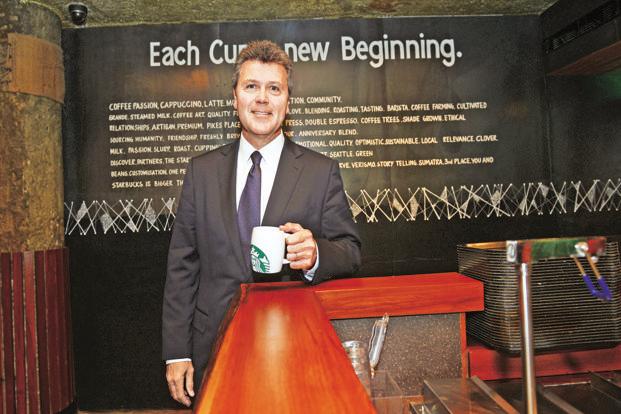
India will be one of Starbucks’ top five markets in long term, says John Culver

The success we have had in India over the last five years gives us great optimism over future growth potential, says John Culver, group president, Starbucks International.

John Culver, group president, Starbucks International. Photo: Ramesh Pathania/Mint

Mumbai:

It has taken US-based coffee chain Starbucks Corp. five years to open 100 stores in India. In comparison, the Seattle-based firm plans to open 500 stores per year in China, doubling its store count to 5,000 by 2021.

Nevertheless, John Culver, group president, Starbucks International, who was in Mumbai to celebrate the milestone of 100 stores, is optimistic that India would one day be among its top five markets. Edited excerpts:

How does India compare to other markets?

India has been our fastest growing new market. The success we have had here over the last five years gives us great optimism over future growth potential.

We believe that one day India will be one of the top five markets. I won’t put a time frame to it. It’s over the long haul. We will make the right investments along the way in the business to build out the stores and the footprint.

Not only do we see growth in terms of top line and bottom line, more importantly we see growth with our people and the investments we make in our people.

Today we are also announcing that 40% of our workforce will be female. Right now we are at 25%.

Starbucks remains a premium offering in India. Is this by design?

We have something that attracts all consumers to our stores. Not only do we have premium beverages we also have value.

My Starbucks rewards is a great example. We have 300,000 people as a part of this programme and they account for 25% of our overall transactions.

This is continuing to build and attract a wide variety of consumers regardless of income and class.

What will be your growth drivers?

There are 600 million people that sit in the middle-class (in India). That presents a huge opportunity. The other thing you are seeing is the growth in coffee consumption.

Over the last 10 years, coffee consumption in India is growing at 40%. This is an emerging market and Starbucks is at the forefront of delivering high-quality, great experiences to consumers that are unique. If we focus on that experience we can create something special.. similar to what we have seen in other markets.

In India, the emerging middle class is spread across at least 100 cities.

We see a huge opportunity in India in multiple cities over time. Today we have announced operations in our seventh city.

We will continue to go deep into those cities that we operate in and also look at new cities over time.

What next?

We will continue to introduce new coffee and coffee blends with our partner Tata Coffee.

We will also continue to provide new experience. We will also look at food that will fit consumers taste profile, continue our digital efforts, given the role digital is playing and look at various experiences outside our stores and sell our products through other grocers and e-commerce.

source: http://www.livemint.com / LiveMint / Home> Companies / by Sapna Agarwal / Tuesday – October 24th, 2017

Brewing Treasure

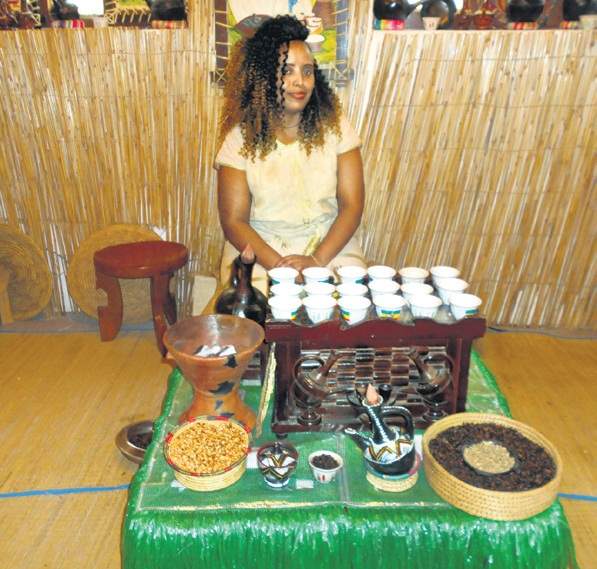
An Ethiopian woman roasts a pan of green coffee beans in their traditional technique

Stepping into a small unassuming villa on the backstreet of Al Fahidi district in Bur Dubai, I feel I am embracing the cultural ethos of several centuries. The aroma of freshly brewing coffee wafts in the air. I walk past a gift shop to reach the centre of a unique wind-tunnel house named the Dubai Coffee Museum, which was set up in October 2014. My journey into the history of coffee begins as soon as I enter the creator and owner of the museum, Khalid Al Mulla.

I accompany him on a round of the ground floor where each space provides a glimpse of different coffee-drinking cultures. As we step in his favourite zone, he says, “Here is the coffee from Ethiopia where coffee drinking reputedly began at first.” Here, a stylish Ethiopian lady is roasting a pan of green coffee beans in a traditional technique. Next to her is Egyptian barista Abdul, dressed in an Egyptian ‘galabeya’ and skull cap, standing guard on a customised silver and gold coffee machine.

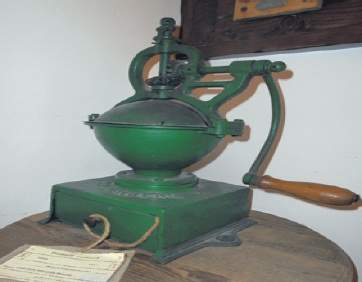
An ancient coffee grinder

The small exhibition rooms, where coffee beans from countries across the world are neatly stacked, are also home to coffee artefacts and antiques. Khalid’s collection is huge. Prominent among the pieces are distinctive 300-year-old jug-shaped clay coffee pots known as ‘jebena’ (the Yemeni equivalent is ‘jamena’), which were historically used by the Ethiopians .

Steps inside the museum lead up to a literature room displaying texts from 18th century to the present day. One such text, Johann Friedrich von Pfeiffer’s 1784 encyclopaedia, is believed to be the oldest printed text on coffee, with 177 pages dedicated to ‘kaffee’ as Johann would have called it. There is also a custom-built brew bar, where one can sip acup of caffeine powered rocket fuel brewed in the traditional Japanese siphon method.

The tour ends with a cup of Ethiopian coffee at a cosy Emirati-style ‘majlis’ on the ground floor, drunk in the local Bedouin coffee tradition. Khalid says, “As the director of Dubai-based coffee importers and roasters, Easternmen and Co., I participated in trade shows. I was surprised to see visitors’ interest in these objects, which forced me to create the first-of-its-kind coffee museum in Dubai. The concept is to showcase global coffee history.”

source: http://www.newindianexpress.com / The New Indian Express / Home> Magazine / by Sharmila Chand / Dubai, UAE – October 21st, 2017

Karnataka needs international coffee trade fairs

PTI file photo for representation.

The Coffee Board of India, under the administrative control of the Ministry of Commerce, Government of India, has to contribute to the coffee economy, which is in crisis with three years of near-drought, untimely rains and poor crop yields in Karnataka.

Coffee plantations also have pepper vines inter-planted among them to supplement income, which makes the crash in pepper prices since February this year, worsen the financial hardship of coffee planters.

Moreover, flaws in crop insurance and revenue protection insurance schemes have not really benefited 90% of the coffee-growers, who own plantations of 25 acres or below. The Rainfall Insurance scheme has been discontinued due to lack of adequate modalities in place. Moreover, the newly introduced Revenue Protection Insurance scheme which was initiated as a pilot project in Chikkamagaluru has not evinced much interest among the insurance companies. Therefore, the coffee plantation sector, which employs an estimated 11,00,000 skilled workers, finds that their livelihoods are at stake across the coffee districts of Kodagu, Hassan and Chikkamagaluru.

While coffee growers are confronted with high input costs in terms of labour wages and fertiliser prices, they have to endure low prices for coffee and pepper, which makes it financially unviable to manage plantations. If coffee plantations begin to suffer losses, then the coffee economy will become unsustainable and small growers will find it more remunerative to sell their plantations or convert them into holiday or health resorts — a development which has already taken shape over the last five to seven years. That will surely herald the beginning of the end of the coffee plantation sector and its related industries. Therefore, the Coffee Board needs to transform to a market support role in addition to its R&D functions.

Till the mid 1990s, the Coffee Board functioned in a regulatory role. However, the Coffee Board now needs to adapt to a free market economy since the 1991 economic liberalisation and transition to that of a facilitator. It would need to support the coffee economy through the organisation of trade fairs and help small growers and international buyers to comply with the various statutory requirements towards coffee trade and export.

The Women’s Coffee Alliance India, Bangalore, successfully conducts a vibrant Coffee Santhe or Coffee Fair in Bengaluru annually, and involves all the stakeholders of the economy. For instance, much like the Ministry of Defence organises Aero India at Bengaluru to connect foreign aeronautics majors with the domestic industry; the Ministry of Commerce can also conduct a coffee trade fair under the aegis of the Coffee Board.

The small coffee grower is unable to attend international coffee trade fairs overseas due to cost constraints of airline travel. Therefore, the Coffee Board should hold international trade fairs in Kodagu and Chikkamagaluru for buyers and sellers as a platform to interact with each other. The Coffee Board has large tracts of land with established infrastructure and research stations at Balehonnur, Chikkamagaluru and Chettalli in Kodagu, which can be utilised as centres for international coffee trade fairs and as integrated coffee parks.

Moreover, the boom in coffee tourism over the last decade has developed the hospitality and travel industry resources in these plantation districts to be able to hold the proposed trade fairs. Besides, the two international airports in the proximity are at Mattanur, Cannanore district in Kerala, which is a 90-minute drive from Kodagu and at Mangaluru, which is a two-hour drive away from Chikkamagaluru. As airline connectivity to these two coffee plantation districts, which are also internationally acclaimed biodiversity hotspots exists, these districts are ideal locations to organise trade fairs.

It will make the grower aware of the requirements of the discerning international consumer. The buyer will see for himself the journey of the Indian coffee bean from the plant to the cup. It will incentivise the grower to produce the kind of coffee that the buyer desires. Only a grower knows the trials and tribulations of coffee cultivation and only he can market his coffee with passion and obtain the best price possible for his crop.

Considering that 70% of the coffee grown in the country is exported, the small grower should market his coffee overseas. An important point to note is that Indian coffee is grown under shade, which uses ecologically sustainable methods and adoption of fair trade practices in the eco-sensitive zone of the Western Ghats, which can command premium prices in the international markets. To make Indian coffee competitive in the world market, the Coffee Board must publish a list of internationally-banned pesticides, which will also make the environment safe for plantation workers.

The outcome of such international trade fairs would lead to a demand for ‘Single Origin Estate Specific and Area Specific’ coffees, which will start to gain importance. Today, these fairs held at foreign locations are not inclusive of all stakeholders and have become the exclusive domain of a few elite coffee growers and traders. The Coffee Board should aim to democratise the sale of coffee and enable the small grower to export coffee to international markets rather than allow a select few to prosper at his expense.

(The writer is Chairman of Karnataka Planters Association, Chikkamagaluru)

source: http://www.deccanherald.com / Deccan Herald / Home> Supplements> Economy & Business / by Maneypanda Madaiah Chengappa / October 22nd, 2017

Délicieux signs up for Bahrain coffee expo

Manama :

Bahrain-based Délicieux company has signed up as a key sponsor for the second edition of the Bahrain International Chocolate and Coffee Exhibition which kicks off on December 7.

The three-day event is being held under the patronage of Bahrain Tourism and Exhibitions Authority CEO Shaikh Khalid bin Humood Al Khalifa at Bahrain International Exhibition and Convention Centre.

The sponsorship marks Délicieux’s debut appearance at the Bahrain International Chocolate and Coffee Exhibition, following the success of event’s first edition in attracting visitors as well as active companies in the field.

ShaikhaNooraKF20oct2017

Délicieux Company CEO Shaikha Noora bint Ali Al Khalifa said: “It expands on the company’s market presence in the promising Bahraini chocolate and coffee market, whilst offering an opportune networking platform with visiting suppliers and buyers from other countries, and simultaneously providing marketing catalyst to our Bahrain-based clientele.”

Sheikha Noora said the second edition was likely to attract high footfall with an anticipated spike in demand for chocolates and coffee on display, in preparation for National Day celebrations.

“Our presence at such expos will help us further in networking with companies in the same field, enabling quality enhancement and product development to meet the dynamic needs of consumers,” she noted.

As a result of the knowledge exchange, Bahrainis have become familiar with the varieties of coffee, recognizing the differences of premium and commercial coffee, she added.

Shaikha Noora said Délicieux was a first-of-its-kind company in Bahrain to specialise in premium coffee, offering Ethiopian, Colombian and Rwandan brew.

Amid growing demand for specialty coffee in GCC, Délicieux will soon be introducing its Yemeni and Saudi Arabian coffee starting from next month. The company already offers more than 15 distinct Belgian chocolate flavours, she added.

-TradeArabia News Service
source: http://www.tradearabia.com / Trade Arabia / Home / Manama – October 15th, 2017

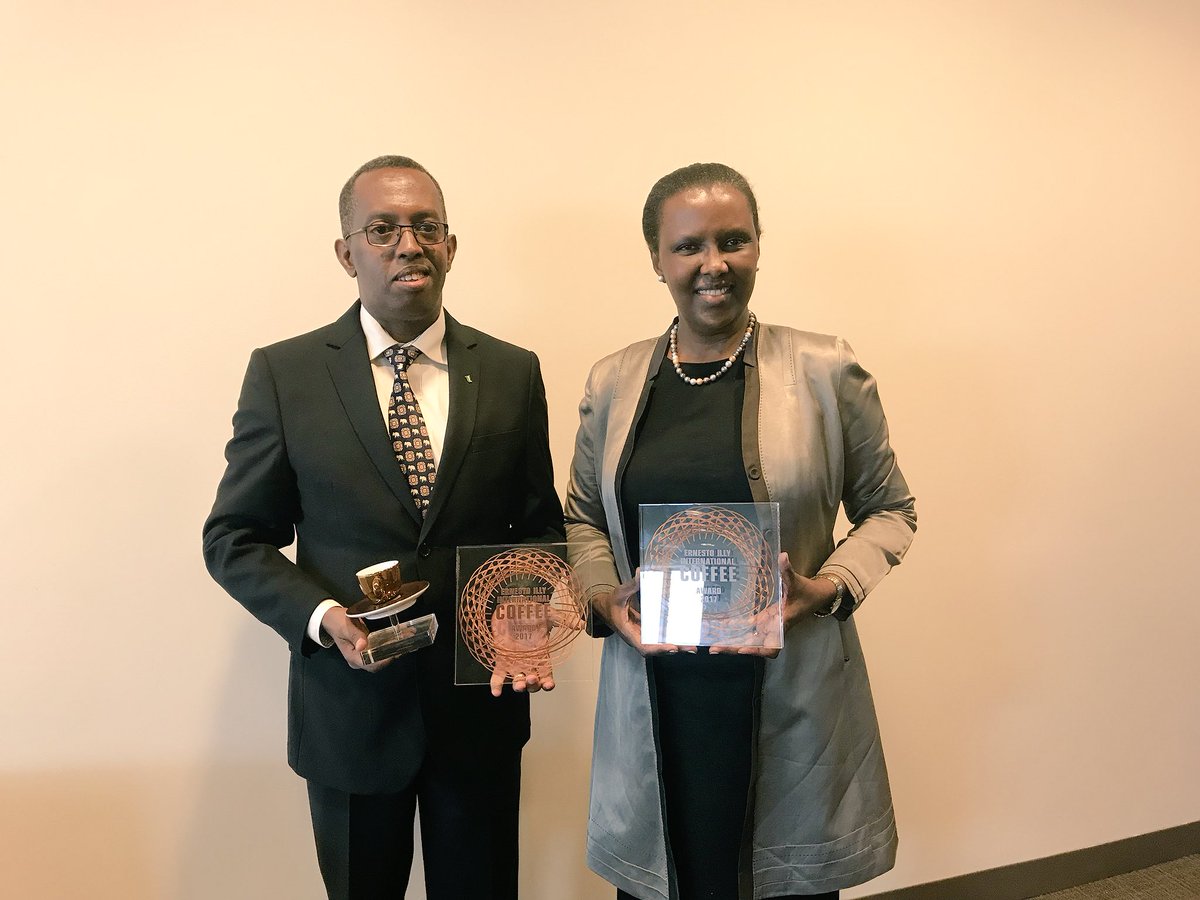
Rwanda Scoops International Coffee Award

Ambassador Valentine Rugwabiza poses for a photo with an award winner

Rwanda coffee has won one of the international coffee award conferred to the best coffee growers in the world.

“The second Ernesto Illy International Coffee Award 2017” was offered to Rwanda in the ceremony held in New York City, United States of America (USA).

Out of 27 contestants, three nationals; Jean Bosco Ngabonziza, Tumwamini Ndamwemera Jean Paul and Faustin Nzabarakize were awarded for their coffee’s unique aroma.

Their prizes were handed to Rwanda’s ambassador to the United Nations, Valentine Rugwabiza.

According to National Agricultural Export Development Board (NAEB) statistics, Rwanda exported 18.4 tons of coffee and earned $58.5 million in 2016-2017 fiscal year compared to 19.5 tons made $60.7 million in 2015-2016.

It is projected that there will be an annual average export growth rate of 29 per cent translating to $104.3 million by 2018.

The annual coffee event organized by Illy Family recognizes 3 best coffees from 9 most important producing countries; Brazil, Columbia, Costa Rica, Ethiopia, Guatemala, Honduras, India, Nicaragua and Rwanda.

Founded in 1933, the Ernesto Illy Family owns coffee business in 140 countries across the globe with estimated net worth $432.1 million in 2015.

Contact the Author: @nshimiyimanaleo

source: http://www.ktpress.rw / KT Press / Home> Business – Economy / by Leonard Nshimiyimana / October 18th, 2017

An ode to local heritage

Standing tall: Government Archaeology Museum in Madikeri.

Two doormen, embellished with silver jewellery and adorning red dhotis welcome visitors while standing guard at the entrance of the Government Archaeology Museum in Madikeri. The museum has been set-up inside a 150-year-old intrinsic church, which is located at the southeast entrance of Madikeri Fort. With Roman Gothic architecture, the 19th century church invites the art connoisseurs into the world of forepassed artefacts. As one crosses the glass-painted windows, sky-reaching arch, limestoned blue walls, and the dwarapalakas at the entrance, one is introduced to Kubera, the Lord of Wealth, revived from the ruins of a temple in Bettageri.

Artefacts from every era

While statues of folk deities stand firm on wooden stands, two horns pop out from behind the 18th century Ganesha statue. And they are the horns of a 1922 aurochs, which is now preserved to perfection. Adjacent to the aurochs stands a stuffed life-size leopard, “given to the museum by Mysore Archaeological Society,” explains, Renuka, the curator.

Inscriptions from the Ganga dynasty, seals from the Lingayat kingdom of Haleri, statues of Jain tirthankaras, 3D paintings of the kings and queens of Kodagu, terracotta and brass kitchenware from 12 century, and beautiful lintel that has been carved from limestone are a few objects that decorate the inner linings of the museum. However, it is the cultural folk deities and the traditional weapons that steal the show here. “People want to see and learn more about the uniqueness of the culture of Kodagu. And they ask for cultural, tale-telling artefacts of the district,” explains Renuka.

The 18th century swords and daggers from the historical reminiscence of British rule are arranged neatly in a glass case. “The collection also includes the swords used by King Veera Rajendra,” she explains. The cult weapons — odi kathi, peechakathi — synonymous with dagger and sheath knives, tell the tales of the warrior clans of Kodagu. There is also a section of armouries that bring light to the heroic deeds of Kodavas in the army. One of the highlights among these armouries is a heavy bronze cannon of the 17th century.

The Kodavas also hold special reverence to cult deities that were worshipped in the then extensive, now diminishing, devara kadus or the sacred groves. And the museum is home for many such cult deities revived from 11th and 12th century. Naga idols, masks of boar headed folk gods, idols of the Sun God, Goddess Kali, Shiva-Parvathi idol and Uma Maheshwari idol are just a few to mention among the immense bronze idol collection.

“Most of them are harake shilpas (ex-voto offerings), which were recovered from the ruins of many temples, and some gifted by the temples for preservation,” she confirms. The museum sheds light on the Jain heritage in the region too. Stone and pot inscriptions and intricately carved statues of Jain tirthankaras — they take one back to between the 11th and 14th century, when the Kongalvas (subordinates of Cholas) were the prominent rulers in the district.

There is also a section in the museum dedicated to Field Marshall KM Cariappa, who donated many worthy artefacts of the past. While an ornamental chair of the Field Marshall sits at the centre of this section, it is surrounded by various mementos won by him and a few other age-old statues collected by him as an art connoisseur. “They have been exhibited in the gallery in memory of his parents,” Renuka explains.

The art of preserving

While the staff of the museum is actively involved in reviving historical artefacts, they have also faced hurdles in preserving some historical objects. Renuka explains, “We make sure that none of the ruins of historical idols are immersed in the rivers and immediately fall into action in collecting them. However, sometimes the beliefs of people work against our actions. One such incident took place in Bhagamandala, where the locals refused to hand over the ruins of elephant sculptures in the area due to religious beliefs. However, learning its importance, they are now preserving the sculptures.” Renuka, as a curator of this museum, has revived over 250 artefacts; the recent one being the painting of King Chikka Veera Rajendra, the last ruler of the kingdom of Kodagu.

A State-funded museum, the museum attracts a lot tourists during the weekends who also tour the historic fort located in the area. “We are looking at further improving the museum by including a detailed story of the heritage value and revival process of these historical objects,” concludes Renuka. The museum is open to visitors from 09.00 am to 5.00 pm except on Mondays and general holidays.

source: http://www.deccanherald.com / Deccan Herald / Home> Supplements> Spectrum / by Prajna G R / October 03rd, 2017

Wake-cup to a new brew!

Paying homage to International Coffee Day, Café looks at the trend of a rise in knowledgeable consumption of coffee, doing a little trail of some places known to serve a good brew, in the process

BrewKF06oct2017

Coffee is probably man’s best friend, even ahead of canines.

Much like alcohol (although seemingly less sinister), it often guides many people through relationships, breakups, stressful times, late nights, early mornings…well, you get the drift. In more recent times, beyond the advent of the chains that glorify it with glitz, glamour, strange names and exorbitant price tags, there is a section of the population that craves it’s good ‘cuppa’, a section that has only been growing ever since quality of coffee available in Goa has improved.

But why look at this trend now, one might perhaps inquire. Simply put, International Coffee Day is an occasion to promote and celebrate coffee as a beverage, with events now occurring in places across the world. The first official date of October 1 was announced in 2015, as agreed by the International Coffee Organisation, and was launched in Milan. This day is also observed to promote fair trade coffee and to raise awareness for the plight of the coffee growers. So what better day to address this trend than today, with a little trail pointing out some of the places that provide quality coffee?

Formerly popular by the name of ‘Tamarin’, the new ‘gusto!’ delicatessen is setting a benchmark for itself by becoming the only stockist in Goa of the renowned ‘Black Baza’, 100% biodiversity-friendly, coffee. Set in the heart of Calangute’s ‘Gauravaddo’ at ‘Literati Bookshop’, the establishment has opted to work closely with this coffee because, as the good people at ‘gusto!’ say, Black Baza’s vision fits perfectly with their concepts. It’s a world where coffee farms conserve biodiversity, and all producers have secure and stable livelihoods. Working with over 200 farmers in the BR Hills and Kodagu, Baza is the largest specialty coffee collective in India.

Conservative agreements ensure that farms protect water sources, are chemical free, maintain 60% tree cover, reforest, are fair trade and have 100% traceability. As a result, ‘gusto!’ serves its own blend of Italian style beans and also retails Wanderoo/Otter/Fiscus/Black Baza. A variety of Arabica and/or Robusta beans and ground coffee are available to meet your specific tastes.

Also in Calangute is the new property that everyone is all abuzz about: ‘Le Meridien Goa’. There, at their outlet called ‘Longitude 73’, until October 3, people can satiate their coffee cravings with coffee flavoured cocktails, special éclairs, a latte-art workshop that can help you to impress your guests at your next hi-tea, and a series of other offerings. For art-enthusiasts, the coffee bean art-display at ‘Longitude 73’ is definitely worth a visit.

Another place that works closely with coffee offerings in Goa is ‘Caravela Café’, in Panjim. The little establishment is a breath of fresh air as far as independent cafés in Panjim go, since they serve and are distributors for the artisanal Flying Squirrel Coffee that comes from coffee estates in Coorg. All their coffee is micro-lot, handcrafted, and taken through some unique, creative and natural process for that perfect taste and aroma. Flying Squirrel is available in three variants: Aromatique, Sattva and Parama. Using speciality machines, ‘Caravela Café’ then churns these out in the form of cappuccinos or lattes, if you prefer your coffee with milk; or espressos or americanos, if you like your coffee without the additional flavour that milk adds to it. Only recently, ‘Caravela Café’, along with Flying Squirrel, organised a coffee appreciation session, where around 15 people increased their knowledge about the types and different tastes of coffee. The café has a charming environment for coffee drinking too, with its homely and quaint interiors.

‘The Chikoo Tree Project’ in Margao draws its roots from its founder’s ties to south India, which ensures that coffee is a subject that is always close to the heart. The establishment has partnered with popular brand Devi Coffee and as a result, serves gourmet coffee from the estates of Coorg and Chikmaglur, Mysore Nuggets AAA Arabica, Wayanad Robusta and Madagascar Vanilla. For those who need to beat the heat, there is also an interesting variant known as the Iced Jaggery Coffee on offer. Interestingly enough, the Devi brand grew in Goa itself, after Devika Dutt, MD of Sussegado Coffee India Pvt. Ltd. and an avid coffee consumer, along with her husband decided to retire from the financial world in 2010 and leave behind the business in Singapore. They opted to move to Goa and open a small café where they would freshly roast coffee. Today, they are busier than ever, and the small café became what is today known as the Devi brand.

At the end (or is it beginning) of the day, coffee is almost a way of life, a part of the daily routine. Whether Java, Colombian or French Roast, there is little doubt that every one of its flavours, you’re likely to toast. And on that note, may it be a good weekend, old bean.

source: http://www.heraldgoa.in / Herald / Home> Cafe / by Fernando Monte Da Silva – cafe@herald-goa.com / October 01st, 2017

More the forest trees, the better the coffee

Plantations with native trees produce more coffee which is also of better quality

Forest trees are good, not just for the environment but for your coffee too: having more forest trees in coffee plantations maintains tree diversity and also increases coffee production and quality, shows a study. This could be vital information as native trees are being replaced with exotics in coffee-growing landscapes to increase coffee production.

India, the world’s sixth largest coffee-producer, grows ‘shade’ coffee, under the canopies of naturally occurring native trees such as jackfruit, Black dammar (dhup) and Magnolia (champa) which are legally-protected. However, some planters now replace dead native trees with exotics like Silver oaks which are not protected and can be felled for timber. Silver oaks also serve well as pepper stands, and cultivating pepper on them supplements planters’ incomes. This ‘intensification’ – reducing and replacing native shade tree cover – contributes to forest loss in the tropics, where coffee is cultivated.

Scientists at ETH Zurich (Switzerland) and the College of Forestry (Kodagu) examined whether this intensification affects native tree biodiversity and coffee productivity in Karnataka’s Kodagu district, which produces more than one-third of India’s coffee. They studied tree species diversity in 25 coffee plantations varying in native shade tree cover, with some having only non-native Silver oaks as canopies.

The benefits

Their results, published in the journal Agriculture, Ecosystems and Environment, show that 95 native tree species offer shade for coffee in Kodagu; and intensification decreases this tree diversity. Some plantations, which still retained native trees, even had red-listed tree species (designated as threatened by the IUCN), and some of them in high numbers. The team found that such plantations produced more coffee, which was also of better quality . Silver oak-dominated plantations showed more single-seeded fruits and attacks by the Coffee berry borer, a major pest.

“This is likely due to reduced predators such as ants, birds, or parasitoids, in Silver oak-dominated plantations,” says lead author Maike Nesper (ETH Zurich). Protecting native trees could be crucial, she adds.

“Some regions are re-diversifying tree canopy cover in coffee agroforests, as consumers are increasingly interested in biodiversity conservation and ready to pay premium prices…but to gain the same level of native diversity by reforestation is nearly impossible, and it is crucial to diversity in the first place.”

source: http://www.thehindu.com / The Hindu / Home> Sci-Tech> Environment / by Aathira Perinchery / September 30th, 2017

Subsistence coffee farmers in India unite to transform lives

Speciality coffee products, support and shared value are key to success

Ten years ago, the residents of Kabada Boddaput — in southeastern India’s remote Araku valley — were impoverished subsistence farmers, living in mud huts and getting by on the millet, yams, pumpkin and greens they grew on their one- to five-acre plots.

Cash was scarce and emergencies meant borrowing from friends and family — debts that might take years to repay. “It was a very terrible situation,” recalls Sanyasi Gullela, a farmer. “There were not enough clothes and no money for cattle.”

But life has changed dramatically for Kabada Boddaput’s tribal farmers — along with around 13,000 others in the Araku valley — since they began cultivating coffee, encouraged by the Naandi Foundation, a Hyderabad-based philanthropic organisation.

Last year, Mr Gullela earned Rs105,000 ($1,640) from coffee, which he grows on 1.3 of his three acres of land, and additional funds from the pepper vines coiling around the surrounding shade trees. In recent years, these earnings have financed four cattle for ploughing and an auto-rickshaw for his son. His neighbour has purchased a second-hand tractor.

Daily life has improved, with the newfound cash used to buy more nutritious food, such as lentils, and new clothes. Some locals have upgraded their mud homes with cement and tiles. “Nowadays, I have a lot of choices,” says G. Tirupati Rao, who grows coffee on two of his 3.5 acres. “What we want we can easily buy from the market. Earlier, we had to compromise.”

While around the world coffee has developed a reputation for bringing few tangible benefits to those toiling to grow it, the view in the Araku valley is different. The crop — grown bio-dynamically without costly fertilisers or agrochemicals — has become an unlikely stepping stone to socio-economic progress for some of India’s most neglected and marginalised peoples. “Coffee has given dignity to farmers,” says Chiranjeevi Naidu, a board member for the Small and Marginal Tribal Farmers Mutually-Aided Co-operative Society, set up in 2006 to process the coffee grown through the Naandi project.

The Araku valley has a history of coffee production dating back to the colonial era, when British planters grew thousands of acres. After independence, India’s government-run Coffee Board took over the plantations, employing local people. And the board gave coffee seeds to farmers, although few flourished in the absence of other support.

But many Araku farmers were eager to keep trying. “They said: ‘Anything that was valuable in India, the British took control of, so coffee must be valuable’,” says Manoj Kumar, Naandi’s chief executive officer.

Naandi’s corporate donors were less enthusiastic, he recalls. “I’ve never heard of anyone coming out of poverty through coffee,” one told him. But Mr Kumar — who had rather stumbled into the coffee business when he was asked in 2004 to develop “livelihood projects” to help Araku farmers — was undeterred. Naandi promised technical support with cultivation and offered to market the farmers’ produce overseas.

Since then, Naandi’s agricultural experts have taught Araku’s novice growers to produce top-quality organic coffee, some of which is being sold as “speciality” coffee to select roasters and traders from Japan, Korea, and Europe. These high-end buyers — who taste and rate each lot before purchasing — are willing to pay up to Rs700 per kg for the best of the beans. The bio-dynamic agriculture practised by the Araku farmers is labour intensive but requires no costly cash inputs. Farmers enrich the soil through mulching, using leaves, fallen fruits and other freely available organic matter. They use inexpensive, herbal soil additives to enhance soil fertility and fight pests.

They have learnt the discipline of harvesting beans only when they are bright red and fully ripe. For these efforts, co-op members last year received a guaranteed price of Rs375 per kg of top quality, fully-ripened beans.

From that, the co-op — where the beans are processed within 12 hours of being harvested — deducts Rs90 per kg for transport and processing, with Rs280 per kg profit left for the farmer.

This compares with Rs90-Rs110 per kg that Indian farmers typically receive for bulk coffee to be sold on the New York Commodity Exchange.

“If you want to do sustainable coffee at scale, it has to be speciality coffee,” says Mr Kumar. “When they buy, they pay more than anyone else will pay.”

Problems remain, especially in finding enough buyers willing to pay a premium for all the high-quality coffee the Araku farmers can produce. Last year, co-op members grew 100 tonnes of coffee, but Naandi is working with another 7,000 farmers whose saplings will mature soon, and other villages are pleading to join the initiative.

Mr Kumar believes Araku’s coffee output could easily rise to 500 tonnes or more. But the total world market for speciality coffee was just 10m tonnes in 2011 — although it is said to be growing fast — and speciality coffee buyers tend to buy in small lots from diverse regions around the world. “I don’t have enough high-quality buyers,” Mr Kumar admits.

To expand the market for its own speciality coffee, Naandi recently raised $5m from its Indian philanthropists for Araku Originals — its dedicated, for-profit, coffee marketing arm — to market its wares in Europe.

Araku Originals has opened a flagship store in Paris and is also selling its coffee though 34 other gourmet food shops and other upmarket retail outlets across France. The coffee that does not make the grade as speciality coffee is sold as organic, fair trade coffee elsewhere in Europe. “We are a benevolent link to the international market,” Mr Kumar says. “It can’t just be procured and dumped.”

Despite the challenges, Mr Kumar is convinced that coffee can be made a sustainable cash crop for farmers — but only if those involved across the industry are willing to share the profits more generously.

“You need a very clear-cut, shared-value business model with the farmer,” he adds. “Otherwise, it won’t work.”

source: http://www.ft.com / Financial Times / Home> Agricultural Production / by Amy Kazmin / September 24th, 2017