Ashwini Ponnappa and N Sikki Reddy went down to top-seeded Russian combination of Olga Morozova and Anastasia Chervyakov 21-16 21-11.
Ashwini Ponnappa and N Sikki Reddy had comfortably beaten England’s Lauren Smith and Sophie Brown 21-16 21-18 in the semis.
India’s women’s doubles pair of Ashwini Ponnappa and N Sikki Reddy finished runners-up at the Welsh International Challenge badminton tournament after losing in straight games in the final.
The unseeded Indian duo went down to top-seeded Russian combination of Olga Morozova and Anastasia Chervyakov 21-16 21-11 in a contest that lasted just 37 minutes.
Earlier, Ashwini and Sikki had comfortably beaten England’s Lauren Smith and Sophie Brown 21-16 21-18 in their semifinal match. The Indians took 39 minutes to get the better of the English team.
Meanwhile, the men’s doubles combo of Jishnu Sanyal and Shivam Sharma lost in the semifinals against Liao Kuan Hao and Lu Chia Pin of Chinese Taipei.
The third-seeded Chinese Taipei pair needed half-an-hour to make it to the finals by beating sixth seeded Indians 21-17 21-15.
Indians bowed out in the semifinals of the mixed doubles event also as second seeded N Sikki Reddy and Pranaav Jerry Chopra lost to Malaysians Goh Soon Huat and Shevon Jemie Lai 16-21 14-21 in 39 minutes.
source: http://www.indianexpress.com / Indian Express / Home> Sports> Badminton / by PTI / Cardiff – December 04th, 2016
Assam chief minister, Sarbananda Sonowal on Thursday inaugurated the exhibition cum sale of Nagaland Coffee at Kisama. He was accompanied by Nagaland chief minister, T.R. Zeliang and cabinet colleagues from Assam and Nagaland.
According to an official, the department promotes both Arabica and Robusta variety of coffee.
The department took up development of coffee in Nagaland in the year 2014 in collaboration with the Coffee Board of India with the aim of uplifting the economy of the rural people.
Coffee has a number of health benefits, such as lowering the risk of type II diabetics, alezheuner’s disease, dementia parkinson’s disease etc.
The department has teamed up with a coffee expert from South Africa, Dr. Pister to promote the production of coffee in the State. Dr. Pister will also be demonstrating the various process of coffee making like pulping, roasting etc and preparation of world class cappuccino, espresso etc.
source: http://www.nagalandpost.com / Nagaland Post / Home> State> State News / Dimapur – December 02nd, 2016
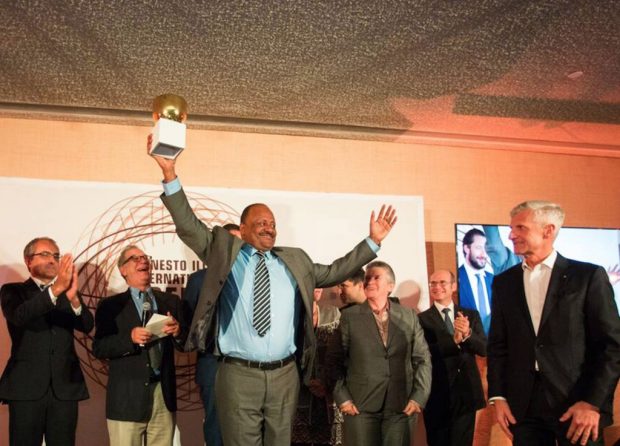
Ahmed Legesse of Ethiopia accepting the top prize at the 1st Ernesto Illy International Coffee Awards gala in New York. Illycafé photo.
Last week, the espresso-focused Italian coffee giant Illycafé presented its first annual Ernesto Illy International Coffee Awards, recognizing the top quality producers in its supply network.
Held at the Delegates Dining Room of the United Nations in New York, the event notably pulled the mask off Illy’s signature blend, while more importantly recognizing and promoting the individual producers behind it in the spirit of quality through collaboration. The company has been holding a similar awards program annually in Brazil, yet in UN-fashion, decided to expand the program to include a number of additional major producing countries.
From its quality lab in Trieste, Italy, Illy identified the three best lots from the 2015-16 crop year from each of nine countries that have regularly contributed to Illy’s signature blend, before an international jury selected the top lot from each country. The awards gala itself recognized all 27 finalists.
The countries represented included Brazil, Colombia, Costa Rica, El Salvador, Ethiopia, Guatemala, Honduras, India and Nicaragua, while the international jury — calibrated by Mark Pendergrast and Illy Quality director David Brussa — was composed of coffee professionals, chefs and members of the coffee-focused media, including Peter Giuliano, Kerri Goodman, Corby Kummer, Grace Hightower, Suvir Saran, Viki Geunes, Luigi Taglienti, Maria Loi, and Adolfo Henrique Vieira Ferreira.
In the end, Ahmed Legesse from Ethiopia was presented with the Ernesto Illy International Coffee Award, with coffee praised by the jury as having an intense yet delicate flavor, and unique high-intensity floral jasmine notes mixed with a hint of citrus and fresh fruit. Receiving an equal score, a Honduran lot from Juan Angel Milla received a special honorable mention.
“Exactly 25 years ago, my father Ernesto Illy created the Brazilian Quality Award, which triggered the transformation of Brazil into a high quality coffee producer,” illycaffè Chairman Andrea Illy said in an announcement following the event. “Today we celebrate this important milestone by extending this prestigious award to all the major producing countries of the unique illy blend, with the aim of building the future of coffee by bringing together growers and coffee lovers.”
Here, by country, are all 27 finalists in the 2016 Ernesto Illy International Coffee Awards
Brazil
1. Juliana Tytko Armelin
2. Daniella Romano Pelosini
3. Arabela Pereira Lima
Nicaragua
1. Jose Arauz
2. Carlos Alberto Cruz Lopez
3. Victor Hugo Castillo
________________________________________________________
Nick Brown
Nick Brown is the editor of Daily Coffee News by Roast Magazine. Feedback and story ideas are welcome at publisher@dailycoffeenews.com.
________________________________________________________
source: http://www.dailycoffeenews.com / Daily Coffee News by Roast Magazine / by Nick Brown / November 08th, 2016
The organic coffee grown by Girijan farmers in the picturesque Araku valley of Visakhapatnam district is making a mark not only in the country but internationally as well, and all efforts will be made to promote it in an aggressive manner, according to Social Welfare and Tribal Welfare Minister R. Kishore Babu.
He was speaking here on Wednesday morning after releasing two new products of the Girijan Co-operative Corporation (GCC), a state government undertaking. The products are Vaisakhi Coffee and Kumkum (saffron) powder. “Coffee cultivation is bringing light into the lives of Girijans in the Eastern Ghats of Visakhapatnam district. The state government has taken up a project to bring one lakh acres under coffee cultivation in the district and Rs. 526 crore would be spent on it,” he said.
He lauded the GCC for procuring coffee directly from the Girijan farmers and marketing it on its own, eliminating middlemen. He said Araku coffee would be promoted under the brand name Vaisakhi and there was good demand for kumkum powder. “The GCC has already received orders worth Rs. 10 lakh from the famous Srisailam Siva temple in Kurnool district, and we expect big orders from other temples in the state and outside as well,” he said.
Kishore Babu said the state government was giving the GCC functional autonomy and “in the past few years the turnover of the GCC has risen almost three-fold from Rs. 90 crore in 2013. For the current year we have set a target of Rs. 365 crore and Rs. 155 crore has already been achieved. In the next five years, the turnover of GCC should cross Rs. 1,000 crore.”
GCC Vice-Chairman and Managing Director A.S.P.S Ravi Prakash said the corporation would strive to increase the income levels of Girijans and “GCC has waived farm debts of Girijan farmers to the extent of Rs. 1.8 crores.”
Araku MLA G. Sarveswara Rao said organic products such as turmeric and coffee procured from the Eastern Ghats inhabited by the Girijans, should be promoted in the domestic and international markets.
sarma.rs@thehindu.co.in
sourcce; http://www.thehindubusinessline.com / Business Line / Home> News> National / by CH. R.S. Sarma / Visakhapatnam – November 09th, 2016
Columbus, Ohio coffee roaster Crimson Cup Coffee & Tea recently traveled into Peru’s Andes Mountains to expand relationships with coffee farmers. During the trip. licensed Q Grader Brandon Bir led judging for a coffee competition in the Junin region.
Columbus, Ohio :
Brandon Bir, coffee sourcing and education manager for Columbus coffee roaster Crimson Cup Coffee & Tea recently traveled into Peru’s Andes Mountains to expand relationships with coffee farmers, agronomists, and others dedicated to improving the quality of the country’s coffee. While there, the licensed coffee Q Grader led judging for a coffee competition in the Junín region.
Bir’s trip originated in Lima. While visiting the capital city, he shared samples of Crimson Cup’s Ethiopian Kossa Kebena and 1991 Blend coffees with local coffee houses and coffee cuppers.
“We had some great discussions about Peruvian coffees, Lima’s coffee culture and how things are evolving,” he said. “They have some well-put-together cafés, and everyone’s competing for exceptional coffees.”
“Local coffees are getting better every year, with better coffees scoring in the mid-80s on the 100-point coffee quality scale,” he added. “In the past, they were known for their chocolatey flavors but were not extremely nuanced.”
From Lima, Bir traveled into the Andes Mountain jungle to La Merced, a town in the Junín region. There, he visited with Don Julio Arevalo Tello, founder of private co-op NARSA (NEGOCIACIONES AGROINDUSTRIAL AREVALO S.A.) Since 1988, NARSA has focused on helping small coffee and cacao farmers in Peru’s Central Highlands and Amazon regions with achieving market access throughout Peru and beyond.
“NARSA has been instrumental in coffee development in the Junín region,” Bir said. “We’ve been extremely impressed with the way they live their principles of integrity, eco-efficiency and transparency and their focus on inclusion of indigenous families.”
For the next four days, he visited local coffee farms and prepared for the upcoming coffee competition sponsored by NARSA. “The competition is just one of the ways NARSA is involved in improving local coffee quality,” he said.
One of the farms he stayed at was Finca Santa Rosa near the small town of Villa Rica. This farm is owned by third-generation grower Selena Contreras Obregon. Established by Contreras’ grandfather in 1927, the 104-acre, Rain Forrest Alliance-certified farm grows catuai, caturra, bourbon, typica and geisha varietals under a canopy of indigenous trees at an elevation of 1,600 meters.
“This is the third year we’ve visited Selena, her family and her farm,” Bir said. “They continue to impress us with their passion for quality coffee and dedication to progress in every aspect of operations. Over this past year, Selena’s coffee professionals created a new coffee lab to evaluate coffee quality.”
On his final day at NARSA, he coordinated a quality competition among more than 25 local coffee farmers. In addition to friendly competition, a goal was to help farmers understand the qualities that are more prized in coffee beans and that command a higher price. Bir and three other Q Graders cupped coffee samples from morning until the competition ended at 10 p.m.
“Our winner was an 89-point coffee from Damien Conde in Alto Palomar,” Bir said. It stood out from the typical coffees of the region with its flavor profile more similar to that of a high grown Kenyan coffee.”
Crimson Cup will evaluate the purchase of coffee from this crop through its Friend2Farmer direct trade program in the future. The roaster developed its Friend2Farmer direct trade program to ensure that farmers receive a fairer share of proceeds from coffee sales. The company pays a premium to farmers, who can then invest in agricultural and community improvements. Crimson Cup coffee experts also collaborate with farmers on ways to improve the quality of the coffee and quality of live for farmers, workers and their communities. In addition, the roaster invests in projects such as solar dryers to help improve coffee quality.
About Crimson Cup Coffee & Tea
Since 1991, Crimson Cup Coffee & Tea has hand-roasted specialty coffee in Columbus, Ohio and taught independent business owners to succeed through its coffee shop franchise alternative program. Sustainably sourced Crimson Cup coffee is available through a network of more than 350 independent coffee houses, grocers, college and universities, restaurants and food service operations across 28 states, as well as the company’s own Crimson Cup Coffee House in the Columbus suburb of Clintonville.
For more information, visit crimsoncup.com.
For the original version on PRWeb visit: http://www.prweb.com/releases/2016/10/prweb13805703.htm
source: http://www.benzinga.com / Benzinga / Home> PR Web – Columbus, Ohio / October 28th, 2016
In the hills of Coorg in Karnataka lies Madikeri, the town that gives a military feel & charms with its orderliness
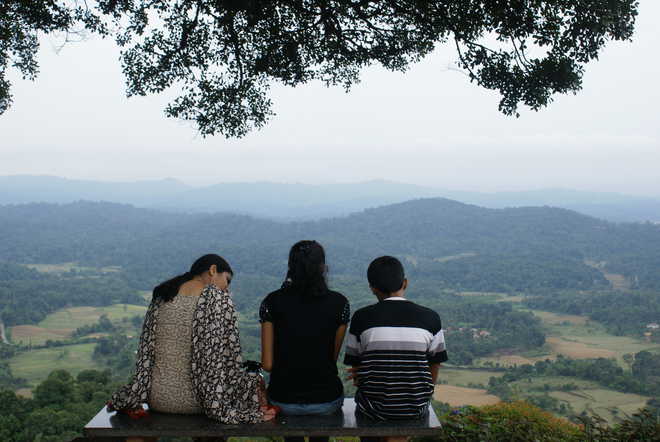
Where order prevails: View from the Raja’s Seat garden; The church in the Fort, now an ASI Museum; Two of the Royal Tombs; The Sri Omkaresvara Siva Temple Photos by the writers
Hugh and Colleen Gantzer
At first glance, Madikeri looks as precise and orderly as a cantonment. In a way, that’s what it is. According to a coffee-planter, “If you throw a stone in Madikeri, you’ll hit a General. If you throw two stones, you’ll probably get a brace of Colonels, bristly moustaches and all!” This could account for the military look of this cottage-dotted town in the hills of Coorg in Karnataka. Madikeri’s narrow, winding roads were meant for brisk walkers and horses. We felt this when we drove through the town to the Palace Fort.
It certainly is a Fort, with thick walls and deep gates. At the far end of its grounds, next to two enormous effigies of elephants is a board that proclaims:
“Mercara was founded by Prince Mudduraja of the Haleri dynasty in 1681 and named after him as Muddurajanakeri. This later became Madikeri by the locals. The British called it Mercara.”
At one corner is a steepled building, now a museum with hero-stones standing erect in the yard. We walked across this former Anglican Church. The light streaming in through its beautiful stained glass windows added to its meditative ambience, ideal for a museum. And, in a fitting tribute to India’s revered Field Marshal Cariappa, the former little vestry had been dedicated to the memory of this unforgettable army chief. He was a Coorgi, a Kodava.
From such shrines to the past, we drove down into town and parked at the gate of a living shrine: the impressive Sri Omkaresvara Temple.
Officially this is a Siva temple of the Lingayats but there are distinctly Islamic idioms in its eclectic architecture. It has a central dome with minarets at the four corners, surmounted by their own, smaller, domes. It is possible that the influence of Tipu Sultan had a lasting impact on the architects of this temple. It was built by Lingaraja II in 1820, just 21 years after Tipu Sultan died in Srirangapatna. We saw the Islamic influence even in other Lingayat monuments crowning a green hill referred to as Gaddige. A plaque installed at the foot of one of the plinths read ‘Royal Tombs’. Built in the Indo-Sarcenic (sic!) style, these monuments with domes and minarets, hold the mortal remains of Kodava Royalty and court dignitaries.
The central tomb is of Dodaveerarajendra and his queen. To the right is the tomb of Lingarajendra built by his son Chikkaveerarajendra in AD 1820. To the left is the tomb of the royal priest Rudrappa, built in 1834.
Nearby are buried two royal officials, Biddanda Bopu, who died fighting Tipu Sultan, and his son Biddanda Somaieh. Clearly these warrior people opposed anyone who tried to cub their freedom to decide their own future.
Our immediate future, however, was constrained by the weather. We looked up at the roiling clouds above us. These were threatening but it hadn’t rained. We decided to rush down to Abbi Falls before a storm boxed us in.
Abbi was spectacular. Even though the water was not gushing in its roaring monsoon fury. it foamed and cascaded over rocks, frothing and surging before pouring into a large pool, and then flowing under a suspension bridge. The falls are well worth visiting but do treat that forest path with a great deal of respect.
It was almost sunset when we reached Raja’s Seat, a popular public garden with horizon-stretching views of the plains. Had the ancestors of the Coorgis battled across those lowlands? We began to think about the origin of the Kodavas.
Their traditional masculine dress of a turban, long coat, sash and curved dagger points strongly to a Middle Eastern connection. The Kodavas have no temples or pujaris, they conduct all their religious or social ceremonies themselves, and revere their ancestors. The Kurds of the Zagros and Taurus mountains of Turkey, Iran and Iraq are also known for their proud and independent nature. Were they the ancestors of the Kodavas? ‘Kurd’ and ‘Kodava’ have a certain similar ring. A popular theory claims that they are the descendants of people who were part of the army of Alexander the Great.
That could explain the very no-nonsense character of their mountain home, Madikeri.
source: http://www.tribuneindia.com / The Tribune / Home> Spectrum> Travel / October 23rd, 2016
A month-long festival of words, performance and visual art, all inspired by the ghost story is taking over the Leeds Library. Yvette Huddleston reports.
There’s a bit of a chill in the air at Leeds Library this month when it hosts a programme of events and interventions entitled The Haunting: Ghosts of Every Shade.
The Haunting is presented by Alchemy – a Leeds-based arts organisation which aims to connect people through the arts and open doors to new ideas through shared cultural experience – working in collaboration with the Library, Leeds International Film Festival and Ilkley Literature Festival.
The Library itself, on Commercial Street in the heart of Leeds, was founded in 1768 and is the oldest surviving example of the ‘proprietary subscription library’ in Britain. It is also rumoured to be haunted by a former librarian from the 19th century, so it is the perfect venue for the month-long programme.
“The space is very evocative – it lends itself to all kinds of interventions,” says Nima Poovaya-Smith, curator and director of Alchemy. “It is an inspirational source of stories through its diverse collections and in putting the programme together we have worked with the rhythm and ambience of the library.”
Pulling together a variety of different art-forms which complement and repsond to each other, visitors are in for a treat. Internationally acclaimed writers Simon Armitage, Imtiaz Dharker, Rommi Smith and John Siddique explore not only the thrills and chills but also the more reflective and provocative aspects of ghosts and hauntings through poetry, performance, short stories.
There are enigmatic installations from artist Zareena Bano and others, plus soundscape, dance, vocals and film with around sixteen new commissions as well as performances, masterclasses, workshops and ghostly trails.
And it’s a wide brief that’s open to all sorts of interesting interpretations. “The project grew out of my own love and passion for ghost stories, particularly the stories of M R James and Edith Wharton, but we are not just looking at haunting in the supernatural sense,” says Poovaya-Smith. “People are haunted in all kinds of ways; haunting can be metaphorical not just literal so we have a great depth with what the artists have done.”
Our fascination with ghost stories is long-standing and complex – on the most profound level they are a reminder of our own mortality – and it is a tradition that crosses cultures and continents.
“I think there are many reasons for our interest in them,” says Poovaya-Smith. “But I think one element is the concept of being ‘safely scared’ – it’s a thrill. And there is such a rich tradition of demonology and dark forces. Then there is our curiosity about the possibility of an afterlife, especially if we have lost somebody.”
A highlight of the programme is artist Steve Manthorp’s exquisitely detailed and mildly discomfiting The Haunted Doll’s House, based on MR James’ classic ghost story of the same name.
“Steve shares my passion for MR James’ work and he told me that he has been wanting to make a Haunted Doll’s House for about thirty years,” says Poovaya-Smith. “It was an idea that haunted him.”
Other highlights include ceramicist Adele Howitt’s installation which responds to Edith Wharton’s psychologically unsettling story Pomegranate Seed and a late night walk through Ilkley with Literature Festival apprentice poet in residence Mark Pajak sharing scary stories and poetry that reveal the macabre folklore and history associated with some of the town’s landmarks.
Across the month there will be numerous workshops and masterclasses including poetry masterclasses by Simon Armitage and Rommi Smith and a spooky Halloween workshop.
“None of the artists have done anything obvious, everyone has produced exquisite work, they have outdone themselves,” says Poovaya-Smith. “In the library itself we have several interventions. We have put objects in bookshelves for people to discover, so around every corner you encounter something interesting.” She adds, smiling: “All these things came together, one might say, in an almost supernatural way.”
The Haunting: Ghosts of Every Shade runs until November 7. For the full programme details visit www.alchemyanew.co.uk
source: http://www.yorkshirepost.co.uk / The Yourshire Post / Home> LifeStyle> Books / by Yvette Huddleston / Friday – October 14th, 2016
India has made a pitch to host the International Coffee Organisation’s (ICO) fifth World Coffee Conference in the country’s coffee capital Bengaluru in 2020.
ICO, the main inter-governmental organisation for the coffee producing and consuming countries, is keen that India host the next conference.
A formal decision from the apex body of the coffee producing and consuming nations is likely to be expected in March 2017, said MK Shanmuga Sundaram, Chairman, Coffee Board, confirming India’s bid to host the global meet.
Every four years, ICO holds the high-level World Coffee Conference to enable discussion around critical topics for the global coffee sector. Previously the conferences have been held in England in 2001, Brazil in 2005, Guatemala in 2010 and in Ethiopia in 2016.
ICO, which is working to strengthen the global coffee sector and promote its sustainable expansion in a market-based environment, has member governments representing 98 per cent of the world coffee production and 83 per cent of world consumption.
source: http://www.thehindubusinessline.com / Business Line / Home> Economy> Agri Business / The Hindu Bureau / Bengaluru – October 14th, 2016
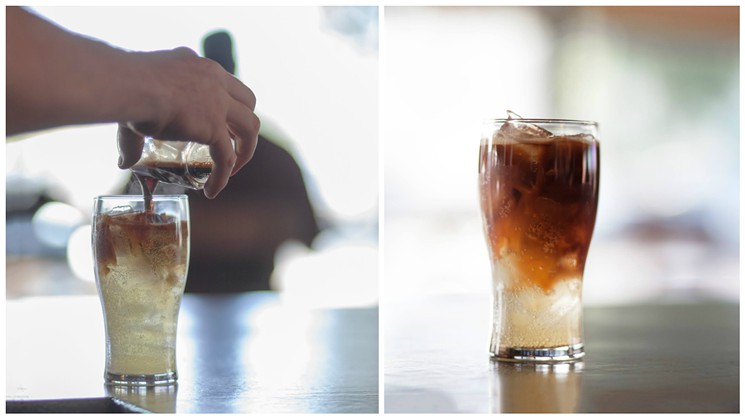
Left to right: a coffee tonic gets made by Kimhak Em at Peixoto Coffee in Downtown Chandler. / Kimhak Em
Maybe you got too caught up in colorful cans of LaCroix to notice, but over the summer, at cafes al over the country, Instagram snaps of what might have otherwise have been latte art were replaced, now and again, by some … bubbly, layered beverage in a plastic cup.
Yeah, what were those? Tan and foamy on top, mysteriously dark in the middle, clear and effervescent on bottom.
We saw it at Cartel. We saw it at Futuro. We saw it at Kream and at Peixoto.
These were clearly no boring cups of cold brew.
As the name suggests, it’s simple: a “coffee tonic;” iced, sparkling tonic water with a shot of espresso layered — not splashed — over top. You have to do it slowly; the copper-colored layer of bubbles sitting on the espresso, called “crema,” is volatile CO2 and since too much friction with fizzy water can result in quite a mess, baristas take it slow.
If you can consider a soda a soft drink that’s been carbonated, flavored, sweetened, and served cold, then you can view the coffee tonic for what it is: a coffee soda, albeit a freshly made one. Given the prominent role that the concentrated coffee plays in the beverage, this drink has really only gotten popular within the specialty coffee sector, where shops tend to pay a greater attention to the flavor of espresso.
Tonic water is pretty sweet, thanks to a good amount of added sugar, but it’s there to balance the beverage’s bittering agent, called quinine; the same stuff that lends pleasant bitter quality to your Italian liqueurs.
Some shops like Futuro put their tonic trust in a proven brand. In that shop’s case, Fever Tree, the standard bearer as of now for the tonic industry — if you asked for a gin and tonic at a craft cocktail bar, they’re probably using Fever Tree. A few widely distributed craft brands like Q are now available as well. Either way, most brands will deliver a neutral flavor that lets the complex flavors in a quality, nicely pulled shot of espresso shine, just as it would let an interesting and nuanced gin. There’s a locally made tonic mixer, too, made by Iconic Cocktail Co, which is flavored with kaffir lime.
Cartel flavored theirs, when they had it (it’s not currently on the menu; it may come back). It was simply tonic water, espresso, with a smidge of vanilla bean paste dotted in.
“We felt the vanilla bean paste helped to make it a bit rounder and accentuate the complex character of the espresso,” says Amanda Cohen, Cartel Coffee Lab’s director of education and quality control. Kream coffee, by contrast, squeezes citrus in theirs to amplify the acidity already present in espresso and the tangy flavor of the quinine.
The most from-scratch end of the coffee tonic spectrum is represented by the folks over at Peixoto, in Chandler. They make their own tonic syrup from start to finish, and add in flavors they feel will compliment the type of espresso. A formula of quinine, citric acid, and sweeter can turn into, for instance, a tonic syrup flavored with ginger and lime, and sweetened with agave. The shop currently offers this variety. They add soda water to the syrup and float the espresso atop. This approach appeals to Kimhak Em, who develops recipes and oversees quality control at the shop and has a background in culinary school. He wanted to put a culinary spin on a drink that’s been trending in coffee shops around the nation.
“I think the first time I had an espresso tonic was at one of the shops that I frequented in the Bay Area,” Em says. That was close to two years ago.
The drink hasn’t existed all that long — it began at a very prominent coffee shop and roaster in Sweden called Koppi. When a coffee shop called Saint Frank opened in San Francisco in late 2013, they paid homage to Koppi’s drink, making their own version — still just Fever Tree tonic, ice, and espresso — called the Kaffe Tonic (kaffe being the Swedish word for coffee). As Saint Frank rose to prominence in eyes of coffee professionals across the country, shops began adopting their own version, some sticking to the drink’s paired down roots, and others opting to personalize.
Three years later, it looks like the drink has stuck.
Editor’s Note: Shelby Moore works with Futuro in various capacities.
source: http://www.phoenixnewstimes.com / Phoenix News Times / Home / by Shelby Moore / Tuesday – October 11th, 2016
There’s a road called Good Hope Road in Washington, D.C. and many of the events in Sarita Mandanna’s second novel occur around Good Hope Road in 1932, as America’s WWI veterans march for the passing of the Bonus Bill, legislation entitling war veterans to a decent income and health care. Vietnam and Afghanistan veterans still have these same issues today.
But this is not a political novel, rather it is a tale of how WW1 affected a rich New England heir and his unlikely best friend, a dirt-poor young black man from Louisiana.
James and Obadaiah are in Paris when war breaks out, and both decide to join the French Foreign Legion. Had they known the horrors that lay ahead, they might have just gone home.
Years later, they have lost contact and James is practically estranged from his adult son Jim. When Jim meets an actress from Boston, Madeleine, things change. Madeleine is determined to mend the rift between father and son.
With much persuasion, James Senior eventually decides to do something about his post-war embitterment and so lobbies the press about furthering the veterans’ Bonus Bill. What starts out as a letter of complaint leads to a national movement, and a new lease of life for James Senior.
The story sweeps from one World War to the next, as Mandanna explores themes of family, friendship, race, civil rights and the utter futility of war.
Epic in its scope, yet beautifully intimate and poetic in its style, it’s a keeper.
Sunday Indo Living
source: http://www.independent.ie / Independent.ie / Home> Entertainment Newsletter / by Anne Cunningham / October 10th, 2016
WELCOME. If you like what you see "SUBSCRIBE via EMAIL" to receive FREE regular UPDATES.
Read More »