Joshna Chinappa is now the second Indian squash player after Dipika Pallikal to enter the top-10 ranking. Dipika is currently ranked 19th.
Joshna Chinappa entered final at the HKFC International in Hong Kong in May. / @ AFP
New Delhi:
Joshna Chinappa, top squash player, on Friday rose to a career high 10th position in the latest PSA world rankings, becoming the second Indian to break the top-10 barrier after Dipika Pallikal.
Chinappa, who has been in fine form in the last six months, moved a place to be 10th in the standings. Pallikal, who broke the top-10 barrier in December 2012, is ranked 19th in the latest rankings.
Chinappa had reached her biggest ever final at the HKFC International in Hong Kong in May.
She is now getting ready to defend her title in the National Championship, to be held in Mumbai from July 12.
Pallikal, who was 18th last month, dropped a place in the rankings. She was a quarterfinalist at the HKFC International.
The only other Indian in the top 20, Saurav Ghosal, remained on 17. Ghosal had been off action for a while nursing an ankle injury and is due to return to active squash at the Nationals in Mumbai.
source: http://www.sports.ndtv.com / NDTV Sports / Home> News / by Press Trust of India / July 01st, 2016
City-based freelance journalist and author P T Bopanna’s book ‘The Romance of Indian Coffee’ has been chosen as the world’s best book on coffee at The Gourmand World Awards function at Yantai in China.
The book, earlier shortlisted for the finals of the ‘Best in the World’ books under the ‘coffee books’ category, was picked from the entries of 64 countries, according to Bopanna.
‘The Romance of Indian Coffee’ was published in 2011, and takes a 360-degree view of Indian coffee.
The final results were announced recently in which the book was ranked first, followed by entries from the United States and Brazil in the second and third places respectively, Bopanna said in a release here.
Spain headquartered The Gourmand International every year honours the best food and wine books, printed or digital, as well as food television with the awards open to publishers in all languages and countries.
The Gourmand Awards celebrate global cookbook and wine book publishing, and feature many world-renowned chefs each year.
Bopanna has authored five books and runs a few Kodagu-centric websites and recently produced a documentary film titled ‘Discover Coorg’.
source: http://www.outlookindia.com / Outlook / Home> The Newswire> Books & Culture / PTI / June 28th, 2016
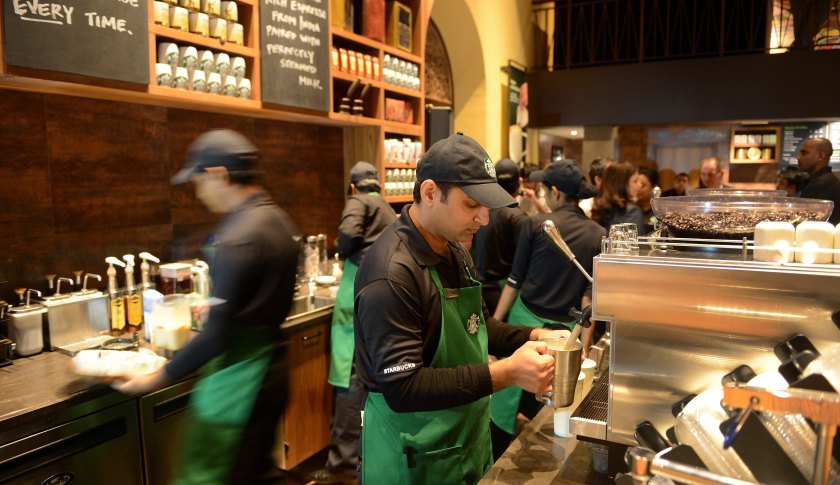
Staff work behind the counter of India’s first newly-inaugurated Starbucks outlet in Mumbai on October 19, 2012. / Photo- PUNIT PARANJPE/AFP/Getty Images)
It’s also one of the coffee chain’s fastest-growing markets.
Starbucks for the first time will sell single-origin, premium coffee from India in the United States as part of its effort to support coffee production in the country better known for its tea.
Starbucks SBUX -0.23% for a limited time later this year will sell a small-lot arabica coffee from the Tata Nullore Estates in India’s Coorg coffee growing area. The coffee will be roasted and sold at Starbucks’ Reserve Roastery and Tasting Room in Seattle. The price was not disclosed.
John Culver, group president for Starbucks Coffee China/Asia Pacific, told Reuters that the aim is for this to be the “first step in what we hope will be many reserve coffees coming out of India.”
It’s also one of the coffee chain’s fastest-growing markets.
India, which produces both robusta and arabica, is the world’s sixth-largest coffee producer. Its coffee output has increased 16% over the past 5 years, according to International Coffee Organization (ICO) data.
India’s estimated 2015/16 harvest is expected to be 5.83 million 60-kg bags of coffee, according to ICO.
The country is one of the coffee chain’s fastest-growing markets. Starbucks’ India, an equal joint venture between Starbucks and Tata Global Beverages Limited, has grown to 84 stores across six cities in India since its start in 2012.
Starbucks India, which so far has served only 100% arabica coffee grown and roasted in India, will also begin offering Kenyan and Sumatran coffee soon, Culver said.
source: http://www.fortune.com / Fortune / Home> Retail> Coffee / by Reuters / June 27th, 2016
Coffee grown at the Tata Nullore Estates located in Coorg will now be available at Starbucks in Seattle. This is the first time Starbucks will offer a single-origin coffee from India in the US.
This is part of the multiple new initiatives decided in a meeting between the Chairman and Chief Executive Officer of Starbucks Coffee Company, Howard Schultz, and Chairman, Tata Sons Ltd, Cyrus Mistry, at the iconic Starbucks Reserve Roastery and Tasting Room in Seattle.
“For the first time, Starbucks will offer a single-origin coffee from India in the US, giving customers from outside the country a unique opportunity to experience a rare, small-lot coffee from the Tata Nullore Estates located in the beautiful Coorg coffee growing area of India. Starbucks Reserve Tata Nullore Estates will be the first coffee from India to be roasted at the Starbucks Reserve Roastery and Tasting Room and will only be available at this Seattle location later this year,” said a press statement.
Starbucks also announced plans to increase its coffee roasting capacity for supplying its stores in India and, over time, select markets around the globe. Since Tata Coffee Ltd opened its doors to a roasting and packaging plant in Kushalnagar in Coorg, Karnataka, in 2013, this facility has steadily increased its roasting capabilities. Today, it roasts the Starbucks India Estates Blend and Espresso Roast coffees and will soon expand to include both Kenyan and Sumatran coffees for Starbucks stores throughout India.
“We are proud to work with Starbucks, a company which shares our commitment to both the coffee growing regions and the coffee farmers to ensure we meet the global demand for high-quality coffee over the long-term,” said Mistry.
Starbucks also announced it will soon take flight on Vistara, India’s fastest growing full-service airline, later this year. Starbucks’ fresh brewed coffee service will be exclusively available on all Vistara flights. A joint venture between Tata Sons and Singapore Airlines, Vistara operates more than 457 flights weekly to 17 destinations across India and, in June celebrated the milestone of flying two million travellers.
Starbucks will also extend its Teavana specialty tea brand to India this December. Starbucks also plans to expand the availability of Himalayan Mineral Water, bottled by Tata Global Beverages, beyond Starbucks stores in India to Singapore later this year, as the companies explore opportunities to introduce the bottled water brand to stores across Starbucks China and the Asia-Pacific region.
Schultz and Mistry committed to come together to provide young people in India valuable skills training over the next five years through Tata STRIVE, an initiative aimed at arming youth with skills for employment, entrepreneurship and community enterprise.
source: http://www.thehindubusinessline.com / Business Line / Home> Companies / The Hindu Bureau / Mumbai – June 27th, 2016
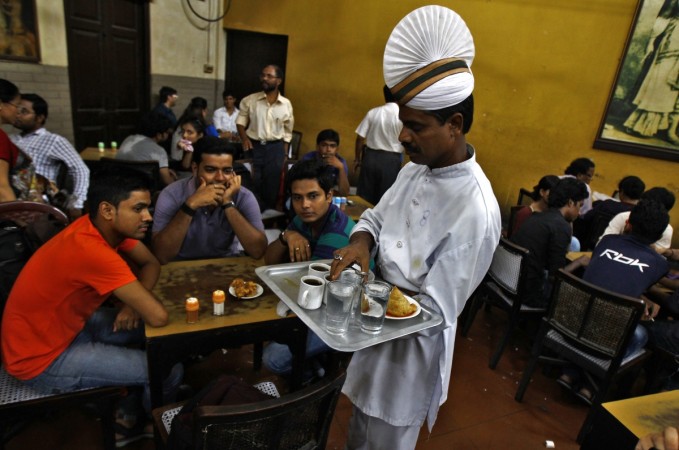
A waiter serves coffee to customers inside an Indian coffee house in Kolkata June 20, 2014 (Representational image).Reuters file
Coffee prices are at a 13-month high in international markets, after rain hit world’s largest-producer Brazil, lifting share prices of Indian coffee companies on Wednesday.
Tata Coffee was the biggest gainer at 6.21 percent on the BSE at around 2.30 p.m., followed by Tata Global Beverages and Bombay Burmah Trading Corporation.
“In Brazil it is raining too much in the Arabica areas, and this is definitely causing quality concerns,” Reuters had quoted a European physical coffee trader as saying last Friday.
An Indian coffee grower said heavy rainfall is bound to impact harvesting of coffee crop.
“Rains at the time of harvest can damage the crop as the beans will fall off. As a result, Arabica prices have been looking up in the last few days. Also, one cannot wish away the effect of drought in Brazil earlier in the year. Hence, it may not turn out to be a bumper crop as projected but not a bad crop either,” the Economic Times quoted coffee grower Anil Bhandari as saying.
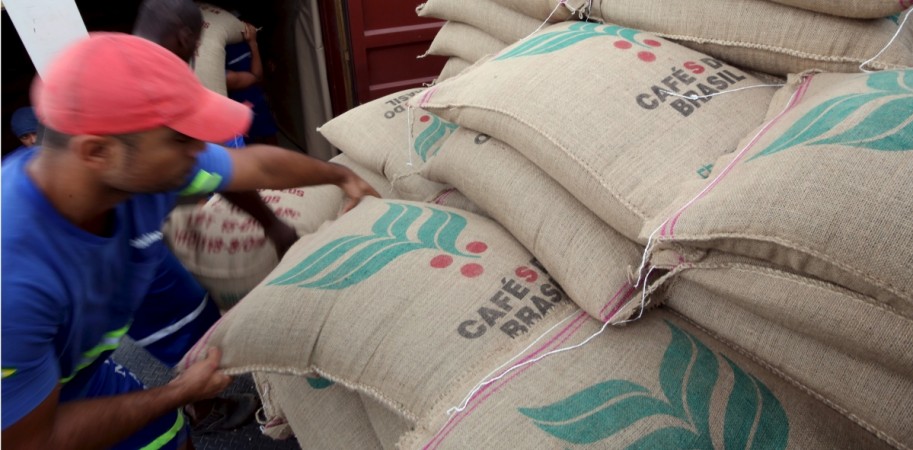
Workers load 60-kg jute bags of coffee beans for export into a container in Santos, Brazil, December 10, 2015.Reuters file
On June 17, the US Department of Agriculture (USDA) had forecast world coffee production for 2016/17 to rise by 2.4 million bags from the previous year to 155.7 million bags (60 kg per bag). The estimate was based on Arabica output in Brazil increasing to about 60 percent of total production, neutralising lower Robusta production in the country, along with Vietnam, and Indonesia.
Arabica and Robusta are two main categories of coffee worldwide. The Arabica crop determines global coffee prices.
After factoring global consumption at 150.8 million bags, the USDA said exports from Indonesia, Vietnam, Brazil and India are likely to remain lower (than last year).
India had exported 3.20 tonnes of coffee in 2015-16, up 13.39 percent from the previous fiscal.
After from being the largest producer, Brazil is also the largest exporter of coffee.
source: http://www.ibtimes.co.in / International Business Times / Home> News> Companies /by S V Krishnamachari / June 22nd, 2016
Rohan Bopanna has been India’s top ranked doubles players over the last few years and had a very successful 2015 where he won four titles and reached the final of the year ending ATP Tour Finals tournament at London.
He has also done well at the majors, reaching the quarter-finals of two Grand Slams, including the French Open this week and semi-finals of Wimbledon where they beat the legendary pair of Mike and Bob Bryan.
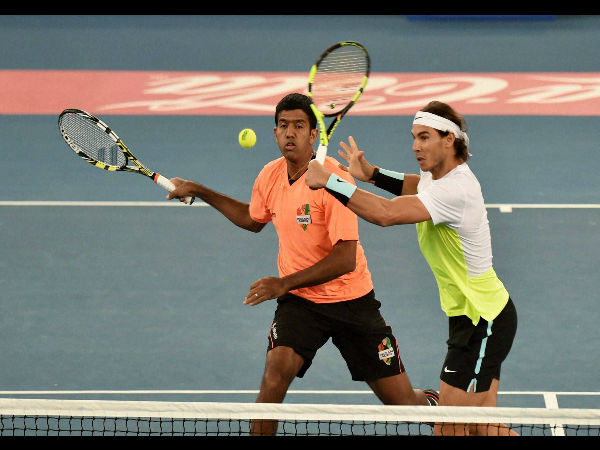
File photo. Indian Aces’ Rafael Nadal and Rohan Bopanna during a game against UAE Royals Roger Federer and Cilic during the International Premier Tennis League (IPTL) men’s double match at IG Stadium in New Delhi.
How would he explain his consistency over the past few years and the impact of Leander Paes and Mahesh Bhupathi?
“It’s really special that I am playing a high level of tennis. I am at the peak of my career. I have seen how much Leander and Mahesh have done for India and they still keep fighting out there. It’s not easy.”
“I am very happy that I am No.1 in the country and keeping the Indian flag flying every single tournament and working hard to winning the title every time you step on court. It’s been a tough journey but I am really happy the way I have been playing.”
So what are the travails of a professional tennis player? Bopanna felt it was the sacrifices they make to be away from home, family and friends and travel about 30-35 weeks every year.
“But this is the choice I have made and know this is how it’s going to be. But thankfully my family and friends understand this and it makes it easier.”
Bopanna also shared some of his career goals. “Winning a Grand Slam and reaching No.1 in the rankings would be the ultimate goal. I had reached a high of No.3 in 2013 after reaching the semi-finals at Wimbledon and would like to better that.”
He added that he is highly motivated by competition and doesn’t think about the awards. “I don’t think you have to worry about the awards. If you keep playing well, the country will recognise how you are doing and grant you that award.”
Bopanna is a man on a mission. Looking to give back to tennis what the sport has given him, he has launched the Rohan Bopanna Tennis Academy at Bengaluru. “The main reason is because of the passion I have for the sport. The Indian players have a lot of skills but it is the fitness aspect that we are lacking. So I will be focussing on that.”
Bopanna also shared his favourite memories on court. “My most special moment was representing India for the first time in Davis Cup in 2002. Also my singles win in final rubber of 2010 Davis Cup against Brazil in Chennai to take India to the World Group as we made a comeback from 0-2 down to win 3-2. In Grand Slams, it was reaching the final of the US Open with Aisam-ul-Haq Qureshi. It’s rare that India and Pakistan come together in sports.”
So does Paris hold special memories? “The city is so beautiful. It is such a romantic city. It was the first place my wife accompanied me. There’s so much to do, there’s great culture, great food and the best clay courts in the world,” answered Bopanna.
The Indian star from Bengaluru loves watching other sports and follows Manchester United and the ‘Bangalore teams’ — be it Royal Challengers Bangalore in the Indian Premier League (IPL), Bangaluru FC in the I-League and Bengaluru Bulls in the Premier Kabaddi League. He was a big fan of Sachin Tendulkar, Rahul Dravid and loves to watch Virat Kohli now and also the Indian badminton stars.
Bopanna is also amazed at the skills of star South African batsman AB de Villiers, “Every time I speak to South African players, they say he’s great in Tennis, great in Golf, great in Cricket. He’s just an all-round sportsman.”
In fact, Rohan’s love for tennis and sports is so great that his wife jokes that his tennis bag is his first love!
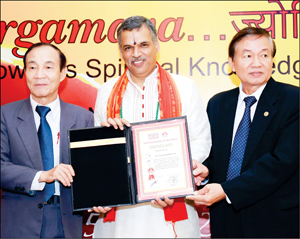
Yoga Guru Dr. Raghavendra R. Pai, Founder, Sri Vedavyasa Yoga Pratishthana, Mysuru, seen receiving the award at the 2nd Om Yoga & Wellness Hub Festival, held at Vietnam recently.
Mysuru :
In the culture barter expedition of global leaders around the world, Yoga from India has found itself a revered place across borders in an overwhelming acceptance.
Standing up for the physical, mental and spiritual balance practice, Yoga traces its origin back to the diversely fit cultural land of India.
Last year in his UN address, Prime Minister Narendra Modi suggested to have June 21 of every year dedicated to celebrate this practice as International Yoga Day.
“Let’s pledge to make Yoga an integral part of our daily lives,” he mentioned. June 21 (Summer Solstice), is also the longest day in the Northern Hemisphere.
As the entire world gears up for the 2nd International Yoga Day celebrations in June 2016, countries across the globe are leaving no stone unturned to make it a grand success. Vietnam, much ahead in its vision to promote Yoga, had organised an event to recognise the efforts of Yoga practitioners from India, who have worked hard to promote Yoga across the world.
Vietnam’s Om Yoga & Wellness Hub, a centre for Yoga, Ayurveda and Wellness, along with Sri Vedavyasa Yoga Pratishthana, Mysuru, had jointly organised the 2nd Om Yoga & Wellness Hub Festival, in line with International Yoga Day celebrations, on May 14 and 15, 2016 at Om Yoga & Well- ness Hub by Master Santhosh Cheriyamane, Binh Duong, Vietnam.
The event created two National Records — 81 yoga students and instructors performing 1008 Suryanamaskaras and a 24-hour Yoga marathon under the guidance of Yoga Guru Dr. Raghavendra R. Pai, Founder, Sri Vedavyasa Yoga Pratishthana, Mysuru and Master Santhoshkumar Cheriyamane Anand, Founder, Om Yoga and Wellness Hub, Vietnam.
For their excellence in Yoga, Dr. Raghavendra Pai and Master Santoshkumar Cheriyamane were awarded the prestigious ‘Vietnam King’ title by the Vietnam Book of Records on May 24. The certificates were officially handed over to them by the President of ‘Vietnam Book of Records’ Dr. Nguyen Van Vien and Chief Spokesperson Le Tran Truong An.
The other recipients of these title included Konanavar Somashekhara, Hebbasuru Siddappa Shivappa, Dombara Ganesh, Keri Suresh Kallappa, Annigeri Shivakumar, Yoga instructors from Karnataka and Perumal Selvakumar and Palanisamy Premkumar from Tamil Nadu.
Santosh Kumar Cheriyamane Anand, a Yoga practitioner, originally, hailing from Kushalnagar in Kodagu and Nguyen Thi Thanh Van from Vietnam, co-founders of Om Yoga & Wellness Hub, have popularised Yoga in Vietnam and also successfully established centres across three more cities in Vietnam. At these Centres, 12 dedicated instructors from Karnataka, Tamil Nadu and Kerala are imparting knowledge on not just practising Yoga, but also on Ayurveda and its natural healing methods and processes to those interested in and around the region.
The efforts of these Yoga practitioners in promoting Yoga across the globe is only the beginning of a much bigger dream envisioned by Ministry of AYUSH (Ayurveda, Yoga and Naturopathy, Siddha and Homeopathy) and the UN.
source: http://www.starofmysore.com / Star of Mysore / Home> General News / May 30th, 2016
Chinappa will meet the top seed Joelle King in the final on Saturday.
Joshna Chinappa (in front) in action at the HKFC International in Hong Kong on Friday (image courtesy: Hong Kong Squash Twitter)
World No. 13 Joshna Chinappa, who is the last Indian standing at the $25,000 MEML HKFC International 2016, delighted Indian fans at this Hong Kong tournament by reaching her career’s biggest ever PSA final on Friday. And it did not come easy! The third seed showed a lot of resilience to carve out an 8-11, 11-9, 12-10, 7-11, 11-9 victory over the World No. 10 and defending champion Annie Au of Hong Kong.
The 29-year-old Indian national champion had defeated Au at the Asian Squash Team Championships just a few days back and the experience surely came in handy. She was narrowly edged by the second seed and home favourite in the first game of the match but came up with a big response to take the next two games narrowly.
However, the 27-year-old southpaw was not one to go down so easily. Buoyed by the crowd support, she stormed back to grab the fourth game 11-7. With the momentum on Au’s side, the pressure was then all on Joshna’s shoulders to try and stop Au from running away with the decider.
And she managed to do just that! She was close on the heels of the local player even though Au had a slim lead of 8-6 deep in the fifth game. But Joshna made one last push and with an incredible show of determination, she was able to grab the win in exactly 1 hour.
The Indian was understandably elated after such a big achievement.
“Every point was fought to the max, just happy to get through to my biggest ever PSA final,” said the Chennai girl.
Joshna to meet top seed in final
She will next meet the top seed Joelle King who beat the eighth seed Donna Urquhart 11-8, 10-12, 11-6, 11-6 in the other semi-final. The two last met in the second round of the Hong Kong Open in December where Chinappa went down in a gruelling five-game match.
Earlier, sixth seed Dipika Pallikal had bowed out to King in the quarter-finals.
source: http://www.sportskeeda.com / SportsKeeda.com / Home Page> Squash> HKFC International / by Sudeshna Banerjee@Sudsports / May 27th, 2016
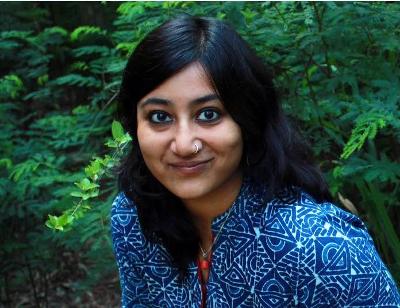
Verdant forests, picturesque mountains, lush coffee plantations — for many, Coorg is the perfect place to unwind. However, it was a different quest which took Arshiya Bose to the coffee land. A PhD holder in geography and environmental science from the University of Cambridge, she visited Coorg as part of a research project. Her mission — to make coffee production environment-friendly.
Realizing not all is well with the current production process — use of pesticides, exploitation of farmers, growth of coffee in the sun instead of shade — Arshiya, 32, started looking for ways to make it sustainable. She wanted to address these problems by adopting a holistic approach that ensures the well-being of both the environment and the coffee producers. The result — Black Baza Coffee, an entrepreneurial idea currently being incubated at the NS Raghavan Centre for Entrepreneurial Learning (NSRCEL), IIM Bangalore. The centre mentors innovators and supports their ventures.
During her research, Ashriya got the opportunity to work with forest dwellers and tribal communities in the Western Ghats, which helped her get closer to her goal. “I studied the social and environmental impacts of coffee production and found there were a number of problems no one was doing anything about. Traditionally, coffee in India has been grown under the shade of trees. But now, it is grown directly under the sun’s harsh rays, which adversely impacts biodiversity. Also, the trade market is extremely unfair to the producers, with the exploitation levels being very high. To fix the loopholes in the social and environmental ecosystem, I started Black Baza Coffee,” said Arshiya, who has tied up with many producers.
So far, the Kolkata resident has got 35 coffee producers on board, of whom 31 are marginal farmers from Biligiriranga Hills in Chamarajnagar. All of them are small growers —they own farms spanning less than 25 acres. “Under our partnership, we promise to buy coffee from farmers, support them through agronomic training and quality improvement and build safeguards for unforeseen price crashes. Many small growers are exploited and we hope to be the most fair buyer of their product ensuring they get their due,” said the young entrepreneur.
Explaining the potential of the idea, professor Suresh Bhagavatula, chairperson, Entrepreneurial Ecosystem Development, NSRCEL, IIMB said, “Coffee is among the top five most popular legally traded products in the world, including oil. It is a $90 billion industry and supports about 75 million people. While India is among the top 10 coffee-producing nations, it accounts for about 3.5% of the world exports. Unlike the rest of the world where sustainability and fair trade are becoming important for consumers, it is yet to catch on in India”.
“Black Baza Coffee would like to market the produce from farmers who practice sustainable methods for production. Consumption of coffee in India has started to increase, which will make it more feasible for ventures such as BBC to be established and serve the local markets as well,” Suresh added.
MUTUAL BENEFIT
We make conversational agreements with farmers and enter into a mutual understanding with them to grow coffee under certain kinds of trees, restrict the use of pesticides and protect their water resources. In return, Black Baza Coffee guarantees to buy coffee from these farmers at a higher premium
source: http://www.timesofindia.indiatimes.com / The Times of India / News Home> City> Bangalore / Shilpa Baburaj, TNN / May 25th, 2016
India’s coffee output in the next crop year is expected to drop by around a quarter to the lowest in nearly two decades as poor rains and hot temperatures hit plantations during the crucial flowering stage, the head of an industry body said.
India is the world’s sixth-biggest coffee producer, well behind leaders Brazil and Vietnam.
Nonetheless, lower production from India could provide more support to global prices, already surging due to a drop in the output in top producer Brazil.
“Dry weather is hitting plantations in the crucial flowering stage. On a conservative basis, we are estimating a 25 percent drop in production,” Baba P. S. Bedi, chairman of the Karnataka Planters Association (KPA) told news agency Reuters.
Karnataka accounts for about 70 percent of India’s total output. India is likely to produce 350,000 tonnes coffee in the current season ending on September 30, according to estimates by the state-run Coffee Board.
With a 25 percent reduction in Karnataka, production could drop to 263,000 tonnes in the 2016/17 crop year, the lowest since 1998/99.
The Coffee Board is expected to provide its first production forecasts for 2016/17 by mid-June, said D R Babu Reddy, an agricultural economist at the Board.
India, which started coffee cultivation in 1670 with seven smuggled beans, produces mainly robusta, used primarily in instant coffee.
“Due to the back-to-back droughts, ground water has been depleted,” said Bedi, pointing to lower rainfall since the start of March on top of drought last year.
Coffee growing regions in southern India received up to 70 percent lower rainfall than normal from March to mid-May, according to the India Meteorological Department.
Higher than normal summer temperatures alongside water scarcity had badly impacted the conversion of coffee flowers into cherries, said Anil Kumar Bhandari, a large planter.
India exports three-quarters of its coffee production and production problems will dent shipments in 2016/17, said an exporter based in Bengaluru.
“This year, exporters are aggressively selling due to a recovery in global prices. Next year we will have very limited carry forward stocks,” the exporter said.
Italy, Germany and Belgium are the main buyers of India’s crop, paying a premium over global prices.
India’s coffee exports have risen 19.4 percent to 213,187 tonnes since the start of current marketing year on October 1.