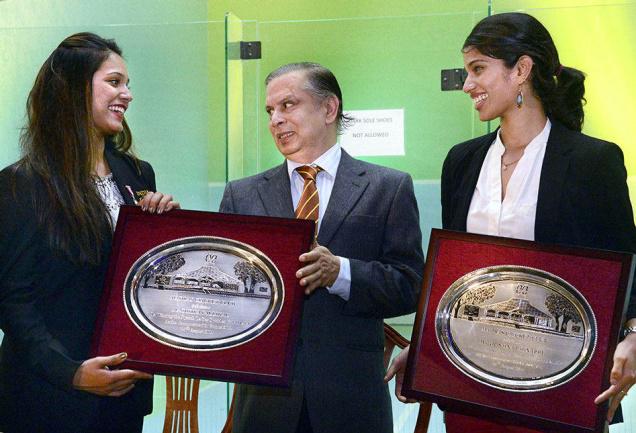
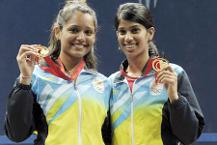
Dipika Pallikal and Joshna Chinappa being felicitated by MCC President Ajit Kumbhat. Photo : M.Vedhan
Madras Cricket Club (MCC) on Saturday honoured two of its “own children” — Joshna Chinappa and Dipika Pallikal — for having won the squash doubles gold at the Glasgow Commonwealth Games.
MCC president Ajit Kumbhat, hailed Joshna and Dipika as “role models for future generations.”
Tamil Nadu Squash Rackets Association founder member Dr. Ravi Santosham described the duo as “world champions”. Also, Joshna’s comeback from a grave knee surgery a few years ago was the stuff of legends, he said.
Former men’s National squash champion Ali Ispahani urged Joshna and Dipika “to stay out of the country for eight months (in a year)” if they wished to succeed. “If they stay out of India (and practice abroad) they can reach the top 5 (in the world),” he said. The day is not far off when the “girls from our club” will become world champions, he added.
The Hindu Sports Editor Nirmal Shekar said the growth of squash had a lot do with “N. Ramachandran (World Squash Federation president) and clubs like MCC.” He added: “they (Joshna & Dipika) will be right on top (in world rankings) in the next few years.”
Former World women’s champion Sarah Fitz-Gerald, now coach of Dipika, said both the players had “the ability to go higher.”
source: http://www.thehindu.com / The Hindu / Home> Sport> Other Sports / by Special Correspondent / Chennai – August 31st, 2014
By Prof. A.V. Narasimha Murthy, former Head, Department of Ancient History & Archaeology, University of Mysore
Victoria Gowramma is an enchanting but a perplexing name as it is a curious combination of western culture represented by Victoria and Hindu culture symbolised in Gowramma. In fact, an old fashioned and devoted Hindu woman with traditional virtues is referred to as Gowramma. Actually Gowri is Parvathy, the consort of Shiva. Slowly the name Gowramma is vanishing from Hindu household in preference to more modern names. However, that name still persists among the Kodavas.
I was re-reading D.N. Krishnayya’s book Kodagina Itihasa (History of Kodagu) in Kannada. It is a good book and reads like a novel but gives authentic history of Coorg. He has devoted many pages for sketching the life of Gowramma. In fact, C.P. Belliappa has made a special research on the charming lady and has written a book titled Victoria Gowramma: The Lost Princess of Coorg, which I have not been able to read unfortunately. Further he has taken the trouble in exploring and locating her cemetery at Brompton in South-West London. Thus Belliappa has given a new lease of life in history to this extraordinary Princess of Coorg and has added a new chapter to the history of Coorg. K.B. Ganapathy has also written about her in his book ‘The Cross and the Coorgs’ and its Kannada version Kodagina Mele Shilubeya Neralu. All these books are useful in understanding the personality of this Princess who passed away when she was just 23 years (1841-63).
Victoria Gowramma was the daughter of Kodagu King Chikka Veerarajendra Odeya, son and successor of King Lingarajendra. He was just 17 years when he became the king and due to bad company he became a cruel and autocratic king and people of Coorg cursed him to the maximum but were scared of him to raise their voice. Killing people when he did not like them or those who did not toe his line had become a daily affair without any mercy. A low class person by name Kunta Basava, who was looking after the Palace dogs rose to the position of a Dewan of the State and encouraged the King in all his atrocious acts. Added to it, he had a strong weakness for women and as soon as he saw a charming woman, he would get her into his harem. The British warned him but he ignored their advice. Finally he submitted himself to the British and became a prisoner in his Palace. He was first taken to Vellore and finally to Kashi where he was kept as a State prisoner. He requested the British government to permit him to take his dear daughter Gowramma with him to England and the British permitted him.
Thus Princess Gowramma went with her father and reached England in March 1852. The deposed King and Gowramma were given a rousing reception at London and Veerarajendra was actively participating in social life of London along with his daughter Gowramma. Suddenly he thought of her future after his own death and wrote a letter to Queen Victoria, requesting her to take Gowramma under her protection and convert her to Christianity and give proper education to her. The queen was very happy and Gowramma was converted to Christianity in Windsor Castle church by Canterbury Archbishop.
Queen Victoria became her guardian and gave her the name Victoria Gowramma. Chikka Veerarajendra was also present on that occasion and he expressed his gratefulness to the queen. The responsibility of her protection and education was entrusted to Major Drummond and his wife. As they did not look after her properly, she was sent to Lady Login and Sir John Login who were proficient in Hindustani. She was not encouraged to meet her father frequently and was allowed to meet him on special occasions only. Gowramma had forgotten Hindustani and Veerarajendra did not know English and hence the father and daughter talked to each other through a bilingual interpreter. Most of the time Veerarajendra was weeping whenever he met his daughter and thought that he was responsible for her plight under the British but it was too late. He became sick and when she came to meet him, he handed over a bag to her which contained a large number of precious stones and rich ornaments and asked her to wear them. Both of them cried.
Veerarajendra died in 1859 in London but Gowramma could not go to the funeral as she was living in White Island, far away from London.
His body was kept in Kansal Green Cemetery and after two years the body was brought to Calcutta through a ship. From there it was taken by road to Kashi and was buried there as per the rituals of Veerashaiva community and a tomb was built over it. The expenditure for all this was Rs. 2500 and the British government sanctioned this amount. When he died he had cash and valuables worth around rupees four lakhs and it was distributed among his relatives. Nothing was claimed by Gowramma as she was under the protection of the queen herself.
Gowramma was under the protection of Mrs. Drummond. The latter had two daughters who were active and were going to school. But Gowramma was always inactive and had no interest in learning. Hence she was being treated badly by the family. She felt that under the influence of Gowramma, her two daughters also may get spoilt and requested the queen to relieve her family from the responsibility of Gowramma. Then Gowramma was entrusted to another European woman by name Lady Login. She had a good knowledge of India, and also had the responsibility of looking after Dilip Singh. He was the first King to be converted to Christianity whereas Gowramma was the first woman to get converted.
As part of the ritual, the queen wanted her to go to Italy. The queen had sent an expensive diamond ear-ring and necklace of pearls and asked her to lead a life acceptable to God. Veerarajendra who was present on the occasion was happy at this gesture. Then Gowramma was taken to Italy (Vatican) by Lady Login and the new climate made her healthy and enthusiastic, regarding the royal life. Though some people tried to get her married to Dilip Singh, the latter did not agree as Gowramma did not come up to his expectations.
Then Gowramma came to England along with Lady Login. The latter wanted to be relieved of the responsibility of Gowramma and she was put under the care of Lady Katharine Harcourt. But the latter put Gowramma under a Junior Governess and Gowramma did not like that. Then she was put under the care of Sir James Wirhog. At that time Colonel Campbell used to visit her house. He was a young widower and showed great interest in Gowramma. They were married and they had a female child who was given the name Edith Victoria Gowramma. Campbell and Gowramma enjoyed fairly good life, visited many places and took part in royal festivals and parties. The queen was very happy and ordered that there should be no deficiency in providing funds and amenities to Campbell and Gowramma. Thus everything looked wonderful to the couple.
Gradually her tuberculosis was becoming severe. Queen Victoria made all arrangements to get her the best medical help. But the medicines did not help and finally she died in 1864 (March 30) when she was just 23 years. As per the desire of the queen her body was buried in Brampton Cemetery in London and an epitaph was carved on the marble stone as follows:
“Sacred to the memory of Princess Victoria Gowramma, daughter of ex-Raja of Coorg, the beloved wife of Lt. Colonel Campbell. Born in India, July 4th 1841, she was brought early in life to England, baptised into the Christian faith under the immediate care and protection of queen Victoria who stood sponsor to her. She died on 30th March 1864.”
After her death, her daughter married Captain Yardley and had a son who died in a road accident. Thus ended the family of Victoria Gowramma. Now she has entered the pages of history, the ultimate of everyone including kings, queens and princesses. But there is something melancholic in her life which makes us to have a soft corner for her. That is the greatness of Victoria Gowramma.
source: http://www.starofmysore.com / Star of Mysore / Home> Feature Articles / August 30th, 2014
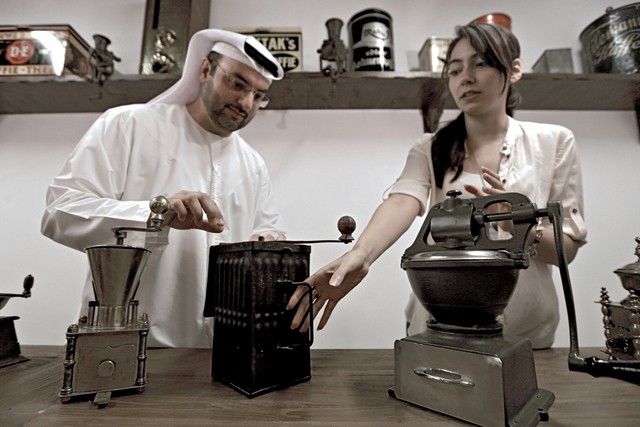
Khalid Al Mulla, the founder of the Coffee Museum. show two German-made coffee grinders from the Second World War to Arezou Schulz, a project manager at the museum. Ravindranath K / The National
During the Second World War, every German soldier carried an essential piece of equipment along with his weapon. Small, sturdy and built to survive almost anything, it was a coffee grinder.
The steel box had a handle on the top and a container at the bottom to catch the coffee grounds. It could be easily disassembled and packed away.
So strong indeed was the European love of coffee that even a scarcity of metal after the war ended did not stop the production of coffee grinders and roasters. Instead, munitions were melted down to manufacture them.
The importance of coffee to different cultures and countries through the centuries is the theme of Dubai’s new Coffee Museum, which will allow visitors to view the rituals of serving the popular beverage and to taste it.
Stepping into villa No 44, a traditional Emirati home in Bur Dubai’s Al Fahidi historical district, the visitor is immediately struck by the familiar aroma of freshly brewed coffee. Even though the museum’s signage has yet to be put up and its official opening is at the end of October, the museum is already swarming with coffee lovers.
“You will love coffee even more after visiting the museum and understanding its history and cultural relevance to us and the other cultures,” says Khalid Al Mulla, the museum’s 43-year-old founder and the director of Easternmen & Co, a coffee company.
His love of coffee begun in childhood, as it did for many Emiratis and Arabs who grew up watching their parents drink coffee and serve it to guests in a show of hospitality and friendship.
Mr Al Mulla later joined the coffee industry, importing to the UAE varieties from more than 16 countries including Indonesia, Brazil, Sri Lanka and Yemen.
He also became the local representative for several coffee brands and coffee-machine makers, including some from Japan.
But he still wanted to add another dimension to his enjoyment of coffee, so he decided to create a historical archive of his passion.
“Coffee drinking should be an entire experience, where all the senses are involved,” Mr Al Mulla says with pride as he takes The National on a tour of the museum, which comes alive with different aromas and sounds.
Seeing how coffee beans are roasted and brewed – from using traditional methods to the latest gadgets – and tasting the essence of different coffee beans are all part of the experience.
The interior of the museum at Bastakiya, Dubai / Ravindranath K / The National
In the two-storey museum, which has six rooms on each floor, each part of the exhibition tells a different story about coffee and how it relates to its fans. Three of the rooms display antiques from the Middle East and around the world.
From Britain, there is a man-sized coffee grinder with an actual carriage-like wheel for a handle that carries the 18th-century crest of a British monarch. From the Ottoman Empire, there are several grinders and hand-held portable roasters that are about 600 years old.
It is said that the first coffee house in Europe was opened in Vienna, using equipment taken from Ottoman troops defeated outside the city’s walls in the 17th century.
Other rooms in the museum display screens, filters, and grinders known as madaq, which are hundreds of years old.
The grinders, which are covered in Quranic verses and weigh more than 12 kilograms, are too heavy to carry. There are also grinders for women, with added support for the leg, allowing the grinder to lean in for support as the beans were being ground up.
In Ethiopia, the coffee pot is known as the jabena. It lacks the distinctive spout of the Emirati dallah. It was Yemenis who introduced the spout, calling the pot a jamena.
The dallah’s spout, which resembles a falcon’s beak, is sharper and narrower to allow the pouring of smaller amounts of coffee. Tradition stipulates the use of two dallahs, one for serving and the other to keep the coffee hot on the stove.
“As one digs, one discovers interesting history,” says Mr Al Mulla, citing as an example the reason for the popularity of Sri Lankan coffee beans in the UAE. “Because Sheikh Zayed used to drink it and liked it, we came to love it as well.”
All the objects on display at the museum – assembled over the years from around the globe – are from his personal collection.
“The museum connects the past of coffee to its present, and so I added live demonstrations of the coffee rituals in the Ethiopian culture, the Egyptian, the Arabic Bedouin, as well as the Levant and Turkish versions, so that every kind of coffee can and will be made here,” says Mr Al Mulla.
Coffee from the Levant is brewed over hot sand to better distribute the heat, he reveals. To be sure, Mr Al Mulla is a walking encyclopaedia on everything related to coffee.
Much of the museum’s top floor is dedicated to the research and study of coffee, with a library filled with rare books and a media room to screen coffee-related documentaries. “The history of coffee is still debated, with many versions,” says Mr Al Mulla. “But the version I like is the one about the man with the same name as me. They call him Kaldi, but his name was actually Khalid, just like mine.”
In the story of Kaldi, the drinking of coffee started in the Ethiopian Highlands hundreds of years ago. Then a goat herder, Kaldi noticed that his flock became hyperactive after eating some unknown berries from a tree. Curious, he tried them, and he remained alert and was unable to sleep afterwards.
There are different versions about how the actual drink was made.
According to some versions, Kaldi’s wife threw the beans on to a fire and roasted them. She then crushed the beans and made the grounds into a drink. In other versions, Kaldi took the coffee berries to a holy man. The latter disapproved of them, saying they were a drug and threw them into a fire. As the berries were roasting, they released the pleasant aroma with which we are all familiar. The roasted beans were then ground up and boiled in hot water, creating the world’s first cup of coffee and its second most traded commodity, after oil.
Coffee had also been drunk in monasteries, where monks were said to have consumed the beverage to keep awake for all-night prayers. From Ethiopia, the coffee trade crossed into Yemen, where Sufi Muslims used it as an aid for worship. It was in Yemen that the drink was first called qahwa.
“The legendary Mokha port in Yemen was once the main coffee exporting site for the region,” says Mr Al Mulla. “The Yemeni port’s name is synonymous with the mocha coffee that we drink today.
“Coffee spread across the world via the Arabs and Turks as the Islamic empire expanded into Europe and the rest of the world.”
Whether Asian or African, Central or South American, the islands of the Caribbean or the Pacific, all coffee varieties can trace their heritage to the trees in the ancient coffee forests of the Ethiopian plateau.
“The story of coffee started with an Ethiopian Khalid, and continues with an Emirati Khalid,” Mr Al Mulla says with a laugh. “I hope I tell it as well as he once did. The legend of coffee continues.”
His museum, unsurprisingly, has a coffee shop and a gift shop. The latter sells all kinds of coffee and coffee machines, as well as coffee-related jewellery, such as a dangling golden coffee bean on necklaces and bracelets.
The opening hours are from 10 am to 7pm, with tickets expected to be about Dh15 for adults and Dh5 for children.
Mr Al Mulla is still deciding whether to include the coffee served in the cost of the visit or to levy an extra charge.
To find out more about Coffee Museum, click here.
rghazal@thenational.ae
source: http://www.thenational.ae / The National / Home> UAE> Arts & Lifestyle / by Rym Ghazal / August 17th, 2014
What is the similarity between Bill Gates, Usain Bolt, Justin Timerblake and Ashwini Ponnappa?
They have all embraced the ALS Ice-Bucket Challenge willingly.
Ashwini completed the challenge on Tuesday afternoon. She in turn issued a challenge to her doubles partner Jwala Gutta and former swimmer Rehan Poncha.
After players and support staff of Bengaluru FC doused themselves in an icy-cold shower on Monday, they issued a 24-hour challenge to Sania Mirza, Ponnappa and Yuvraj Singh.
After Sania completed the challenge on Tuesday morning, Ponnappa followed suit pretty soon. Both of them have uploaded the video on YouTube.
Sania had already done the ice-bucket once before but since people complained that there was a lack of water, she did it again on Tuesday.
She, in turn, challenged Cara Black, Mahesh Bhupathi, Yuvraj and actor Ritesh Deshmukh.
What is the challenge exactly for? It raises money for charity — especially ALS — a neurodegenerative disorder.
After Mark Zuckerberg, Bill Gates, Cristiano Ronaldo and Oprah Winfrey, I-League champions Bengaluru FC and doubles ace Rohan Bopanna have taken up the Ice Bucket Challenge, which has gone viral on social media.
The challenge involves participants dumping a bucket of ice water over their heads to raise awareness about Amyotrophic Lateral Sclerosis (ALS), commonly called Lou Gehrig’s disease.
Once completed, the individual posts the video on social networking sites and nominates three people to take up the challenge within 24 hours or donate $100 to any charity working to fight the neurodegenerative disorder.
Bopanna, who was nominated by Indian-American tennis player Amrit Narsimhan, took to Twitter on Sunday to post his icy video. A shivering Bopanna nominated Bengaluru FC and actor Rahul Bose for the challenge.
Bose chose to opt out, tweeting, “Been chosen by Rohan Bopanna for #IceBucketChallenge to raise money/awareness for ALS. Hv decided not to waste clean water, but will donate!” However, Bengaluru FC were happy to oblige.
“We accept Rohan’s challenge and nominate Ashwini Ponnappa, Sania Mirza and Yuvraj Singh. Good luck guys, let’s end ALS,” Club COO Mustafa Ghouse said.
source: http://www.timesofindia.indiatimes.com / The Times of India / Home> Sports / by Maxin Mathew, TNN / August 19th, 2014
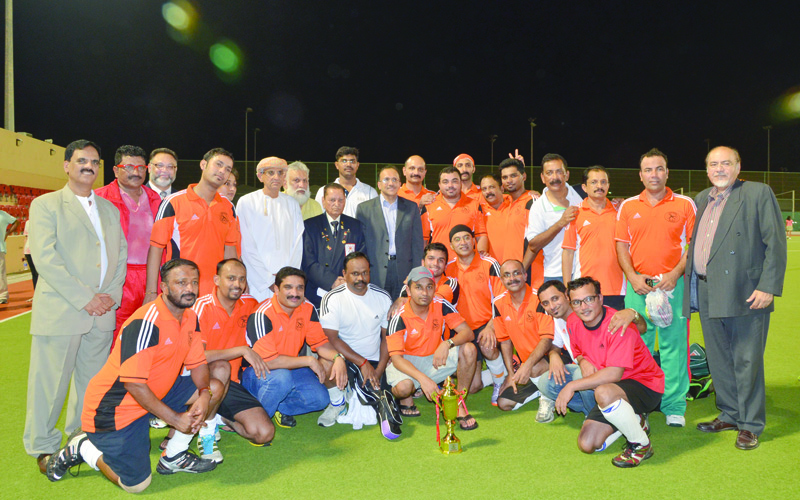
To mark the 68th Independence Day of India, under the patronage of Indian Embassy in Oman and Oman Hockey Association (OHA), the Friends of Naqvi Group and Team Coorg organised an exciting hockey festivity at the Sultan Qaboos Sports Complex on August 8.
Two festival matches, one for the Ambassadors Cup and the other for the seventh edition of Independence Day of India 2014 Cup, were played under the flood light at the lush green hockey astro turf. JS Mukul, Indian Ambassador to the Sultanate, was the chief guest and Shaikh Mahfood Ali Juma al Juma was the guest of honour.
The other sports dignitaries present were the OHA- secretary-general Redha Taqi Lawati, the Secretary-General of Oman Cricket Madhu Jesrani and the former Indian hockey player Sultan Abbas Naqvi.
The Indian Embassy XI lifted the Ambassadors Cup defeating Indian School Al Seeb 2-1 and the Oman Veterans XI lifted the Independence Day Of India 2014 Cup defeating Team Coorg Muscat 6-3 in the presence of hockey lovers of all ages.
“We got ample chance to score but could not capitalise it in the absence of our star forward Zaman,” said Team Coorg manager Belu Kuttappa.
The prizes and other citations were given away by JS Mukul, Madhu Jesrani and Redha Taqi Lawati.
The excitement of evening for the children below 10 years of age was the Indian national anthem recitation competition which was judged by Kanchan Bijlani and Farheen Khan.
This patriotic activity will now be a regular feature in years to come.
“I am quite pleased and charged to see such a massive attendance of the hockey lovers of Oman from all communities at the stadium, who have turned in such a large number to mark the independence celebration of India through this hockey festivity,” said veteran hockey ace SAS Naqvi who has indeed pledged his entire life for the promotion hockey in India and Oman.
The event was supported by Khimji Ramdas, Raha Poly products and Pokari (Muscat Pharmacy) and BG.
The vote of Thanks was given by Mohammad Osama Rawat.
source: http://www.main.omanobserver.om / Oman Daily Observer / Home> Sports / by Oman Observer / Sunday – August 10th, 2014
The Friends of Naqvi Group and Team Coorg, under the patronage of Embassy of India Muscat and Oman Hockey Association, will be organising the 68th Independence Day celebrations hockey festivity at the Sultan Qaboos Sports Complex on August 8 from 7pm to 9:30pm.
The Ambassador XI will play against Indian School Al Seeb and the Team Coorg Muscat will lock horns with Oman Veteran’s XI, a press release said on Tuesday.
HE JS Mukul, the Ambassador of India to Sultanate of Oman, will be the Chief Guest and Sheikh Mahfoodh Ali Juma Al Juma, Chairman Oman Hockey Association, will be the Guest of honor.
“This event is organised for the last 7 years in row. Hockey events like this – The Dhyan Chand Day and The Republic Day of India Hockey celebration – are the regular events organised by Team Coorg Muscat.
“We take this opportunity to express our gratitude to HE JS Mukul, The Ambassador of India to Sultanate of Oman who is regularly presiding such hockey festivities on a regular basis and express our sincere thanks to Sheikh Mahfoodh Ali Juma Al Juma, the Chairman of Oman Hockey Association for his kind gesture in arranging the Sultan Qaboos Sports Complex Hockey Stadium for this event”, said veteran hockey player, administrator and coach SAS Naqvi.
The event is supported by Khimji Ramdas Group of Companies, Raha Poly Product and Pocari (Muscat Pharmacy).
There is also some surprise in store for children below 10 years of age.
Oman Tribune
source: http://www.omantribune.com / Oman Tribune / Home> Sports / Muscat – August 2014
Charisma Kaliyanda with Australian Prime Minister Julia Gillard Mysore :
Kaliyanda Charisma is in the thick of Australian politics. She is currently running up for election to the State Parliament of New South Wales, which is one of the States of Australia. “I hope to be elected in March 2015, at which time I will work hard to represent the constituents of the seat of Holsworthy” she said. Charisma is contesting from Holsworthy on a ticket from the Australian Labor Party, who have selected her as their candidate to contest the upcoming State election.
“I was inspired to become involved in politics by three incidents that all occurred around the same time. Firstly, my University (University of New South Wales) was making big changes to our degrees and I was complaining in class when one of my classmates asked me “what are you going to do about it?” She invited me to stand with her friends for election to the Student Representative Council (SRC) of UNSW. I realised I was just wasting my breath by complaining without taking any action, so I joined my classmate and her friends. The following year, I was elected President of the UNSW SRC,” said Charisma, speaking to Star of Mysore.
“Secondly, as part of my studies I travelled on exchange to Mexico. Here, I realised the value of being involved in politics — if people from all walks of life are not involved in politics then the decisions that are made cannot be representative of society as a whole,” she said.
“Finally, it was around this time that I was diagnosed with Type 1 diabetes. This experience made me realise that the health system we have in Australia is fantastic, and that health and education are so important to being able to succeed in life. So, I got involved in local politics,” said Charisma.
Charisma is an occupational therapist by profession. Her experience with the health system there led her to get Masters in Occupational Therapy from the University of Sydney. “I love working in paediatrics, which is why I completed a program working at a school for children with physical disabilities in Mumbai last year,” she said.
About her background, Charisma said that she is the daughter of Kaliyanda Jaya and Banumathi, from Kolakeri village, Madikeri taluk, Kodagu. Banumathi is working for NSW railways. She and her brother were born in Bangalore. When she was around four years old, her parents decided to migrate to Australia. “Although the size of the Kodava community in Sydney has increased in recent years, it was relatively small when we were growing up. However, despite having lived in Australia for over 20 years, my parents have ensured that we have never forgotten our roots, our language and our traditions,” said Charisma.
“I have always found it a privilege to be able to share my heritage, particularly with Australian friends, as Australia’s multicultural society celebrates the richness of different cultures. We speak Kodava thakk at home, and make sure to celebrate Kailpodhu, Puthari and Kaveri Shankramana with not only our Kodava friends but also our non-Kodava friends. The Kodava community in Sydney gets together for our festivals every year, but we also celebrate at home. My friends love my mum’s pandhi curry and wotti” she said.
“My family is extremely supportive – they have always encouraged me to pursue my goals wholeheartedly. I am lucky that we have been able to visit family and friends in India every 3-4 years. My father is Kaliyanda Jaya, from Kolakeri and my mother, Chottera Bhanumathy, is from Kunjalageri. We still have family and friends living in Coorg and Bangalore, however, we make it a point to visit our grandmother in Kunjalageri, whenever we are in India,” she said.
source: http://www.starofmysore.com / Star of Mysore / Home> Feature Articles / August 10th, 2014
ipika Pallikal (left) and Joshna Chinappa pose with their medals after winning the gold in women’s doubles squash event during the 2014 Commonwealth Games in Glasgow. (AFP Photo)
Glasgow :
Forget the gold. Few gave them a chance to even finish on the podium in the Commonwealth Games, given that teams with pedigree like Australia, England, New Zealand and Malaysia were in the fray.
But two girls from Chennai – Joshna Chinappa and Dipika Pallikal – squashed all doubts and did the impossible on Saturday to claim the top prize in women’s squash doubles. This is India’s first ever medal in the sport in the Commonwealth Games.
It took the fifth seeded Indian duo just 28 minutes to tame the top seeds Jenny Duncalf and Laura Massaro of England in straight games: 11-6, 11-8.
The scoreline might suggest that the game was a little one sided but it was not. The British pair, after losing the first game, roared back for a 7-2 lead in the second. The Indians fought back to clinch a famous victory .
“We were down for a while, but we were confident. We were telling ourselves that we could do it. We were not here to settle for the silver. We had the belief and the confidence that we could win the gold medal,” 22-year-old Dipika told TOI.
It was a tough competition for the Indian girls as the field included quite a few former Commonwealth Games medallists. “Doubles was a tough competition. It was important for us to take one match at a time, not thinking about whom we were going to play if we advanced. I guess that paid off as it took away the pressure,” she said.
Dipika admitted that the feeling that she and her 27-year-old partner Joshna were the architects of India’s first medal winners in squash was yet to sink in. “I guess it will take a couple of days to sink in. We are delighted.”
Former national champion Bhuvaneshwari Kumari, here as a coach, said the medal would do a world of good to the game back home. “It will inspire people back home. The government and the federation have been very supportive but I think this gold will help us get more support.”
source: http://www.timesofindia.indiatimes.com / The Times of India / Home> Sports> Tournaments> Commonwealth Games 2014 / by Biswajyoti Brahma, TNN / August 03rd, 2014
It may come as little surprise that the Arab world is considered one of the fastest growing coffee markets in the world, with the UAE one of its most active centres.
Caffeine devotees across the UAE drink nearly twice as much of the popular beverage as anywhere else in the GCC, helping create a vibrant and diverse coffee and café scene, and providing the perfect marketplace for businesses looking to tap into the increasingly diverse and sophisticated tastes of their customers.
One such business is Coffee Planet – a UAE-grown and Dubai SME 100 ranked company which, according to managing director Robert Jones, will see the largest growth levels in its history this year.
“Last year we saw 35 percent overall growth,” he says. “At the end of Q1 this year we were up 38 percent compared to Q1 last year.”
Familiar to drivers across the emirates, Coffee Planet is well known as the brand of choice at petrol stations, but there’s much more to its success than that.
Since launching in 2005, Jones and his team have built something of an empire by stealth, gradually growing a business to be proud of, and one which many people might not even know they’ve interacted with.
“I like to say that we are like an iceberg,” continues Jones.
“Most people see us in the gas stations or supermarkets, but they don’t know that on the flight they are taking via Emirates or Etihad, they’ll be drinking our coffee. Or in the hotel where they have lunch, they’ll be drinking our coffee.”
Excerpt from –
The Daily Grind: Coffee Planet
source: http://www.elanthemag.com / Elan / Home> Innovation / August 01st, 2014
WELCOME. If you like what you see "SUBSCRIBE via EMAIL" to receive FREE regular UPDATES.
Read More »