Category Archives: World Opinion

Ajai, Nadia, Fouad hope to do well at Asiad

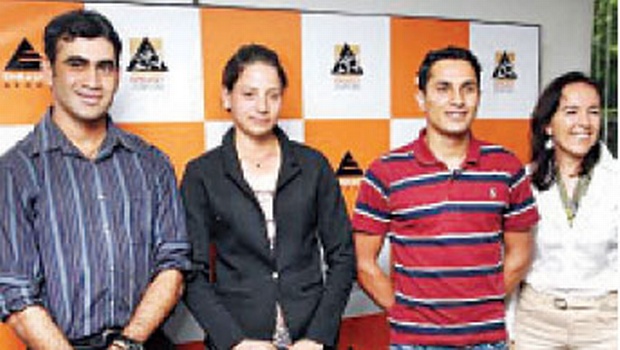
Ajai Appachu, Nadia Haridass, Fouad Mirza and Silva Storai

Bangalore :

Three of Karnataka’s excellent show jumpers from Embassy International Riding School, Bangalore, will make their way to Incheon, Korea for the 17th Asian Games to be held from September 19 to October 4.

Ajai Appachu and Nadia Haridass will represent the country for the second time in the Asian Games, while Fouad Mirza will make his debut. In 2010, Ajai was selected for Asian Games, but did not make it due to technical issues.

Equestrian has featured in the Asian Games ever since it was first staged in New Delhi in 1982. To date, Japan leads in the number of accolades collected at the Asian Games followed by South Korea and India.

Appachu, Mirza and Haridass train at Bangalore’s premier horse riding school, Embassy International Riding School (EIRS). They have meticulously trained under reputed instructors.

Appachu has earned several accolades at events across the world. Recently, he stood second at the renowned Hopetoun Commonwealth Cup in Scotland.

At 22, Mirza has performed splendidly, having won over 50 regional and international championship medals. He stood fourth at the Hopetoun Commonwealth Cup.

Nadia, a dressage specialist, has been a consistent performer in the category and has gained recognition in equestrian circles by winning many laurels and representing the country at both national and international platforms.

“I think we stand a good chance of winning in South Korea as we have the best horses. In the run-up to the Asian Games, we have been training hard in Europe and also participating in tough competitions,” said Appachu. Nadia, who trains under Olympian Hubertus Schmidt in Dusseldorf, Germany, said: “Competing against the world’s best riders in the qualifying rounds of Asian Games has infused confidence in me ahead of the big event. Qatar has spent a huge amount of money to prepare for the race and they can be tough opponents.”

“I am optimistic about winning a medal in the team event. Overall, the championship will be tough as Korea, Japan and Qatar have invested heavily on buying a good breed of horses,” said Oxfordshire-based Fouad.

“Nowadays, more parents want their children to pursue the sport and I hope we have some good performances at Asian Games,” said EIRS director Silva Storai, who was a professional rider herself, not too long ago.

source: http://www.thenewindianexpress.com / The New Indian Express / Home> Cities> Bangalore / by S.S. Shreekumar / July 29th, 2014

This Woman from Srirangapatna is the Queen Bee Among Entrepreneurs

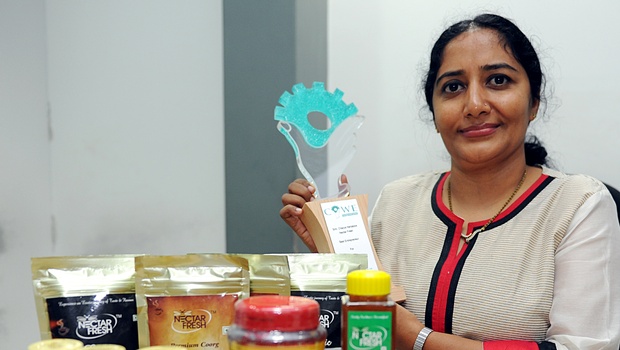
Chayaa nanjappa National Best Entrepreneur Award From the Confederation of Women Entrepreneurs of India was presented toher in Hyderabad on Monday. |EPS

Bangalore :

From Srirangapatna to Europe, it has been a long and difficult journey for 42-year-old Chayaa Nanjappa. But she has battled the odds and today heads a rural enterprise which produces high-quality honey that sweetens many a home even in Europe and the United States.

As a reward for her hard work, Chayaa was on Monday awarded this year’s ‘National Best Entrepreneur Award’ in food processing by the Confederation of Women Entrepreneurs of India.

Her path to success has not been a smooth one; she had to overcome many an adversity, physical abuse and traumatic relationships. But now, this gentle, self-made woman provides a livelihood for not only many illiterates of Mysore and Mandya districts, but also some tribals across the state. She is also the largest buyer of forest honey from Malayalis and tribes like Siddis and Jenu Kurubas.

She began her journey by setting up a small unit at Bommanahalli with the help of a `10-lakh loan. She then shifted operations to Nanjangud and later, to Srirangapatna.

Today her enterprise Nectar Fresh, which produces monofloral honey, has a capacity of 200 tonnes and is worth `6 crore. It is one of the largest bulk suppliers and packers of honey in the country and falls in the top five bulk exporters of raw as well as processed honey. Nectar Fresh also has the ISO 22000:2005 certification.

Chayaa told Express, “With no work experience or exposure, I started a rural industry in 2007 that could be identified with my hometown, Coorg. After doing a basic course from Central Bee Research and Training Institute (CBRTI), I jumped into the industry completely, sourcing honey from tribes and farmers.” She has 20 mobile apiary vans across the country.

Going International

To earn her brand a significant international presence, she decided to market it as a basket of products, including jams and sauces. The result: it found a place in the European market. “I added jams and sauces to my basket by purchasing pulp from sick units run by women in places like Bangalore and Mangalore, and sourcing fruits like papaya and tomato directly from farmers,” she said.

With exports to Germany and France, Nectar Fresh has broken the monopoly of global companies like Bereenberg, Darbo and Bonne Maman. “We met the stringent standards necessary for approval to export to Germany and made a strong impact by packaging our honey and jam in polypropylene sachets for high quality and shelf life. The European competitors feel threatened by our presence,” said Chayaa, who is now busy tying up with a Saudi Arabian company for the production of jams from dates.

She credited the Karnataka Village Industries Board (KVIB), CBRTI, the Horticulture Department, the Central Food Technological Research Institute (CFTRI), Le Meridien, ITC Foods and a host of others who supported her. “Any small and marginal farmer in Karnataka producing quality honey can contact me. My sole aim is to promote rural products and help women in distress by providing employment opportunities,” she said.

source: http://www.newindianexpress.com / The New Indian Express / Home> States> Karnataka / by Meera Bhardwaj / July 31st, 2014

Coffee waste may fuel your car now

Scientists have created a new biofuel to get the cars running using ground coffee. The study by University of Bath found that different varieties of coffee, including Robusta and Arabica, have reasonably standard composition and relevant physical properties of fuel, suggesting that all coffee waste could be a “viable” way of producing biodiesel.

Chris Chuck, a research fellow at the university, said that around eight million tonnes of coffee are produced globally each year, and ground waste coffee contains up to 20% oil per unit weight. This oil also has similar properties to current feedstocks used to make biofuels. Spent coffee grounds are waste and there’s a real potential to produce a truly sustainable biofuel using these, he added.

source: http://www.timesofindia.indiatimes.com / The Times of India / Home> Science / Agencies / June 18th, 2014

Soon, astronauts to enjoy freshly brewed coffee at ISS

The ISS will soon get an espresso machine, allowing astronauts to enjoy hot, freshly brewed coffee in space. A pair of Italian companies in cooperation with the Italian Space Agency have announced plans to send an espresso machine to the ISS by November, which they are calling the ISSpresso machine.

Lavazza has joined forces with Italian aerospace engineering company to design an espresso machine.

The new machine will use a capsule system instead of a full ground system and will be capable of making not just espresso, but several other hot beverages. The plastic tube that usually conveys hot water inside a normal espresso machine has been replaced by steel tube, making the unit capable of withstanding very high pressure. They also added multiple redundant systems to ensure continued service for many years to come. The liquid product made by the machine is dispensed into a plastic bag.

source: http://www.timesofindia.indiatimes.com / The Times of India / Home> Science / PTI / June 18th, 2014

Tata Coffee receives accolades at the Golden Peacock Awards 2014

Tata Coffee Limited, India’s coffee producer and exporter of gourmet coffee, announced its win at the Golden Peacock Awards 2014, for excellence in ‘Environment Management’ in the ‘Beverages’ category. Golden Peacock Environment Management Award (GPEMA) is the coveted recognition that organisations across India strive to achieve for environment management.

The award was presented as part of the two-day ‘ 16th World Congress on Environment Management’ in New Delhi on July 11 and 12, 2014. Tata Coffee was declared the winner amidst a distinguished gathering of business leaders, jurists, academics, environmentalists, economists, legislators and policy makers. Present as Guest of Honour was Atul Chaturvedi (IAS), Chairman – Public Enterprises Selection Board.

Hameed Huq, Managing Director, Tata Coffee Limited said, “It is a proud moment for the company to be applauded on a national platform such as the Golden Peacock Awards 2014. Tata Coffee has consistently been committed to environment protection and we rely and coexist with nature at our coffee plantations. We promote eco-tourism and sustainability. We are constantly improving the quality of coffee through sustainable practices and agronomy solutions.”

Tata Coffee has been revered for excellence in ‘Environment Management’ based on its system by conservation of water and energy resources and effective utilisation of renewable energy resources. Tata Coffee is also known as a carbon-negative company as it upholds its biodiversity conservation practices.

Tata Coffee has 19 coffee estates in India which produce varieties of Arabica and Robusta coffees. The plantations adopt sustainable practices in irrigation, water management, and pest control. The plantations have set up bee hives to increase the dwindling bee population and bee activity, which, in turn, will serve the purpose of cross pollination, especially for the Robusta coffee.

Sustainable practices have their benefits, including important certifications: among these, the Utz Kapeh certification, which validates that coffees from the Tata Coffee plantations have not been exposed to harmful chemicals and processes, and the Rainforest Alliance certification, which validates the company’s sourcing and growing practices. Tata Coffee was also the first plantation company in the world to get SA 8000 certification, which recognises a company’s fair employment practices.

This year’s awards were declared by the Awards Jury under the Chairmanship of Justice P. N. Bhagwati, former Chief Justice of India and Co-Chairmanship of Justice and UN Human Rights Commission and co-chaired by Justice (Dr.) Arijit Pasayat, Chairman, Authority for Advance Ruling (Customs, Central Excise and Service Tax) and former Judge, Supreme Court of India & former Chairman, Competition Appellate Tribunal of India & Authority for Advance Ruling (Customs, Central Excise & Service Tax) and Lt Gen J S Ahluwalia, PVSM (retd), President, Institute of Directors.The award for the Environment Management System (EMS) is a powerful tool to evaluate oneself in an ecological sphere.

source: http://www.hospitalitybizindia.com / Hospitality Biz India.com / Home> F&B Overview> F&B / by HBI Staff, Mumbai / Wednesday – July 16th, 2014

From coffee forest to a coffee museum

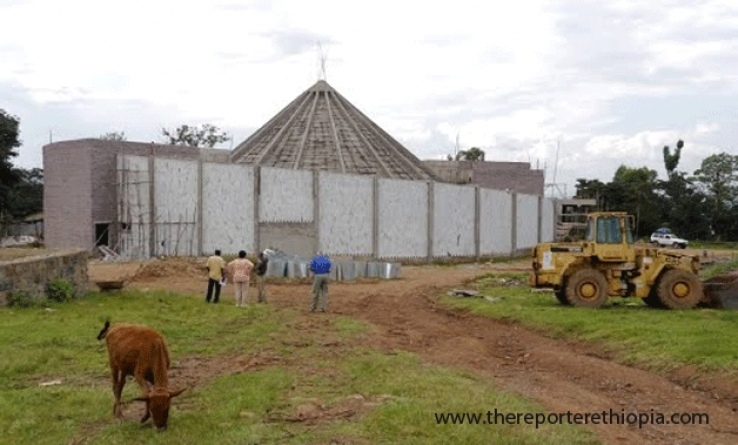
Coffee museum under construction

In the breathtaking experience of traveling across the remote highlands and lowlands of the south-western part of Ethiopia, one can, really, admire the country’s future in building a green economy.

The densely planted indigenous trees on both sides of the road seem to be the gate to a wonderful savanna land. A small town, Bonga, some 420 km south-west of Addis, provides a world-class center for research. The town hosts the first coffee museum of its kind, which many hope will unravel the mystery behind the birthplace of the mysterious green beans.

A goatherd named Kalid is linked with the story of coffee. Back then, Kalid saw his goats climbing the hills easily after eating what seemed to be a special leaf – a leaf that made them so spirited. His discovery encouraged him to be a guinea-pig to test the beans, which proved to be a source of great excitement. This is said to be the compelling story of the beans whose name reached out to every corner of the world.

Coffee has always been associated with Ethiopia’s longstanding tradition and hospitality. Indeed, it became a popular culture among many to grab coffee while discussing matters on the table. A few historians and anthropologists have also embarked on the task to find the birthplace of coffee.

The Kaffa people, located in the south-west of Ethiopia, have persisted with the strong argument that the name “coffee” is derived from their tribal name. They have kept their persuasive journey through historical and legendary accounts. They are, of course, known for their ancient history of self-governing dynasty that goes back thousands of years. They elected kings to ascend the throne, in which their dynasty structure is composed of defense, foreign affairs, justice and another four divisions that typify the modern government system. The last king of Kaffa, Akigo Shokru, was defeated in 1898 and arrested by the then powerful king, Menelik II, after a protracted conflict and several wars intended to include the region under a central administration. His crown is still kept in the Institute of Ethiopian Studies at Addis Ababa University.

In fact, coffee was found to be a treasure for the region some years ago when anthropologists dug out some of the materials that were supposed to have been used for drinking coffee. Moreover, the mother coffee tree in the so-called birthplace of coffee is still erected and preserved for tourists. Mankira, where a coffee bean was first discovered, has been a tourist attraction in the region. There is still a coffee forest in a wonderful natural setting which is placed to produce an organic wild forest honey that adds further fame for the area.

However, there is little to be said in favor of promoting the area or the entire nation as an original place of coffee due to several problems. Nevertheless, the man who is now becoming an icon for the area and has played a significant role in forwarding the idea of portraying the coffee bean as a trademark of the Ethiopian millennium, celebrated five years ago and also laid the foundation for the museum. Hassen Said (Ph.d.), from the Institute of Ethiopian Studies at Addis Ababa University, took the initiative to realize the construction of the museum when he found interesting and strong evidence about the association between coffee and the people of Kaffa.

The museum, which is on the verge of completion, rests on 2,800 sq.m. of land and hosted World Museum Day for the third time last May. “It has been quite an impressive journey to reach here,” he said. From the design of the complex to the construction cost, his insightful vision for the museum was the one guiding everything until it became a reality. “It is a simple love; a love that paid for my little involvement,” he said, describing its prominence among the people. Apart from a 10 million birr contribution from the wealthy businessman Sheik Mahamud Ali Alamoudin, the entire cost of the building was borne by the local people who have paid with the last cent from their pocket. “It feels like a blood-built heritage for the people,” he says.

The museum is expected to have rooms for laboratory purpose, research and documentation. Moreover, it will have a coffee park that brings all types of coffee beans from other parts of the country. “The most important role of the museum will be to promote the area as the original birthplace of coffee, in that we failed to do so thus far,” Kifle Hilemariam, chief administrator of the zone noted. In addition to this, it will also have a bigger impact in the promotion of other tourist sites found in the surrounding areas.

With the kind of personality in which Hassen has built, the realization of having a classy museum that promotes the area’s precious treasure to the rest of the world will indeed be an asset. The zone that comprises 30 percent of the country’s forest is on the verge of being registered as a world heritage site by the United Nations Education, Science and Culture Organization (UNESCO). “This will, of course, boost the country’s image,” Mamait Yilma, director of the national museum, argued.

Aseffa Hailemariam, who is in charge of the museum, notes that it is intended to promote coffee and will also accommodate a number of heritage pieces and artifacts of the people that have been preserved for centuries. “Quite soon the world will confirm Kaffa as a place where coffee was born,” he concluded. The people that realized the importance of environmental conservation a thousand years ago, and kept themselves in the forest planting coffee and hiving bees want to be recognized as “a coffee people”, and this seems be the time to reach out for that.

source: http://www.thereporterethiopia.com / The Reporter / Home> Living & the Arts / by Henok Reta / June 15th, 2013

Madikeri Farmer Eyes Record With 41-ft Cane

Madikeri :

B Hoovaiah is a happy man. A stalk of sugarcane grown by Hoovaiah in Madikeri is all set to enter the Guinness Records as the tallest in the world. The earlier record, set in 2001, was held by Venkatesh Gowda of Kolar.

Hoovaiah, a BSNL tower operator in Convent Junction in Madikeri, has been protecting the cane for three years now. All the required inspections have been completed by expert committees and a team from Guinness is expected to arrive shortly, before an official announcement can be made.

Hoovaiah told Express that an expert team inspected the stalk and measured it at 41.1 feet.

He then formally approached the Guinness authorities, asking them to consider it for a world record.

Later, he received an acknowledgement from Guinness records in-charge, Era Norroy.

Hoovaiah, who served in the Indian Army for 26 years, lives at Bettathoor in Madikeri taluk and has served as a tower operator for 11 years.

He expressed happiness that the cane had been grown organically.

source: http://www.newindianexpress.com / The New Indian Express / home> States> Karnataka / by B C Dinesh / July 10th, 2014

Students from sister city Cincinatti visit Mysore, Kodagu

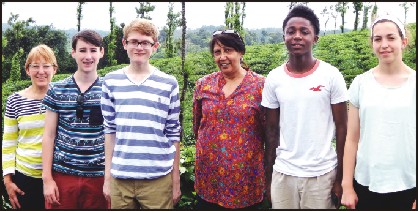
Students from Sister City Cincinatti, USA, at a tea estate in Kodagu. Seen are (from left) teacher Sarah Langenderfer, Jack Langenderfer-10th grade, Sam Krimmer-11th grade, Sister City President Dr. Ratee Apana, Kevion Howzie-10th grade and Molly Giglia-11th grade. These students are from two schools in Cincinnati — Walnut Hills and Schroeder.

Mysore :

High School students from Cincinatti — Molly Giglia, Sam Krimmer, John Langenderfer and Kevion Howzie — together with teacher Sarah Langdenderfer are in city to see their Sister City, learn about high school students here, their daily lives and get a feel of the culture of Mysore.

They were given a warm welcome by students and staff of Kautaliya Vidaylaya who will also perform a small cultural piece for these students. They will visit and spend time in the classroom at St. Joseph’s School. They will meet with students from Rotary School in Mysore, who will accompany them on a service learning session at the NGO Odanadi. On this visit, they have seen Shravanabelagola and Brindavan Gardens. They experienced Mysore city through the Royal Mysore walking tour company, visited Chamundi Hill as well as the Palace.

They spent two days in Kodagu at Dubare, Siddapur, Kutta, Nagarhole and the interactive park in Kadamakolli. Students learnt about tea and coffee cultivation and enjoyed many different plants, fruits and wild animals of the area.

Teacher Sarah Langenderfer has created a blog for their visit.

Varsha Vittal and Dr. Ratee Apana, President of the Cincinnati Sister City Association are in Mysore to assist with their arrangements in Mysore together with Vice-President of the Sister City Association Dr. Pat Niskode and MaryAnn Niskode in Cincinnati to make this visit a success.

Many families in Kodagu especially Kolera Tuckoo and Puthli, Karthamada Nirmala and Suju and H. Vittal and Sujatha Vittal welcomed students into their homes. They have a good understanding of the cuisine and day-to-day life of their hosts.

“We would like to encourage Mysoreans to contact us and connect with the students. They would love to visit a typical Mysorean home and learn about students their age in this city. We are waiting for a committee in Mysore to be set up that can help us strengthen and sustain this relationship,” said Ratee Apana, speaking to SOM.

source: http://www.starofmysore.com / Star of Mysore / Home> General News / June 14th, 2014

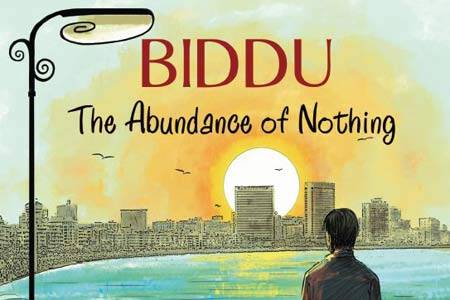
Biddu: From making music to penning stories

BidduKF19jun2014
Book title: The Abundance of Nothing

Author: Biddu

Publisher: Times Group Books

Pages: 304

Biddu ventured into Bollywood with the sensational composition ‘Aap Jaisa Koi’ for ‘Qurbani’ and popularised Indie-pop in India with another best-selling album, ‘Disco Deewane’. He later produced the 3 million-selling album, ‘Made in India’ that kicked off Alisha Chenoy’s career. From this connoisseur of music and the receiver of a ‘Lifetime Achievement Award’ by Rolling Stone magazine comes a spellbinding tale of a young rag picker.

Set against the backdrop of Mumbai in the 90s, the novel takes you through a journey of a young man who comes to terms with life when he’s suddenly left alone in a big bad world. The rise and fall of the vagabond kid amalgamated with the impeccable use of metaphors captures the heart and makes you realign your perception about materialism.

How did the transition from music to writing come about?
I decided that at my stage, and dare I say age, I should walk away quietly from the music scene. Creating pop music is for the young, not for the young at heart. Anyway, I was sitting in my house in Spain, watching the sunset and the surf washing the shoreline and I thought what next? I did not want to go through life with just one experience, one career. The idea of opening a restaurant was tempting, but everyone said ‘You crazy’, you’ll be tied to the restaurant 20 hours a day. So then I thought about writing a novel. Since I had always written my own lyrics (in English), I thought I’d go down that avenue.

Did you hear from your fans after publishing books? How have they taken to your literary abilities?
Almost everyone has been impressed by the stories and my grasp of the language. But then I was brought up in Bangalore, where Hindi was a foreign tongue and English was the lingua franca of the middle class.

What according to you killed Indie-pop in India? As one of the pioneers of Indie-pop, do you feel saddened by the same?
A lack of talent and a plethora of sub standard music killed the Indie-pop industry. Also for a while Indie-pop ruled the waves, because Hindi film music was stuck in a time warp. But they listened to Indie-pop, got the ideas, and sounds among others , plus they had the Moola. A music video of Shah Rukh Khan fronting a song from a major film with the attendant heavyweight promo and publicity is going to have more impact than some unknown doing the same in a pop video.

What inspired you to pen down a story detailing the journey of a young rag picker on the streets of Mumbai?
I had already written my first novel ‘Curse of the Godman’ which was set in Darjeeling circa 1951, when the British had left India. So, I decided to bring my next novel to the present times and set it in Bombay as it’s the city which gave me my fondest memories as a youth in India.

The novel provides a perfect description of Mumbai’s subculture. How did you manage to delve so well into this part of the city despite moving to England long ago?
Writing is all in one’s mind. That and the Internet. The first novel ‘Curse of the Godman’ was set in Darjeeling. A lot of people emailed and wrote to me saying I had captured Darjeeling perfectly. I had to lie and say I spent time there. Why kill the illusion. You can travel the world sitting in front of your computer. But coming back to Mumbai’s sub culture, I lived there for four years and visit it every year. So, in many ways, I used to think of Mumbai as my home in India.

From where do you draw inspiration for your characters?
Inspiration is usually from perspiration. You let your mind wander, sometimes ideas come when you’re swimming, sometimes when you’re walking along the beach and sometimes when you wake up in the middle of the night and can’t go back to sleep. The mind wanders, ideas spring up, you filter them, the good ones from the bad and in the morning you rush to your lap-top and hit the keys.

What has been the biggest surprise or learning experience while writing the book?
The biggest surprise is when you read back a few chapters of what’s been written and if it’s impressive, you ask yourself ‘Did I really write that?’ and a smile percolates through and you get a warm all over feeling and the confidence and adrenalin pumps through your body. It was the same feeling I got when I used to compose a song and it felt like a winner and you knew it would be a hit.

As a child, what did you want to do when you grew up?
As a child of 12, I want to be a 13! But seriously, from a kid, I either wanted to be a film star or a singer. I couldn’t act out of a paper bag (like a lot of stars today!), so I became a singer. When I went to London, I took up writing, arranging and producing because I couldn’t get any work or gigs. So, I made my own records. Which on reflection was a far more lucrative way of doing things.

A literary figure who has inspired you in your life
Shakespeare for sure. I’m not a guy who has heroes. There are people I admire like Mother Teresa and Mahatma Gandhi. But the truth is, even in the world of music, I had no heroes or people I looked up to. You put people on a pedestal only to be disillusioned or disappointed when you actually meet them. Then you bring them down.

Readers interested can order their own copy of the book here tgb.indiatimes.com.

(Originally published on June 09, 2014)

source: http://www.timesofindia.indiatimes.com / The Times of India / Home> Life & Style> Books / by Pallavi Bansal, TNN / June 28th, 2014

How Starbucks and Cafe Coffee Day are squaring up for control of India’s coffee retailing market

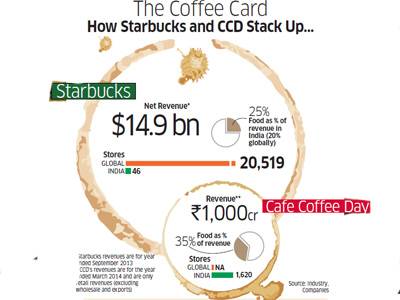
It is 5 pm on a weekday evening and the line at Starbucks in Indiabulls Finance Centre, a swish business complex in south Mumbai, is teeming with executives looking for their caffeine fix. With ties loosened and jackets casually slung over their arms, these men and women from the financial services, consumer goods and media firms housed in the towers of the complex are an ideal target audience for a range of beverages and snacks sold by Starbucks, the world’s largest coffee retailer; in 20 months of its inception in India — via a 50-50 joint venture with Tata Global Beverages — Starbucks has set up 46 such stores nationwide and has plans for dozens more.

Cut to Ulundurpet, far removed from the urbane chatter at Indiabulls. This town of some 400,000 people in southern Tamil Nadu is best known for being halfway between Chennai and Tiruchirappalli, an industrial and temple town some 320 km to the south. If Starbucks has embarked on its fastest-ever expansion globally in India, the homegrown leader Cafe Coffee Day (CCD) isn’t easily intimidated. India’s largest coffee retailer has launched some 150 stores in the past 12 months and plans a similar number in the next year. What’s more, it isn’t sticking to one format. In a bid to firm up its position, CCD has launched formats for malls, highways, an upscale offering called Lounge and a single-origin coffee destination called Square.
The world’s largest chain and India’s No. 1 retailer are squaring up for control of the country’s coffee retailing market.

VG Siddhartha, the reticent founder of CCD, is all beans when he speaks to ET Magazine. “Our dream is to be among the top three retail coffee brands in the world,” he says. Already, CCD is present in some 200 towns across the country (it is often the first and only coffee retailer in many locations) and is aggressively expanding its footprint. “We hope to grow our retail business at about 20% in 2014-15 [and] we hope to do a revenue of Rs 1,200 crore from retail sales and another Rs 350 crore from the wholesale and export business this year.”

Siddhartha is firmly stepping on the gas with CCD. “We want to have around 2,500 Cafe and Express outlets in three years…we will set them up wherever there are opportunities, including at educational institutions, hospitals, expressways and high streets.”


Bean There, Done That

Siddhartha, who pioneered the bean-to-cup concept in the coffee industry — his Amalgamated Bean Coffee owns the plantations where coffee is grown and processed and later served at CCD outlets — is now set to take his next big step. According to reports, CCD has initiated plans for an initial public offering, which may value the chain at $1 billion and provide PE investors such as KKR an exit. CCD and its investors declined comment on the possibility of such an IPO.

A war chest from such an IPO will help Siddhartha finance what is quickly evolving into a two-horse race for India’s coffee cafe mart. India’s No. 1 chain, which has spent the past two decades building up its business — and has been predominately unchallenged — will face up to its strongest challenge yet. The $15-billion Starbucks is preparing to raid its citadel, digging its heels in for a long, bruising brawl.
Coffecard01KF09jun2014


Coffee, Anyone?

India is predominately a nation of tea drinkers, with most chains struggling to keep business afloat. Siddhartha opened the first CCD in 1996 on Bangalore’s Brigade Road, initially to serve pricey cups of coffee and let customers experience internet, then a novelty. While he opened the first store based on visiting a similar store in Singapore, the internet novelty wore off and CCD gradually became a beverage and food retailer.

Over the past two decades, CCD and other chains have been trying to persuade more people to visit their outlets and drink coffee. For all the coffee drinking claims, India remains a relative lightweight. Scandinavians throw back, by far, the most amounts of coffee and, across the world, several other countries such as the US and China swill vastly more coffee than India (see A Tea Country Still).

Since inception, CCD (and several other chains) have scaled up the coffee drinking experience from crowded non-airconditioned cafes to far more luxurious outlets, offering clean cutlery, a refined ambience and, increasingly, a growing assortment of food. Indians have willingly signed up, with industry estimates pegging this segment’s growth at about 20% annually.

The advent of CCD and later a plethora of chains targeting this free-spending consumer catalyzed coffee sales. “Domestic consumption of coffee, which was almost stagnant in the 1980s and 1990s, picked up an impressive pace in the past 7-8 years,” says Jawaid Akhtar, chairman, Coffee Board. “We estimate the domestic consumption at about 115,000 metric tonnes a year now which is growing at about 5% a year…driven largely by consumption through branded coffee chains.”

CCD and Starbucks are both wrestling for a share of this fast-growing market — and elbowing out the strugglers in their slugfest.


Risky Business

CCD’s Siddhartha will be the first to admit that running a cafe chain can be a bruising business. For starters, real estate costs have hobbled and humbled many of CCD’s rivals, who’ve struggled to make costly stores in central districts viable.

According to industry estimates, rentals can account for 15-25% of the cost of running a cafe chain. Then, there’s the investment in making a store appealing to customers with its interiors, finding people to run them and building a food and beverage menu that’s hip enough to keep 18-24-year-olds — the target market for coffee chains — coming back for more. CCD has tried to find a way around this problem by entering into a revenue-sharing deal, paying 10-20% of a unit’s proceeds as a fee. “Store location is a prime factor to consider for these chains,” says Reteesh Shukla, associate director, food and agriculture, with Technopak, a business consultancy. “Retail space is becoming very expensive, but you need to balance the ever-increasing costs of this prime real estate by being in [relatively less expensive] areas frequented by the youth.”

CCD has been successful in India because of its beanto-cup business strategy, which gives it control over bean production and processing and greater efficiency from its back-end set up. While Starbucks does have similar strengths thanks to its Tata tie-up, industry watchers say its relative lack of size in India means it’s at a disadvantage in squeezing out similar economies of scale. Opening a new store isn’t just about finding a good location and dressing it up for a brand-conscious a u d i -ence. Instead coffee chains need to figure out a tricky supply chain — how to get food and beverage to these outlets quickly, while keeping quality high.

The others, who don’t have this backward linkage, have predictably struggled.

While the opportunity may be tempting, food and beverage outlets are dealing with a soft market, where consumers are cutting down on how often they eat out and reducing how much they order when they do. For cafes such as CCD or Starbucks, this is a blessing in disguise — consumers are reducing their spend on full-scale restaurant meals and instead scaling it down to a coffee and a snack.

Starbucks’ Advent

Since he started his coffee chain, Siddhartha is facing up to perhaps his biggest challenge. Starbucks, which opened its first store in 1971 in Seattle’s Pike Market, today operates 20,519 stores globally. In the US, the chain has become a byword for a quick, upscale cuppa (not just coffee, but increasingly tea too, with Teavana Oprah Chai launched with talk show host Oprah Winfrey), with Alist celebs and executives all having their personal favourites. Starbucks has attracted thousands of loyal customers to its My Starbucks loyalty programme and has even worked with tech start-up Square to pilot cashless transactions at its stores.

While Starbucks has till recently focused on its home market, it has changed tack in the past few years. For example, it announced ambitious plans to scale up its presence in China — it will open 700-odd stores this year — even as it looked to manage tough economic headwinds. In October 2012, the firm announced a JV with the Tata Group to launch some 50 stores in India. While Starbucks thought of initially going it alone in India (foreign direct investments in single brand retailing are kosher) it decided to lean on Tata Global Beverages’ experience in the coffee industry supply chain to give it additional leverage here.

Expanding faster in China and then India is financially prudent for Starbucks. Starbucks’ operating margin for the second quarter of financial year 2014 (ended March) was 32.8% for the China Asia-Pacific segment, 21.6% for the Americas and 5.7% for Europe, the Middle East and Africa.

While CCD had to build its brand from scratch in India, Starbucks hopes to leverage a globally familiar label with its target audience. When its first store opened in each city, winding queues were formed well before opening time. Familiar with its offerings in tall, grande and venti sizes, thanks to consumers who’d travelled overseas, either in real life or virtually, Starbucks’ India business got off to a rousing start.

Chinese Inspiration
ChineseKF19jun2014

Starbucks has shown some gumption going after opportunities overseas. For example, it has made a splash in the Chinese market, says Elizabeth Friend, an analyst with Euromonitor, a research and analysis firm. “Starbucks has done very well in a number of emerging markets…much of this has had to do with the brand’s very strong global reputation, which helped it to gain more immediate traction than other lesser-known chains,” she says.

“They’ve also done a really great job tailoring their brand — through store design, menu innovation and even learning how local stores are operated — to best suit each individual market.” In China, this has included leaning toward larger store footprints that offer space to relax with coffee in the afternoon. The addition of beverages such as the red-bean
frapuccino and a broader tea-based menu have helped Starbucks make strong inroads into the Chinese market, says Friend.

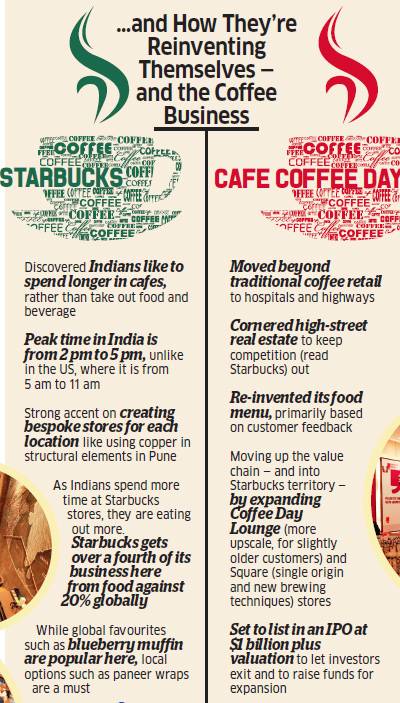
Starbucks’ rise in China may provide many lessons for its India business. In a large country Starbucks has had to localize its menu to keep customers coming in — something it has done quickly in India too, with dishes such as chicken tikka panini. Starbucks had cornered over two-thirds of the coffee cafe market in China until 2010, estimates Euromonitor, even if aggressive domestic rivals have more recently cut its market share to 60%.

Friend of Euromonitor says Starbucks has been able to replicate some of this success in India, too. “Some of India’s new outlet launches have been among Starbucks’ most successful in its history,” she claims. “Starbucks has been steadily gaining on local leader Cafe Coffee Day, though the chain will continue to pose a significant threat.”

Slow Brew

Starting with its first store in Elphinstone Building in south Mumbai — the Tata’s iconic Bombay House headquarters is just a stone’s throw away — Starbucks has built its business steadily in India. In fact, the chain is behind its initial target of 50 stores — it has 46 operational currently — but has expanded to the National Capital Region, Bangalore and Pune as it seeks to take on CCD.

According to analysts, Starbucks has firmed up its presence as a premium coffee retailer, with some malls even using it as a carrot to attract free-spending consumers to its premises. “Having a Starbucks outlet is a guarantee to attract upscale customers to a mall and this in turn helps convince international labels to rent space there,” says Anand Sundaram, CEO of PPZ, a mall management firm which operates malls nationwide; RCity in Mumbai’s Ghatkopar suburb, for instance, houses a Starbucks store.

A 34-year-old Tata Administrative Services graduate is piloting Starbucks’ business in India. Avani Davda went from being an executive assistant to Tata Group veteran Krishna Kumar to helming the joint venture with Starbucks for India. Having tasted her first Starbucks Coffee in Seattle in 2011 (she counts Sumatra and India Estate Blends as her favourites), Davda thinks the chain has plenty of scope for growth. “India is one of the most exciting markets in the world…we believe we have a unique opportunity to deliver an unparalleled coffeehouse experience to Indian consumers,” she says.

“We firmly believe in our ability to build and grow the Starbucks brand in India and are confident in the opportunities that the Indian market offers for it to become one of the top five markets for Starbucks globally.”

Heady Growth India provides a fertile market opportunity for CCD and Starbucks. According to company executives and analysts, there is plenty of opportunity for growth. Euromonitor says the Indian coffee cafe market will grow from Rs 1,683 crore in 2012 to Rs 2,276 core in 2017.

“Growth of cafes in India is driven by many factors, including favourable demographics, rising income levels, graduation from mid-sized towns [to large metros] and the advent of global chains,” says Sunitha Barlota, a research analyst at Euromonitor International. “Cafes in India are considered a perfect place to socialize among college goers and working professionals.”

Others such as Asitava Sen, head of the food, agriculture research and advisory team at Rabobank Group in India, believe there is plenty of headroom for growth in this space, with cafes just starting out on a sharp growth curve. Sen estimates that there are around 2,000 coffee cafes across India and there is room for 5,000 or more nationwide. “The Indian market

is very different from the West … here a visit to a cafe is more a social occasion and less a quick visit…the opportunity for cafe owners is to try and get a greater share of wallet from these consumers,” he adds.

Starbucks has discovered over the past few months how different it is doing business in India. According to Manmeet Vohra, the Indian operation’s marketing and category chief, they discovered that peak hours in India were 2 pm to 6 pm (compared to 5 am to 11 am in the US, for example) and takeout orders accounted for barely a fifth of their business in India (compared to 80% in the US).

What’s more, as customers spend time in the cafes, they needed to design them differently. So the cookie cutter design gave way to customized spaces in each city — for example its store in Pune uses copper elements, in a nod to the heritage of the city. “After office and home, we want to be the firm favourite as a third place to hang out,” Vohra adds.

According to brand consultant Harish Bijoor, consumers have made their preferences clear — Starbucks is the more upscale hangout, while CCD is a budget option. “Both these brands have strongly defined identities and consumers identify with them,” says Bijoor, who worked for eight years at Tata Coffee (a subsidiary of Tata Global) between 1993 and 2001. By his estimates there are currently 2,350 cafes, while the potential is for as many as 6,440 such outlets.

Success Potion

According to analysts such as Euromonitor’s Barlota, there are three or four key ingredients that determine the success of a coffee cafe. Other than location — CCD’s success to date is determined by being located close to colleges, business complexes, high streets and malls — pricing can be a make or break factor. This is particularly crucial at the lower end of the market where budget-conscious buyers are wary of shifting from cheap restaurants (sometimes called Darshinis) to a CCD or Starbucks. Those that do make the shift and pay the premium can be demanding on quality of service and product.

As consumers make their choices known, there seem to be strong indications that India’s coffee cafe market is going to consolidate. According to analysts, while CCD may be the mass market leader, Starbucks has occupied a strong position in the premium space, with plans to slowly but surely expand its presence. This means others in the market, including Costa Coffee, Baritsa and Gloria Jean’s, will struggle to attract and retain loyal custo mers. As the market gets polarized, CCD and Starbucks are expected to soon dominate the coffee cafe sweepstakes.

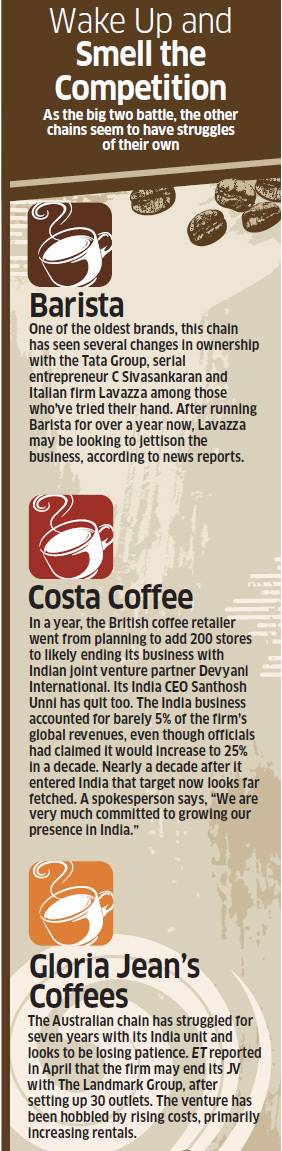
Some of these signs of strife are already visible. For example, Barista, the second organized retail chain in India after CCD, is on the market for a third time . While Ravi Deol, the chain’s first CEO, was tipped as a leading takeover candidate, his interest has faded in the past few weeks. Deol couldn’t be reached for comment. Italian owner Lavazza also declined comment.

Then, Costa Coffee, brought into India by Devyani International, is the subject of much wrangling between partners. Devyani, which runs the India business for the likes of KFC and Pizza Hut, has struggled for years with the Costa Coffee business. Virag Joshi, the CEO of Devyani, wasn’t available on the phone and didn’t respond to an email seeking comment.

Costa Coffee, however, doesn’t seem to have given up on India. “Costa is the world’s second largest coffee shop brand and is growing rapidly in its domestic UK market and globally adding over 300 stores a year,” says Kate Manning, a spokesperson for the chain. “We are very much committed to growing our presence in India.” While Costa has some 120 stores in India, she declined to enumerate the firm’s future plans. Costa’s India head, Santhosh Unni, has recently quit.

Third, Gloria Jean’s is also dealing with its own dose of bitter beans, with its joint venture with The Landmark Group on the rocks. Both sides didn’t respond to emails seeking comments, but real estate analysts said the chain was scaling back its presence in costly high-street locations to salvage the business.

However, CCD’s Siddhartha isn’t getting distracted by the woes of the competition. “All foreign coffee brands are looking at the top 5% of the Indian market — i.e. high income group consumers,” he says. “But we are focusing on the dynamic youth population. Roughly 70% of Indians today are below 35, and our goal is to reach out to them.”

Focus Matters
CompetitionKF19jun2014Experts argue that as a scale player, CCD has been able to escape much of the tumult in the sector because it has focused on its core proposition of affordable coffee, with comfortable surroundings, and steered clear of trying to tinker too much with a winning formula.

This is not to say that it has stood still in an evolving market. CCD, for example, gets around 35% of its business from food — an area it only focused on in the past 12-18 months.

“What stands out about Siddh artha and CCD is their ability to make strategic changes in response to customer demand and competition — expanding the food offerings or rationalizing store count to sustain growth and profitability are great examples,” says Sanjay Nayar, MD and CEO of KKR India.

“There is a great opportunity for CCD to leverage its large network to drive growth in a new direction,” he adds. In March 2010, KKR invested $210 million in Coffee Day Resorts, the holding firm which includes the coffee retailing business.

Venu Madhav, who has been with CCD since day one and got promoted as chief executive over a month ago, says the coffee retailer is streets ahead of the competition in understanding the Indian consumers’ needs.

“Cafes are social hubs, where coffee and conversation play a key role in the success of an outlet,” he says. “India is a value-conscious market and we see ourselves in the affordable luxury category of coffee retail.”

Madhav is keen to expand the reasons consumers stroll into a CCD — not just for a relaxed cuppa but for breakfast, lunch and dinner, too. It’s no surprise that CCDs on many highways are popular rest stops and the chain is focused on expanding its presence in the space.

Brand Battles

CCD is acutely aware that it takes little for consumers to switch loyalties — however good the coffee may be. To try to keep pace, CCD’s interiors are periodically updated to prevent its ambience from looking dated and jaded. “The look of our stores changes completely every couple of years,” avers Madhav.

While CCD continues on its rapid expansion path, Starbucks isn’t rushing to keep pace. According to industry sources, Starbucks could add a dozen or more outlets in the next year in India and is looking to expand its presence in the cities it is present in and consider going to second-tier metros, too.

“Each market comes with its own set of opportunities and challenges and our guiding principle across all markets continues to remain the same: to inspire and nurture the human spirit — one person, one cup and one neighbourhood at a time,” says Davda. And in the process she’d be hoping Starbucks coffee becomes most Indians’ cup of tea.

source: http://www.articles.economictimes.indiatimes.com / The Economic Times / Home> Industry> Services> Retail / by Rahul Sachitananad & K R Balasubramanyam, ET Bureau / June 08th, 2014