Model-turned-actor Shubra Aiyappa’s on a high with her debut film, Prathinidhi (in Telugu), doing well. Already working on her second movie, this time opposite Arvind Krishna, Shubra’s now ensuring her career takes the right course.
“I have been taking some time to sign the right films, now that my first film has done well,” says Shubra. Meanwhile, she’s also brushing up her skills for Bollywood. “I don’t have anything concrete to comment on yet, but yes, I’ve been taking lessons in acting and Hindi diction whenever I have the time, like currently, since I’m on a break between schedules,” says Shubra.
The actress is clear that career is her priority right now. “With so much on my plate, I’d say I’ve no time for a relationship,” she laughs.
source: http://www.timesofindia.indiatimes.com / The Times of India / Home> Entertainment> Kannada> Movies / by Sunaina Suresh, TNN / June 25th, 2014
The glamour quotient for Kannada’s Bigg Boss season two seems to be going higher. After names like Harshika Poonacha and Neethu being tossed around as confirmed contestants, the latest one to join that list is dusky Coorg lass and model turned actress Deepika Kamaiah.
Deepika, who entered Sandalwood with Darshan’s film Chingaari that was directed by choreographer and filmmaker A Harsha, has been a part of some critically acclaimed films in both Tamil and Kannada. Her first tryst with tinsel town was a Tamil film titled Aanmai Thavarel.
The actress even had a breezy visit ton Bollywood when she had a blink and you miss it role in the initial minutes of Rajkumar Santoshi’s comic caper Phata Poster Nikhhla Hero, which had Shahid Kapoor and Ileana D’Cruz in the lead roles.
source: http://www.timesofindia.indiatimes.com / The Times of India / Home> Entertainment> Kannada> TV / TNN / June 27th, 2014
Ajinkya Rahane, left, plays a shot, as Bangladesh’s captain Mushfiqur Rahim watches during their first one-day International cricket match in Dhaka | AP Mirpur :
Fine half centuries from Robin Uthappa and Ajinkya Rahane guided India to a comprehensive seven-wicket win (Duckworth-Lewis) over Bangladesh at the Sher-e-Bangla National Stadium here Sunday to help the reigning World Champions take a 1-0 lead in the three-match One-Day International (ODI) series.
Chasing a stiff target of 273, India were cruising at 100/1 in 16.4 overs when the skies opened up. Post the rain delay, the visitors were set a target of 150 from 26 overs which they achieved with seven balls to spare. India are playing this tournament without top stars like Mahendra Singh Dhoni, and Virat Kohli among others.
Playing his first ODI in six years, Uthappa (50) slammed his sixth half century on his return to the national fold. The exciting right hander, who found his way back in to team after finishing as the highest scorer of the recently concluded Indian Premier League (IPL), hammered three boundaries and sixes each in his 44-ball knock.
He was well supported by Rahane (64) and the duo gave India the start they needed with a 99-run opening wicket partnership. But soon after Uthappa was found leg before wicket, it started raining heavily.
After play resumed, India required 50 runs from 9.2 overs.
Cheteshwar Pujara immediately got out for a duck but man of the match Rahane continued his knock before getting out with India only 15 runs away from the target. Ambati Rayudu (16 not out) and captain Suresh Raina (15 not out) finished things off for India.
Earlier after electing to bat, the hosts put up a competitive total despite a slow start with good performances coming from the middle-order.
Bangladesh suffered an early blow with opener Tamim Iqbal perished for a duck after playing 11 deliveries. Mominul Haque (6) also followed soon but other opener Anamul Haque (44) and captain Mushfiqur Rahim (59) forged a partnership to steady their ship.
After the two got out, with the score at 134/4, all-rounder Shakib Al Hasan (52) and Mahmudullah (41) joined hands to take Bangladesh past the 200-run mark and also upped the run rate.
Lower down the order Nasir Hossain (22), Mashrafe Mortaza (18) and Abdur Razzak (16 not out) kept the momentum going with a few lusty blows to take them to 272/9.
Indian pacer Umesh Yadav was the pick of the bowlers, clinching 3/48 while leg spinner Amit Mishra took 2/55. Debutant spinners Parvez Rasool (2/60) and Akshar Patel (1/59) together scalped three wickets.
Brief scores: Bangladesh 272/9 in 50 overs (Mushfiqur Rahim 59, Shakib Al Hasan 52, Anamul Haque 44; Umesh Yadav 3/48, Amit Mishra 2/55, Parvez Rasool 2/60) lost to India 153/3 in 24.5 overs (D/L) (Ajinkya Rahane 64, Robin Uthappa 50, Ambati Rayudu 16 not out; Shakid Al Hasan 2/27, Mashrafe Mortaza 1/25).
source: http://www.newindianexpress.com / The New Indian Express / Home> Cricket> News / by IANS / June 15th, 2014
India bagged their second title at the Tri-Nation squash doubles tournament here on Thursday when Dipika Pallikal and Joshna Chinappa emerged winners in the women’s doubles final.
Pallikal and Joshna rallied to beat New Zealand’s Joelle King and Amanda Landers Murphy 8-11, 11-5, 11-1 at the National Squash Centre.
Hosts Malaysia were the other country to participate in the three-day event, seen as a warm-up to the next month’s Commonwealth Games.
It was Pallikal’s second title in as many days after she won the mixed doubles with Saurav Ghosal.
The Indians put up a commendable show considering they are busy playing singles for major part of the season.
Pallikal said it was good practice for the Glasgow Games beginning July 23. “I am glad to have won the doubles too. We started off slow today but got better as the match progressed. Joshna played some amazing shots to shock our opponents,” Pallikal told PTI.
She alongside Joshna stunned the mighty Malaysian pair of Nicol David and Low Wee Wern in the semi-finals on Wednesday.
“The win here does a lot of good to our confidence going into the Commonwealth Games. Winning there is our main aim and this tournament helped us understand where we stand in the pecking order. Among top Commonwealth nations, only England and Australia were not here. It was a good test overall,” said the singles World No. 10.
How tough is it switch to doubles while playing singles on the professional tour?
“It is tough but you have to switch off, switch on when necessary,” Pallikal added.
source: http://www.ibnlive.in.com / IBN Live / Home> Sports> Other Sports / Press Trust of India / June 19th, 2014
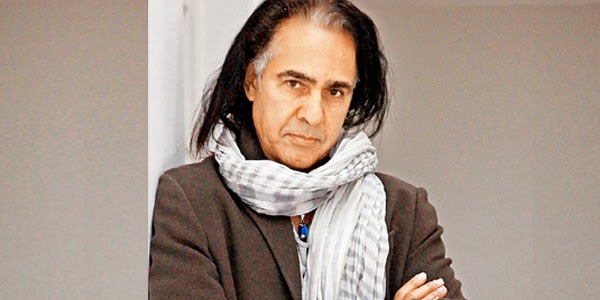
Who can forget the sex siren Zeenat Aman dancing and singing to the sensational disco beats of ‘Aap Jaisa Koi…’ in Feroz Khan’s super hit movie QURBANI in the 80’s. Wanna know who composed this all time hit song? Well the music was composed by Biddu Appaiah, popularly recognized as Biddu, the Indian-born, England based music composer who is regarded as a pioneers of Disco, Euro disco and Indi-pop around the globe.
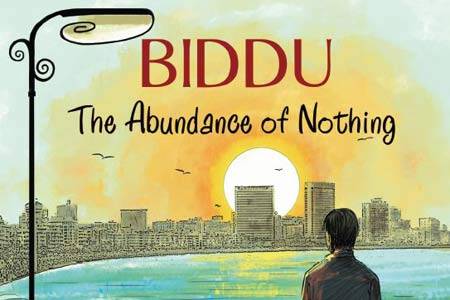
Winner of the prestigious Gramm Award and ranked 34 in the 50 Greatest Producers Ever list of New Musical Express (NMI), Biddu after five decades of career in music has moved to writing and has penned a fictional novel ‘The Abundance of Nothing’ published by Times Group Books.
Speaking about his switch from music to writing he confessed, “I have been regarded as the king of Pop music but truly speaking producing pop music is purely for the young, just being young at heart does not qualify to compose pop music. Hence I decided to silently shift gears from music to my other passion writing.”
Few know that QURBANI had music by famous Bollywood music director duo Kalyanji Anandji but Feroz Khan happened to hear the disco beats of Biddu in London and was so impressed that he hired him to compose just one song for his movie.
Initially Biddu declined the offer as he was busy in the West but when he found Feroz Khan to be serious and willing to pay an enormous amount he gave in.
In an interview Biddu had said, “I am the first person to introduce disco in India thanks to Feroz Khan. It was his obsession that made me compose the song. Before ‘Aap Jaisa Koi…’ the disco fever was nonexistent in India, however the song became such a craze that after ‘Aap Jaisa Koi…’there was a literal flood of disco songs and no Bollywood movie was released without (at least one) disco song
Like today’s item numbers, disco songs had become a permanent fixture till the late 90’s.”
source: http://www.indiaglitz.com / IndiaGlitz / Home> IndiaGlitz> Bollywood / Tuesday – June 10th, 2014
Tennis player girlfriend Sheetal Goutham was key to Robin Uthappa’s return to the top. by Akshay Sawai
One day Robin Uthappa called up his girlfriend, former tennis player Sheetal Goutham, and asked her about her workout. She said she did 3,000 squats. “3,000 squats. Wow.
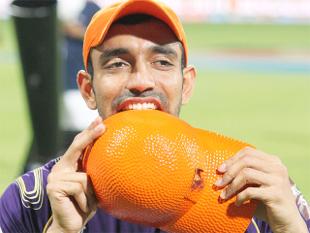
That sort of stuff inspires athletes,” Uthappa tells ETPanache at the Mumbai Cricket Association Recreation Centre, Bandra Kurla Complex. The 28-year-old had just finished net practice with Ajinkya Rahane, under the supervision of coach Pravin Amre. Uthappa was the top-scorer in the IPL for Kolkata Knight Riders and earned a recall in the Indian ODI side. Among the people he credits for his revival are Amre, his personal coach, and Sheetal, who he has known for almost eight years. ,”If not for her, I wouldn’t be playing cricket,” he says.
Uthappa was one of the stars of India’s stirring victory in the inaugural World T20 in 2007. Fame and riches followed. At the first IPL, Mumbai Indians bought him for $800,000 ( Rs 4.75 crore). At the 2011 IPL, Pune Warriors paid him an eye-popping $2.1 million ( Rs 12.45 crore. But soon he lost his form and desire. And though financially secure, he was not happy.
“I turned into a bitter person who did not enjoy other people’s success,” Uthappa says. “That did not sit too well with me. I thought I’d go abroad and do something different.” He discussed this with Sheetal, who spoke sense into him. “First, she put me onto a nutritionist. I was 95kg, in the worst shape of my life. Once I lost weight, I felt better emotionally and physically.”
Two years later, Uthappa is IPL champion, IPL topscorer and in the Indian team. While material things do not define his relationship with Sheetal, he has been generous with gifts to one of the people who made it all possible. “It was her birthday on June 6. I bought her summer dresses. Then there was a DKNY watch she wanted. Some of us got together and bought her that.
During the IPL, I got her an iPad mini.” Nutrition was key to Uthappa’s return to form. It also inspired his first foray into business. Last October, Uthappa and a few friends started ITiBSE 0.48 % f fin, a healthy meal service for professionals and school children. Uthappa invested `1.5 crore in the operation. A senior employee of a major financial institution is a minority stakeholder.
“I lost 20 kilos in a year-andhalf and know the difference healthy eating made to me,” Uthappa says. “Professionals sit at their desks for long hours doing stressful jobs. In India, there are so many people with diabetes and hypertension. We offer cultural food calculated to meet an individual’s requirement and prepared with fresh and natural ingredients. We are providing meals to 300 professionals on a daily basis, and 500-600 school kids per day.”
ITiffin’s target is 15 lakh customers per day across India. “We want to scale up a bit and are looking for investors,” Uthappa says. As far as scaling up his relationship with Sheetal, meaning marriage, he says, “The world will know when it happens. No fixed plans, but it will be soon.”
source: http://www.economictimes.indiatimes.com / The Economic Times / Home> Panache / by ET Bureau / June 12th, 2014
Biddu ventured into Bollywood with the sensational composition ‘Aap Jaisa Koi’ for ‘Qurbani’ and popularised Indie-pop in India with another best-selling album, ‘Disco Deewane’. He later produced the 3 million-selling album, ‘Made in India’ that kicked off Alisha Chenoy’s career. From this connoisseur of music and the receiver of a ‘Lifetime Achievement Award’ by Rolling Stone magazine comes a spellbinding tale of a young rag picker.
Set against the backdrop of Mumbai in the 90s, the novel takes you through a journey of a young man who comes to terms with life when he’s suddenly left alone in a big bad world. The rise and fall of the vagabond kid amalgamated with the impeccable use of metaphors captures the heart and makes you realign your perception about materialism.
How did the transition from music to writing come about?
I decided that at my stage, and dare I say age, I should walk away quietly from the music scene. Creating pop music is for the young, not for the young at heart. Anyway, I was sitting in my house in Spain, watching the sunset and the surf washing the shoreline and I thought what next? I did not want to go through life with just one experience, one career. The idea of opening a restaurant was tempting, but everyone said ‘You crazy’, you’ll be tied to the restaurant 20 hours a day. So then I thought about writing a novel. Since I had always written my own lyrics (in English), I thought I’d go down that avenue.
Did you hear from your fans after publishing books? How have they taken to your literary abilities?
Almost everyone has been impressed by the stories and my grasp of the language. But then I was brought up in Bangalore, where Hindi was a foreign tongue and English was the lingua franca of the middle class.
What according to you killed Indie-pop in India? As one of the pioneers of Indie-pop, do you feel saddened by the same?
A lack of talent and a plethora of sub standard music killed the Indie-pop industry. Also for a while Indie-pop ruled the waves, because Hindi film music was stuck in a time warp. But they listened to Indie-pop, got the ideas, and sounds among others , plus they had the Moola. A music video of Shah Rukh Khan fronting a song from a major film with the attendant heavyweight promo and publicity is going to have more impact than some unknown doing the same in a pop video.
What inspired you to pen down a story detailing the journey of a young rag picker on the streets of Mumbai?
I had already written my first novel ‘Curse of the Godman’ which was set in Darjeeling circa 1951, when the British had left India. So, I decided to bring my next novel to the present times and set it in Bombay as it’s the city which gave me my fondest memories as a youth in India.
The novel provides a perfect description of Mumbai’s subculture. How did you manage to delve so well into this part of the city despite moving to England long ago?
Writing is all in one’s mind. That and the Internet. The first novel ‘Curse of the Godman’ was set in Darjeeling. A lot of people emailed and wrote to me saying I had captured Darjeeling perfectly. I had to lie and say I spent time there. Why kill the illusion. You can travel the world sitting in front of your computer. But coming back to Mumbai’s sub culture, I lived there for four years and visit it every year. So, in many ways, I used to think of Mumbai as my home in India.
From where do you draw inspiration for your characters?
Inspiration is usually from perspiration. You let your mind wander, sometimes ideas come when you’re swimming, sometimes when you’re walking along the beach and sometimes when you wake up in the middle of the night and can’t go back to sleep. The mind wanders, ideas spring up, you filter them, the good ones from the bad and in the morning you rush to your lap-top and hit the keys.
What has been the biggest surprise or learning experience while writing the book?
The biggest surprise is when you read back a few chapters of what’s been written and if it’s impressive, you ask yourself ‘Did I really write that?’ and a smile percolates through and you get a warm all over feeling and the confidence and adrenalin pumps through your body. It was the same feeling I got when I used to compose a song and it felt like a winner and you knew it would be a hit.
As a child, what did you want to do when you grew up?
As a child of 12, I want to be a 13! But seriously, from a kid, I either wanted to be a film star or a singer. I couldn’t act out of a paper bag (like a lot of stars today!), so I became a singer. When I went to London, I took up writing, arranging and producing because I couldn’t get any work or gigs. So, I made my own records. Which on reflection was a far more lucrative way of doing things.
A literary figure who has inspired you in your life
Shakespeare for sure. I’m not a guy who has heroes. There are people I admire like Mother Teresa and Mahatma Gandhi. But the truth is, even in the world of music, I had no heroes or people I looked up to. You put people on a pedestal only to be disillusioned or disappointed when you actually meet them. Then you bring them down.
Readers interested can order their own copy of the book here tgb.indiatimes.com.
(Originally published on June 09, 2014)
source: http://www.timesofindia.indiatimes.com / The Times of India / Home> Life & Style> Books / by Pallavi Bansal, TNN / June 28th, 2014
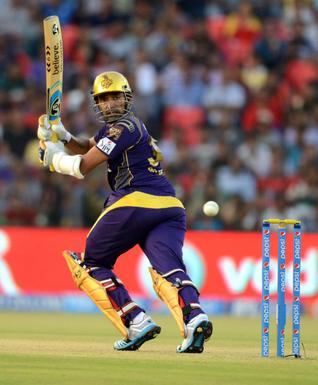
Smash hit: Robin Uthappa in action for the Kolkata Knight Riders./ Photo: Bhagya Prakash K. / The Hindu
A prolific season culminating in an unforgettable IPL outing has helped Robin Uthappa join the Men in Blue
A blistering bat and an inner scrutiny, have constantly defined Robin Uthappa. The wide range of his shots has often matched the depth of his introspective bouts and after every such encounter with the ‘man in the mirror’; Uthappa has emerged stronger as an individual and hungrier as a batsman.
In a roller-coaster life that has belied its 28 summers, Uthappa is now riding a wave. The Karnataka opener’s excellent show with the champion – Kolkata Knight Riders – in this season’s IPL, helped him wrest the ‘Orange Cap’ for being the highest run-getter (660). The rewards were instantaneous as even before KKR took on the Kings XI Punjab in the final, Uthappa was already picked for the Indian squad that will play three ODIs in Bangladesh, this month. An elated Uthappa said: “I always knew I had the ability and game to make the comeback. I worked hard towards refining my game, plugged the gaps in my technique. There is a sense of determination and a sense of belief now.”
Uthappa, who first played for India in 2006, has been an intermittent presence with the national team. A truth reflected in a mere 38 ODIs and 11 Twenty20 internationals played over an eight year period that had long absences away from M.S. Dhoni’s team. The latest return though is a tribute to his constant endeavour to improve both as a player and as a person while also drawing enormous strength from his inner circle of pals in which girlfriend and former tennis player Sheethl Gautham, played a prominent role.
Just like his latest evolutionary phase shaped by having a personal batting coach in former India player Pravin Amre, Uthappa has forever questioned himself and refused to back down even when some of the answers were not flattering. As a school kid, slightly on the heavier side, Uthappa donned the wicket-keeping gloves besides having a biff with the bat while representing St. Josephs. Adolescence and acne also ushered in hard queries about his self-image and the Coorgi lad cut shot on his traditional cuisine that hinged a lot on pork.
He lost weight, sharpened his shots and it was just a matter of time before he noticed by former India captain Dilip Vengsarkar, who was then heading the BCCI’s talent resource development wing. Uthappa was fast-tracked into the Indian limited overs’ squad and he did make an early impression.
Uthappa was part of the Indian team that won the inaugural ICC World Twenty20 at South Africa in 2007. Somehow the start was frittered away while Virender Sehwag and Gautam Gambhir reiterated their credentials atop the batting order. But there was more to it than meets the eye as parental discord back home, scalded Uthappa.
He continued to do well for Karnataka, even briefly donned the skipper’s mantle, a designation he sought for himself.
“I walked up to Brijesh (Patel, KSCA secretary) and said that I wanted to lead the side,” Uthappa once said. And while personal issues bogged him down, he found refuge in his belief in Jesus Christ.
Later, he again grappled with the stigma of being over-weight.
He consulted Sheethl, roped in a dietician, monitored what he ate, worked out, cut the flab, got Amre as his personal coach and just focussed on excelling for whichever team he played for, be it Karnataka or KKR. He also found a balance between his innate aggression and the extreme caution that Amre drilled into him as part of a bid to stay long at the crease.
Karnataka’s winning streak in domestic cricket that helped nail the Ranji Trophy, Zal Irani Cup and Deodhar Trophy, also offered more opportunities for Uthappa to catch the selectors’ eye. The runs with KKR further vindicated what Sandeep Patil and company felt about the opener. The ticket to Dhaka, seems another start for Uthappa and from the looks of it, he wants to hold onto it with his dear life.
source: http://www.thehindu.com / The Hindu / Home> Features> MetroPlus / by K.C. Vijaya Kumar / Bangalore – June 08th, 2014
Arpinder Singh mocked the hot and humid conditions as he improved the National record in men’s triple jump with an effort of 17.17 metres on the final day of the 54th National inter-State athletics championship at the PAC Stadium here on Sunday.
The 23-year-old ONGC employee shocked the previous holder Renjith Maheshwary, who set it in 2010, by ten centimetres and added insult to injury by beating him to the gold by 63 centimetres.
Interestingly, Arpinder improved on his personal best of 16.84 metres, with one of his two valid jumps as he had no mark on four of his jumps. In the process, he also went past the Commonwealth Games qualification mark of 16.83 metres with ease. His first good jump on the third attempt measured 16.49 metres.
M.R. Poovamma outclassed a strong field that included Olympian Tintu Luka, in the women’s 400m with a new meet mark of 51.73 seconds that beat Mandeep Kaur’s 51.74 set in 2008.
It was easy to announce Arpinder Singh (1174 points) of Punjab and Poovamma (1141) of Karnataka as the best male and female athletes respectively. The men’s, women’s and overall team honours were bagged by Kerala ahead of Tamil Nadu.
If Saina and Sindhu performed well, no praise is less for the way Jwala and Ashwini combined to give their best against tougher rivals. By Rakesh Rao.
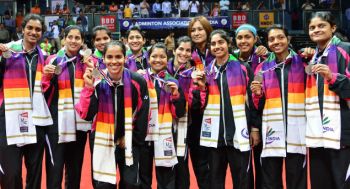
The jubilant Indian women with bronze medals./ Photo: by Sandeep Saxena
In the past four years, women badminton players have brought laurels to the country. Saina Nehwal, P. V. Sindhu and the crack doubles combination of G. Jwala and Ashwini Ponnappa have given India the much-needed identity and a place among the elite nations.
For long, the success story of Indian badminton was associated with the unprecedented achievements of Prakash Padukone and the lone All-England triumph of P. Gopi Chand. Now, there is not much to talk about our men when compared to the feats of our women players. No wonder, when the prestigious Thomas Cup and Uber Cup Finals were hosted by India, only our women’s team was expected to win a medal.
In a format where each tie has five matches — three singles and two doubles — India went in with optimism in two singles and a doubles.
For a nation, that had failed to produce true world-beaters in women’s badminton until 2006, the event was a huge opportunity to showcase India’s worth at the global stage.
With Saina and Sindhu among the world’s elite, having won bronze medals in Olympics and World Championship respectively, India had hoped to make initial headway. With the experienced doubles combination of Jwala-Ashwini looking hungry to make up for the lost time, India was hopeful of claiming the decisive third ‘rubber’ in these best of five match format.
The anticipated, dismal performance of Indian men — losing to Malaysia and Korea in the league — was soon pushed into the background as the women’s team produced a series of consistent performances.
Clubbed with Thailand (headed by World champion Ratchanok Intanon), Hong Kong and Canada, the host gained in confidence by winning every tie.
Saina ended her lean trot to beat Intanon, the Thai girl, who has struggled with fitness and form since winning the World title in August last year.
Saina had not beaten a higher-ranked player since the conquest of World No. 2 German Juliane Schenk in the BWF Superseries Finals in December 2012. Therefore, the 22-20, 21-14 triumph over Intanon was more than just another victory.
Like Saina, Sindhu too won all her five singles. Creditably, the 18-year-old has beaten all three leading Chinese girls — World No. 1 and Olympic champion Li Xuerui, former World champion and World No, 1 Wang Yihan and the reigning Asian Games and All England champion Wang Shixian.
Among Sindhu’s victories, the ones against Indonesia and Japan stood out. The youngster fought match-points in both these matches.
Sindhu bounced back to stop Indonesia’s Bellaetrix Manuputty 21-16, 10-21, 25-23 and returned the following day to overpower Japan’s Sayaka Takahashi 19-21, 21-18, 26-24. In recent times, Sindhu had lost a few three-game encounters. Therefore, these victories should boost Sindhu’s self-belief.
If Saina and Sindhu performed well, no praise is less for the way Jwala and Ashwini combined to give their best against tougher rivals.
Unlike Saina and Sindhu, whose professional needs are taken care of by the Gopi Chand Academy, life is much tougher for Jwala and Ashwini.
Jwala trains under Mohammad Arif in Hyderabad and Ashwini with Tom John in Bangalore. They had to fend for themselves when they had travel to each others’ city for joint training.
Perhaps, these challenges and the adverse times they had faced together in the days leading to the Indian Badminton League (IBL) auction last year, have toughened them. Jwala even fought a legal battle and won a favourable verdict from Delhi High Court against the Badminton Association of India (BAI). So over all, the coming together of these two doubles specialists, who won the National title in December, has helped the country more.
“I think, Ashwini and I are playing better and enjoying our game more than we did before the 2012 Olympics. We will surely improve ahead of the Commonwealth Games, followed by the Asian Games this year,” assures Jwala.
It was against Japan, in the semifinals, that the World No. 36 doubles pair lost its only match to World No. 4 Misaki Matsutomo and Ayaka Takahashi 12-21, 22-20, 21-16. Indeed, it was a gallant performance.
But this loss, after Saina and Sindhu had put India 2-0 up, proved costly. Japan easily won the third singles and the second doubles, where coach Gopi Chand experimented with Saina-Sindhu combination instead of the off-form pair of Pradnya Gadre and Sikki Reddy.
Overall, barring these four players, there is no bench-strength even in women’s badminton as well. India went in with just one plan and lasted as long it worked. All credit to Saina, Sindhu, Jwala and Ashwini for taking India to a historic medal. Will this prove as a catalyst for future medals in team events? Only time will tell.
source: http://www.sportstaronnet.com / Sports Star / Home> Vol.37, No.24 / June 14th, 2014
WELCOME. If you like what you see "SUBSCRIBE via EMAIL" to receive FREE regular UPDATES.
Read More »