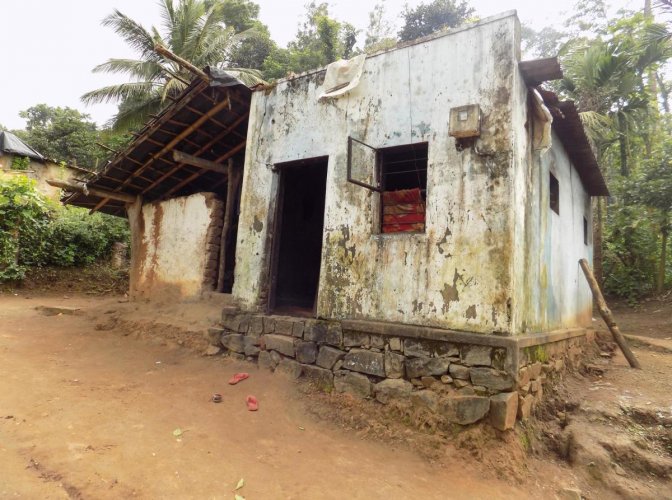
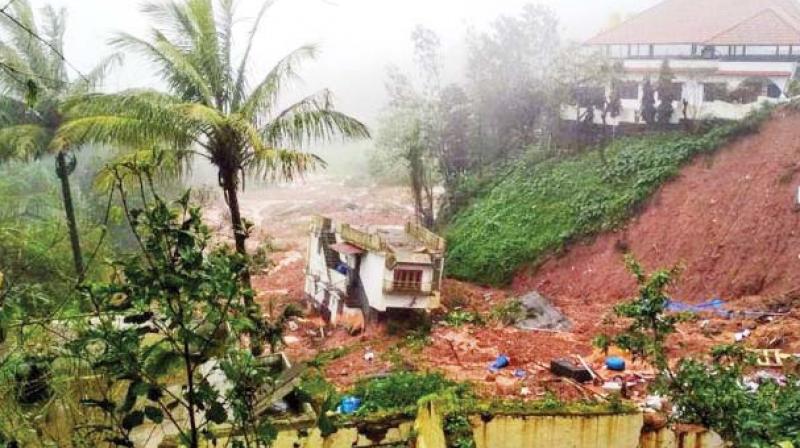
The pathetic condition of a house in the tribal colony at Devarapura in Gonikoppa.
Lack of basic facilities is haunting the Jenukuruba community members at Devarapura tribal colony in Gonikoppa.
The colony is situated between Gonikoppa and Thithimathi with 120 Jenukuruba families and 40 Yarava community families residing in it.
It was during 1988 when Jammada Karumbaiah was the Jilla Parishat president, the government constructed 40 houses with asbestos sheets as the roof for the tribals. Now, the houses are in a deplorable condition and are waiting for a facelift.
The remaining 120 tribal families are still living under thatched roof huts covered with plastic sheet to prevent rainwater from seeping inside.
As the land comes under “Devara Kadu” (sacred grove), the residents are not even issued the title deeds for the land on which they are residing. Hence, they are deprived of basic facilities from the gram panchayat.
The houses neither have electricity connections nor a drinking water supply.
The houses lack toilets. There is no proper road leading to the houses. The children still depend on kerosene lamps for completing their homework. The ITDP department had supplied solar lamps in the past. However, a majority of the lamps are defunct .
“On the ground of the sacred grove land, a landowner has filed a case in the court urging the government not to sanction land for the tribals. Thousands of acres of sacred grove lands in the district have been encroached by the rich. When a poor labourer seeks land to build a house, the government has failed to respond,” said colony leader and DSS activist Jenukurubara Subramani.
Women in the colony have to walk for several kilometres to fetch a pot of water from a water body.
Every year, at least two to three women are trampled by wild elephants while on there way to fetch water. In spite of it, the authorities have failed to initiate measures to supply water to the colony, alleged residents.
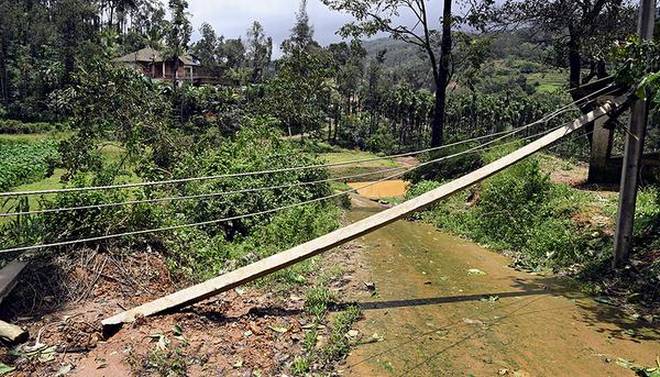
Further, they said the electricity poles were installed with a transformer to supply electricity to the colony five years ago. However, electricity is yet to reach the households.
Without proper road connectivity, the residents also find it difficult to reach the main road in case of an emergency.
source: http://www.deccanherald.com / Deccan Herald / Home> States> Districts / by DH News Service, Gonikoppa / November 27th, 2018
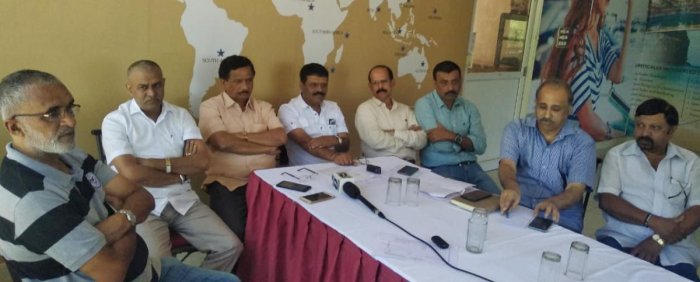
Legislators at a meeting on the implementation of the Kasturirangan report recommendations on the conservation of the Western Ghats.
MLA K G Bopaiah said that habitation area should be dropped from the purview of the ecologically sensitive area (ESA) while implementing the recommendations of the Kasturirangan panel on the conservation of the Western Ghats.
There is time till December 2 to file objections to the draft notification issued by the Ministry of Forest and Environment on the implementation of Kasturirangan recommendations, he added.
Speaking at a meeting organised to discuss on Kasturirangan report on Monday, he said the first draft notification on the recommendations was issued in 2014. The fourth draft notification was issued in the month of October.
Following a stiff opposition from the people living in the Western Ghats area, the Green bench had ordered to collect public opinion in the matter. The people from Kodagu should file objections to the report to ensure that the recommendations are not implemented, he added.
He said that the recommendations are harmful to the farmers as well. If more number of objections are submitted, it will benefit the people of Kodagu district, he said.
He appealed to the gram panchayats, taluk panchayats and zilla panchayats to file objections based on the resolution passed against the implementation of recommendations of Kasturirangan report.
Varadi Anushtana Virodhi Samithi office bearer Nanda Subbaiah said, “The Kerala government had made an on-the-spot verification of the villages falling within the ecologically sensitive areas (ESA) and kept agricultural land, plantations, and habitations out of the purview of the ESA.”
MLA M P Appachu Ranjan, MLC Sunil Subramani and others were present in the meeting.
source: http://www.deccanherald.com / Deccan Herald / Home> States> Districts / by Adithya KA, DH News Service / November 26th, 2018
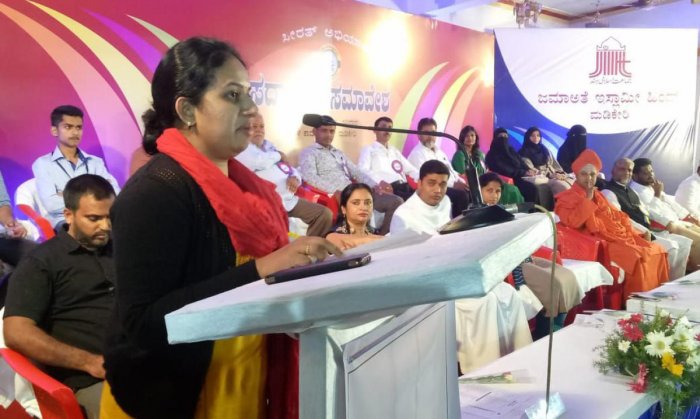
Deputy Commissioner P I Sreevidya speaks at Sadbhavana Convention organised by Jamaat-e-Islami Hind, Madikeri unit, on Saturday.
The volunteers, who took part in the rescue operations during the massive landslides and floods that ravaged Kodagu, are role models for the entire country, said Deputy Commissioner P I Sreevidya.
Speaking at the Sadbhavana Convention, organised by Jamaat-e-Islami Hind Madikeri unit on Saturday, she said volunteers not only took up rescue operations but also lent a helping hand to the district administration.
“As many as 600 victims have been provided shelter at the relief centres by the district administration. The government has been providing facilities to the victims. Members of various organisations are also extending financial assistance and providing relief materials to the victims,” added the deputy commissioner.
Kalancheri Mutt seer Shanthamallikarjuna Swami said that such conventions were essential to foster communal harmony in the society.
As many as 15 volunteers, who were part of the rescue operations, were felicitated on the occasion.
source: http://www.deccanherald.com / Deccan Herald / Home> States> Districts / by Adithya K A / DH News Service,Madikeri / November 25th, 2018
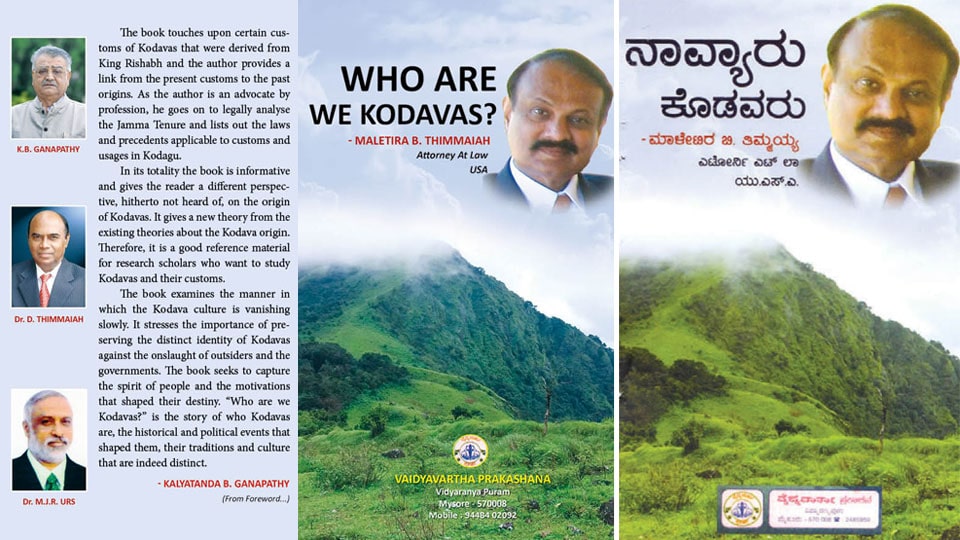
D.M. Trust has organised a function at Rotary Hall on JLB Road here tomorrow (Nov.25) at 5 pm to release the books ‘Who are we Kodavas?’ (English) and ‘Navyaaru Kodavaru?’ (Kannada), written by Maletira B. Thimmaiah, Attorney-at-Law, USA.
Star of Mysore Editor-in-Chief K.B. Ganapathy will release the books. City advocate J.M. Aiyanna will preside. D.M. Trust President Dr. D. Thimmaiah, Joint Commissioner of Commercial Tax, Shivamogga, H.G. Pavithra and Vaidya Vartha Prakashana Founder-Director Dr. M.G.R. Urs will be the chief guests.
Published by Vaidya Vartha Prakashana, the English version of the book has 84 pages while Kannada edition has 80 pages, both priced at Rs.50.
Here we publish the Foreword to the book by Kalyatanda B. Ganapathy, Editor-in-Chief, Star of Mysore and Mysooru Mithra:
This is a book about the people of Kodagu, the land inhabited by Kodavas with their own distinct identity recognised and recorded in history as unique. Written by Maletira B. Thimmaiah, Attorney-at-Law, Staten Island, New York, United States of America, the book traces the origin of Kodavas, their customs, rich history of more than 5,000 years and how a land of such uniqueness was being systematically ravaged by invaders, modern laws and urbanisation thereby depriving the future generations of the rich natural beauty and more importantly the environment.
From time immemorial, Kodavas, with their unique folklore culture, have shown affection, tolerance and respect towards the people who helped them regardless of the communities they belonged to. Showing their gratitude in the form of providing them space and work, Kodavas still regard their guests as God — ‘Athithi Devo Bhava’ and perhaps this attitude has cost them dear when it came to preserving their culture, language and properties.
Supported by extensive research on history, religious books, encyclopaedia, customs and physical features and himself as a member of Kodava community, the author Maletira B. Thimmaiah traces the origin of Kodavas and their customs from ancient times. Kodavas must prepare the future generation to stand tough in defending their heritage against intrusion of outsiders. And to stand firm against outside influence and lobby, each Kodava must know his/ her origin, he writes.
According to the author, the first advent of human habitation in Kodagu is prior to 3000 BC. Rishabh, a ruler from Magahada, abdicating the throne as King of Ganges Valley Civilisation, shared his kingdom among his 100 sons, renounced everything and travelled to Kodagu, then called ‘Kutaka’ in Sanskrit and named it ‘Kudaga’ in ‘Pali’ and other South Indian languages called ‘Prakrits.’
While the first son of Rishabh named Bharat ruled northern half with Ayodhya as capital, the second son Bahubali ruled the South with Paudanapura as capital. The rest of the 98 sons of Rishabh were given different kingdoms. The final fight between Bharat and Bahubali took place in the south and the battle resulted in Bahubali renouncing his kingdom. Later, all the sons of Bahubali went to Rishabh who lived in ‘Kutaka’ for advice. This was how an uninhabited Kodagu became the place to live for North Indian Ganges Valley people.
According to the author, Rishabh believed in ‘Shramana’ school of thought that did not have God, Soul and Creation and where the philosophy of procreation dominated — human being is procreated by his parents and in turn, parents were procreated by their parents. Thus ancestors were the reason or ‘Karana’ (cause) for the continuity of generations to generations. Explaining this theory, the author draws similarities with Kodava customs where families still worship the ‘Karana’ and ‘Gurukaranas’.
The book then touches upon Hinduism and argues how Kodavas do not belong to Indus Valley Civilisation but Ganges Valley Civilisation. Elder-oriented or elder-centric customs and practices existed in Kodagu before the advent of Hinduism to India. Priests were not involved in Kodava traditions in any manner with a major role played by elders or village ‘Thakkas’. Brahmins had to work under the ‘Thakkas’ and they did not have any supremacy. As such, Brahmins felt belittled and ignored. Hence they considered Kodavas as descendants of Kroda King, born to a ‘Shudra’ woman who was low in caste (according to Hindu caste system) and was unchaste. They called Kodavas as ‘Ugras’ and said the name Kodava was derived from Kroda king.
The book argues that this was the revenge of Brahmins or the priest class against Kodavas who did not allow them to their ‘Ainmanes’, ‘Kannikombare’, ‘Kaimada’, festivals, marriages and other auspicious ceremonies.
The author then traces Lingayat religion and kings who influenced Kodavas. Kodavas were pitted against Kodavas. They killed each other while the Lingayat Rajas watched the fun. Then came Islamic invasion led by Hyder Ali and Tipu Sultan where Tipu converted a large number of Kodavas into Islam and massacred those who did not comply with his orders.
Next came the Britishers who introduced coffee. They tricked Kodavas to part with their Jamma lands to cultivate coffee and institutions like “Consolidated Coffee Estate” was born. The book describes how the British exploited Kodavas to serve their own interests in India and world over. The physical strength and bravery of Kodavas were well used by the British and moved many Kodavas from paddy fields to war fields. While a few got acclimatised, many Kodavas died unnoticed and unsung. The British even imposed heavy land revenues and brought in land laws for their advantage. Some of the unjust and illogical regulations introduced by the British continue even today even after Kodagu State was annexed into Karnataka.
After the British rule, the elected governments, with ignorant and self-centred lawmakers, brought in more restrictive laws without understanding the ground realities. This was done with no representative from Kodagu while framing such rules. Many land laws have been questioned in the Court of Law. The book illustrates how Kodagu has become a looting place for outsiders since independence. The laws enacted by Karnataka government like Land Revenue Act, Forest Act, Management of Reserved Forest Rules and land tenures have dealt many fatal blows to Kodava customs, traditions and land holdings, says the author.
The book touches upon certain customs of Kodavas that were derived from King Rishabh and the author provides a link from the present customs to the past origins. As the author is an advocate by profession, he goes on to legally analyse the Jamma Tenure and lists out the laws and precedents applicable to customs and usages in Kodagu. Probably the author is unaware of the fact that Jamma tenure is no longer existing since 2011 following an amendment to the Karnataka Land Revenue Act, 1964.
In its totality the book is informative and gives the reader a different perspective, hitherto not heard of, on the origin of Kodavas. It gives a new theory from the existing theories about the Kodava origin. Therefore, it is a good reference material for research scholars who want to study Kodavas and their customs.
The book examines the manner in which the Kodava culture is vanishing slowly. It stresses the importance of preserving the distinct identity of Kodavas against the onslaught of outsiders and the governments. The book seeks to capture the spirit of people and the motivations that shaped their destiny. “Who are we Kodavas?” is the story of who Kodavas are, the historical and political events that shaped them, their traditions and culture that are indeed distinct.
‘Who are we Kodavas?’ by NRI Kodava to be released in city tomorrow
source: http://www.starofmysore.com / Star of Mysore / Home> News / by November 24th, 2018
In Kannada, we have a proverb that can be loosely translated as “giving one’s hands and cuff too”. It indicates a situation where one unwittingly lands in a predicament due to one’s own mistake. We have several proverbs in Kannada that convey the same meaning, one even suggesting inviting a passing by ghost to come in and have a feast. (Beedeel hogo marina manege karedante)
A letter written by senior author S L Byrappa to the Chief Minister suggesting that Karnataka should seek help from Tamil Nadu to rebuild flood-ravaged Kodagu can best be described thus – inviting trouble. His reasoning is that since Tamil Nadu is the “biggest beneficiary” of Cauvery water and as the river originates at Talakaveri in Kodagu, it should contribute in a big way to rebuild Kodagu.
If all were well with Tamil Nadu, Karnataka could have asked for help, but TN has never tried to hide its exaggerated claims on Cauvery water. Even when Karnataka reels under famine, resulting in a large number of farmers committing suicide, our neighbour is unmoved and holds on to its demand for Cauvery water. Now, if the State seeks help from TN and if it agrees and does give funds, then TN will declare all the more brashly that the river “belongs” to it. A previous example is the Mulle Periyar dam, which is in Kerala but TN ‘owns’ it as a result of an agreement made more than a century ago, during British rule.
If we go ahead, Karnataka will be forced to give up its right over the river and when the Tamils claim ‘Cauvery belongs to us’, Kannadigas will not have grounds to debate the claim.
Interestingly, S L Bhyrappa made this suggestion to ask TN for help recently at a special lecture series on “Current social and environmental affairs of India” at BM Sri Hall, at Manasagangotri, Mysuru. The lecture was jointly organised by H M Nayak Foundation and Kuvempu Institute of Kannada Studies. Now, all the four names associated with the lecture program – B M Srikantaiah, H M Nayak, Kuvempu and Manasagangotri – have strived all their lives for the betterment of Kannada, Karnataka, its culture and natural resources.
B M Srikantaiah’s inspiring speech 100 years ago about the lack of pride in Kannadigas and how it is the need of the hour to kindle pride and honour among Kannadigas is evergreen. Kuvempu would never agree to beg a neighbour to safeguard the State’s interest. He was instrumental in starting Manasagangotri at Mysuru and shifting the post graduate centre from Madras. Though he completed his MA in Kannada from Presidency College, Madras, he insisted that the Mysuru State required its own university. Definitely, he would not have approved of begging TN for help, as wouldn’t any other proud Kannadiga.
The TN government has consistently been in a position of advantage with regard to Cauvery water. To suggest that Karnataka seeks help from TN can only be described as suicidal and nothing short. Let us all chip in and rebuild Kodagu.
Then, there is another suggestion to build a huge statue of Cauvery and develop a Disney Land kind of amusement park at KRS dam. Who gets such ideas or who gives such ideas to the government? What is the need for it? Experts are slamming the idea saying it will be dangerous for the dam. Also, in the river/dam basin only irrigation /water storage activities must be carried out instead of indulging in amusement parks to attract tourism. Hence, the government should abandon the ideas of a statue and ‘Disney Land’ at KRS dam.
The statue culture, which Tamil Nadu defined some decades ago, is diminishing. The Statue of Unity is out of the purview of this debate as is the one of Mayawati. Now, a huge statue of Rama is being planned, which is altogether a totally different debate. A river takes its birth in a small way and then expands. The same is seen with Cauvery. Why should we have a huge statue of Cauvery? The one that is already there at KRS is small, beautiful and is being worshipped regularly. That is enough.
source: http://www.bangaloremirror.indiatimes.com / Bangalore Mirror / Home> Opinion> Others / by Pratibha Nandakumar, Bangalore Mirror Bureau / November 19th, 2018
840 people who lost their homes have been identified. Kodagu during the flood (Representional Image)
Mysuru:
The Kodagu administration, which has identified land to build houses for 840 people, who lost their homes in the district’s floods and landslides in August this year, is getting ready to form layouts on it with all basic amenities including roads, electricity and water connection for their benefit.
According to Kodagu additional special deputy commissioner, M K Jagadish, a Rs 31.63 crore proposal has been sent to the state government to form the layouts with 373 sites in five places to begin with. Experts of the Geological Survey of India have already assessed the land identified.
While three private companies have come forward with model houses, the state government has not yet chosen one or the company for building them. “Chief Minister H D Kumarswamy has suggested we build two bedroom houses,” the officer added.
The state government, which has decided to give Rs 50,000 to each displaced family until the houses are built for them, has released Rs 6 crore towards this and the process of distribution was underway, the officer said.
While as many as 524 people have lost their houses in Madikeri taluk, 205 have been made homeless in Madikeri town, 88 in Somwarpet taluk, and 23 in Kushalnagar town. Of them 98 have decided to build houses on their own land. The land identified by the government has already been levelled, and 30 x 40 sites will be marked on it from November 2.
While most victims of Kodagu’s rains and floods have returned home, 683 still remain at seven relief camps in the district.
source: http://www.deccanchronicle.com / Deccan Chronicle / Home> Nation> Current Affairs / by Shilpa P / Deccan Chronicle / November 01st, 2018
A file photo of the damage caused by the floods in Kodagu. | Photo Credit: G.P. Sampath Kumar
It will expedite rehabilitation and reconstruction works in district
Chief Minister H.D. Kumaraswamy has announced the formation of the Kodagu development authority to enable speedy reconstruction of the district, parts of which were ravaged by floods and landslips this August.
He was interacting with the affected people at Gandhi Maidan in Madikeri on Wednesday. Mr. Kumaraswamy said he received memorandums from the people to constitute a separate authority and found merit in the suggestion. “An authority under the chairmanship of the Chief Minister will be constituted to expedite the relief and rehabilitation work in Kodagu,” said Mr. Kumaraswamy.
The Chief Minister also said the educational expenses of children affected will be entirely borne by the government while emphasis will also be on restoration of schools and colleges that were damaged during the natural calamity.
In addition, emphasis will be on restoration of farm land, including plantations, for which staff from other districts too will be deployed or posted to agriculture and horticulture departments. He said the State government had released ₹127 crore for the rehabilitation works in the district so far.
There were nearly 800 families who had lost their houses and the government will release ₹10,000 per month towards house rentals as a temporary measure. Each family that has been bereft of its property will receive ₹8.53 lakh as compensation and the reconstruction of houses will be taken up quickly, he added.
The objective of the interaction programme was to infuse confidence among the victims and elicit their views and expectations from the authorities. Mr. Kumaraswamy said he will visit the district again to review the rehabilitation.
source: http://www.thehindu.com / The Hindu / Home> News> States> Karnataka / by Special Correspondent / Mysuru – October 18th, 2018
We head to where the beans grow in India to discover the country’s nuanced flavours.
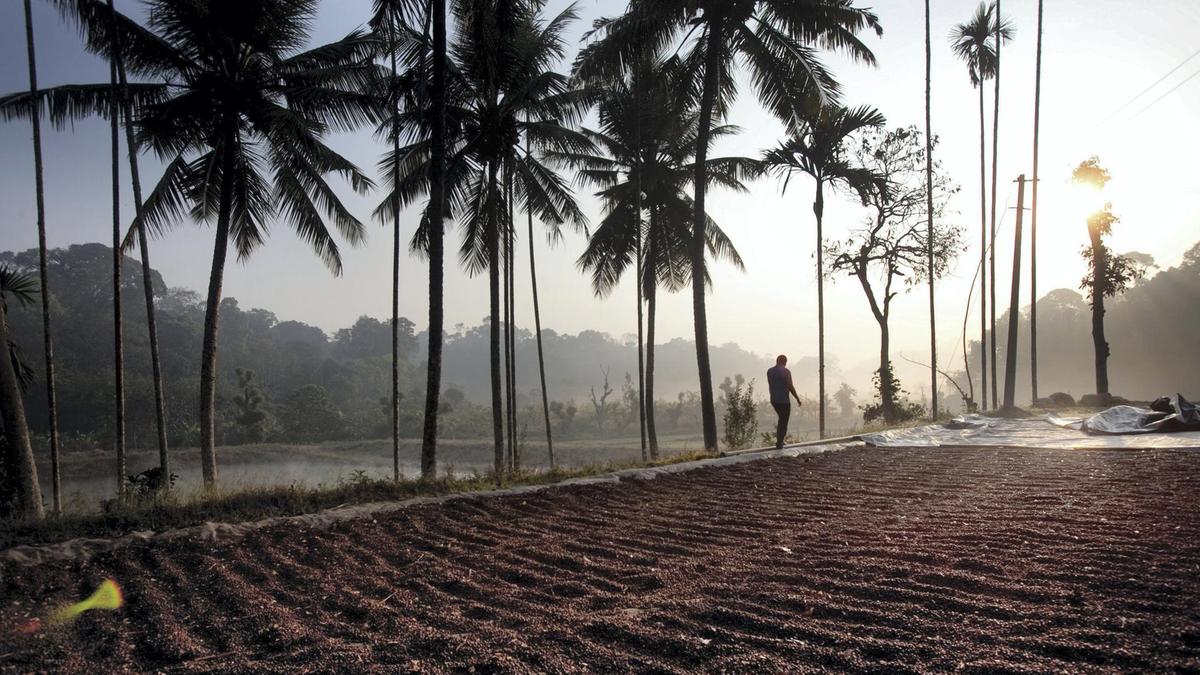
Coffee berries left out for dry processing on a farm in Coorg, India. Bloomberg
It is still early in the evening, with a few hours to go before sunset, but all I can see outside is the swirling mist. When I had checked into at my resort a few hours earlier, the view from the balcony of my room was a lush carpet of green. Now, it’s white blanket. But I am not surprised. After all, this is Coorg, in south India, and I’m visiting during monsoon months, when the fog sweeps over as soon as there’s a break in the rain.
The scenery on my way from Bangalore changed dramatically once I entered the area; crowded highways turning into narrow lanes and commercial activity making way first for emerald paddy fields and then undulating hills dotted with seasonal waterfalls and sprawling plantations. It is obvious that Coorg is a blessed land; a variety of spices growing with abandon across this tiny region – pepper, cardamom, nutmeg, clove and even honey. The undisputed star of Coorg, though, is coffee.
Known in the local language as Kodagu, Coorg is part of the region in south India where coffee first arrived in the country. Legend has it that Sufi saint Baba Budan was delighted when he discovered coffee during a pilgrimage to Makkah, sometime in the 17th century. And on his way back, via the port of Yemen, he hid a few beans in the folds of his robes. As celebrated novelist R K Narayan wrote in his book A Storyteller’s World, “The origin of Indian coffee, thus, is saintly. It was not an empire builder or a buccaneer who brought coffee to India but a saint, one who knew what was good for humanity.”
“Indeed, he did,” I think, as I sip on the frothy brew at the coffee shop of The Tamara resort the next morning. Located within a functioning organic coffee plantation, the property is proof of how easily coffee travelled from Baba Budan’s base in the town of Chikmagalur to nearby Coorg, and how well it flourished in the wet, hilly landscapes there. The Coffee Board of India estimates that more than 70 per cent of the country’s beans are grown in Karnataka, almost entirely in Chikmagalur and Coorg, and are used for both domestic consumption and exports to Europe.
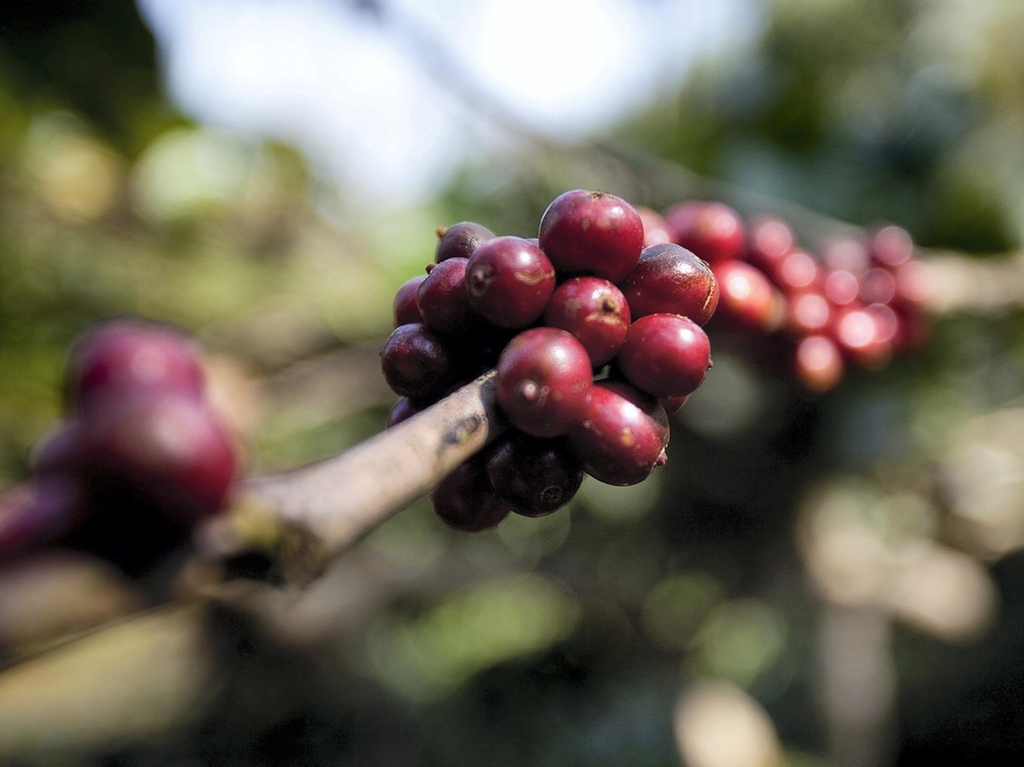
he fresh fruit that bears the beans. Bloomberg
The cup is my reward at the end of a two-hour walk through the coffee estate with Sareesh Kumar, the resident naturalist who seems to know the names and qualities of practically every plant on the trail. The rain has let up for the morning, and I am exhilarated by the hike through a thick canopy of silveroak and rosewood trees with pepper vines snaking around their tall trunks. Sunlight barely filters into the Arabica and Robusta shrubs all along the path, and the air is crisp and refreshing.
Kumar extols the moody nature of the coffee plant that demands great care and attention along with shade, and describes the taste differences between a brew made from Arabica and Robusta beans. I listen to him with half an ear as I lean towards the plump fruit in the vain hope of smelling coffee. He smiles at my enthusiasm, saying the berry has a long way to go before it reveals its true colours, or in this case, aromas and flavours.
And then it’s quiz time: “What does the coffee flower smell like?” he asks me. I know enough by now not to say “coffee” but I take a lame stab at the response anyway. It turns out, it’s jasmine. That’s what the sneaky coffee flower smells and even looks like.
It is an easy walk, with caterpillars and leeches, parakeets and hornbills, waterfalls and streams for company all the way. Before we know it, we fetch up in front of the small cafe that doubles as souvenir shop. It’s time for the “Blossom to brew” lesson. I learn to select, roast and powder my own coffee beans. Ah, finally, that aroma I have been dreaming of. And then I get to make my own drink. The south Indian in me can allow nothing other than local filter kaapi (a strong drip decoction lightened with hot milk and sugar) and I sit back to enjoy what I consider my personal blend.
On my way back home, I take a detour for a slice of Tibet. Bylakuppe is the second-largest hub – after Dharamshala – for Tibetan monks in India who followed in the footsteps of their spiritual leader, the Dalai Lama, some 60 years ago.
The cluster of monasteries, stupas and residential areas (divided into old and new Camp) was built in the early 1970s on land given as a gift to the community by the king of Mysore. The most famous of these temples is the Namdroling Monastery with its golden roof (it’s also known as the Golden Temple), that beckons to visitors from a great distance. Turning off the main road, we drive through dusty lanes where the only colour is that of prayer flags fluttering in the morning breeze and the maroon and yellow robes of monks walking in small groups or riding their motorbikes with great style.
A monastery in Bylakuppe, a hub for Tibetan monks in India. Charukesi Ramadurai
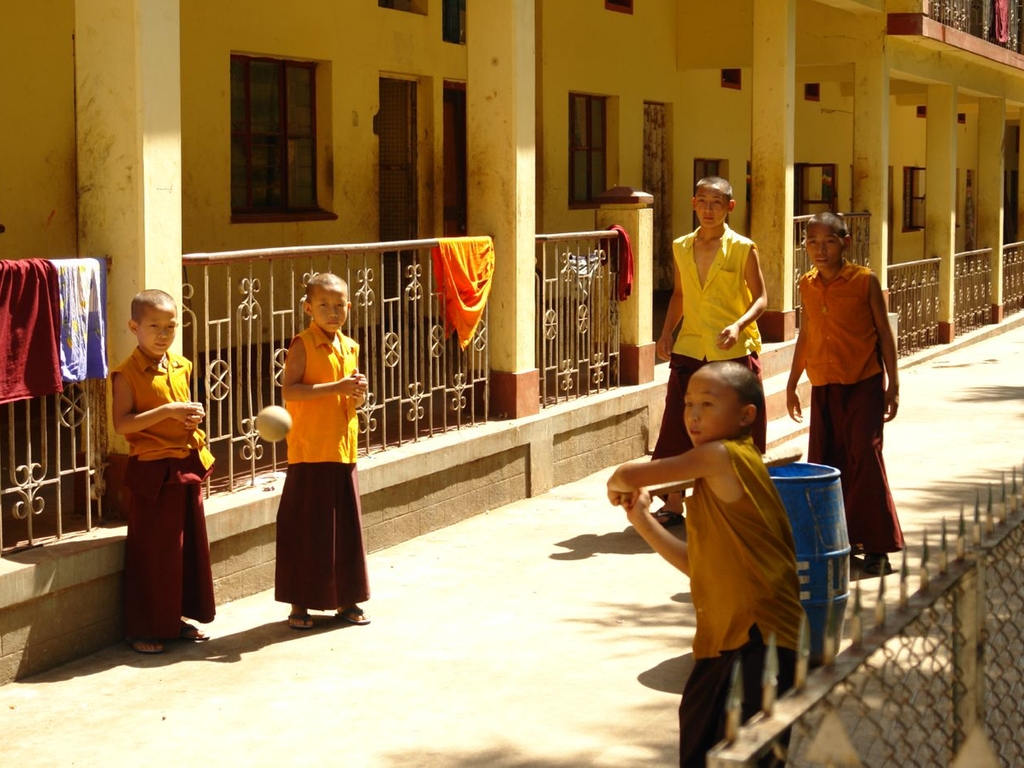
While the tourist crowds throng the premises of the temple, taking photographs from all angles, bargaining raucously with local vendors and arguing over where to find the best thukpa and momos in the neighbourhood, it is a completely silent tableau inside. There are three gigantic gilded statues of Buddha, in his states as Shakyamuni, Padmasambhava and Amitayus. On one side of the room, I spot a row of monks poring over their scripture books and chanting in low tones. On my walk around the monastery, I come across another group of monks – young, barely in their teens – engaged in a boisterous game of cricket. I realise then that this Tibetan community here is much like coffee itself: both are settlers from another country who have made Coorg home.
Of course, there is more to Coorg than coffee. History residing in the old temples and ruined forts near the town of Madikeri and adventure that ranges from easy treks to canoe rides all over the region. Then there are the popular picnic spots like the perennial Abbey Falls, the Dubare Elephant Camp and the Talacauvery shrine, from where the River Cauvery (held sacred by locals) originates.
But I ignore all these attractions to stay put in my room, watching the clouds play hide and seek with the green hills.
source: http://www.thenational.ae / The National / Home> Lifestyle> Travel / by Charukesi Ramadurai / October 18th, 2018
Foraging has long been a way of life for wild-food loving Coorg
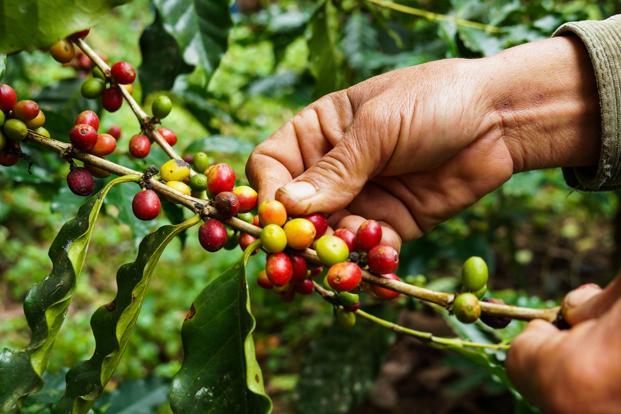
Coffee-picking at an estate in Coorg. Photo: iStock
René Redzepi, the foraging genius who stormed the culinary world with his New Nordic cuisine, would have a lot to smile about in Coorg. Here foraged ingredients don’t just put in an occasional appearance but are the main attraction, making Coorg an interesting region for true-blue wild-food pioneers. The eastern declivities of the Western Ghats that make up Coorg are extensively clothed in forests. Shade-grown coffee plantations offer the ideal habitat for rare flora and fauna to thrive as do sacred groves or devakads, designated as protected forests under the Indian Forest Act.
Against this backdrop is a staggering bounty of indigenous greens, weeds, flowers, fruits, berries, nuts, mushrooms and shoots, many of which play a starring role in the local cuisine.
Gazetteer Of Coorg, first published in 1870, devotes reams to Coorg’s jungle bounty: wild pepper, wild ginger, wild cloves, bitter local oranges known as kaipuli, rose apples, jungle mangoes, bastard sago—esteemed for its toddy—hog plums, several kinds of bamboo shoots, and an alphabetical list of over 60 ferns.
Locals keep their eyes open to what’s growing around them, constantly sizing up culinary possibilities. Freshly plucked cape gooseberries go into jams, a tangle of greens are added to stir-fries, and fronds of tender bracken ferns get pickled and ground into chutneys.
Kaveri Ponnapa, author of The Vanishing Kodavas, says in one of her earlier articles on Coorg: “Most women of my mother-in- law’s generation who lived on coffee plantations never set out on a stroll without the equivalent of the Russian avoska, the ‘maybe’ or ‘perhaps’ mesh bag—you never knew what surprise the season would throw your way.”
Several ingredients are unique to these parts. Like kachampuli, the dark vinegar made from the concentrated juice of the garcinia gummi-gutta fruit (called panapuli locally), which adds a sour kick to pork and fish dishes. And the famous Coorg honey, made from wild roses and forest blooms, which locals drizzle on akki ottis or rice rotis, and eat with ghee for breakfast.
Naveen Alvares, executive chef at Evolve Back Chikkana Halli estate, attributes this love of indigenous ingredients to Coorg’s unique geography and culture. “Kodavas, who make up most of the population, are ancestor worshippers and eat what is available off the land. Most have a plantation background or a sacred forest, so the connect with the land is very strong,” he says.
Walking through the resort’s lush plantations, among the oldest in Coorg, I see the coffee-forest symbiosis in full bloom. Coffee bushes sit beneath a canopy of silver oak trees that support festoons of black pepper. Ginger and turmeric, planted for intercropping, dot the forest floor. Jackfruits hang from trees. You can hear red-whiskered bulbuls chirruping.
Several exotic edibles are to be seen, many of them unconventional in the Indian context. As I stop to admire the bizarre artistry of a passionflower, Alvares smiles, “This is what makes Coorg special. It’s wildness.”
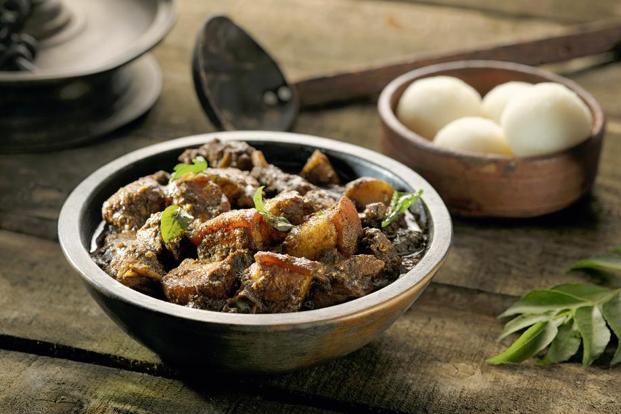
Dinner is a knockout pandi curry. The dark colour and complexity of this most iconic of Coorg pork dishes derives from dark roasted spices and kachampuli, a souring agent Alvares clearly loves.
I drive down from Siddapur to Madikeri the next day. The hour-long journey is jawdroppingly scenic. Acre after acre of coffee plantation presents itself, occasionally punctuated by the whoosh of a waterfall or the brilliant blue of a kingfisher.
A treasure trove of mushroom diversity, the Western Ghats are home to 750 species. Edible fungi known as kummu grow wild on Coorg’s hills and are highly prized for their exotic flavour. Vancouver-based blogger Shalini Nanda Nagappa mentions several varieties in her blog, A Cookery Year In Coorg—“feathery, delicate nucchi kummu and kokkalé kummu, succulent aal kummu, the giant nethalé kummu,..and the decidedly meaty pandi kummu.”
Only locals who carry with them an intimate knowledge of when, where and how to harvest the edible varieties can procure them, Nagappa points out. As a result, these treasures rarely make it to local markets and remain confined to the kitchens of plantation owners and local villagers.
‘Pandi curry’ at the Evovle Back resort.
The pleasures of kummu elude me during this visit, but I do feast on other Kodagu treats at Coorg Cuisine, a popular local restaurant in Madikeri. My lunch companion is M.B. Kumar, a Madikeri-based Kodava agriculturist and plantation owner. The wild mango curry, made with small jungle mangoes or kaad maange and black jaggery, is by turns sweet, sour and peppery. It’s unlike anything I’ve ever tasted. Chewing on a mango kernel, it is love at first bite.
The smoked pork, known as chillkana pandi, packs a meaty savouriness, while the freshness of the forest pervades a bowl of lightly fermented and sauteed baimbale or bamboo shoots. There’s pandi curry, of course, intensely flavoured and addictive as always. And akki ottis and kadumbuttus (rice balls) to mop it all up with.
To put pork’s near sacred place in Coorg’s cuisine in context, Kumar narrates a colourful legend. When Parvati expressed a desire to see Arjuna’s back (the great warrior never showed his back—a sign of weakness—during war), Shiva disguised himself as a hunter and shot a wild boar that Arjuna’s arrow had pierced. An altercation followed. As Arjuna fell over his opponent, his back was revealed, granting Parvati’s wish. A shower of flowers fell from the heavens and the pork was distributed as prasad to the hunting party.
The yarn illustrates the extent to which Coorg’s geographical seclusion has shaped its unique cuisine. “While we Coorgs (Kodavas) treat pork as prasad and offer it to our ancestors during rituals, it would be considered blasphemous to go anywhere near pork in neighbouring Mysuru,” Kumar laughs.
As we eat, Kumar draws my attention to the age-old tradition of foraging for monsoon greens, known as thoppus in Coorg’s interiors. The repertoire of seasonal weeds is dazzling. Thatte thoppu has a slightly bitter taste but tastes delicious with akki ottis and a little ghee; kakke thoppu with its purplish-black fruit is effective in deworming; therme thoppu or bracken ferns taste good simply sautéed with onions and pair divinely with eggs.
During mid-monsoon, on the 18th day of a period known as kakkada, Kodavas pick the leaves of a wild plant called madd thoppu and extract its juice to make a payasam.
The bustling Friday market in Madikeri is chock-full of these supergreens and more. Kembe (colocasia leaves) and kaipuli are up for grabs as are spices and meat. Walking around, it becomes abundantly clear that Kodavas are not just master harvesters, they’re also skilled at altering foodstuffs for preservation by yeast and bacteria. A huge assortment of jams and pickles made from the spoils of the land lines the local stores. Everything is home-made and unbranded.
On my last morning in Coorg, I drop in at Coorg’s Progressive Beekeepers Co-op Society store and pick up a bottle of wild honey to take back home. As I make my way to Bengaluru to catch my flight, the resinous, sour-sweet taste of kaad maange lingers on my tongue.
Wild foods, which grow in their natural habitat without fertilizers or pesticides, don’t deplete the earth’s resources. And they taste incredible. What if we, like Kodavas, thought of the forest as our pantry? Let’s tap into our vast underutilized permacultures and support the foragers who gather these ingredients. Let’s showcase our native treasures at the finest restaurants through dishes that startle with their newness and intensity.
Let’s go wild.
source: http://www.livemint.com / Live Mint / Home> Leisure / by Sona Bahadur / October 21st, 2018
With donors from across the state contributing to CM’s Relief Fund, exclusively released to Kodagu district, over Rs 62 crore has been collected as on September 20.
Madikeri :
Following the natural disaster in Kodagu district, the numerous families that had lost houses and other properties were handed over Rs 3,800 – Rs 1,800 for clothing and Rs 2,000 for utensils and other household goods (per family)- under SDRF/NDRF guidelines.
Since the damage has been severe and the process of permanent rehabilitation will take some more time, the district administration including Deputy Commissioner Sreevidya P I and Kodagu District Minister Sa Ra Mahesh had proposed a request to the State government to increase the amount from meagre Rs 3,800/- per family to Rs 50,000, in a letter dated 28 August.
While the State and National Disaster Fund guidelines do not allow any changes to be made to the gratuitous funds, the state revenue department had stepped into people’s aid and had forwarded the proposal of releasing Rs 50,000/- each for the distressed families from the Karnataka Chief Minister Relief Fund-Natural Calamity 2018. The proposal, which was forwarded to CM H D Kumaraswamy was later forwarded to the Cabinet Committee for approval, which has now been sanctioned.
With donors from across the state contributing to CM’s Relief Fund, exclusively released to Kodagu district, over Rs 62 crore has been collected as on September 20. As many as 1,156 families have been directly affected by natural disaster and 186 houses have been damaged completely, 530 houses have been damaged severely and 404 houses have undergone partial damage.
While Rs 320 crore has been allotted to Karnataka under SDRF, an additional state fund of Rs 400 crore is provided to the state.
source: http://www.newindianexpress.com / The New Indian Express / Home> States> Karnataka / by Express News Service / September 22nd, 2018
WELCOME. If you like what you see "SUBSCRIBE via EMAIL" to receive FREE regular UPDATES.
Read More »