Category Archives: Business & Economy

A purposeless power-line via Kodagu to Kerala

‘A case of spending money to benefit contractor, bureaucracy and politicians’

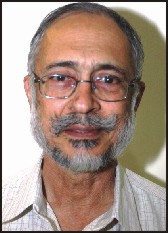
The following is the text of a talk delivered by Maj. Gen. S.G. Vombatkere (Retd.) at a meeting held at Kodava Samaja, Ponnampet, South Kodagu, on Tuesday, 21st Oct. 2014.
MajGenVombatkereKF02nov2014

by Maj. Gen. S.G. Vombatkere (Retd.)

Sri S. Gopal, dignitaries on the dais, Members of Kaveri Sene and Coorg Wildlife Society, and members of the august audience, I thank you for giving me this opportunity to say a few words about the 400 KV Double Circuit (D/C) HT line connecting Mysore with Kozhikode.

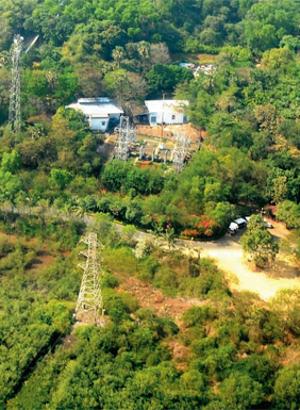
The 210-km 400 KV Double Circuit HT line connecting Mysore with Kozhikode is under construction by Power Grid Corporation of India Limited (PGCIL). It is said to be required to evacuate electric power generated by Kaiga Nuclear Power Station to supply North Kerala.

PGCIL claims that of 210-km, about 92-km in Kerala’s Wayanad District and about 63-km in Mysore District is completed, and 55-km through Kodagu District remains to be constructed. This “remaining” portion in Kodagu District is being opposed by the people of Kodagu, spearheaded by Kaveri Sene and Coorg Wildlife Society on grounds of environmental destruction that will adversely affect the Kaveri watershed which is the source of life-giving water to Karnataka and Tamil Nadu.

Also it will ruin coffee plantations due to tree-felling and intensify the human-animal conflict especially related to elephants, which is already claiming human lives in Kodagu. The objections of the Kodava people to this project are not new, but are several years old. I will speak on this issue and ask some questions concerning technical, environmental and governance matters.

Technical questions

Let us first examine whether this 400KV HT line is at all required. As on date, there are seven HT lines supplying power to Kerala, five from Tamil Nadu and two from Karnataka. These seven lines have a total capacity of 3,000 MW while the share of Kerala from the national grid is only 1,000 MW. Further, although the energy share of Kerala from the national grid is 9,350 Million Units (MU), Kerala is drawing about 11,350 MU from the existing seven HT lines. This shows that the existing seven HT lines are more than adequate for Kerala’s power needs from the national grid, and the proposed 400KV D/C HT line is not at all required.

Thus the question arises as to why PGCIL has constructed 155-km when the project is not necessary and also when the 55-km segment within Kodagu District is facing objections from the people of Kodagu. The environmental and social costs of the project have obviously not been taken into account.

Karnataka State officials have deposed before the National Green Tribunal (NGT), stating that the objections of Gram Sabhas are “belated,” “motivated” and are an “after-thought.” These statements are uncalled for, and show the dismissive attitude of officials towards simple people. The objections may be “belated” because village people did not get to know about the PGCIL project earlier. And if the village people are “motivated” in objecting to the project, their motivation is in preserving the environment which is a vital watershed for South India, saving their own coffee plantations which are their livelihood, and trying to mitigate the growing human-elephant conflicts. Thus, the question arises as to why our own officials have this attitude towards projects.

The 90-paise “disease”

The fact is that even though all officials are not corrupt, many officials are interested in getting large projects sanctioned and executed because a good portion of every rupee of public money spent does not go towards the project work but gets diverted into private pockets. When Rajiv Gandhi was the PM, he had estimated that 80-paise in the rupee went astray. Now, decades later 90-paise, possibly more, would be seen vanishing if an honest, transparent audit were to be made. When a project is estimated at Rs. X crores, X-crore 90-paise portions vanish. Some people indelicately refer to such standard practice as corruption. But if at least the project was a genuine requirement and was executed with quality and in time, one could still wink at the corrup… oops, sorry, the vanishing 90-paise. And this 400KV HT line is an unnecessary project as has been shown earlier.

Environment and Governance

The felling of trees in forest areas and in coffee plantations is harmful to the environment. PGCIL argues that felling a “mere” few thousand trees may not harm the environment. But this argument fails to address the cumulative effect of felling trees for different projects of roads, HT power lines, etc., in the Western Ghats which is an “eco-sensitive hot-spot” in India and even in the international context.

The Ministry of Environment, Forests and Wildlife (MoEFW) is busy giving clearances to any and every project and weakening the Environment Protection Act. When Article 48A of the Constitution reads, “The State shall endeavour to protect and improve the environment and to safeguard the forests and wildlife,” this attitude of MoEFW is condemnable.

The cumulative effect of this deforestation, especially in special regions like the Western Ghats and in particular Kodagu, is not at all a consideration for MoEFW, in the country’s mindless rush towards industrialisation at the cost of environmental destruction.

Kodagu District is special in two ways. One, its famed soldiers protect our country as a fundamental duty, in accordance with Article 51A(d), to defend the country. And two, its people are saving the source and vital watershed of Kaveri, and performing their fundamental constitutional duty “to protect and improve the natural environment including forests, lakes, rivers and wildlife” in accordance with Article 51A(g), doing what MoEFW should be doing but is actually doing the opposite. For all this, we all need to salute the people of Kodagu.

When the State, consisting of the Executive, the Legislative and the Judiciary, fails the People, the people have to resist and uphold the Constitution of India. In opposing this 400 KV Double Circuit HT line, we are performing our fundamental constitutional duty. Let us join together to do our duty!

Jai Hind!

source: http://www.starofmysore.com / Star of Mysore / Home> Feature Articles / Tuesday, October 28th, 2014
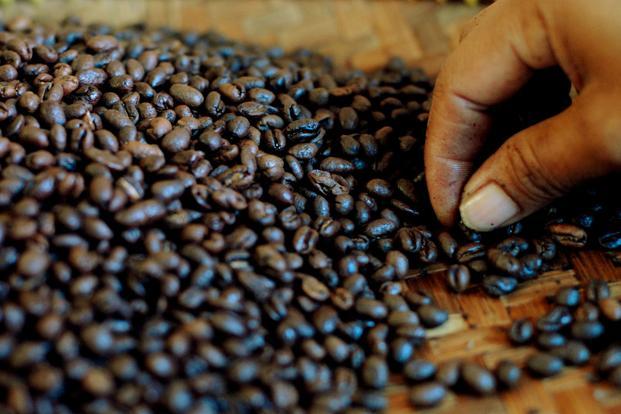
Coffee prices get a Brazilian boost

International coffee prices rose sharply this week, as fears resurfaced that Brazil’s crop could get adversely affected by a drought

A thin harvest may be bad news for Brazil but is good news for growers in other countries. Indian coffee producers are seeing firm crop trends in 2014-15. Photo: Bloomberg

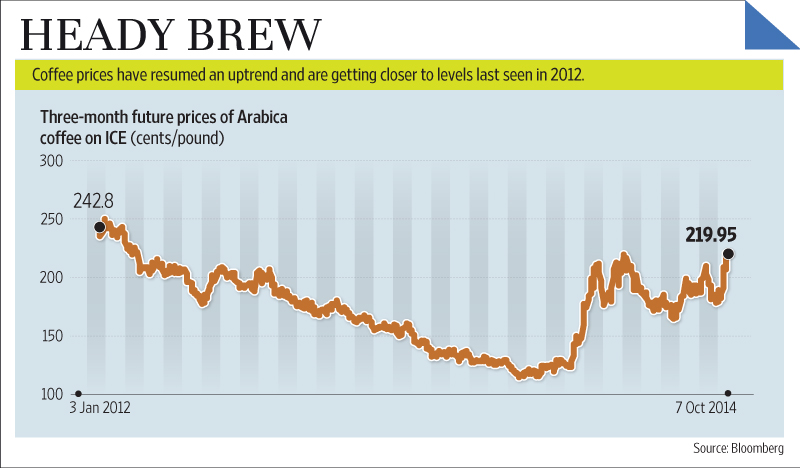
International coffee prices rose sharply this week, as fears resurfaced that Brazil’s crop could get adversely affected by a drought. This comes just a fortnight after Brazil’s agricultural organization Conab released its September estimate, which had assuaged market fears and even saw prices drop.

But on Monday, the three-month forward Arabica coffee contract rose by 9.2% intra-day, according to The Wall Street Journal, and closed the day with a gain of 6.9%. This marked a two-and-a-half-year high for this contract. On Tuesday, its level was unchanged. If the news on the weather from Brazil continues to support higher prices, then this uptrend could be sustained. But recent months have seen volatile price movements; so, there is risk of a reversal, too.

GraphKF15oct2014

The International Coffee Organization’s price data show the prices of all grades of Arabica coffee have moved up, in sync with Brazil. Though Brazil’s effect is felt more by the Arabica variety, even the lower Robusta grade has perked up in October. It has recovered losses sustained in September.

A thin harvest may be bad news for Brazil but is good news for growers in other countries. Indian coffee producers are seeing firm crop trends in 2014-15. The country’s coffee crop is estimated to increase by 13.2% to 344,750 tonnes. The Arabica crop is expected to increase by 3.2%, while Robusta, which is the main local crop, is expected to rise by 18.3%.

Thus, one can expect the plantation business of growers such as Tata Coffee Ltd and CCL Products India Ltd to post good results. But this uptrend poses a challenge for coffee marketers such as Nestlé India Ltd and Hindustan Unilever Ltd (HUL). Rising input costs will force them to hike prices, which can hurt volume growth.

source: http://www.livemint.com / Live Mint / Home> Money / by Ravi Ananthanarayanan / Tuesday – October 07th, 2014

Starbucks to take Coorg coffee global

StarbucksKF02oct2014

Hyderabad:

Tata Starbucks Limited, a 50:50 joint venture between Tata Global Beverages and Starbucks Coffee Company, is planning to take its Indian coffee blends global. For this, the world’s largest coffee retailer plans to send its Coorg sourced coffee blends to its stores in the United States and other Asian countries.

Speaking on the sidelines of launch of its flagship outlet in Hyderabad, the firm’s chief executive officer (CEO) Avani Davda said, “We have taken two very popular blends from India Indian estate blends and Indian espresso roast to the United States and Asia Pacific markets. India is a very long-term market for us and we see such initiatives only growing in the future.”

The coffee retailer, which has almost 58 stores spread across six cities in the country, has about 15-17 coffee estates spread in the Coorg region and out of this four are of the India estate blends. Processed at the company’s roasting facility at Kushalnagar in Karnat-aka, the blends may see a pick up after the United States autumn season, opined Ms Davda.

Elaborating on the expansion plans and also on their competitors, the chief executive said, “We look at social trends and it is definitely about coffee”.

“We are not focused on the Indian competition but on how well we could weave a customer centric coffee experience,” Ms Davada added.

source: http://www.deccanchronicle.com / Deccan Chronicle / Home> Business> Companies / DC Correspondent / October 01st, 2014

Expert panel gives go-ahead for power line; 50,000 trees in Kodagu forests will go

The figure is floated by green activists and is disputed by the authorities, though within the government agencies it varies from 2,247 to 21,000. The trees fall in the verdant forests of Kodagu and the activists could be close to the mark, admit official sources

KodaguTreeKF30sept2014

Protests and campaigns have come to a nought, and the axe is set to fall on over 50,000 trees in the evergreen deciduous forests of Kodagu with an expert panel giving its nod to the power line project meant to light up towns and villages in Kerala.

Terming the alternative routes proposed by the locals as technically and financially unfeasible, the three-member expert committee has given its go-ahead to the high power transmission line between Mysore and Kozhikode. Activists of the ‘Save Cauvery’ movement in Kodagu say the decision will ring the death knell for more than 50,000 trees.

While the Power Grid Corporation of India (PGCI) continued to maintain only 2,247 trees will be cut, deputy conservator of forests, Virajpet, has submitted an affidavit before the Green Tribunal in Chennai that a total of 21,000 trees will be felled along the alignment line proposed by PGCI. However, activists who have trekked the entire stretch using GPS coordinates argue that not less than 55,000 trees, both in private areas and on forest land, will face the axe.

Following widespread protests across Kodagu district over the large-scale clearance of forest and degradation to the fragile eco-system of the area, the state government had appointed a three-member expert committee to look into the issue and study the feasibility of possible alternative routes as proposed by the activists. The committee comprising noted elephant expert Prof Raman Sukumar of Indian Institute of Science (IISc) and Ajai Misra, Additional Principal Chief Conservator of Forests (APCCF) was headed by R S Shivakumara Aradhya of Central Power Research Institute (CPRI).

‘Other routes not feasible’

NGOs and activists had proposed alternative routes that would be less damaging to the eco-system, but the committee has stated in its report that these routes are not only detrimental to wildlife conservation, but require huge capital and are technically not feasible. According to the report, accessed by Bangalore Mirror, adopting other routes would require more forests to be cleared than what the present proposal will necessitate. Activists had suggested use of the D-line (District line dividing the two districts of Mysore and Wayanad in Kerala) passing via Nagarhole or the existing 220 KV line on the Kadakola-Kaniyampetta corridor for linking Karnataka with Kerala and Tamil Nadu in the South, besides upgrading the 110 KV corridor between Kasaragod and Mangalore.

“Alternative routes will destroy the Kodagu environment as a large number of trees will have to be cut, adversely affecting the Dubare-Devamachi reserve forest which has considerable presence of elephants and tigers. Using these routes will not only affect the tribal settlement inside forests, but also call for felling of trees in coffee estates which are part of Kodagu ‘s ecosystem. The paddy fields along the proposed line would become unfit for cultivation. The temperature of line conductors will affect coffee plants and affect the national forest policy, which envisages about 33 per cent forest and tree cover. Work in these areas would not only reduce inflow to Kaveri and its tributary Lakshmana Theertha, but also intensify the man-animal conflict,” the report said.

‘Existing lines are over-exploited’

On the prospects of using the existing corridors, the committee observed: “While the corridors are designed to carry a load of 130 MW to 140 MW, they have been used to transmit 180-200 MW of power regularly. Due to overloading, there already has been high sagging of conductors. Further, the ground clearance is low and there have been instances of elephants being subjected to fatal shocks. The Dasara elephant ‘Drona’ too had been a victim of this in the past. The existing 220 KV line runs North East-South West of Kabini for about 32 km of which 20 km is through Nagarhole forest; upgrading the line would only further disturb the ecology.”

‘Tunnelling will hit coffee estates’

Studying the feasibility of laying underground cables, the committee reported it would cost five to 20 times more than the cost of overhead transmission lines. “If the cable is laid, the ground above has to be cleared of vegetation and must be provided with access roads for maintenance. The cable has to be cooled by forced air or by way of circulating water. Further, the repair time is 25 times greater than that of overhead line repair,” the report states.

The experts clarified that laying a double circuit line along the D-line will require 130 hectares of dense tropical forest to be cleared. Besides, reactive power absorption devices have to be installed every eight to 10 km along the cable route; these sub-station-size structures requiring about 2,500 sq metres, the experts said.

‘Project crucial for Karnataka too’

Even though the line between Mysore and Kozhikode was planned under Kaiga Stage II for transferring the generated power from Kaiga to other places way back in 2007, work could not be taken up for several administrative and technical reasons. “Besides this project, there is absolutely no grid connectivity between Kerala and Karnataka. The proposed line, besides helping Kerala, will help us draw power from Koodankulam and other new stations planned along the Tamil Nadu coast. This Southern grid connectivity will help Karnataka harness more than 3,500 MW wind power generated in Tamil Nadu,” said a senior official from the energy department.

Referring to illegal clearance of forests in excess of what was permitted, the committee said, “The line route, proposed by the Power Grid Corporation, requires about 6,000 trees to be cut within a 12-km stretch of coffee plantations in Kodagu, in addition to the 2,247 trees (above 55 cm girth) already felled in that stretch.” Acknowledging clearance of forest for about 52 metres as against the permitted 46 metres along a four-km stretch, the experts suggested efforts to regenerate the natural vegetation in the stretch of land between the 46-52 metre width in Dubare and Devmachi reserved forests.” The committee has also directed the forest department to implement a conflict mitigation plan for preventing man-animal conflict in the area which will completely be funded by PGCI for a minimum of three years after completion of the project.

Reacting over the recommendations of the committee, power minister DK Shivakumar told BM, “The committee has given us a green signal to go ahead with the project. The activists, farmers have to understand this and must support the government by giving all the necessary help. There is tremendous pressure from the Centre to accomplish the project and it is more important from the energy security of the state in future. It helps us draw more and more power in a short duration time from the generating stations of Tamil Nadu. We are just waiting for the rains to stop and once the rains are officially ended, we will take up the work along the proposed corridor.”

source: http://www.bangaloremirror.com / Bangalore Mirror / Home> Bangalore> Cover Story / by Niranjan Kaggere, Bangalore Mirror Bureau / September 29th, 2014

Domestic tourists prefer Mysore-Kodagu tour packages

Domestic tourist arrivals may go up this festive season if the inquiries and bookings for touring Mysore and Kodagu are any indication.

Surprisingly, there have been bulk bookings from non-traditional markets. Travellers hailing from Telangana and Andhra Pradesh have planned their itinerary this Dasara, according to travel and tour operators. Like every Dasara, tourist arrivals from Tamil Nadu and Kerala are expected to be on the higher side.

“Generally, tourists from some parts of south India tour up north. But with the floods recently, tourists were perhaps looking for alternative tourist spots like Mysore. The inquiries and bookings have picked up,” explains B.S. Prashanth, president, Mysore Tour and Travel Operators’ Association. He told The Hindu that tourists were planning combined trips to Mysore and Kodagu. Home-stays in Kodagu were reaching full occupancy, he said. Tourists prefer Mysore and Kodagu packages as they get the best of holiday over there, Mr. Prashanth said. “We have confirmed bookings from foreign tourists, who had booked six months in advance,” he said.

Some tour operators in Mysore were promising to facilitate watching of the Jamboo Savari. “This way, the operators were attracting tourists,” a tour operator told The Hindu. Deputy Director of Tourism Husseni told The Hindu his department had been getting calls from inter-State travellers to know more about the festivities. “Besides explaining the events, we also guide them to visit websites to know more about the events,” he added.

The Karnataka State Tourism Development Corporation and the Karnataka State Road Transport Corporation will launch tour packages.

KSTDC Managing Director Harsha said tourists booking at the KSTDC’s properties in Mysore, KRS, Madikeri and Srirangapatna can avail themselves of packages. KSRTC Divisional Controller (Urban) Mahesh said the corporation was launching special package tours called ‘Darshini’, with packages like Giri Darshini, Jala Darshini, Deva Darshini, and Nagara Darshini. The tickets are available on the corporation’s website or at the reservation counter in the mofussil bus-stand here, he said.

source: http://www.thehindu.com / The Hindu / Home> National> Karnataka / by Shankar Bennur / Mysore – September 24th, 2014

Honey park proposed at Bhagamandala

State government has already released `60 lakh
HoneyCombKF25sept2014

To bring back the glory of honey production in Kodagu, the State government has come forward to set up a honey park in Bhagamandala. The State government has already released Rs 60 lakh and primary preparations are in progress.

The Honey Park would act as a comprehensive centre for honey production and related activities. It would also endeavour to provide marketing facilities for the product in the entire State. The park will come up in Apiculture Training Centre at Bhagamandala. The Park will be maintained by food processing division of Agriculture department.

The Park will be set up to promote apiculture, which will supplement the income of the farmers. Agriculture department in-charge Secretary and Director of Horticulture department have already held talks with farmers on the structure of the Honey Park, and a proposal has been sent to the government. There are more than 10,000 farmers engaged in apiculture in Kodagu district. Apiculture has spread to Chikmagalur, Shimoga, Dakshina Kannada, Uttara Kannada, Mysore and Chamarajanagara. Owing to diseases affecting honey bees, apiculture had seen a set back in the recent years.

Apiculture was ruling the roost in Kodagu two decades ago. There were bee hives in each and every plantation. Apiculturists were getting 10 to 15 kg of honey from one bee hive. However, now it has reduced to six to seven kg honey, said Apiculturist C Madappa.

“With diseases affecting honey bees, apiculture saw a set back in the district. In the first phase, honey bees will be nurtured in the Park. Later, a research unit, museum on apiculture, honey processing unit, and an export unit will be set up.”

Along with Honey Park, a training centre will also be set up. Tribals and farmers will be trained in apiculture. The tribals will be trained in collecting honey in forests. This in turn will help in improving the economic condition, said Horticulture Department Deputy Director (in charge) S N Sudheendra Kumar.

source: http://www.deccanherald.com / Deccan Herald / Home> District / by Shrikanth Kallammanavar / Madikeri, DHNS – February 04th, 2014

Tata Coffee reappoints Hameed Huq as MD

The Board of Directors of Tata Coffee Ltd at its meeting held on November 07, 2013, have reappointed Mr. Hameed Huq as Managing Director on the expiry of his present tenure of office viz from January 03, 2014 to March 31, 2015.

Shares of Tata Coffee Ltd was last trading in BSE at Rs.1054.65, down by Rs.78.40 or 6.92%. The stock hit an intraday high of Rs.1154.95 and low of Rs.1020.

The total traded quantity was 1.69 lakhs as compared to 2 week average of 0.42 lakhs.

Source: Equity Bulls

source: http://www.equitybulls.com / Equity Bulls / Home> Stock Report / November 07th, 2013 (2013-11-07)

2013 was a year of joy, sorrow for Kodagu

Kodagu district witnessed a series of incidents in the year 2013 that has bygone. The year brought joy and sorrow to the district, however a keen look into the year reveals that the district witnessed more negative events than the positive ones.

From the heavy rainfall that proved disasterous to the district, to the reports under the guise of conservation of environment creating ripple in the society, the district has seen it all. It was also a year of protest, as there were repeated protests opposing Madhav Gadgil report and Kasturirangan report on conservation of Western Ghats, demand for title deeds to tribal, demand for relaxing the law on possession of weapons, protest seeking autonomy status to Kodagu.

Of all the events, the rain fury leading to major damage across the district, occupies the first place in the list of events. Coffee growers and agriculturists incurred crores of rupees loss due to rain. Six persons and 30 cattle lost their lives. The district administration had submitted a report to a study team from the Central government estimating the rain loss at Rs 86 crore.

The district witnessed a success in the form of amendment to the Land Revenue Act, 1964, scrapping the tax imposed on Jumma Bane land. Unfortunately, despite the amendment, people complain that the revenue department officials have failed to implement the Act effectively.

The presence of Maoist activities which was felt in the end of 2012, continued even in 2013. Maoist activities were noticed in Madikeri, Virajpet and Somwarpet taluks. In this backdrop, the government has decided to set up an Anti Naxal Force camp in Kutta.

For the first time in the history, Talacauvery – Bhangadeshwara temple management committee offered ‘Annadana’ for a period of one month from October 17 to November 16 as a part of Tulasankramana.

Despite the disputes that prevailed in offering ‘Annadana’ right to private organisation, ‘Annadana’ was offered, thanks to the efforts by Deputy Commissioner Anurag Tiwari who strove hard to co-ordinate between the temple committee and Kodagu Ekikarana Ranga.

source: http://www.deccanherald.com / Deccan Herald / Home> District / by Shrikanth Kallammanavar / Madikeri, DHNS – December 31st, 2013

The Tamara Coorg wins ‘Best Luxury Honeymoon Resort in India’

TamaraCoorgKF22sept2014

The Tamara Coorg won the award for ‘Best Luxury Honeymoon Resort in India’ at the Service Excellence Awards 2014 organised by Brands Academy recently.

Established as a celebration of unmatched excellence, Service Excellence Awards honour the doers and pioneers of the service industry. World-renowned chess champion, Vishwanathan Anand, presented the awards at a gala ceremony held in Mumbai, India.

Senthil Kumar, CEO, The Tamara Coorg, attributed the resort’s successes to its dedicated staff and world-class standards. “We are honoured to win this award and be recognised for our services. We strive to not only maintain our standards but to continue to exceed our guest’s expectations in the wonderful journey that lies ahead of us,” he said.

source: http://www.hospitalitybizindia.com / HospitalityBizIndia.com / Home> Newstrack / by HBI Staff, Mumbai / Monday – June 09th, 2014

Home stays to be certified as ‘good and clean’

Tourism dept plans to get both new and existing ones surveyed by third party

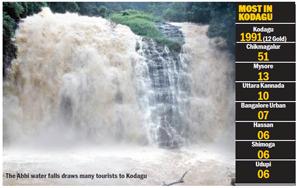
The Abbi water falls draws many tourists to Kodagu

Ahead of Dasara, the tourism department is on a mission to assess the quality of home stays across the state. Following complaints of illegal home stays popping up around various tourist destinations amid fresh applications seeking licences, the department wants to screen both the existing and upcoming home stays with the help of an external evaluating agency.

Karnataka has about 2,000 home stays classified under Gold and Silver class. However, it has been more than four years since the tourism department reviewed the condition of existing home stays and allowed setting up of new ones. “There are about 500 to 600 applications comprising both the new ones and existing home stays. All of them have to be reviewed before handing them a certificate which will boost their business and tourism activities,” said A Poovaiah, Joint Director, Tourism department.

The parameters for evaluation include hygiene, sanitation, ventilation, quality of services, affordability, safety standards and so on. “The department will not directly evaluate the home stays on these merits. Instead, a third party will be chosen by way of tendering and all applications seeking permission to set up home stays will be referred to an experts’ committee. They will visit the proposed place and assess the applicants. Based on the recommendations and final inspection by the department experts, we will classify them,” Poovaiah said.

The department has strict guidelines for setting up of home stays, but there have been several illegal home stays. “At times, house owners mislead officials, claiming that the guests are their distant relatives and officials cannot intervene. Unless people tip us off about such illegal home stays, we can’t initiate any action. Further, the tourists must insist on seeing the accreditation or certificate issued to them by the tourism department,” said a senior official.

The Scotland of India— Kodagu — has the highest number of home stays followed by Chikmagalur. Only Kodagu has Gold category home stays, which number 12. The other 13 districts have only Silver class home stays.

source: http://www.bangaloremirror.com / Bangalore Mirror / Home> Bangalore> Others / by Niranjan Kaggere, Bangalore Mirror Bureau / September 16th, 2014