Category Archives: Business & Economy

The Bandipur-Brazil corridor

In Bandipur: dung sold at Rs 3,000 a lorry load.In Brazil: a ravaged coffee crop. Asks NITIN SETHI : what’s the relation?

Hangala was selling cow dung Auctioning
— (Credit: Photographs: M D Madhusudan

It’s hard to tell who was the first in the village to really strike upon the business idea. But very soon everyone in Hangala was part of it. The sleepy and dry village at the periphery of Bandipur National Park, Karnataka, had in a mere two year’s time, transformed itself into the nerve centre of a booming trade.

Hangala was selling cow dung. Auctioning it, quite literally, and making millions. The buyers came from other parts of Karnataka — from Tamil Nadu and Kerala, as well. Those were years of boom, the 1990s. It isn’t too bad, even today; though you are quite likely to get this wistful remark from the village’s residents today: “The high point of the trade lasted for about five years and we all made good”.

Hangala was not the only one to prosper from dung trade; the other 74 villages on the periphery of the park also thrived on it. And unknown to them, the trade was fuelled by happenings in Brazil.

Hangala, or any other village for that matter, never came to know how. They didn’t care to, or needed to, say villagers, they just wanted to make the best of it. For, the region was in dire straits then. Rains had failed Karnataka repeatedly. 60 per cent borewells had gone dry in Hangala and the village’s rainfall-dependent agriculture was on the verge of collapse.

The villagers, like most others in the region, grew low- yielding crops of millets and pulses. The average annual family income was as low as Rs 17,000. The money to be ploughed in to agriculture on the other hand was huge; labour, manure, fertilisers and seeds had to be bought before the monsoons. “Cash strapped, we perpetually ran to the local moneylenders,” says Kalappa. Interest rates ranged from 60-340 per cent annually. Even if drought spared them one year, there would always be the crop-depredating wild pigs and elephants to deal with. As an alternative some farmers opted for cash crops, cotton and castor. The crops were to some extent resistant to depradations by wild animals and brought them instant cash. But only so much.

Everyone in the region was looking for better opportunities. And, when coffee prices around the world shot up in the early 1990s, the villagers found a way out of their difficulties. These were the years when the flurry of activity at coffee markets across the world matched the fury with which the frost struck and destroyed Brazilian coffee.
High on coffee After crude oil and metals, coffee is the hottest selling commodity in the international market. The annual global exports exceed US$12 billion. About 60 countries trade in it, and Brazil, the largest grower contributes approximately 30 per cent of the global production.

Brazil’s annual coffee production is, however, prone to recurrent bouts of frosts and droughts. In fact, frosts have severely damaged Brazil’s coffee crop 31 times in the last 172 years. The frequency of the attacks have increased during the last few decades. And, in the mid-1960s and the mid-1990s Brazil suffered the worst, losing 50 per cent of its exports.

Each time the golden rule of the free market came into effect: when supply of goods reduces, prices shoot up. In fact, prices rose quite dramatically as coffee was (and continues to be) the centre of a international speculative trade, which keeps its prices volatile. The beneficiaries of this sudden rise were bound to be coffee farmers in minor producer countries, such as India (which produces 3-4 per cent of the coffee grown globally), with their produce steady in times of global slump.

But Indian growers were in no position to benefit in the 1960s. For, the farmers had to compulsorily sell their produce to the state-run Coffee Board at a fixed price. However, things were different in the 1990s: the Coffee Board had lost its control over the coffee growers. Now, the latter minted money.

And how?
The value of India’s average annual coffee export rose by 158 per cent between 1989-93 and 1994-98, although the corresponding increase in export volume was only 36 per cent. Profits soared by as much as 834 per cent, much of it shared between coffee farmers of three contiguous districts: Kodagu in Karnataka, Nilgiris in Tamil Nadu, and Wayanad in Kerala. For, about 45 per cent of India’s 3,467 square kilometres expanse of coffee-growing areas falls within these districts, which together produce 57.2 per cent of India’s coffee. While the going was good, farmers increased the land under coffee plantations. There was a problem though: manure. Indian coffee growers prefer organic manure, which gives their produce a distinct taste and value. The ever-increasing plantations now needed larger volumes of it. The obvious source: cattle. But coffee growers were loath to let cattle graze on fertile and valuable lands that could alternatively be brought under coffee, yielding even more profits.

Dung had to be managed from outside the plantation area.

Bright idea
If coffee growers couldn’t keep cattle on their highly priced land, couldn’t someone else? It is difficult to say who thought of it first; the fact remains that the entire region cottoned on fast. Coffee growers prospected and hit upon the well-connected villages around Bandipur. A good choice: livestock was abundant, agriculture was nominal, and land was not intensely used, and therefore very cheap. Here was a source for manure, loads of it.

What must have clinched the ‘deal’ was that most villages on the northern boundary of the national park had free access to the park forests. So fodder was not a problem. The pact struck, an inter-state trade in cow dung took off.

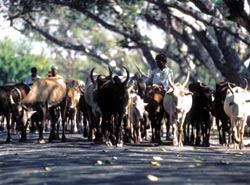
Villages such as Hangala began auctioning their dung for as high as Rs 3,000 a lorry load. Brazil’s ill luck and the vagaries of international commodity trade had brought the region unexpected riches. Hangala alone produced 39 tonnes of dung daily at the peak. Of this, it sold 16-24 tonnes — an average of 4 truckloads every day. Here was a business with no recurring costs; the fodder was ‘stolen’ from forests. “And the cattle were bought dirt cheap from Ooty. We didn’t need high milk-yield varieties, just ones which could amble through the adjoining forests and defecate” says Kalappa, a resident of Hangala.

Simple rules governing dung collection came into effect: all dung that fell in the cattle shed belonged to the cattle-owner; that deposited while cattle grazed in the forests was gathered by dung collectors (including women who found a formal occupation, finally). Dung collectors sprung up. So did agents, lorry managers, suppliers, brokers — a supply chain.

The village council in Hangala decided it should also get a share of the trade proceeds and began auctioning off streets and public places for dung collection. Exclusive collection rights were auctioned off at nine public locations — including the cattle pound and eight streets cattle used to reach grazing grounds. “We thought auctioning would bring money to the village for its development,” says H S Nanjappa, zilla panchayat member. After all, the annual trade from this village alone was worth about Rs 65 lakh.

The fact that much of the village manure was going out did not impact farming: the money earned helped purchase government-subsidised fertilisers.

Over time, villagers bought more cattle; the bovine population increased in all the villages participating in the trade; in some, by as much as 30 to 40 per cent over just five years. And in a few villages the growth rate of livestock shot up as high as 13-17 times greater than the national average livestock growth rate for the same time period.
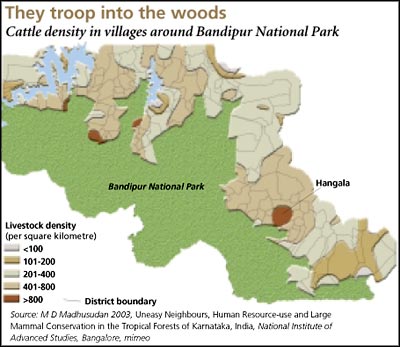
All this cattle grazed in the forest, with people following, avidly
collecting. The only alternative for grazing, common pasture lands, had anyway long disappeared. Additionally, most villages were now cropping marigold, turmeric, cotton and sunflower, which produce no consumable waste. “And even where ragi (finger millet) is grown, it’s a hybrid that produces very little hay,” says A Obireddy, principal scientist, National Dairy Research Institute, Bangalore. The forest was the cheapest, and at times the only, source of fodder for the thousands of cattle.

And today
Brazilian coffee is doing extremely well. Indian coffee growers face their worst crisis ever in 30 years. But the dung trade has acquired a steam of its own. “We now sell dung to Kerala for ginger, chilly, tea and many other crops. It’s not as voluminous as before, but prices have risen by almost Rs 1,000 in the last two years,” says M C Subbappa of Mangala village, which depends entirely upon dung trade (only about 10 of its 200-odd families own land). “What other options do we have?” he asks, as his 20-odd cattle rush home, tended by a labourer he pays Rs 5,500 annually. “I have had a daughter married off with this money. My son can work in the fields elsewhere because my future is secure.” “Our dependence on moneylenders has reduced considerably,” says Nagamma, a local tribal leader.

In Hangala too, the trade is flourishing. In the day, the village wears a desolate look: most men are out with their cattle. “Some are also trying for a few hybrid cows, for milk. The grass this side of the forest has been over-grazed. I tell them not to sell all their manure but what’s to stop them? Its not illegal,” says Nanjappa. Villagers recollect a local politician trying to stop the dung trade, even as his own henchmen made money off the trade.

It’s not illegal to sell cattle for meat either and there is a huge demand from across the border in Kerala. “Well, some do sell their cattle for a good price,” reluctantly accepts Kalappa. The village has more than 6000 cattle and nearly 5000 sheep and goats; there is enough meat to sell. A single cow can fetch up to Rs 8,000 for meat in Kerala. “Sometimes people who want to supposedly protect the cows from slaughter impound our cows at the Kerala border. But I guess they have to also fit into the business, right?” smirks Mallikarjun of Mangala village. He then goes right back to what he thinks is best for him: tending his cattle.

Inputs from E Vijaylakshmi
source: http://www.downtoearth.org.in/ Home> Features/ Issue October 31st, 2004
Govt move attracts more paddy growers

Madikeri:

The support price for paddy this year has attracted more farmers to sell their paddy production directly to the government agencies. Hence, this has increased the government’s paddy sock in Kodagu district.The state government has fixed the price per quintal of paddy at Rs 1,110 for ‘A’ grade variety, the government will add Rs 250 subsidy for this and the farmer will get Rs 1,360 per quintal.

The medium quality paddy will get price of Rs 1,080 plus Rs 250 and the aggregate amount of Rs 1,330. Farmers are selling their paddy production directly to agricultural produce marketing committees (APMC) in Madikeri, Gonikoppal and Kushalnagar. “The purchase started last month. So, for 882 quintals in Madikeri,1,192 quintals in Gonikoppal and 113 quintals in Kushalnagar, and in total 2187 quintals of paddy, is sold in APMC,” explained Jayadevaraje Urs, executive, District Food And Civil Supply Corporation Ltd.
Private buyers could not compete with the price, they cannot provide any subsidy and farmers are rushing towards APMC centres as the facility is scheduled till March-end. Later, there is no guarantee whether the same price will be continued by the government. The subsidy will be given to farmers on the basis of 18 to 20 quintals of production per acre and up to the maximum limit of 100 quintals only. The quality test is a compulsory process and moisture test will be done before the paddy is purchased from farmers.”The farmers should bring paddy in gunny bags and each bag should contain only 50 kg. They should also bring certification from the respective village accountants that the paddy is grown during 2011-12.

They should produce record of rights of property. The APMC will give acknowledgement for receiving the paddy and the cheque will be sent to the bank account of sellers within a week,” said Bellu Somaiah, president, APMC, Madikeri.Thalur Kishore Kumar, a farmer from Bettageri, expressed happiness over the government’s new support price. He said that he sold 25 quintals of paddy at Rs 1,300. “When I asked private dealers, they were willing to offer him only Rs 750 per quintal. The government’s new policy has provided the farmer an opportunity to make profit and has encouraged the cultivation of more paddy during next season,” he added.

source: http://www.articles.timesofindia.indiatimes.com / City> Mysore/ TNN / January 14th, 2012

Starbucks moving forward with MoU with Tata Coffee as government notifies 100 % FDI in single brand retail

New Delhi :
US-based coffee giant Starbucks today said it is moving forward with the memorandum of understanding (MoU) signed with Tata Coffee and hopes to make an announcement soon even as the government has notified 100 per cent FDI in single brand retail.

In an e-mailed response, John Culver, President, Starbucks (China and Asia Pacific) said: “We are moving forward with MoU (signed with Tata Coffee in 2011) discussions and planning, and hope to make an announcement soon”.

On January 10, the government allowed 100 per cent FDI in single-brand retail, paving way for global chains to have full ownership of their India operations.

The company had earlier signed an MoU with Tata Coffee for formation of a strategic alliance for sourcing of coffee beans. As per the MoU signed, the companies also agreed to explore the opportunities for opening coffee shops in India.

Culver further said: “We are excited about the great opportunities that India presents to Starbucks and look forward to offering high-quality coffee, handcrafted beverages, legendary service and the unique Starbucks experience to customers in India”.

However, the 100 per cent FDI in retail comes with a sourcing clause. It will be mandatory to source at least 30 per cent from the domestic small and cottage industries which have a maximum investment in plant and machinery of USD 1 million (over Rs 5 crore).

Starbucks said at this point the company does not have anything further to add.

Starbucks is the world’s biggest coffee chain, managing over 16,000 stores, and operates in more than 50 countries.

source: http://www.articles.economictimes.indiatimes.com / ECONOMIC TIMES/ News> News By Industry> Cons. Products / PTI / January 12th, 2012

Record Tourism Influx Into Kodagu

Bangalore:

Kodagu district, aptly called the Kashmir of Karnataka and the Switzerland of India, is fast becoming a popular tourist destination with urbanites from various parts of the country making a beeline to this serene hill station surrounded by coffee plantations, where numerous resorts and home stays have mushroomed to cater to the needs of the tourists whose numbers swell during the holidays and weekends.

The pleasant weather, picturesque landscapes and fresh air are a luxury for many of the urban populace who simply look forward to relax in such serene atmosphere, away from the urban hustle-bustle, noise and air pollution.

According to sources in the Tourism Department, the number of tourists visiting Kodagu is higher than those visiting Munnar in Kerala, one of the most popular hill stations of South India. As per the statistics provided by the Karnataka and Kerala Tourism Departments, the number of tourists who visited Kodagu in 2010 was 5,94,467 (including 5,87,216 domestic and 7,251 foreign tourists), which is double that of Munnar which saw 2,45,438 tourists (including 19,690 foreign tourists). Up to Nov. 2011, Kodagu saw a quantitative leap with over 15 lakh visitors.

Tourism officials are thrilled by the prospects of developing Kodagu as a popular tourist destination. The hill district is situated at an elevation of 1,525 metres MSL.

Though the tourist footfall in Munnar has not gone down, the fact that the numbers have swelled significantly in Kodagu has given it the lead, said officials.

Situated at the confluence of three mountain streams –Muthirapuzha, Nallathanni and Kundala __ and placed about 1,600 metres above sea level, the hill station of Munnar once used to be the summer resort of the erstwhile British administration in south India. Marked by vast expanses of tea plantations, colonial bungalows and waterfalls, Munnar had so far been the ever-green favourite of tourists in sea-rch of a calm and quiet hill station.

source: http://www.StarofMysore.com / General News / January 09th, 2012

Govt. Mulling on Regularisation of Encroached Govt. Lands


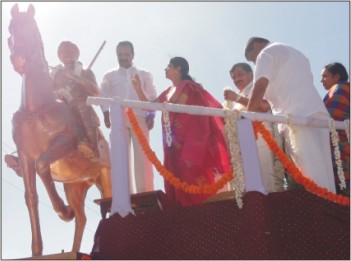
Caption: D.V. Sadananda Gowda is seen unveiling the statue of freedom fighter Guddemane Appayya Gowda in Madikeri yesterday. His wife Dotty Sadananda Gowda is seen offering floral tributes.

Madikeri, Jan. 3:
The Government is mulling on regularisation of encroached government lands by making amendments to Section 94(C) of the Karnataka Land Revenue Act, 1964, said Chief Minister D.V. Sadananda Gowda.

He was speaking at the launch of several works undertaken by various Departments at the Town’s Gandhi maidan after unveiling the statue of Freedom Fighter Guddemane Appayya Gowda here yesterday.

The government is contemplating on making amendments to the Revenue Act so as to give land rights to farmers who have taken up cultivation in C and D category lands in Kodagu district.

The Chief Minister also said the Services Guarantee Bill, which aimed at transparency in Governance, will be tabled before the Assembly in the coming session. As many as 152 functions under various departments will be brought under the purview of the Bill, he pointed out.

A medical college will be established in Kodagu, for which the funds will be earmarked in the forthcoming budget, he added.

Earlier, Madikeri MLA Appacchu Ranjan in his introductory address, said the State should submit Rs. 133 crore proposal to the Centre for checking Wild Elephant menace.

A medical college should be established in the district and ICU should be opened at District Hospital, Madikeri, he said.

Appachu Ranjan also urged the government to initiate measures for developing Talacauvery and Bhagamandala, construction of General Thimmaiah Memorial and KSRTC division for Kodagu.

Speaker K.G. Bopaiah said land has been identified for construction of DC office complex, Police Station at Suntikoppa, Ayurveda College at Virajpet and Medical College in Kodagu.

source: http://www.StarofMysore.com / General News / January 03rd, 2012

Award for P.M. Belliappa


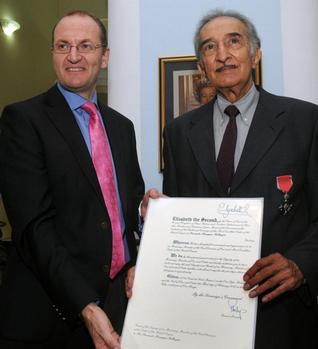
British Deputy High Commissioner in southern India Mike Nitharvrianakis presents the Most Excellent Order of the British Empire citation and medal to the president of ABS P.M.Belliappa in Chennai on Monday. Photo: K Pichumani
Recognising his contribution towards improving the Indo-U.K. relationship, the British High Commission presented the Most Excellent Order of the British Empire (MBE) badge to P.M. Belliappa, president of the Association of British Scholars at a function here on Monday.

Mike Nitharvrianakis, British Deputy High Commissioner in southern India, said that the award is to recognise Mr. Belliappa’s services to environmental protection and for promoting Indo-U.K. alumni relations through the ABS. Calling the award as a “very, very rare honour”, Mr. Nitharvrianakis said “Indians who study abroad always try to give something back to the country where they spent their academic life. Mr.Belliappa is a prime example.”

Terming the occasion as a moment of great joy and pride, Kartar Singh, Deputy Director, British Council, said that Mr. Belliappa is a true ambassador of Indo-U.K. relationship. “This award celebrates his human spirit,” he said. Reflecting on his life and career, Mr.Belliappa said “I have had three careers, running almost in parallel – civil service, my years as an international environmental consultant and the ABS. In all of them, I’ve achieved a measure of success. But the results were achieved only due to a collective endeavour.”

source: http://www.thehindu.com / News> Cities> Chennai / by Staff Reporter / April 12th, 2011

Picturesque Coorg to get rail connectivity

Coorg or Kodagu is in a dilemma today on whether to accept the new development in the region or not. For decades people from Coorg district of Karnataka demanding railway route for the region and at the same time some traditional populace protesting it as such a development can harm the serenity of the terrain. Kodagu district of Karnataka, a prominent tourist place does not have railway or air connectivity. This isolation of the region surrounded by mountains, forest, fields and waterfalls has worked as blessing in disguise.

But now railway department has proposed a train route from Mysore to Madikeri, the headquarters of the district, and the survey is already undergoing. Recently, Minister of State for Railways K.H. Muniyappa launched the first stage of the preliminary survey works on the route at Kushalnagar in Kodagu district. The work relating to the preliminary engineering-cum-traffic survey between Mysore-Kushalnagar-Madikeri will be completed in four months and the project would start in less than a year. According to K.H. Muniyappa, although the preliminary survey works were taken up from Mysore to Madikeri, the first phase of the project work would commence from Mysore to Kushalnagar. The project was expected to cost Rs. 600 crore.

M C Nanayya, Member of Legislative Council (MLC) and JD(S) leader from Coorg has a different opinion.
He said, “I am perfectly positive about extending railway line from Mysore to Kushalnagar. As this line goes through Belagola, Hunsur, Piriyapattana and Kushalnagar there is no threat to forest of private plantations. The route covers plains and government land and will not harm environment or farmers. But, I am against this railway line extending to Madikeri as the route goes through hilly terrain forest near Kushalnagar which is of 2800 ft height from sea level and Madikeri forest is 3900 ft height from sea level. The route is not necessary as this covers forest, hilly terrain and private coffee plantations and we can travel same distance by road in 40 minutes. As the route is environmental hazard and not eco friendly I will oppose such plan.”

Though, efforts were made to provide rail links to Kodagu during the tenure of the former Chief Minister late R. Gundu Rao who hailed from Kushalnagar but failed to fulfill the dream in his term. So, at last now the region is going to cheer up with new railway link.

“It is true that serenity of the region will be harmed, but any development we should accept. If railways come the travel will become cheaper. There are positive and negative points attached in it. Knowing such a type of development will harm the environment, it is difficult to accept,” Says Seetha Aiyanna, Vice president, Kodava Samaja, Bangalore.

But, Seetha Aiyanna and others residents of the region accept that protesting voices are becoming weak nowadays. Knowing the necessity of development everyone wants railway and air connectivity to this beautiful district.

source: http://www.TheSundayIndian.com / by N K Suprabha / Bangalore, January 07th, 2012

Nescafe plan: Going beyond the Cup

New Delhi, JAN. 5:
Nestlé India has rolled out the India leg of its global Nescafe Plan by setting up a coffee demonstration farm and training centre in Kodagu district, Karnataka.

Nescafe Plan is the Swiss MNC’s ambitious global initiative to bring under one umbrella coffee farming, production and consumption activities — one that it says will “help it optimise its coffee supply chain.” In 2010, when the world’s biggest coffee buyer had unveiled the Plan, it had announced an investment of CHF 500 million (Rs 2,811 crore).

Mr Jawaid Akhtar, Chairman, Coffee Board of India, inaugurated the coffee demonstration farm at Bindhu Estate, Kodagu.
Nestle will be training farmers in using technology and best practices for sustainable production of high quality coffee.

Mr Antonio Helio Waszyk, Chairman & Managing Director, Nestlé India, said, “In the Nescafe Plan, our team will work with coffee farmers as well as other experts and the Nestlé R&D Centre in France to combine the traditional wisdom amongst the coffee farmers in India with the benefits of modern science to make coffee farming more successful and sustainable.”

Nestlé, which purchases 10 per cent of the world’s supply of green coffee every year, had launched the Nescafe Plan in 2010 in Mexico. Under the Plan, the Swiss MNC had said it would double the amount of coffee it sources from farmers directly to 180,000 tonnes in the next five years.

The idea in India, it says, is also to improve penetration of its instant coffee brand Nescafe amongst consumers and expand the market.

Mr Nandu Nandkishore, Nestlé Executive Vice-President and Zone Director for Asia, Oceania, Africa and West Asia , said, “By working with farmers in this way, we know where the coffee comes from, and they know they have a partner who will give them competitive prices for high quality produce.”

chitra.n@thehindu.co.in

source: http://www.thehindubusinessline.com / Industry & Economy / Our Bureau / New Delhi/ New Delhi, January 05th, 2012

Kodagu forest circle gets CCF

Madikeri:
In order to utilise the experiences of the senior officers in the department and get them into field work, the State Government has upgraded all the 13 Forest Circles in the state to the level of CCF (Chief Conservator of Forests) Office from the Conservator of Forests, with effect from December 24, 2011.

Kodagu got the upgradation in the first list, others being Mangalore, Belgaum, Uttarakannada and Chikmagalur district’s Forest Circles and the district also got a new Chief Conservator of Forests in the form of J N Raj who took office on December 31, 2011. Raj told Express that the upgradation will help people, as the CCF level official work will be done here and the rest will be sent to Bangalore for their consent.

The rules and guidelines will become more clear, once the scope and limits of the office will be made public, he added. He added that he will first study the situation thoroughly here and plan accordingly, since the expectations of the people will be more once the office gets upgraded. He said that the vacancies in the department and man-elephant conflict will be the big challenges before the Forest Department.

Once the summer approaches, instances of wild fire will be more, which will make the elephants come out in search for water and food. As a result, they may scatter from the group and pass through residential areas and estates leading to crop loss, human and elephants deaths.

source: http://www.ibnlive.com / South> Karnataka / Express News Service / The New Indian Express / posted January 05th, 2011

Kodagu readies itself for CM’s visit today

Kushanlanagar, Jan 1, DHNS:

In the backdrop of chief minister Sadananda Gowda’s scheduled visit to Kushalnagar and Guddehosur on January 2, MLA MP Appachu Ranjan held discussions with officers recently.

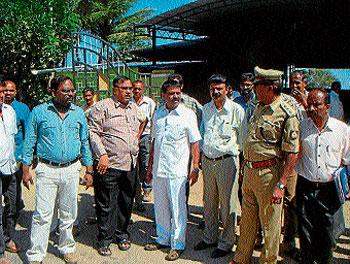
The MLA, along with deputy commissioner Dr Prasad and superintendent of police Manjunath Annigeri, visited Guddehosur, the native place of the CM’s wife Dati, and discussed about security aspects.

The CM is scheduled to visit his in-laws’ house in Ballur, followed by a visit to Chamundeshwari temple.

Then the CM will take part in a get-together party of Gowda community members, which will be organised at Gowda Samaja in Kushalnagar, informed Appachu Ranjan.

The MLA visited Gowda Samaja and inspected the venue. He also visited the helipad, where the CM’s helicopter will land. The MLA asked the SP to arrange for tight security during the chief minister’s visit. Zilla panchayat member B B Bharathish, BJP district president M N Kumarappa, DySP Paul Verma and others were present.

source: http://www.DeccanHerald.com / Home> District / January 10st, 2012