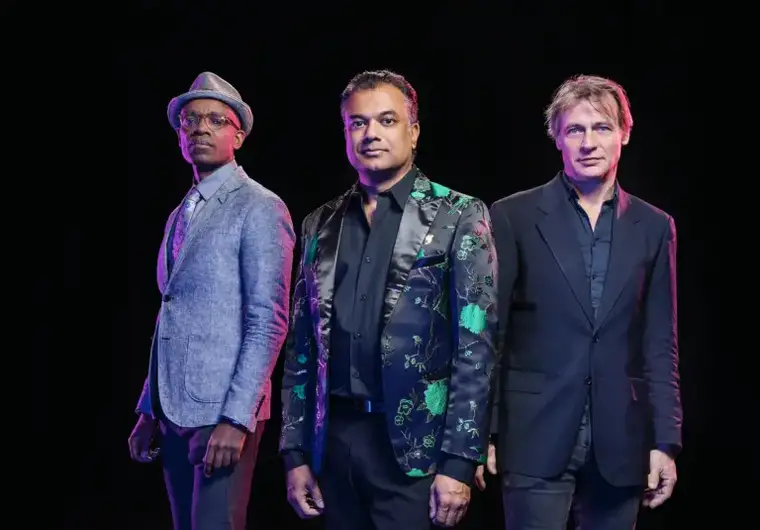
Saxophonist Rudresh Mahanthappa’s Hero Trio will make their NYC Debut this August to celebrate Charlie Parker’s Birthday at Smoke Jazz.
Located at the junction of 106th and Broadway (aka Duke Ellington Boulevard), Smoke Jazz Club is one of New York City’s premier live music venues. Renowned for offering top-notch programming of accessible, timeless jazz featuring legendary performers, modern masters, and rising stars, Smoke stands apart with its candlelit dining room, stellar acoustics, and classic American cuisine.
Rudresh Mahanthappa’s Hero Trio also includes bassist Harish Raghavan and drummer Rudy Royston. Their performance will set on Thursday and Sunday at 7 and 9 p.m., and on Friday and Saturday at 7, 9 and 10:30 p.m.
Hero Trio earned high praise for its eclectic 2020 self-titled debut and the 2022 follow-up Animal Crossing. Animal Crossing is a digital-only EP featuring four new songs, each an unlikely addition to the canon of jazz standards which is also the titular theme from the wildly popular video game.
At Smoke, Mahanthappa will explore Parker’s compositions, classic standards, and modern covers with the Raghavan and Royston. “The idea behind Hero Trio was to turn the idea of playing a set of standards on its ear and freshen up the idea,” the saxophonist explains.
Rudresh Mahanthappa is widely known as one of the premier voices in jazz of the 21st century as well known for his exellent alto saxphone performances. He has been recognized by multiple jazz magazines including DownBeat Magazine, Jazz Journalists’ Association,and JazzTimes Magazine. He has also received the Guggenheim Fellowship and the Doris Duke Performing Artist Award, and is currently the Anthony H. P. Lee ’79 Director of Jazz at Princeton University.
For information visit https://www.smokejazz.com/calendar/.
source: http://www.nysmusic.com / NYS Music / Home> Blues-Jazz> NYC Metro> Upcoming Shows / by Savanna Tong / August 07th, 2022
Call to help preserve memories of a vanishing people
While modernisation has opened many opportunities for the well-qualified, it has also distanced the young from their heritage and culture. This is even more accentuated amongst Kodavas living outside Kodagu. There is a need to establish a platform where young Kodavas could learn and keep in touch with the community’s heritage, cultural practices, folklore, music, dance, festivals and history, says Mrs. Codanda Rathi Vinay Jha, IAS (Retd.) and Chair, India Foundation for the Arts (IFA), who has initiated establishing a Virtual Museum of Kodava Heritage & Culture named ‘Sandooka,’ a treasure trove of information. —Ed
Kodavas are a micro-minority community in India, who live in Kodagu (Coorg) in Karnataka State. It is estimated that there are about 1,50,000 ethnic Kodavas within and outside Kodagu.
Kodavas, by virtue of living quite isolated in a densely wooded hilly terrain on the Western Ghats of India since time immemorial, have developed their own unique culture, physical attributes, cuisine, language, attire, religious rituals and practices.
Over the centuries, Kodavas adapted themselves to the harsh weather conditions, dangers from wild animals and the inhospitable terrain of Kodagu and transformed the land to an idyllic haven it is today. With the passage of time, they toiled literally with bare hands to cultivate paddy in the valleys.
With the forests providing bountiful supply of wild game, they became expert hunters initially with bows and arrows, and later with firearms which enabled them to emerge as a warrior race. They transformed the fertile land and were able to grow enough paddy that they could export to neighbouring areas.
The interactions with immediate neighbours in present day Kerala, Mysuru and Mangaluru, influenced the Kodava language, places of worship, construction of their dwellings and some of the religious practices as well. However, Kodavas still retain their fundamental philosophy of ancestor and nature worship. They come under the broad umbrella of Hinduism.
Kodagu was ruled by Kodava Nayakas or Palegars who were basically warlords. The Haleri dynasty established their rule in Kodagu after cleverly replacing the hopelessly divided Nayakas during the early part of the 17th century. The Haleri Rajas ruled for over two centuries until the British takeover of the administration in 1834 after deposing the last Raja. During the rule of the Haleri Rajas and later the British, Kodavas remained the prominent community very much involved in the administration.
During the British rule, education was introduced and this brought about quantum changes in the lifestyle of the Kodavas. Kodavas found several employment opportunities. Introduction and scientific cultivation of coffee and spices vastly improved the economy of the region. Kodava culture and ethos found expression in the writings by the British, European and Kodava authors.
By the time India got her independence, many Kodavas held important and high-level offices in sectors such as the Defence Forces, Administration, Revenue Department, Forest Department, Police, in the field of Education, Engineering and Medicine.
Kodavas have several distinctive elements in their social, cultural and religious practices. One of them is the deferential status given to women. There is no dowry system in the community. Centuries ago, widow remarriage was permitted. This enlightened attitude is now reflected in well-educated Kodava women shining in a variety of fields.
After India’s independence many Kodavas ventured out of Kodagu seeking better opportunities in education, employment, business and sports. Kodavas are now spread all over the globe. The last three decades has seen a large number of Kodavas migrating outside the country. There is now a sizable number of Kodava diaspora in the US, Canada, UK and Australia. In many cases, there are a couple of generation of Kodavas born and brought up outside Kodagu and outside India as well.
While modernisation has opened many opportunities for the well-qualified, it has also distanced the young from their heritage and culture. This is even more accentuated amongst Kodavas living outside Kodagu. There is a need to establish a platform where young Kodavas could learn and keep in touch with the community’s heritage, cultural practices, folklore, music, dance, festivals and history.
It is with this aim in mind that Mrs. Codanda Rathi Vinay Jha, IAS (Retd.), as Chair, India Foundation for the Arts (IFA), initiated establishing a Virtual Museum of Kodava Heritage & Culture (VMKHC). This project is evocatively named — Sandooka — a treasure trove of information. IFA has successfully supported several path-breaking projects in the field of art and culture.
Sandooka will be a living museum that will be interactive and open to receiving relevant new materials from the public. People, especially the future generations of Kodavas, will have an easily accessible platform to gather details of their heritage. Weblinks will also be given to some of the websites dealing with Kodava culture. It is hoped that this treasure trove of information will be of immense help to those who wish to carry out further research on Kodavas. VMKHC will cover the following aspects of Kodagu and Kodavas:
1. Customs and Rituals
2. Cuisine
3. Architecture
4. Clothes and Jewellery
5. Art & Craft
6. Landscape
7. Literature and Folklore
8. Community Histories
9. Festivals
The project is generously funded with a Corporate Social Responsibility (CSR) grant from Recaero India Pvt. Ltd., which is a pioneer in the field of aerospace engineering and is headed by Vinay Jha, IAS (Retd). A highly professional team has been forged to deal with every aspect of the project. The team comprises:
Lina Vincent – Project Head; Upasana Nattoji Roy – Designer (Switch Studio); Saurav Roy – Designer (Switch Studio) and Mookanda Nitin Kushalappa – Researcher.
IFA office-bearers are: Arundhati Ghosh (Executive Director) and Darshana Davé (Project Co-ordinator); Advisory Group: Rathi Vinay Jha, C.P. Belliappa and Hemanth Sathyanarayana.
Sandooka invites submission of Kodava artefacts, rare photographs, antiques including jewellery (photos) and anecdotes of yore. All accepted materials will be given due recognition and credits. Sharing your valuable knowledge and collections will enrich the contents of Sandooka.
For details of submission of materials, please visit: www.sandookamuseum.org
source: http://www.starofmysore.com / Star of Mysore / Home> Feature Articles / by C.P. Belliappa / August 01st, 2022
Every school has a library hour and they are now being put to good use following the efforts from the Kodagu Zilla Panchayat.
Madikeri :
Taking inspiration from the ongoing Chess Olympiad, the Karnataka state government has issued a notification to introduce the game of Chess to the students. Similarly, the rural kids of Kodagu are now indulging in the board game, which is being introduced across all the Digital Libraries in the district.
Every school has a library hour and they are now being put to good use following the efforts from the Kodagu Zilla Panchayat. “The state has issued a notification to introduce indoor board games in libraries.
Similarly, to coincide with the ongoing Chess Olympiad, Chess has been introduced in the digital libraries – which is being utilized by many rural kids,” explained Banwar Singh Meena, the CEO of ZP. He added that the digital libraries are being promoted as a social space and several indoor games including carrom and chess are being introduced.
The funds from the grama panchayat are being used to buy the required sports material and kids will have access to rubik cube, carrom, chess and even rural board games including ‘Chenna Mane’. “The concept is being introduced gradually across the libraries. The panchayat staff, librarian, PDO or anyone who knows the games is training the rural kids. These are all silent games and go hand in hand with the library decorum,” he added.
Many schools, especially in the rural parts, are now using the facilities of digital libraries to promote interest in reading and introduce the interest in board games. The kids who mostly spend their free time indulging in mobile phones, are now heading to libraries to play board games during the school’s library hour period and during their free time.
source: http://www.newindianexpress.com / The New Indian Express / Home> States> Karnataka / by Prajna GR, Express News Service / July 31st, 2022
Kodava Education Society Joint Secretary Chiriyapanda Raja Nanjappa inaugurates ‘Kodavame Padipu’ programme at CIT PU College in Ponnampet on Wednesday. Karnataka Kodava Sahitya Academy Chairperson Dr Parvathi Appaiah, Academy member Dr Mullengada Revathi
People are busy in agricultural activities during the month of Kakkada and also it keeps raining during the month. Hence, our ancestors imposed restrictions on holding auspicious programmes during Kakkada month, opined Kodava Sahitya Academy member Dr Mullengada Revathi Poovaiah.
Speaking during ‘Kodavame Padipu’ programme, organised by Karnataka Kodava Sahitya Academy, at Coorg Institute of Technology (CIT) in Ponnampet on Wednesday, she said that the youth should understand the reasons behind the religious rituals. “Our elders gave a lot of importance to indigenous food and used them during the rainy season. They planned their food according to the seasons,” Revathi added.
Inaugurating the programme, Kodava Education Society Joint Secretary Chiriyapanda Raja Nanjappa said it is believed that the Kodava tribe was present during the origination of River Cauvery and called upon the present generation to get acquainted with the local tradition and culture.
He further said, “The Jamma land is not government land. It is inherited by Kodavas from generations. Also, the gun is used for religious rituals in Kodava culture. However, our ancestors did not use a gun for fighting. Gun rights of Kodavas should be preserved, he added.
During the programme, the resource persons spoke on the importance of ‘Kakkada Padinett’, ‘Kakkada Tingalra Pudume’, ‘Kodava Namme’ and ‘Kodava Takk’.
Karnataka Kodava Sahitya Academy Chairperson Dr Ammatanda Parvathi Appaiah, member Padinjaranda Prabhukumar, CIT PU College Principal Dr Sannuvanda Rohini Thimmaiah, Thookbolak Kala Sahitya Vedike convener Madhosh Poovaiah and others were present.
Students of CIT PU College watched the programme online.
Yesterday morning as I sat at my working desk, there sat a brown cover addressed to me on the table.
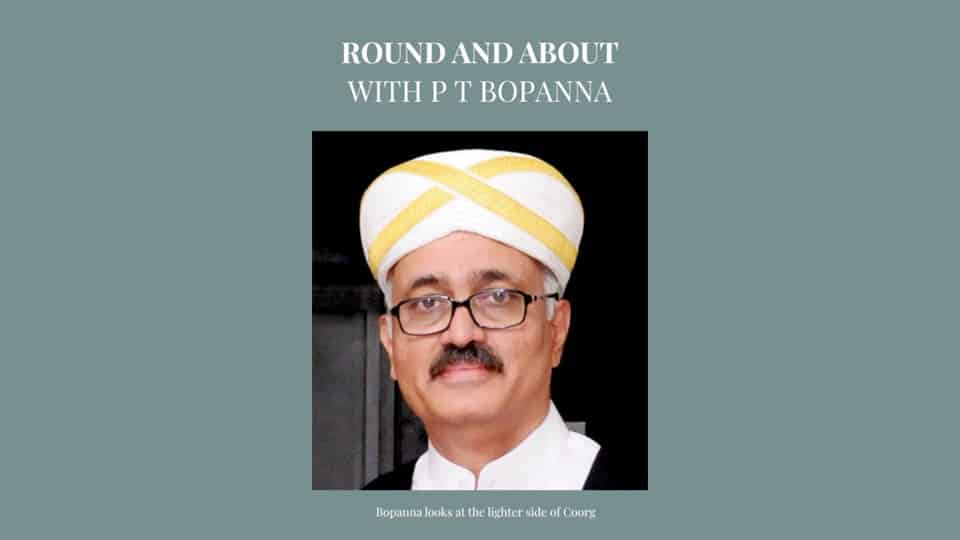
It came from Palanganda T. Bopanna, a journalist author from Bengaluru. Inside was a thin book with a thick hard cover embellished with the photograph of the author in his ethnic Kodava headgear of a peta adorned with a pattern of golden strap crossing each other as if hugging the peta.
The title of the book is quite revealing and says what it contains:
Round And About With P.T. Bopanna’ with a bottom line: Bopanna looks at the lighter side of Coorg. Himself being a Kodava (Coorg), his writings here are of Kodagu related subjects or about himself with VIPs. I finished reading it in one hour and here I am writing about it. This was possible because each of the 25 pieces inside, including the Foreword by the Kodava iconic Fashion Guru of India Prasad Bidapa and the Epilogue, are no longer than two or three pages in fairly larger font and pictures. Good reading for those familiar with Kodagu (Coorg) and the people written about in the book.
There is a Preface also by the author and I was delighted to find the names of Mr. Boverianda Chinnappa and Mrs. Nanjamma Chinnappa, now residents of Mysuru, being mentioned for their “valuable suggestions” in bringing out this thin book of 68 pages. “The couple has been a source of strength to me in my book and web ventures,” he writes in gratitude.
As a Kodava myself, I know there are any number of Kodavas all over the world engaged in different activities and pursing professions who have become great achievers. Kodava people belong to a microscopic minority as a population who lived in a land of their own known as Kodagu ruled by Nayaks and then Kings and then the British, now a district in Karnataka.
The land area cannot increase but population increases. As a result when the family grew, its land-holding was not sufficient for running the family. Perforce they got themselves educated and some members had to leave Kodagu and then Kodava (Coorg) diaspora became a reality. Fortunately those who went out of Kodagu, a great majority of them, are doing well and very well. Some of them became celebrities and some are recognised by the governments. But there are other achievers who remain without public recognition but doing very well in their given profession, business or industry.
One example for anonymous achievers and distinguished persons among Kodavas is given in the book itself in the person for whom the book is dedicated (page 3). He is Pemanda Monappa Belliappa, a retired IAS Officer of Tamil Nadu.
Acknowledged as an outstanding administrator, Belliappa was decorated with MBE (Member of the British Empire) by the Queen of England. More than this, he established ‘Pemanda Monappa Scholarship’ in Cambridge University in perpetuity, in the name of his father, Pemanda Monappa, former Karnataka Inspector General of Police. Nearer home, he has also made handsome donation to the Coorg Education Fund, Madikeri. People like Belliappa are indeed the pride of Kodagu. There are many such Stars of Kodagu!
Bopanna, who claims to be a chronicler of Kodagu or Kodavas, may also venture to trace all those achievers among them, after independence of our country (1947) and publish a book with their biodata. This would be a great contribution from him to the Kodava people.
source: http://www.starofmysore.com / Star of Mysore / Home> Columns > Abracadabra / by K.B. Ganapathy / July 20th, 2022
The government has started post and pre matric hostels and residential schools to impart free education to the students.
MLA K G Bopaiah hands over a laptop to a student at the Government First Grade College in Madikeri. Credit: DH Photo
MLA K G Bopaiah said that students should make use of the facilities from the government for their bright future.
He was speaking after distributing free laptops to the SC/ST students who had secured highest marks in the II PUC exam during 2020-21 at the Government First Grade College.
The government has started post and pre matric hostels and residential schools to impart free education to the students, he added. Deputy Director PU department Puttaraju said that laptops have been distributed to 24 students.
“I am happy for receiving the laptop. One of my lecturers has helped me financially to continue with my education,” Aloor Siddapura PU College student K Vijaya said.
source: http://www.deccanherald.com / Deccan Herald / Home> State> Karnataka Districts / by DHNS, Madikeri / July 16th, 2022
Through her institute Karaumbiah’s Academy for Learning and Sports, Olympian Ashwini Nachappa is aiming to bring potential athletes from Kodagu on the right track.
After a foray into films in the 90s, Nachappa in 2004 established her own institution, Karaumbiah’s Academy for Learning and Sports or KALS (named after her husband Datha Karumbiah) in Gonikoppal, Kodagu.
While sports enthusiasts around the globe are hooked on to the World Athletics Championships that kicked off in the USA, in Bengaluru, Karnataka’s very own former track and field athlete Ashwini Nachappa is single-mindedly focused on reviving activities at her sports academy in Kodagu after a “difficult two years”.
A Kodava by birth, Nachappa’s drive for athletics picked up when she was just eight years’ old. While her father worked in Kolkata, Nachappa lived with her mother and sister Pushpa, who is also an athlete, near Kanteerava Stadium in Bengaluru. Little did Nachappa know that the stadium would be a turning point leading to her accomplishments in the track and field discipline.
“My sister and I used to love running on the tracks of the stadium every morning. The late Mohinder Singh (triple jumper) saw us and bribed us with sweets and wanted to see us more on the field. For every round, he would offer sweets and I ended up taking more sweets. Since then, there was no looking back,” said the Olympian, who bagged her first gold at All Indian Open Nationals in Bengaluru in 1980.
Nachappa began her career in track and field as a hurdler and long jumper, before making the switch to sprints. She participated in two Asian Games, one held in 1986 at South Korea, and the other in 1990 at Beijing, China where she bagged a silver medal in 4 × 100 m relay. She also represented India in two World Championships, one in 1987 in Rome, and the other in 1991 in Tokyo, as a member of the 4 × 400 m relay. She also won the 200 m gold at the 1990 National Open Meet in New Delhi ahead of P T Usha, clocking 24.07 seconds.
After a foray into films in the 90s, Nachappa in 2004 established her own institution, Karaumbiah’s Academy for Learning and Sports or KALS (named after her husband Datha Karumbiah) in Gonikoppal, Kodagu. Later in 2010, Ashwini’s Sports Foundation, a non-profit organisation, was built in the same academy to nurture potential athletes from Kodagu.
“We realised that Kodagu produced some excellent sporting talent but the children either had to travel to Mangalore or Bangalore to pursue their dreams. That is when we decided to blend academics and sports through the foundation and the school to embolden the sporting culture from the grassroots level in Kodagu,” said Nachappa, who is also associated with Parikrma Humanity Foundation, an NGO providing English language education to the poorest from the slums of Bengaluru. In fact, she was also associated with the Special Olympics programme for 12 years, offering year-long sports training to specially abled children.
A venture that started with 25 students has now grown with 850 students who are into athletics, hockey, and air rifle shooting. Some of them have made it to the Indian hockey team in the junior category and have represented the state at National Athletic Championships and National Shooting Championships. The sports academy consists of a synthetic athletic track and an astro turf for hockey.
“It has been a difficult two years for all, financially and emotionally. At our academy, we have re-started sporting activities this year with a new set of athletes across three core sports. Keeping in mind the impact of the pandemic over students, we have also started addressing physical and emotional challenges of children through small initiatives,” said Nachappa, adding that raising funds for the academy remains a challenge.
“Raising funds has been quite a challenge over the years for the sporting academies. However, we are using the revenue generated from the KALS to develop the amenities at our academy. We have also received grants from the national and state’s sports funds,” said Nachappa who believes that the participation of women in sports has increased over the years.
“During my early days as a sportsperson, I never thought gender would be a barrier to achieve your dreams. It’s all about talent and it is important to keep doing what you do. For me, life has been a learning experience, even now. With the pandemic putting a full stop to sports for the last two years, we are going to restart training processes at our academies and go on to produce more young athletes for the country,” said the Arjuna awardee.
source: http://www.indianexpress.com / The Indian Express / Home> Cities> Bangalore / by Sanath Prasad, Bengaluru / July 16th, 2022
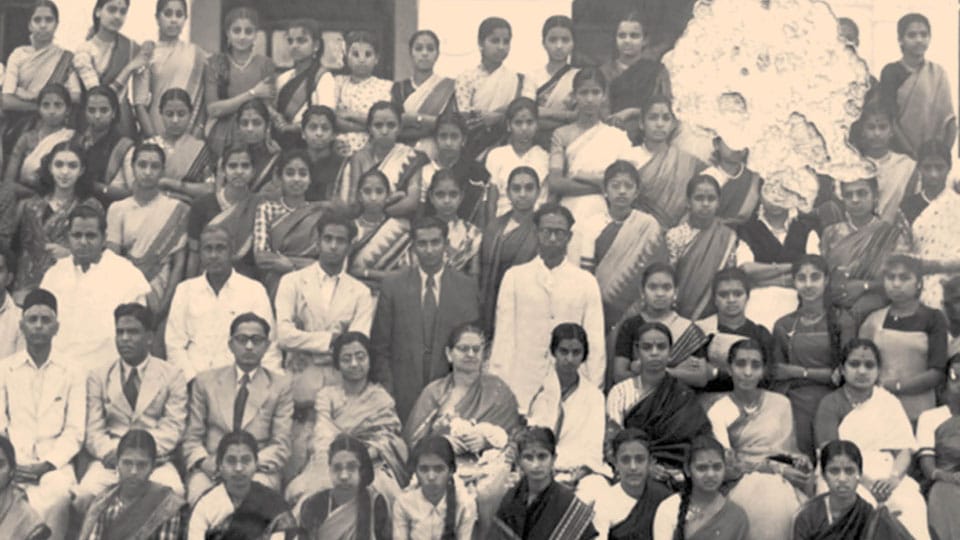
My memories of Maharani’s College, Mysore [now Mysuru], come to life whenever I pass the building where I studied seven decades ago. In the heart of the city, the College is still painted in the classic pale yellow and emerald green of old Mysore buildings. It is surrounded by old rain trees with spreading branches. Students would sit in their shade to chat or eat their lunch.
I had been a lonely, home-schooled girl until I passed the SSLC privately and could join the Intermediate College. I was nervous about interacting with my peers. Most girls in those days, wore saris or “Langa-davani” [half sari]. But I was “sensibly dressed” by my mother Mukta. She kitted me out in what was then called “Punjabi Dress”; a kurta-pyjama outfit and a “chador” [a Farsi word she had found for chunni or veil]. Naturally, I got teased. “Enu, ninu Mysuru hudugiallava? Punjab inda yavaga bande?” [Are you not a Mysore girl? When did you come from Punjab?]
The College was established by the far-sighted Maharani Kempananjammanni Vani Vilasa Sannidhana in 1917 for women’s education. Broad verandahs with arched pillars encircled the ground and upper floor. A wooden staircase with a wide bannister led upstairs, the steps worn down and polished smooth over the years by the cascading feet of many young girls. Across the road was the Hostel.
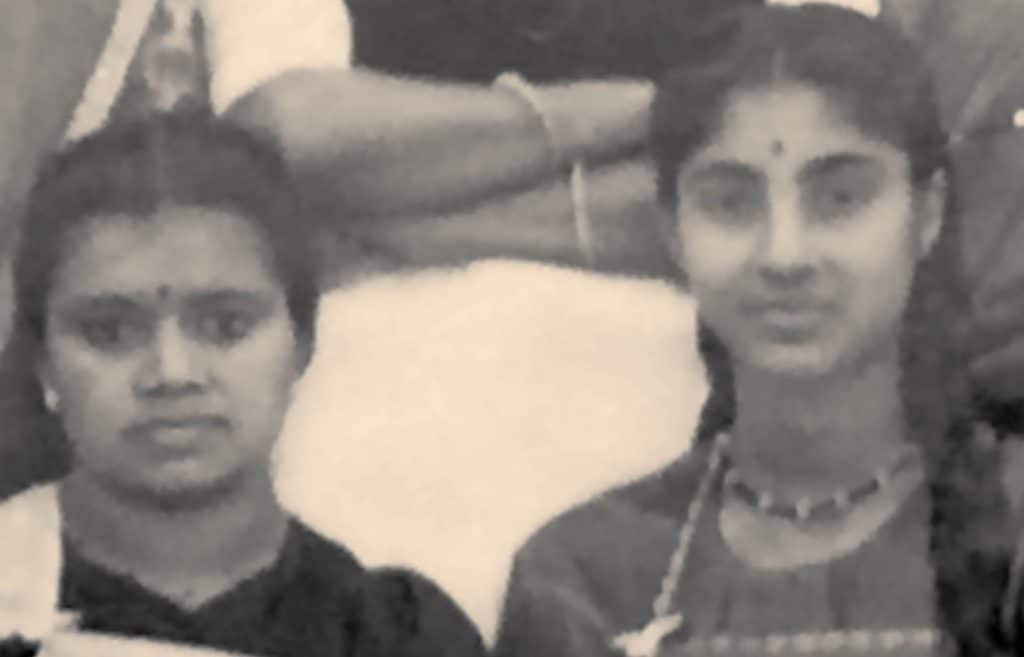
Girija’s friends Bollamma and Dechamma.
My first friend was Cauveriamma from Coorg [now Kodagu] and she introduced me to two girls in the Hostel; Bollamma and Dechamma. Bollamma was plump with twinkling eyes and a dimpled smile.
Dechamma was a beauty with a chiselled nose, arched black eyebrows and dark eyes while her cheeks were tinged with pink. They were friendly and generous, hospitably sharing treats that came from their homes in Kodagu.
The Principal was Jayalakshammanni, an Ursu lady. She was tall with an extremely “fair” complexion. Her natural reserve and imposing personality quelled the pupils without her having to speak at all.
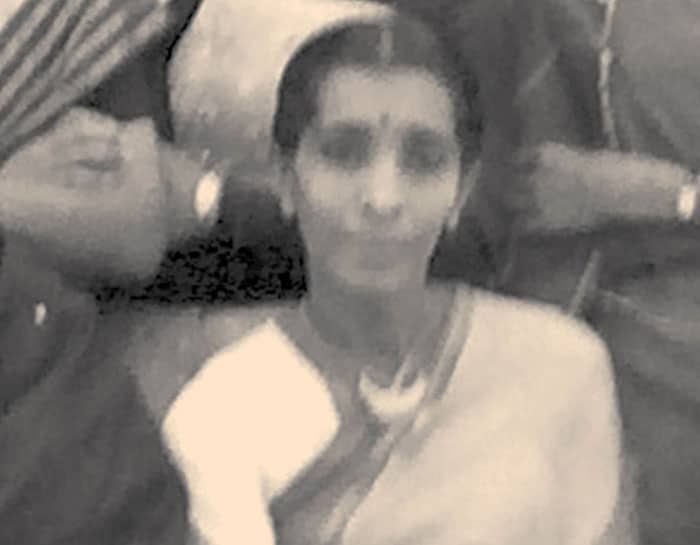
Gangamma, the History Lecturer, presided over the most interesting classes we had. She too was from Kodagu. A slender woman of medium height, she had a remarkable rapport with the class.
Gangamma, the History Lecturer.
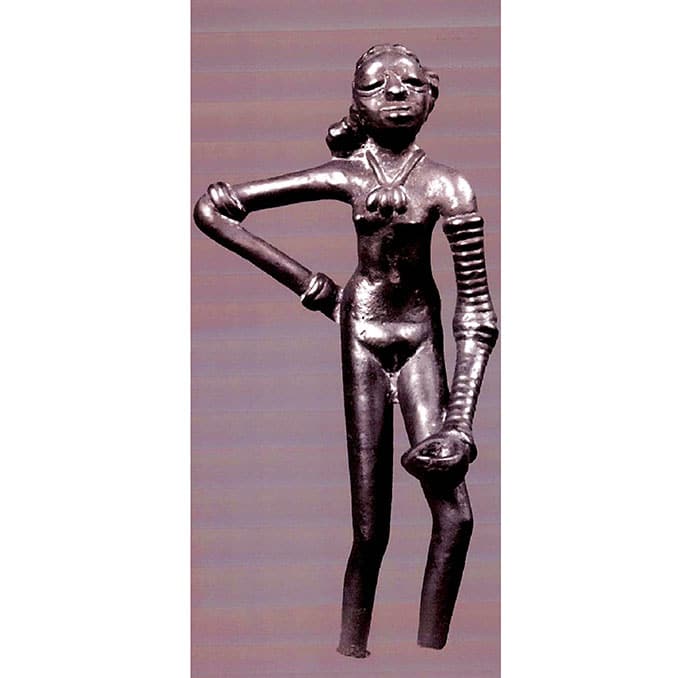
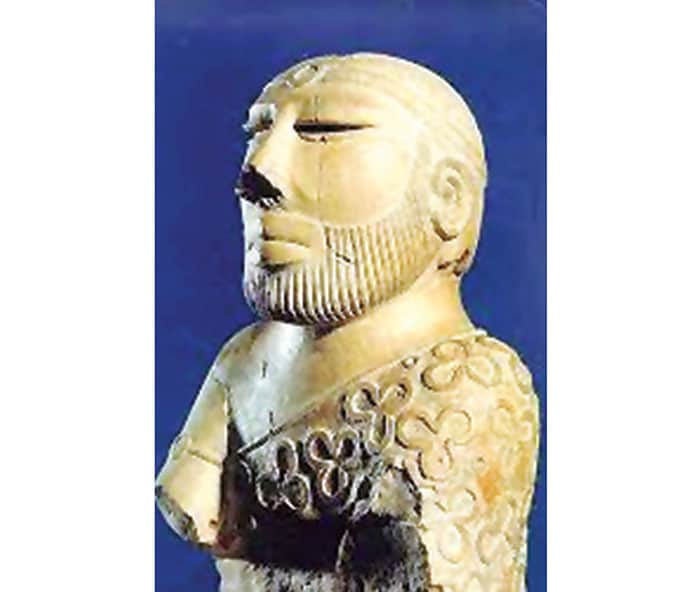
Her tasteful sarees were worn with delicate jewellery; a triangular gold pendant on a thin chain or a double tiger-claw charm, glass bangles which tinkled as she gestured during her spirited lectures. The first lesson was about Mohenjo-Daro. She roused our interest describing the bust of the Priest King of Mohenjo-Daro, his head band, the floral design on his robe. She described the famous “naked” statuette of the Dancing Girl, “She wore no clothes girls, only many bangles!” which brought the house down.
We were required to study Greek and Roman history in addition to Indian history. Even the complicated sagas of the Peloponnesian Wars, the Athenians, Spartans and other warring Greeks were enlivened by her lectures.
Logic was taught to us by H.T. Shanta, who is remembered in Mysore University circles for her erudition in philosophy. She lectured us on subjects like the Fallacies in Logic, giving us a break when the lessons became abstruse or hard to follow. With just ten minutes to the bell, she would relate funny stories or ask a good singer in the class to render a “fillum hit.”
The Dancing Girl.
Once we discussed superstitions; that it is unlucky to walk under a ladder or have a black cat cross your path. The one that appealed to her most had been taught to me by my mother. It was about crows:
“One for sorrow,
Two for joy
Three for a letter
Four for a boy
Five for silver
Six for gold
Seven for a secret never told.”
The English lecturer was Sharada. Pupils who were not proficient in English were in awe of her. After reading a poem aloud, she would ask the student to explain it line by line. I was asked to paraphrase “On Westminster Bridge” by William Wordsworth. Drilled by my mother, I already knew the poem. However, I slipped up when asked the difference between “riot” and “ryot.”
Bust of the Priest King of Mohenjo-Daro.
My second language was Hindi. I was in a class of just a few girls. Our Lecturer, R. Deve Gowda, was a big, swarthy man with crisply curling hair and a strong jaw. He had studied at the Banaras Hindu University. Apart from our serious texts, he would regale us with Hindi Dohas [couplets] from Kabir, Tulsidas or Rahim [the Sufi Abdul Rahim Khan-i-Khanan, 1556-1627, of Emperor Akbar’s court]. A Doha by Rahim on marriage ran like this:
“Rahimanbiyahbiyadi hai, sakuhu to lehubachai, Paayanbediparat hai dholbajai, bajai.” [Rahim says marriage is like an ailment, to be avoided if possible. Fetters are placed on the feet while drums are played]
Recalling it now, I began to wonder if a Sufi mystic really wrote this! The Doha was found by a helpful friend, just as I remembered it long ago…on an Osho blog !
These first two years in the University were the formative ones in our life; honing our talents, channelling our interests in the best direction. Now I see the splendid new Maharani’s College on Valmiki Road. On the pavement there, under green and white striped awnings, flower shops display ready-made bouquets or tubs of gladioli, gerberas, lilies, roses and chrysanthemums.
Until the pandemic, the bright faces of the girls going home from class and their colourful attire were a counterpoint to the floral colours. I hope that the hopes and ambitions of these young Indians are realised. Decades hence may they also think back on their days in Maharani’s College with pleasure as I do.
source: http://www.starofmysore.com / Star of Mysore / Home> Feature Articles / byGirija Madhavan / June 14th, 2021
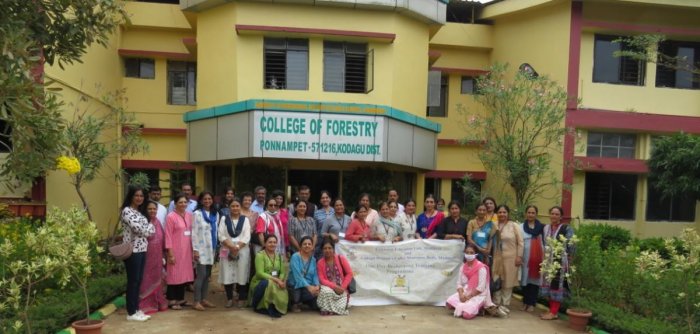
Participants at the training programme on apiculture at the College of Forestry in Ponnampet.
Apiculture helps in increasing the production of coffee and other crops, said College of Forestry head Dr Cheppudira G Kushalappa.
He was speaking during apiculture training organised by the University Of Agricultural and Horticultural Sciences and Kodagu Women’s Coffee Awareness.
There are ample opportunities for apiculture in Kodagu. The beekeeping should be taken up scientifically, he added.
Stating that honey production has declined in the district, he said there is a need to create awareness on apiculture.
Kodagu Women’s Coffee Awareness secretary Anitha Nanda said there is a need to concentrate on apiculture along with coffee plantation.
Dr R N Kenchareddy, the college extension wing head, said, “Those interested in apiculture will be given three months training. They will be given Rs 7,500 as allowance.”
source: http://www.deccanherald.com / Deccan Herald / Home> State> Mangaluru / by DHNS, Ponnampet / January 17th, 2021
Coorg Public School & Pre-University College has secured 100% results in the II PU Board Examination the results of which were announced recently.
The college authorities said the hard work and perseverance of the students coupled with expertise of the teachers who were relentless in ensuring support round-the-clock helped the students to notch up impressive scores and 19 students secured centum in various subjects.
Out of 61 students, 43 have achieved distinction, 17 students secured first class and 1 student secured a second class, the release added.
source: http://www.thehindu.com / The Hindu / Home> News> National> Karnataka / by Special Correspondent / Mysuru – June 22nd, 2022
WELCOME. If you like what you see "SUBSCRIBE via EMAIL" to receive FREE regular UPDATES.
Read More »