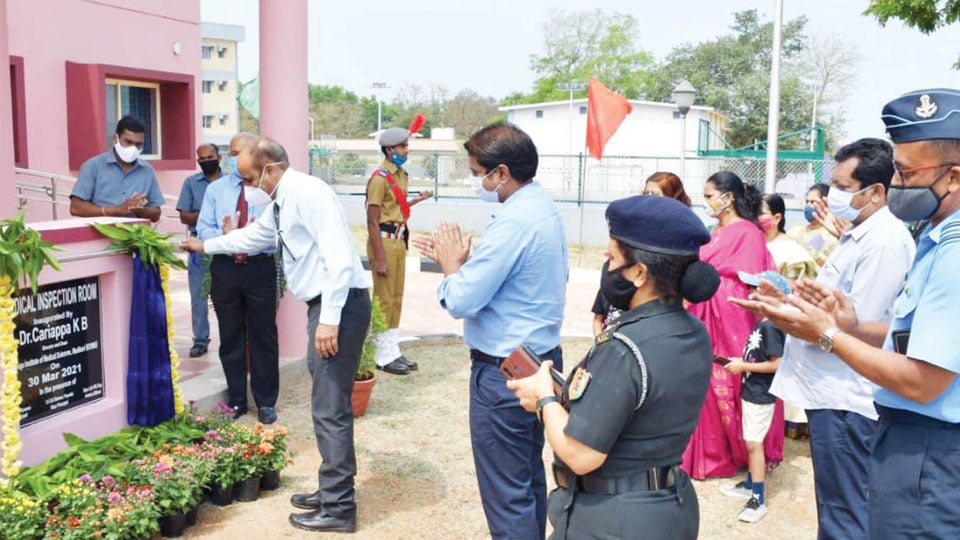
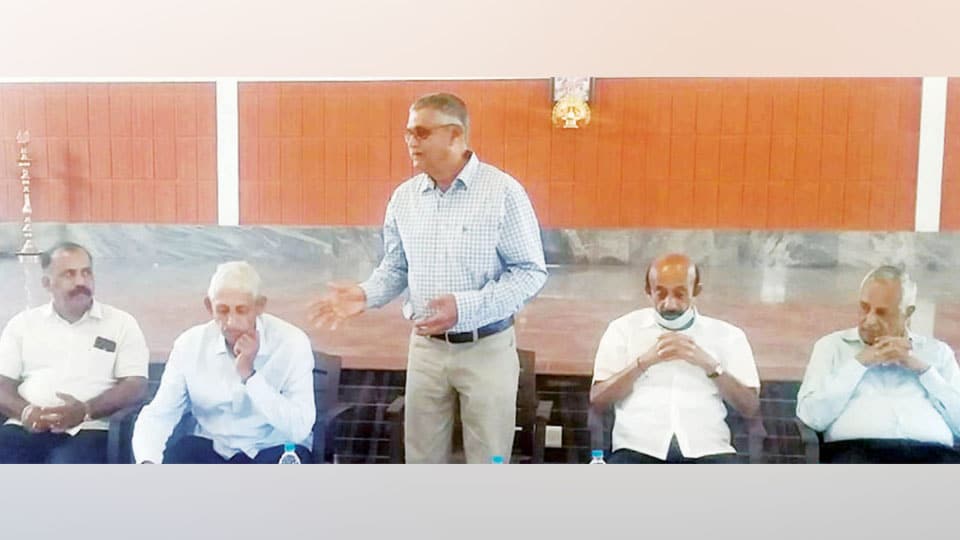
Dr. K.B. Cariappa, Director and Dean, Kodagu Institute of Medical Sciences, Madikeri, inaugurated Mother Teresa Medical Centre, school’s medical inspection room at Sainik School in Kodagu on Mar.30 in the presence of Dr. K. Mohan, District Health Officer, Kodagu and Dr. Rupesh, Resident Medical Officer.
Speaking on the occasion, the chief guest lauded the Sainik School set up and encouraged the cadets to imbibe leadership qualities to join Indian armed forces and strive to transform this vision into reality.
He also recalled the legendary military leaders like Field Marshal K.M. Cariappa and Gen. K.S. Thimayya and their military achievements.
The school medical inspection room with the presence of nursing assistants caters in ensuring health of the cadets. Detailed medical history charts are maintained for individual cadets and an accurate periodical record of height, weight and chest measurements is also maintained.
CBSE’s latest initiative mandates Health and Physical Education (HPE) subject to all cadets. The school medical inspection room is a repository of cadets’ medical history and a learning centre too. It helps cadets to learn and maintain hygiene, educate the importance of nutritious food and significance of physical exercises.
Dr. K. Mohan, District Health Officer (DHO), Kodagu, inaugurated Reverse Osmosis (RO) Plant at the school campus.
Col. G. Kannan, Principal, Priya Kannan, the first lady of the school, Lt. Col. Seema Tripathi, Vice-Principal, Sqn. Ldr. R.K. Dey, Administrative Officer, Sangeeta Dey, Dr. H. Mahesh, School Medical Officer and S. Suryanarayana, Senior Master, staff and cadets were present on the occasion. All safety measures including wearing mask and social distancing were followed during the event.
Cdt. M.G. Apoorv was the master of ceremony. Cdt. R. Shashank and Cdt Harsharaj spoke on Mother Teresa’s contribution to humanity and Reverse Osmosis (RO) respectively.
source: http://www.starofmysore.com / Star of Mysore / Home> News / April 11th, 2021
During the lockdown situation, when the world took the virtual path, Yashmi was introduced to the UN Ocean Decade Summit and she took part in the virtual programs conducted by the initiative.
Manavattira Yashmi Dechamma
Madikeri :
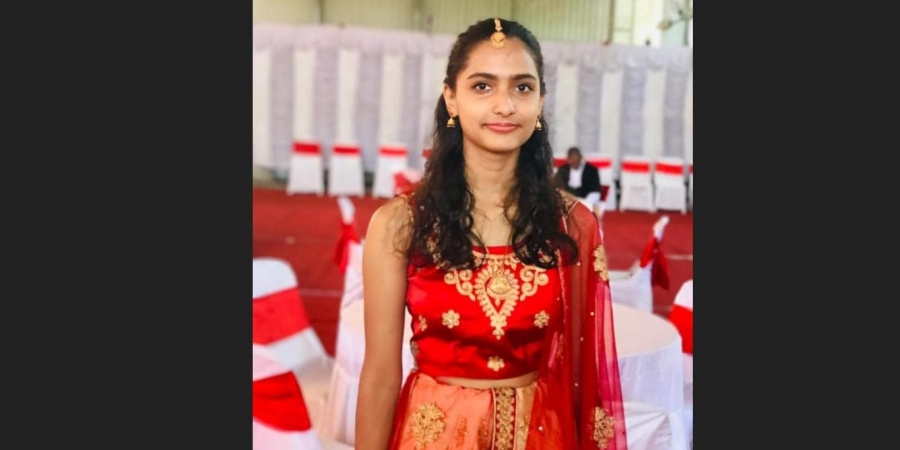
“The earth is already in a bad state and it will be inherited by us tomorrow. We want to breathe the same pristine air that our grandparents breathed,” shared Manavattira Yashmi Dechamma, a ninth-grade student who has been selected for the UN Ocean Decade Summit to be hosted in Hawaii soon.
Yashmi earned this opportunity after her video documentary on the theme ‘Water is sacred’ won the H2021 Water Summit storytelling contest in the 13-17 age group category.
A native of Nelaji village in Kodagu, Yashmi is currently pursuing her studies in Acharya Vidya Kula in Mysuru.
During the lockdown situation, when the world took the virtual path, Yashmi was introduced to the UN Ocean Decade Summit and she took part in the virtual programs conducted by the initiative.
“While I was aware of climate change, I learnt from speakers all across the globe about what climate change did to the earth. I knew that the earth was in danger. But I obtained clarity on the growing problem after attending the virtual summit,” shared Yashmi.
She was then introduced to the H2021 Water Summit where she attended virtual sessions for four consecutive weekends and it is here she learnt about the storytelling competition.
“Each session was based on a particular theme. The theme ‘Water is sacred’ was close to me as I am from the Kodava community and we worship River Cauvery,” she shared. Yashmi visited Kodagu and shot some beautiful captures of River Cauvery.
With a Kodava song playing in the background of the video, she has highlighted the sorry state of the river today – which has become a victim of pollution.
The video then moves to highlighting the efforts from the youngsters in reviving the river and the documentary ends with a strong message ‘Let us heal her (River Cauvery) and not fix her’.
“I have heard my mother explain the beauty of Kodagu that existed during her childhood times. The district witnessed heavy rainfall then too. However, it is only now that the incessant rainfall is causing destruction and damage. The summits I attended helped amplify my voice and I shot the video with the support from my cousin Bhuvana Nanaiah and her father Nanaiah,” explained Yashmi.
Daughter of Manavattira Kushalappa and Nalini, Yashmi looks forward to strengthening the Youth Advisory Council in the country and has written to the concerned about her vision for a better future.
source: http://www.newindianexpress.com / The New Indian Express / Home> Good News / by Prajna GR / Express News Service / March 31st, 2021
Stressing on the need for more reservation for women in education and in the job sector, Dr Parvathi said that girls should not be deprived of education
Participants at the International Women’s Day programme organised by Karnataka Kodava Sahitya Academy and Aimanda Pommakkada Koota, in Maragodu village. Credit: DH Photo
Education becomes more meaningful if it instils cultural values among students, opined Karnataka Kodava Sahitya Academy chairperson Dr Parvathi Appaiah.
She was delivering the keynote address during the International Women’s Day programme observed by Kodava Sahitya Academy and Aimanda Pommakkada Koota, in Maragodu village recently.
Stressing on the need for more reservation for women in education and in the job sector, Dr Parvathi said that girls should not be deprived of education.
Madikeri Government First Grade College lecturer Bodukuttada Radhika Kuttappa said education alone can bring positive development among girls.
During the session, Taluk Panchayat former president Revathi Parameshwar spoke on ‘Kalakottaneke Pommakkada Badkal Badalavane’.
Aimanda Divya presented her views on ‘Kodagra Samskruthi, Samkraratha Bolachel Avvangada Pathra’.
Books and CDs brought out by Kodava Sahitya Academy were kept for exhibition and sale.
As part of the cultural programmes, students from Kaveri Degree College, Gonikoppa, members of Aimanda Pommakkada Koota and dance troupes from Virajpet performed dances on the occasion.
The best performances were awarded cash prizes, sponsored by Non-resident Indian Aimanda Jagadish.
Prior to the programme, office-bearers of Aimanda Pommakkada Koota and Kodava Sahitya Academy took out a cultural procession in the town.
Pommakkada Koota president Pushpavathi, Maragodu Gram Panchayat president Ayyandra Poornima Shrinivas, academy member Gowramma Madammaiah, academy former president Rani Machaiah, former principal Dr Pushpa Kuttana, academy members Babbira Saraswathi, Prabu Kumar and registrar Ajjikuttira Girish were present, among others.
source: http://www.deccanherald.com / Deccan Herald / Home> State> States> Karnataka Districts / by DHNS, Madikeri / March 14th, 2021
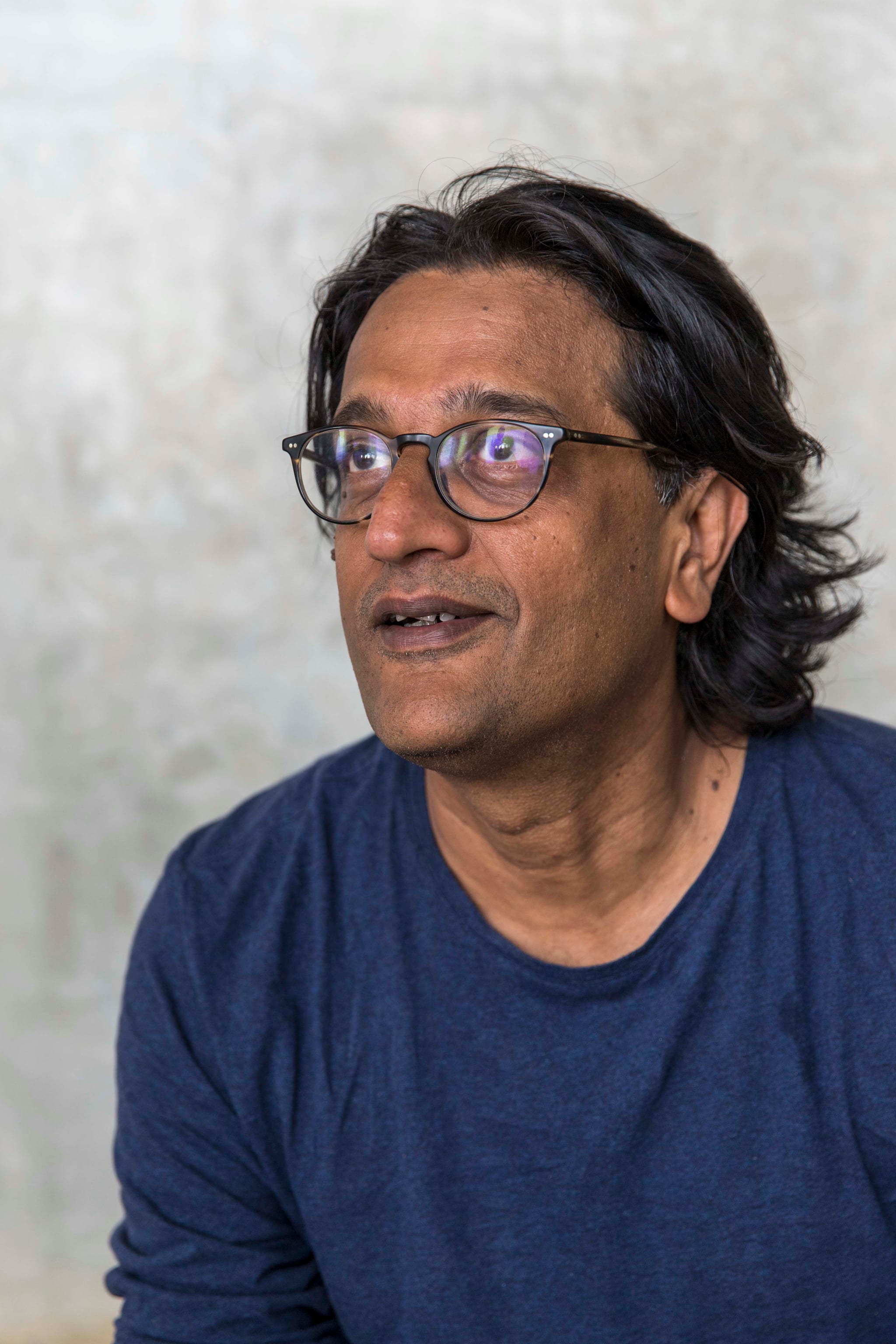
Kumar worked with adivasis in Andhra’s Araku Valley for decades, grew coffee of the highest quality and took it to Paris in 2017. On March 19, Araku Coffee opened its first café in India in Bengaluru. Kumar wants to replicate the Araku model for other crops as well, he tells us how
Cafe L’Orange
In the late 1990s, the late Kallam Anji Reddy, founder-chairman of pharmaceutical company Dr Reddy’s Laboratories, appointed developmental economist Manoj Kumar as the head of his NGO, the Naandi Foundation. Kumar’s brief was to foster sustainable livelihoods in rural India.
One of the many projects Kumar embarked on in the early 2000s was to get adivasi farmers in Andhra Pradesh’s Araku Valley to grow specialty coffee, which, simply put, is organic and sustainably grown coffee of the highest quality. To many people, it appeared to a quixotic endeavour. Araku was not a traditional coffee-growing region. Kumar, who grew up in Kerala drinking kattan kaapi, the traditional home-brewed black coffee, had no real knowledge about coffee; and the Araku Valley had been riddled with Naxal insurgency for decades. Kumar worked with, and lived among, the tribals for over a decade and through biodynamic farming and the formation of an adivasi cooperative, one of the world’s largest fair-trade and organic certified cooperatives, he achieved the seemingly impossible.
In 2017, Kumar opened the first Araku Cafe and store in Paris and about a year later, Araku Coffee bagged top honours for the best coffee pod at the prestigious Prix Epicures OR awards in Paris. On March 19, Araku opened its first cafe in India. The 6000 sq ft, two-level flagship cafe in Indira Nagar in Bengaluru features, among others, an in-house roastery, the country’s first Specialty Coffee Association-certified Coffee Academy, a book store, and food that is sustainably procured.
In an interview to Moneycontrol, Kumar talks about the growing interest in specialty coffee in India, its transformative potential, and about replicating the Araku model in other parts of the country. Edited excerpts:
How do you see Araku’s flagship cafe take the specialty coffee story forward in India?
By and large, the production of specialty coffee in India has so far been almost nil, barring a few micro estates. We have been a notable exception. Our success has made coffee growers realise that it is possible to get much higher value and definitely profits if they can elevate their coffee to the level of a specialty coffee. I’m hoping that this desire to excel will be infectious to the community of coffee growers in India. They could learn to look at coffee as being more than just an average-to-poor-quality mass-produced commodity, which is neither financially rewarding nor sustainable. We are blessed to have the climate and topography to grow coffee. Europe and most of the coffee-drinking nations don’t grow coffee. I see our cafe in Bangalore as a place where people can interact and learn more about the power of specialty coffee. And we would want to take it beyond producers to policy makers and to everyone through a consumer movement to inculcate a certain pride in the opportunity we have to make coffee a profitable Indian-origin commodity and revive India’s agriculture to an extent. Araku is not a traditional coffee-growing region, and yet we have grown world-class coffee there. So, you can imagine the potential of places such as Chikmagalur and Coorg…
Tamagoyaki Toastie is on the menu of Araku’s café in Bengaluru.
Have you met people from the coffee-growing community who want to get into specialty coffee?
Absolutely. When we started the Araku journey, we had only between 10 percent to 20 percent of farmers whose coffee could be rated as specialty coffee. Today, I have 80 percent of my farmers all growing specialty coffee. I have requests from many small estate and large estate owners, and even people who are into wine now want to know if we can help them with the same regenerative agricultural practices that made our coffee world-class.
Araku Coffee co-founder Manoj Kumar
You’ve been to specialty coffee hotspots across the world. How have your experiences shaped the flagship store?
Scandinavia inspired me a lot. The quality of service there was based predominantly on knowledge. Every brewer, roaster, and barista I met had a completely different level of knowledge and that knowledge was shared with the customer. A relatable example would be going to an Apple store for the first time and discovering that every staffer has an in-depth knowledge about the products. So, one of the things I took away from there was that our team had to be knowledgeable about what they were selling, even if it meant setting up a coffee school at the cafe. Our team is not just selling a random service, they are selling coffeeology. And our prices are extremely competitive. Somebody even mentioned that a lot of the coffee we serve is, more or less, the same price as the coffee you get at Starbucks.
The Naandi Foundation has been at work replicating or adapting the Araku model in other parts of India. How has that worked out?
The Naandi Foundation is now massively expanding its agricultural footprint. We are now in a large way expanding into Wardha and the Vidarbha region, replicating the Araku model with other crops. We started off with pomegranate and that is very much on track but we are also exploring or expanding into other portfolios. Turmeric in that region is world-class, and it has a Geographical Indication tag. Then, we looked at red gram and other pulses. The idea is to have a bouquet of produce for the farmer to get it to be profitable and to identify one or two which become unique to that region. I think the winners here will be turmeric, pulses, and organic cotton. We are also looking closely at working in Meghalaya and Kerala and the Konkan belt.
You first went to the Araku Valley in 2001. Looking back, which was the turning point of your journey?
I’d think earning the trust and respect of the tribals was the turning point. I had started with just 1,000 farmers, and I would tell them that one day their land would produce a coffee that would be world-class. And they would always tell me that they wouldn’t let me down. That kind of love and trust from their end really made all the difference.
MURALI K MENON works on content strategy at HaymarketSAC.
source: http://www.moneycontrol.com / MoneyControl / Home> News> Trends> Features / by Murali K Menon / March 20th, 2021
The project has been launched for the first time in the country on an experimental basis by the Khadi and Village Industries Commission with support from the management of Ponnampet Forestry College.
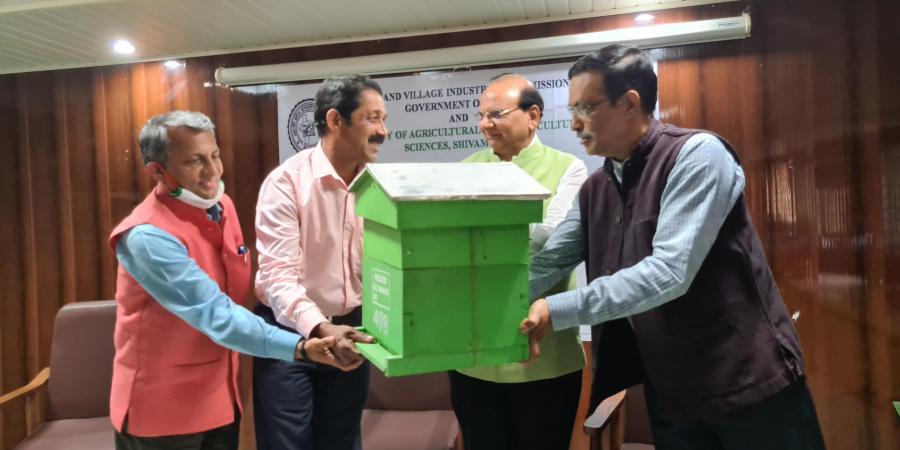
Beekeeping equipment distributed to a farmer during the event (Photo | Special arrangement)
Madikeri :
A research project to reduce human-elephant conflict with the help of honey bees was inaugurated at Ponnampet Forestry College in Kodagu on Monday. The project has been launched for the first time in the country on an experimental basis by the Khadi and Village Industries Commission (KVIC) with support from the college management.
RE-HAB — Reducing Elephant Human Attack by using Bees — aims at controlling wild elephant movement into villages by roping in honey bees. The success of the initiative will be monitored regularly to launch it across the country. A total of three elephant conflict places have been chosen in Kodagu district including two at Nagarahole Sanctuary and one at Thora village in Virajpet where a total of ten beehive boxes have been placed across the forest fringe. The boxes have been placed approximately at eight feet distance and tied using a fence rope. This set-up will act as an elephant conflict mitigation measure.
The project was launched by KVIC Chairman Vinay Kumar Saxena at Ponnampet Forestry College. “In 2017, the Sweet Revolution was launched in the nation to promote apiculture. Beekeeping has many benefits and a farmer can earn from the bee wax, royal jelly and bee venom apart from the honey extraction. Further, beekeeping enables cross pollination and increases the income of a farmer by 30%,” he said.
Saxena explained that states with high elephant populations are spending crores on solving the human-elephant conflict and added, “Many of the mitigation methods to control the conflict are unscientific. The research project of RE-HAB will be monitored regularly and, if successful, will be implemented across the country.”
He said that the RE-HAB project will create a sustainable employment opportunity in beekeeping while also fighting the elephant conflict ecologically. Dr Kushalappa, the dean of the Forestry College, reckoned that the project will enable integrated farming while controlling the elephant menace.
Alongside launching the project, a total of 50 beneficiaries were given bee colonies and beekeeping equipment by KVIC to promote apiculture in the district. Dr Sudarshan of KVIC said, “We are finding a physical solution to an ecological problem. Nature must work with nature and the RE-HAB will work at a low cost.”
source: http://www.newindianexpress.com / The New Indian Express / Home> States> Karnataka / by Prajna GR / Express News Service / March 15th, 2021
During a picnic, some students who went for a swim in the Cauvery were pulled by the water currents. Lenin Bopanna managed to save the lives of four students but drowned in the process.
Lenin Bopanna
Madikeri :
A student who drowned saving the lives of his schoolmates was posthumously honoured with the Hoysala Shaurya Award by the Women and Child Welfare department. The award was received by the boy’s parents at a ceremony hosted in Bengaluru.
Lenin Bopanna was a student of Lion’s School in Kalathmadu village near Gonikoppal. In March last year, 39 students of the school from the Scouts and Guides team had visited the popular tourist destination of Dubare Camp for a picnic.
However, a tragic event unfurled as some students who went for a swim in the Cauvery river were pulled by the water currents. Lenin Bopanna managed to save the lives of four students during the incident but drowned in the process.
The son of Madeera Harish and Kavitha of Hysodluru village, Lenin was nominated for the award with the help of state Scouts and Guides Commissioner PGR Sindhya. Lenin’s father Harish said that his son received the award for his bravery following the efforts of Sindhya and the principal of Lion’s School.
source: http://www.newindianexpress.com / The New Indian Express / Home> States> Karnataka / by Express News Service / March 10th, 2021
Kodagu does not have appropriate or adequate sports infrastructure though the tiny district has produced innumerable sporting icons over the years. Hence, the Union Government must establish a Sports University in Kodagu to give a platform for thousands of emerging sportspersons from Kodagu and also to encourage sportsmen from other districts of Karnataka.
This demand emerged at a meeting of Federation of Kodava Samajas at Balugodu Samaja premises near Virajpet recently. Explaining the need for a Sports University in Kodagu, the participants of the meeting said that Kodagu district had contributed thousands of sportspersons to the State and to the Nation.
Every village in Kodagu has sports talents in abundance but the budding sportspersons lack encouragement, state-of-the-art facilities and professional training. This way, several sports talents are being ignored, speakers at the meeting said.
Over 50 players from Kodagu have represented Indian hockey team till date. Not only hockey, the district has produced brilliant sportspersons in other disciplines like athletics, tennis and badminton too. Hockey is encouraged in Kodagu with many tournaments including Kodava Hockey Festival taking place around the year. But other sports lack facilities and encouragement.
Kodagu has sports hostels but the facilities available are not adequate. There is a potential for swimming, squash, kabaddi, badminton champions to emerge from the district if proper training and facilities are given, the speakers said.
If at all the Sports University is established in Kodagu, there will be many state-of-the-art stadiums, and training camps can be conducted by Karnataka State Olympics Association.
“The Central Government is enthusiastic about starting a Sports University in Mizoram. As Kodagu has given innumerable sports achievers to the nation, we must ask for a Sports University to our district,” they said.
Establishment of such a University will enable youngsters and emerging sports champions from Kodagu to experience high level competition where national players and international legends and coaches will come to Kodagu and interact with young talents here.
The meeting resolved to urge the Union Government to establish a Sports University in Kodagu. Former Minister Meriyanda C. Nanaiah, Federation President Kallichanda Vishnu Cariappa, Joint Secretary Mederira Naveen, former President Mallengada Dada Belliappa and others were present.
source: http://www.starofmysore.com / Star of Mysore / Home> News / March 13th, 2021
Litterateur Kechamada Subbamma Thimmaiah (Pullangada), wife of late Kechamada Thimmaiah, a senior Kodava litterateur and a recipient of ‘Chutuku Ratna’ State Award, passed away yesterday. She was 91.
A native of Kanur village and a retired teacher, she was the Chairperson of the 12th District Kannada Sahitya Sammelana held at Ponnampet.
She has written many books in Kannada and Kodava languages. She leaves behind two sons and a host of relatives and friends.
Last rites were performed at Kanur village yesterday, according to sources.
source: http://www.starofmysore.com / Star of Mysore / Home> Obiturary / February 14th, 2021
Minister for Cooperation S.T. Somashekar, Minister for Urban Development B.A. Basavaraj, and Appachu Ranjan, MLA, during their visit to the Sainik School in Kushalnagar on Tuesday. | Photo Credit: Special Arrangement
It was flooded after heavy discharge from Harangi dam in 2018
A sum of ₹5 crore has been sought for the development of Sainik School at Kushalnagar that faced flooding during heavy discharge from Harangi Dam in 2018, the year when Kodagu witnessed its worst floods and landslides.
Minister for Cooperation S.T. Somashekar and Minister for Urban Development B.A. Basavaraj, along with Madikeri MLA Appachu Ranjan, on Tuesday visited the Sainik School. The school authorities told the Ministers about the problems the school faced during Kushalnagar floods.
Principal Kannan explained to Mr. Somashekar the damage caused from the floods in 2018 and sought support for the school’s development.
Mr. Somashekar immediately telephoned Additional Chief Secretary of Irrigation Rakesh Singh, and explained to him the issue.
Mr. Somashekar sought ₹5 crore for taking up development works by the school. “The ACS has responded positively to the appeal,” according to the Minister.
source: http://www.thehindu.com / The Hindu / Home> News> States> Karnataka / by Special Correspondent / Mysuru – February 16th, 2021
Years after it was formed, the Kodagu Institute of Medical Sciences at Madikeri, the District Headquarters, has been granted permission by the Government for introducing B.Sc Nursing Course. The course was a long-standing demand from the people of Kodagu, which did not have any medical institute until 2014, when the Medical College was announced.
Following the sanction for starting the much in demand B.Sc (Nursing), the Medical College has begun preparations for admitting 100 students in the current academic year. As all the 100 seats are under Government quota, the students have to get admission through counselling from Karnataka Examinations Authority.
The construction of the building for Kodagu Institute of Medical Sciences began in 2014 and was completed in 2016. At present, there are 750 students in the College studying for MBBS course and the District Hospital, which has been attached to the Medical College, has been recently upgraded.
Medical College Dean Dr. Cariappa said that with the Government granting permission for B.Sc Nursing, the classes will begin from this year itself. Pointing out that there are 100 seats for B.Sc Nursing, he said that this is a four-and-half-year course. The College has recruited teaching and non-teaching faculties and classes are expected to commence soon, he added.
Madikeri MLA Appachu Ranjan said that the Government was appealed last year to start Nursing Course in the Medical College. The Government has now granted permission and the course will commence this year itself. However, a meeting of Medical College authorities and Health Department officials will be held shortly to decide on the place where classes will be held, he added.
Virajpet MLA and former Assembly Speaker K.G. Bopaiah said that the Health Minister was appealed to start B.Sc Nursing when he last visited Kodagu. This apart, the Chief Minister too was appealed to start the course.
Now, responding to our appeal, the Government has granted permission for Nursing course and classes are expected to commence soon, he pointed out.
source: http://www.starofmysore.com / Star of Mysore / Home> News / February 22nd, 2021
WELCOME. If you like what you see "SUBSCRIBE via EMAIL" to receive FREE regular UPDATES.
Read More »