Category Archives: Agriculture

Tata Open Maharashtra: Bopanna-Ramkumar lift men’s doubles trophy

The second-seeded Indians erased the first set deficit to win 6-7(10) 6-3 10-6 in one hour and 44 minutes.

Pune: Indian duo Rohan Bopanna and Ramkumar Ramanathan pose with the trophy after defeating Australia’s Luke Saville and John-Patrick Smith to clinch the title at the Tata Open Maharashtra Tennis Tournament, at the Balewadi Stadium in Pune (source: PTI)

India’s Rohan Bopanna and Ramkumar Ramanathan won their second ATP World Tour title together after pipping the top seeded Australian pair of Luke Saville and John-Patrick Smith in the final of the Tata Open Maharashtra, on Sunday.

The second-seeded Indians erased the first set deficit to win 6-7(10) 6-3 10-6 in one hour and 44 minutes.

Bopanna and Ramkumar had combined as a team on the ATP Tour for the first time at the Adelaide event last month in the run-up to the Australian Open and won the trophy.

For Bopanna, it was his 21st ATP doubles title while for Ramkumar it is his second trophy at this level and it will push him inside doubles top-100 for the first time in his career.

They split USD 16370 as prize money and earned 250 ranking points each.

Bopanna had won this event with compatriot Divij Sharan in 2019.

Still going strong at an age of 41, Bopanna said it’s his years of playing experience that is helping him out in the circuit.

“A lot is to do with experience, which you really bring in, years and years of experience and the biggest thing is my body is feeling very very good at the moment,” Bopanna said after the match.

“I did a lot of yoga which has helped me tremendously and I am very thankful to my Yoga Teacher (Mohan) in Bangalore which has made such a difference for me and I can try something new at this age.

“It has made a difference and that really shows as long as I am playing matches, competing and doing something that is physically appealing. May be at the practice court I may not be giving my 100% but as long as I am feeling good and go out their and enjoying the pace as currently right now.”

Asked to compare the two titles that they have won together, Bopanna said performing before the home crowd was tough while in Adelaide no one watched them.

“Both are extremely special but anytime you win a title at home it’s lot more pressures. In Adelaide no one was really watching, but here there were lot more expectations and especially coming here with a win people expected an automatic win which wasn’t easy but at that tie break the crowd really helped.

“You just get that extra boost, that extra energy. Even if your legs are feeling tiered that’s the energy you need to hit the serve especially for me. Winning in India is always especial and especially with an Indian partner is truly truly great.

Ramkumar said he now wants to play ATP 500 event in Dubai and for that wil try to do well in the the upcoming two Challengers in Bengaluru.

“Let’s see if there is a chance to get in Dubai and hope I can play that,” said the 27-year-old.

Ramkumar said everyone believed in his game and that gave him confidence in this tournament.

“Coming from Bops (Bopanna) who always believes in me, my coaches and every one who have always believe in me and said you play well and that just keeps me going.

“I just have to work on a few thing on court and just keep competing at this level as much as I can which will improve my game and automatically the ranking,” he said.

Big serves marked the beginning of the contest with only Ramkumar and Luke losing a point each in the first four games.

Bopanna’s volley error on a return from Luke made it 30-all in the fifth game but Ramkumar pulled off an ace and followed that up with another huge serve to hold for a 3-2 lead.

The Indian team had got a chance to break Patrick-Smith’s serve in the next game when Luke made an error while attempting an overhead volley at 40-30 but the opportunity could not be utilised as the Australian pulled of a big serve on the deuce point.

The Australians also created break opportunity on Ramkumar’s serve in the ninth game when they found two service return winners and the Indian serving a doubler fault at 40-30 but the home team managed to hold.

A comfortable hold at love by Patrick-Smith made it 5-5.

Eventually a tie-break was required for deciding the first set. Both the teams had a number of set points as the Indians squandered two chances and the Australians three before converting their fourth.

They got the chance when Bopanna made an unforced error at 10-all and Ramkumar netted a forehand on set point.

In the second set, the Indian duo needed a good start and they got it by breaking Luke’s serve in the third game when the Australian made a volley error on deuce point.

Bopanna saved a break chance on his serve in the next game to keep their nose ahead. Patrick-Smith was serving to stay in the set in the ninth game and was broken to allow the Indian team force a Super Tie Breaker.

At 30-all, an engrossing rally ensued between the two pairs. Luke blinked to give Indian first set point which they converted when Bopanna dispatched a volley winner with ease.

Bopanna and Ramkumar dominated the STB to secure the title.

source: http://www.indianexpress.com / The Indian Express / Home> Sports> Tennis / by PTI / February 06th, 2022

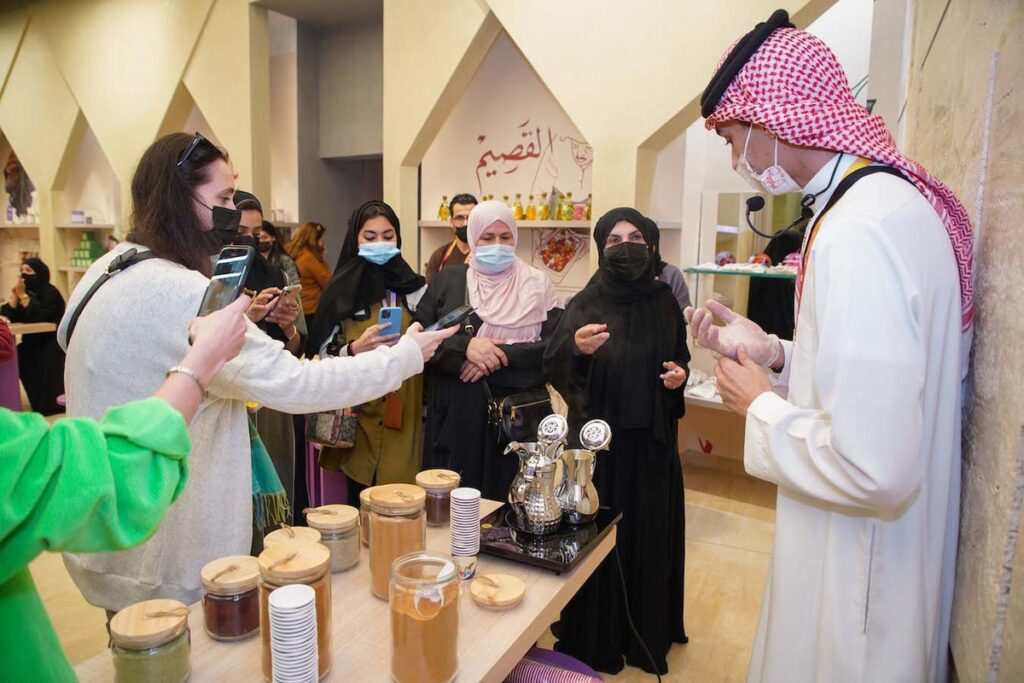
Saudi pavilion launches Coffee Week at Dubai’s Expo 2020

The event runs until Jan. 29. (Supplied)

Dubai : 

The Saudi pavilion at Dubai’s Expo 2020 Dubai on Tuesday launched Saudi Coffee Week, a five-day event to celebrate the country’s coffee culture.

Running until Jan. 29 from 3:00 to 9:00 p.m., the series features daily activities to inspire and educate visitors on the Kingdom’s coffee traditions that form an essential part of its culture. 

The event will also host two workshops at Sard Café to help guests learn the art of making Saudi coffee. (Supplied)

This includes showing casing a variety of coffee-making and brewing techniques, as well as tasting experiences.

The event will also host two workshops at Sard Café to help guests learn the art of making Saudi coffee.

The pavilion also features booths from Ethiopia, Colombia, Honduras, Panama, and Australia at the Open Square to familiarize visitors with traditions of other countries. 

source: http://www.arabnews.com / Arab News / Home> Lifestyle / January 26th, 2022

Karnataka government sends a reminder on retaking 1200 acre land developed by Tata as a tea estate in Kodagu

The land will soon be reclaimed in accordance with the state orders and will be handed over to the forest department to be developed as a reserve forest area.

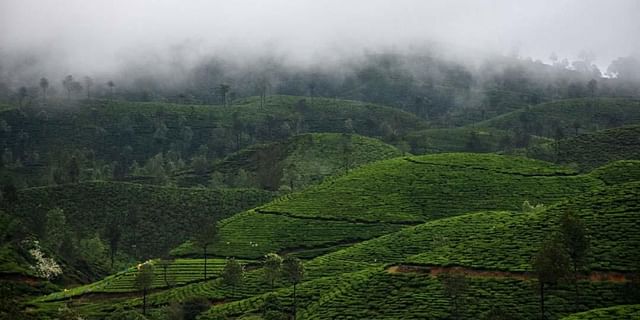
Image for representational purpose only. ( File | EPS)

Kodagu :

The Ponnampet Tahashildar has sent an official reminder letter to the forest department for taking possession of the 1203 acre land developed by Tata Company as a tea estate in Kodagu.

The land will soon be reclaimed in accordance with the state orders and will be handed over to the forest department to be developed as a reserve forest area.

In the letter dated December 20, Tahashildar Yogananda has mentioned the handing over of 1203 acre land across survey numbers in Hysodluru, Poradu, West Nammale, and T Shettigeri villages of Ponnampet taluk to the forest department. 

The 1203 acre land was leased to Tata Coffee Limited Company and since the period of lease of 99 years has been completed, the same needs to be handed back to the department as a reserve forest area.

In 1914-1915, Mac Dogal Glenlora Limited leased nearly 1300 acre paisari land from the then British Government for a period of 999 years. This leased land was handed over to Tata Coffee Limited (then known as Consolidated Tea Company).

The timber in the paisari land was cleared to make way for a coffee and tea estate and the land was changed from ‘paisari’ to ‘Reedemed Sagu’. 

However, the state argued that the land tenure was changed without the notice of the government and the tenure was a reserve forest area.

Further, while the land was leased by the then British government for 999 years, the same agreement was changed in 1940 by the then Coorg Commissioner to 99 years. Following this, notices are said to have been served to the Tata Company for handing over of the land even as the company approached the Court stating that the change in revenue documents from Redeemed Sagu to Reserve Forest land was done illegally by the government. However, the state argued that the Tata Company had illegally changed the tenure to Redeem Sagu.

The case was heard recently at the Virajpet Court and the Senior Civil Judge, MG Lokesh had disposed of the case on December 3  stating that the plaintiffs have to approach the revenue authorities and this cannot be decided in civil court. It stated that the revenue authorities or the Government can decide regarding this issue. However, the government had sent an order for acquiring the lands in 2012, which was then questioned by the company in the court.

After the court hearing, the Kodagu revenue authorities have followed the earlier government order defending the change of tenure from ‘Reedem Sagu’ to reserve forest and the Ponnampet Tahsildar Yogananda has now passed an order for reacquiring of the 1203 acre reserve forest land from the company.

“We have received the official letter from the tahsildar and steps will be taken to begin the acquiring process,” confirmed Chakrapani, Virajpet DCF. 

source: http://www.newindianexpress.com / The New Indian Express / Home> States> Karnataka / by Pragna GR, Express News Service / December 21st, 2021

Post Graduate Diploma in Coffee Quality Management at Coffee Board: Apply by Dec 1

coffee

Coffee Board, No.1, Dr.B.R.Ambedkar Veedhi, Bengaluru-560 001 has invited applications for admission to the Post Graduate Diploma in Coffee Quality Management (PGDCQM) for the academic year 2021-22, instituted to support the requirements of the Indian coffee industry for trained personnel with the specific knowledge and skills required to function as coffee tasters.

Course content include Coffee cultivation practices, Post-harvest management and practices, Coffee Quality Evaluation, Roasting and brewing techniques, Marketing and Trade, Quality assurance systems (Theory and Practical sessions).

The course duration is 12 months in 3 trimesters conducted in English. Free accommodation will be provided only during the first trimester at CCRI, Balehonnur, Chikmagalur.

Admissions open to candidates from open category and preference is given to those sponsored by coffee industry. Selection will be based on academic record, personal interview and sensory evaluation test.

Eligibility: Applicants must hold a Bachelor’s degree with at least one of the subjects namely Botany, Zoology, Chemistry, Biotechnology, Bioscience, Food Technology, Food Science, Environmental science or a Bachelor’s degree in Agricultural sciences.

Application forms can be downloaded from www.indiacoffee.org or collected personally from Coffee Board, Bangalore.

Filled in application form along with a NEFT transfer details for Rs.1500/- payable to Coffee Board Account No. 64015049024, State Bank of India, IFSC – SBIN0040022, Dr.B.R.Ambedkar Veedhi, Bengaluru should reach ‘Divisional Head, Coffee Quality (I/c) Coffee Board, No.1, Dr.B.R.Ambedkar Veedhi, Bengaluru-560 001’ latest by  1st December 2021.

Foreign students admitted under open and sponsored categories should be well versed in the English language. Their admission is subject to the cclearance of Govt. of India.

Interview and selection will be held on 10th December 2021.

Course Fee is Rs.2,50,000/-. SC/ST applicants submitting caste certificate along with the application will get concession of 50% in course fee.

www.indiacoffee.org

source: http://www.english.mathrubhumi.com / Mathrubhumi / Home> English Education> News & Updates / November 28th, 2021

s

Expedite crop survey, Kodagu DC directs officials

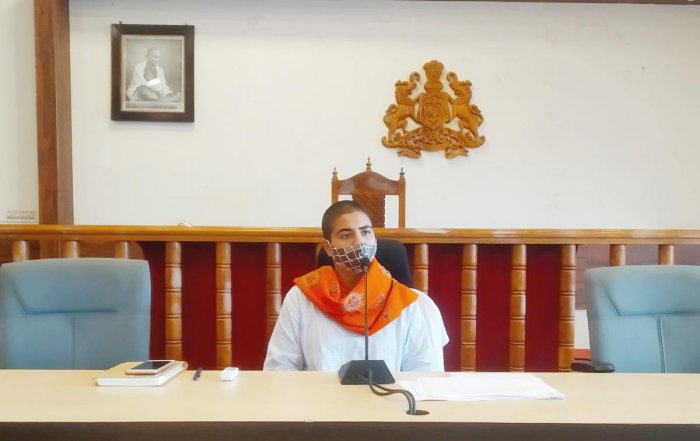
Deputy Commissioner Charulata Somal at a review meeting in Madikeri on Wednesday.

Observing that the crop survey is being hit by an inordinate delay in the district, Deputy Commissioner Charulata Somal instructed the officials concerned to speed up the process.

Reviewing the progress of the crops survey, during a meeting held at her office on Wednesday, she said that crops in 2.62 lakh survey numbers should have been completed in the district by now.

However, crops in only 1,762 survey numbers have been covered, she said and requested the cooperative banks, coffee board and other organisations related to agriculture and horticulture to cooperate with the department in carrying out the survey.

Cooperative Societies deputy registrar B K Salim said that there are 73 primary agricultural cooperative societies in the district and they will join hands in the crop survey.

Agriculture department technical officer Narayana Reddy said that the farmers can carry out the crop survey themselves, by downloading the crop survey application on their mobile phones.

Charulata Somal also asked the officials to ensure the supply of fertilisers in the district in adequate quantity.

Agriculture department deputy director Shabana M Sheikh said that 32,082 metric tonnes of fertiliser have been supplied to the district.

Coffee Board deputy director Shivakumaraswamy, District Lead Bank manager R K Balachandra, horticulture department deputy director H Shashidhar were present.

source: http://www.deccanherald.com / Deccan Herald / Home> State> Mangaluru / by DHNS, Madikeri / August 26th, 2021

Huthari festival observed with traditional fervour

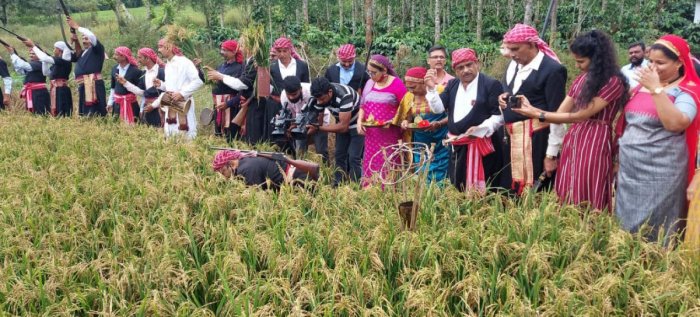
The paddy sheaves were cut by the CNC members during Huthari celebrations at the paddy field belonging to Nandineravanda Uthappa, in Chikkabettageri.

The Codava National Council (CNC), led by its president N U Nachappa, celebrated Huthari or Puthari — the harvest festival of Kodagu, at a paddy field of Nandineravanda Uthappa, in Chikkabettageri village, near Kushalnagar, on Friday.

Wearing traditional Kodava attire, the members participated in the celebrations by cutting paddy sheaves. Later, they offered prayers for the prevalence of peace and to eradicate Covid-19 from the world. 

The members offered prayers to the gods and initiated the process of Huthari celebrations by ‘Nere Kattuva’ ritual using the leaves of Arali, mango, jackfruit, Kumbali and cashew nut trees. 

After the rituals, the members took out a procession to the paddy field, accompanied by the ‘Dudikottpat’. After firing thrice in the air, Nachappa offered puja rituals and cut paddy sheaves.

Later, the paddy sheaves were brought back to the house and puja rituals were conducted.

CNC members presented ‘Kolata’, ‘Pareyakali’ and other cultural programmes.

Later, they also danced to the traditional beats and relished rice payasa, ‘Thambittu,’ ‘Kadubu,’ ‘pandi curry,’ ‘chicken curry’ and others. 

Speaking on the occasion, Nachappa urged the government to declare a national holiday for the Puthari festival. 

The Kodavas should be considered as a separate race to save the Kodava tribal culture for the future generation. Kodava language should be included in the Eighth Schedule of the Constitution, he said. 

“Kodava culture has all the qualifications to be included in the Intangible Cultural Heritage List of Unesco. By showcasing our rituals, we can assert our rights,” he added.

source: http://www.deccanherald.com / Deccan Herald / Home> State> Mangaluru / by DHNS, Kushalnagar / November 19th, 2021

Farmer From Kodagu Has Won An Award For Preserving Local Pepper Crop

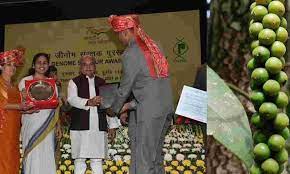
Left, N Poonacha receiving the award at the ceremony in New Delhi. Right, Snapshot of the indigenous ‘Adi Pepper’ spikes.

HIGHLIGHTS

  • Napanda Poonacha of Kodagu district, a progressive farmer, who hopes to be recognized as a pro-nature farmer
  • He was recently granted the Plant Genome Saviour Farmer Reward (2019-20) for his efforts to save indigenous ‘Adi Pepper’ crop

Napanda Poonacha of Kodagu district, a progressive farmer, who hopes to be recognized as a pro-nature farmer and has set examples for the other farmers to come forward to encourage them. He is working hard to establish commercial crops that have minimal or no negative impact on biodiversity, and he was recently granted the Plant Genome Saviour Farmer Reward (2019-20) for his efforts to save indigenous ‘Adi Pepper’ crops.

The Union Agriculture Ministry’s Protection of Plant Varieties and Farmers’ Rights Authority bestowed the honour on Poonacha, who received it from union agriculture minister Narendra Singh Tomar at an event in New Delhi on November 11.

He is the owner of Adi Pepper Demo Farm and Research Center in Garvale, where he is actively engaged in discovering natural crops in the district that have the capacity to become commercial crops while inflicting minimal environmental impact.

Napanda Poonacha expressed his happines for recieving the award. He said that farmers who recognise, conserve, and cultivate crops that are beneficial to biodiversity have been given this honour. Furthermore, He received the prize for his research, conservation, and promotion of the ‘Adi Pepper,’ an indigenous kind of pepper mainly grown across the natural habitat of Garvale village borders in Kodagu, India.

He further explained that Adi Pepper crops can be discovered all around the Garvale region in their natural habitat. They undertook the responsibility at the research centre to obtain this species of pepper registered under PPFRI, and in 2015, this high-quality pepper was recognised as a farmer’s variety pepper. This is the only pepper species that has passed biochemical testing, and it is regarded the best of the seven pepper species growing in Kodagu.

Since that particular form of pepper was once known as forest pepper and was mainly used for domestic reasons by the people, it has recently reached a brand value of Rs 3500 per kilo, generating more than six times the earnings of the other black pepper species sold in the district.

source: http://www.thehansindia.com / The Hans India / Home> News> State> Karnataka / by Susmita Modak / by Hans News Service / November 19th, 2021

Puthari Festival Venue Changed: Celebrations To Be Held At Kodava Samaja In Vijayanagar

The Management of Kodava Samaja, Mysuru, has decided to celebrate Puthari Namme (harvest festival) on Nov.20 in the premises of Kodava Samaja in Vijayanagar I Stage. Earlier it had been decided to celebrate the festival in the premises of Sree Cauvery Educational Institutions in Kuvempunagar.

Now due to incessant rains since a week and also keeping in mind the forecast of rains for 4 more days, the Samaja has decided to change the venue.  The celebrations will commence at 5 pm at the Samaja premises. All traditional Kodava dances will be performed on the occasion by both the men’s and women’s teams.

Arrangements have been made to distribute Kadh (new paddy crop) on that day.   All the members are requested to note the change of venue and cooperate in the celebrations, according to a press release from Malachira M. Ponnappa, Honorary Secretary, Kodava Samaja.

source: http://www.starofmysore.com / Star of Mysore / Home> In Briefs /November 19th, 2021

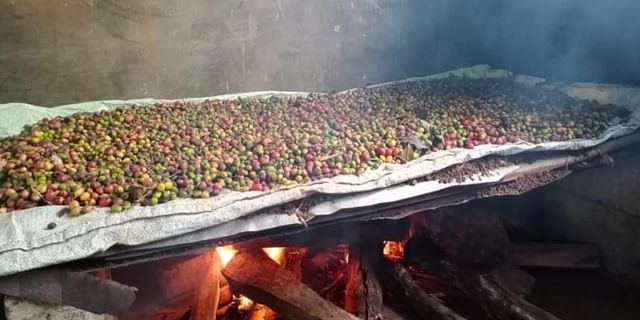
Unseasonal rains force Kodagu coffee growers to dry produce in wood fire

With rainfall still continuing to lash parts of Kodagu, the growers are faced with a herculean task of picking the beans in the rain.

The wood fire installed by coffee grower Vikas to dry beans.

Madikeri :

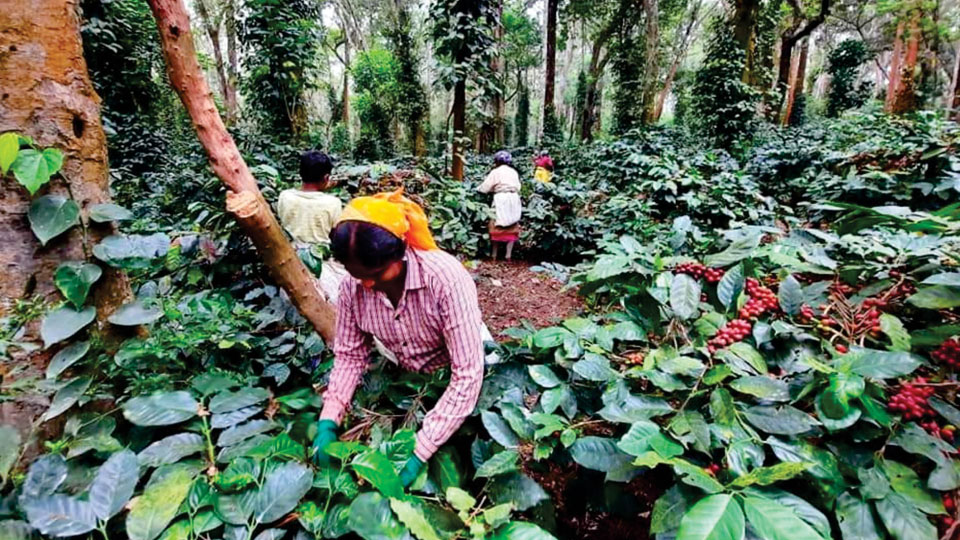
The change in the weather pattern has increasingly affected the coffee growing sector in Kodagu. As rainfall continues to lash the district in November, the coffee growers are struggling to save what is left of the coffee yield.

The coffee picking season for Arabica variety begins in November and the picked ripened beans are to be dried under the sun. However, with rainfall still continuing to lash parts of Kodagu, the growers are faced with a herculean task of picking the beans in the rain. Further, the collected beans cannot be dried in the rainfall and many growers are building make-shift stoves to save the ripened beans.

K Vikas, a coffee grower in Makkanduru village has raised a make-shift stove to dry the ripened coffee beans. Coffee beans, which are usually dried under the sun, are now being dried on a wood fire stove. “The bad weather condition has forced us to take this non-traditional method of drying coffee beans,” Vikas explained.

Meanwhile, the ripened beans without drying do not possess any demand in the market and are not bought by the traders due to the existing risks concerning the weather. “The coffee curing centres will not accept yield that has a mixture of ripened and unripened beans; the cost of separating these two beans cannot be managed by the growers in the current scenario. The curing centres are also sceptical about purchasing un-dried coffee following the present weather condition,” explained BN Ramesh, a coffee trader in the district.

The unseasonal rain had already inflicted heavy loss to many growers as the coffee plants witnessed increased droppings and rotting. The continuation of rainfall in the month of November is now threatening to wipe out what is left of the crop damage. 

source: http://www.newindianexpress.com / The New Indian Express / Home> States> Karnataka / by Pragna GR, Express News Service / November 14th, 2021

CFTRI Scientist Develops New Beverage From Coffee Leaves

Mysore/Mysuru:

Here is a chance for coffee growers to get additional cash from their plants throughout the year apart from income from the sale of beans. Mysuru-based Central Food Technological Research Institute (CFTRI) has developed a technology to prepare a value-added product from coffee leaves that packs in health benefits too.

Coffee is only harvested for a few months every year, depending on the country’s harvest season. This can leave a number of producers and workers without work (and income) for a significant portion of the year.

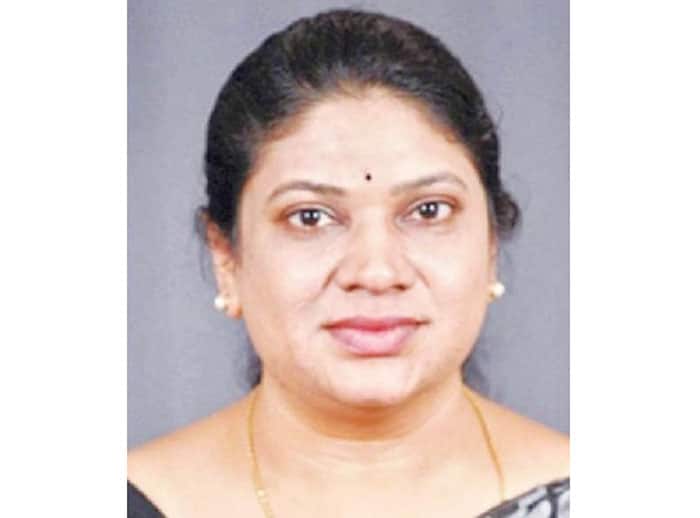
Pushpa S. Murthy

However, some producers have decided to diversify the crops that they grow and sell. As coffee leaves are constantly being produced, growers can harvest them in the off-season if there is demand, according to Pushpa S. Murthy, Principal Scientist (Spice and Flavour Science Department) of CFTRI.

This technology follows a CFTRI project on the development of value-added products from coffee leaves taken up in 2019. The project was funded by the Union Ministry of Food Processing Industries.

If farmers can use the leaves which can be harvested during the off-season or during pruning, without interfering with coffee bean growth, it will have a great impact on the social elevation of coffee farmers, she said.

Around 70 percent of the coffee industry is unemployed or underemployed during nine months of the year due to the nature of the growth cycle of the coffee beans. The project aimed to provide a year-round sustainable process for the coffee farmers.

With CFTRI technology, the brew can be prepared with water, allowed for a few minutes to steep, filtered and consumed. The institute has initiated the transfer of this technology to the coffee industry, and a few industry participants have already extended their consent, she said.

The leaf brew does not really taste like coffee, according to Murthy. “The brew is subtle with less caffeine compared to coffee or tea,” she said. On the nutritional value of the beverage, she said coffee leaves are rich in phenolic acids with potential health benefits. A coffee leaf contains around 17 percent more antioxidants than green tea. The beverage should be consumed plain.

The beverage accords health-promoting polyphenols like chlorogenic acid and mangiferin which help in reducing blood glucose levels, inflammation and blood pressure, she said.

 Leaf drink ‘kuti’ and ‘kahwa daun’ popular in Sumatra, Ethiopia

Coffee leaf tea has been consumed in Sumatra, Ethiopia, Jamaica, Java and Sudan for centuries. From the 16th century to the 19th century, Ethiopian farmers set aside their harvested coffee for trade or consumption in special ceremonies. As a day-to-day drink, the Harari people in Ethiopia instead enjoyed ‘kuti’.

‘Kuti’ tea was made by boiling coffee leaves in hot water, sometimes with a pinch of salt or some sugar. It was generally boiled for at least 30 minutes, as it was believed that the longer the leaves were boiled for, the sweeter the resulting brew would be.

Coffee leaf tea bears some similarities to green tea, but it is more earthy and sweeter. It is lower in caffeine than green tea, and thanks to its high levels of antioxidants, it has historically been believed that it cures or relieves cold symptoms.

In the 19th century, Dutch colonists transported coffee plants to designated farming regions in Indonesia. Workers on the coffee plantations were forbidden from consuming the coffee they harvested, so they drank something called “kahwa daun” instead.

‘Kahwa daun’ was made by drying coffee leaves in the sun to reduce their bitterness. The leaves were then smoked and roasted for a few hours. Finally, they would be steeped in boiling water, and then served in a coconut shell.

source: http://www.starofmysore.com / Star of Mysore / Home> Top Stories / November 14th, 2021