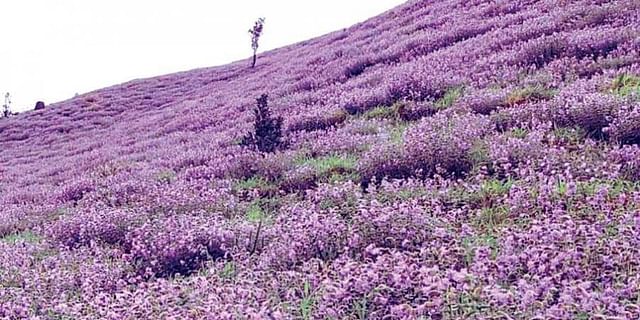
The mass blooming of the Neelakurinji flower (Strobilanthes kunthiana) in Kodagu district is giving the much-needed boost to the state’s tourism sector.
Neelakurunji flowers bloom at a hillock in Kodagu district | forest department
Bengaluru:
The mass blooming of Neelakurngi in Coorg has made it a rallying point for wildlife enthusiasts, botanists, photographers and tourists.
The blooming at the hillocks of Mandalpatti and Kote Betta in Kodagu, tourism has also taken up the north. Since the blooming has happened for the first time in a such a massive scale and is after 12 years, more so after tourism activities have opened up after the pandemic, every one are heading to India’s Scotland to see them.
The new entrant in the list to draw tourists is heli- tourism. As the state government and the tourism department are trying the revive the long pending heli- tourism, a firm in Bengaluru has undertaken a heli- ride to Kodagu and surrounding areas, giving an areal view of the blooming Neelakurunji flowers on the hillocks.
Govind Nair, Director, Thumby Aviation Private Limited said already one trip from Yelahanka air base to Coorg was done earlier this week. Now it is being offered as a part of the Nowhere trip to Coorg, a package tour, where a detour to Mandalapatti will be done.
Tourism packages and inineraries are being revamped on the go, depending upon the blooming and withering of the flowers. But since it is a once in 12 years sighting, many resorts are offering a visit to the region as a part of the package, to draw more crowds.
Trekking and flying has now taken the front seat to draw tourists. Even as the recent guidelines of the ministry of aviation states that drones are prohibited over national parks, wildlife sanctuaries and other eco- sensitive places, conservationists and foresters object to helicopters flyover over the region. They point not just is the area a fragile Western Ghats region, little is know the species in Kodagu and so all precaution should be exercised to safeguard them.
Botanists point that utmost care should be taken in the area as the flowering in this part of Western Ghats has not been recorded and documented. Karnataka as around 45 species of Kurunjis and in different altitudes different species have been recorded. Each species blooms at different intervals like once in six years, nine years, 11 or 12 years. So administration must ensure that tourism and footfall is limited to the region, so that they are well protected.
source: http://www.newindianexpress.com / The New Indian Express / Home> Cities> Bengaluru / by Bosky Khanna, Express News Service / August 27th, 2021
Estate owners urged to discourage it over COVID-19 fears.
Amidst the growing fears of an impending third wave of pandemic, it has now come to light that workers from Kerala bordering Kutta village in Kodagu were being employed in coffee estates and are shuttling daily by foot for work.
The State government has made it mandatory for those coming into the State from Kerala to carry an RT-PCR negative report not older than 72 hours irrespective of whether the travellers were vaccinated – either first or both doses of vaccine.
When former Speaker and Virajpet MLA K.G. Bopaiah visited the checkpost at Kutta on Tuesday to oversee the COVID-19 surveillance at the border over a spike in cases in the neighbouring State, he came to know about workers belonging to a Kerala village bordering Kodagu coming daily to Kutta by foot to work in the estates.
Mr. Bopaiah advised the coffee estate owners to provide accommodation to the workers after complying with the guidelines in case they have emergency works in their plantations and would like to employ workers from Kerala.
As per the district administration’s order, persons from Kerala travelling daily to Kodagu must carry out COVID-19 test once in 15 days and always carry the RT-PCR negative report with them. It is not clear whether the employers were cross-checking the details while engaging them in their estates.
“The task force set up in each gram panchayat must look into all various aspects for controlling COVID-19 in the border villages. It must work on preventing daily commuting of workers from Kerala to the border estates. This can help prevent the COVID-19 spread,” he opined.
The staff roped in from various departments for work at the checkposts in Karike, Kutta, Makutta and Sampaje in Kodagu have been categorically told to ensure that no vehicle enters the State without the travellers producing valid RT-PCR negative report not older than 72 hours.
The district officials have been told to continue with the guidelines issued based on the test positivity rate which is currently below 5 per cent. If the TPR crosses 5 per cent, stricter measures were needed.
About 40-50 vehicles from Kerala cross the border at Kutta daily.
source: http:// www.thehindu.com / The Hindu / Home> News> States> Karnataka / by Special Correspondent / Mysuru – August 03rd, 2021
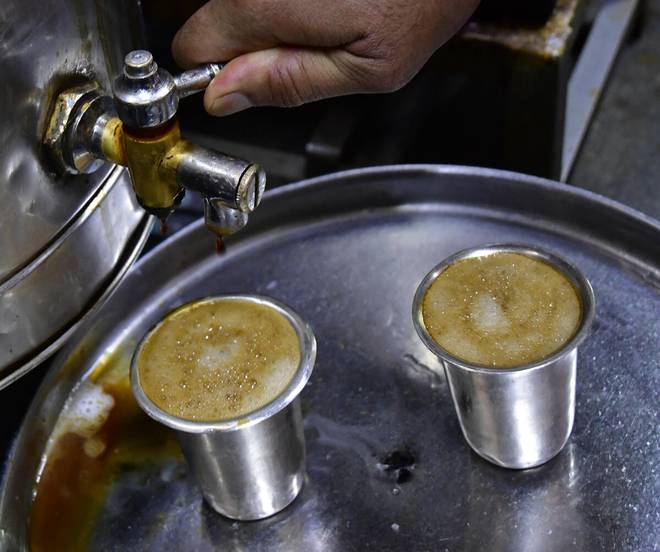
A file photo of a server collecting coffee from a container in a restaurant. | Photo Credit: K. Murali Kumar
‘Nations should jointly combat issues in coffee sector’
Coffee growing countries, India, Brazil, and South Africa, should collaborate to combat common challenges they face such as global price volatility, high cost of production, and labour shortage, suggested International Coffee Organisation (ICO).
At the opening session of the two-day IBSA Coffee Festival on Wednesday, ICO executive director Jose Sette said India, Brazil, and South Africa had several opportunities to work together to address common issues they face in the coffee growing, processing, and marketing fronts.
India produced over 3,20,000 tonnes of green coffee in the last harvest season that ended in March 2021. Karnataka alone accounts for over 70% of the country’s total coffee production, with Kodagu, Chikkamagaluru, and Hassan districts being the State’s coffee heartlands.
Coffee Board chairman M.S. Boje Gowda said, “It is great that we are joining hands with the international coffee community to improve the coffee scene of India and this exercise means a lot for coffee farmers across the country, and especially for an army of them in Karnataka.”
Suresh K. Reddy, Ambassador of India in Brazil, said coffee production had increased 34% in that country in the last two decades although the area under production had only reduced. Indian coffee community had to adopt cost-effective growing techniques and yield enhancing practices from Brazil, he recommended.
“We are also looking forward to collaborating with Brazil in enhancing domestic consumption of coffee in India,” said Mr. Reddy. India’s per capita coffee consumption is around 200 grams while it is 6 kg in Brazil.
Mr. Reddy further said time had come for the commodity apex body, Coffee Board, to position itself as a holistic organisation for the overall development, promotion, and growth of Indian coffee.
Jaideep Sarkar, High Commissioner of India in South Africa, said under the free trade agreements of WTO regime, it was tough for individual governments to promote their own coffees beyond a point and therefore working together was the best option for the global coffee growing community.
Andre Aranha Correa do Lago, Ambassador of Brazil in New Delhi, said, India was beginning to see a lot of speciality coffee coming via exports and this would open up newer opportunities for coffee entrepreneurs in India to process, value add, and re-export.
“We want to be part of the growing India coffee story and IBSA is an ideal platform for a unique partnership between these coffee producing countries,” Mr. Lago added.
source: http://www.thehindu.com / The Hindu / Home> News> States> Karnataka / by Mini Tejaswi / Bengaluru – August 05th, 2021
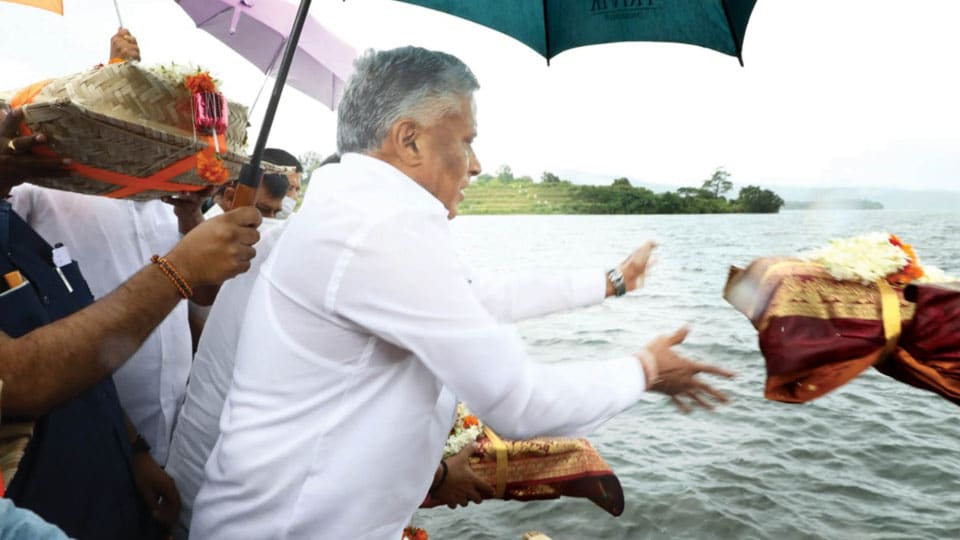
With the Harangi Dam in Kodagu district full to the brim, thanks to copious rainfall in the past few days, Kodagu District Minister V. Somanna yesterday offered bagina at the Dam, in keeping with the tradition.
During the offering of the Bagina, Somanna performed puja to four crest gates of the Dam and also pressed the crest gate button to release 8,000 cusecs of water from the Dam.
Later speaking to press persons, Somanna said that Harangi Dam was the first major Dam in the State to have filled up this monsoon. Noting that the Dam feeds water to 1.65 lakh hectares of Kodagu, K.R. Nagar taluk in Mysuru and five taluks of Hassan district, he said that water will be released for standing Kharif crops and through all canals of the Dam.
Maintaining that the B.S. Yediyurappa Government is doing what all it can for expanding the irrigation network in the State, Somanna contended that there was no drought in the State for two years. However, rain has played havoc in some parts of the State, he said and added that scattered rains across the State has helped farming.
Clarifying that the Government has released money for de-silting of Harangi Dam, he said that tenders have been invited for the purpose. Noting that there were no successful bidders two times, he said that the Government was ready to hand over the works if a competent contractor comes forward for the third time.
Asserting that Kodagu DC has informed him that the district has so far suffered an estimated loss of Rs. 95 lakh due to heavy rains, Somanna said that measures will be taken for providing relief to the family of a person who was recently washed away in floods.
Mysuru-Kodagu MP Pratap Simha, in his address, said that though he was an elected MP for seven years, he could not offer bagina to Harangi Dam for one reason or the other. But he was happy now that he got a chance. Arguing that the State has been receiving good rainfall after B.S. Yediyurappa came to power, he said that nature too seems to be impressed by the works of the Chief Minister.
Referring to the damages caused to Madikeri-Mangaluru National Highway, Simha said that it has come to his notice and he will do all he can to repair the damaged sections of the road. Also, it has been planned to construct earth retaining wall at landslides prone 22 points of the Highway, for which he would render all help, he added.
Harangi Dam officials said that the Dam has a water storage capacity of 8.5 TMC and the maximum water level of the dam is 2859 ft. At present, the water level is retained at 2858 ft. as a precautionary measure and whatever additional water that the Dam gets (inflow) will be discharged through canals.
Earlier, the Minister and a host of other dignitaries offered puja to the idol of Goddess Cauvery at the lower level of the Dam.
MLAs Appachu Ranjan, A.T. Ramasway and H.P. Manjunath, DC Charulatha Somal, MLC Sunil Subramani, BJP District President Robin Devaiah and a host of other officials and people representatives were present.
source: http://www.starofmysore.com / Star of Mysore /Home> News / July 17th, 2021
No more unrestricted entry; move to curb illegal activities
Mysore/Mysuru:
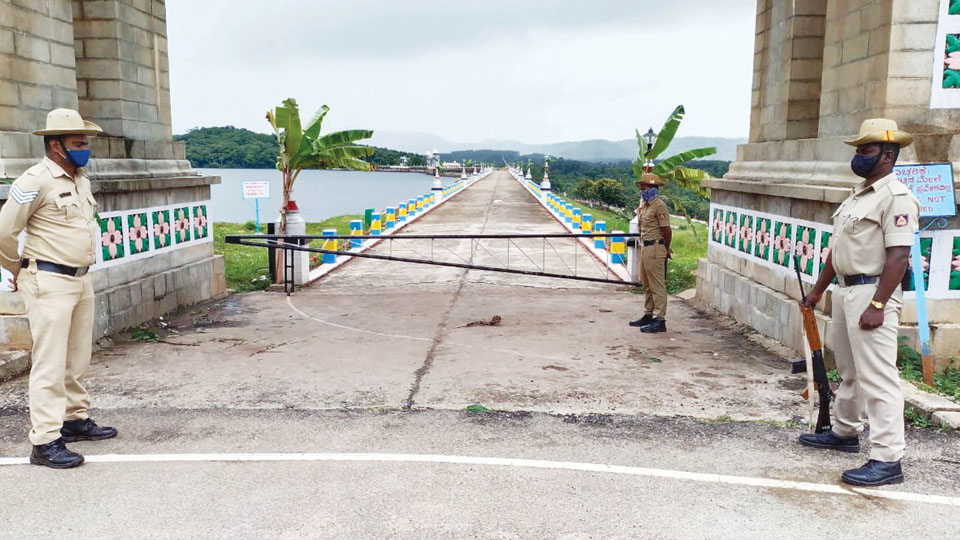
Amidst thick of a controversy over the safety and security of the KRS Dam in Mandya in the wake of rampant illegal mining, the State Government has upgraded the security of Harangi Dam in Kodagu district that is the only upstream reservoir that supplies water to KRS.
Till now, the Harangi Reservoir security was manned by lathi-wielding Kodagu District Reserve Police and Civil Police.
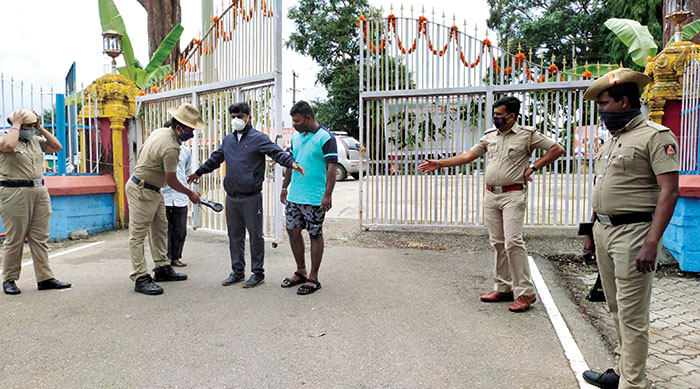
Now the security apparatus has been handed over to gun-toting professionals from the elite Karnataka State Industrial Security Force (KSISF). Over 23 men are guarding the Dam 24×7 and unrestricted entry has been banned. All visitors will be frisked henceforth and only those who have valid permission from the KSISF will be allowed inside.
The KSISF also manages the security of the KRS Dam. The Harangi Dam is in the upper Cauvery sub-basin reservoir near Hudgur village in Somwarpet taluk. Water from the reservoir irrigates 1.65 lakh hectares of farmland in Kodagu, Hassan and Mysuru districts. The maximum height of the reservoir is 2,859 feet and it has the capacity to store 8.5 tmcft of water.
The KSISF personnel are guarding the Dam main gate, four sluice gates and power house. Vigil will be kept till the end of the right canal. As per the new security protocol, vehicle parking has been arranged at the entrance of the Dam and visitors have to obtain permission from the Irrigation Department to enter the reservoir premises. Also, permission from the KSISF is required for private vehicles.
Earlier, private vehicles could enter into the Dam premises easily and entry was unrestricted if the visitors had the backing of politicians and elected representatives. The place was also a haven for illegal activities where liquor parties were held at the Dam guest house and also at a few places in the vicinity and backwaters.
Now all those who enter inside the Dam are screened and the registration number of the vehicles and information of tourists are documented.
Speaking to Star of Mysore, Inspector K.S. Chandrashekar said that as Harangi is a sensitive zone, the KSISF has been entrusted with the security.
He said that the Dam security and the safety of visitors were paramount and security will also be provided to the sound-and-light show in the evenings.
The KSISF was set up in 2012 and it started its service by providing security cover to Vidhana Soudha, Vikasa Soudha and KRS Dam when Siddharamaiah was the CM. The KSISF personnel are trained in access control, gadgets management, communications, people management, fitness and have an eagle eye for disaster management.
source: http://www.starofmysore.com / Star of Mysore / Home> News / July 18th, 2021
Project RE-HAB (Reducing Elephant – Human Attacks using Bees) aimed at thwarting elephant attacks in human habitations using honey bees, seems to have yielded success with jumbos taking alternative routes to avoid coming into contact with bees.
With a view to reduce human-elephant conflicts in the country, Khadi and Village Industries Commission (KVIC) has launched a unique project of creating “bee-fences” to address this burning issue in several States including Karnataka.
The pilot project has been launched at few locations in Kodagu. These spots on the periphery of Nagarahole National Park are known to be human-elephant conflict zones. Total cost of project is Rs. 15 lakh.
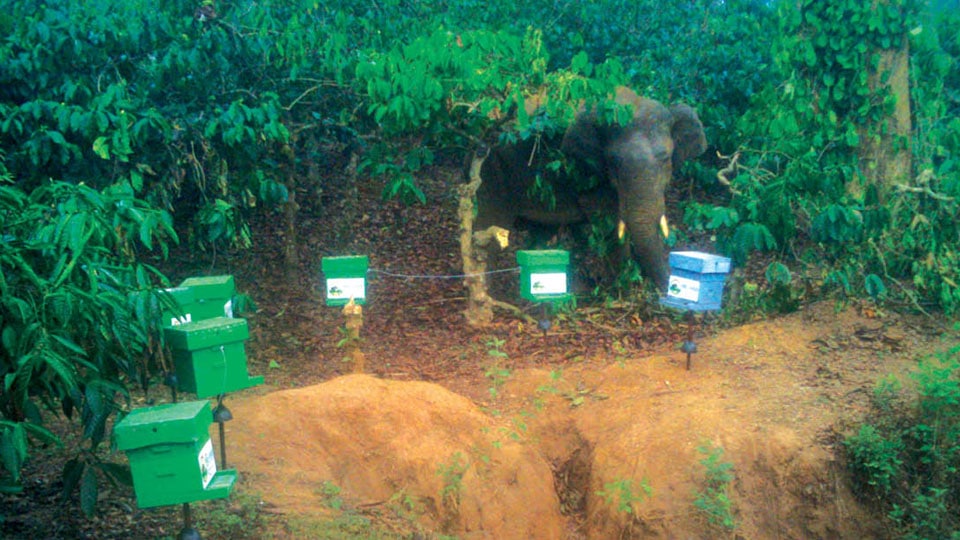
Reality check has revealed that the wild pachyderms were maintaining a safe distance from bee boxes. Locals say this has reduced the elephant menace by 70 percent. Bee boxes have been placed at Kutta including Choorikaad and Tithimathi ranges. Jumbos were not seen in these places in the last 25 days. Villagers opined that elephants may have found alternative route.
In fact, the jumbos had damaged bee boxes near Kodange Haadi near Nagarhole recently. Since then, they have not come back. There are instances of young elephants straying into these fences. The cameras have captured the hesitancy of jumbos crossing the fence fixed with bee boxes and also taking de-tour within 27 seconds.
KVIC has set up 15-20 interspersed bee boxes at selected locations. The bee boxes are set up in the passage ways of elephant-human conflict zones to block the entrance of elephants to human habitations. The boxes are connected with a string so that when elephants attempt to pass through, a tug or pull causes the bees to swarm the elephant herds and dissuade them from progressing further. Bee boxes have been placed on the ground as well as hung from the trees to block the passage way of elephants. High resolution, night vision cameras have been installed at strategic points to record the impact of bees on elephants and their behaviour in these zones. The collective buzz of the bees is annoying to elephants that force them to return. Elephants, which are the most intelligent animal and carry their memories for long, avoid returning to the place where they have encountered honey bees.
Nearly 500 people die every year due to elephant attacks in India. This is nearly 10 times more than the fatalities caused by big cats across the country. From 2015 to 2020, nearly 2,500 people have lost their lives in elephant attacks. Out of this, nearly 170 human fatalities have been reported in Karnataka alone. On the contrary, nearly one-fifth of this number, that is nearly 500 elephants have also died in retaliation by humans in the last 5 years.
In the past, Governments have spent crores of rupees on digging up trenches and erecting fences to dissuade elephants. Also, hundreds of crores of rupees have been spent on compensation for loss of human lives. These trenches and barbed wire fences have often caused the deaths of elephant calves and thus rendering these ideas largely impractical.
source: http://www.starofmysore.com / Star of Mysore / Home> News / July 05th, 2021
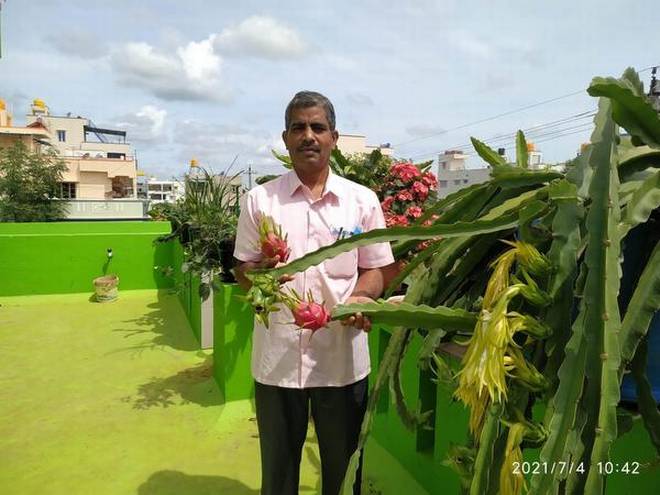
Vijay Angadi showing a Dragon Fruit plant on his terrace in Hassan.
People in urban localities, who lack sufficient space, can take up cultivation on the roof
The cultivation of dragon fruit is picking up among farmers. In Hassan, the fruits are grown on the roof as well.
Vijay Angadi, an agriculture expert and programme executive at AIR in Madikeri, has grown the fruit on his terrace garden at the 2nd phase of Visvesaraya Extension in Hassan.
Mr. Angadi, known for popularising organic terrace gardens, planted a dragon fruit sapling two years ago. “The plant grew well. We got a few fruits in the first year. In the second year, the number of fruits has gone up and I added a few more plants,” he said.
The fruit has antioxidants, vitamin C, is rich in fibre and low in calories. Given its taste, medicinal value and demand in the fruit market, many farmers are taking up cultivation in a big way. Those in urban localities, who lack sufficient space, can take up cultivation on the roof.
“The plant belongs to the Cactaceae family and is a drought-resistant variety. It can survive in high temperature as well,” said Vijay Angadi, a post-graduate in Agriculture Studies.
He suggested that people interested in earning money by selling dragon fruit can take up cultivation on the terrace. “On the roof of a house built on a 30×40 sqft area, one can grow 30 plants. Within two years, one gets the yield and can earn up to ₹30,000 a year, depending on the price in the market. Besides this, the grower can also sell plants. It adds to the family income,” he said.
As a programme executive with All India Radio, Mr. Angadi has produced hundreds of programmes for radio on farming. He has inspired many people in Hassan to take up terrace farming.
“I have around 100 pots on my terrace. I grow vegetables, green leaves and fruits in my garden without using chemicals,” he said.
source: http://www.thehindu.com / The Hindu / Home> News> States> Karnataka / by Special Correspondent / Hassan – July 05th, 2021
Kozhikode Mayor Beena Philip has said that the corporation was willing to cooperate with the Indian Institute of Spices Research (IISR) for the proposed spice street project.
Inaugurating the foundation day programme online at the IISR here on Thursday, she said the emerging farming scenario enhanced the social and scientific relevance of institutions like ICAR- IISR in the wake of the pandemic.
She also emphasized that the spice economy was important for the farming sector. However, the ability to maintain and enhance spices production needs to be anchored on improved cultivation practices and research advances, she said.
Presiding over the session, Dr. A.K. Singh, Deputy Director-General, ICAR, New Delhi, said the spices sector had witnessed significant changes in the recent past, and that the country was poised to make gains in production and trade in spices in the coming years.
Dr. Athulya G. Ashokan, Associate Professor, Pushpagiri Institute of Medical Sciences, delivered the foundation day lecture on ‘Management of post-COVID syndrome’. The IISR also launched the e-commerce platform for sale of good quality spices from verified sources and products from incubatee entrepreneurs associated with the institute.
In a new initiative aimed at supporting women entrepreneurs, the institution has entered into an agreement with the Kozhikode District Kudumbashree Mission to provide support for development and marketing of value-added products, production of quality planting materials, and delivery training services.
The IISR also executed two technology commercialisation agreements for the turmeric variety IISR Aleppey Supreme and black pepper micronutrient mixture.
Marking the occasion, the institute conferred spices excellence awards on Kanthraj K.M. from Kodagu district in Karnataka and Rajesh E.M. from Kozhikode. R.L. Innovative Agri Pvt. Ltd., an agri-startup company, was also honoured with the award.
The staff recreation club of the institute donated 10 mobile phones and tablets to support online education of students from under-privileged sections as part of its outreach activities. The institute released five extension folders and three technical bulletins on various aspects of spice cultivation to mark the foundation day.
Dr. J. Rema, Director, ICAR-IISR, and Dr. Vikramadithya Pandey, Assistant Director General, ICAR, spoke.
source: http://www.thehindu.com / The Hindu / Home> News> Cities> Kozhikode / by Special Correspondent / Kozhikode – July 02nd, 2021
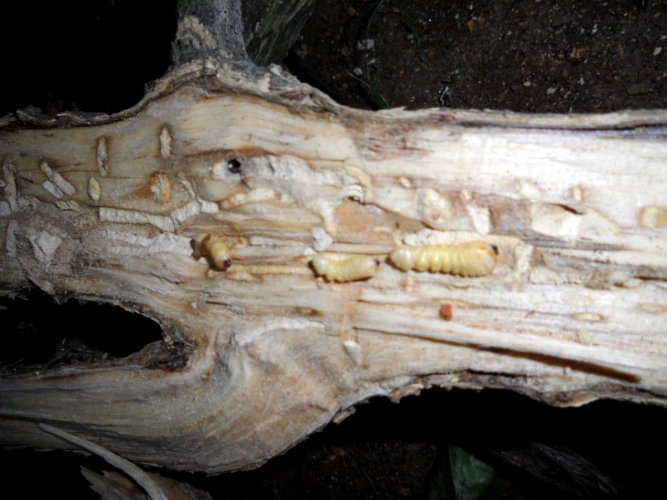
White stem borers destroying a coffee plant. Credit: DH Photo
Arabica and Robusta coffee varieties grown in Kodagu are known for their quality.
Robusta variety is grown mostly in Madikeri and Virajpet taluks, while Somwarpet is known for arabica coffee.
The weather of Somwarpet is the best suited for the arabica variety, say the growers.
However, there are a lot of challenges before arabica coffee growers, the major one being the infestation of white stem borer (Xylotrechus quadripes).
The adult borers feed on the stem of the coffee plant and lay eggs inside the stem. Their season of reproduction is the months of March and April. During this period, the stem borers lay eggs on all plants in the coffee plantation.
In Somwarpet taluk, coffee is grown on 28,540 hectares of land. Arabica coffee is grown on 22,940 hectares and robusta is grown on 5,600 hectares.
Many growers have been switching to robusta as arabica is infested by the white stem borer.
Fed up by the borer menace, the plantation owners themselves have been asking the workers to uproot the arabica coffee plants that were nurtured for many years.
A lack of proper control measures is also one of the main reason for the growers to destroy the plants.
The arabica variety of coffee requires more care as compared to robusta. Meanwhile, the labour cost and the production costs are increasing, among other expenses towards manure and fertilisers.
Adding to the problem, the market rate is also disappointing the farmers.
Control measures
Experts have come up with a technique to trap female borer, by using the artificial pheromones of male borer insects, say authorities of the coffee board.
B R Jayendra, a coffee planter from Bettadalli, said that the control measure of white borer is consuming a lot of time, in the existing methods available.
By the time the borers are controlled, almost all plants are destroyed. Effective control measures are needed to save arabica coffee.
Taluk Coffee Growers’ Association president Mohan Bopanna said that the coffee planters are going through difficult times.
Like the Kerala model, the Karnataka government too should announce support price for coffee growers. The loans of coffee growers who are facing difficulties should be waived, he added.
Another coffee planter S M D’Silva from Abburukatte said it is almost impossible to destroy the affected plants at a time.
The small grower will be hit hard if they destroy all coffee saplings in the plantation, he said.
source: http:///www.deccanherald.com / Deccan Herald / Home> State> Mangaluru / by DHNS, Somwarpet / June 28th, 2021
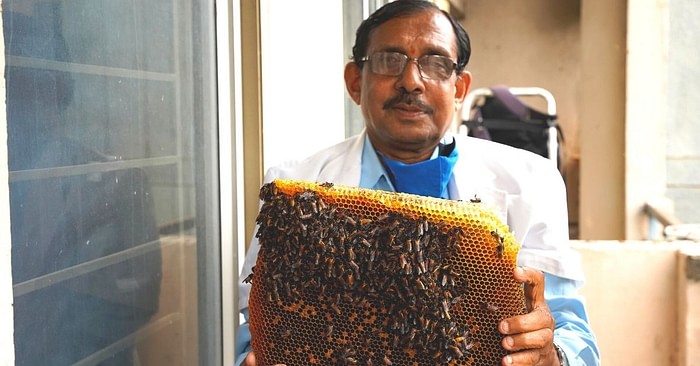
K A Ponnanna from Karnataka joined IISc as a security guard, but began serving as a field assistant at the Centre for Ecological Sciences and helped mentor students in handling bees and collecting samples for research.
K A Ponnanna, a native of Kodagu in Coorg, Karnataka, grew up amid peaceful co-existence with wild rabbits, lion-tailed macaques, deer, honey bees, wasps, and several other insects and animals.
He says these creatures were his pets. “The relationship between humans and wildlife was unique, as we reared and tended to wild animals and depended on them for livelihood,” he recalls.
Speaking with The Better India, Ponnanna (70) says that as he grew older, his job took him to places including Nashik, Hyderabad, Deolali, Dharangadhara and Jammu, where he served as a technician in the communications equipment field at the School of Artillery, a training institution of the Indian Army.
Ponnanna retired in 1993 and was appointed as a security guard with the Indian Institute of Science, Bengaluru. However, within a few days, his job profile took a different turn altogether.
The security guard became a field assistant and conservator of bees until he retired in 2012. Interestingly, despite the change in role, he continued his designation of a security guard and drew a salary for the same profile. He spent all his time at the Centre for Ecological Science (CES) department attending and mentoring students for their research work.
Here is his story.
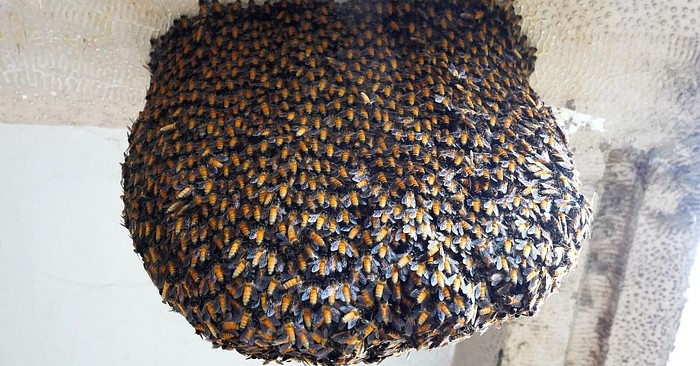
Beehive at IISc campus. / Credits: KG Haridasan.
A few days into his job as security guard, Raghvendra Gadagkar, then associate professor at IISc, struck up a conversation with Ponnanna. “He had helped rescue a few beehives in the campus and I had heard about his enthusiasm and fearless attitude. I noticed that he was interested in honey bees. Our conversation helped me understand how he grew up tending to honey bees and wasps in his native village,” Raghavendra says.
He adds that considering the experience that Ponnanna had, he requested him to volunteer in the research. “The work involves spotting honey bees and safely handling the hive, collecting samples and even bees at times. It is a delicate process. And Ponnanna proved to be brilliant in all aspects,” he says.
He adds that he was impressed by Ponnanna’s skills and passion towards bees, and that he requested the security department to transfer Ponnana to the lab with the existing designation and salary.
“It is difficult to make such arrangements in a government institution. However, the administration was flexible and recognised the value Ponnanna held,” Raghvendra explains.
A friend, mentor and philosopher
Ponnanna says he was thrilled and thoroughly enjoyed every bit of the change in his profile.
“I had never attended any classes or received formal coaching on bee handling. I’d never worn clothes, gloves or held any equipment to handle bees. Moreover, I did not know the departments and their locations,” he says, modestly adding, “In my village, everyone handled bees and wildlife, and this was not unique to me.”
Ponnanna slowly got a hang of things as he worked in the lab, assisting students and researchers. “I can now differentiate between the types of bees, insects that are poisonous and non-poisonous, reptiles and other wild animals. I used the knowledge to help students in their research and accompany them during field visits to handle bees and wasps,” he adds.
The students accompanied him in batches and took help in collecting samples for their academic requirements.
Sujata Deshpande, an assistant professor at the Zoology department of Mumbai-based St Xavier’s College, was one of the PhD students who received help from Ponnanna.
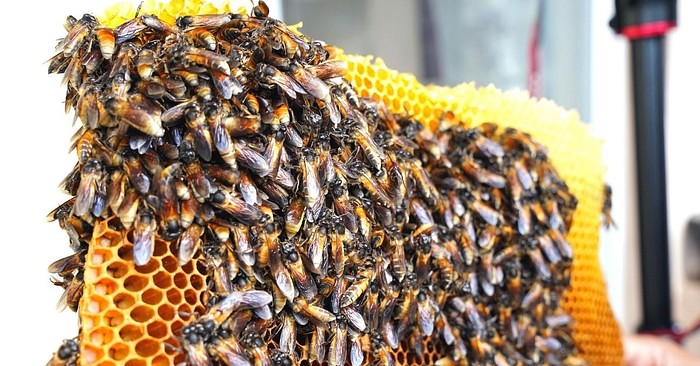
Credits: KG Haridasan.
“I was studying between 1999 and 2005, and he was more like a fatherly figure and mentor. He was always punctual and never hesitated to work late hours if needed. As students, we had to roam around a lot and search for wasps. But Ponnanna knew the most likely places that we’d find them, making our job easier. He handled bees like they were his children – with utmost care and protection,” she says.
Sujata says that hurting even one insect pained him. “The bee boxes in the campus would be safe and protected under his supervision. The chances of infections and diseases among the insects were also low because of the care he took,” she adds.
The academician says the field assistant’s traditional knowledge about bees helped students understand the insects and added value to their research.
Sujata says that over the years, Ponnanna’s role further evolved as a conservator. “The bees in Bengaluru suffered habitat losses in urban areas, and he often received calls for rescuing them. He would rush to the spot before anyone could destroy the beehives,” she adds.
Echoing her thoughts, Raghvendra says, “He has saved hundreds of beehives from destruction due to burning or spraying of pesticide and offered them a safe place inside the IISc campus. Many people wanted to get rid of the beehives around their residences, but he carefully removed them and resettled them without hurting any bees.”
He says that Ponnanna also became a friend, philosopher and guide to the students.
‘Have compassion for animals’
Raghvendra retired in 2012 and joined the institution as an honorary and Department of Science and Technology (DST ) year of science chair professor. Ponnanna retired around the same time and was reassigned as a consultant where he could continue to help students.
Credits: KG Haridasan
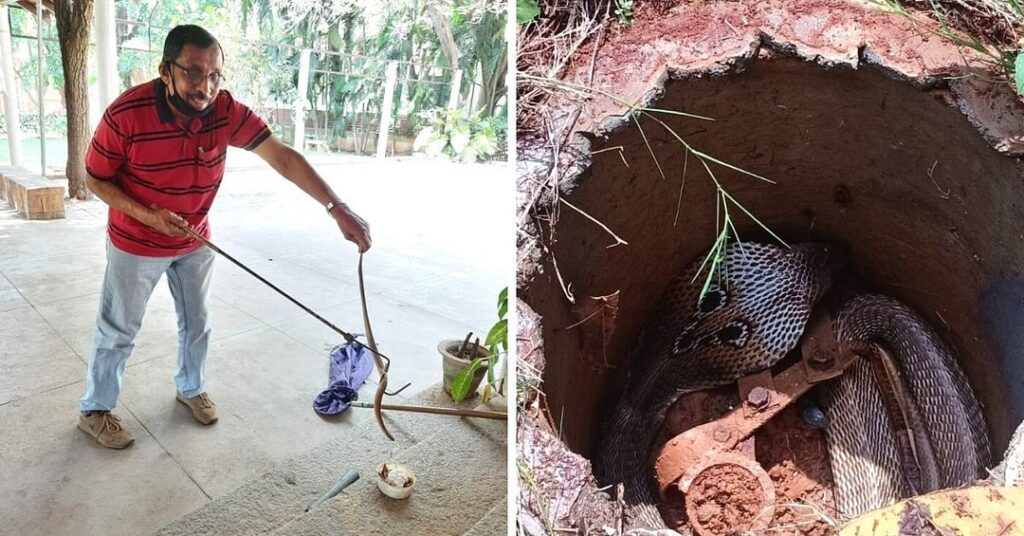
Apart from assisting researchers, Ponnanna also rescues snakes, other insects and animals.
Sharing his views on bee conservation, Ponnanna says that the destruction of habitat and beehives are contributors to adulteration in honey. “The use of pesticides in farms affects the bee population, and the insects often suffer from infection due to poor care. All these factors affect the population and honey production. To compensate, the companies adulterate the honey and sell it only because of its sweetness, but not for the medicinal properties the natural honey holds,” he says.
He adds that there needs to be a change in which the animals, insects and other biodiversity elements in nature are treated.
Ponnanna says that students should have a more practical approach and be willing to get their hands dirty in the research. “Apart from performing experiments in the lab, students should know how to handle what they are studying in the field. Only passion and sensitivity towards subjects can help achieve that,” he adds.
Citing an example, he says, “It is not difficult to catch an elephant when humans have managed to land on the moon. But we cannot hold the animal by the neck and choke it. We need to show compassion towards birds, insects, animals and other species. We should understand their anger, behaviour and other characteristics to ensure they are not harmed.”
Edited by Divya Sethu
source: http://www.thebetterindia.com / The Better India / Home> Inspirational> Karnataka / by Himanshu Nithnaware / June 23rd, 2021
WELCOME. If you like what you see "SUBSCRIBE via EMAIL" to receive FREE regular UPDATES.
Read More »