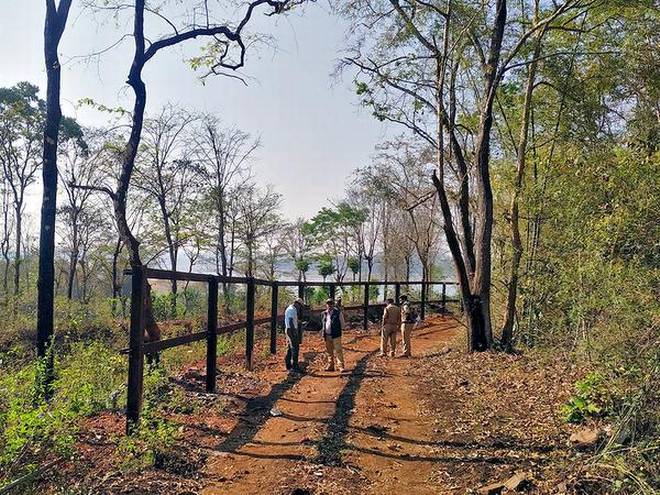
The Forest Department has installed railway barricades to stop entry of elephants in Alur range.
Across 4.5 km in Alur range, these will restrict elephant movement
The Forest Department has put up railway barricades for about 4.5 km in Alur range of Hassan district to avoid the movement of elephants. The 2.1 m tall barricades, made of used railway tracks, have been installed between Nagavara Elephant Camp and Bharatur in Alur taluk. This is the area wherein elephants from Kattepura forest in Kodagu district move towards Alur range crossing the backwater of Hemavati Reservoir located at Gorur.
People of Hassan have been dealing with the elephant menace for decades. As many as 70 lost their lives in the conflict in the district since 1991. Similarly, 63 elephants have died so far. Besides solar fencing and elephant-proof trenches (EPT), the department has taken up the installation of railway barricades as a solution to avoid conflicts.
K.N. Basavaraj, Deputy Conservator of Forests, on Friday, took a team of journalists to Nagavara Elephant Camp to show them the barricades. “We keep learning how to avoid conflicts. Now, the installation of railway barricades is considered to be the effective system to minimise the conflicts,” he said. Chandrashekhar, a contractor from Mysuru, has bagged the contract to put up barricades for 4.5 kms at a cost of ₹4.65 crore. He procured 750 tonnes of the used tracks from the Ministry of Railways at an open auction. “The barricades are 2.1 m above ground level. They have been erected with the support of concrete 1.5 m below the ground. Two horizontal barricades are such that neither a cub nor adult elephant could cross them. We have learnt from the past experiences where elephants died while attempting to cross the barricades,” the officer said.
The purpose is to avoid the entry of elephants from Kodagu to Hassan. In 2014, the department captured 24 elephants and relocated them, resulting in a decrease in man-animal conflict for a brief period. “However, the number of elephants increased gradually, as many crossed the Hemavati backwaters. Now, we are plugging the hole so that elephants’ entry from Kodagu is restricted,” the officer said.
The department plans to extend the barricade for 40 km covering the boundary points. In Kodagu, the elephants that raid coffee estates could be driven back to forest areas easily, while in Hassan it was not possible. The herds keep moving from one estate to another damaging the crop, the officer said.
Opposition from farmers
Farmers of Nagavara and surrounding villages in Alur taluk have opposed the railway barricades alleging that these would force the elephants to camp in their estates for a long period.
Rangaswamy, a resident of Nagavara, said, “No doubt the barricades restrict elephants coming from Kodagu. What about those elephants already in the boundaries? Now, they cannot go back to Kodagu because of the barricades and continue to remain in the estates located close to the barricades.”
Mr. Basavaraj, DCF, reacting to the allegations, said the barricades had been put up just now. The officers would analyse the elephants’ movement and take appropriate action whenever necessary. “We have plans to extend the barricades for 40 km. As of now, we have a system to open the barricades at key points to let the elephants go back to their places,” he said.
He further clarified, “The path that we are blocking is not considered to be the natural path of the elephants. Only in the recent years, they have begun to tread this path.”
source: http://www.thehindu.com / The Hindu / Home> News> States> Karnataka / by Sathish G.T. / Hassan – March 27th, 2021
With human-animal conflict increasing day-by-day in forest rich Kodagu district, Minister for Forest Aravind Limbavalisaid that a Kodagu-specific Foundation will be formed to mitigate human-animal conflict.
Replying to a question by BJP MLC Sunil Subramani in the Legislative Council recently, Limbavali said it has come to the notice of the Government that attacks on human beings by wild animals such as tigers and elephants are on the rise in Kodagu district. The Forest Department has taken many measures to prevent wild animals from straying into human habitats, he said and added that 47 water ponds have been formed to ensure that wild animals get water within the forests.
Stating that desilting of 66 water bodies is going on in the district, the Minister said that 34.35 km solar fencing and 161.60 km barbed wire fencing has been installed along the forest borders and 91.55 km elephant trench has been dug up. Besides, 33.37 km of suspended solar fencing and railway track barricades have been erected using 24.62 tonnes of old railway tracks. To erect more railway track fencing, the Department has purchased 496.17 tonnes of old railway track, he explained.
Limbavali further said that 52 rapid action teams have been formed and 71 teams to drive stray elephants have been constituted. These teams will also keep a watch on poaching, he said and added that the Government will take all measures possible to end human-animal conflicts, which has become a bane in the region.
He said that an adult female in a herd will be identified for radio collaring, to help track the movements of other elephants. Nine elephants have been radio-collared so far and the staff are keeping a track of their movements round the clock, he added.
source: http://www.starofmysore.com / Star of Mysore / Home> News / March 22nd, 2021
Fermentation techniques that involve anything from fruits to alcohol are giving the brew a new high.
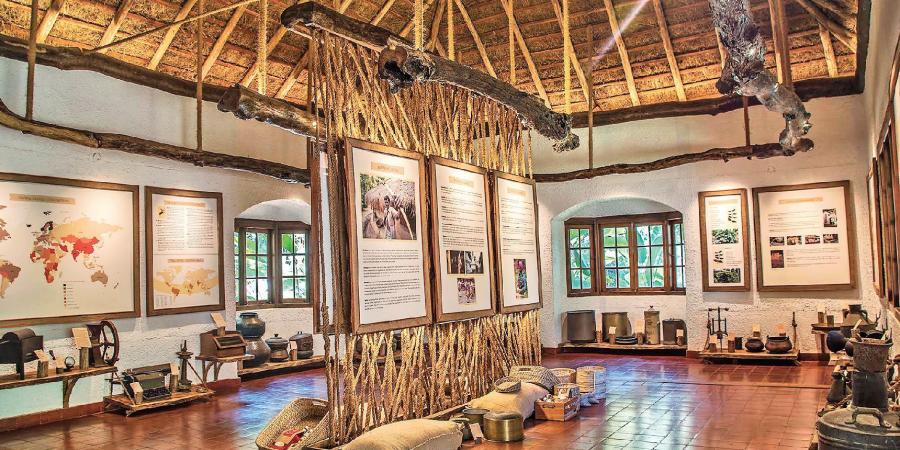
If you want to educate yourself on all things coffee, a visit to Sidapur Coffee and Culture Museum at Evolve Back in Coorg, will take you on a journey of discoveries.
From whisky barrel-aged coffee to fruit-fermented beans and innovative experiments in farming, fermentation and drying the fourth wave of coffee is set to spring a surprise. The brew is going artisanal. There is an increased focus on how it is grown, nurtured, processed as well as how it is being roasted. Sunalini Menon, Asia’s first woman professional coffee taster, and President, Coffeelab Ltd, Bengaluru, says: “Artisanal coffees are unique in taste and are always available in micro quantities.”
Such coffees are identified with sustainable practices in cultivation and prepared with care, precision and high-quality roasting.” Something like this is happening at Baarbara Estate, currently managed by the fourth generation of coffee growers from Chikmagalur, Karnataka.
Through their brand The Caffeine Baar, they are seeking to serve many coffee explorations to enthusiasts. Poojya Prasad, the co-founder, says, “We have worked on a unique fermentation process involving pineapple, which has given good results. To start with, pulped coffee beans are mixed with pineapple for a select number of hours.
The natural juices and the skin of pineapple, ferment the coffee beans. This process is monitored in a controlled environment. Once it’s complete, the mixture is dried on raised beds over several days. The coffee is monitored at each interval, resulting in batches with varying depths and notes of flavours.” Roasters are having a field day. Take for instance, Maverick and Farmer Coffee Roasters, who have introduced new coffees that unlock more than what species, terroir or roasting can offer.
By intervening in the growing, processing, drying, blending and roasting stages of coffee (without any artificial additions), the endeavour is to explore different kind of tasting notes Indian coffee can offer. “We work on micro-lot coffees,” says Ashish D’ábreo, the founder-partner at Maverick and Farmer Coffee Roasters. Last year, they began work with fermentation and used ingredients such as fruit, yeasts, and cultured bacteria for the fermentation process. Abdul Sahid Khan, the training manager at Lavazza Training Center, India, adds, “Being passionately connected between coffee products and a need for eco-consciousness, have coffee roasters sourcing whole beans in small batches through direct and fair trade.
Many of the coffee roasters and importers today partner with handpicked farmers, and even reinvest into the farmer family’s land/business.” Research is at the cornerstone of these innovations. Located in Sakleshpur in Karnataka, Harley Estate, an extension of Harley Plantation Research Institute (HPRI), Asia’s first private research facility dedicated to coffee, is a lab where coffee-related experimentation goes on round the year. The purpose is to improve plantation management techniques and develop unique processing methods.
“We have, over the last couple of years, created over 50 processing methods, each bringing out different aspects of the coffee. We also conduct educative sessions for those who are in the coffee business,” says Chandini D Purnesh, Director, Classic Coffees. Coffee also has a health angle that is often overlooked.
Green coffee, for instance, is different from regular coffee and is the natural unroasted form of Arabica Coffee grains, said to have three times more antioxidants and lesser caffeine compared to black coffee.
“It boosts metabolism and provides support and strength to achieve health and fitness goals, that serve you in the long-term,” says Amit Tyagi, Founder and CEO, Neuherbs India. So the next time you sip on a cup of coffee, don’t forget that the long journey of the bean to cup has had several turns and twists to create that perfect flavour you love.
Sidapur Coffee and Culture Museum “If you want to educate yourself on all things coffee, a visit to Sidapur Coffee and Culture Museum at Evolve Back in Chikkana Halli Estate, Coorg, will take you on a journey of fascinating discoveries. The museum has different sections that talk of the story of the founding Ramapuram family, the history of coffee in Coorg, how coffee is cultivated globally and how to brew the perfect cup of coffee. This also features the culture of Coorg and its close association with coffee cultivation. Our hugely popular programme, Coffeeology, is a daily live session on the art and science of gourmet coffee, where visitors can observe and experience the making of an assortment of coffee preparations from around the world.” Jose T Ramapuram, Executive Director, Evolve Back
source: http://www.newindianexpress.com / The New Indian Express / Home> Lifestyle> Food / by Bindu Gopal Rao / Express News Service / March 07th, 2021
Neethi Mahesh has dedicated a lot of years to researching the riparian habitats of the Kodagu district. She is currently working with a tribe of honey collectors and students for better results .
Just like we hardly think of women when it comes to research in niche fields, one rarely thinks of fish when it comes to conservation. Neethi Mahesh is changing both mindsets. “Yes, the Government of India does have a Department of Fisheries, but its concern is with commercial fishing, rearing, catching and so on. When it comes to freshwater fish, quite a bit of work has been done in the past, but we have barely scratched the surface when it comes to taxonomy,” says Neethi. And the fish that has caught her academic interests is the migratory fish mahseer that dwells in riparian habitats, the area of interface between river and land, of Kodagu.
Environmental Studies and Ecology are subjects to which she was introduced early on and growing up in a space surrounded by greenery drove her to choose this field of research
The 37-year-old’s journey started at Agumbe Rainforest Research Station where she was volunteering for the King Cobra Telemetry Project (a project to understand the ecology of cobra) in 2013. It was then that she heard about mahseer, their dependence on freshwater and how they migrate in the monsoons. While the river Seethanadi in Agumbe was not an ideal option to carry out research, she shifted to Kodagu and currently works at Dubare Reserved Forest. “Why mahseer is important is because it is a strong indicator of the river ecology itself. And it is in the riparian habitat that they spend most of their time,” asserts the researcher who was assisted in funding for her research by the WWF India and The Rufford Foundation in 2015 and The Conservation Hero Grant by The Habitats Trust in 2019.
River outreach with students | (Pic: Neethi Mahesh)
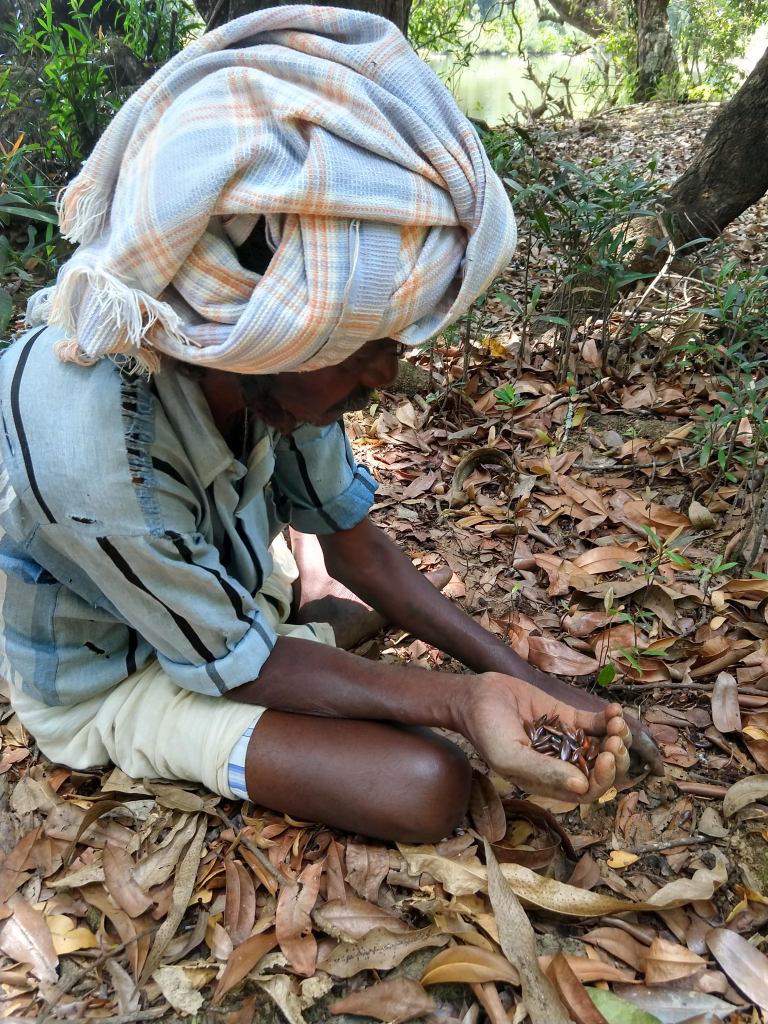
River bank modification, land-use change, dam proposal and more — there is a lot that threatens riparian habitats, which are majorly responsible for diverting flood water downstream. Invariably, the native species are threatened too. Hence, she has also been working with the native Jenu Kuruba tribe, who are traditional honey collectors, to preserve the local species. To this end, they started a seed bank and a nursery along with executing plantations of local species, all with the support of the Karnataka Forest Department. “The tribals were shifting to planting commercial species because it gets them the money, but a lot of time was spent on making them understand that their indigenous knowledge and skills are valuable. And unless it’s not documented, we will never know about it,” says the independent researcher who hails from Bengaluru. They have identified 12 species, as of now, that are important and have so far collected six to seven species. “One of the species that we are working for is a kind of river jamun (plum) that grows during the monsoon and drops into the river where, via observation, we can confirm that mahseer and other omnivore and herbivore fishes feed on it,” she explains.
It was in the year 2015 during which she mapped out the river stretch of Kaveri and did her basic groundwork for her research
What we love best about what Neethi is trying to do involves government school children as well. “There has been environmental generational amnesia and the new landscape is normal to them. We are trying to get them out in the open, teach them how to test the water in the river, how fertilisers affect it and so on,” she explains. But what she is most excited about currently is her soon-to-be-launched portal Our River, Our Life. “It’s a river-monitoring page. One can upload their quality report of their location online. It could also serve as a flood-watch. And then there is also her Voices from the River blog, where people can share their river stories,” she informs. It surely sounds resourceful.
Collecting seeds | (Pic: Neethi Mahesh)
Her area of research Spatial ecology is the study of the spatial area occupied by a species. The species’ relationship with the habitat, other species and so on are studied in detail. It is also the study of the species’ own microhabitat and what affects it. Some of the courses that can help you understand more about this are: – Graduate Certificate in Spatial Ecology from Michigan State University, US – Computational Methods in Ecology and Evolution (MRes) from Imperial College, London
source: http://www.edexlive.com / EdEx-TNIE / Home> Happennings> Fish / by Seema Rajpal, Edex Live / March 06th, 2021
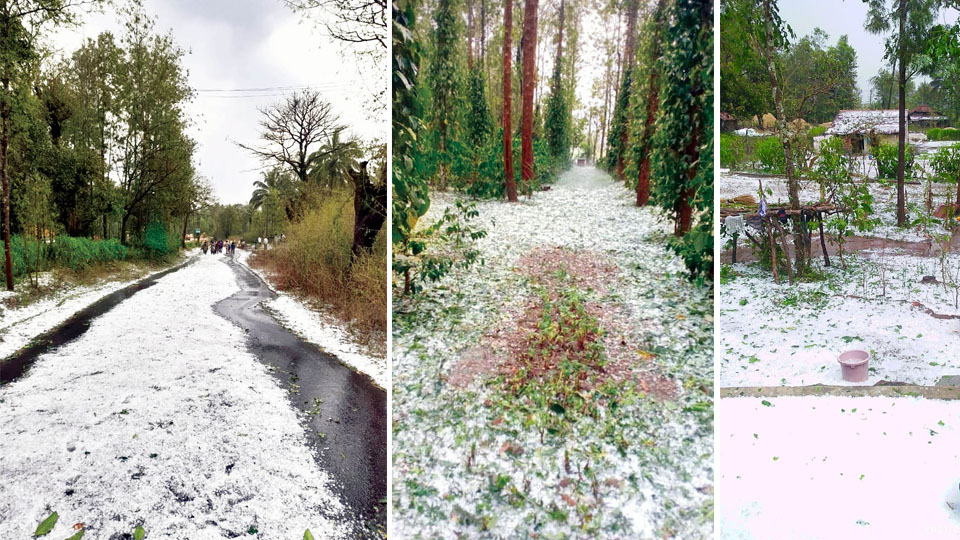
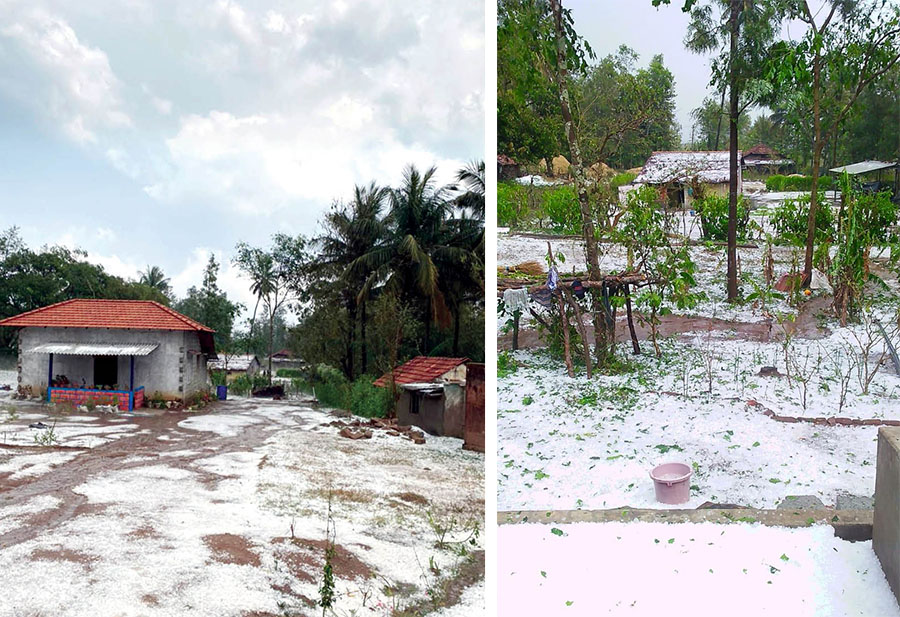
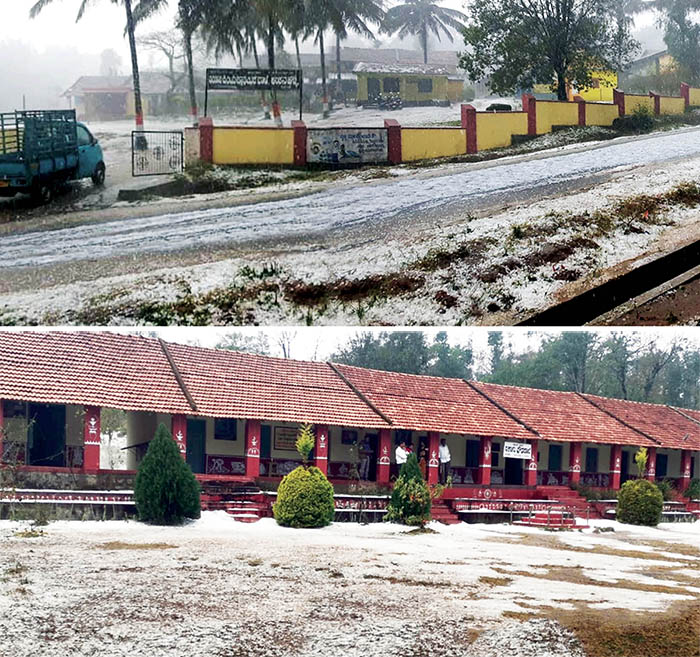
Parts of North Kodagu were swathed in a white carpet yesterday with ice left behind after a hailstorm.
Heavy rains and hailstorms lashed villages of Nidtha, Ankanahalli, Mullooru, Dundalli, Doddalli and Gudugalale near Shanivarsanthe of Somwarpet taluk in Kodagu district yesterday, taking residents by surprise. In Chamarajanagar too it rained hail last evening, throwing traffic out of gear.
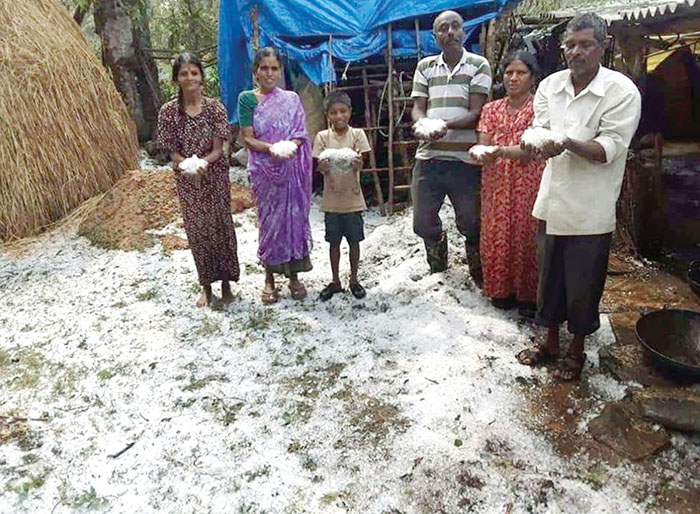
In Kodagu, due to rain of hail, villages resembled snowing Kashmir plains. Children and women cheered the hail storm and they rushed outside homes to fistfuls of hailstones. Photos and videos of the hail went viral, inviting reactions of awe and delight in social media.
While the hail rain looked attractive with white carpet spread and with visuals of people holding the hailstones in their hands, it worried the farmers and coffee growers of Kodagu as this is the season of coffee blossoms and if it rained hail, it would damage the flowers resulting in low-yield next year. The growers are already tormented by unseasonal rains and, lack of support from the Government and less pricing for coffee.
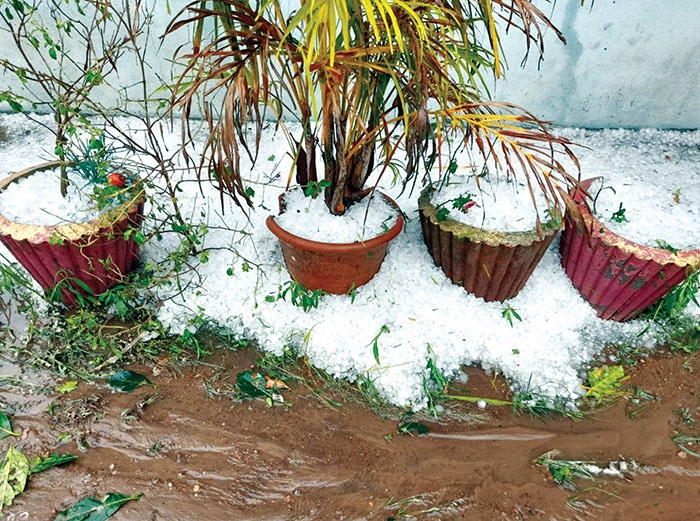
Heaps of hailstones were found on the roads, coffee estates, roof of the houses and coconut plantations. The Ankanahalli Government School and a veterinary clinic were covered with hailstones. Along with hailstones and rains, the gusty winds also damaged the standing crops including coffee, paddy, green chilli, mango and arecanut in the district as there is high moisture content. This also will dent the product quality.
As the weatherman has predicted rains for two or three more days, coffee growers have said that due to rain, ripe coffee berries have fallen onto the ground and the drying process has been affected as it rained in the second and third week of January — a crucial month for drying. The rains also resulted in early flowering before the annual harvest, they said.
Ice formation in static clouds
Giving a scientific perspective to the hailstorm, former Deputy Director General of Geological Survey of India (GSI) told Star of Mysore this morning that though the hailstorm looks beautiful with white ice cubes all over, it is bound to cause major damage to standing crops.
“There was a dip in the temperature in January this year and the average temperature ranged between 12 to 13 degrees Celsius. And there was no cloud movement for more than 15 to 20 days after the cold spell. This caused ice to form in the static clouds and now due to rise in temperature and Rathasapthami, the ice has melted and it has resulted in the rain of hail. While in Kodagu small white ice cubes fell onto the ground, in Telangana and Andhra Pradesh large cubes even weighing about 500 grams fell from above,” he explained.
The Kodagu District Administration must send a team to the affected villages and assess the damage that will be severe. Farmers and growers are entitled for Government compensation, he added.
The Karnataka State Natural Disaster Monitoring Centre (KSNDMC) has predicted scattered to widespread light to moderate rains with isolated heavy rains likely over South interior Karnataka and Malnad districts and isolated to scattered very light to light rains likely over Coastal and North interior Karnataka districts for three more days.
The rains are a result of a weather system — a trough in Arabian Sea from Kerala to Gujarat coast. The weather system which was over Vidarbha as a cyclonic circulation has now shifted towards Madhya Maharashtra and adjoining areas. A trough is also extending from this cyclonic circulation to Kerala. These two weather systems — resulting low level moisture feed from Bay of Bengal in the form of South-easterly winds and humid winds from Arabian Sea at a height of three kilometres — are causing rains and hailstorms, says weatherman.
source: http://www.starofmysore.com / Star of Mysore / Home> News / February 21st, 2021
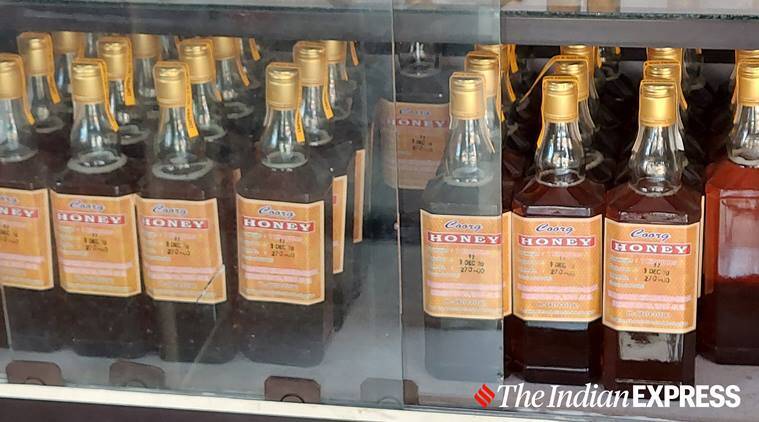
The beekeepers and producers of ‘Coorg Honey’ said they want the authorities concerned to take their brand across the country and beyond and bring back the halcyon days when the hill district used to be the country’s top honey producer.
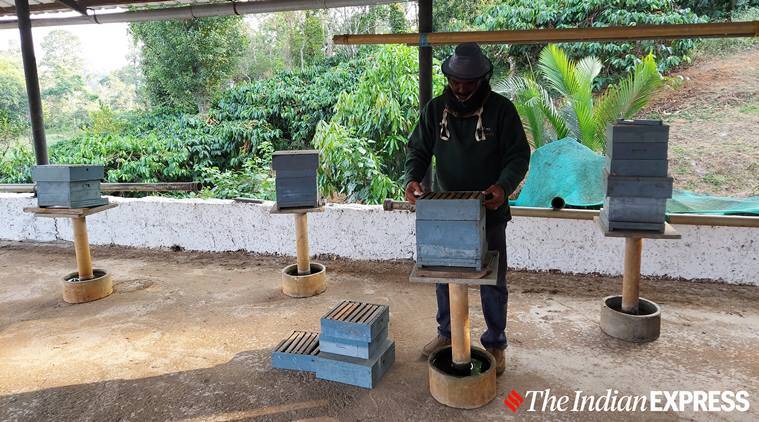
Nagesh, an apiarist in Bittangala village in South Coorg. (Express Photo by Darshan Devaiah)
Be sweet with Coorg Honey. Those were the words of Sri Shambhavananda Swamiji from Sri Ramakrishna Mission who developed a unique method of bee-keeping known as ‘Coorg Standard Hive’ in the hilly district of south Karnataka-Coorg (Kodagu). Now, the beekeepers want the state government to not only make the practice sustainable but also go big on promoting brand ‘Coorg Honey’.
Citing a recent investigation by the Centre for Science and Environment (CSE), which found that honey sold by major brands in India was laced with modified sugar syrup, the beekeepers and producers of ‘Coorg Honey’ said they want the authorities concerned to take their brand across the country and beyond and bring back the halcyon days when the hill district used to be the country’s top honey producer.
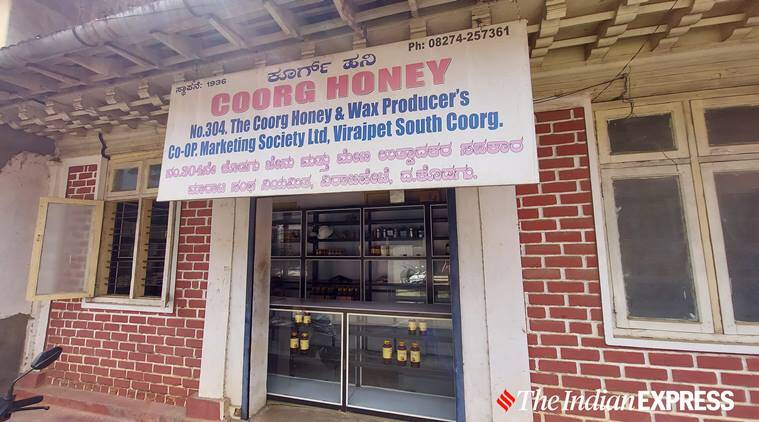
After becoming the first president of Sri Ramakrishna Saradashrama in Coorg way back in 1928, Swami Shambhavananda initiated a bee-keeping project in the district knowing that the lush, hilly terrain presented an ideal setting for the practice which could also contribute to the local economy. In 1936, Swamiji set up the ‘Coorg Honey and Wax Producers Co-operative Society Ltd’, which, in time, became the first honey producers’ co-operative in the country.
Coorg Honey society building in Virajpet. (Express Photo by Darshan Devaiah BP)
Over the last few years, the practice of bee-keeping and honey collection in the district has declined, to the extent that the Coorg Honey and Wax Producers Co-operative Society Ltd is now forced to procure honey from North Indian states just to keep their brand alive.
Speaking to indianexpress.com , Kodira Praveen Chengappa, former president of Coorg Honey and Wax Producers Co-operative Society Ltd, said, “Everyone who comes to Coorg, which is one of the country’s top tourist destinations, wants to take home a pot of ‘Coorg Honey’. However, the beekeepers in the district are not producing honey now like they used to. Since the production has reduced, our society has little option but to buy honey from beekeepers in Chikamagaluru, Karnataka, Bihar, Punjab and other places, who collect pure and original honey. We do a strict quality check then if the honey meets our standards, we sell it under the ‘Coorg Honey’ brand name.”
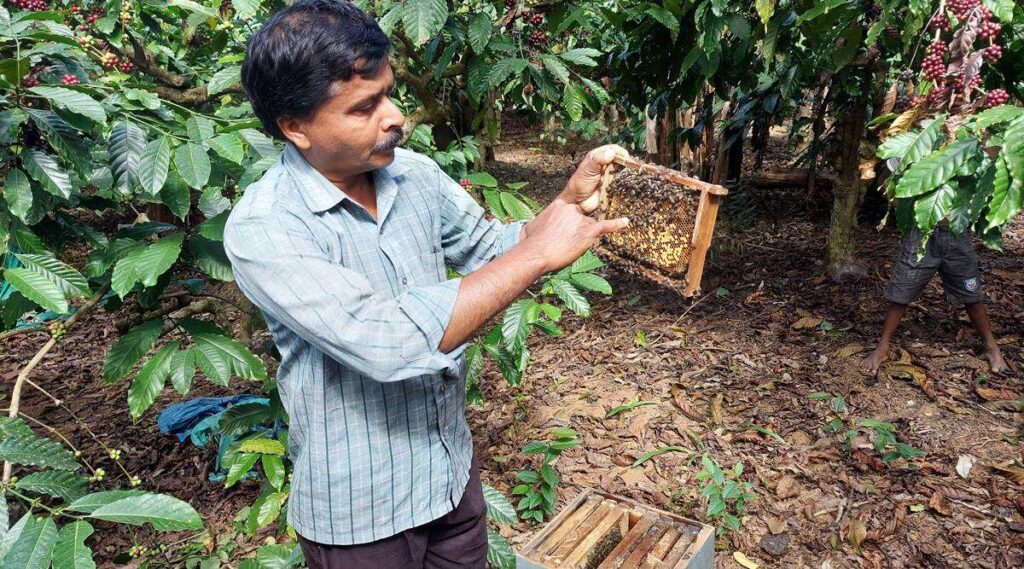
Kodira Praveen Chengappa taking honey from his honey bee box. (Express Photo Darshan Devaiah BP)
Apis Cerana bees, known as the honey bees of Coorg, still flock around the colourful indigenous flowers, lining the Western Ghats, drawing nectar. However, the practice of beekeeping has been severely hit.
“Earlier, many trees were planted and wildflowers, including coffee blossoms, paddy, ragi, were cultivated, drawing bees by the droves. However, honey collection has been severely dented as the use of pesticides these days is killing the bees,” Chengappa said.
Apiculture or beekeeping used to be one of the important farming activities in Coorg and contributed substantially to the income of local farmers. “In 1936, Shambhavananda Swamiji started the first honey producers’ co-operative in India at Virajpet in Coorg district. Later, in 1938, he founded the Ramakrishna Ashram and started to impart beekeeping lessons to local youth, who took an interest in the practice, at his office and a honey processing unit. He also sent local enthusiasts to beekeeping training centres in Pune and Coimbatore. He also marketed ‘Coorg Honey’ in Mumbai and other cities,” Chengappa said.
Though the production of ‘Coorg Honey’ has declined drastically, the former boss of the co-operative said the demand for the brand remains undiminished and with a bit of hand-holding from the government and other authorities concerned, the district could return to its glory days of honey making.
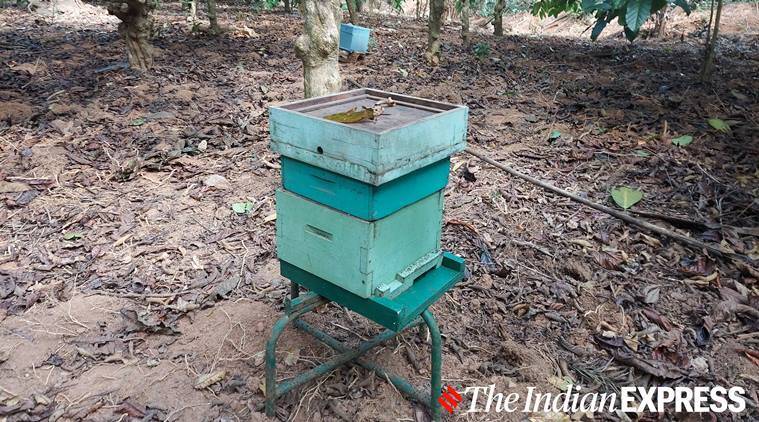
Bee hive boxes kept inside a coffee estate in Coorg. (Express Photo by Darshan Devaiah BP)
Traditional beekeepers, who have been harvesting honey since ages, are struggling these days as the honey bees of Coorg are declining in number, largely because of the use of pesticides. They said that radiations from mobile towers in the district are proving fatal for the bees.
Nagesh, an apiarist at Bittangala village in South Coorg who has been into beekeeping for three decades, told indianexpress.com, “I request our farmers not to use pesticides as it is because of these chemicals that the honey bees are dying. I have also seen the bees dying because of radiation from mobile towers. As much as 30 to 50 per cent of bees are dying due to mobile tower radiation and another 80 per cent because of the use of pesticides.”
Nestled in the midst of rolling hills and dense forests, Coorg experiences periodic shifts in climate and temperature, making it a favourable haunt for four major species of honey bees. According to Nagesh, a Coorgi, the honey tastes different as seasons roll and also at time of crop cultivation. “During the harvesting of coffee beans, the honey tastes very different compared to the season when paddy is cultivated,” Nagesh said, adding that the main four species of honey bees found in Coorg are Ponn thene (Apis dorsate) in forest areas, Potti thene (Apis cerena), Kaddi thene (Apis floria) and M ooli thene(Apis trigona), which are domesticated.
Beekeepers in Coorg keep around 30 to 50 bee boxes within an area of one to one-and-a-half kilometres, depending on the source of bee forage, in their coffee estate or areca nut farms. Nagesh said bee colonies, these days, is very hard to find as they are facing the risk of a colony collapse disorder where the majority of worker bees in a colony disappear.
Coorg honey. (Express Photo Darshan Devaiah BP)
A beekeeper in Coorg can harvest 2-3 kgs of honey from one box. “Earlier we used to harvest 10 to 20 kgs of honey from one box. During the peak time, honey can be extracted once in 15 days from one box if there are strengthened colonies. However, that is not possible now,” Nagesh said.
The horticulture department has started providing Bee Hive Boxes and training to interested people at the beekeeping training centre in Bhagamandala, North Coorg. Founded in 1953, the centre provides three months of training, where students are taken through the basics of bee collecting, bee hiving and honey collecting or extraction, among other practices.
Prakash Mandanna, a beekeeper who took his lessons in the practice at Bhagamandala training centre, said, “After enrolling for a training course 10 years ago, I started beekeeping. However, six years later, the bees were afflicted with diseases such as Thai sac brood. Planting of exotic trees such as Silver Oak, Eucalyptus and Acacia Auriculiformis in the coffee estates affected pollinators and altered the native flora of Coorg.”
“The loss of forest cover and native trees is also an important reason for less honey bee production in Coorg. The government should focus on revival of bee production through the expansion of forest cover and forage plants in the district,” Mandanna told indianexpress.com.
He said the need of the hour is for the state horticulture department to promote beekeeping among the youth in the district. “Our government has undertaken various initiatives to promote beekeeping but the problem is that people are losing interest in the practice as the bees are not available in plantations and forests now. The horticulture department should come forward and support beekeeping in Coorg,” he said.
Officials in the horticulture department said various initiatives have been taken up in recent years to increase production of honey and provide subsidy to farmers interested in Apiculture.
Speaking to indianexpress.com, Dr Hemalatha, senior assistant director, Horticulture (Apiculture), said, “We have three different schemes at central, state and district levels to help farmers who are interested in apiculture. As part of the state sector, we are giving a budget for beekeeping development and under the central sector scheme, we are providing pollination support. We are also giving residential beekeeping training at the Bhagamandala centre in Coorg where approximately 15 to 20 interested farmers can take a training in beekeeping every year and earn a stipend.”
She said the horticulture department is also reaching out to farmers across the state, who are interested in beekeeping. “Our schemes are aimed at helping farmers interested in Apiculture and we are spreading the word through local newspapers and grama sabha meetings. Honey Mela is also organised every year in Bengaluru to promote Apiculture,” Hemalatha said.
source: http://www.indianexpress.com / The Indian Express / Home> Cities> Bangalore / by Darshan Devaiah BP, Coorg, Madikeri / February 15th, 2021
Ex-banker Soomanna Mandepanda and his wife, Puja Soomanna set up their startup Humblebean in 2017 to ensure better prices and reach for small coffee farmers and improve every part of the value chain.
For former banker Soomanna Mandepanda, the motivation for setting up Humblebean was not just to sell the best coffees, but more importantly, uplift the small and medium Indian farmers who grow them.
In the process, he is trying to bring about changes at almost each stage of the business — from cultivation and supply chain to research and education.
Founded in 2017 by Soomanna and his wife and former Yahoo executive Puja Soomanna, Bengaluru-based Humblebean works on an omnichannel model: It ties up with small coffee farmers in south India, roasts and grounds supply, provides the beans to roasters, exports its products, operates brew bars, and has an online presence.
A responsible way to grow coffee
The coffee drinking experience has been gaining traction in India, with the market for the brew expected to record a compound annual growth rate of 7.2 percent during 2021-25, according to a January 2021 Statista report.
Startups including Sleepy Owl, The Flying Squirrel, and Coffeeza, as well as shops such as Third Wave Coffee Roasters are making their presence felt in the market.
India is the world’s sixth-largest producer of coffee and fifth in terms of exports; in fact, 70 percent of its production is exported, says a January 2021 report by the India Brand Equity Foundation. Yet, Soomanna says, “a lot of small and medium farmers and farms aren’t getting the kind of business and reach they should” .
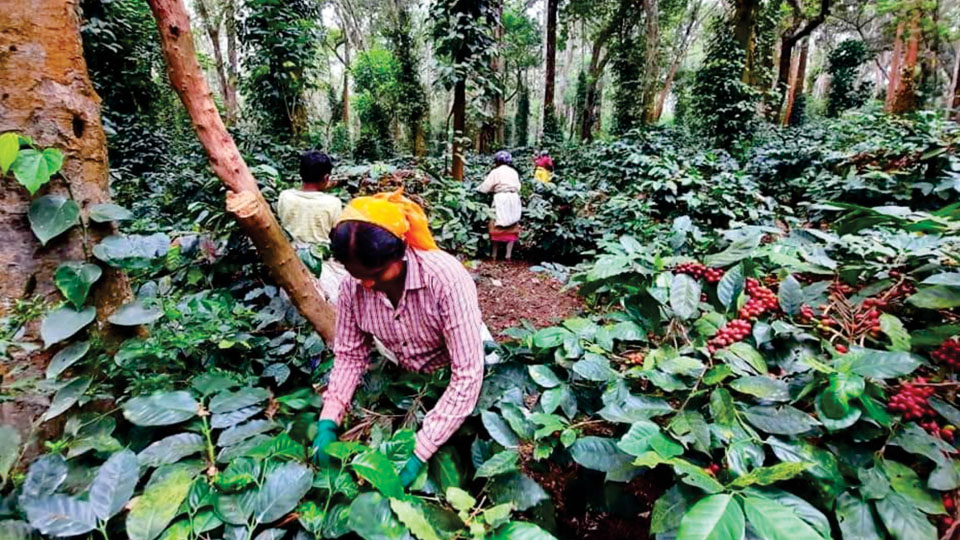
Soomanna would know: he spent most of his childhood on the coffee estates of Coorg and was a small farmer before moving to the world of finance and banking for 13 years. One way to correct the imbalance, he says, is by “making great biodiverse coffee that farms in India are already poised to do”.
According to him, 80-90 percent of coffee farms in India are held by small and medium farmers, whose secondary income comes from crops such as jackfruit, avocado, pepper, and orange that are part of the same farms.
Cultivating other crops alongside coffee “ensures automatic carbon sequestration, top soil replenishment, and lesser need to feed chemicals unlike commercial crops grown in other countries”, says Soomanna. “The mining of the minerals is automatic and you become carbon neutral.”
Puja Soomanna
Advocating farmer-friendly norms
Increasingly popular among young consumers are organic, speciality, and Rainforest Alliance coffees that respectively employ natural methods of cultivation dispensing with harmful chemicals, are of the highest grade being derived from a single origin or single estate and protect the environment as well as worker rights.
However, in India these certified varieties are grown largely on rich estates; most small and medium farmers cannot afford the costly certifications and grades.
Coffee cultivation and the business are still quite unorganised in India, the certifications cost a lot of money, and need constant follow-ups, says Soomanna. “The norms are difficult to adhere to for most small farmers. It is a replication of an American model.”
___________________
He says most large corporations in India export to Europe. “The small companies in Hassan, Chikmagalur, etc. certify about 150 estates and add the tags. But the farmer doesn’t get the price because the better prices are still being fetched with the local trader. The local traders are important, but the real traceability is lost.”
As farmers don’t get better prices, there is little driving them to improve their produce, he says. “Speciality coffee is something few farmers can afford to grow.”
Hence, the need to bring in farmer-friendly rules, he says.
The Humblebean coffee
Promoting social value investing
Given the largely unorganised state of affairs, Humblebean focused on getting farmers on board. The team collected random samples, tasted them, and guided farmers on growing the beans in a better way.
By 2018, the team had got 50-60 farmers on board and given them assessment reports free of cost. Until then, the startup was in its pre-revenue stages, bootstrapped with funds from family and friends.
The team then focused on getting roasters to directly buy from farmers. For this, it adopted the idea of social value investing, in which everyone who is part of the value chain comes together to solve a problem and there is money in it for all.
__________________
“Once we got the farmers on board, we decided to tie up with brands and introduce them to the new portfolios of coffees,” says Soomanna. “We incubated close to four different brands in India from scratch to start a unique brand with a different blend. The idea was to bring in multiple partnerships and inclusiveness in the farming community on one platform.”
Most of the speciality coffee firms have restricted names and types of beans grown on particular estates. “The idea is to bring in more brands that can access different estates, work with them, and encourage the farmers,” says Soomanna.
Humblebean also fulfils the complete roast and ground process for such brands and even gives them a credit facility, he says.
Quality comes with education
Towards the end of 2018 and early 2019, the Humblebean team found that coffees served at most star hotels weren’t up to the mark.
One of the reasons for this, Soomanna says, is that coffee as education is lacking in hotel management schools: one has to go to Italy to learn more about its nuances. The Coffee Board of India mostly takes care of the functionality, he says.
_________________
“We met a few management schools and after some discussions it was decided that the colleges would look at it as part of the curriculum,” says Soomanna.
Brewing innovative Indian blends
Even as Humblebean works to improve every part of the value chain, it is trying to offer consumers a very Indian coffee drinking experience.
To that end, the startup opened its first Brew Bar in the food experience section of a workspace on Bengaluru’s Residency Road in 2019. Humblebean was one of the early members of that workspace set up by a Singapore-based company.
Puja, who conceptualised Brew Bar, spent time innovating the blends with the use of Indian robustas.
“We don’t serve a single cup of speciality coffee; we wanted to make sure through the brewing methods can small and medium farmers come into mainstream brewing?” says Soomanna.
______________
He says these Indian blends “aren’t being used by a single new-age speciality coffee company” as they are considered “harsh and used as a filler across the world. But they are unique and you need great expertise and experience to make a robusta out of them”.
Following research and development, the startup has also come up with its own set of products. Together with B2B partners, it has launched these products online and will soon sell them at other marketplaces. The range is priced at Rs 220-350 for 250 gm for limited editions and depending on the roast.
“Indian coffees can have a global impact,” says Soomanna. “The idea is to be farmer-friendly and also not cause too much environmental damage. We want to bring an amazing cup of coffee from the farms the way it should be drunk.”
Edited by Lena Saha
source: http://www.yourstory.com / YourStory / Home> Start Up / by Sindhu Kashyap / February 07th, 2021
There is an increasing demand from coffee growers for a relief package in the budget to be presented by the State Government this year.
The demands have grown after the Kerala Government increased the Minimum Support Price (MSP) for raw Robusta Coffee at Rs. 90 per kg in Wayanad district. For a 50 kg bag, the MSP offered by Kerala is Rs. 4,500. The MSP announcement that comes at a time when coffee growers are reeling under severe crisis owing to the low price of the produce, higher input cost and vagaries of weather.
Even the coffee grower community from Kodagu have been demanding relief package as they feel that the amount paid through the calamity relief fund under the National Disaster Management Plan will not be sufficient to recoup the losses suffered by them due to unprecedented rains.
Former Vice-President of Coffee Board Dr. Sannuvanda Kaverappa said that since 2015, the coffee growers in Karnataka were suffering due to lack of good prices, high input and labour costs and adverse weather, but successive governments have ignored the plight of the growers.
A waiver of coffee loans, re-scheduling of outstanding loans and reduction in the interest rate for loans are justified considering the difficult times faced by the growers, he said. “Coffee planters in the district are reeling because of various reasons, including the vagaries of monsoon and COVID-19. I appeal to the Government to declare a special relief package and announce a waiver of short-term loans and developmental loans taken by coffee growers,” he said.
He also sought immediate payment of pending subsidies towards replanting and other schemes of the Coffee Board. “Kodagu has been tormented by weather and either it is lack of rains or excessive rains that have led to landslides and destruction of plantations.
Karnataka must follow the Kerala model where an MSP of Rs, 90 per kg has been declared to Wayanad coffee growers,” he demanded.
source: http://www.starofmysore.com / Star of Mysore / Home> News / January 25th, 2021
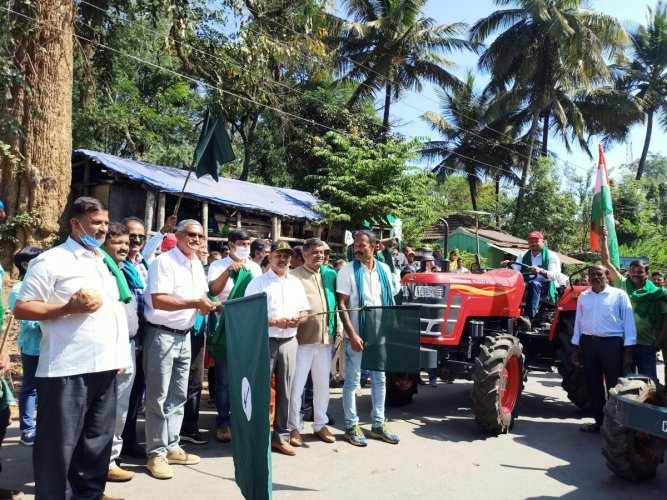
The tractor rally led by farmers was flagged-off at Kutta on Monday.
Urging the Central government to shelve the new farm laws and demanding support price for coffee, farmers and planters from Kodagu took out a tractor rally from Kutta, the border of Kodagu to Bengaluru, on Monday.
Gathering in large numbers, the farmers, along with their family members, including children, battled the cold weather and lashed out at the Central government.
The farmers seated in the tractors and jeeps raised slogans against the Central and state governments. They also demanded a minimum support price for coffee and pepper.
Probably for the first time in Kodagu, farmers, coffee planters, elected representatives from various political parties and labourers were part of the same protest.
The rally was held under the leadership of Raitha Sangha district president Kadyamada Manu Somaiah.
Speaking on the occasion, Kodava Federation president Kallichanda Vishnu Cariappa said that the farmers in the district have been toiling hard from the last three years. But, the crops have been destroyed in the recent untimely rainfall.
Having no other choice, the farmers have got down to the streets, demanding support from the government, he said.
Rajya Raitha Sangha president Badagalapura Nagendra said that the farmers have decided to take to the stir to claim their right.
Farmers from the district should be provided with a major share in the compensation announced by the Central and the state governments as they have incurred huge losses, he said.
MLC Shantheyanda Veena Achaiah said that the government should give up its stubbornness and should listen to the farmers’ issues.
The rally comprising tractors, jeeps, cars and bikes travelled to Mysuru via T Shettigeri, Hudikeri, Ponnampet, Gonikoppa, Titimati and Anechowkuru.
A protest will be held in front of Freedom Park in Bengaluru on January 26.
ZP member Mukkatira Shivu Madappa, Lt Col Baleyada Kalaiah, Codava National Council president N U Nachappa, former MLC C S Arun Machaiah and others were present.
source: http://www.deccanherald.com / Deccan Herald / Home> State> Mangaluru / by DHNS Gonikoppa / January 26th, 2021
Coffee growers from Kodagu, who are seeking minimum support price (MSP) for coffee, will join the farmers’ protest scheduled to be held in Bengaluru on January 26 against the Centre’s farm bills.
The coffee growers are seeking to draw attention to their predicament over coffee prices remaining stagnant for more than 20 years while the costs they incurred on labour and other agricultural inputs including fertilizers have increased manifold.
“One 50 kg bag of robusta coffee used to fetch ₹3,000 in the mid- and late nineties. The price has remained unchanged more than two decades later also” said Karnataka Rajya Raitha Sangha (KRRS) leader from Kodagu Manu Somaiah.
Coffee growers are putting up with the stagnant prices of coffee while shouldering the burden of rising costs of labour and other agricultural inputs, he said and sought to know why the State is refusing to extend MSP to coffee when neighbouring Kerala was extending the same to its growers.
“About a week ago, we held a meeting and decided to press for our demand for MSP for coffee”, said Mr. Somaiah. “When Kerala, which produces barely 20 per cent of the country’s coffee production, can extend MSP, why can’t Karnataka, which accounts for more than two-thirds of India’s coffee production do the same?”, he questioned.
He said their appeals for MSP are met with the standard reply that coffee was a commercial crop that is not entitled for support price. “But, when Kerala government can do it, what logical explanation can Karnataka government give?”, he asked.
The coffee growers of Kodagu have been at the receiving end of nature’s fury during the last three years when the region was struck by landslides and floods, causing widespread damage to the crop.
Mr. Somaiah recalled that the coffee growers were receiving remunerative prices when it was regulated by Coffee Board till the early nineties. But, it shifted to open market policy soon thereafter on the same promise that the present farm bills are assuring – that the farmers will earn more. But, it was not to be, he regretted adding that the prices are now determined by the trading in New York and London Stock Exchanges.
Mr. Somaiah said the coffee growers in Kodagu are also upset with the State government and Centre over the falling price of black pepper, which is grown as inter-crop. The price of black pepper had reached ₹900 per kg till the Centre started allowing imported pepper from Vietnam and other countries to flood the domestic market and bring down the prices to the level of ₹300 per kg, he lamented.
The coffee growers of Kodagu are joining forces with the farmers from the rest of the State, who are planning to gather in Bengaluru on January 26. The coffee growers from Kodagu will gather at Kutta on January 25 before leaving in about 150 vehicles towards Bengaluru. The coffee growers will hold demonstrations in Ponnampet and Gonikoppa before spending the night in Mandya and proceeding to Freedom Park in Bengaluru on January 26.
source: http://www.thehindu.com / The Hindu / Home> News> States> Karnataka / Mysuru – January 23rd, 2021
WELCOME. If you like what you see "SUBSCRIBE via EMAIL" to receive FREE regular UPDATES.
Read More »