Women in Kodagu are increasingly learning cultivation and becoming self-reliant
Madikeri :
Don’t underestimate the mushrooms. They are having their moment. This is a story about homemakers in Kodagu district. And it is also a story about mushrooms. “I grew up wanting to do something unique,” says Ambika Achaiah, 35, a budding entrepreneur from Cheyyandane village. While Ambika dreamt of starting a unique venture, she was married off after completion of her degree and nearly 10 years passed in managing home and hearth.
Nevertheless, her ambition to achieve something different was reignited when she stumbled upon a radio broadcast about free training for mushroom cultivation in 2019. “I was excited when I learnt of it. I travelled nearly 60 km to Krishi Vignyana Kendra in Gonikoppal to avail the training under the National Skill Development Corporation programme,” recalls Ambika. While she thought that it would last a day, she was shocked to learn that it was a 25-day course. Encouraged by KVK scientist Dr Somashekar, Ambika completed it and received a certification in oyster mushroom cultivation.
Ambika is currently working at the mushroom cultivation lab in KVK and experimenting on different varieties of mushroom cultivation. “I started off with spawn cultivation. But now I am versatile in mushroom tissue culture and the entire process of mushroom cultivation. I have applied for a loan and I will soon set up my own unit at my house,” she says.
While she is involved in developing the popular oyster mushroom variety, she is also experimenting on cultivating the seasonal milky mushroom. Apart from the cultivation process, she trains other like-minded homemakers. “Various women cooperative societies and other self-help groups invite me for motivational talk. I encourage women to take up the profitable mushroom business and I have also provided training for a few women in mushroom cultivation,” Ambika says.
Rashmi Bharadwaj, 40, is also a homemaker. She indulged in gardening – especially in orchid cultivation – as a hobby and sometimes even earned some pocket money. However, it has been nearly two years since Rashmi stepped into the field of mushroom cultivation and today she runs her own unit. “I run a mushroom cultivation unit on contract basis with KVK in Gonikoppal. It would take nearly Rs 15 lakh to establish a unit. However, it was easier for me to work on contract as I did not have to worry about initial investment. And all the equipment is readily available,” says Rashmi.
After being a homemaker for several years, she started working for a minimum remuneration at a mushroom spawn cultivation unit. But after eight months into this job, she started cultivating oyster mushrooms from scratch and she now sells 100 to 120 harvested oyster mushroom bags per day. “I work from 9 am to 5 pm every day. Apart from the ready-to-cook oyster mushroom bags, I also manufacture Ready To Fruit Bags, which sell like hot cakes among mushroom farmers,” she explains. Ready to Fruit bags (RTF) are mushroom seeded and grown straw bags of oyster mushrooms.
The clients who buy them have to cut out a few holes in these RTF bags and keep them in a well-lit area (not under direct sunlight) and sprinkle water regularly. Oyster mushrooms bloom from these packets, without the risk of any contamination and effortlessly within five to seven days. Another shining example is Lakshmi, 55, who worked as a domestic help and switched many jobs in between even as she worked as a hospital help at daily wages for 25 years until recently. “I worked at a hospital as a cleaning staffer for many years. But I wanted to become self-reliant,” she recalls.
Lakshmi stumbled upon the mushroom cultivation training programme and she found her path to independence. She is cultivating mushrooms on a small scale and has set up her own unit in a single bedroom. “Contamination-free is the key to mushroom cultivation and the business gets profitable only when the set-up is unpolluted. I collect paddy straws from a known people, bake and dry the straw, purchase mushroom growing bags and start spawn cultivation by keeping the bags under the cot – where the temperature is less and visibility is low,” says Lakshmi.
Though she is self-reliant, she says, “I am unable to manufacture mushrooms on a large scale as I lack the required funds to purchase improved facilities. However, I am happy with my small scale set-up, which is better than working for someone.”
Oyster Mushrooms After White Button, oyster mushrooms are mostly cultivated and consumed across India. These have many health benefits as they are rich in proteins, vitamins, minerals and fibres, and low in calories. They are believed to help increase immunity.
Women Turn Entrepreneurs The mushrooms, bought by customers across Kodagu, are not just making for a tasty treat but are enabling entrepreneurship skills among many women. The cultivated mushrooms are sold throughout the year at local markets, and even home delivery is available on request.
source: http://www.newindianexpress.com / The New Indian Express / Home> States>Karnataka / by Prajna G R / Express News Service / January 17th, 2021
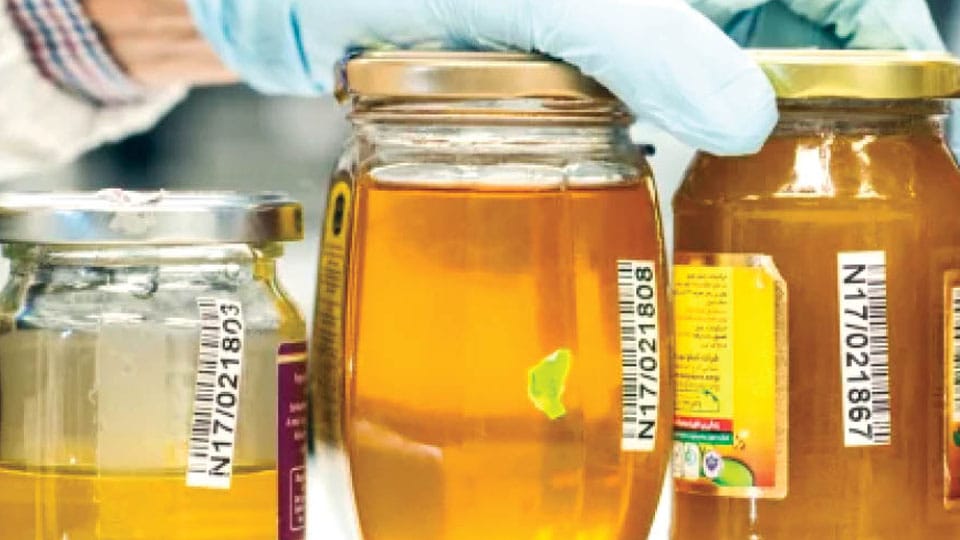
Last week, we got some bitter news about something sweet. The Centre for Science and Environment (CSE) reported that when they subjected 13 prominent brands selling honey to a sophisticated test in Germany for adulteration, except three, all other brands failed.
The only three brands that passed were Saffola, Markfed Sohna and Nature’s Nectar.
As fear of refined sugar has increased, so also adulteration of other sources of sweetness. Best example is jaggery.
As jaggery gained popularity as an alternate to sugar, its adulteration started. Mandya jaggery was very popular until jaggery makers from Uttar Pradesh came calling and started adding chemicals to rapidly increase production capacity and visual appeal.
In a report submitted to the Government by the Co-operation Department, it found chemicals like “calcium hydroxide, sodium hydrosulphite (hydrose), sodium formaldehyde sulfoxylate (safolite), ortho-phosphoric acid, seashells, baking soda, oil (castor/coconut) and orange-red powder (artificial food colouring) in jaggery blocks”! We educated urbanites find it hard to even pronounce the names of these chemicals which makes us wonder if farmers are making jaggery or chemical engineers?
This is a serious issue because India accounts for over 70% of world’s jaggery production and such practices will ruin our reputation and income. Already Mandya jaggery brand has taken a hit as the use of chemicals has significantly reduced its shelf-life which has forced many wholesalers to sell their product in distress.
We in India don’t seem to take food adulteration seriously. Be it the Government, the producer or the consumer. It is common knowledge that fruit-sellers use calcium carbide because it reacts with the moisture emanated by the respiration of the fruit. And when it does, a gas called acetylene emanates which helps in ripening the fruit. This gas is carcinogenic! Yet, rarely do you see the Government personnel raiding these “ripening sheds.”
Vegetables are not spared either. Bittergourd and lady’s finger are dipped in copper sulphate water to make them look greener. Brinjals are coated with old oil to give them a shine; carrots are dipped in red dye-water and watermelons injected with gulal to make them red from inside. Rarely do you see officials confronting, let alone arresting these colouring artists.
Most of us turn a blind eye to this saying that we cook hot meals and all “these things die”… not really.
But the fallout of this food adulteration should be the rebirth of kitchen gardens and organic farms. It’s time to move on from show gardens to kitchen gardens.
Every year during Dasara the Government has a competition for the “Most beautiful home garden.” May be the same publicity must be given to “Best kitchen garden.”
P.S.: Speaking of organic food, once a husband went to a store to shop for his wife who was very health-conscious and wanted organic, pesticide-free vegetables. The husband walked upto the section where he saw vegetables stacked and asked the sales man if the vegetables were organic. The sales boy didn’t understand. The irritated husband picked up some vegetables and said, “Listen, my wife is health-crazy. So I need to know have these vegetables been sprayed with any harmful pesticides?”
The petrified sales man replied, “No, Sir. You’ll have to do that yourself!”
Ramakrishna Ashram Swamijiand Coorg Honey
Speaking of bees and honey, once upon a time Coorg was the top producer of honey.
In the early 1940s, there used to be a Government-appointed “Bee Man” whose job was to go from house to house, from estate to estate, teaching planters about the importance of bees to the environment and also teach them how to maintain a Bee Box and extract honey.
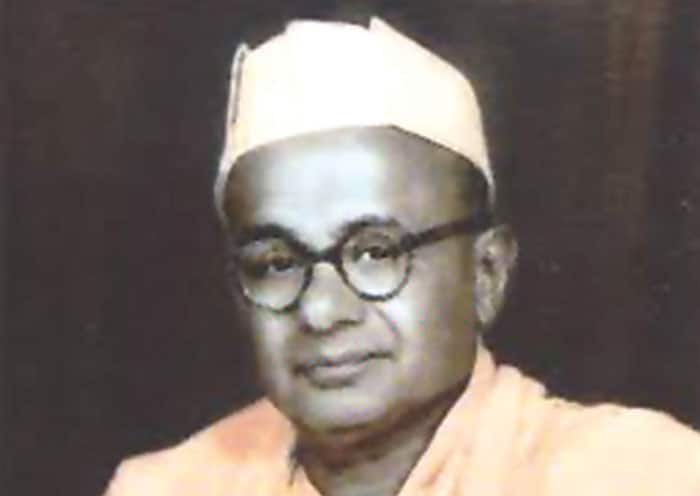
In fact, Scientific Bee farming in Kodagu was initiated by Sri Shambhavananda Swamiji, the man who founded the Sri Ramakrishna Vidyashala in Mysuru. In 1928, when Swami Shambhavananda became the first President of Sri Ramakrishna Saradashrama in Ponnampet, Kodagu, he initiated a project for Bee-keeping. Since he was born in Kodagu as Chengappa into the Thelapanda family, he knew that Kodagu was very suitable for bee-keeping and could contribute to the local economy.
Sri Shambhavananda Swamiji
Soon he prepared the first apiary and in 1936 set up the ‘Coorg Honey and Wax Producers Co-operative Society Ltd.’ This became the first honey producers co-operative in India.
Shambhavananda Swamiji even developed a new method of bee-keeping now known as ‘Coorg Standard Hive.’ No wonder Coorg came to produce almost 50% of all honey produced in Karnataka.
Now, if any one has space around their homes or in their farms there are many workshops that teach bee-keeping. In fact, there is an Apiculture Training Centre at Bhagamandala, Kodagu, where one can take a few weeks training in bee-keeping.
It may be recalled that the Government in 2014, to increase production and marketing of Coorg Honey, ordered the setting up of a “Honey Park” at Bhagamandala, Kodagu. The park was to be managed by the Food Processing Division of the Agriculture
Department. Later, Rs. 60 lakh was also released for the project. An old building was refurbished and not much else has been heard. Now, six years on neither is there a Park nor is there any Honey. Guess, like most Government projects it was all about the “Money Honey”?
e-mail: vikram@starofmysore.com
source: http://www.starofmysore.com / Star of Mysore / Home> Columns in Black & White / by Vikram Muthanna / December 19th, 2020
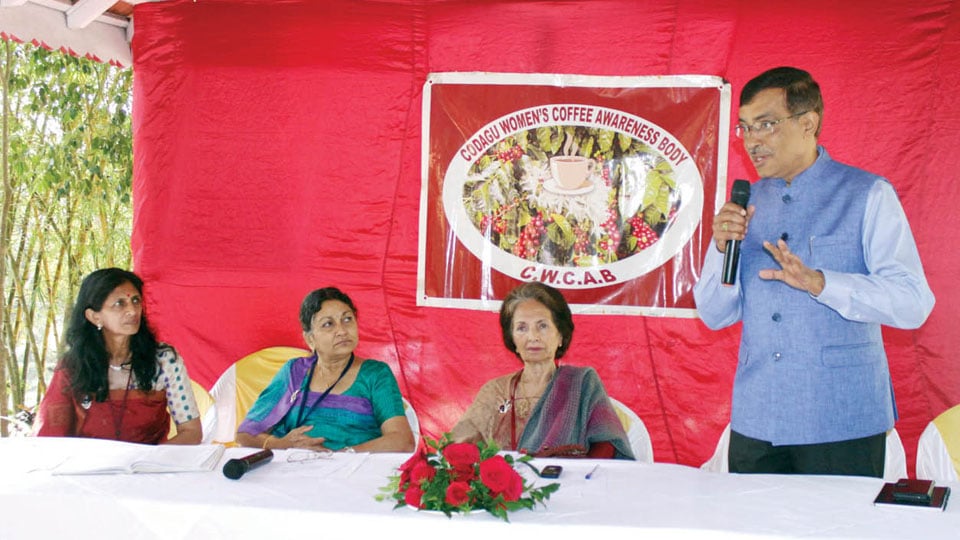
Ponnampet Forestry College Dean calls upon growers to maintain quality from estate to cuppa; 18th AGM of Kodagu Mahila Coffee Jagruthi Sangha held
Madikeri:
Coffee growers should give priority for cultivating tasty coffee naturally, said Ponnampet Forestry College Dean Dr. Cheppudira G. Kushalappa.
He was speaking at the 18th Annual General Body meeting of Kodagu Mahila Coffee Jagruthi Sangha held at a private hotel in Madikeri recently. Though Vietnam and Brazil produces large quantity of coffee, they are unable to get back the amount invested in coffee cultivation. They use highest quality of fertilisers to cultivate the crop and most of the finances are drained out here.
The growers of Kodagu must concentrate on cultivating coffee naturally by reducing the use of fertilisers. There are 360 species of trees inside the coffee estates in Kodagu. As a result, the ground gets good manure. This is the reason why Kodagu coffee is famous across the world.
“The undeniable natural beauty and abundance in Kodagu — from rainfall to fertile soil and diverse water sources — has made the region a highly sought-after location to cultivate coffee. Coffee flourishes in a unique blend of climatic conditions that includes humidity, heat and rainfall. Kodagu is ideal for these conditions and the slopes of the Western Ghats ensure orthographic rainfall that measure between 60 to 80 inches,” he said.
The abundant species of shaded trees work together in a two-tier system to protect coffee plants. These trees also prevent soil erosion and provide mulch to act as fertiliser. “The soil of Kodagu is rich with nitrogenous material and has a good sub-surface drainage,” he said and called upon growers to maintain quality from the estate to the cuppa.
Coffee Board quality expert Vikram Kuttaiah said that the prices of coffee have not increased drastically for the last 25 years. The maintenance of Arabica coffee was Rs. 25,000 per acre 25 years ago and now it has reached Rs. 80,000 per acre. The maintenance of Robusta variety has increased from Rs. 10,000 to Rs. 60,000.
“The maintenance costs have increased manifold but the prices of coffee has remained stagnant. There is a huge disparity between production costs and end profits. There is a situation where the grower has to be satisfied with meagre income,” he explained.
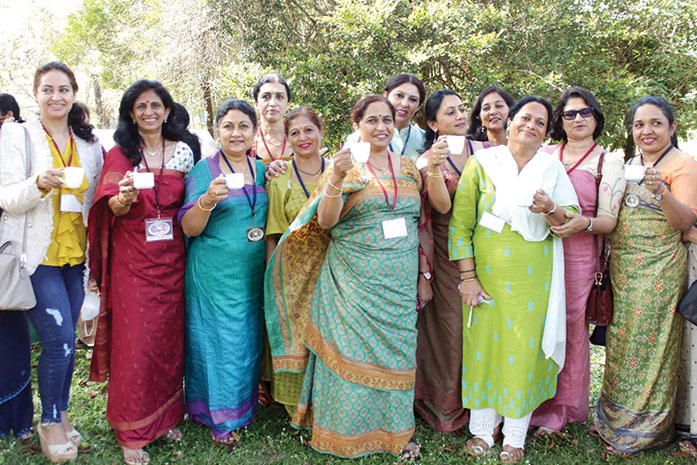
Kodagu Mahila Coffee Jagruthi Sangha President Pandikuthira Chitra Subbaiah said that the Sangha has been creating awareness about Coorg Coffee since the last 18 years. Sangha Director Kumari Kunjappa has been provided permission by Kodagu District Administration to open an outlet at Coorg Village that is coming up near Raja’s Seat in Madikeri, she said.
source: http://www.starofmysore.com / Star of Mysore / Home> News / December 14th, 2020
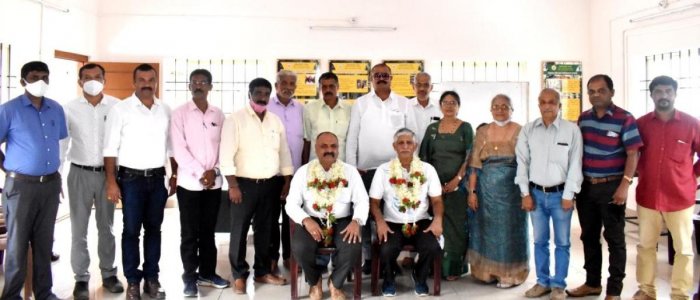
Biddatanda Ramesh Changappa and Mallanda Madhu Devaiah were elected as the president and vice president of Kodagu district Hopcoms in Madikeri.
Biddatanda Ramesh Changappa has been elected as the president of Kodagu district Hopcoms, while Mallanda Madhu Devaiah has been elected as the vice president.
S P Ponnappa, Padiyammana V Mahesh, Leela Medappa, Sathish, Machimanda D Ganapathi, H M Sudheer, Baby Poovaiah, B A Harish, Nagesh Kundalpadi, Umesh Rao Urs, Poovappa Nayak and K M Manohar were elected as the directors.
The election was held in the office of the horticulture department.
Speaking on the occasion, the newly elected president said that various programmes will be organised through Hopcoms in the district in the coming days.
Measures will be taken to purchase the farm produce directly from farmers at a better price, he added.
Vice president Mallanda Madhu Devaiah said that it is a huge responsibility and he will strive for the betterment of Hopcoms.
source: http://www.deccanherald.com / Deccan Herald / Home> State> Mangaluru / by DHNS, Madikeri / November 27th, 2020
Harvesting new crops is always a much-awaited occasion, with many festivals revolving around this event. One such harvest festival celebrated by Kodavas is Puthari (which translates to new rice), and it marks the first harvest of the paddy crop.
Puthari is celebrated in the Kodava month of Birchiyar, which falls in November and December. This year Puthari is on November 30.
“In the past, rice cultivation was what brought prosperity to Kodagu. There are beautiful images in our folk narratives of caravans of oxen, loaded with rice, setting off from ancestral homes to neighbouring regions indicating a thriving rice trade. Puthari celebrates the new crop of rice that promises a year of abundance; it’s a time of thanksgiving, and is the most important festival of the year,” says Kaveri Ponnapa, the author of The Vanishing Kodavas.
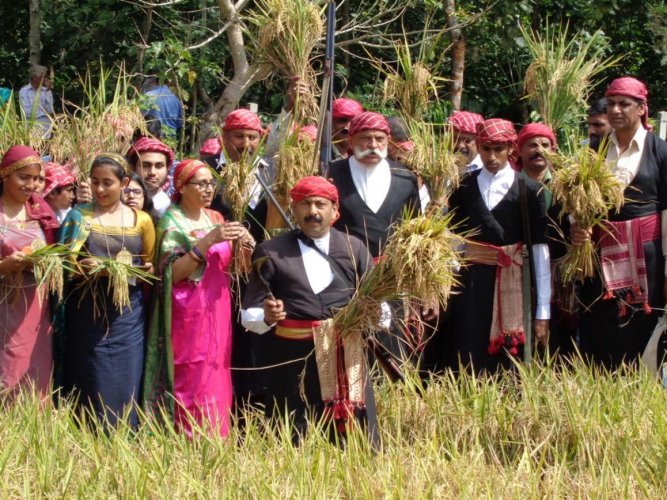
On a predetermined day, at a fixed time after dusk, the Nere Kattuvo ceremony is first held, wherein leaves of certain trees are tied together and later placed at different corners of the house. Men in traditional kupya chele and women wearing Kodava saree then go to the paddy field, led by a woman holding a taliyakki bolcha (lamp) under the light of the full moon.
Here the Khadh Edpo ceremony is held. The eldest man of the family called the patedara cuts an odd number of paddy sheaves (khadh) and they return carrying the harvested crop in a kuthi (a sacred bamboo container) while uttering Poli Poli deva — praying for a bountiful year.
The paddy sheaves are placed in front of the nellaki bolcha (sacred lamp) at the ainmane (ancestral home) and people pray for a good harvest. Then two special types of desserts — thambutt (made from roasted rice flour and mashed banana) and rice payasa — are prepared.
The day ends with children bursting firecrackers and a wholesome meal.
Traditionally, Puthari would be followed by week-long celebrations. On the days following Puthari, a few people would go door-to-door visiting every house in the hamlet and sing songs eulogising the family members of that house, beating a dudi (traditional hourglass drum). This formed part of the mane paado (singing at houses) ceremony. Children of the hamlet would tag along with these singers in merriment.
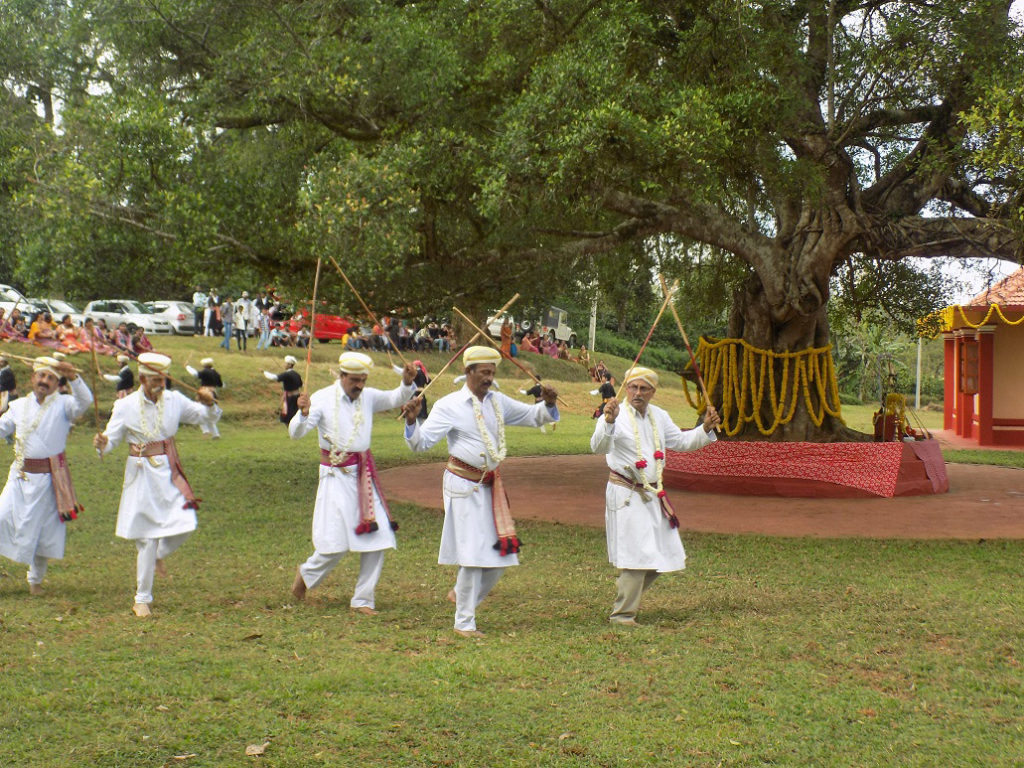
On the last day of the celebrations, people would visit the mandh, the sacred grounds of the village, and men would perform kol aat, a traditional stick dance.
Men performing Kol aat as part of Puthari celebrations. DH File Photo
Building solidarity
“Rice cultivation is a community-oriented activity — one had to rely on neighbours to help with transplanting and harvesting. So, you find that many of the customs — the dances, feasts, the bringing in of new household implements and so on — are all directed at building solidarity. It’s also a time when we reconnect with our own clans; the dudi patkaras (traditional singers) walk from one ancestral home to another, singing the histories of clans, re-establishing our links with our heritage, and the land,” says Kaveri.
While many Kodavas have moved outside of Kodagu for their careers, Puthari is still celebrated in the same spirit of togetherness. Kodava families in a region get together, and celebrate this festival upholding the traditions.
“Since we stay in Bengaluru, every year on Puthari, we make it a point to go to Bangalore Kodava Samaja, which we regard as our ainmane in the city. There we symbolically harvest some paddy crop and bring back home the paddy sheaves to the tunes of Poli Poli deva,” says Mundanda Sudha Poovaiah, an advocate practicing in Bengaluru.
source: http://www.deccanherald.com / Deccan Herald / Home> Spectrum> Spectrum Statescan / by Dhanyata M Poovaiah , Bengaluru / November 18th, 2020
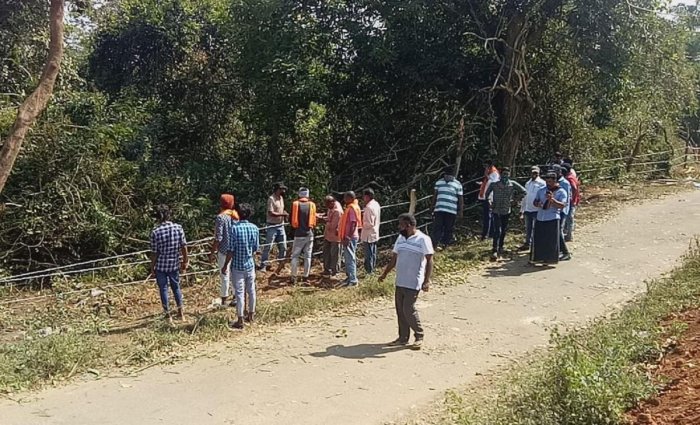
Revenue department workers take over the gomala land at Arji village in Virajpet taluk and secure it by erecting fences. Credit: DH.
Revenue department workers took over 15.12 acres of gomala land identified through the survey at Arji village in Virajpet taluk on Tuesday and secured the land by erecting fences.
Thirty days ago, the taluk Gomala Samrakshana Horata Samiti had staged a protest and urged the local administration to preserve the gomala land in Arji.
Tahsildar Nandish, after holding a discussion with the committee, had ordered for a survey of the land. Accordingly, the survey department identified the 15.12 acres of land and handed over the map to the tahsildar.
The tahsildar, with the cooperation of the villagers of Arji, took over the land and installed fences.
The official meanwhile assured that all gomala land will be cleared of encroachments and the same will be protected.
Twenty-three acres of gomala land has been encroached upon. Notices will be served to 51 people to clear the encroachments within the next 30 days, he said.
Also, a five-acre land was reserved for the construction of KSRTC bus depot. Currently, the land is vacant. If the said land is taken over by the revenue department, 28 more acres of land will be recovered.
Including the land recovered on Tuesday, a total of 43.12 acres of land will be added to the gomala, he added.
Virajpet Taluk Panchayat president Smitha Prakash, Zilla Panchayat member Acchapanda Mahesh Ganapathy, Taluk Panchayat member B M Ganesh, district BJP unit former president Suja Kushalappa, Gomala Samrakshana Samiti convener M M Ravindra, members Purushottam, Ramaiah and others were present.
source: http://www.deccanherald.com / Deccan Herald / Home> State> Mangaluru / by DHNS, Virajpet / November 25th, 2020
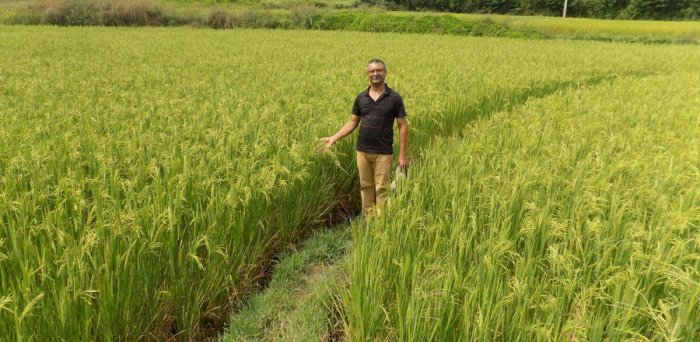
If carried out with hard work and passion, farming will not only bring satisfaction but will also support the livelihood, opined Podamada Mohan, a progressive agriculturist from Balele Devanuru village.
Mohan has been cultivating paddy on only two hectares of land. However, he has been able to harvest an average of 62 quintals of paddy per hectare, annually. This is made possible owing to the innovative methods of irrigation, pest control and so on.
For his commitment towards agriculture, he has been awarded the taluk-level progressive farmer award in Virajpet, for the year 2015-16.
Mohan has been cultivating Atira and Tunga varieties of paddy. Now, both the varieties are almost ready for harvest. He has maintained cleanliness in the paddy farm by removing the shrubs.
Manure
He said that a mixture of DAP, Urea and Potash are provided to the crops in the quantity of 20 kg per acre, at the time of transplantation. This will help in the faster growth of paddy sheaths.
The process of providing fertiliser is repeated twice, with a gap of one month. The high-lying area of the paddy farm, which is known as ‘Nippuni’ is provided with 100% manure while the low lying ‘Kippani’ area is provided with 20% of manure.
The paddy farm has not been affected by any disease. Mohan has made sure to spray insecticide 15 days before the transplantation.
This will control the disease at the initial level, he said.
No takers
Mohan lamented that 45 quintals of unsold rice from last year, is remaining at his house. Even though the rate is Rs 1,125 per quintal, there are no takers.
No suitable market price is available at the APMC as well. The low price is discouraging for many farmers, said Mohan.
source: http://www.deccanherald.com / Deccan Herald / Home> State> Mangaluru / by DHNS, Gonikoppa / November 10th, 2020
Chairman of Government Land Protection Committee for maintaining the status quo until the joint survey on lands was done
Former Speaker and Government Land Protection Committee Chairman K.G. Bopaiah on Saturday told the Kodagu forest authorities not to cause any inconvenience to farmers of the district until the joint survey of lands categorised in ‘C’ and ‘D’ class was done.
Speaking at the taluk KDP meeting in Madikeri, the MLA said he had received complaints that small farmers cultivating coffee in “Paisari” lands since many decades are now facing hurdles in pursuing their profession. “Such complaints should not persist. We should imagine the plight of such farmers in Bhagamandala, Sampaje, Kalooru, Birunani, and other places which had been hit by successive floods.”
During the meeting, Veena Achaiah, MLC, said many paddy fields in Makkandur, K Nidugani and Madhe gram panchayat limits had been affected in the 2018 floods and added that sand, mud and uprooted trees had collected in the lands. A special package should be announced for these places and in the interest of farmers but no effort has been made in this connection yet.
On the occasion, Mr Bopaiah told the Kodagu ZP engineers to take up works on priority and complete the bridge construction work in Korangala and Chirangala. Bridges in these two villages had collapsed in heavy rains in August this year.
source: http://www.thehindu.com / The Hindu / Home> News> States> Karnataka / by Special Correspondent / Mysuru – November 07th, 2020
As COVID-19 raged across the globe, leading to lockdowns in key markets such as the European Union, coffee exports from the subcontinent were stymied. A smaller crop made it a double whammy.
TREND
Expectations of a larger crop in 2020-21 (Oct-Sep) and rising at-home consumption have, however, led to hope of a resurgence.
“Coffee exports are slowly returning to normal… exports were affected because during the lockdown, due to logistic constraints, we were unable to move coffee beans from estates to curing works as only cured coffee is exported,” said Karnataka Planters’ Association Secretary Anil Savor.
According to Cogencis data, India’s coffee exports since the beginning of this year are down 11% on year at 257,107 tn. But with favourable weather conditions ahead of the beginning of harvesting next month, exporters and planters expect a bigger crop and, in turn, higher overseas sales.
“It (exports) will improve from January… Pent-up demand is not visible yet, but there should be a 5-10% improvement during Jan-Mar… given the low prices that farmers are getting, there will be rush to sell since they need cash flow requirement,” said Coffee Exporters Association President Ramesh Rajah.
India’s coffee year begins in October and growers start harvesting during Nov-Dec. According to India Meteorological Department data, the country received 9% above-normal rainfall during Jun-Sep, a positive for coffee plantations.
“In coffee production, one year you have less output, then the next year you have a bigger one, as coffee is basically cyclic. So, going by that, we think this year we have a good output,” Bengaluru-based exporter Prashanth Nagaraj said.
The market estimates coffee output in the 2020-21 season at 300,000-320,000 tn, sharply higher than an estimated 270,000-280,000 tn in 2019-20. The Coffee Board of India’s final production estimate of 298,000 tn for 2019-20 is well above market estimates.
The pandemic has completely changed the trend of coffee consumption across the globe, with a shift away from consumption in cafes.
“The overall market is dull… but it will improve because during the pandemic, there was a sharp drop in offtake but now, we are seeing at-home-consumption is increasing, so a large part of out-of-home consumption is being taken over by at-home consumption,” Rajah said.
“…Italians (demand from Italy) will come back to us. Jan-Mar, we don’t see a very big increase but in Apr-Jun, we see much more improvement… Also, West Asia, Germany, and other traditional markets will also buy from India.”
India may, however, face some competition as it sells the standard arabica variety at a premium of 30 cents per pound in international markets because of its superior quality compared to coffee from other parts of the globe.
Brazilians sell their produce at a discount of 20 cents per pound, former Coffee Board of India member Jaya Prasad H.B. said.
Brazil is the world’s top producer and exporter of coffee, while India is the seventh-largest grower.
With several positives on the horizon, Indian coffee exporters are hoping for sunny days ahead. End
US$1 = 73.36 rupees
Edited by Subham Mitra
source: http://www.cogencis.com / Cogencis / by S. Anirudh Iyer and Preeti Bhagat / October 13th, 2020
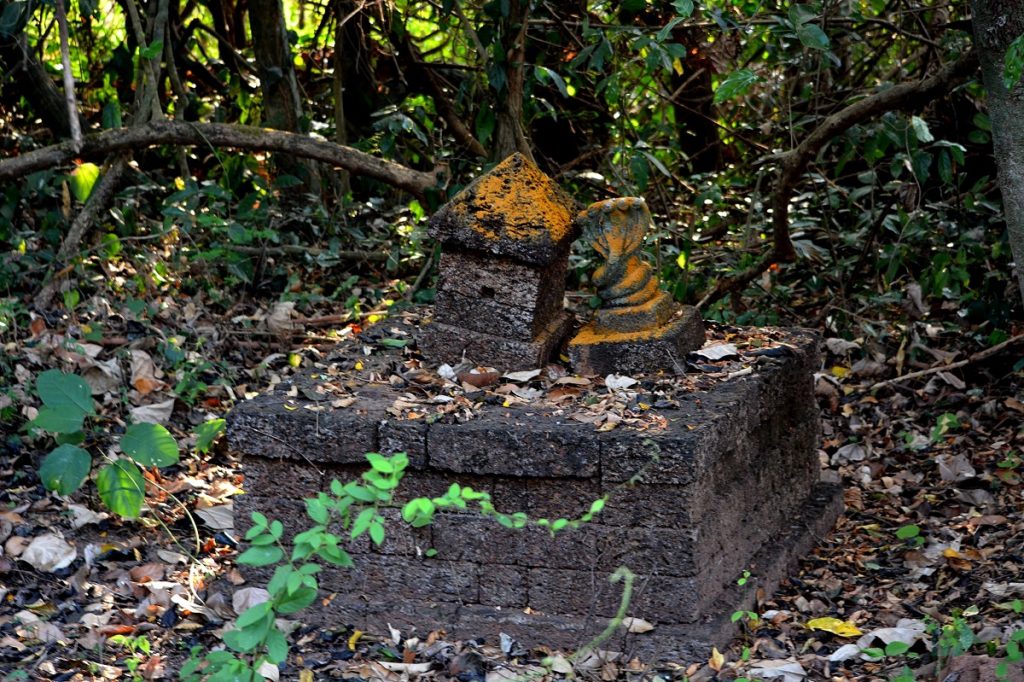
A sarpakaavu, or traditional sacred space for snakes, in Kerala. Photo: Manoj Karingamadathil/Wikimedia Commons CC BY SA 3.0
Underlying cultural and religious beliefs in serpent deities has played a role in protecting iconic animals such as snakes and other species dwelling inside the Western Ghats’ sacred groves. But these beliefs are eroding among youth and economic pressures are eating into the groves, threatening their very existence. Experts call for greater state government protection to preserve the groves’ legacy for the benefit of posterity.
For millennia, local communities in India have maintained sacred groves where they managed natural resources and many of these are tied to their cultural and religious beliefs. In the Western Ghats, such groves are relatively undisturbed patches of evergreen forests that sometimes have a pond, stream, or well that ensures perennial water supply. Often located outside of protected areas, sacred groves are rich in biodiversity, housing many threatened and endemic species of plants and animals. In many cases, these fragments are the only relict forests that remain outside the protected area system.
The mountain chain of the Western Ghats along the western coast of India is older than the Himalayan mountains; in 2012, 39 sites in the region were inscribed on the World Heritage Sites list by the United Nations Educational, Scientific and Cultural Organisation (UNESCO). While India boasts the highest number of sacred forests globally, with estimates suggesting at least 100,000, the Western Ghats is endowed with a large concentration. Although many are undocumented, Kodagu district in the southern state of Karnataka alone was estimated to have 1,200 sacred groves.
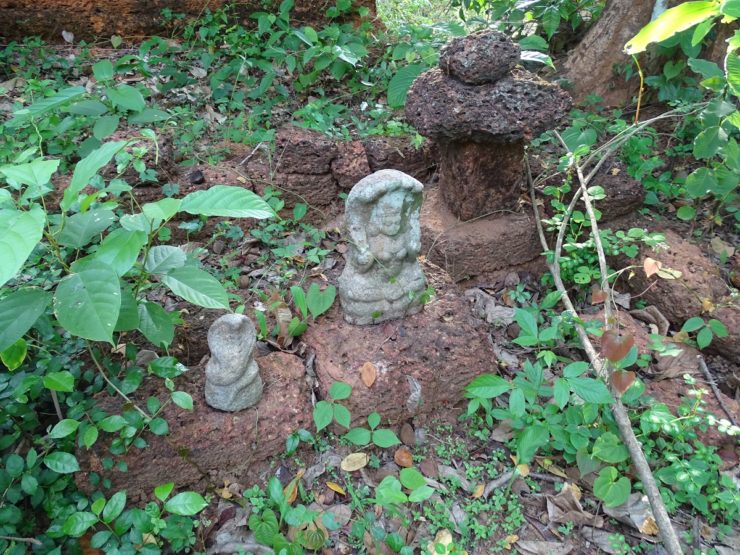
Many of these verdant groves are associated with gods and are named after deities. The worshipping of serpent gods known as nāga plays a central role in many groves in Kerala known as sarpakaavu in Malayalam (snake garden or grove), and often house idols of serpent deities.
Worshipping involves unique rituals that are performed in sarpakaavu and temples with serpent deities. One common ritual involves pouring a preparation of water, milk, rice powder, and turmeric on the deities and devotees call this offering as ‘Noorum palum’, said Dileepkumar R., director of Indriyam Biologics Pvt. Ltd., Jayakumari Kunjamma, senior research fellow at the University of Kerala who has also authored a book on snake worship in Kerala, and Divya S. chief scientific officer of Indriyam Biologics Pvt. Ltd.
Sacred groves: a refuge for snakes
In a study published last year, researchers surveyed visitors of 30 sacred groves in Kannur and Kasaragod districts in the state of Kerala and Kodagu (Coorg) in Karnataka. They found that visitors were less likely to harm snakes inside the groves than outside. And, a large proportion of visitors who did not harm snakes even outside of the groves worshipped snake deities.
Felix Yuan, the lead author of the study and doctoral student at the University of Hong Kong had expected a “fair number of people would not harm snakes inside the groves” given the role of snake deities in the region, but he was surprised by the results. An overwhelming 96% of the visitors surveyed showed pacifist attitudes towards snakes encountered inside the groves, whereas only 60% had the same reaction outside of the groves. The reverence towards snake deities and pacifism towards snakes pervaded all the sacred groves regardless of whether they had idols of snake deities present or not.
“The broader implications of this study lie in the intricacies of the relationships between sacred natural sites and local communities,” explained Yuan, “where the reverence for a specific plant or animal can potentially result in its protection despite the ongoing degradation of other ‘natural’ qualities of these sites.”
Visitors tend to live in harmony with snakes inside the groves (sarpakaavu). Dileepkumar, who frequently visited sarpakaavu in Kerala since childhood, said that if people spotted snakes, they would not touch the creatures, leaving them to slither around the groves freely.
V.C. Balakrishnan, who has also grown up in Kerala, had on some occasions, encountered snakes in the sarpakaavu. “I will just wait for them to pass by,” he said.
Serpent god worship and the role of taboos
At the heart of the conservation of snakes in the groves lie taboos, which are essentially an interplay of devotion and fear, according to U. Prashanth Ballullaya, co-author of the study and a doctoral student at the Central University of Kerala. Local communities believe that their ancestors created the sarpakaavus to provide shelter to snakes, he said, adding that snakes, especially cobras, were considered divine.
Fear also plays a prominent role. Harming snakes is a sin, Ballulaya gleaned from the surveys. If anyone harms snakes inside the groves, they will be cursed and more snakes will emerge, said some visitors. One of the repercussions of killing snakes according to traditional beliefs is that the family could be deprived of progeny and hence there is a cultural practice of worshipping the habitats of snakes among communities in the Western Ghats, explained T.V. Ramachandra, professor at the Indian Institute of Science (IISc), Bengaluru. “Later, gradual transitions to worshiping idols with snake inscriptions happened and eventually, temples with concrete structures replaced these,” he said.
A king cobra. Credit: Rushenb/Wikimedia Commons, CC BY-SA 4.0
Shonil Bhagwat, professor at the Open University, United Kingdom, said “a ‘healthy’ fear of wild animals is good because that discourages people from going to parts of sacred groves, naturally creating ‘no go’ areas.” He believes that “these so-called ‘fences of fear’ can help protect biodiversity within sacred groves by simply keeping people out of the groves, or at least some parts of the groves.”
Communities in the rural highlands of the Western Ghats in Kodagu and adjoining urban lowlands in Kasaragod were surveyed and the results were published in 2019. Researchers found that both urban and rural communities did not abuse the groves by cutting trees, dumping waste, hunting small animals, taking soil and foliage, and damaging termite mounds. And those with nāga deities, who are not only highly revered but also feared, were rarely abused.
The protection of snakes was extended to other taxa as well. Palatty Allesh Sinu, assistant professor at the Central University of Kerala and co-author of the community perception study was surprised to learn that “even taking a leaf from the sacred groves is considered a taboo or abuse of the land.” Believers told him that “the organic matter is food for insects, which is food for frogs and snakes!” Because of this snake-centric food chain, Sinu and his team were forbidden from collecting insects from the groves.
Rural communities had stronger cultural and religious beliefs than their urban counterparts, who valued groves also for their environmental benefits. Although the reasons for this are difficult to answer, said Sinu, one farmer told him “our agriculture, economy and lives are bound to these forests around us … When there was no access to a temple, these forests and local deities living inside the forest were the resort for us. When the upper castes have direct access to Gods, the backward caste people did not have.”
Erosion of beliefs
Community-preserved sacred groves in the Western Ghats are facing mounting pressures over the past decades. Many are shrinking in size or have disappeared altogether. At the time of its formation in 1956, Kerala boasted more than 10,000 sacred groves, but in 2015, only around 1200 remained, according to a report prepared by the Kerala State Assembly Committee on Forest, Environment, and Tourism. A global Nature study published in May reported that reptilian phylogenetic diversity in the Western Ghats is under very high levels of human disturbance.
“Earlier thesarpakaavu was a symbol of divinity and sanctity and it was with only utmost reverence that one was allowed to enter its premises,” said Dileepkumar, Kunjamma and Divya. “People were afraid to touch the trees let alone cut them. But the scenario has almost completely changed with the term ‘sarpakaavu’ being reduced to a mere social terminology. The infuriating demand for more land to accommodate the growing population coupled with the placid attitude of today’s generation has diminished the values of biodiversity and conservation,” they rued, adding that most people view the groves as wastelands, which could be used for construction.
Researchers have observed that youths are losing interest in sacred grove traditions. The loss of oral traditions that narrated stories behind the groves has been cited as one factor. Bhagwat believes that awareness of sacred groves and nature conservation should start early. “If children are introduced to the creepy crawlies that live in sacred groves and maintain a healthy forest ecosystem, they will learn to like this real, everyday nature that is found in landscapes where people farm, live and work,” he said.
V.C. Balakrishnan, who is the secretary of the NGO Society for Environmental Education in Kerala (SEEK), also stresses the role of educating youth to ensure the protection of the groves. SEEK, he explains, holds many camps on the importance of the sacred groves and biodiversity.
On 25 September, Dileepkumar R. joined forces with a group of snake experts and developers and launched a mobile app called SnakeHub, which is dedicated to education and conservation. Currently, the app is a social responsibility initiative of Indriyam Biologics Pvt. Ltd., a Department of Scientific and Industrial Research recognised medical startup working on snakebite management and mitigation, but the group plan to register a society and keep it as an independently functioning body under the organisation. With 114 snake species, Kerala is the top three states in India in terms of species number (after Tamil Nadu, which has the highest, followed by West Bengal) and more than half of these are endemic to the Western Ghats, said Vivek Sharma, head of SnakeHub App.
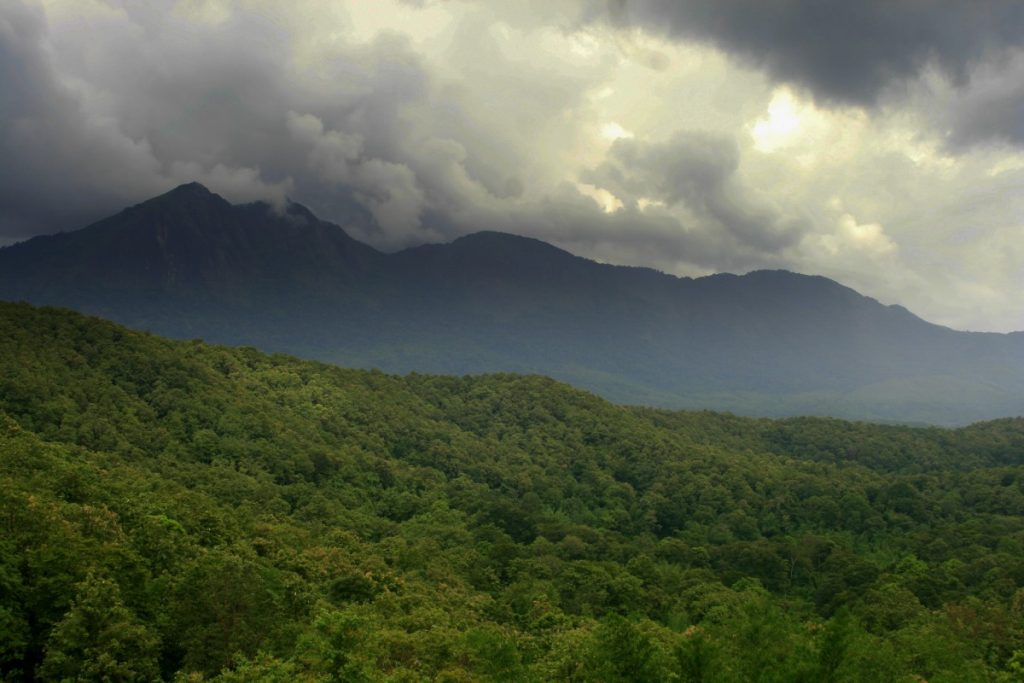
A part of the Western Ghats. dotcompals/Flickr, CC BY 2.0
In both English and Malayalam, the app is the first on snakes in the state of Kerala. Apart from providing biological and ecological information on all of the species, the app also covers snakebites including a list of hospitals equipped to treat bites. “Snakebite is an important objective in our work and based on requirements, we will add facilities to provide snakebite-related solutions and education materials,” said Sharma.
Their goal is to expand the scope of the app to the rest of India in other regional languages to cater to rural communities. India accounts for almost half of the total number of annual deaths from snake bites worldwide. Earlier this year, a study estimated that over the last 20 years, 1.2 million people died from snake bites nationwide. Most of the deaths occurred in rural areas and farmers were most at risk especially during the monsoon season.
“Sanskritisation” and commercialisation
Over the years, there has been a trend towards “Sankritisation” of the groves, which involves the conversion of animistic deities in the sacred groves to mainstream Hindu gods and goddesses, explained Bhagwat. This phenomenon, he said, paves the way for cement structures such as temples and other buildings to be constructed in the groves, which compromises the conservation value of the groves because natural features such as trees disappear. “The only way to solve this problem is to make the custodians of sacred groves aware that trees are important to protect biodiversity within the groves,” Bhagwat said.
“The sacred groves are losing their sanctity and some of the groves are becoming temples for commercial purposes,” said Balakrishnan, explaining that the owner can earn an income through money offered to the deities.
es are taking over in urban areas and even creeping into the hinterlands. According to Sinu, some sacred groves are under the direct control of the state while others are privately owned. “Sadly, both want to generate money out of it,” he lamented. “Selling the land is a way,” he said. “So, they first relocate the deities including snake god through a ceremonial ritual and free the land.” Many owners are in the process of relocating deities, noted Sinu, adding that the ceremony is a costly affair amounting to about Rs 4 lakh (Rs 400,000).
Ramachandra of IISc echoes these concerns. Cemented buildings have become commercial spots, he said, revealing that many sacred groves that are under the revenue department have undergone large-scale conversion to other land uses such as villas and resorts in Kodagu. He attributes these conversions to a lack of knowledge among the bureaucracy of the ecological and hydrological significance of the groves, which has sustained the livelihood of communities in the region for centuries.
Dileepkumar, Kunjamma and Divya believe that people fail to realise that their exploitation of the groves could pave the way for their own doom. “With the sacred groves being deconstructed, the snakes that were taking refuge in the grove vegetation enter into human colonies leading to a conflict between snakes and humans thereby posing a threat to both snakes and humans alike,” they warned.
A sarpakaavu in Kerala. Photo: Manoj K/Wikimedia Commons CC BY SA 3.0
How to protect the sacred groves?
Apart from cultural beliefs, the coexistence of snakes and humans hinges on the preservation of the ancient sacred groves of the Western Ghats.
Experts believe that state governments must play a greater role in protecting the sacred groves of the Western Ghats. Earlier this year, the Kerala state government launched a program “Pachathuruthu” to cultivate ‘green islands’ in degraded land in a bid to preserve biodiversity. For the initiative, “they are planting trees that can give shade, shelter, and food for birds and other animals,” Sinu said. “We have over 1500 sacred groves in Kerala along the west coast. Why not declare them as natural sanctuaries?”
Ramachandra proposes that the Karnataka and Kerala Forest Department should assign heritage status to all the sacred groves of the Western Ghats under section 37(1) of the Biological Diversity Act 2002. Such a move, he argues, will ensure the conservation of these ecologically fragile regions.
Conservation of the groves should be initiated at both the community and government level, according to Dileepkumar, Kunjamma and Divya. “Snake groves are an inherent part of Kerala culture and conserving them must be our obligation. For implementing the conservation strategies initiated by the government, a special task force must be employed to ensure the protection and maintaining the status quo of the snake groves.”
Balakrishnan said that the forest department had funded building fences around the sacred groves a few years ago. “These sacred groves are to be protected surely because they are rich in biodiversity and they are the wealth of our future generations.”
This article was first published on Mongabay India .
source: http://www.science.thewire.in / The Wire, Science / Home> Science> Environment / October 29th, 2020
WELCOME. If you like what you see "SUBSCRIBE via EMAIL" to receive FREE regular UPDATES.
Read More »