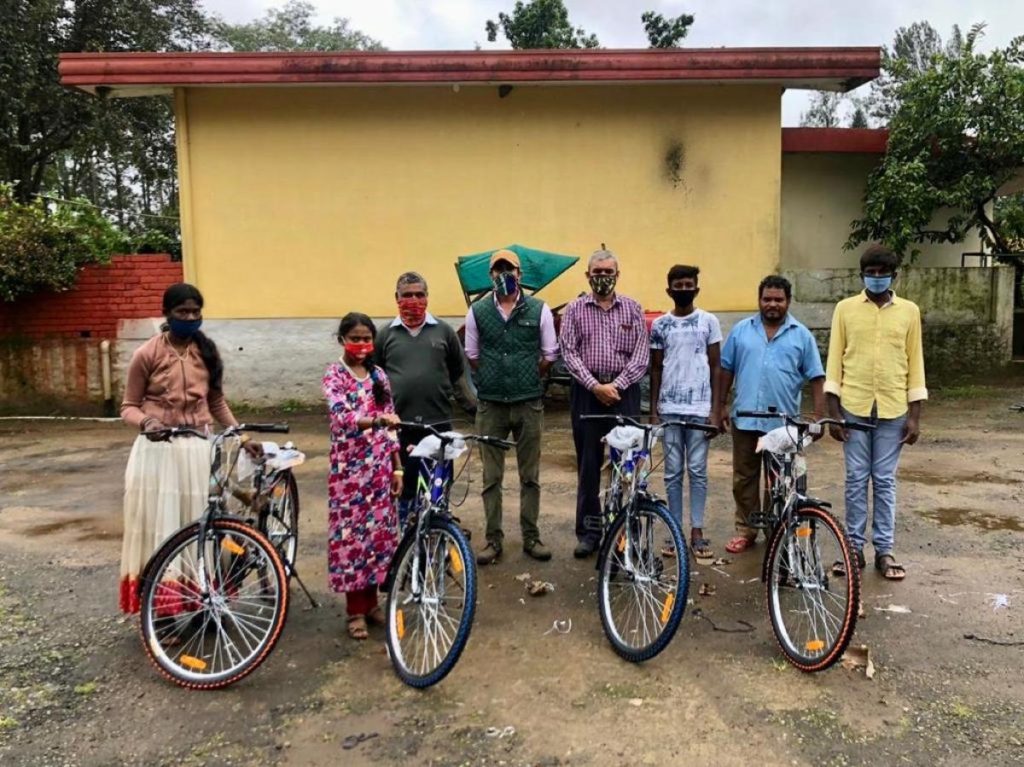
Planters and father-son duo Vinod Sivappa and Vishal Sivappa donated bicycles to the needy workers and students. DH Photo
Extending a helping hand to the needy students and agricultural labourers, a father-son duo from Suntikoppa have donated new bicycles to labourers and students to help them commute easily.
Planters and father-son duo Vinod Sivappa and Vishal Sivappa donated bicycles to the needy workers and students. DH Photo Extending a helping hand to the needy students and agricultural labourers to reach from one place to another. The livelihood of the labourers, who are dependent on plantation work, was affected due to the lack transportation facility.
Realising this Vishal Sivappa and his father Vinod Sivappa, planters from Suntikoppa, distributed bicycles to the needy workers and students.
Vishal said that his parents and grandparents were involved in social service. During the current situation, people are in need of assistance as their livelihood is affected.
“I see many students walking 5 km to 10 km to their schools and workers in various estates walk several kilometers on a daily basis. Donating bicycles would definitely help them reach their destination much faster. This is very small contribution and I am really happy to help them,” he added.
Vishal’s father Vinod is also engaged in farmer welfare programmes over the past few years. Vinod said that he felt proud to extend his support to his son’s initiatives directed towards the welfare of the needy labourers.
source: http://www.deccanherald.com / Deccan Herald / Home> State / by DHNS / August 12th, 2020
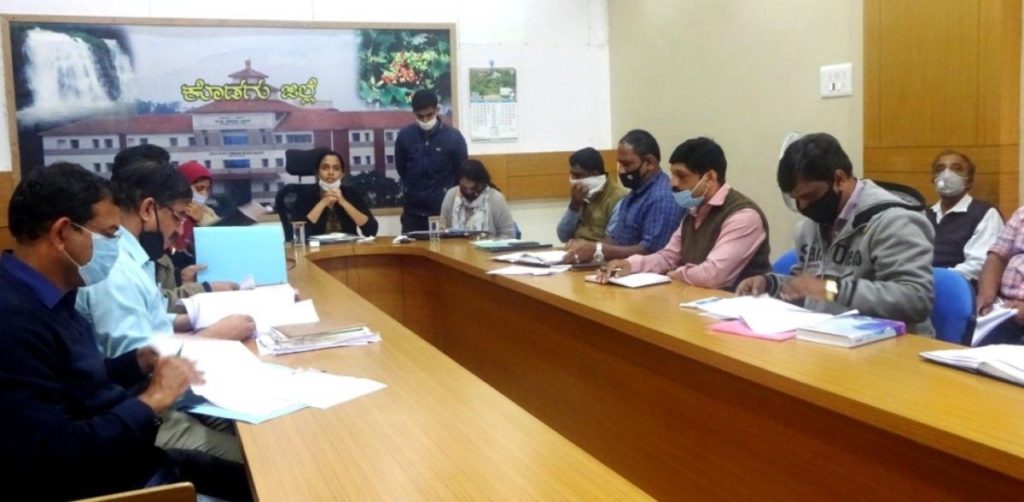
Deputy Commissioner Annies Kanmani Joy chairs a meeting in Madikeri on Friday.
Now, farmers can directly enter the details of the crops they have cultivated in their RTCs (record of rights, tenancy and crops) with a few clicks on the app on crop survey.
The last date for entering the details on the crop survey is August 24. The ‘Farmers Crop Survey App 2020-21’ has been developed by e-governance department of Karnataka, said Deputy Commissioner Annies Kanmani Joy.
Chairing a meeting on implementation of the crop survey, she said the farmers should mention survey number, hissa number of the land owned by them and upload details on agriculture crops, horticulture crops and other forest crops cultivated by them.
The DC said farmers had to take photographs of the crops cultivated on the land and fill in the details. Depending on crop details and extent of area cultivated that are documented in the pahani, government will announce support price and compensation during the natural calamities. The crop survey will benefit in documenting the details of the crops cultivated in pahani, Annies said
If farmers are unable to conduct survey of crops on their own, then they can seek the assistance of private individuals to document the details after August 24, she added.
The details uploaded by the farmers will be verified by the officials. The farmers can visit Raitha Samparka Kendra, revenue inspectors, village accountants and assistant agriculture and horticulture officials, for any query.
Agriculture Minister B C Patil, in a video conference with Deputy Commissioner, said that the crop survey should be implemented like a ‘Utsava’. For the first time in the country, the crop survey is carried out by the farmers themselves using an app.
In the past, objections were raised when the crops that the farmer claimed to have grown was different from the one recorded on the RTC. As the farmers themselves take up the survey, the mistakes in the RTC can be avoided, Annies said.
The ‘Farmers Crop Survey App 2020-21’ can be downloaded from Play Store. A farmer should register his name and mobile number using an OTP. The farmers should select district, taluk, hobli, village and add survey number of the land and then furnish details of the crops cultivated.
MLA M P Appachu Ranjan visited the rain-affected Makkandooru and other areas on Friday. He inspected the affected farmland, houses and public roads in Makkandooru, Kadagadalu, Hodduru Gram Panchayat jurisdiction along with officials.
source: http://www.deccanherald.com / Deccan Herald / Home> State> Karnataka Districts / by DHNS, Madikeri / August 14th, 2020
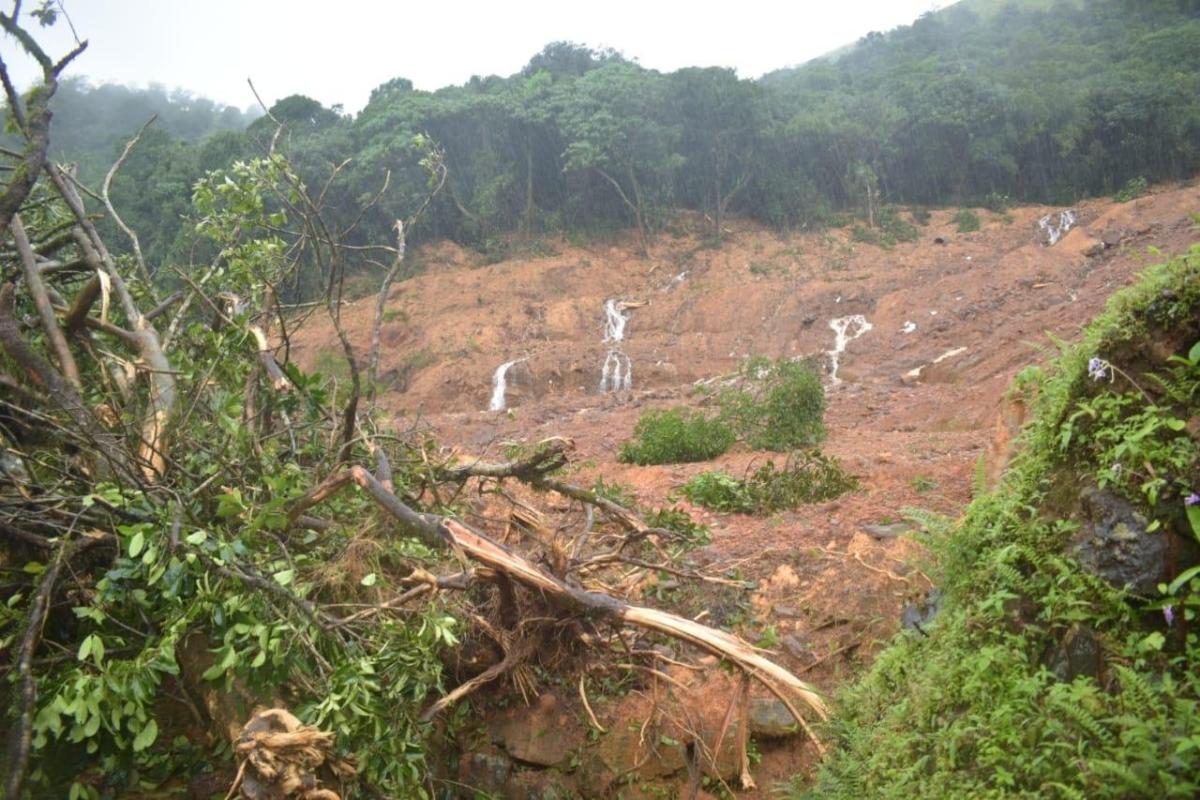
The site of landslide in the Brahmagiri range, Kodagu. DH Photo
The oft-cited maxim of the ecological sensitivity of the Western Ghats, repeated ad nauseam over the past two decades or so, has fallen on deaf ears. The failure to prevent the degradation of forests in the Sahyadris, along with the increasing instances of extreme rainfall over a short period of time — especially over the past three years — has wreaked havoc in this lifeline of South India.
The Karnataka government, which has improved its performance in terms of flood preparedness, relief work and rehabilitation measures, seems to have taken little action to prevent or mitigate future landslide hazards.
Despite the devastation, the government has either proposed or persisted with over 20 linear projects that could damage more than 25,000 hectares of forest in the region. These projects include Yettinahole River Diversion project, Kalasa-Banduri project, Sharavathy pumped storage power plant, Hubballi-Ankola railway line and many road construction and widening projects.
Worse, this year landslides have been reported in 80 locations between Mangaluru and Karwar, where highway construction work has been taken up.
Apart from infrastructure projects, change in land use norms, the lack of a long-term mitigation policy to address deterioration of green spaces and improve forest cover, and relentless expansion of plantations in the Malnad districts are just some aspects contributing to a looming environmental disaster in one of the world’s biodiversity hotspots.
Several activists, who relentlessly protested against projects in the Western Ghats, have hung up their boots, and lament the futility of their past efforts to ensure legal protection to the ecosystem.
There is no dearth of comprehensive reports on the cause of problems in the region and how to address them. In 2011, the report submitted by the Western Ghats Ecology Expert Panel, under the chairmanship of Prof Madhav Gadgil, had warned of impending natural disasters unless immediate and sustainable measures were taken to protect the ecosystem. The report sought to designate over 60% of the Western Ghats as highest-priority Ecologically Sensitive Zones.
All the states who are the custodians of the Western Ghats ignored this report. The states couldn’t come to a consensus on the subsequent Kasturirangan report even after four draft notifications, with Karnataka repeatedly rejecting the recommendations.
The Gadgil committee report was back in focus last year, as most of the places where the landslides took place were considered ecologically sensitive by the committee.
Now, the state government has set up another panel to study landslides in the region.
The benefit of commissioning a new report is still unclear. However, the government’s actions have made it evident that it is not keen on conserving the Western Ghats; experts say the degradation of forests here will have cascading effects, triggering landslides, choking streams and posing a flood threat for downstream areas, something we are witnessing today.
A scientific paper by Prof T V Ramachandra, Centre for Ecological Sciences, Indian Institute of Science and others shows that the extent of evergreen forests shrank by 16% in Kodagu between 1973 and 2018, from 40.47% to 24.17%; a loss of around 67,000 hectares of forest land. “The region had 32% of forest cover under interior or intact forests in 1973, whereas in 2018 it covers only 19% in various protected areas,” says the study.
“The expansion or construction of linear alignments would result in irreversible ecological degradation. The recent floods and landslides are certainly a warning to the decision makers of likely implications, with the drastic changes in the land cover eroding the native forest ecosystems. Further interventions will worsen the ecology and hydrology as well as livelihood, with increase in instances of human-induced calamities,” the paper warned. Yet, the state revenue department lifted a ban on the conversion of land use in Kodagu in February this year.
Degradation main cause
While environmental degradation triggering landslides is starkly evident in Kodagu, similar situations persist in all districts bordering Western Ghats – Hassan, Chikkamagaluru, Shivamogga, Dakshina Kannada, Uttara Kannada, Dharwad and Belagavi.
Conservation biologist Keshava H Korse pointed out that major landslides are being reported at core ridges of Western Ghats due to repeated disturbance of vegetation in such areas. “Bhagamandala, where major landslides were reported in the past two years, is one such area which has loose soil,” he said.
The area was classified as a highest-priority ecologically sensitive zone in the Gadgil committee report, where all development projects were expressly forbidden due to the fragility of the ecosystem. Yet, several projects were taken up here.
“The injuries to the Ghats cannot be healed in one go. Just to recover the natural vegetation where landslides have occurred, it will take four years,” Korse said.
Among the alarming incidents during the downpour in the first two weeks of August this year, were the landslides reported just six km from Linganamakki reservoir in Shivamogga district, pointed out Ananth Hegde Ashisara, Chairman of Biodiversity Board. He is heading a 10-member committee set up in February this year, to study the main causes for such landslides and to suggest an action plan to mitigate them.
Some of the places highly prone to landslides include the Kodagu DC office, villages near Jog Falls and settlements situated in the Western Ghats. “Our major challenge is to ensure people relocate from areas which are dangerous. It is a difficult task as people don’t want to move away from their homes or agricultural land,” Ashisara said.
Though reasons for landslides were varied across Malnad districts, he suspected that vegetation loss was one of the key triggers for extensive damages witnessed in Kodagu and Chikkamagaluru.
“Deforestation is high, non-agricultural use of land near the forests are prominent. The ecosystem can rejuvenate by reducing human interference in such regions. The ecosystem will revive on its own; this can be accelerated by planting flora indigenous to the region,” Ashisara said.
G S Sreenivasa Reddy, former chairman of Karnataka Natural Disaster Monitoring Cell and a member of the committee, said that there were observable changes in rainfall patterns that have triggered the crisis. “We will give recommendations on what each department should do to mitigate the problem,” he said.
According to him, the cascading effect of disturbing the Western Ghats will worsen fluctuations in the intensity of rainfall, affecting water security and crop cultivation patterns.
Col (rtd) C P Muthanna, former president of Coorg Wildlife Society, noted that Western Ghats are susceptible to even minute changes. “We are talking with the district administration to discuss measures to prevent such incidents. We are against converting land for commercial use as it causes degradation,” he said. Efforts are also being made to encourage planters to cultivate native trees inside plantations.
Sundar Rao Bantwal, who put an end to his environmental activism after the Yettinahole project was cleared, painted a gloomy picture on how environmental concerns were always sidelined over profits by politicians and contractors. “Despite a strong opposition, large projects are taken up in eco-sensitive zones. Even if we drag the cases to court, it will be of little consequence. Approaching the Green Tribunal too won’t help,” he said, citing the controversial project as an example. The project might fail in 10-15 years and neither those who approved it nor the ones constructed will take responsibility for the disaster, he added.
Ramachandra said despite recurring disasters, as many as 55% people in Kodagu are for ‘development’, while 40% are for conservation measures, with a small minority undecided. “After the last floods, we managed to convince the Deputy Commissioner to impose restrictions against resorts mushrooming in the district, which used to occupy natural courses of water. Recently, the restrictions were lifted after political interference,” he said.
Virajpet MLA K G Bopaiah was of the view that climate change was responsible for the widespread devastation. “Save for the last three years, receiving 20 inches or more rainfall in less than a week is unprecedented,” he said. Disputing that change of land use was the major cause for landslides, he said that landslides were reported where thick forests were present. “Nobody has even considered interfering in such dense forest areas,” he said.
Noting that several areas of the district were susceptible to landslides following heavy rainfall, he said that measures will be taken to address the same.
source: http://www.deccanherald.com / Deccan Herald / Home> Specials> Insight / by Akram Mohammed, DHNS, Bengaluru / August 15th, 2020
Following copious rains across Kodagu district, the Harangi reservoir is almost full. The dam is two feet short of reaching its maximum level of 2,859 feet at 2,857 feet this morning.
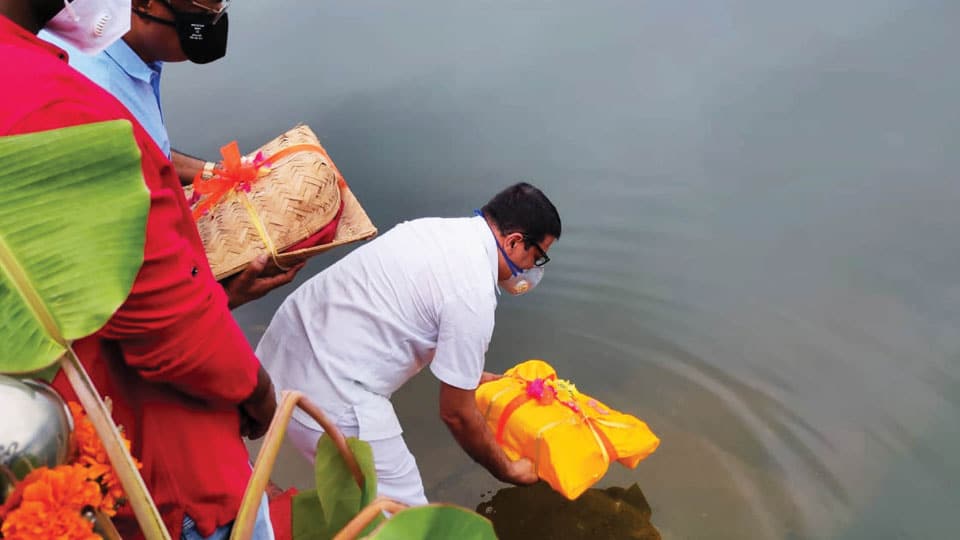
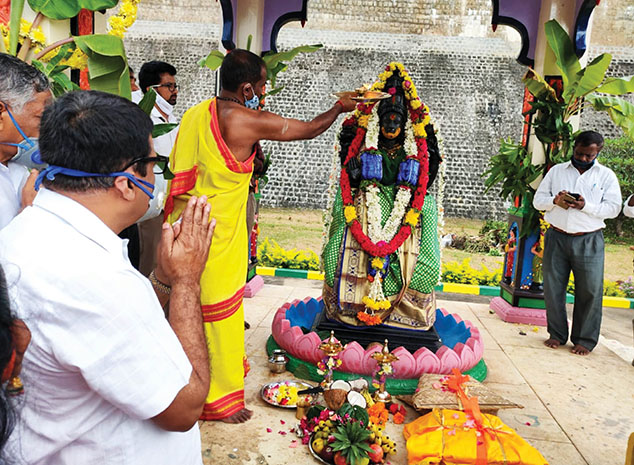
Before the crest gates were opened, Madikeri MLA M.P. Appachu Ranjan offered ‘Bagina’ to River Cauvery after performing puja to the statue of River Cauvery located at the base of the reservoir this morning.
Executive Engineer Rajendra, Harangi Reservoir Assistant Engineer Nagaraju and other BJP leaders were present on the occasion.
This reservoir is the main source of water for KRS dam in Mandya district. Irrigation Department Executive Engineer Rajendra said that water from the Harangi reservoir is now being released into the river.
Following heavy flow in recent days, water is also being released into irrigation canals.
The right bank cannals feeding irrigated lands in Hunsur and KR Nagar taluks of Mysuru district are getting 1,500 cusecs of water every day while 400 cusecs of water is being released to left-bank canals feeding lands towards Hassan district. The inflowing water is much clear compared to last year.
Experts opine that this is probably due to growth of vegetation at the areas of landslides, which had caused heavy damage in the region, last year.
Harangi Dam provides irrigation facility to thousands of acres of farmland in Periyapattana, Hunsur and KR Nagar of Mysuru district, Arkalgud taluk of Hassan district and Kodagu district.
The Harangi Dam can hold 8.5 TMC of water.
source: http://www.starofmysore.com / Star of Mysore / Home> News / July 31st, 2020
Horticulture Department has produced over 54,000 saplings for distribution among growers this year.
Kodagu is known for its oranges besides coffee and spices. But, the last two years of devastation triggered by floods and landslides affected the crop, causing losses to growers. Over the years, the crop area has not expanded much with issues over falling prices and pest attacks.
In a bid to expand the crop which is primarily cultivated amidst coffee plantations, the Department of Horticulture has produced over 54,000 orange saplings for distribution among the growers for planting them in their plantations this year. These saplings had been produced at State-run horticulture farms across Kodagu.
“We have set a target of increasing the crop size by at least 10 per cent a year. The department has eight farms where the saplings of Kodagu oranges were carefully produced to expand its area of cultivation. Kodagu’s climatic condition is unique and the oranges grown here come with a lot of pulp and also taste good,” said Shashidhar, Deputy Director of Horticulture, Madikeri.
The area of cultivation has come down over the years to less than 5,000 hectares and the yield has also been falling because of climate change. Subsidy is offered to growers to boost cultivation of the fruit, also called Coorg Mandarin
Appanna, a progressive farmer from Gonikoppal, has over 100 orange trees and was harvesting over two to three tonnes a year. “I suffered loss because of excessive rains. I used to harvest 30-40 kg from each tree but the yield fell to less than 10 kg and the fruit quality had also dropped,” he explained.
source: http://www.thehindu.com / The Hindu / Home> News> States> Karnataka / by Shankar Bennur / Mysurue – July 30th, 2020
Other forests and sanctuaries where tiger presence has been found in significant numbers include MM Hills Wildlife Sanctuary and Madikeri Wildlife Division.
In terms of density, Nagarahole has 11.82 big cats per 100 sq.km and Bandipur has 7.7
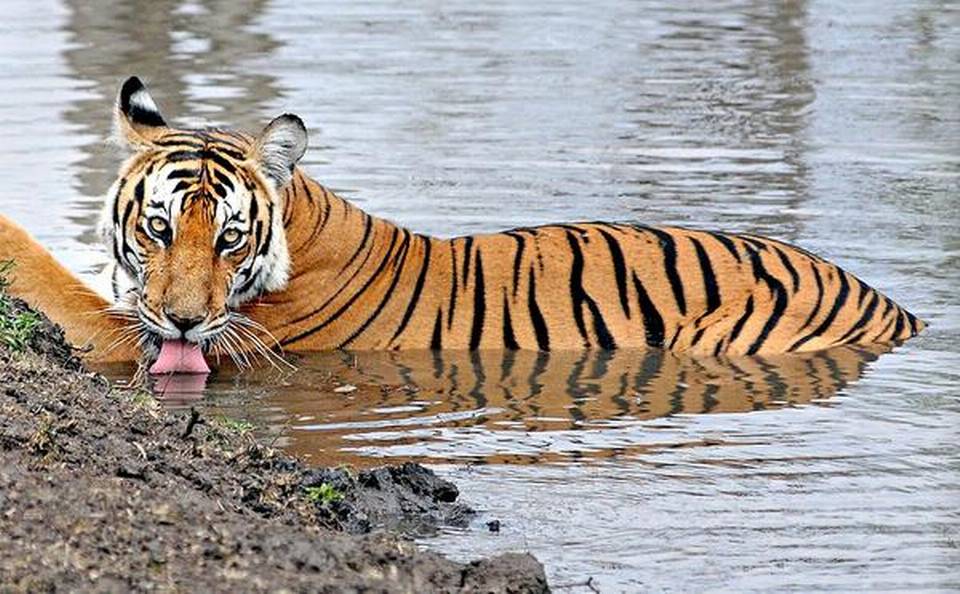
Bandipur and Nagarahole lead in tiger numbers in the State followed by BRT Tiger Sanctuary, Bhadra and Kali tiger reserves, as per the ‘Status of Tigers, Co-predators, and Prey in India’ released on Tuesday.
In terms of density, Nagarahole has 11.82 tigers per 100 sq.km, while Bandipur has 7.7 tigers per 100 sq.km. BRT has 4.96 tigers per 100 sq.km and Bhadra has a relatively low tiger density pegged at 2.86 in the same area.
Other forests and sanctuaries where tiger presence has been found in significant numbers include M.M. Hills Wildlife Sanctuary, Madikeri Wildlife Division, Madikeri Territorial Division, Virajpet Territorial Division, Koppa Wildlife Division, and Haliyal Forest Division which is part of Joida taluk of Uttara Karnataka district, among others.
Based on the camera trap images, 127 individual tigers were identified in Nagarahole followed by 126 tigers in Bandipur, 52 in BRT, 30 in Bhadra, and four in Kali (Anshi-Dandeli) tiger reserve. Officials in the Forest Department, however, said these refer to the minimum numbers only as a sizeable number of tigers from the adjoining habitats utilise the reserve too.
Based on the 2018 tiger enumeration exercise, the summary of which was released last year, the new report released by Minister for Environment, Forest and Climate Change Prakash Javadekar in New Delhi ahead of the International Tiger Day to be observed on Wednesday, also evaluates vulnerable areas that require conservation attention.
While the summary of the Status of Tigers in India-2018 released last July pegged the number of tigers in Karnataka at 524 (with a minimum of 474 and maximum of 573), the new report analyses the status of habitat corridors connecting major tiger populations apart from providing information about the prey base and their density.
The density of prey animals including chital, sambar gaur, wild boar, and barking deer were also analysed and were found to be high enough to sustain the predator population in good numbers. The chital density was pegged at 51 per sq.km in Bandipur where 36 other species of ungulates, carnivores, omnivores, and even domestic animals were photo captured. Pangolin was the rarest species photo captured, followed by leopard cat, as per the report.
Giridhar Kulkarni, wildlife activist, said the increase in tiger numbers both within and outside the reserves augurs well for conservation. But such habitats and corridors are under serious threat due to linear projects like railways, highways, transmission lines etc. and called for notifying potential wildlife habitats as sanctuaries or national parks in Shivamogga, Uttara Kannada, Belagavi, and other districts.
A case in point is the analysis pertaining to the Cauvery Wildlife Sanctuary, where the report airs apprehension of the proposed Mekedatu dam and calls for critical re-examination as the project threatens to inundate a sizeable portion of the sanctuary.
source: http://www.thehindu.com / The Hindu / Home> News> States> Karnataka / by R Krishna Kumar, Mysuru / July 28th, 2020
Even though coffee and pepper are the prominent commercial crops in Kodagu, several farmers have been growing both agricultural and horticultural crops in integrated farming method, thereby, contributing to food security.
Somengada Ganesh Thimmaiah from Nallur village of Ponnampet in Virajpet is one such agriculturist who has scripted success through his innovative methods in farming.
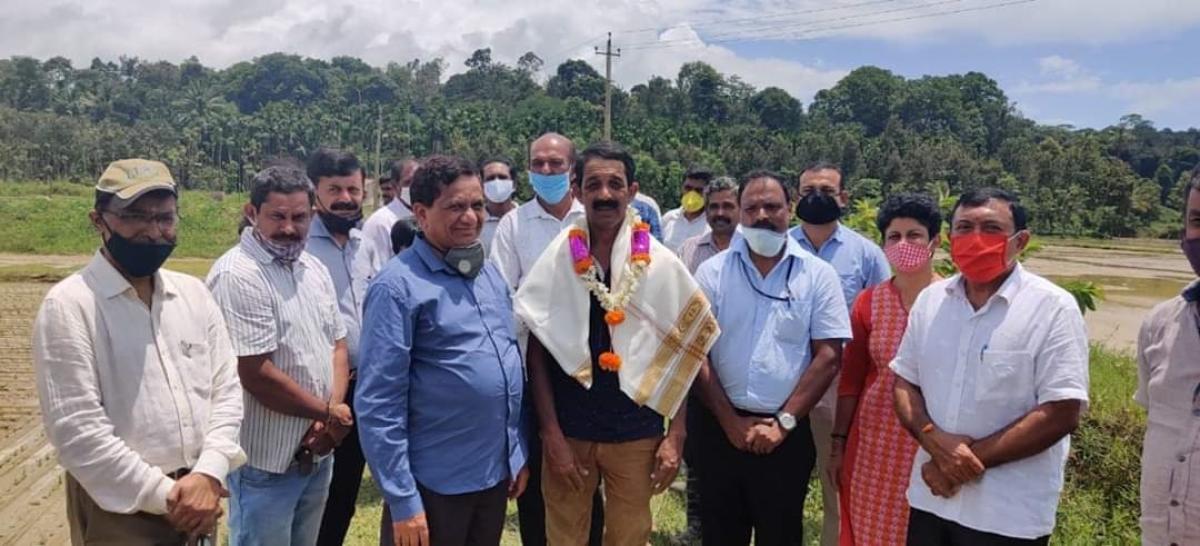
Somengada Ganesh Thimmaiah was felicitated by Virajpet MLA K G Bopaiah. DH Photos
He is the winner of the National-level Babu Jagjivan Ram Krishi Samman award this year. Indian Council of Agricultural Research (ICAR), New Delhi, conferred the prestigious award on Thimmaiah during a function held recently on the occasion of its 92nd Foundation Day.
Thimmaiah has been following the integrated method in agriculture where he grows areca, coffee and paddy as main crops and a variety of vegetables and fruits and sub-crops.
Along with agriculture, he is also into apiculture, poultry and pisciculture, which gives him additional income. Thimmaiah has also been growing the ‘Beth’ plants required for honey bees.
He has successfully experimented with more than 60 paddy varieties and has implemented a mechanised system in agriculture and his paddy field is tech-savvy.
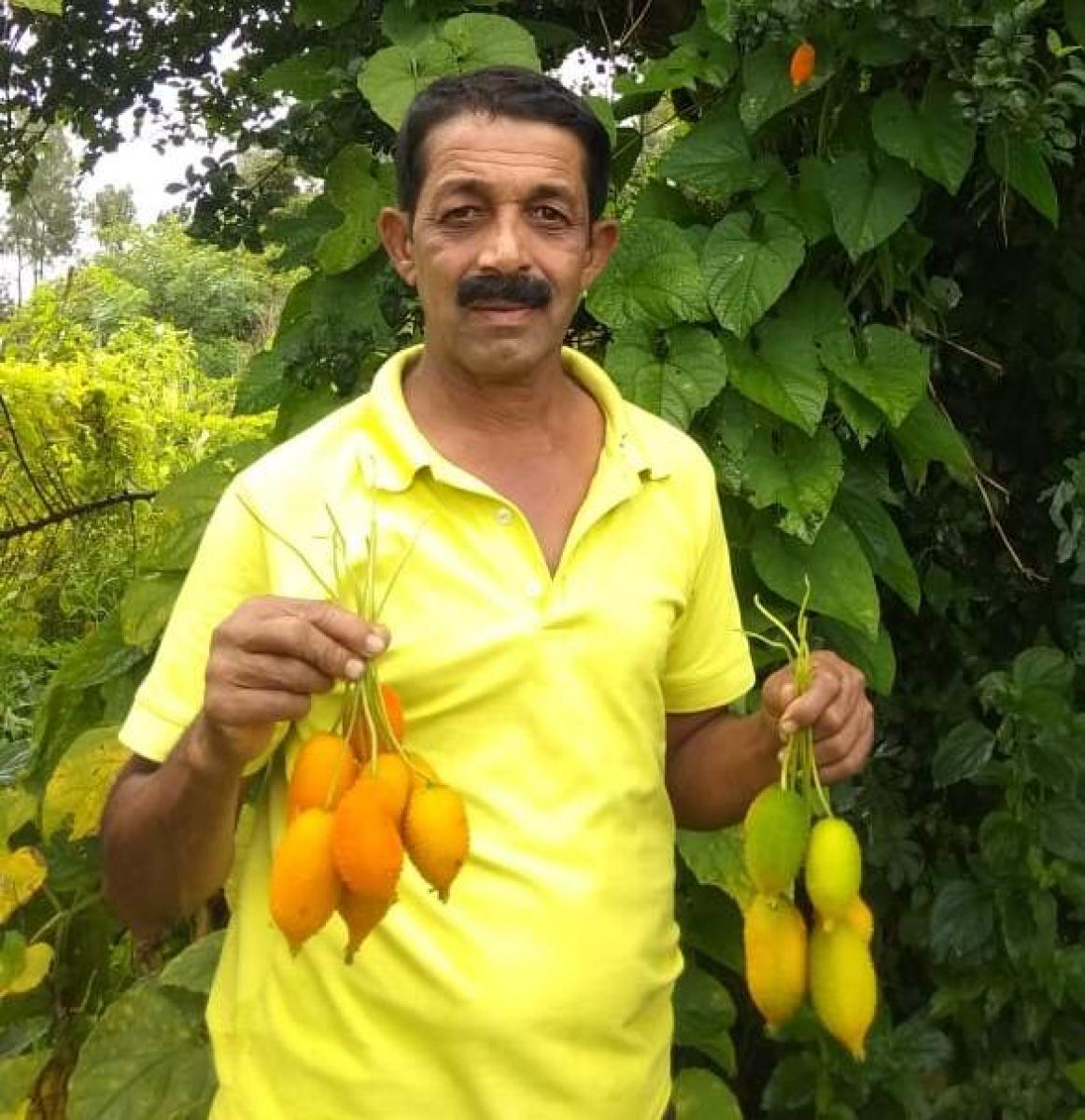
The annual produce of paddy on his farm is 350 to 400 quintal while that of coffee is about 200 bags. He said that pepper also is one of his main sources of income. He has also been cultivating butter fruit, sapota, mango, jackfruit, orange, egg fruit and rambutan as well.
A lot of youth have been visiting Thimmaiah’s farm and seeking his guidance in farming to which he says youth showing interest in agriculture and horticulture is a good sign.
Virajpet MLA K G Bopaiah visited Thimmaiah’s farm and felicitated him for winning the much-coveted award.
Forestry College, Ponnampet, too, honoured Thimmaiah. College Dean Dr Cheppudira G Kushalappa, Extension Unit Head Dr R N Kenchareddy, Agricultural Officer Teetamada Meera were present on the occasion.
source: http://www.deccanherald.com / Deccan Herald / Home> State> Karnataka Districts / by Aditya K A, DHNS, Madikeri / July 22nd, 2020
Traditional beekeepers are busy bottling the flavours of Western Ghats
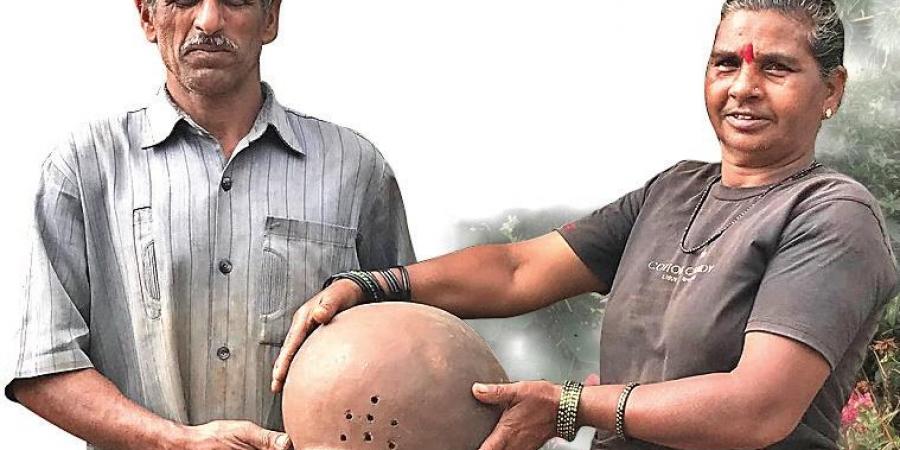
Pattu Cariappa and his wife Nethravathi
Madikeri :
The buzz fills the air in the north-eastern villages of Somwarpet during the spring season. Apis Cerana bees, known as the honey bees of Coorg, go around merrily collecting nectar from colourful indigenous flowers lining the Western Ghats. The sweet nectar is bottled — to produce one of the purest forms of honey in the nation — ‘Kala Thein’.
Massive bee hives on tree trunks and building tops always fill the beholders with a sense of fear. But to the bee keepers, honey bees are their comrades. The villagers nurture and look after the bees and in return, these insects provide them with a lifeline. It would not be an exaggeration to say that the traditional beekeepers of seven villages – Kumbara Gadige, Mutlu, Kikkaralli, Hammiyala, Hacchinadu, Surlabbi and Mankya – are preserving the Western Ghats by indulging in traditional beekeeping.
Pattu Cariappa, a resident of Hammiyala village, briskly walks up to his estate and points at an earthen pot covered with fresh leaves. He then lifts the pot, which is placed upside down, and shows the bee hive where the bees are going about busily. He inserts a finger into the hive and slowly guides the bee onto one side to reveal the honey-filled comb. Ask him if he is not scared to do so, he smilingly replies, “These bees are well-acquainted with me. I won’t harm them and they don’t harm me.”“I learnt the art of beekeeping by watching my elders. The best time to start is in December.
First, we smear the heated pot, which has three to four tiny holes, with bee wax. We carry this pot into the forest and place it on a steady area. Since we know our forests well, we also know where the bees are likely to build a hive and we keep the pot in a suitable place. Once this is done, we frequently visit the spot to check if the bees have arrived. Once the bees settle into the pot, we bring the pot close to our house. We shift the pot only during evening hours – when all the bees have settled in the hive after collecting nectar,” explains Pattu.
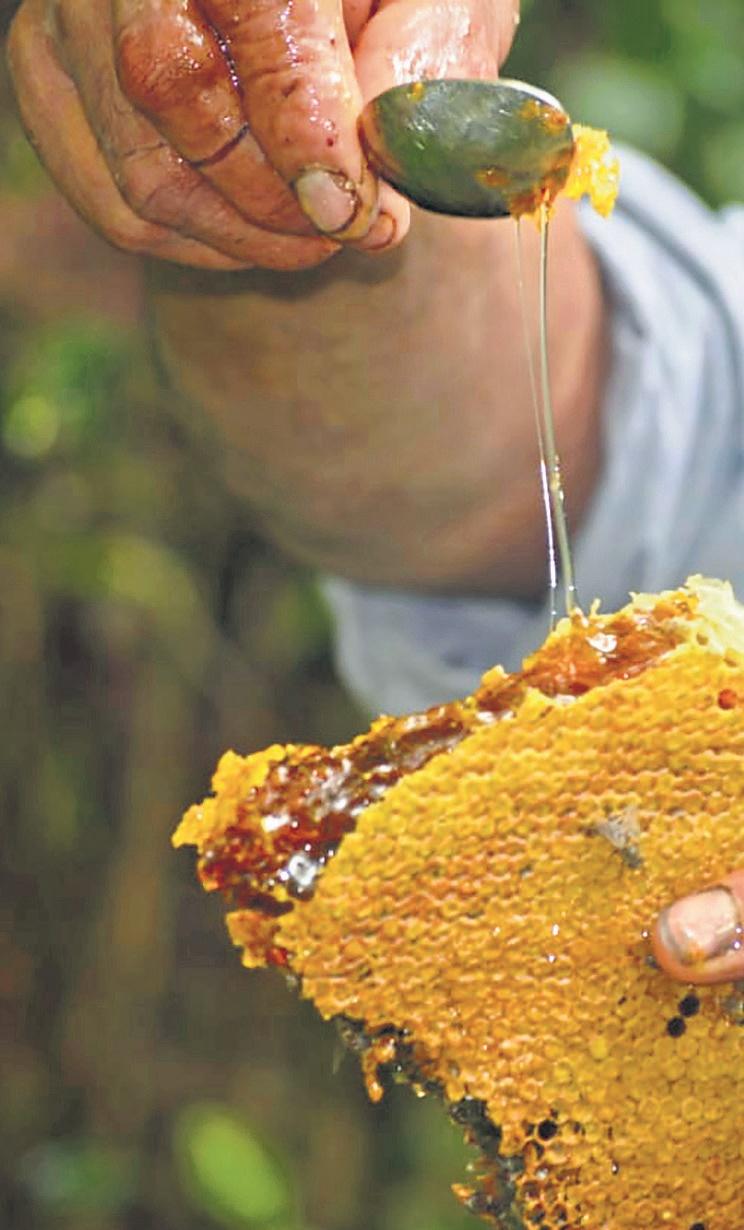
While the beekeeping starts sometime in December, the honey is extracted and harvested only after a year and half – in June. In traditional beekeeping, the harvest method does not use smoke or other harmful gas to chase them away. Instead, the beekeepers slowly move the honeybees to one side and take out the comb. The honey is then extracted from the comb. “I do not use bare hands to squeeze out the honey as it is unhygienic. Instead, I use a clean white cloth to extract honey from the comb, which is then bottled to produce one of the purest forms of honey,” he adds.
“Some people think that pure honey does not turn sugary. But it does and settles at the bottom of the bottle. Pure honey has very less moisture content,” he says. How does one know if the honey is pure? Pattu’s wife Nethravathi explains, “If the hive is built inside the cavity of a tree, one can smell the tree bark in the extracted honey. Similarly, any form of adulteration can be found out easily through the smell. Wild honey, which uses harmful methods of extraction, is watery.” The seven villages have a good economy. While the traditional beekeepers have been harvesting honey since ages, it is only recently that they have found a sustainable earning.
“Earlier, we used to sell it on the streets across the district and did not earn much from it,” recalls Pattu.
However, they have now found a platform for their business through the initiative of ‘AinMane’ of Thammu Poovaiah. A popular café based in Madikeri, AinMane, is sourcing honey from these traditional beekeepers. “The ‘AinMane’ management is promoting the traditional form of honey and providing us with a sustainable lifestyle,” says Nethravathi.
source: http://www.newindianexpress.com / The New Indian Express / Home> States> Karnataka / by Prajna GR / Express News Service / July 19th, 2020
The paddy seedlings, ready for transplantation, in the field belonging to B B Shantamallappa in Doddabilaha village.
Farmers have tilled their fields to transplant paddy seedlings. Tractors and tillers are seen in the paddy fields in various parts of the district.
Paddy is grown in 250 hectares of land in Shanivarasanthe hobli. The farmers here prefer Intan, Tunga, BNR and Tanu varieties of paddy.
Dundalli village has received an average rainfall of 15 inches.
“There have been good rains in Kajuru, Edehalli, Doddakolattur and Koojageri villages and the transplantation can be done in 15 days,” farmer Chandranna Kajuru said.
He grows Rajamudi variety of paddy.
Another farmer B S Mohan from Doddabilaha village said he is excited for the first transplantation of paddy in the season.
Good showers
Napoklu, Bhagamandala, Talacauvery and Madikeri received good rain on Wednesday. Only 11 feet are left for the Harangi reservoir to be filled to its brim.
The debris at the place of the landslide on Bhagamandala-Talacauvery road near Cherangala has been cleared, facilitating vehicular movement on the stretch.
Home guards are deployed to handle the flood situation in Bhagamandala. Motorboats are kept ready to shift the people to safer areas.
Deputy Commissioner Annies Kanmani Joy and Superintendent of Police Kshama Mishra visited Bhagamandala and inspected the condition at the area of the landslide.
Siddapura, Nelyahudikeri, Palibetta and neighbouring regions too, received heavy rain. People dwelling on the banks of River Cauvery have been asked to shift to safe locations.
Red alert declared
Following prediction of heavy rain, a red alert has been declared in the hilly regions of Kodagu, a press release from the DC’s office stated.
In case of emergencies, the public may contact the 24×7 toll-free number 08272-221077, or WhatsApp: 8550001077.
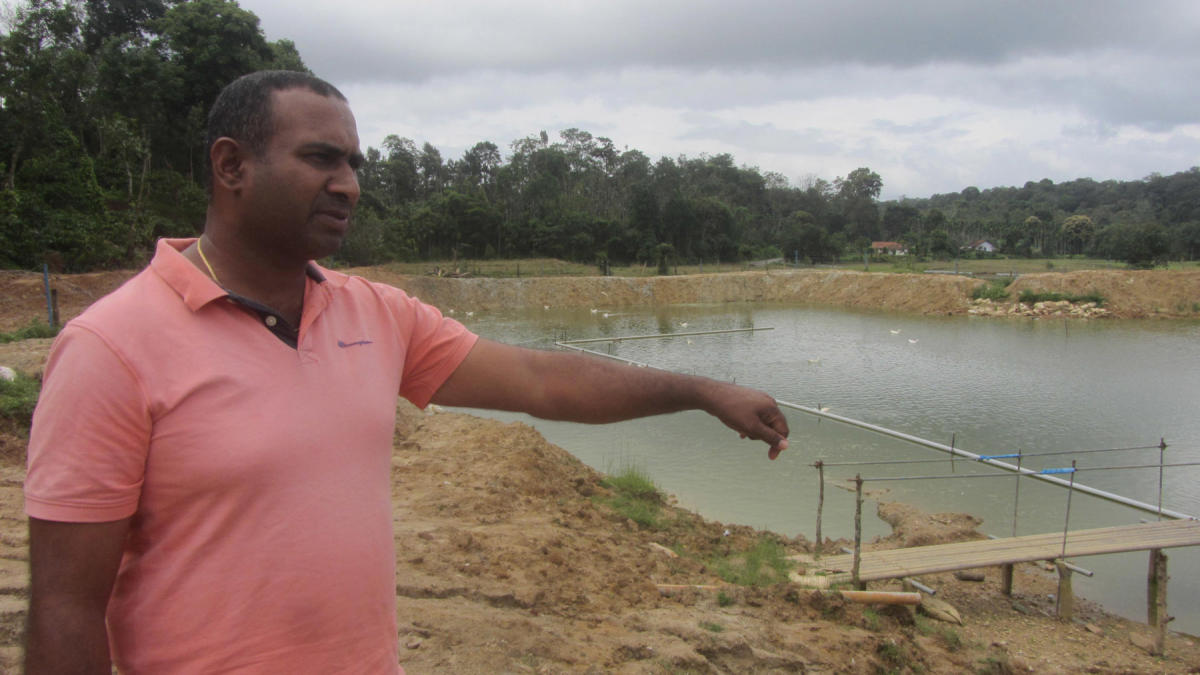
The lake where Tejas Nanaiah has taken up pisciculture at Kaggodlu in Madikeri.
At a time when farmers faced a crisis during the lockdown, here is a farmer who scripted success in pisciculture at Kaggodlu in Madikeri taluk.
He had taken up fish rearing in a vast lake spread in front of his house and sold the fish to earn additional income. Mandrira Tejas Nanaiah had sold 6,725 kg fish this season and fetched a good income.
He had spent nearly Rs 7 lakh for rearing fish in the last two years. He sold the fish in front of his house. Within a few hours of catching them, the fish sold like a hotcake. Along with pisciculture, he has taken up coffee, cardamon, arecanut cultivation as well.
A law graduate, Mandrira Tejas showed a keen interest in farming since the beginning and had taken up fish cultivation for the last few years. In addition to the lake, there are six farm ponds in his farmland, which have also been used for fish rearing.
He cultivates Rohu, Katla and common carp fish varieties. Initially, he had purchased fish seeds from the fisheries department in Madikeri. Now, he procures it from Bengaluru.
A fish normally weighs one and a half kg within a year. After two years, it weighs three kg. If the fish is caught in the second year, then a farmer will fetch more income, said Tejas.
All the weeds and unwanted organisms are cleared from the lake before initiating fish cultivation. Lime and cowdung slurry are also used in the lake, he said.
“I learnt the art of fish rearing through my experience,” he added.
For achieving success in integrated farming, Tejas had even won the taluk-level Yuva Krishika Award.
source: http://www.deccanherald.com / Deccan Herald / Home> State> Mangaluru / by DHNS, Napoklu / June 28th, 2020
WELCOME. If you like what you see "SUBSCRIBE via EMAIL" to receive FREE regular UPDATES.
Read More »