Category Archives: Agriculture

Startups break new ground, use tech to help farmers

These firms are tapping governments, insurers, banks, farming co-operatives, development agencies and corporate social responsibility programs to create a business and help farmers.

Startups and technology firms are trying to break into India’s agricultural landscape using newer business models. These firms are tapping governments, insurers, banks, farming co-operatives, development agencies and even corporate social responsibility programs to create a viable business and help farmers. Most farmers have small holdings. Some even rent the land they farm on from others. Farmer distress is widespread.

Farming contributes around 15% to India’s gross domestic product. In short, India has few large farms that can pay for technology solutions. When CropIn Technologies first started out in 2010, the company tried selling its agri-tech solutions directly to farmers.

After investing lakhs of rupees, however, it managed to earn just Rs 6,000. Now, it tailors its solutions to specific needs. “Each customer segment that we deal with, we have a different value proposition for them,” said Jyoti , head of business development at CropIn Technologies. Large companies that depend on agricultural produce want information on sowing and pre-harvest activities up to harvest.

Development agencies are keen to develop sustainable farmer livelihoods, Vaddi said. CropIn is working with the World Bank in Bihar and Madhya Pradesh on a climate resilience project. It is also identifying a model where farming communities can adopt technology to create sustainable benefits — such as weather alerts on phone, best practices on farming, and advice on taking care of pest attacks. Agri-tech companies such as CropIn are also finding a market in banks and non-banking financial companies that give agricultural loans. The lenders are seeking CropIn’s expertise to help manage risk.

“If they have invested money in certain loans with farmers, the bankers want to know if it performing, how the crop is doing. Sometimes, a farmer takes a loan to sow one crop and then sows half his field with something else. There could be a genuine reason, but this is information a banker would want to know,” Vaddi said. CropIn is working with public and private sector banks as well as NBFCs. For banks and insurers, the company provides a platform that has data on the historical crop yields yields of a district. This helps in forecasting yields using machine learning.

The company also uses remote sensing satellites to determine what crops are sown in a region, using crop signatures it has collected over the past five years. Large technology companies, such as IBM and Microsoft, too are involved in the agri-tech space. The Weather Company, an IBM unit, provides hyperlocal weather information to farmers, along with data on soil moisture and temperature, which aids farmers in making informed decisions on how and when to irrigate. The company has tied up with agro-tech startup AgroStar to create crop disease prediction algorithms. “We are not expecting marginal farmers to pay for this.

We work with governments, banks, insurers, corporates who have business interests in agriculture and corporates that want to do meaningful CSR work,” said Himanshu Goyal, India Business Leader at The Weather Company. “It is not very expensive. It is cheaper than what a normal software costs and it is affordable,” he said. The company looks at delicately balancing value and cost, which even a company can appreciate, and one where people can build in affordability in business models, he said.

Microsoft is working with agrochemicals company United Phosphorus and the International Crop Research Institute for the Semi-Arid Tropics (ICRISAT) to provide agri-tech solutions to farmers. State governments and government-promoted organizations are also potential markets for agri-tech companies. The agriculture ministry signed a statement of intent earlier this month with IBM for a pilot study on using artificial intelligence and weather technology solutions in agriculture.

Tie-ups with governments also use sensors in agricultural fields to measure soil health and ground-level conditions. Pilots that require placing sensors on farms are also underway. Eka Software, which has built a digital commodity management platform that is used by the likes of Cargill and Rio Tinto, has built a blockchain platform for coffee farmers in a tie-up with the Coffee Board of India. The platform aims to help farmers get a good price for their product, while offering coffee roasters and exporters data on crop quality. “There is a lot of scope to use technology to digitise agriculture in India and curb waste,” Manav Garg, CEO of Eka Software, told ET in an interview earlier.

“We have built this platform for coffee, but we can also create similar platforms for other agricultural commodities.” State governments are also looking to invest in blockchain technology to help cashew and shrimp exports. “India is one of the largest exporters of shrimp to the European Union, and the EU has put in requirements to disclose the health of the shrimp. In Andhra Pradesh and Tamil Nadu, the governments are putting in place blockchain (technology) in which the manufacturers of the shrimp feed the content and that is made available to buyers. Kerala is doing the same thing for cashew nut,” said NG Subramaniam, chief operating officer of India’s largest IT services company Tata Consultancy Services. The blockchain technology is being launched by the state fisheries department, the Marine Product Export Development Authority and Tata Trusts, the Tata Group’s philanthropy arm. Business models are still evolving at at the farm level, experts say, whereas at the retail level — organic food or providing farm produce directly to homes — it is more established.

The government’s increased focus on improving farm incomes is also resulting in more pilot projects in the agri-tech space. “Future scale-up models will need farmers to have a stake, both to have ownership over and to demand accountability from the services. This is an emerging context,” said Amit Vatsyayan, Partner – Government and Public Sector Advisory Services, EY India. “A platform approach is very much needed for greater acceleration and adoption.”

Agritech Startups in India

CropIn
Offers farm management solutions for agricultural sectors. Works with farming companies, agri-input companies, crop insurance providers, seed production companies and government.
Total Funding: $16 million
Investors: Chiratae Ventures, Bill and Melinda Gates Foundation, Ankur Capital and 8 Other Investors

AgroStar
It provides agri-inputs including fertilizers, seeds, manures, farm equipment, etc. to farmers.
Total Funding: $15 million
Investors: Accel Partners, Aavishkaar, Chiratae Ventures and 3 Other Investors

FarmBee
Has an online platform providing data-driven agricultural solutions. It offers agricultural content, commodity prices, weather data, and contextual advice to the farmers. Enterprise customers include TAFE, RBL Bank, Pepsico etc.
Total Funding: $9 million
Investors: Sandeep Bhammer, Ravikant Banka, Shailaja Reddy and 23 Other Investors

NinjaCart
Has a B2B marketplace connecting farmers with retailers. Initially started out with a hyperlocal grocery marketplace but pivoted to B2B marketplace for sourcing fresh fruits and vegetables, staples and FMCG goods directly from farmers and brands after 6 months of launch. Currently works with about 120 retailers.
Total Funding: $48million
Investors: Accel Partners, Syngenta Ventures, Neoplux and 13 Other Investors

Stellapps Technologies
Uses IOT, mobility and data analytics to improve agri- supply chain parameters including milk production, milk procurement, cold chain, animal insurance and farmer payments. Offers a platform SmartMoo, which gathers data via sensors that are embedded in milking systems, animal wearable, milk chilling equipment & milk procurement peripherals and provides insights for management of cattle, organization of dairy farms and for logistics management.
Total Funding: $11 million
Investors: Bill and Melinda Gates Foundation, IndusAge Partners, Qualcomm Ventures and 8 Other Investors

source: http://www.economictimes.indiatimes.com / ET Rise / Home> Business News> RISE> Startups> News Buzz / by Jochelle Mendonca, ET Bureau / July 26th, 2019
Task force to study coffee sector issues

To submit report to Commerce Minister by Aug.31

The Union Government is expected to soon set up a task force that will engage with various stakeholders in the coffee sector, examine the issues faced by it and make suitable recommendations to the Union Commerce Minister.

According to Jeffry Rebello, chairman of the coffee committee of the United Planters’ Association of Southern India, the industry representatives held detailed discussions with Commerce Minister Piyush Goyal recently on the issues faced by the sector.

This included the need for better research, permitting growers to add value, bringing down the percentage of chicory permitted to be mixed with coffee and schemes of the Coffee Board.

“We had presented a memorandum too. The Minister had announced that a two-member team will be formed and it will meet the stakeholders. The team is expected to submit its report to the Minister by August 31,” he said.

Welcoming the announcement on the task force, Mr. Rebello said it is likely to be set up soon after the Budget session of the Parliament, he said.

source: http://www.thehindu.com / The Hindu / Home> Business / by Special Correspondent / Coimbatore – July 27th, 2019

‘Roots of Kodagu’ campaign from today

Under the campaign, ‘Roots of Kodagu’, local youth have pledged to plant 60,000 saplings on Mysuru-Kodagu National Highway with the objective of protecting River Cauvery, the lifeline of Southern Karnataka.

The campaign will be flagged off from Anechowkooru border within the limits of social forest on July 27.

The saplings will be planted and seed balls will be sown particularly in the forest area which was engulfed by fire.

The programme will be carried out under the guidance of the Forest Department. Around 70 organisations had pledged support to the campaign. As many as 400 volunteers were expected to take part in the event.

Say Tree organisation of Bengaluru had provided 50,000 seed balls and the Forest Department had given 10,000 saplings for the campaign.

The organisers said that fruit-bearing plants and the plants in tune with the climate of Kodagu will be planted in large numbers. These plants will act as sources of food for wild animals. This will not only minimise human-animal conflicts but also will improve the groundwater table.

Besides conducting the campaign, volunteers will also create awareness about afforestation. They will urge the public to plant saplings during family functions in order to commemorate the event.

The main objective of ‘Roots of Kodagu’ is to recreate the green forest cover in Kodagu, which will protect River Cauvery, said the volunteers.

The programme encourages collective responsibility in the preservation of River Cauvery.

“One should understand that if River Cauvery is protected, everyone stands protected,” stressed ‘Roots of Kodagu’ volunteer Chendanda Shami Madaiah.

source: http://www.deccanherald.com / Deccan Herald / Home> State> Mangaluru / by DH News Service, Ponnampet / July 26th, 2019

Costly solar-powered insect trap; farmers in shock

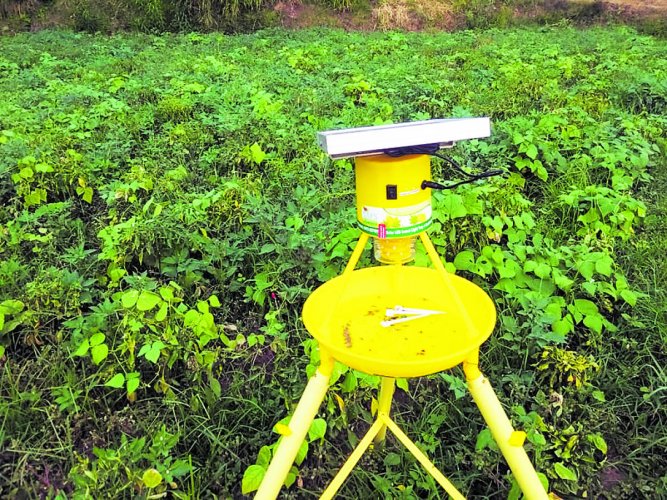
The expensive solar light-powered insect traps being sold to unsuspecting farmers under the centre-sponsored PMKSY by Agriculture department in Kodagu district.

A suspicion among farmers about subsidised farm equipment and accessories being overpriced due to unholy nexus between officials and private entities appears to be true.

The department of Agriculture in Kodagu district under Pradhan Mantri Krishi Sinchai Yojana (PMKSY), scheme to improve farm productivity, has procured 150 solar light-powered insect traps after placing an indent for 350 such insect traps from Kalaburagi-based Fortune Sales Corporation to be distributed among the farmers.

According to information obtained by RTI activist Sanjeeva Kabaka from Puttur, each unit, including GST, purchased from Fortune corporation had cost over Rs 11,800. The department of Agriculture in its reply to the queries under RTI had revealed paying Rs 17,38,373 for over 150 units.

Sanjeeva says the haste to purchase such expensive solar-powered insect traps despite the availability of low-cost solar-powered insect traps had raised eyebrows.

“A farmer-cum-inventor Karibasappa’s indigenous solar-powered insect trap is priced at Rs 4,800, including GST and door-delivery charges,” he points out.

Karibasappa, when contacted, said that he had sold his units, each priced at Rs 4,800, to the Department of Agriculture in nine districts, including Shivamogga under ATMA scheme.

“By selling units that are three times more expensive than my unit proves that officials are making money,’’ said Karibasappa, who is in New Delhi participating in an exhibition.

He said the insect traps purchased by the Agriculture department in Kodagu district cannot withstand high wind speed and is made of plastic. Its battery life lasts only about six months.

“My prototype is able to withstand high wind speed, is made up of metal and the lithium battery has a shelf life of four years and covers two acres,” he said.

Incidentally, Karibasappa’s prototype has the backing of officials in Agricultural universities and also had won Infosys Foundation’s Aarohan Innovation award.

Joint Director of Agricultural Department, Kodagu, Raju did not respond to calls.

Watershed development department Director Padmanabh Naik when contacted said the standards for procurement of insect traps were laid by the Agriculture Department under the directions of Minister for Agriculture.

Kodagu Deputy Commissioner Annies Kanmani Joy, when contacted, promised to look into the issue of Agriculture department selling expensive solar-powered insect traps to farmers.

source: http://www.deccanherald.com / Deccan Herald / Home> State> Mangaluru / by Harsha, DH News Service, Mangaluru / July 20th, 2019

The Sour Truth

Kachampuli01KF22jul2019

It is monsoon season in Kodagu and though rains are less this year, people in remote villages of Kodagu, who have grown Garcinia gummi-gutta tree in their estates or have access to the tree grown in the wild, are busy in preparing Kachampuli, the dark, tart vinegar. Kachampuli preparation has been passed on from generations and is indispensable in Coorg cuisine. Every Coorg kitchen has a couple of bottles, or more, of Kachampuli tucked away at the corners or stored in the attic. This Weekend Star Supplement introduces readers to this enigmatic liquid and explains the process of obtaining it from yellow fruits hanging on top of tall trees.

Kachampuli: The Quintessential Coorg Condiment

A full-fledged processing unit at Ponnampet Forestry College

by B.C. Thimmaiah

Souring agents are an integral and inseparable part of our culinary traditions. Depending on the State and community, souring agents vary. Apart from lip-puckering tamarind and lime juice that is quite ubiquitous in most Indian dishes, there are a host of other souring agents that enhance the flavour of dishes like Kodava Pandi Curry (pork curry) where Kachampuli makes it the ‘Dish with a Zing’.

The concentrated juice is obtained from Garcinia gummi-gutta, the same fruit that is used in dried form in parts of Kerala, where it is known as punampuli or kodampuli/kudampuli. It is a relative of kokum, which is used in Mangalorean, Konkan and Maharashtrian cuisines. In Kodava language, the fruit is known as ‘Panpuli’ and its boiled extract is ‘Kachampuli’.

The fruit is like a large Amla but with prominent sections. In its fresh form, it is known to possess medicinal properties and is the basis for many weight-loss products. The English name is Brindle Berry. Before it is stored, the Panpuli is taken apart in slivers, dried and then smoked. It’s here that the green fruit turns into matt black. Later, dry pieces are soaked in warm water and torn apart before being added to the curry.

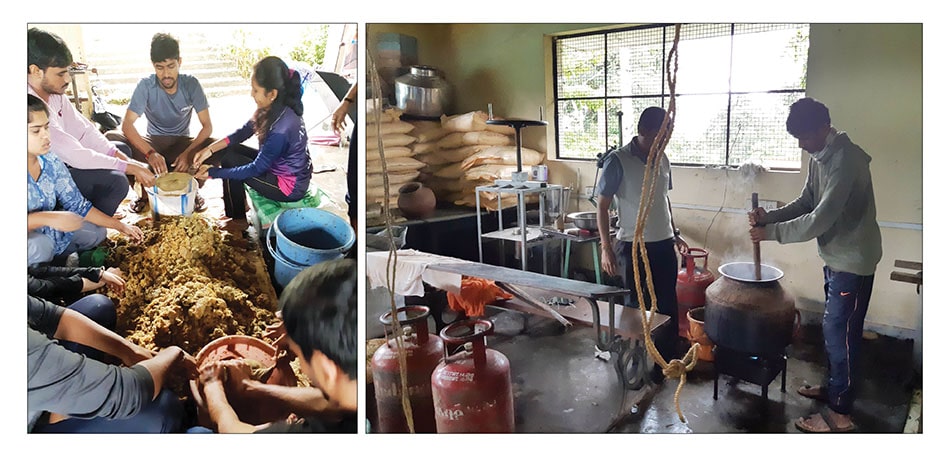
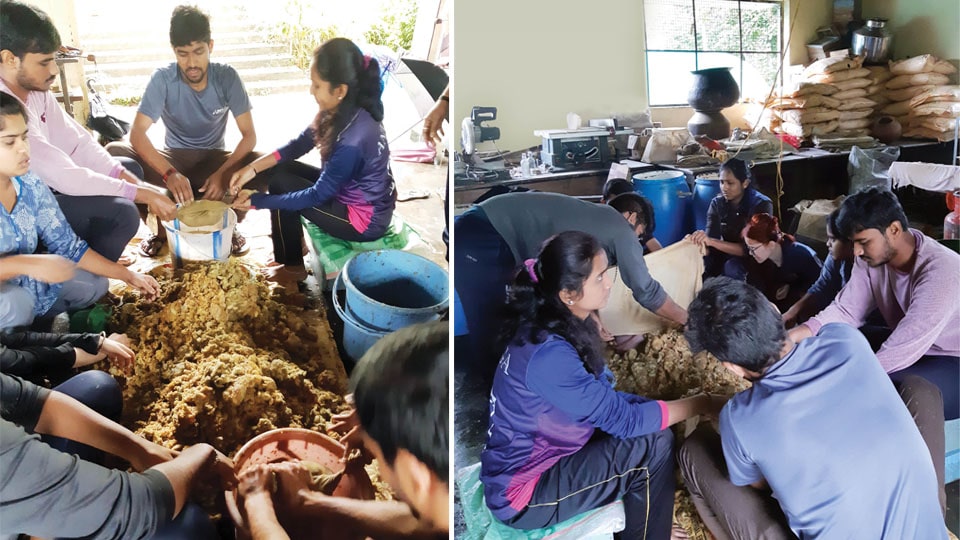
Students of Forestry College, Ponnampet, extract the seeds from the fruit. Once the succulent aril is separated from the seeds, the extracted juice is boiled and stirred constantly to procure the thick Kachampuli.

Juice preparation process

In Kodagu, the fruit is left out in baskets until the pulp breaks down. A large vat is kept below to collect the juice and the pulp is removed. The juice at first is pale and golden. It is then boiled in large clay pots until it turns dark burgundy in colour. This slow heating turns it into a syrupy vinegar. The final result is a dark and thick liquid and this liquid extract is known as Kachampuli.

Interestingly, Kachampuli improves with age. The older brews are preferred over the newer ones for cooking. The new bottles are usually stored in attics in Kodagu and are left there to mature and attain that perfect texture, taste and colour. Kachampuli is usually used in the final stages of cooking, mainly in meat and fish dishes, most famously in Pandi Curry and fish curry.

Kachampuli03KF22jul2019

An expensive commodity

While Kachampuli was abundantly available in the open market earlier, now it is a scarce and an expensive commodity even in Kodagu, its hometown, thanks to the present generation that is unwilling to take the trouble of preparing it as it is a long-drawn and pain-staking process. Adulteration of Kachampuli to make a quick buck too has become rampant.

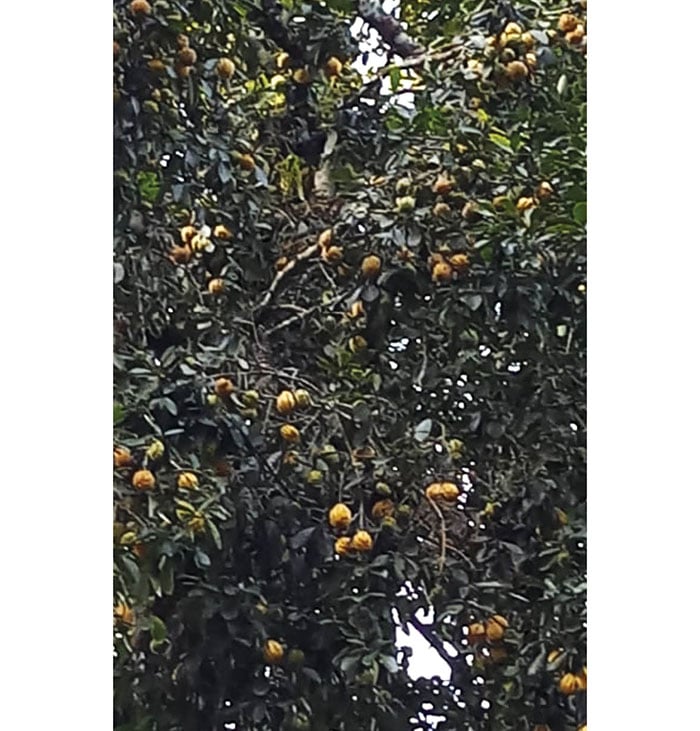
A fully grown Panpuli or Garcinia gummigutta tree in Kodagu with its yellow fruits

Realising Prime Minister Narendra Modi’s ‘Make in India’ initiative

Considering the rarity of the fruit and its many uses, College of Forestry at Ponnampet in South Kodagu has started a full-fledged unit that procures the Garcinia gummi-gutta fruit from farmers, processes it, prepares Kachampuli and then markets it. This initiative has not only ensured that the tradition continues but also eased the scarcity of the unique product in the market.

The initiative at the College was started by former Dean of the College Dr. B.C. Uthaiah and continued on a major scale by the present Dean Dr. C. G. Kushalappa, who has conducted extensive research in Devarakadus, the Sacred Forests of Kodagu and the wild and edible fruits of Kodagu, and Dr. B.N. Satish, Assistant Professor, Department of Forest Products and Utilisation.

Hands-on Training

The College is following the traditional methods of using forest produce available in Kodagu. “Our College offers Hands-on Training (HoT) programme to add value to non-timber forest produce where wild and edible fruits of Kodagu like Garcinia gummi-gutta, gooseberry, kokum and Karada (karmunji in Kodava language) fruit are made into products including pickles, jams and jellies, candies, squash, toffees and, of course, Kachampuli. This apart, we do produce hair care products from soap nuts and agarbathi. These exotic products are marketed under Sayhadri Brand,” says Dr. Kushalappa.

“This initiative is completely agriculture-and-farmer-oriented and we want to tell our farmers that their products have value and market. We provide plantation material or saplings, standardise production, maintain quality and focus on effective waste disposal. We have procured Government of India-manufactured machines from Coimbatore and we have a larger plan to set up Small Scale Industry production units at Ponnampet,” he explains.

Efforts to retain youths from migration

Basically it is to retain the youths in Kodagu who are migrating to cities in search of job opportunities. “We want to tell them that they can lead a comfortable life by adopting innovative farming and cultivate such unique fruits in a large scale as Kodagu is a natural zone under Western Ghats for such fruits. Our intention is to make them self-reliant. It is our way of nation-building aligning with the theme of Prime Minister Narendra Modi’s Make in India initiative,” he rues.

“It is an entire world out there when it comes to wild berries and there is a huge market. For example, Garcinia gummi-gutta extract by multi-national companies is sold in the US and Europe as bio-slim products. We are trying to tie up with institutes like Central Food Technological Research Institute (CFTRI) for product development,” Dr. Kushalappa explains.

Kachampuli05KF22jul2019


Grafted trees for high yield

Apart from producing the actual and authentic Kachampuli, the College supplies Garcinia gummi-gutta saplings for large-scale cultivation. “It is a huge tree and no coffee plant can grow under it. Our grafted tree does not grow that tall and growers can take up integrated coffee and Garcinia gummi-gutta cultivation. Our saplings are short and gives a high yield,” he reveals.

On the Kachampuli product marketed by the Forestry College, Dr. Satish says that the product is made in a traditional way with the use of modern techniques. “It is free from any sort of adulteration and we have not used any preservatives. There is a great demand for the product from both residents of Kodagu and the natives who live outside the district,” he says.

One tree, many fruits, multiple uses

The Garcinia gummi-gutta is a small or medium-sized tree and the bark of the tree is grey, smooth and contains abundance of bright-yellow gamboges (a gum resin produced by various trees, used as a yellow pigment and in medicine as a purgative). The tree starts bearing fruits when it is eight-years-old and it continues to bear fruits till it reaches 40 to 45 years. The fruits are two to three inches in diameter and are yellow when ripe with six to eight grooves. One tree can yield 100 to 125 kgs of fruit.

Kachampuli06KF22jul2019

Around 25 kgs of Garcinia gummi-gutta fruit is required to prepare one litre of Kachampuli with an investment of Rs. 300 to Rs. 350 per litre. Once the product is ready, it can be sold up to Rs. 1,500 per litre.

There will be six to eight seeds surrounded by a succulent aril (an extra seed covering, typically coloured and hairy or fleshy). Usually, the Garcinia gummi-gutta flowering takes place from February to May every year and from June to August it is fruiting season and that’s the time when people of Kodagu get on to prepare the famed Kachampuli.

Uses of Garcinia gummi-gutta fruits

The Garcinia gummi-gutta fruits are edible, but too acid to be eaten raw. They are valued for their dried rind which is used in Travancore-Cochin and Malabar as a condiment for flavouring curries in place of tamarind or lime. In Sri Lanka, the fruits are picked under-ripe, the thick pericarp cut into sections, dried in sunlight and preserved for future use. The dried material is used along with salt in the curing fish. The edible oil extracted from the seed resembling kokum butter is used extensively in preparation of the local dishes.

Apart from using the fruit and its extracts for food purposes, the raw and processed rind of the fruit is extensively used as a condiment, coagulant and for polishing gold and silver articles. The Garcinia gummi-gutta seed is an edible source of fat and interestingly the tree does not have any pest or disease and is a characteristic trait of the tree family. The fruit is also used in Indian traditional medicine for edema, delayed menstruation, constipation and other intestinal disorders.

source: http://www.starofmysore.com / Star of Mysore / Home> Feature Articles / July 14th, 2019

Experts say forest officials must develop safety instincts

A day after a Bandipur ranger was attacked by a tiger, wildlife experts have asked foresters working in tiger reserves and national parks to exercise caution.

TigerKF05jul2019

Hubballi :

A day after a Bandipur ranger was attacked by a tiger, wildlife experts have asked foresters working in tiger reserves and national parks to exercise caution. They suggest that field-level officers develop the instinct to sense danger when in the wild, so that animal-human conflicts can be checked.

Four cases of animals attacking forest officials have been reported from various reserves of Karnataka in the last one year, and two people have died in different incidents. While IFS officer Manikantan heading Nagarhole Tiger Reserve was trampled to death by an elephant, a temporary forest watcher from Cauvery Wildlife Sanctuary met with the same fate.

After a tiger attacked Range Forest Officer Raghavendra in Bandipur, experts are asking why the officer ventured into the tiger area, that too unarmed. “The officer should have been aware of surprises the wild can throw up. Before being deputed at Bandipur, Raghavendra had worked in BRT Tiger Reserve. It was wrong of him to venture out to check the presence of a tiger without precautions. Field officers must be made aware of negative aspects of forest protection and use this knowledge to avoid dangerous situations,” a wildlife expert told TNIE.

K M Chinnappa, a senior wildlife conservationist, revealed that from his observation, most wild attacks occur when animals are chased. “The unfortunate death of a forester near river Cauvery happened when a team was driving away elephants. When foresters are transferred to different forests, they must be trained to cope with the different conditions they are likely to encounter, for some could be very dangerous,” he said.

“We have been asking the government to appoint local guards, who would know the terrain and dangers involved,” he added.

A retired forester admitted that there is no specific training given to field officers to deal with surprise wild attacks. “Sloth bears and elephants (tuskers) are most unpredictable in the wild. It is important that a forest team is made aware of possible dangers to expect, and be in a position to take precautionary measures,” he said.

source: http://www.newindianexpress.com / The New Indian Express / Home> Cities> Bengaluru / by Amit S. Upadhaye / Express News Service / July 03rd, 2019

Coffee Board takes tech route to help growers boost yield

App-solutely smart: In the case of white stem borer, growers and the Board have validated 90% accuracy.   | Photo Credit: Reuters
App-solutely smart: In the case of white stem borer, growers and the Board have validated 90% accuracy. | Photo Credit: Reuters

Apps fed with data help forecast weather, predict leaf rust

For the 3.5 lakh coffee growers in India, 98% of whom are small-scale, challenges affecting production include labour shortage, climate change and pest attacks.

One way to manage these is by adopting technology, which the Coffee Board is trying to bring about for the growers.

Last year, Eka Software Solutions took up a pilot project for the Coffee Board of India on machine-learning based applications. According to Shuchi Nijhawan, vice president – agri business for Eka Software, the Board and the company took up three areas to try machine learning based apps. One was addressing the white stem borer problem, another was weather forecasting, and the third, predicting leaf rust.

Machine-learning

“Based on the data, photos provided, we created a machine learning algorithm to forecast each of these issues (for a grower). We worked with 20 liaison officers of the Board and they coordinated with the growers.

“The success of the app depends on the data fed in. In the case of white stem borer, the growers and the Board have validated 90% accuracy,” she says. Eka’s digital platform for agriculture aggregates data from different sources and applies the algorithm to provide insight to the coffee growers.

Srivatsa Krishna, chairman of the Coffee Board, adds that though there is no exact data, it is learnt that in the last 10 to 15 years white stem borer would have brought down Arabica production by 25-30%. “The growers do need solutions for such issues.”

“Despite the Coffee Act having been around for more than seven decades, farmers have zero technology. The only way to increase productivity is by bringing in technology,” he says. Even before smartphones became popular, coffee growers had checked prices on the London and New York exchanges almost on a daily basis.

Hence, adopting technology should not be difficult for them. The Board has plans to scale up the analytics technology for adoption by more farmers.

Currently, 90% of the estates depend on labourers for most of the work and there is not much technology adoption among coffee growers in cultivation or to increase production.

“If someone is ready to do it [technology] for us, we will adopt it. It will help increase yield,” says Sundar Subramanium, executive director of Mother Mirra Coffee Plantations. Ms. Nijhawan says the company is exploring partnerships for other crops too. “Indian farmers want such technology services. There are several agriculture institutes and cooperatives in the country that have a lot of data. I see a huge potential for these technologies.”

source: http://www.thehindu.com / The Hindu / Home> Business> Industry> Green Shoots / by M Soundariya Preetha / June 02nd, 2019

Hundreds submit pleas at Parihara Adalat

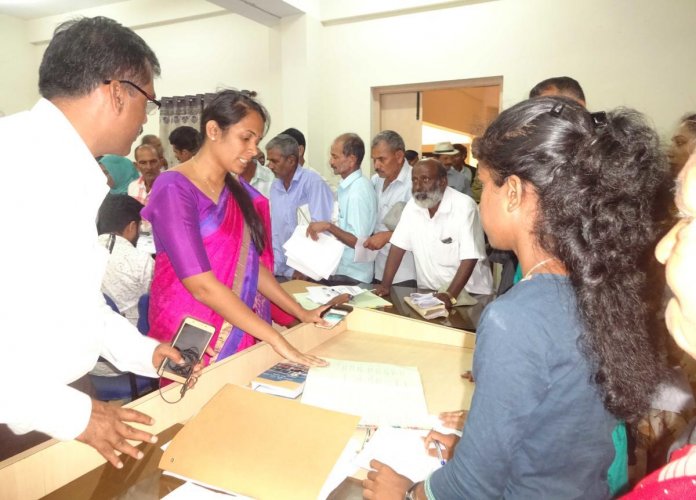
Kodagu Deputy Commissioner Annies Kanmani Joy checks the applications received during the Parihara Adalat in Madikeri on Monday.

Hundreds of people affected by the natural calamity in Kodagu last year took part in the Parihara Adalat and submitted their pleas to the district administration on Monday.

The Parihara Adalat was organised by the district administration to respond to the grievances of natural calamity victims.

The adalat will be held for three days on the second floor of the assistant commissioner’s office auditorium in the district administration complex in Madikeri.

On Monday, hundreds of people enrolled their names.

Deputy Commissioner Annies Kanmani Joy said that the district administration has dispensed 90% compensation to those who have lost their livestock, crops and homes. If anyone is left out, they will be provided with the compensation through the adalat.

The details of compensation have been put up on the website http://parihara.karnataka.gov.in

If the compensation amount has not reached the beneficiaries, such people may furnish their grievances to the district administration during the adalat to be held till May 29.

Many fields and plantations were filled with silt as a result of the natural calamity. A large number of crops were also damaged. Owners of the fields can also claim compensation during the Parihara Adalat.

The compensation amount provided by the government will be credited to the bank accounts of the beneficiaries. The owners of the houses which were completely damaged were added in the first list and the names of those whose houses are found in vulnerable areas were added in the second list, the DC said and added that the rent allowance for the victims who lost their houses, from November 2018 has been directly credited to the bank accounts of the victims.

Assistant Commissioner T Jawaregowda and Tahsildar Natesh were present.

source: http://www.deccanherald.com / Deccan Herald / Home> State> Mangaluru / by Adithya K A / DH News Service, Madikeri / May 27th, 2019

Project Radio Collar Launched To Track Elephants In Kodagu

ProjectCollarKF19may2019

Siddapura:

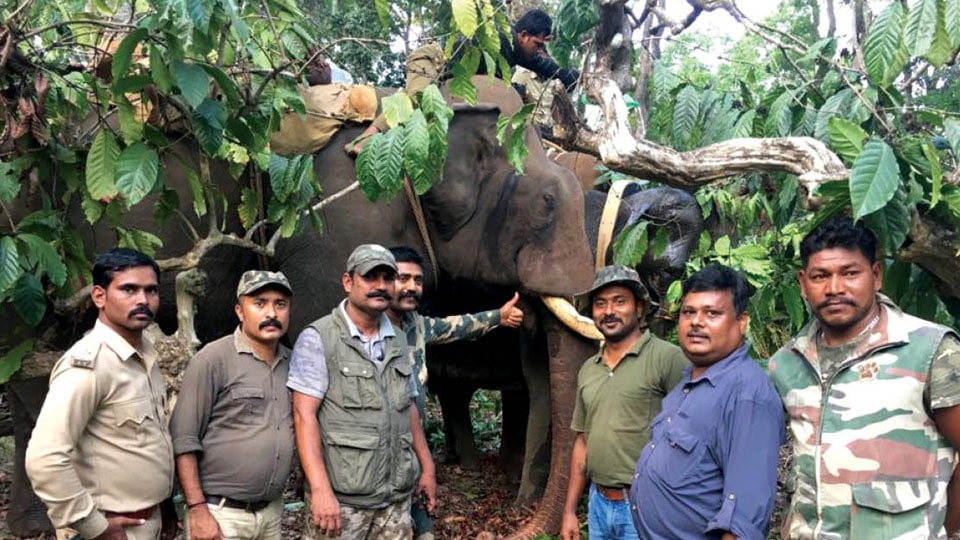
Concerned at the increasing instances of elephant-human conflict, the Forest Department, for the first time in Kodagu, has put radio collars on elephants to study their migration patterns.

The Department has decided to put radio collars on selected elephants so that their migration patterns can be studied. An analysis of their movements will help in avoiding human-elephant conflict that results in deaths of humans and damage to crops, said Department officials.

Accordingly, over six elephants that usually enter coffee estates and fields have been radio-collared in places including Virajpet, Madikeri, Kushalnagar, Maldare, Ammathi & Pollibetta. These areas have witnessed increased elephant attacks in the recent past.

The collars were fitted on the wild pachyderms with the help of tamed elephants including Bhima, Abhimanyu and Krishna. Last time, over four collars were fitted on the elephants and the Department staff was able to successfully track the elephant movements and prevented them from entering the human habitats.

Department officials said that radio collars could further strengthen the elephant corridor management strategy. It could also become an early warning system for villagers in order to avoid conflict with elephants as the collars could provide real-time information. Radio-collaring of animals is a tried and tested method of studying free-ranging wild animals that has been in practice for several decades. It is primarily used for tracking the movement and activity patterns of the tagged animal, with the signals being sent to a handheld device or to a computer via a satellite.

It is often the only method that is available for studying the movement and activity patterns of a secretive species like the tiger or a wide-ranging species like the elephant. Information obtained from the use of radio telemetry is of high scientific and conservation value. The GPS-enabled radio collars will provide updates in real-time about the location of a herd and help track them within the State as well as during migration. A tool embedded in the collar will send signals 24X7.

“Once we receive signals on the presence of the elephant herd near human habitation, the ground-level Rapid Response Team of the Dept. will be alerted on their mobile phones so that they can rush to the place and launch an operation to drive elephants back into the woods,” said District Forest Officer Maria Kristhu Raj.

The kumkis (tamed elephants) will infiltrate the herd and scatter the elephants. When the female leader is isolated, the experts perched on the nearest kumki will shoot her with a dart loaded with a tranquillising drug called xylazine. The dosage will be decided according to the size and strength of the matriarch. “After being hit, the elephant will walk like it is intoxicated for 10 minutes and then it will fall asleep. So, our men have a window of about 40 minutes to put the radio collar on the elephant,” he explained.

“In the 40 minutes the animal was under sedation, the team fixed the radio collar and activated it. Soon, veterinarians injected a drug to revive it. The entire operation was over in 50 minutes and the animal started heading back into the forests,” the DFO added.

source: http://www.starofmysore.com / Star of Mysore / Home> News / May 14th, 2019

‘Yashaswi spices’ now on wheels

A model of the mobile shop for 'Yashaswi' products.
A model of the mobile shop for ‘Yashaswi’ products.

The ‘Yashaswi’ enterprise initiated under ‘Project Coorg’ programme of Bharatiya Vidya Bhavan has been quite successful, and from Sunday, the Yashaswi brand spices will be marketed on wheels.

The scheme was started to provide support to women victims from Kaluru village in Kodagu, who were affected by flash-floods and landslides.

Project Coorg Head Balaji Kashyap said that a well-equipped van has been sponsored by the Kodava Koota based in North America, exclusively for the sale of spices. The mobile spices shop will move across Kodagu district.

The spices prepared and packed by the victims are being marketed at the stalls in Raja Seat premises and the Child Welfare Committee in Madikeri, as well. Apart from spices, there are coffee and honey under the same brand name.

source: http://www.deccanherald.com / Deccan Herald / Home> State> Mangaluru / by Adithya K A / DH News Service / Madikeri – May 12th, 2019