The state government on Thursday revoked the temporary ban on conversion of land in the flood-hit Kodagu district.
The ban had come into effect after last year’s devastating floods washed away large chunks of land in the coffee district.
The Revenue Department on Thursday ordered tahsildars and assistant commissioners to allow conversion of land up to 15 to 20 cents for building houses by the locals after obtaining a ground report.
“Several people have been submitting applications seeking the conversion of land to build houses for a living. But since the floods, the government had ordered temporary ban on conversion of lands for non-agricultural purposes. But keeping in mind the public request, the government has directed to allow conversion of land up to 15 to 20 cents for building houses by the locals.”
The state government while revoking the temporary ban has also laid down certain conditions to prevent damages to the properties in future due to any natural calamity.
As per the conditions, no permission shall be given for construction of buildings in non-stable areas so identified by the Geological Survey of India (GSI) in its report; the buildings shall be at least 10 meters away from the rivers and rivulets and conversion shall not be allowed along the valleys and on those lands which had witnessed landslide in 2018.
source: http://www.deccanherald.com / Deccan Herald / Home> State / by Niranjan Kaggere, Bengaluru / May 09th, 2019
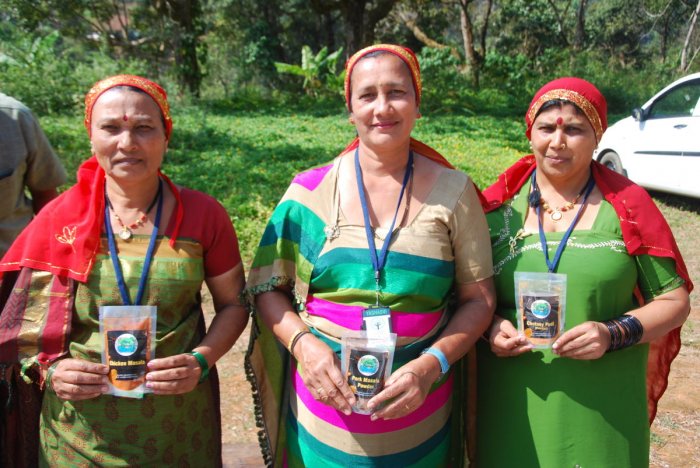
Women Kaluru, who had been affected by the natural calamity in Kodagu, have turned entrepreneurs by releasing ‘Yashaswi’ spices, initiated by ‘Project Coorg’.
The second outlet of ‘Kaluru Stores’, exhibiting and selling articles made by the women affected by the natural calamity in the district, will be inaugurated in town on Sunday, April 14.
The store has been conceptualised by ‘Project Coorg’.
Post-floods, ‘Project Coorg’ identified women from Kaluru, who had been affected by the natural calamity, and trained them to prepare spices at the Bharatiya Vidya Bhavan, Kodagu centre. The spices graded and packaged were sold in the market under the brand name ‘Yashaswi’.
The first outlet of ‘Kaluru Stores’ was opened near Raja Seat with assistance of Kodagu district administration.
The second outlet is ready to be opened in front of Shishu Kalyana organisation near the government bus shelter in Madikeri.
‘Project Coorg’ head Balaji Kashyap said that the opening of the second outlet of Kaluru products had boosted the confidence of the women entrepreneurs. The women underwent training for 180 days in preparation of the spices, he added.
The second outlet will be inaugurated by the Dakshina Kannada Kannadigara Sangha president Ramachandra Upadhyaya at 11 am on April 14.
Bharatiya Vidya Bhavana Kodagu Kendra president K S Devaiah, legislators K G Bopaiah and Appacchu Ranjan, MLCs Sunil Subramani, and Veena Acchaiah, Kodagu Shishukalyana Samsthe president K Mohan Monnappa and writer Nagesh Kaluru will take part in the inauguration of the outlet, sources said.
The initiative was announced by Suresh Prabhu, Union minister for commerce and industry, in Delhi in September, 2018. Mint
– The project was announced by Suresh Prabhu, minister for commerce
and industry, in Delhi last September
– The blockchain platform will allow a coffee producer to directly
transact with multiple buyers.
The Coffee Board on Thursday launched the pilot of the country’s first blockchain-based marketplace app for trading in Indian coffee, aimed at getting growers better returns by removing myriad middlemen.
Known as the Coffee Blockchain initiative, the pilot was activated simultaneously by Jose Dauster Sette, executive director of the International Coffee Organisation from Nairobi and Anup Wadhawan, India’s commerce secretary from New Delhi.
The project was announced by Suresh Prabhu, minister for commerce and industry, in Delhi last September. So, why did it take six months for the project to go live?
“There were more than 20 stakeholders from three different countries. We had to get all of them on board, and then test the platform. We believe this is perhaps only the third attempt at a coffee blockchain after France and Ethiopia,” said Srivatsa Krishna, chief executive officer and secretary of the Coffee Board, a government organisation tasked with promoting Indian coffee.
The blockchain platform will allow a coffee producer to directly transact with multiple buyers.
In India, coffee is cultivated in about 454,000 hectares by 366,000 coffee farmers — 98% of them small farmers — whose returns are meagre. Krishna said the aim of using blockchain is to “premium-ise” coffee, add “bean-to-cup traceability” and cut the role of middlemen.
The blockchain-based solution was developed in coordination with Eka Software Solutions. Manav Garg, the company’s CEO and founder, said the idea of using blockchain is to “record the first smart contract on a blockchain with the 20-odd stakeholders, and establish trust in the marketplace”.
“With this activation, we are confident that the Coffee Board of India will help the Indian coffee trade make more inroads into the premium market internationally and make India one of the top three coffee producers in the world,” Garg added.
Krishna said the Coffee Board is also “testing” blockchain-based solutions from a couple of other vendors but added that “the one from Eka Software was the most suitable at this moment”.
Blockchain is no longer a technology that is just about powering cryptocurrencies like bitcoin and ether. A distributed digital ledger technology (DLT), it is also being used by manufacturing companies to improve their supply chains; by healthcare and electricity companies; and by the financial sector to make transactions more transparent.
source: http://www.livemint.com / Live Mint / Home> Explore / by Leslie D’Monte / March 29th, 2019
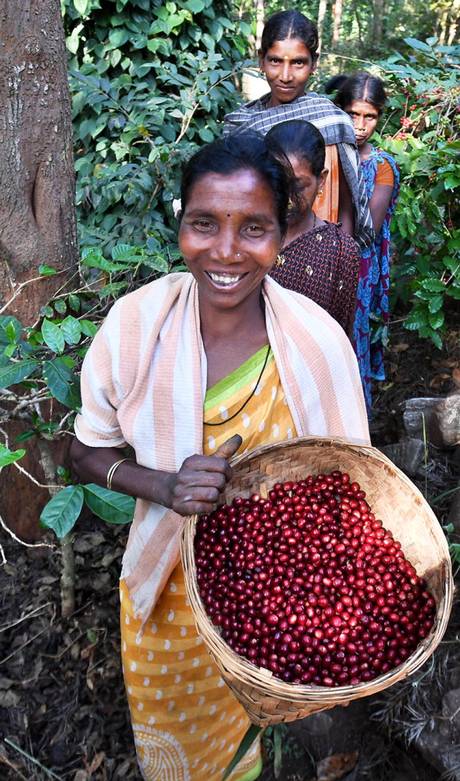
Global praise: Tribal women harvesting organic coffee on a plantation near Girliguda in Araku, Visakhapatnam.The Araku Valley coffee which is processed and marketed with the help of the tribal farmers cooperative society recently won the gold medal for the best coffee pod in the Prix Epicures OR 2018 Award in Paris. | Photo Credit: K.R. Deepak
The government on Friday said it has awarded Geographical Indication (GI) tag to five varieties of Indian coffee including Coorg Arabica.
The move is expected to help the growers get maximum price for their premium produce.
The Department for Promotion of Industry and Internal Trade, under the Ministry of Commerce and Industry, has recently awarded this tag to — Coorg Arabica coffee from Karnataka, Wayanad Robusta coffee from Kerala, Chikmaglur Arabica from Karnataka, Araku Valley Arabica from Andhra Pradesh, and Bababudangiris Arabica coffee from Karnataka.
The Araku coffee is produced by the tribals, who follow an organic approach in which they emphasise management practices involving substantial use of organic manures, green manuring and organic pest management practices, the ministry said in a statement.
Similarly, it said, Bababudangiris Arabica coffee is selectively hand-picked and processed by natural fermentation.
In India, coffee is cultivated in about 4.54 lakh hectare by 3.66 lakh coffee farmers of which 98 per cent are small farmers.
Coffee cultivation is mainly done in the southern states of India including Karnataka, which accounts for 54 per cent of the total production. It is followed by Kerala (19 per cent), Tamil Nadu (eight per cent).
It is also grown in non-traditional areas such as Andhra Pradesh and Odisha (17.2 per cent) and North East states (1.8 per cent).
India is the only country in the world where the entire coffee cultivation is grown under shade, hand-picked and sun dried, it said adding the country produces some of the best coffee in the world, grown by tribal farmers in the Western and Eastern Ghats, which are the two major bio-diversity hotspots in the world. Indian coffee is highly valued in the world market and sold as premium coffee in Europe.
“The recognition and protection that comes with GI certification will allow the coffee producers of India to invest in maintaining the specific qualities of the coffee grown in that particular region. It will also enhance the visibility of Indian coffee in the world and allow growers to get maximum price for their premium coffee,” it added.
A Geographical Indication (GI) is primarily an agricultural, natural or a manufactured product (handicrafts and industrial goods) originating from a definite geographical territory.
Typically, such a name conveys an assurance of quality and distinctiveness, which is essentially attributable to the place of its origin.
Darjeeling Tea, Tirupathi Laddu, Kangra Paintings, Nagpur Orange and Kashmir Pashmina are among the registered GIs in India.
Experts said that award of GI tag gives protection to the producer of those genuine products, which commands premium pricing in the markets both domestic and international.
“Once the GI protection is granted, no other producer can misuse the name to market similar products. It also provides comfort to customers about the authenticity of that product,” National Intellectual Property Organisation (NIPO) President T.C. James said.
Such products also get premium pricing in the markets, he added.
source: http://www.thehindu.com / The Hindu / Home> Business> Industry / by PTI / New Delhi – March 29th, 2019
Jaggery coffee may not be your cup of tea but expect the brown brew to be presented as a welcome drink at a resort in the middle of a large coffee plantation, such as the Cottabetta bungalow in Pollibetta, Coorg, south Karnataka. Nearly 130 years old, this plantation resort was once the residence of British planters. Owned by the Tatas now, it consists of a Kerala-style house with the bedrooms around the inner courtyard, offering the old-world charm and comfort.
On the hillsides, a dense forest of short and stunted trees bearing this exotic berry, in the shadow of the taller trees on which pepper creepers climb high, abounds. The soil here is good for a host of other spices, too. That’s what the traders from the west came looking for, and then settled down to rule our country.
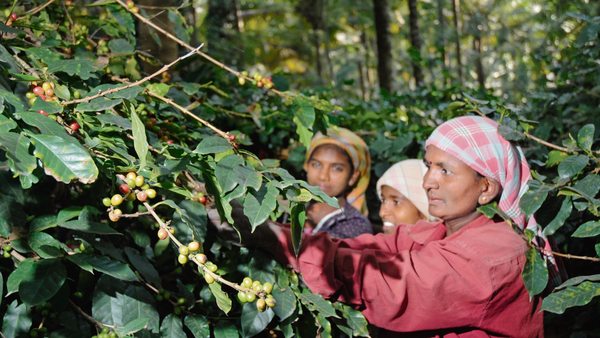
A tour of this particular plantation gives an insight into the process of producing coffee. According to a tour guide, Udhav, a coffee plant starts yielding berries after seven years, and then goes on doing it for over 75 years. Initially the berries are red, but turn brown once they go through several stages of drying, pulping, roasting and grinding before landing on our tables as the brew with a heady aroma. Robusta is the variety that grows here. It’s the favourite of the elephants, too. Most plantations are surrounded by an electric fence to protect them from pachyderms (animals like elephants, hippopotamus and rhinoceros) but, says Udhav, “sometimes they find out how to switch it off. Generally, it is the matriarch of the herd who knows how”!
Monastery
In another direction from Madikeri, about five kilometres off the Bangalore road, lies a Buddhist monastery, Namdroling. This seminary imparts education in the Nyingmapa tradition of Buddhism. Over 3,000 students from the primary to postgraduate level, from the Himalayan regions and abroad, “chant and study, work and practice” here. His Holiness Penor Rinpoche set up this monastery in 1963.
He “attained Mahaparinirvana” in 2009. The Dalai Lama consecrated it and christened it as Namdroling, though its full name is Thegchog Namdrol Shedrub Dargyeling (Land of increasing practice and teaching of the utmost yana that achieves spontaneous liberation). The centre is also known as the Golden Temple because of the three 40-feet high, gilded statues of the Buddhist icons. The entire complex has been elaborately decorated with the Tibetan-style paintings, murals and religious figures. Bylakuppe, a small town where this is located, is a far cry from Tibet in terms of climate and culture but it houses the second largest Tibetan settlement after Dharamsala.
Around 40km from Madikeri is Talakaveri, on the Brahmagiri hill, the source of the Kaveri river. A tank marks the source of the river, and a nearby temple is a popular place for pilgrimage. Not too far from Madikeri lies the Dubare elephant camp. It is located on the banks of Kaveri. Apart from watching big animals, one can do some still-river rafting close by. The best time to visit Coorg is soon after the rains when water cascades down the falls and mist rises up to shroud the mountains. Perhaps, that’s why it’s also known as the Scotland of India.
source: http://www.tribuneindia.com / The Tribune / Home> Spectrum> Travel / by Lalit Mohan / March 10th, 2019
It was only the next morning that I saw the damage that the floods had inflicted on the family.
It was dark and still drizzling when Thenira Kishore Ganesh pulled into his parents’ house in Mekeri in Kodagu. It was a modest but spacious building in the traditional style within a large compound, with an outhouse, a well and flowering plants of various kinds. When Kishore told his parents that I would be staying in the house for the night, they immediately showed me where to freshen up and asked me how hungry I was.
I had been on the road since the crack of dawn having set out from Bengaluru to cover the impact of the floods and landslides that had hit Kodagu a few days earlier. Heavy rains had lashed the district through July and the first half of August making planters worry about their coffee and pepper crops. But the consistent heavy rain took a far bigger toll when on August 16, it brought entire hillsides and villages down in a series of landslides.
Since the condition of the roads and public transport services was uncertain, I had hitched a ride from Bengaluru with Kishore and his brother-in-law Darshan Thimmaiah. They were travelling back home to check on their families and help with relief work. I met Darshan just the previous day at the relief collection centre in Bengaluru. He works at the Ministry of Human Resources Development while Kishore works with the computer manufacturing company Lenovo in Bengaluru. His parents look after the family’s agricultural lands in Mekeri.
The 250-kilometer drive from Bengaluru to Kodagu took longer than it usually did. The Kushalnagar-Madikeri road bore signs of damage from the landslides. There was heavy traffic as relief from across the state poured into the district. We stopped in Suntikoppa where Kishore and Darshan made their own enquiries of the people displaced and living in shelters, while I gathered information for the reports I had set out to write. We stopped again at a petrol bunk in Madikeri where we met two ambulance drivers who had run out of fuel and cash. Kishore and Darshan paid for the two vehicles to be fuelled up.
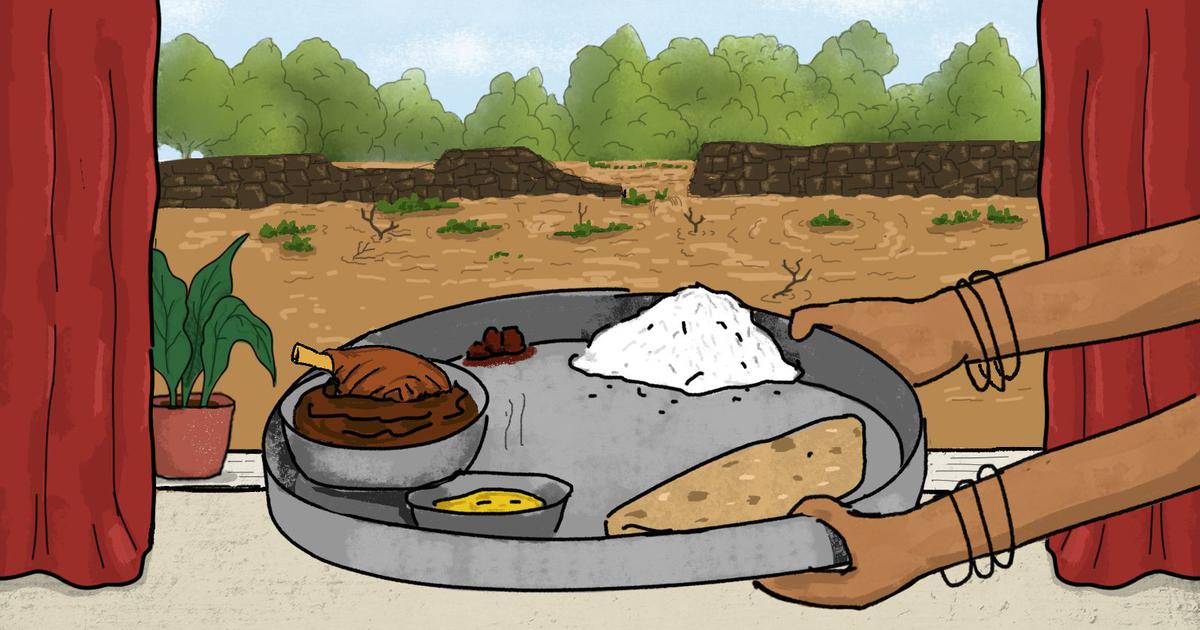
While Kishore and Darshan dropped off their bags at the family house in Mekeri, Kishore’s mother offered me – an unexpected and ravenous guest – lunch. I happily wolfed down the otti (rice chapati), mutton curry, dal, rice and pickle.
That afternoon, Kishore and Darshan drove me to a relief centre 20 km away. It was already beginning to get dark when we left and they advised me not to try to get to my hotel in Madikeri since it was still raining, the roads were bad and landslides were still being reported across the area.
With no other place to stay, I went back to Kishore’s parents house. And so, having already shared their lunch, the family shared their dinner with me and readjusted their sleeping arrangements to make room for me.
Journalists often rely on the kindness of strangers and, reporting from the location of a natural disaster, I found myself profoundly thankful for the hospitality of Kishore’s elderly parents that evening.
It was only the next morning that I saw the damage that the floods had inflicted on the family.
Across the narrow road in front of their house, Kishore’s family has five acres of land on which they grow paddy. Kishore’s father, who manages the fields for his relatives living outside Kodagu, had supervised sowing in early July. Now, in mid-August, the rice saplings were lying on their sides, flattened by the water that had come rushing down from the hills in the previous day. A 200-metre long field that belongs to Kishore’s uncle had a large chasm in the middle. A stream that used to run around the field and into an irrigation canal now ran through that chasm, the water muddy with silt washed down from fields upstream.
“We don’t know what kind of losses we will have from this,” said Kishore. He estimated that his family will need to spend at least Rs 1 lakh just to restore the field by filling it in with mud.
And yet, when I offered to split the fuel bill with the brothers-in-law who drove me around for a day and a half, they only asked that I donate that amount to flood relief.
source: http://www.scroll.in / Scroll.in / Home> BackStory 2018 / by Nayantara Narayanan / December 25th, 2018
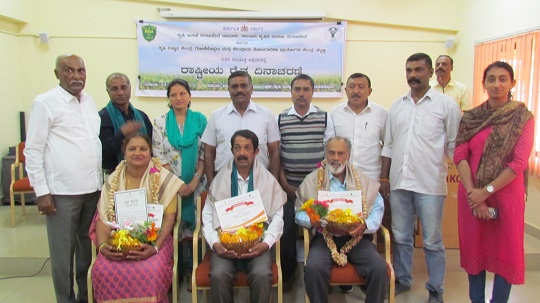
Kisan Diwas Was Celebrated on 23rd December,2018 at KVK Gonikoppal, Kodagu campus Jointly by the Department of Agriculture, CHES, Chettalli and ICAR-KVK, Gonikoppal. About 100 farmers, Staff from Department of Agriculture, KVK and CHES Chettalli participated in the function. The programme was inaugurated by Shri Raghu Nanaiah, President, Taluka Krishika Samaja President. Other guests on the stage were Shri Chotu Kaverappa, President Zilla Krishika Samaja President, Shric S.C. Thimmaiah progressive farmer, Smt Ashwini Nanda and Shri M.P. Somaiah, President Puthari Farmers Producer Co. Ltd. The programme started with lighting of the lamp, followed by Felicitation of Progressive farmers for their integrated farming and Cleanliness in farming and minimum use of external inputs. Shri S.C. Thimmaiah of Nallur village, Ponnampet, Virajpet and Smt. Ashiwini Nanda were felicitated for their achievements in farming. Puthari Farmers organisation was felicitated in recognition of their services to the farming community.
The award winning farmers addressed the farmers and talked in detail about their farming practices and how through integrated farming system they are reducing the cost of cultivation and achieving higher productivity. The programme started with the playing of Farmers Song. In the beginning Smt. Reena, ADA, Agriculture Department welcomed the dignitaries and the farmers. The whole programme was coordinated by Shri Veerendra Kumar and Shri B. Prabhakar, SMS of this KVK.
source: http://www.iihr.res.in / ICAR – Indian Institute of Horticultural Research / Home / December 25th, 2018
The yard identified for organising ‘Raitha Santhe’ on the premises of the APMC in Madikeri
The APMC in Madikeri will reintroduce ‘Raitha Santhe’, the farmers’ shandy, from December 21.
The weekly shandy was stopped following landslides and incessant rain in Kodagu.
After a long gap, the APMC has decided to relaunch the unique market wherein a platform will be provided to farmers to sell their produce directly to buyers (customers).
The programme, which was initiated on January 12 this year had received a poor response. The APMC has now relaunched the shandy by incorporating some changes with an objective to make it friendly for both the farmers and the buyers.
“From December 21, ‘Raitha Santhe’ will be held on the premises of the APMC near KSRTC depot on every Friday and Wednesday,” said APMC Madikeri Chairman S Ambi Cariappa.
It has been decided to hold the farmers’ shandy on two days in a week. Earlier, the market was meant only for the farmers of Madikeri taluk. This time, the facility will be extended to farmers from various parts of Kodagu district as well as from the state.
Basic amenities such as a new building and parking space will be provided at the venue of the ‘Raitha Santhe’.
APMC member Beppurana Medappa said that the ‘Raitha Santhe’ intends to encourage customers to purchase products directly from farmers at reasonable prices.
Apart from vegetables and fruits, value-added products by farmers will also be featured during the sale. Farmers have also been extended tax exemption to carry out the business, he added.
Apart from vegetables and fruits, value-added products by farmers will also be featured during the sale. Farmers have also been extended tax exemption to carry out the business, he added.
Another member Kangira Sathish said that earlier, the customers had complained of a limited variety of vegetables at the ‘Raitha Santhe’. Hence, provisions have been made this time to sell a wide range of vegetables, along with groceries.
source: http://www.deccanherald.com / Deccan Herald / Home> State> Districts / by Adithtya K A / DH News Service / Madikeri – December 16th, 2018
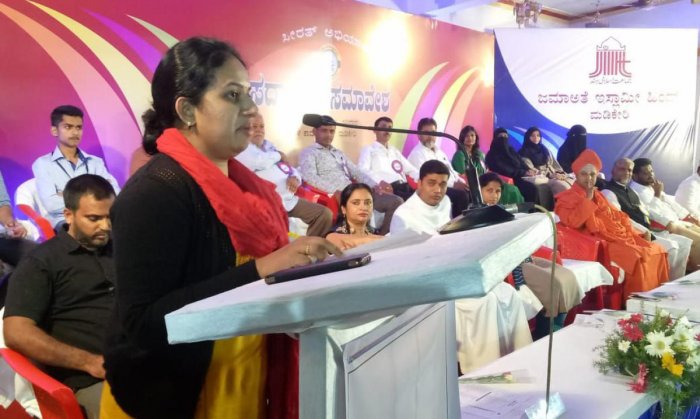
Deputy Commissioner P I Sreevidya speaks at Sadbhavana Convention organised by Jamaat-e-Islami Hind, Madikeri unit, on Saturday.
The volunteers, who took part in the rescue operations during the massive landslides and floods that ravaged Kodagu, are role models for the entire country, said Deputy Commissioner P I Sreevidya.
Speaking at the Sadbhavana Convention, organised by Jamaat-e-Islami Hind Madikeri unit on Saturday, she said volunteers not only took up rescue operations but also lent a helping hand to the district administration.
“As many as 600 victims have been provided shelter at the relief centres by the district administration. The government has been providing facilities to the victims. Members of various organisations are also extending financial assistance and providing relief materials to the victims,” added the deputy commissioner.
Kalancheri Mutt seer Shanthamallikarjuna Swami said that such conventions were essential to foster communal harmony in the society.
As many as 15 volunteers, who were part of the rescue operations, were felicitated on the occasion.
source: http://www.deccanherald.com / Deccan Herald / Home> States> Districts / by Adithya K A / DH News Service,Madikeri / November 25th, 2018
WELCOME. If you like what you see "SUBSCRIBE via EMAIL" to receive FREE regular UPDATES.
Read More »