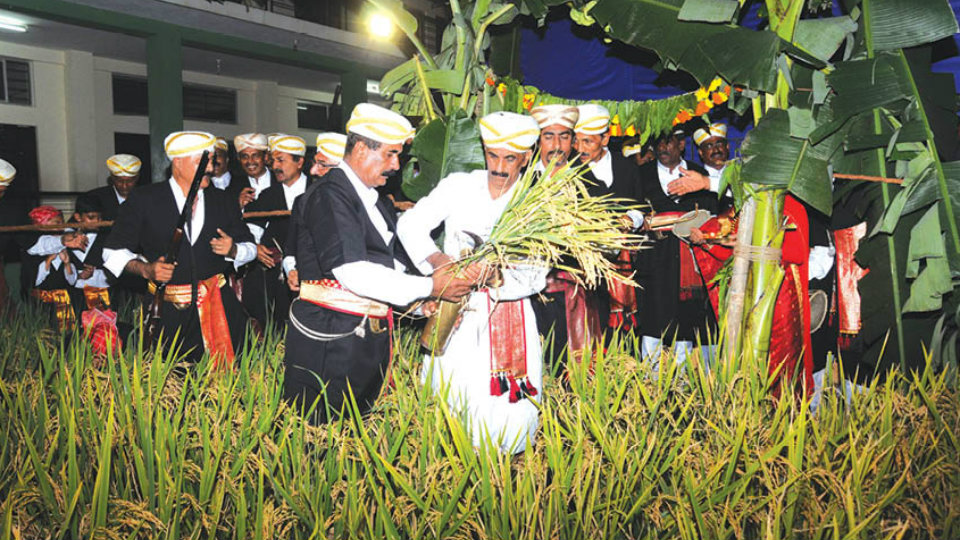
Kodava Samaja, Mysuru, will be celebrating Huthri, the harvest festival of Kodagu, tomorrow (Nov.23) at Sree Cauvery College Grounds in Kuvempunagar from 5.30 pm onwards.
On the occasion, traditional Kodava dances will be presented. ‘Nere kattuva’ ritual will be held at 7.30 pm; reaping new paddy crop (Kadiru) at 8.30 pm; distribution of thambutt prasada at 9.30 pm.
As in the previous years, Puthari Eedu was held from Nov.18 daily at 6 pm at the Samaja premises in Vijayanagar where traditional Kodava dances are practiced. The Eedu programme, sponsored by various Kodava Sanghas, will be held this evening also.
While Ketolira Ravi Belliappa trains the young and old male dancers in Bolkaat, Kolaat, Kathiyaat and Pareyakali, Kullachanda Vinutha Kesari imparts training to girls in Ummathaat.
Thanks to Kodava Samaja, Mysuru, for strengthening the community bonding and preserving the Kodava culture and tradition by holding such events and encouraging the youngsters.
The main event in traditional Kodava attires will be held during Huthri celebrations tomorrow evening at Cauvery Institutions premises.
Gowda Samaja
Huthri festival will also be celebrated under the auspices of Kodagu Gowda Samaja, Mysuru, at its premises in Vijayanagar 2nd Stage here tomorrow from 7 pm onwards. ‘Nere kattuva’ ritual will be held at 7.45 pm; reaping of new paddy crop (Kadiru) at 8.45 pm. There will be distribution of Kadiru also, according to a press release from Samaja Hon. Secretary K.S. Ganapathy.
source: http://www.starofmysore.com / Star of Mysore / Home> News / November 22nd, 2018
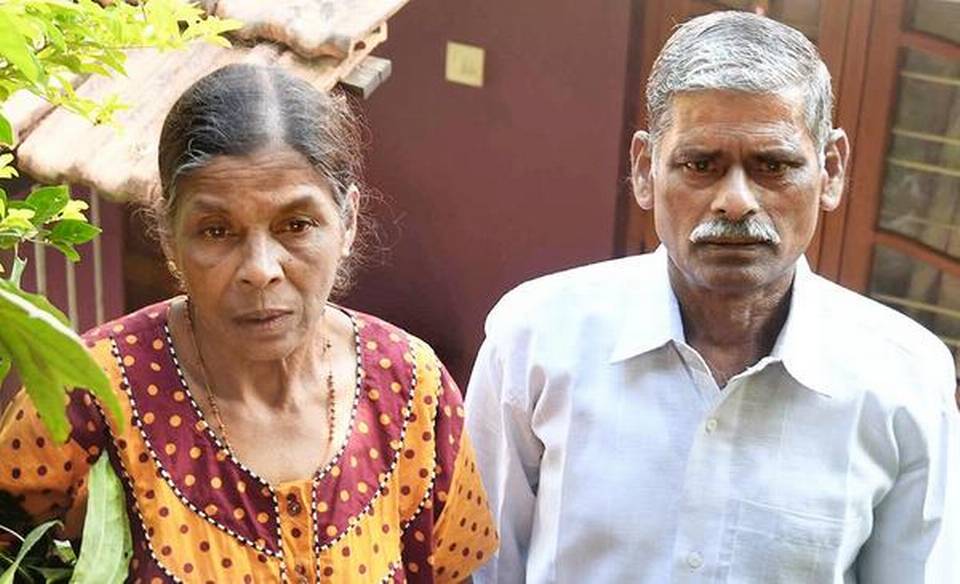
Apolimanthera and Dominic, in front of their house at Hattihole, Kodagu.
The landscape bears the wounds of the devastating deluge; families, worried about the future, are wary of returning home.
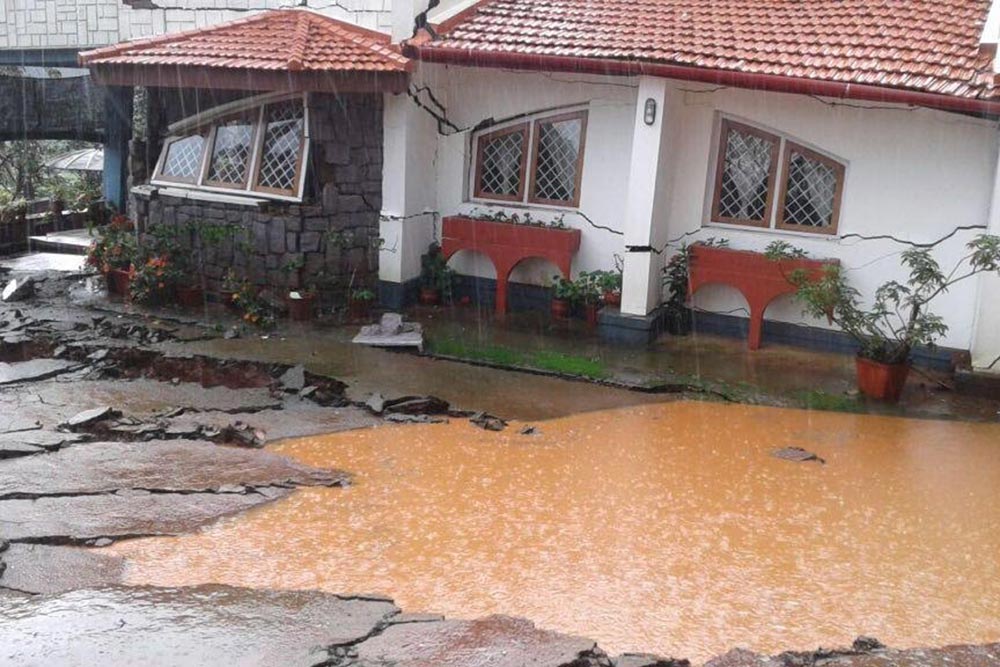
A river, brown with muddy water, flows its usual course on a sunny afternoon, deceptive of the ravage it had caused two months ago when heavy rains and floods devastated Kodagu. On one side of the river’s bank sit two houses – both with different stories of the same tragedy.
One bears large cracks on the walls. Dominic, 63, and his wife Apolimanthera, 59, had to flee from their home in Hattihole, Kodagu district, for a week, after the water level rose on August 17, inundating their home that is below road level. “The water was up to our waist on the road, and we were asked to rush out. We stayed at the relief centre set up in the church for around a week and returned to the devastation after the levels receded,” Mr. Dominic said.
Pointing to a large tree that was swept away by the force of water, which now stands as testimony to the extent of the disaster in the middle of the river, visible from their backyard, he lamented that the river water was now unfit to be used for anything.
Next door, within the same compound is the house of Francis Montheiro, 47, now locked up. A social worker, Mr. Montheiro, known as Appu, was an active volunteer during the floods too. Mr. Dominic last saw him on the morning of August 17, after which he went missing. His body was found in the river nine days later.
Mr. Montheiro’s wife Flaviya Jyothi, 44, a nurse at a private hospital in Madikeri, and two children have shifted to the capital. “My husband used to pick up and drop me halfway. But now, with my shift timings, I decided to shift to Madikeri to make travel easier,” she said. Their sons are in Class 10. Mr. Monteiro was engaged in small businesses dealing with pepper and coffee and drove a taxi.
The house they have left behind, Ms. Jyothi said, is the only asset the family has. “We received ₹5 lakh in compensation. But how do you make up for the loss of a person? Appu is now only a name in our memories,” she added.
Francis D’Souza runs a small hotel on the main road that leads to Hattihole. Having lost his house in the flood, he now lives in a house on rent. “Not just our house, when we left for the relief centre, someone stole what was left in the house and the hotel – jewellery, homemade wine, and bottles of honey (which he sells) and sacks of pepper,” he said.
Three months after the floods, signs of devastation are still everywhere. In Thantipala, the van of a local resident lies almost fully buried in sand left behind by flood water. Mounds of flood residue comprising mud and broken trees line up either side of the road paved out.
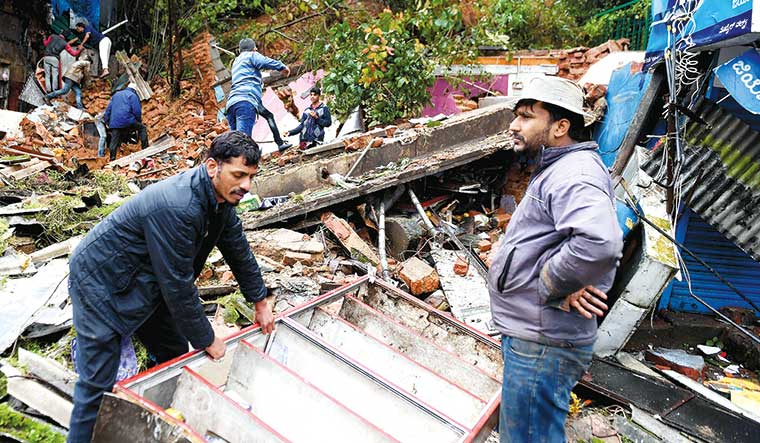
In Udaygiri, the remains of the sole house that survived a massive landslip hinges on the edge, as locals continue to stream in, standing cautiously on the other side and trying to remember the road that once led straight to that house. Raghavendra Shetty, a school teacher, said one person had died here, and at least five houses had turned into rubble.
Normalcy is still a far cry for these families.
Says Ms. Apolimanthera, with large coffee estates being wiped out, work as an estate worker was hard to come by. “I used to earn around ₹1,800 a week. Now I am lucky if I find enough work to pay me ₹300 a day. In our 50 years here, we have never been faced with anything like this,” she said.
Apart from dealing with coming to terms with the present, many are worried about the future.
Charan Panthale drives down to his field in Devasthur, where his house stands half destroyed. A large tree trunk, brought in by the gush of water that crashed into his house, still stands. Sacks of husk lie outside the house on a bed of mud that was the land it was harvested in.
“We have lost one and a half acres. There is nothing we can do about it at present. It will take a long time,” he said. The family is temporarily living with relatives.
840 beneficiaries in the first phase
The Kodagu district administration has identified 840 beneficiaries who will be given houses in the first phase. The government will approve one of the five model houses being built by different agencies and companies.
Sreevidya P.I., Deputy Commissioner, Kodagu, told The Hindu that the report had been submitted to the government and awaited approval. The beneficiaries were chosen based on applications and cross verification with agencies such as the gram panchayats.
“There are five houses and three have been completed. The Chief Minister has also seen these. New technology has been tried out in these. We will see which of these is suitable for the hilly terrain and landslips and accordingly, one model will be selected,” she said.
The DC also said that some people had expressed willingness to build houses on their own, for which the government would provide some compensation, and they too could utilise the technology implemented in the model houses. The unit cost is yet to be decided, she said.
As for crop losses, a hectare-wise compensation based on the type of plantation – coffee, paddy, pepper, etc –would be initiated , Ms. Sreevidya said, adding that NDRF guidelines were followed for the surveys, and with Union government funds involved, they would have to wait for government approval.
(This is the first of a two-part series.)
source: http://www.thehindu.com / The Hindu / Home> News> States> Karnataka / by K.C. Deepika / November 17th, 2018
Foraging has long been a way of life for wild-food loving Coorg
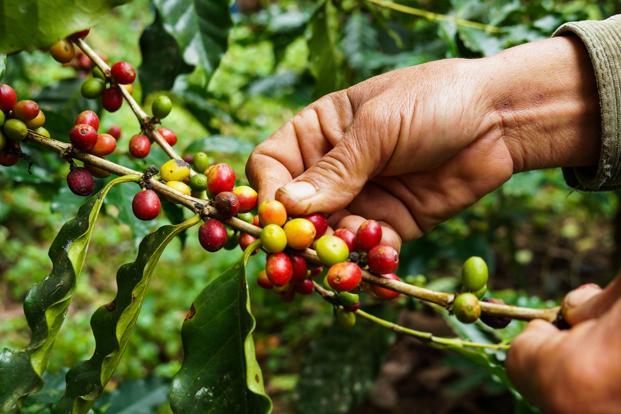
Coffee-picking at an estate in Coorg. Photo: iStock
René Redzepi, the foraging genius who stormed the culinary world with his New Nordic cuisine, would have a lot to smile about in Coorg. Here foraged ingredients don’t just put in an occasional appearance but are the main attraction, making Coorg an interesting region for true-blue wild-food pioneers. The eastern declivities of the Western Ghats that make up Coorg are extensively clothed in forests. Shade-grown coffee plantations offer the ideal habitat for rare flora and fauna to thrive as do sacred groves or devakads, designated as protected forests under the Indian Forest Act.
Against this backdrop is a staggering bounty of indigenous greens, weeds, flowers, fruits, berries, nuts, mushrooms and shoots, many of which play a starring role in the local cuisine.
Gazetteer Of Coorg, first published in 1870, devotes reams to Coorg’s jungle bounty: wild pepper, wild ginger, wild cloves, bitter local oranges known as kaipuli, rose apples, jungle mangoes, bastard sago—esteemed for its toddy—hog plums, several kinds of bamboo shoots, and an alphabetical list of over 60 ferns.
Locals keep their eyes open to what’s growing around them, constantly sizing up culinary possibilities. Freshly plucked cape gooseberries go into jams, a tangle of greens are added to stir-fries, and fronds of tender bracken ferns get pickled and ground into chutneys.
Kaveri Ponnapa, author of The Vanishing Kodavas, says in one of her earlier articles on Coorg: “Most women of my mother-in- law’s generation who lived on coffee plantations never set out on a stroll without the equivalent of the Russian avoska, the ‘maybe’ or ‘perhaps’ mesh bag—you never knew what surprise the season would throw your way.”
Several ingredients are unique to these parts. Like kachampuli, the dark vinegar made from the concentrated juice of the garcinia gummi-gutta fruit (called panapuli locally), which adds a sour kick to pork and fish dishes. And the famous Coorg honey, made from wild roses and forest blooms, which locals drizzle on akki ottis or rice rotis, and eat with ghee for breakfast.
Naveen Alvares, executive chef at Evolve Back Chikkana Halli estate, attributes this love of indigenous ingredients to Coorg’s unique geography and culture. “Kodavas, who make up most of the population, are ancestor worshippers and eat what is available off the land. Most have a plantation background or a sacred forest, so the connect with the land is very strong,” he says.
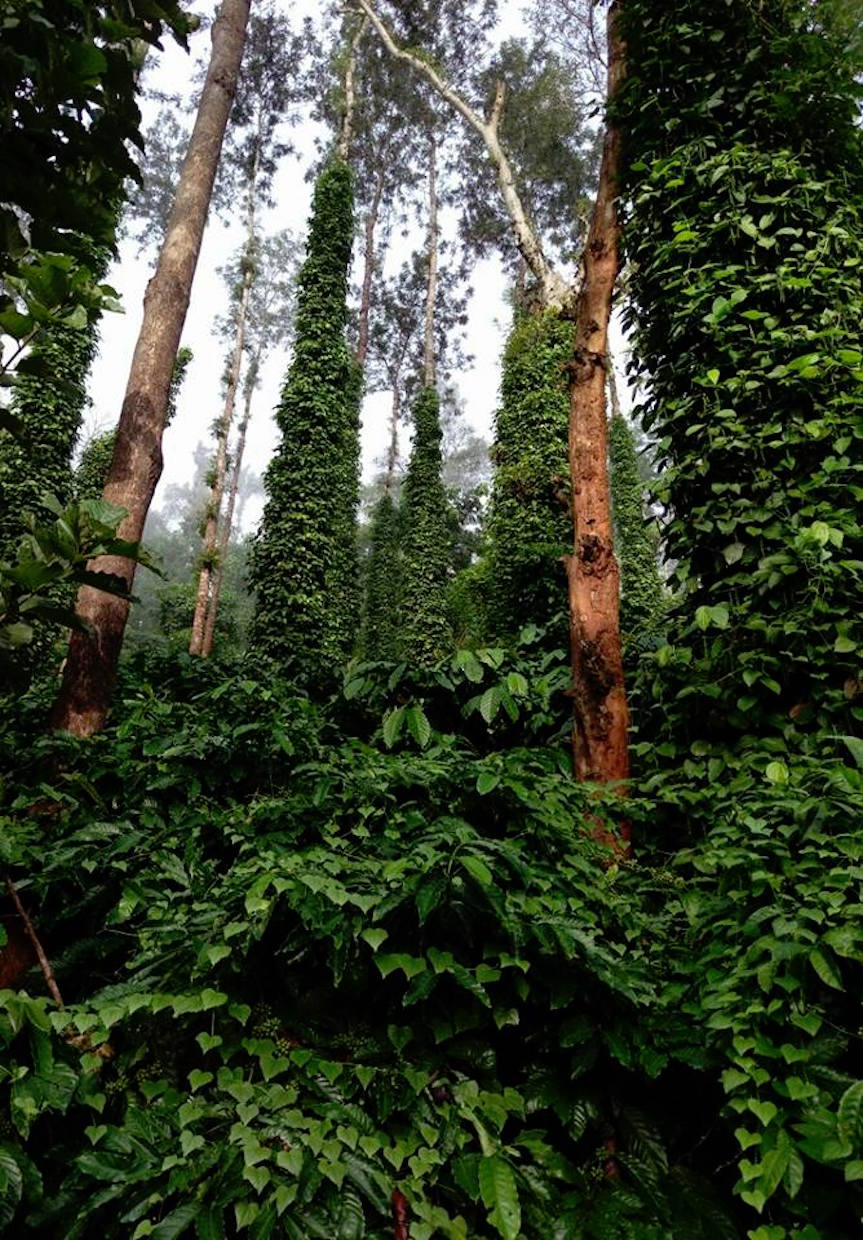
Walking through the resort’s lush plantations, among the oldest in Coorg, I see the coffee-forest symbiosis in full bloom. Coffee bushes sit beneath a canopy of silver oak trees that support festoons of black pepper. Ginger and turmeric, planted for intercropping, dot the forest floor. Jackfruits hang from trees. You can hear red-whiskered bulbuls chirruping.
Several exotic edibles are to be seen, many of them unconventional in the Indian context. As I stop to admire the bizarre artistry of a passionflower, Alvares smiles, “This is what makes Coorg special. It’s wildness.”
Dinner is a knockout pandi curry. The dark colour and complexity of this most iconic of Coorg pork dishes derives from dark roasted spices and kachampuli, a souring agent Alvares clearly loves.
I drive down from Siddapur to Madikeri the next day. The hour-long journey is jawdroppingly scenic. Acre after acre of coffee plantation presents itself, occasionally punctuated by the whoosh of a waterfall or the brilliant blue of a kingfisher.
A treasure trove of mushroom diversity, the Western Ghats are home to 750 species. Edible fungi known as kummu grow wild on Coorg’s hills and are highly prized for their exotic flavour. Vancouver-based blogger Shalini Nanda Nagappa mentions several varieties in her blog, A Cookery Year In Coorg—“feathery, delicate nucchi kummu and kokkalé kummu, succulent aal kummu, the giant nethalé kummu,..and the decidedly meaty pandi kummu.”
Only locals who carry with them an intimate knowledge of when, where and how to harvest the edible varieties can procure them, Nagappa points out. As a result, these treasures rarely make it to local markets and remain confined to the kitchens of plantation owners and local villagers.
‘Pandi curry’ at the Evovle Back resort.
The pleasures of kummu elude me during this visit, but I do feast on other Kodagu treats at Coorg Cuisine, a popular local restaurant in Madikeri. My lunch companion is M.B. Kumar, a Madikeri-based Kodava agriculturist and plantation owner. The wild mango curry, made with small jungle mangoes or kaad maange and black jaggery, is by turns sweet, sour and peppery. It’s unlike anything I’ve ever tasted. Chewing on a mango kernel, it is love at first bite.
The smoked pork, known as chillkana pandi, packs a meaty savouriness, while the freshness of the forest pervades a bowl of lightly fermented and sauteed baimbale or bamboo shoots. There’s pandi curry, of course, intensely flavoured and addictive as always. And akki ottis and kadumbuttus (rice balls) to mop it all up with.
To put pork’s near sacred place in Coorg’s cuisine in context, Kumar narrates a colourful legend. When Parvati expressed a desire to see Arjuna’s back (the great warrior never showed his back—a sign of weakness—during war), Shiva disguised himself as a hunter and shot a wild boar that Arjuna’s arrow had pierced. An altercation followed. As Arjuna fell over his opponent, his back was revealed, granting Parvati’s wish. A shower of flowers fell from the heavens and the pork was distributed as prasad to the hunting party.
The yarn illustrates the extent to which Coorg’s geographical seclusion has shaped its unique cuisine. “While we Coorgs (Kodavas) treat pork as prasad and offer it to our ancestors during rituals, it would be considered blasphemous to go anywhere near pork in neighbouring Mysuru,” Kumar laughs.
As we eat, Kumar draws my attention to the age-old tradition of foraging for monsoon greens, known as thoppus in Coorg’s interiors. The repertoire of seasonal weeds is dazzling. Thatte thoppu has a slightly bitter taste but tastes delicious with akki ottis and a little ghee; kakke thoppu with its purplish-black fruit is effective in deworming; therme thoppu or bracken ferns taste good simply sautéed with onions and pair divinely with eggs.
During mid-monsoon, on the 18th day of a period known as kakkada, Kodavas pick the leaves of a wild plant called madd thoppu and extract its juice to make a payasam.
The bustling Friday market in Madikeri is chock-full of these supergreens and more. Kembe (colocasia leaves) and kaipuli are up for grabs as are spices and meat. Walking around, it becomes abundantly clear that Kodavas are not just master harvesters, they’re also skilled at altering foodstuffs for preservation by yeast and bacteria. A huge assortment of jams and pickles made from the spoils of the land lines the local stores. Everything is home-made and unbranded.
On my last morning in Coorg, I drop in at Coorg’s Progressive Beekeepers Co-op Society store and pick up a bottle of wild honey to take back home. As I make my way to Bengaluru to catch my flight, the resinous, sour-sweet taste of kaad maange lingers on my tongue.
Wild foods, which grow in their natural habitat without fertilizers or pesticides, don’t deplete the earth’s resources. And they taste incredible. What if we, like Kodavas, thought of the forest as our pantry? Let’s tap into our vast underutilized permacultures and support the foragers who gather these ingredients. Let’s showcase our native treasures at the finest restaurants through dishes that startle with their newness and intensity.
Let’s go wild.
source: http://www.livemint.com / Live Mint / Home> Leisure / by Sona Bahadur / October 21st, 2018
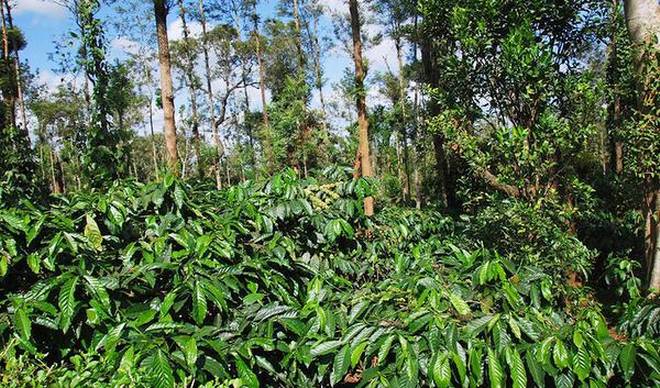
A coffee plantation in Kodagu, in the shade of silver oak trees. | Photo Credit: MAIL
Using silver oaks is detrimental for robusta
The exotic silver oak may be coffee growers’ preferred shade tree now, but research shows that it affects carbon sequestration and tree diversity in Kodagu’s agroforest systems.
Kodagu’s coffee farms were created when farmers cleared forest undergrowth and started growing coffee under the shade of giant evergreen trees. This ‘native shade’ coffee is still prevalent in the district, but evergreen trees are quickly losing out to the fast-growing silver oak. Farmers do not need permission from forest officials to lop or cut silver oak; this also contributes to its popularity. However, old forest trees make up a huge portion of carbon stocks here, and carbon stocks matter because the higher the carbon contained in vegetation, the more it helps with mitigating climate change.
Carbon stocks
To find out if carbon stocks change when silver oak takes over, a team including scientist Manjunatha Munishamappa from Bengaluru’s Environmental Management and Policy Research Institute studied a total of 49 native and exotic agroforestry systems – where either robusta (which needs more sunlight) or arabica coffee varieties are grown – near 18 forest patches that fall under both moderate and high rainfall zones. In each plot (all spread across 22 locations along the Cauvery river in Kodagu), the researchers quantified shade tree species diversity and the amount of organic carbon sequestered in the trees by measuring wood, root, litter and soil biomass. Across all plots, the researchers identified a total of 86 native tree species; and the total carbon stocks rose with increasing tree diversity.
Native trees in coffee estates and forests displayed high and comparable carbon stocks (approximately 193 and 222 megagrams (Mg) of carbon (C) per hectare respectively) as well as tree diversity (around 45 tree species). However, the introduction of silver oak negatively impacted both carbon stock and diversity. Predictably, robusta coffee estates with silver oaks had significantly lower tree diversity (nine species) and lower carbon stocks (up to an average of 65 MgC per hectare) than all other land-use systems in both precipitation zones.
Current trends
Hence, the current trend of replacing native shade trees in coffee estates with silver oaks is detrimental for carbon storage and tree diversity, especially in robusta farms. Current policies do play a role in this change, because the exotics can be cut for timber without prior permission.
“We have submitted two reports to the Karnataka government on these findings, we hope some policy changes will be incorporated,” he said.
source: http://www.thehindu.com / The Hindu / Home> Science / by Aathira Perinchery/ October 20th, 2018
While estates in Somwarpet taluk have suffered an overall 30% crop loss, Madikeri taluk has witnessed over 33% crop loss.
File photo of a damaged coffee estate in Kodagu. (Photo | EPS)
Madikeri :
The Coffee Board has completed its survey in estates in Somwarpet and Madikeri taluks to assess the damage in the recent floods.
While estates in Somwarpet taluk have suffered an overall 30% crop loss, Madikeri taluk has witnessed over 33% crop loss. The officials confirmed that serious damages to coffee plantation have been recorded at Shantalli, Suntikoppa and Madapura areas, while Kodlipet and Shanivarsanthe have recorded minimum crop damage in Somwarpet taluk.
“We have received over 10,000 applications (all from Somwarpet taluk growers) requesting compensation. A few growers have submitted five to six applications, which include compensation requests for crop loss of orange, pepper, cardamom along with coffee,” said Coffee Board Senior liaison officer H R Muralidhar.
www.newindianexpress.com / The New Indian Express / Home> States / by Express News Service / October 09th, 2018
Mullayanagiri [mool-ya-na-gi-ree] is a mouthful not only for those people who don’t speak either of the four languages of the five Southern Indian states, but even for most Indians who are unfamiliar with the region.
At an elevation of 1,930 meters, Mullayanagiri is the highest mountain peak in the Southwestern Indian state of Karnataka, in the Chikmagalur district. The peak forms a part of the Baba Budan range of mountains, which are part of the greater Western Ghats. The names of Chikmagalur and Baba Budan will resonate with most of the Indian populace for its association with coffee and salubrious weather.
Chikamagalur, the lesser-known, quaint hill town, became the first recorded place in India to cultivate coffee when it was introduced to hillsides from Yemen around the mid to late 1600s. As the story goes, seven beans of coffee were smuggled out of Yemen’s town of Mocha by an Indian hermit named Baba Budan.
Baba Budan then planted these in the hills of Chikmagalur. No one is sure of how much and how well these foreign beans grew in the time following, but coffee cultivation was seriously undertaken in the 18th Century by British entrepreneurs who turned forests in Southern India into commercial coffee plantations.
In fact, coffee was cultivated long before tea, mainly in Northern India. This is a relatively unknown fact, as India is perceived to be a tea-drinking nation and does have excellent tea gardens in Darjeeling, Bengal and Assam.
“Coffee was an established commercial crop by the turn of the 19th Century and was exported to Europe via London,” said Anil Bhandari, president of the India Coffee Trust, a nonprofit organization that promotes coffee consumption. “By the early 1940s, Indian Arabica coffee — or Mysore coffee, as it was known then — had established itself in the European market and had a branding all of its own. However… WWII and the loss of the European market during that phase caused the unique branding of Mysore coffee to disappear from buyers’ consciousness.”
Coffee grown in the forests of India, the world’s sixth largest producer of coffee, is cultivated under thick canopies in the Western Ghats — a UNESCO World Heritage site and one of the world’s most important biodiversity hotspots.
In the 2016-17 season, India produced 5.5 million bags of coffee. A majority of the country’s coffee is grown in the three southern states of Karnataka, Tamil Nadu, and Kerala, followed by Andhra Pradesh and Telangana, which was a part of Andhra Pradesh until recently.
Nearly 65 percent of the total production comes from Karnataka, while Tamil Nadu contributes approximately 15 percent, and Kerala makes up around 20 percent. It has been estimated that there are more than 210,000 coffee producers in India, the majority of whom are smallhoder farmers with plots around two hectares.
As in most producing countries, India processes coffee by the washed (or wet) method as well as the natural (or dry) method.
India is renowned for its unique shade-grown coffee. The two commercially important species of coffee, Arabica and Robusta, are grown under heavy shade that is believed to contribute to the flavor profile of the coffee to the coffee, along with other influences such as the monsoons, spices that grow around coffee, and the various fauna that thrive alongside it.
Within this bio-diverse growing environment, the mixture of vegetation prevents soil erosion and fallen leaves decompose to become rich humus, thereby retaining the forest ecosystem. The Indian Rainforest-grown Arabica is unique in its properties and sought after for its flavor and characteristics, as these are grown at higher altitudes.
Increasingly, the industry is shifting towards sustainable farming practices, and more estates have become certified by Rainforest Alliance-UTZ and Fairtrade. Organic coffee is also of increasing interest, especially for coffee grown on tribal land, which represents about 42 percent of the coffee area in India. In these areas, coffee is managed in traditional ways, often organically.
Most of India’s coffee exports go to Europe, Japan and the Middle East, while many global consumers remain unaware of the complexities and quality that fine Indian coffee from Southern estates can offer. The name “Coffee of India” is only used as an indication of origin at the export level, when packages are shipped from India to the country of destination.
“Indian coffee, particularly the Robusta parchment and cherry, continue to see good demand from Italian buyers,” said Ramesh Rajah, the president of the Coffee Exporters Association of India. “Of concern is the falling Arabica production due to extremely low prices prevailing in the international market, as well as the recent flood damage, which is still being assessed.”
Rigid control of quality and grade designations by India Coffee Board, an agency of the Government of India, ensures the export of only the finest and the most aromatic of India’s hand-picked coffee beans.
Encouragement for the local coffee industry comes not only from the Coffee Board of India, but from nonprofit bodies such as the India Coffee Trust that are working towards fortifying and intensifying these efforts.
“The India Coffee Trust is the result of a general consensus among the stakeholders of the Indian coffee industry to create a nonprofit organization that discusses and promotes Indian coffee,” Bhandari said. “Assisting the Trust with the objective of creating a wider global outreach and visibility of India’s fine Shade Grown coffees is the Indian Coffee Collective. Together, our primary mandate is to promote India’s shade-grown coffees and it’s long standing history with the humble brown bean.”
With a goal of raising awareness around preserving and promoting the values of coffee culture in India, the India International Coffee Festival — jointly organized by the India Coffee Trust and Coffee Board of India — took place in Bengaluru in January 2018. The four-day attracted more than 5,000 local, national, and international visitors.
The next festival is scheduled for 2020. Time will tell where Indian coffee will be by then.
source: http://www.dailycoffeenews.com / Daily Coffee News (by Roast Magazine) / by Anamika Ghosh / October 02nd, 2018
Coffee cupping, exhibition of coffee berries to be held.
The Coffee Board of India, in association with Way Win, a farmer-producer company in the coffee sector in Wayanad, and Vikaspaedia, an initiative of the Union Ministry of Electronics and Information Technology, is organising various programmes to mark International Coffee Day on October 1.
Ports Minister Kadannappally Ramachandran will inaugurate the programme at the Town Hall here at 10 a.m. on the day.
Coffee Board Deputy director (Research) Vijayalakshmi will deliver the keynote address on the occasion.
Coffee cupping, a practice of observing the tastes and aromas of different brewed coffee varieties, would be the major attraction of the programme, organisers said in a release here on Thursday.
Exhibition of various types of coffee berries will also be held.
source: http://www.thehindu.com / The Hindu / Home> National> Kerala / by Staff Reporter / Kalpetta – September 28th, 2018
Before the rains started, coffee planters in Coorg were talking of a good crop —the plants were well rested after a lean year and went through the process of blossoming and forming fruits. That settled, seasonal certainty is gone with the wind and merciless lashings of torrential rain.
HELPLESS / A planter contemplates nature’s carnage where once existed a fecund patch / PHOTOGRAPH BY AJAY SUKUMARAN
A fully-done crossword puzzle is on the table next to Chitra Subbaiah who confesses that she could forego reading the newspaper, but not the crossword. We are in the cottage of a home-stay in Madapura, north Coorg, resplendent in the evening sun—the first day in two months that the rain has let up. It brings some relief from fear. Chitra, nearing eighty, recounts a painful experience with great fortitude. “You have to do some mental jugglery, you know. You can’t curse your fate.” She’s staying in a friend’s cottage because her home, in the neighbouring village of Hattihole, now lies beneath a pile of earth which slid down the hillside, burying everything she owned.
“Wiped out, totally. I don’t have one pin. There is nothing to say there was a house,” she tells Outlook. All she could reach out for in time were her spectacles, medicines and some gold the workers from her coffee estate had entrusted her with safekeeping. The workers’ quarters on her coffee estate too went down. Fortunately, they had time to move out. She points to others in the same situation. “At least I can rent a house and stay. What about so many others, who have nothing,” she asks.
Before the rains started this year, coffee planters in Coorg were talking of a good crop—the plants were well rested after a lean year and went through the process of blossoming and forming fruits.
The scene at a typical Coorg coffee estate / PHOTOGRAPH BY GETTY IMAGES
That settled, seasonal certainty is gone with the wind and merciless lashings of torrential rain. It rained heavily through July and August in this region of south Karnataka bordering Kerala. Then, in late August, came a series of punishing cascades of sodden earth. Now, there’s a trail of ruin in these charming hills, where landslides have swept off whole villages, re-arranged estates and shattered its economy. With immediate rescue measures tapering off, one question hangs limply in the air: where do you start picking up the pieces?
“I can’t plant anything now on my land, that’s for sure,” says K.U. Erappa, standing in his camouflage gumboots in a relief camp inside Madikeri’s old fort where, grouped with several families, he has been staying for days now. “All that’s left of my coffee plants are just stalks,” Erappa says. His ageing mother walks up to say, “We had a small house, but it was pretty.” Their grief is palpable. Erappa owned a few acres of coffee and paddy in Mukkodlu, one of the hardest-hit places in north Coorg, in the vicinity of district capital Madikeri. Much of Coorg is remote, away from the main-travelled roads. Like others, Erappa has been going back to salvage what he could. His three children, like most kids from his village, have been sent away to a temporary residential facility in a school in Ponnampet town at the southern end of the district. “We never dreamt Coorg would come to this,” says N. Bose Mandanna, a planter from Suntikoppa.
Right now, a full picture of the damage isn’t available, though it is being estimated. Planters like Mandanna reckon that at least 5,000-7,000 acres have been wiped off in the landslides. For the plants still standing, there’s the danger of wet feet and black rot—water-logging at the base of the plant that strangulates it, causing leaves to fall off. “When leaves are lost, next year’s crop is also lost,” says Mandanna. Coorg, with about one lakh hectares in cultivation, accounts for close to 40 per cent of India’s coffee production. The 2017-18 post-blossom estimate was 1,33,500 metric tonnes, most of which is exported, Italy being a top destination. To make matters worse, prices, say market watchers, have been at historic lows. Brazil is harvesting a good crop this year and so will Columbia and Vietnam.
The desolation on the spot after the landslide / PHOTOGRAPH BY AJAY SUKUMARAN
“International prices have gone (down) to levels last seen in 2006. We are getting a lot less now, if you factor in the inflation,” says Ramesh Rajah, president of the Coffee Exporters Association. Prices depend on the big three producers—Brazil, Columbia and Vietnam—which account for over 70 per cent of the global production. “Only if there are supply shocks in the big three will there be impact in international prices. India can lose one third or even half its production and the international market is not going to blink,” says Rajah.
In the mid-nineties, Coorg coffee saw a boom when prices rose because of a supply shortage in Brazil whose production, apart from being vulnerable to frost, was considered inefficient then. The boom years lasted a decade until trends began to reverse. Owing to hilly terrain, Coorg can’t mechanise the way Brazil did. So, it has been grappling with high labour costs. Nor can other crops be sown, as coffee plants need trees for shade. Many Kodavas, as Coorg’s natives are called, concede the difficulty in maintaining plantations. The symptoms, many say, have been showing—an ageing population, a younger generation that has been migrating to cities and bits of land being sold to meet expenses, the latter contributing to a social churn in the highlands. This devastating blow came on top of all this.
The future, many say, is bleak. First, the question of land lost, by no means an easy task, given the complexities that involve verifying claims, boundaries and so on. “Let the government acquire the property. See the record, settle them,” says planter Mittu Chengappa, who’s also a Karnataka Congress general secretary. His suggestion, that the government acquire private land ravaged by landslides for afforestation so that owners can begin afresh elsewhere, has been voiced by many. Unlike neighbouring Chikmagalur—where coffee was first grown in India—there are more small growers in Coorg, many owning only a few acres.
Chitra Subbaiah’s house in her estate in Hattihole village
Even for those who didn’t lose land, replanting will be a big financial burden, says Rajah. Besides the upfront cost, it would mean a five-year wait for yields. “So, how will they sustain themselves for five years? What does he do about infrastructure within the farm, workers’ houses, his house?” asks Rajah. Coffee planters have always weathered difficult years, but the destruction this year is unprecedented. “Some years, the crop yield is sharply lower because of lack of rain or excess rain. But this is the first time we have actually seen this sort of damage where infrastructure is damaged. It’s going to be very difficult in the short term,” reckons Rajah. In the long term, he says, every producing country is bleeding, so things can be pulled back to a degree by increasing efficiency. Of course, primary rehabilitation remains a priority; the process of replanting will take place slowly.
“The other thing is the labourers are not coming back. We are still in a state of flux, a dilemma as to what’s going to happen. There are a lot of issues, it’s very fluid,” says Nanda Belliappa, a coffee grower from Hattihole who has to now walk half a kilometre inside his property to reach his house, as the road leading to it is blocked. The Hatti, a stream outside his gate—where once a Malayalam film was shot—has beached fallen tree trunks ashore. “The neighbours’ coffee plants and trees are on our road…it’s unbelievable,” says his wife Anitha. In villages in these parts, the conversations go from rain to earthquake—many planters say they heard loud booms and felt tremors, but officials say no seismic event was captured.
Bose Mandanna too says he won’t be so pessimistic as to say that the coffee industry won’t claw back. But he’s doubtful about the prospects of a full recovery in North Coorg. “This area cannot come back in a hurry,” he says. Last weekend, as the evening drew on, Madikeri wore a deserted look—tourism has stalled and hotels are ordered not to take in travellers for some time. “Every night, there’s fear that the hill will come down on your head,” says Mandanna. The Kodava harvest festival Kailpodh, when they worship their guns, went by this week. Says Mandanna, “Nobody was interested in the festival. Coorg has become like a funeral parlour.”
source: http://www.outlook.com / Outlook / Home> The Magazine> Business / by Ajay Sukumaran / September 17th, 2018
Old-timers and environmentalists blame tourism for the devastating floods in Kodagu
Shattered hopes: As many as 1,206 houses and 278 government buildings were damaged in the Kodagu floods | Bhanu Prakash Chandra
IF THE RAINS had not wreaked havoc in Kodagu, Karnataka’s coffee country would be preparing for ‘Kail Murta’, a festival in which the Kodavas worship their weapons. But, the district, which got battered by flash floods and landslides that took 12 lives and rendered more than 1,500 families homeless, is now left with just one weapon: resilience.
On the midnight of August 15, torrential rains started pounding Kodagu. The hills cracked up and tumbled down, and the rivers swallowed everything on their way—century-old houses, brand-new homestays, tiny tea shops, lush green paddy fields, vast stretches of coffee plantations, forests, livestock, bridges and vehicles. Incessant rains submerged low-lying areas in Kushalnagar, Somwarpet and Madikeri, pilgrimage centres like Talacauvery and Bhagamandala, and major bridges like Bethri, while landslides along the national highways turned those into death traps.
By the time the district administration launched rescue operations, the communication lines were cut off and most villages had become inaccessible. Heavy rains, tough terrain and scattered habitations made rescue operations a daunting task even for the armed forces and the National Disaster Response Force. Many people were hungry and exhausted when the rescue teams finally reached them.
Manu Madappa from Mukkodlu village said around 40 people took refuge in his homestay for three days. But with no help arriving, they decided to trek to Madikeri. “We covered a distance of 20km, walking in the rain on a muddied path, and made it to a relief camp in Madikeri,” he said.
As many as 51 relief centres have been opened across the district, sheltering 7,594 people as on August 22. NGOs have ensured an uninterrupted flow of relief material to these camps. The Kodava Samaj in Bengaluru and Mysuru are the nerve centres for organising relief material.
Local MP Pratap Simha, who was part of the rescue operations, said the devastation was unimaginable. “Incessant rains prevented airlifting of stranded people although three Army choppers were on standby. After I sent an SOS to Defence Minister Nirmala Sitharaman, the Army unit from Karwar was rushed in,” he said. “The relief centres are working well, and our next big challenge is rehabilitation. We will need huge cash donations to rebuild homes.” According to the Karnataka State Natural Disaster Monitoring Centre, 1,206 houses and 123 kilometres of roads have been damaged, 58 bridges and culverts have collapsed, 278 government buildings and 3,800 electric poles and transformers have been severely damaged.
Chief Minister H.D. Kumaraswamy, who conducted an aerial survey, said the infrastructure damage alone amounted to Rs 3,000 crore. “A team of engineers from the Border Roads Organisation and the Army engineering task force have been called in to clear roads and restore them,” said Kumaraswamy. “A team from the National Geophysical Research Institute, Hyderabad, is conducting geotechnical studies to ascertain the causes of landslides. We have deputed two IAS probationers to fasten the process of identifying the lands for rebuilding 2,000 temporary homes.” he said.
The government has promised Rs 3,800 per family, along with essential groceries as immediate relief. The chief minister has promised the affected people work under the National Rural Employment Guarantee Act and offered to issue provisional documents for those who have lost their Aadhaar and ration cards and title deeds. “Rs 5 lakh will be given to the family of the deceased. Special classes and books for children are also being planned,” said Kumaraswamy.
The rainfall was unprecedented, but old-timers and environmentalists said the alarming plight of Kodagu was the fallout of the booming tourism industry. G.S. Srinivas Reddy, director of the Karnataka State Natural Disaster Monitoring Centre, said Kodagu received 103 per cent more rainfall than normal this year.
U.M. Poovaiah, editor of Brahmagiri, a Kodava weekly, said he had never seen or heard of such devastation in the history of Kodagu. “This is the fallout of unregulated tourism that has razed down the hills to make roads to homestays. The riverbed has been encroached upon. Unplanned construction has pushed the district to the edge. The authorities are to blame for the influx of tourists and atrocities against nature in this once-pristine district. We want unlicensed homestays and construction activity to be stopped,” said Poovaiah.
The Coorg Wildlife Society, too, blamed the severe stress on Kodagu because of the change in land use and unbridled tourism. In a letter sent last May to Prime Minister Narendra Modi, the CWS wrote, “Kodagu provides almost 50 per cent of the total inflow into Cauvery, which is the lifeline of South India, and provides water to over 80 million people and 600 major industries across the region. The food, water and economic security of southern India hinges largely on Cauvery River. It is therefore in national interest to preserve the Kodagu landscape and protect its ecosystems.”
Colonel (retd) C.P. Muthanna, president of CWS and co-ordinator of the Save Kodagu and Cauvery campaign, said more than 2,800 acres of paddy fields, coffee plantations and highlands were converted to residential layouts, sites, commercial complexes and resorts between 2005 and 2015. “Kodagu’s fast-paced urbanisation will turn it into a slum,” said Muthanna. Earlier this year, he had urged the Karnataka government to regulate tourism in the region and demanded an audit of water and waste and sewage management in the resorts. “While Kodagu has a population of 5.5 lakh, the number of tourists goes up to 13 lakh,” he said.
A report by the Centre for Ecological Sciences, Indian Institute of Science, Bengaluru, said massive deforestation and monoculture plantations caused the landslides. “Trees hold the top soil and also absorb and regulate the flow of rainwater. But deforestation for construction of roads and power lines have resulted in soil erosion,” said T.V. Ramachandra of the centre. “If the government wants to avert disasters, it should not take up any mega projects.”
source: http://www.theweek.in / The Week / Home> The Week> Cover Story / by Prathima Nandakumar / September 02nd, 2018
Seeds of chilli, brinjal, tomato, gourds, and radish will be given to farmers. | Photo Credit: Photo courtesy: Annadana
NGO to donate indigenous vegetable seeds to farmers to ‘bring back diversity lost in the floods’
After the deluge, it is time to pick up the pieces. For many who are dependent on agriculture for their livelihood, it is going to be a start from scratch. A not-for-profit headquartered in Bengaluru is now offering to help farmers with the first steps.
Annadana Soil and Seed Savers Network, which, among other things, conserves heritage seeds, plans to donate indigenous vegetable seeds to “bring back the diversity that has been lost in the devastating floods in Kerala and Kodagu”.
These species, said founding trustee and chairperson Sangita Sharma, were taken from the same places that they will be going back to and include ginger, turmeric, chilli, brinjal, tomato, gourds, and radish.
“Annadana has been conserving heritage seeds for 17 years. Each year, around 20,000 to 30,000 seeds are given to farmers. We participate in seed exchange and sharing sessions and we have varieties collected during our visits to Kerala. We plan to give these indigenous seeds to Kerala and connect them back with them. After these floods, there is a need to revive the diversity that has been lost,” she said.
With the full impact of the devastation yet to be known, making it difficult to know the number of farmers affected and the number of seeds required, the NGO intends to distribute the free seeds to farmers in Kerala and Kodagu through networks of farmers. It also plans to offer technical expertise as well in helping farmers regenerate their soil through its ‘empowered farmers’ who double as master trainers.
“There is total devastation right now. Crops such as rubber, coconut, teak, and timber do not have the water-holding capacity like the forest species have. Forests must remain forests. The entire ecosystem has been shaken up in the recent past. The farmers in these regions now have a lot of work. They need to find out what was coexisting there and reintroduce that. Forests will have to be revived. We want to offer our expertise and revive food species. If the soil is healthy, indigenous varieties will quickly adapt themselves,” added Ms. Sharma.
source: http://www.thehindu.com / The Hindu / Home> News> States> Karnataka / by K.C. Deepika / Bengaluru – August 25th, 2018
WELCOME. If you like what you see "SUBSCRIBE via EMAIL" to receive FREE regular UPDATES.
Read More »