Category Archives: Agriculture

How SOS organics has successfully created a sustainable village model in Uttarakhand

All SOS organics products are made from crops that are completely rain fed, chemical free and using natural farming and sustainable agricultural techniques.

A quick look at SOS Organics website and you will realize that there is something more than natural and organic in their varied products. Gur Shakkar, Khandsari sugar as alternatives to white sugar and sweeteners, soapnuts as natural cleansers, environmentally sound beeswax candles devoid of soot/smoke, home care products made of native plant oils, herbs and natural essential oils – these catch your immediate attention. All these products are made from crops that are completely rain fed, chemical free and using natural farming and sustainable agricultural techniques.

The Alternative spoke to its founder, Amrita Chengappa about her venture in Uttarakhand.

A little bit of everything to nourish and heal
Pulses, flour, millet, spices, herbs, pickles, jams, marmalades and honey, tea, as well as beeswax candles – there is a little bit of everything needed to lead a healthy life. Amrita says, “Our line of natural cosmetics is based on apricot kernel oil, and includes soaps, hand creams, face creams, body and foot scrubs, lip balms, and body oil. All items are made with beeswax and precious essential oils and are free of chemicals and hormones.”
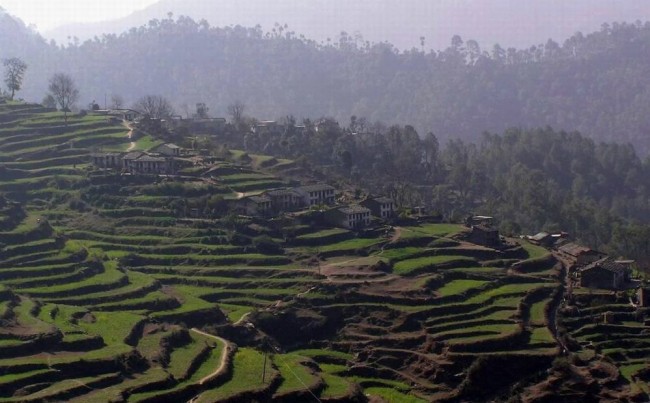
Himalayan terrace farms are the source of SOS organic products Courtesy: SOS organics Facebook page

In Uttarakhand, farmers have very small land holdings that are completely dependent on rain. So instead of asking the farmers to grow one particular type of crops, say only rice or millet, Amrita has encouraged mixed farming. “We are targeting indigenous low input crops that they have been growing over the last hundred years. We encourage them to grow a little bit of everything so that it all adds up to become a basket full of goodness to nourish and heal the body,” says Amrita.

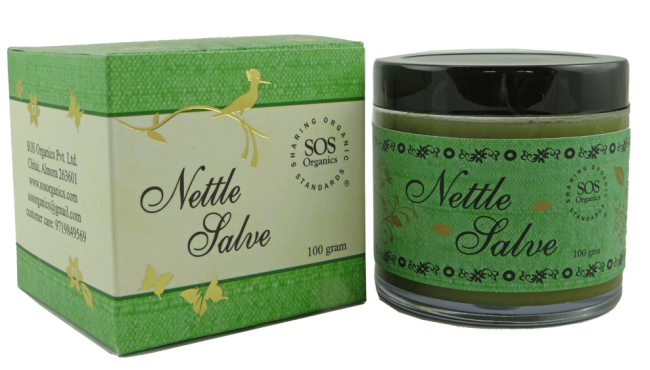
Their latest products are based on the humble nettle which has an abundance of health benefits. “One day we became aware of just how much nettle was growing all around us in the wild and nobody was using it. After some in-depth research that took us all the way back to Milarepa, who lived on nettle soup for years while meditating in a Himalayan cave, we began experimenting and created nettle tea and nettle flakes,” says Amrita.
SOSorganics02KF24jan2017

The Inspiration
Amrita and her husband who have set up a village unit in Uttarakhand have been closely working with locals there.

“We had the inspiration to move to the Himalayan foothills in 2002, with only an idea to work in a village and bring meaningful employment in the area,” says Amrita. She adds, “We have found that the specific environmental conditions of the Himalaya produces incredible crops. The mineral content in the soil adds to the quality of the crop and it has many medicinal properties as well.”

One of the main issues in the state has been a lack of employment opportunities. So they decided to set up a self-sufficient unit at Kumaon. “My main concern was employment of the local ladies as I believe that all over India it has always been women who run the show and they deserve to be empowered,” adds Amrita.
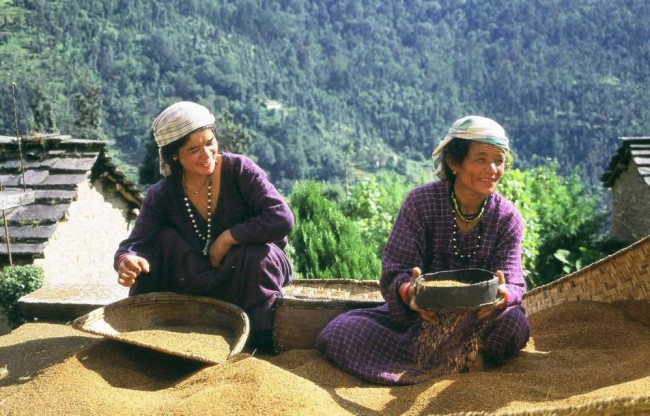
Happiness that comes with healthy living is the only true happiness! Courtesy: SOS Organics Facebook page
ita at this point also mentions,“We did not want to take something or destroy anything from the environment, rather our emphasis has always been on the preservation of biodiversity and environment, and the providing of holistic technologies to ensure highest quality.”

Every village needs to be self-sufficient

The company strongly believes in Mahatma Gandhi’s saying that every village needs to be self-sufficient. Their entire unit runs on rain water harvesting. And they work with local small scale farmers from over 70 villages in the Himalayan region.

Amrita further adds, “SOS Organics is an ongoing experiment dedicated as a model for holistic sustainable living in the villages of the Himalaya.”

In addition to the farming techniques, natural processing and product development have also been undertaken. The Foundation is presently deeply involved in special holistic milling techniques, sun drying and sun-UV-radiation, ventilation drying, dehydrator development for low temperature drying, vacuum packing and systematic moisture proof storing of raw material. An extensive initial product line of natural farming produce has been developed and tested in the market and is now available online and in select holistic outlets.
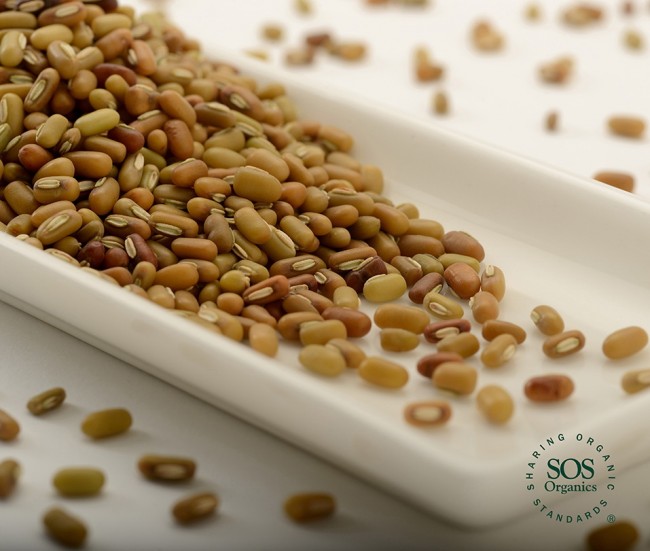
SOSorganics05KF24jan2017

Engaging community and being in tune with rural life
“The problem in the hills is that you cannot do anything that has a lot of volume because the lifestyle is different. We have six hour working days for the ladies as on most days they have to go home, collect water, cut wood etc. Plus in the winter it gets darker soon and the area where we live there are leopards and other wild animals,” she says.

So they had to modify their business model, making it in tune with the local life and with less stringent deadlines. They also make sure to celebrate local holidays and to stay connected with the community in all possible ways. “Our aim has always been to make the business model sustainable for everyone from the consumer to the person actually engaged in making these products. We make the people working here comfortable and the orders are worked around this,” says Amrita.

Challenges
Amrita says, “So much of the incredible knowledge of the Himalayan people is in danger of getting lost. The older living generations have often not been able to pass on their wisdom to the younger people as they have set out to live everywhere else than in their own village, embracing modern life and technology.”

She adds,“The scary thing is that we do not have a proper understanding of traditional knowledge system and what we are replacing it with does not seem to make the grade. People here feed millet to animals as they have been told the white rice is aspirational. We are striving to work against this kind of a mindset.”

Future Plans
“We very much live in the here and now, which is full of experiencing, learning, and understanding. New insights and inspirations happen on their own and we are always ready to say yes! – and embrace yet another venture,” concludes Amrita.

source: http://www.thealternative.in / The Alternative.in / Home> Magazine> Lifestyle / by Usha Hariprasad / Juine 18th, 2015
Revering nature & culture

Harvest festival

HarvestfestivalKF11jan2017

Puttari Polud (also called Huttari), the rice harvest festival of Kodagu, is perhaps the grandest and most elaborate festival in the Kodava calendar. The word putt-ari means new rice and the festival is celebrated on the full moon day during the Kodava month of birchyaar. One day before the Puttari feast, the Kaladcha festival is observed in the Padi Igguthappa Temple. Igguthappa is the god of the rice crop, harvest and rains.

Preparations for Kaladcha and Puttari are commenced around 15 days in advance. The Pardanda family of Padi village, who are the deva thakka (temple caretakers), the parupatyagara (temple officials) families and other prominent families of Padi, Nelji and Perur villages are summoned in writing. On a particular day, they bring rice, coconut, jaggery, banana and areca nut to the shrine. Astrologers from Ammangeri village determine the date of Puttari feast. They arrive at the temple and convey the exact time for Puttari ceremonies, as determined by the stars.

Traditional fervour
In the afternoon, astrologers, priests, caretaker families, musicians and other devotees go up Malma hill (Igguthappa Betta which is a few kilometres away from the temple), and announce the auspicious time at a shrine in the midst of a sacred grove. Then they will go to the Pardanda Ainmane in Padi and announce it again.

At Malma, the temple caretaker announces the deva kattu (religious restrictions) to be observed by the people of the neighbourhood for the next 14 days. Accordingly eating meat, consuming alcohol, physically or verbally hurting animals or humans, pulling out plants and cutting trees are forbidden in the period. Marriages and funeral ceremonies are not to be conducted during the period. No special puja, except Satyanarayana Puja, is performed in the temple during the period.

Afterwards the astrologers, caretakers and others go to the Makki Sarthavu Temple in Bethu village near Napoklu and announce the date and time again. The astrologers continue conveying the auspicious time to various families of the region. At each house, they are given thambutt powder, rice, jaggery, banana, salt and pepper, sufficient for a meal. Thambutt powder, prepared from boiled rice which is fried until it is golden brown, is used with mashed bananas and finally seasoned with sesame seeds and grated coconut to prepare the thambutt sweet dish. Kodava people gather in their ancestral house, called the ainmane, to celebrate the festival.

On Kaladcha day, the deva thakka goes to Malma again and announces that the deva kattu need not be followed thereafter. This is called kattu muripo, or removing the restrictions. During Kaladcha, the temple deities are embellished with ornaments, and chendas (a percussion instrument) are played. Yetherata is also performed on the occasion. Decorated oxen are made to dance with bags (often rice bags) on their backs.

Puttari Polud is first observed in the Padi Igguthappa Temple and the village of Padi. Hence, the first day is called the Padi polud (Padi celebration) or deva polud (divine celebration). The following day, the festival is celebrated in the rest of Kodagu and it is known as naad polud (public celebration).

While the rituals at the temple are presided over by the archak (priest), the deva thakka performs the rituals. On both days, the first evening near the temple and the second at ancestral houses, the nere kattuvo (tying of certain leaves) and the kad edpo (cutting of paddy sheaves) rituals are performed. At the temple, these two ceremonies are followed by prasada (devotional meal).

After dusk, a designated male family member ties together certain leaves around bits of the inoli creeper with pieces of achchi fibre into bundles. Each of these bundles, called a nere, is placed in a basket. Then an unmarried young lady from the family carries a small lit lamp upon a plate. She leads the family members to go down to the fields.

A designated man ties a nere from the basket to the base of a sheaf of paddy and pours milk from a kutti (bamboo container) onto it. He cuts that sheaf (kad) with a sickle while the other family members cry out ‘Poly, Poly Deva!’ (Let us prosper, let us prosper, O God!). A gun is then fired into the air. Five, seven, nine or 11 sheaves of paddy are cut and given to the assembled family members. They carry these sheaves to the prayer place in the house.

The nere bundles are then tied in various places around the house and the farm. Later, the thambutt sweet dish is consumed by the family. Firecrackers are burst in the night.

On the day after naad puttari, the mane paado (house-singing) ceremony happens. Four folk singers of the village carry small hourglass drums, each called a dudi, and go from residence to residence. While all four strike the drums with cane sticks in rhythm, two of them take turns to sing verses praising the members of the family. A few days later, the villagers gather at the village greens (mand). The village musicians blow their horns and beat their large drums. The men dance in circles beating small rattan cane sticks called kola as they skip around in rhythm with the music. This is called the kolata or the stick-dance.

Festival of arms
There are two other major Kodava festivals — Kail Polud and Kaveri Sankramana. Kail Polud is the festival of arms for the Kodava martial community, now observed on September third every year. Before this festival, naati (rice seedlings) grown in a small area is transplanted across ploughed and puddled fields.

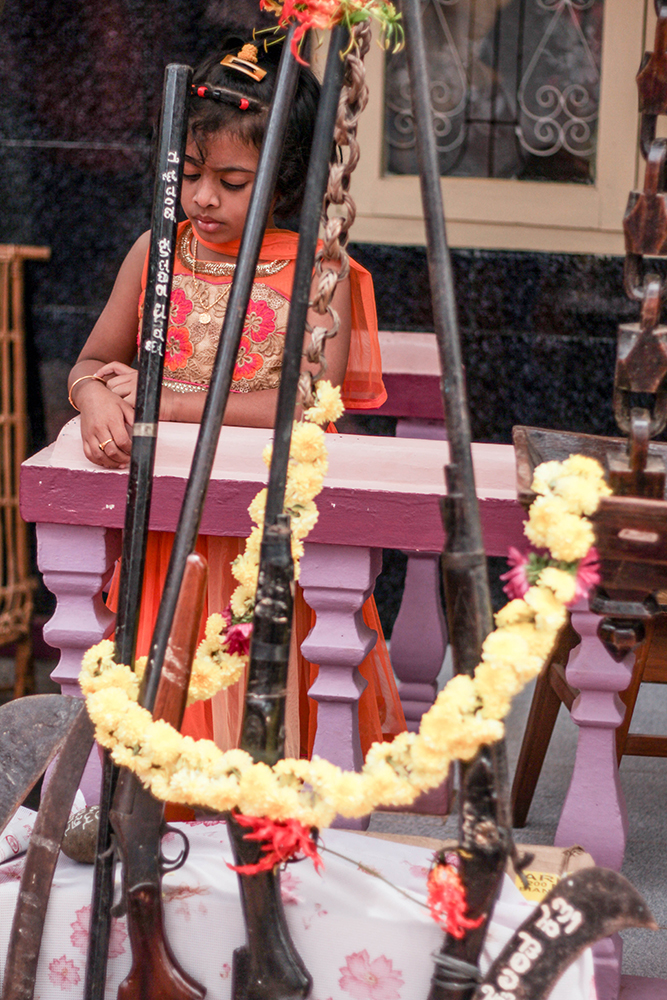
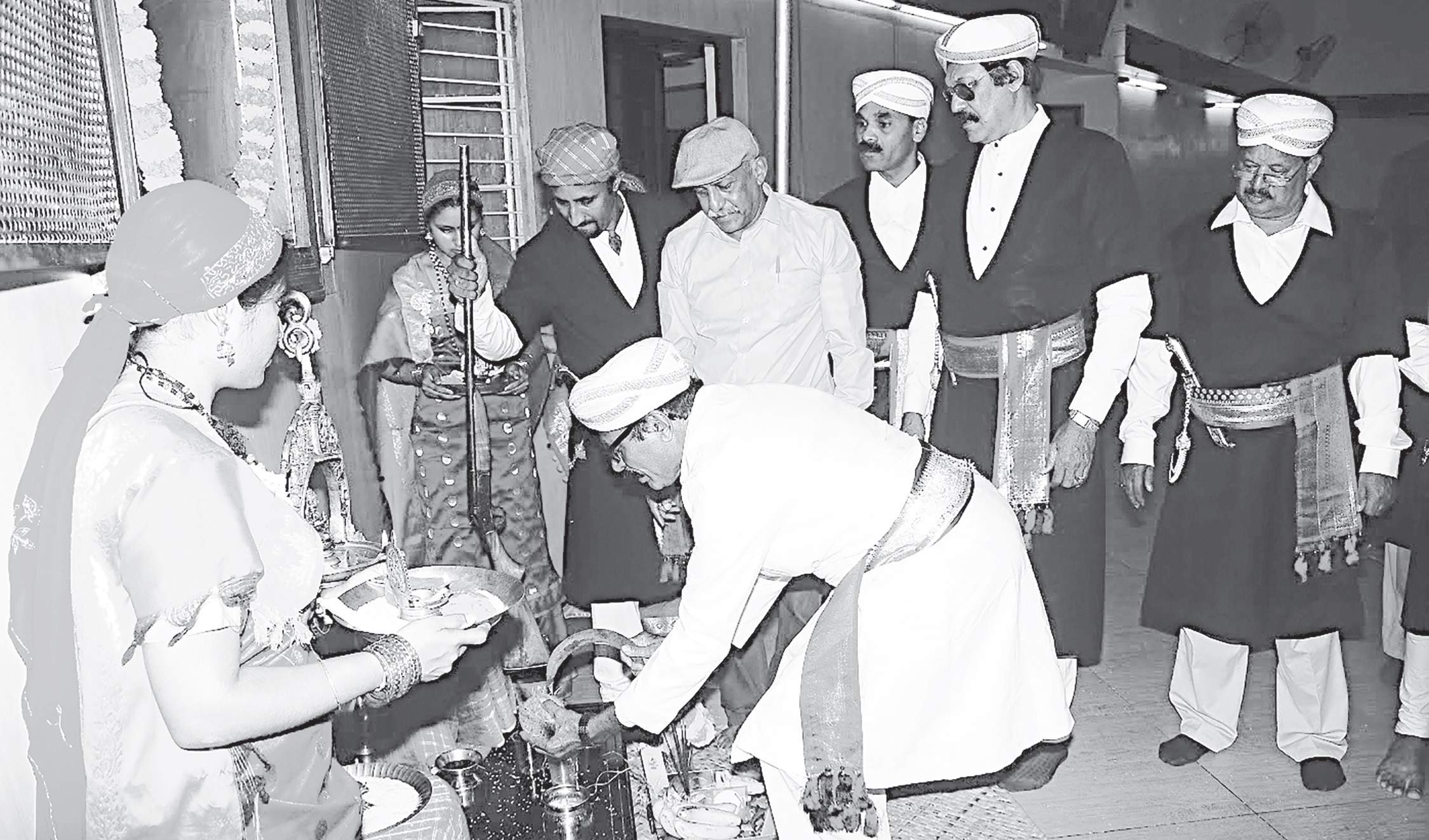
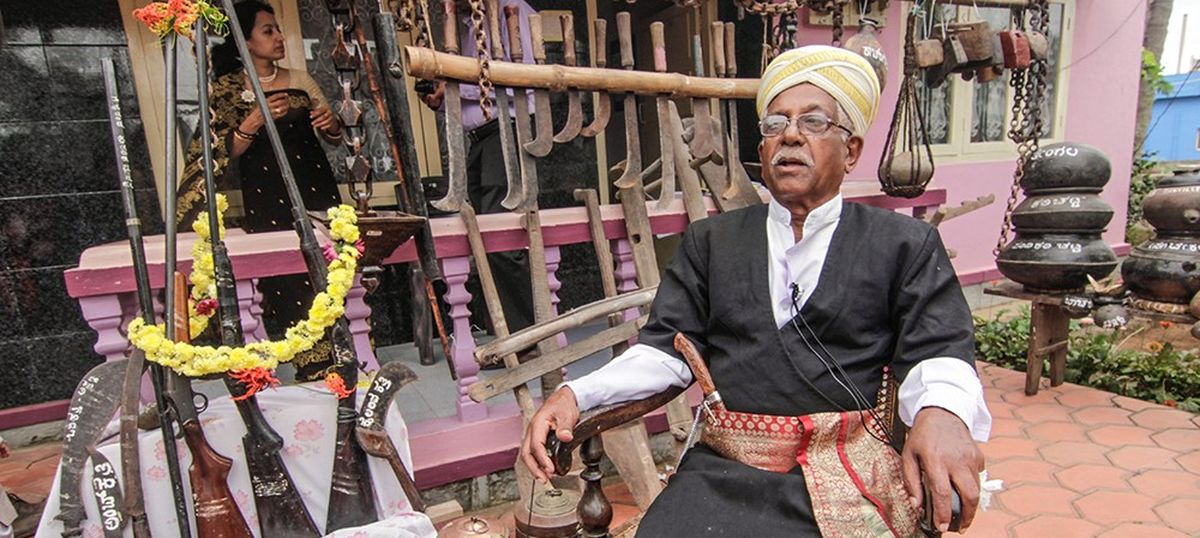
The Kodavas worship traditional farmhouse weapons such as war knives and long guns. They are cleaned and decorated with flowers and vermillion in the puja corner on the Kail Polud day. Sports such as shot-put and shooting at coconuts are arranged that afternoon. In the ancient times, this polud (celebration) marked the commencement of the hunting season, during the Kodava month of Chingyaar, when the Simha Rashi (Leo zodiac sign) is in prominence. While in the past people kept arms to use in wars, now they are kept as cultural symbols, to guard the crops and to ward away wild creatures.
Kaveri Sankramana is a festival dedicated to the river goddess Kaveri, the patron of the Kodavas. It happens on the first day of thulyaar, when the sun seems to enter the Libra zodiac sign. Ritual water is obtained from Talakaveri, the source of the river, and distributed among the natives of Kodagu.

A kalasha is worshipped in the houses and a vegetarian meal comprising dosa and pumpkin curry is prepared on that day. In the following month, pinda (ritual rice balls) is offered to or uttara kriya (last rites) is performed for deceased family members upon the banks of River Kaveri at Bhagamandala.

source: http://www.deccanherald.com / Deccan Herald / Home> Supplements> Spectrum / by Mookanda Kushalappa / December 06th, 2016

In the hills of Coorg, a martial tribe celebrates an annual festival with worship of guns

Kodava elders hope the festival of Kailpodh will encourage the community’s youth to enter international sporting events

Image credit:  Shawn Sebastian and Tejaswi Dantuluri
Image credit: Shawn Sebastian and Tejaswi Dantuluri

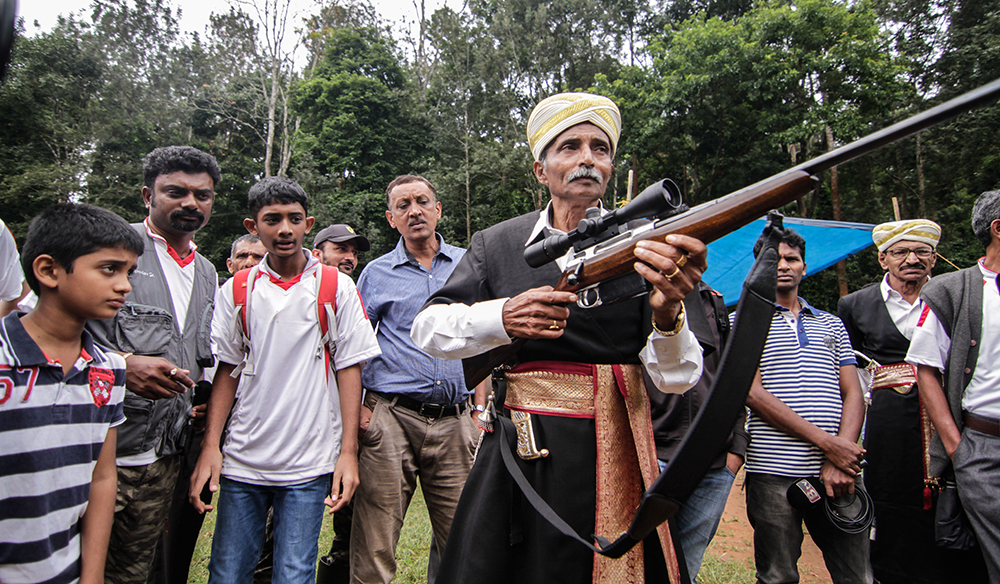
Deep in the sanctum of his 150-year-old ancestral home, Lokesh Achappa is surrounded by weapons. Dressed in a Kupya, the traditional Coorgi outfit of knee-length black overcoat, a gold and maroon sash with an ornate, carved silver dagger tucked in its folds, Achappa prays to an array of weapons: an antique double-barrel, a .22 mm rifle, traditional daggers and swords, all garlanded with flowers and smeared with sandalwood paste.

Once the ritual is complete, he steps out of the house, and a series of thundering gun shots reverberate across the valley.

Coorg, a district in Karnataka famous for its coffee, is home to the Kodavas, a martial hill tribe with a population of less than six lakh. Historically, the community has shared a deep connection with its weapons. Valiant guerrilla fighters and agriculturists, the Kodavas once defended territories with locally made bow-and-arrows. With the advent of firearms, guns became central to Kondava life. Weapons appear frequently in important social customs: births and deaths in the Kodava tribe are announced with gunfire, every newborn touches a bow and arrow, as initiation into the tribe. At the annual harvest festival of Puttari, one of the most important events on the Kodavas festival calendar, everyone in the valley opens fire.

Weapons are also celebrated at Kailpodh, the annual Kodavas (or Coorgi) festival in the first week of September which marks the end of hardships for the agrarian community – once the paddy has been transplanted. During the festival, Kodavas clean and worship weapons to express their gratitude for the protection they have offered.

“The period is a time for jubilation when distant families get together,” local resident Ashik Appanna explained.

Image credit:  Shawn Sebastian and Tejaswi Dantuluri
Image credit: Shawn Sebastian and Tejaswi Dantuluri

With the tightening of gun regulation laws, the ban on hunting, and due to large-scale migration of younger generation Coorgis, many have predicted that the Kodava weapon culture will disappear altogether. Elders of the Kodava community are hoping that festivals like Kailpodh will encourage young Kodavas to return to their traditional shooting skills.

Gun Rights and Regulations
In 1861, the British administrators granted Kodavas an exemption from the Arms Act, for their support to the East India Company in administrative and military affairs.

“Gun ownership is a birthright for us,” said Appanna Bacharinanyanda, an 80-year-old retired lecturer who exhibits antique Kodava weapons and utensils in his front yard every Kailpodh.

Bacharinanyanda says the Kodavas never “misuse” guns. He expresses a deep apprehension over the government’s attempts at over-regulating weapons: “These days authorities have started demanding bribes to grant us the exemption certificate, which is completely unacceptable.”

With the Wildlife Protection Act of 1971, hunting has been prohibited in India. The legislation came as a big blow to the Kodavas, for whom hunting was an integral part of life and survival.

Naveen Bidappa, a young Kodava lawyer, pointed to a photograph in his house of a man named Tiger Thimmaiah. In the picture, Thimmaiah stood next to a tiger he had killed and then tied to a tree.

“He shot 12 tigers, hence the name,” smiled Bidappa.

Since tigers posed the biggest menace for livestock, tiger hunters were once highly venerated figures in the Kodavas society.

“Narimangala (tiger-marriage) was a big tradition in the olden days,” he said. “The tiger hunter was married to the tiger he killed, and villagers would offer them gifts and cash as a mark of respect.”

Changing relevance of gun culture
In early September, scores of Kodava youth assembled at a school ground at the Coorgi village of Chettali. Each carried a gun.

Bidappa, a 70-year-old elder from the community, walked into the ground filled with curious onlookers, and shot a coconut hung several yards away to inaugurate the annual shooting competition that coincides with Kailpodh. He hit the bulls-eye with a single shot.

“Shooting skills are in our blood,” he said, shrugging at the crowd’s deafening cheers.

Over the last few years, shooting competitions that were once limited to households have turned into larger events, with an increasing number of shooting enthusiasts showing up from all over Coorg.

“Our aim is to prepare and pass down shooting skills to the younger generation,” Bidappa said.

Over the next five years, local shooting competition organisers plan to develop a shooting range in the village to groom young shooters, and train them for national shooting competitions.

“Festivals such as Kailpodh have found a new meaning in changing circumstances,” he said.

A Kodava shooting competition. Credit: Shawn Sebastian and Tejasvi Dantuluri

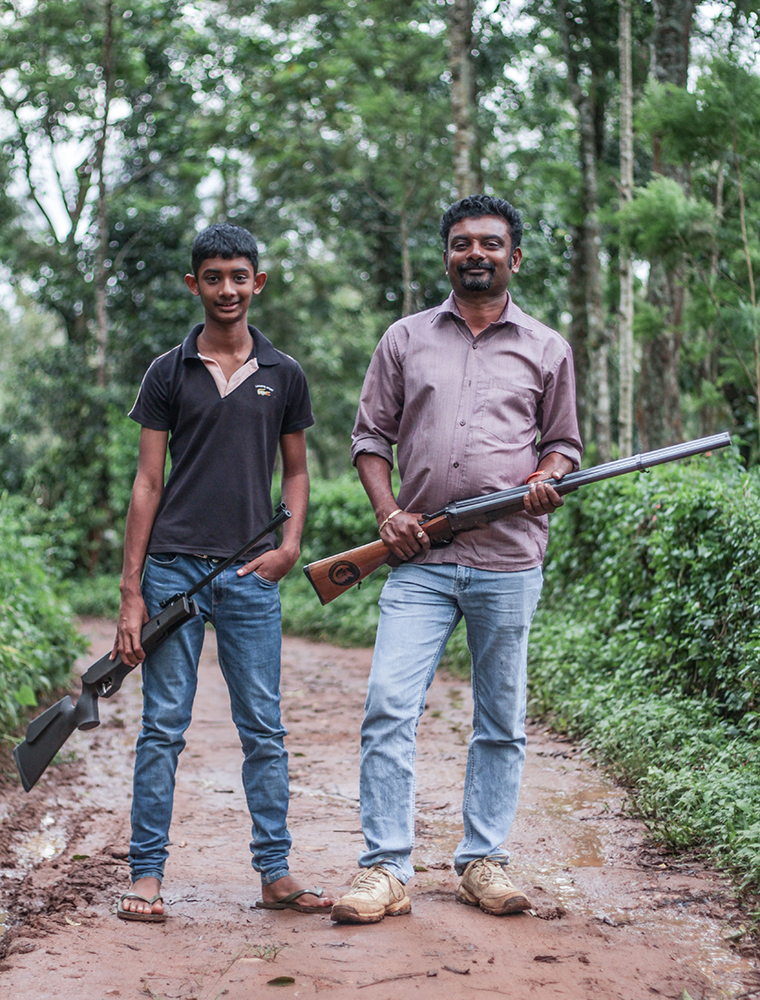
Fifteen-year-old Lakshan Ayyappa is a widely recognised face at Kodavas shooting competitions. He is the great-grandson of Tiger Thimmaiah, but has also established himself as an ace shooter in his own right – he has won more local competition prizes than he can remember.

“My target is to make it for 2020 Tokyo Olympics,” he said. Ayyappa first learnt to shoot at the age of five. He was taught by his mother.

“Whenever I see a new gun, I discuss it with my dad,” he said. “I know everything about its make, calibre, range, the cartridges used. I feel by the time we are born, we are already half trained.”

Like in Punjab, it is usual for Kodava households to send a member of their family to join the military. Many attribute this to early affinity Kodava youngsters develop with weapons.

Credit: Shawn Sebastian and Tejasvi Dantuluri

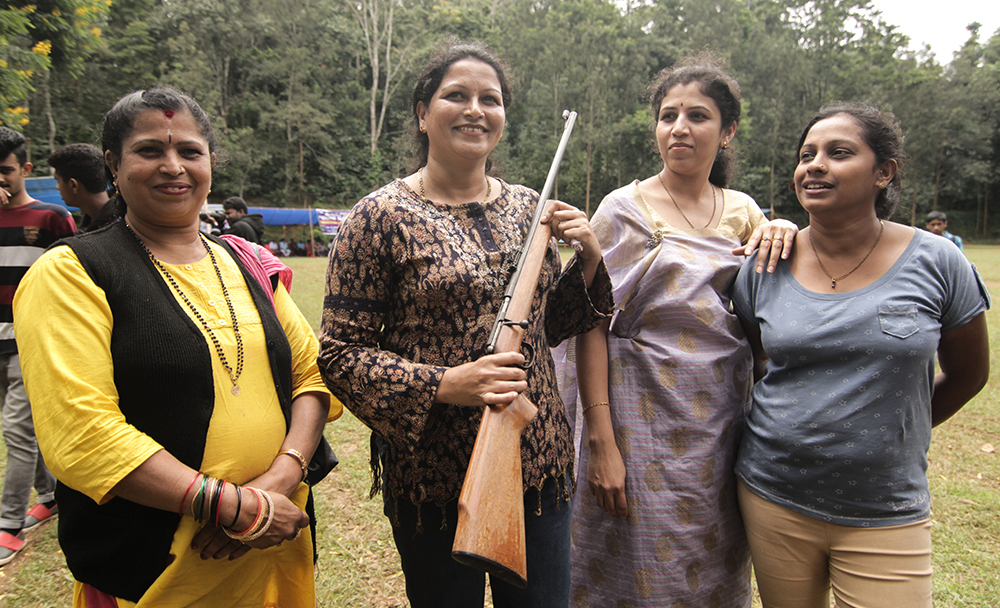
Shooting is not a male sport in the Kodavas tribe. Kodava women traditionally kept guns to protect their families when the men left for hunting and battle. Everyone from septuagenarian grandmothers to 16-year-old girls participate in local shooting competitions.

Credit: Shawn Sebastian and Tejasvi Dantuluri

Shooting is not a male sport in the Kodavas tribe. Kodava women traditionally kept guns to protect their families when the men left for hunting and battle. Everyone from septuagenarian grandmothers to 16-year-old girls participate in local shooting competitions.

Credit: Shawn Sebastian and Tejasvi Dantuluri

Several modern-day sports like shooting and archery have been born of indigenous communities across the world. In India, the attempts at unearthing such indigenous talents have been poor.

A few notable exceptions are people like Laxmirani Manji, from the Santhal tribe in Jharkhand who represented India in archery at the 2016 Rio Olymipcs, and Limba Ram of Ahari tribe in Rajasthan, an Arjuna awardee archer who represented India at three Olympics. If they are given enough support and attention, many modern-day Tiger Thimmaiahs might emerge from Coorg.

We welcome your comments at letters@scroll.in.

source: http://www.scroll.in / Scroll.in / Home> Magazine> After the News / Point & Shoot

Best of 2016: Climate change measured in coffee rain

As Karnataka roils over the Kaveri water dispute, the underlying cause is lowered climate resilience of the agro-forestry ecosystem in Kodagu’s coffee plantations

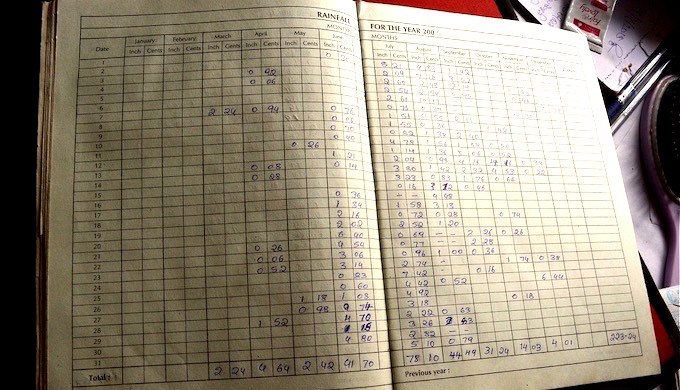
Coffee farmer B. B. Thammaiah’s rainfall record (Photo by S. Gopikrishna Warrier)

Coffee planters in the hill district of Kodagu in Karnataka are meticulous in keeping rainfall records in their estates. For some, the data goes back for decades. Their numbers tell the story of changing rainfall patterns, an indicator of climate change. The changing patterns also have an impact on the way they grow coffee, which has an effect on climate resilience in the hills and the plains.

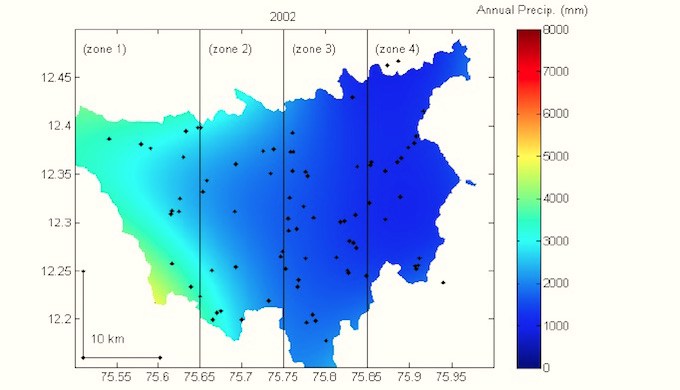
Due to the presence of this decentralised network of rainfall measuring stations, it is easier to obtain a nuanced picture of the precipitation trends for Kodagu, earlier known as Coorg, than in other parts of India. The average annual rainfall varies from above 5,000 mm in the western edge of the district to 1,200 mm in the east.

This data was used as part of the baseline survey by an international collaborative project to study the unique coffee agro-forestry system of Kodagu district. The College of Forestry at Ponnampet in Kodagu, as a participant in the Coffee Agro-forestry Network (CAFNET) project, has analysed the rainfall data of over 60 years from 116 coffee farms.

“Keeping meticulous rainfall data is part of the culture we inherited from the British,” said C.G. Kushalappa, university head for forestry and environment sciences at the College of Forestry.

The CAFNET report noted that the length of the rainy season had decreased by 14 days over the past 35 years. It also noticed a strong fluctuation in annual rainfall with an apparent cycle of 12 to 14 years.

Low rainfall in coffee land

Whether it is due to being the lowest point in this cycle or an El Nino changing rainfall patterns, 2015 and 2016 have been years of low rainfall in Kodagu. This is the second year of deficit rainfall in Kodagu. During 2015, it was deficient by 19%. As a result, the storage in the Krishna Raja Sagara dam reservoir, built across the Kaveri River immediately downstream of Kodagu district, has a 31% deficit this year.

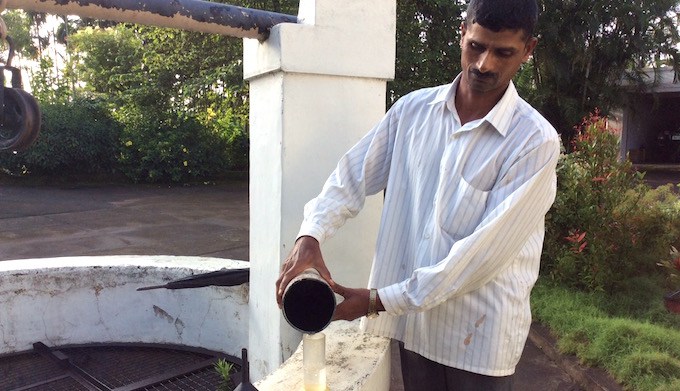
On the ground measurements by coffee grower K.K. Naren in Kunda village near Ponnampet confirms this. “Our normal rainfall is 90 to 100 inches (2,200 to 2,500 mm). This year we have got 38 inches, whereas by this time we should have received 70% of the year’s rain.”

A farm worker measures rainfall in K. K. Naren’s coffee farm. (Photo by K. K. Naren)

Coffee planters are confused by the erratic rainfall of recent years. “Rain and weather patterns have become increasingly unpredictable in recent years,” said M.B. Ganapathy, head of plantations for Tata Coffee. “Even though the quantum does not seem to have changed, the rainfall is not well distributed any longer. There are long dry periods followed by heavy rain and high-velocity winds. This has made farm management difficult for us.”

Blossom showers affected

According to coffee farmer B.B. Thammaiah of Kolagadalu village, the erratic rainfall has meant that blossom showers, which usually take place between February and April, are missing in some years. This has an impact on coffee production, since this helps coffee flowers to blossom, ensuring good yields later in the year.

There is an ecological impact of this, according to Kushalappa. When the blossom showers became erratic, coffee farmers started irrigating during these months. For traditional coffee cultivation, it was a combination of mixed-shade trees plus blossom showers that gave a good yield. When the blossom showers were replaced by irrigation, the shade from the trees did not matter. The farmers’ dependence on the native trees decreased, resulting in their proclivity for letting the native trees die. These trees are being replaced by silver oak.

See: Bringing coffee back into the shade

There is also an issue of ownership that is leading to the clearing of forests. Thammaiah’s farm is in Kolagadalu village, not far from the western crest of the plateau deep in a forested valley. His farm receives more than 5,000 mm of rainfall every year. While in the valley floor he continues to grow rice as his forefathers did, he cultivates coffee in the shade of the forest trees. Though the forest may not be as thick as it was during his grandfather’s time, he plans to conserve it.

The landscape of Thammaiah’s farm is typical of what the people of Kodagu inherited. While historically joint families cultivated the rice paddies where they owned the land, they used the forest for collecting mulch and firewood and grazing cattle. The families do not have property rights over the trees, which belong to the government.

Economics of silver oak

Silver oak, on the other hand, can be planted, cut and sold. M.C. Cushalappa, a coffee farmer from Siddhapura, said that silver oak yields a two-fold benefit to coffee farmers. One, it can supplement the family’s income in times of need. Two, its straight trunk can be used as a support for pepper vines, which bring more additional income. With no ownership and no economic stake on the native trees, farmers do not have an incentive to keep them alive.

Cushalappa’s family has paid the price of the native trees to the government and obtained ownership over them. “This encourages me to maintain the native tree species in my farm, unlike most of the other farmers in Kodagu.”

The coffee agro-forestry system of Kodagu is of immense importance ecologically; not only does it provide climate resilience to the hill communities but provides water to millions downstream through the Kaveri. The current acrimony over the waters of the Kaveri between Karnataka and Tamil Nadu have led to violent protests.

There is a problem though. Unlike in other parts of the country where the forests are fully under the control of the forest department, in Kodagu they are under the combined control of the department and thousands of coffee farmers. It means that it is difficult to give them a protected status. It is not as if the forest department it always the best protector; but uniformity in control has the potential to improve conservation practices.

Geographical location of coffee farms where rainfall data has been collected for 70 years and a map of rainfall distribution generated with these data points as an exmple for the year 2002. ( Image by College of Forestry, Ponnampet)

“The majority of forests in Kodagu are not notified and hence for their upkeep thousands of coffee farmers have to be incentivised,” a forest department official said, speaking on condition of anonymity. “About 90% of the catchment of the Kaveri river before the Krishna Raja Sagara reservoir is in Kodagu. There is need for a mindset change so that the farmers conserve the native trees and biodiversity.”

Through the CAFNET study, the ecosystem services could be quantified. “We looked at the role of native trees and silver oak to study their hydrological impact. Our team studied how much of the rain was intercepted, how much came through the stem, how much got run off, and how much got recharged,” noted Kushalappa.

The magic of native trees

The study found that increasing the proportion of exotic species such as silver oak in the shade cover composition had little impact on rainfall interception since trees intercept less (1% to 6%) than coffee plants (9% to 22%). Although there are lower quantities of water from native tree plots going to rivers than from the exotic tree plots, the higher contribution of evaporated and transpired water from native trees have a positive impact on the microclimate. Further, large canopy and deep-rooted systems of the native species help in the percolation of water to deeper aquifers, mainly during the monsoon.

Thus, native trees held the rainwater as it fell torrentially, and released it gradually into the rivers. At the same time they created a climate-resilient environment in the farms.

The mixed agro-forestry systems also helped in sequestering carbon. The CAFNET studies showed that Arabica coffee grown under the shade of mixed species sequestered more than the reference forests. Arabica coffee grown under silver oak sequesters marginally less than Robusta grown under native trees. Robusta grown under silver oak sequesters substantially less than the other combinations.

The missing blossom showers could be adding to the reasons for coffee farmers opening their canopies. On the flip side, the farmers’ actions could result in more carbon in the atmosphere, making rainfall more erratic in Kodagu.

source: http://www.indiaclimatedialogue.net / India Climate Dialogue / Home> Impacts / by S. Gopikrishna Warrier / December 27th, 2016

Traditional gaiety marks ‘ Huthri ’ festival in Mysuru

The members of Mysuru Kodava Samaja seen with the newly harvested paddy crop during Huthri festival celebrations in city last evening.

Mysuru :

Hundreds of Kodava community members celebrated “Huthri” festival in city last evening with traditional fervour.

The festival symbolises harvest season and the arrival of grains (wealth) into a Kodava home. The festival was organised by Kodava Samaja – Mysuru at Sree Cauvery Educational Institutions premises in Kuvempunagar.

Kodava men and women were dressed in their traditional best. The celebrations reflected traditional Kodava culture. The ritual of “kadiru” cutting was performed by hockey coach Kotera Muddaiah amidst gun salute and cheering of “poli poli deva”, praying for prosperity, by the members.

Later, the harvested bundles of paddy were brought into a decorated hall, pujas performed to Lord Igguthappa and Goddess Cauvery. “Kadiru” and the traditional dish of “Thambittu” were distributed to the gathering. On stage, a series of cultural programmes were performed including “Balopaat”, Bolakaat”, “Kolaat”, “Kathiyaat” and “Ummathaat”.

Prizes were distributed to the winners of the recently held Kodava cultural competitions organised by the Federation of Kodava Samajas where members of Kodava Samaja Mysuru had won prizes in eight of the nine competitions.

President of Mysuru Kodava Samaja Moovera K. Kuttappa, Vice-President Ballyamanda M. Nanaiah, Honorary Secretary Mandira P. Kalaiah, Joint Secretary Chottekalappanda Prema Uthaiah, Treasurer Mechanda M. Ponnappa and others were present on the occasion.

KODAGU GOWDA SAMAJA

The festival was also organised by Kodagu Gowda Samaja at the Gowda Kalyana Mantap in city. Paddy was traditionally harvested and pujas were performed to Lord Igguthappa and Goddess Cauvery. Later, the traditional “Thambittu” was served to the participants. Community members performed various traditional dances praying for prosperity of the land and its people.

Kodagu Gowda Samaja President Chettimada U. Janardhana, Vice-President Kodakandi G. Bharath Kumar, Secretary Kuntikana S. Ganapathy, Jt. Secretary Neyanni K. Ramesh, Treasurer Kadyada Ravi Bheemaiah and others were present.

source: http://www.starofmysore.com / Star of Mysore / Home> General News / December 14th, 2016

CNC celebrates Huttari festival

Codava National Council (CNC), led by its president N U Nachappa, celebrated Puttari (Huttari), the harvest festival of Kodagu at a paddy field of Uthappa at Chikkabettageri near Kushalnagar on Tuesday.

The festival symbolises the homecoming of ‘Dhanya Lakshmi’. The Codava National Council members, wearing traditional attire, participated in the celebration.

Before cutting the paddy sheaves, the members offered prayers and offered by tying the leaves of ‘Arali,’ mango, jack, ‘Kumbali’ and cashew- nut.

After the ‘Nere Kattuvo’ ritual, the participants walked in a procession to the paddy fields accompanied by the ‘Dudikottpat’ (dudi is a small drum of Kodavas). Nachappa cut the paddy sheaves and initiated the celebrations. Before harvesting, they shouted slogans ‘Poli Polio Deva’ and fired three times in the air.

The Codava National Council members presented traditional Kolata, ‘Pareya Kali,’ ‘Chowkata’ and other cultural programmes, adding colour to the festivity. ‘Payasam’ (sweet) was prepared from the new rice and was offered to the God.

Mouth-watering dishes like ‘Thambut,’ ‘Adikehittu,’ ‘Kadubu,’ ‘Payasam’ and others were savoured on the occasion.

Later speaking to reporters, N U Nachappa said the Kodavas should be entrusted with the constitutional security. The government should announce autonomous status to Kodava land.

source: http://www.deccanherald.com / Deccan Herald / Home> District / DHNS – Kushalnagar, December 14th, 2016

‘Taking coffee to the common man’s cup’

manyepandakf13dec2016

Manyepanda Madaiah Chengappa recently took over as the Chairman of Karnataka Planters Association (KPA). Karnataka accounts for more than 70% of the coffee production in India.

According to United Planters Association of Southern India (Upasi), Karnataka’s post-monsoon estimated coffee production for 2015-16 was 253,340 tonnes, with the all-India number standing at 350,000 tonnes. KPA has about 700 members as of date.

In an interview with Furquan Moharkan of DH, Chengappa says that his aim as the chairman is to make domestic demand for the cup of coffee transform from an elitist drink to a common man’s drink.

What are the challenges that coffee plantation sector faces today?

Climate change has increased, apart from pests and diseases impacting the coffee crop productivity. The Arabica coffee crop yield has reduced from 1,200 kgs, to 600 kgs per hectare, while Robusta coffee has decreased from 2,000 kgs, to 1,400 kgs per hectare, over the last decade. For instance, this year, Kodagu has 300 mm less rainfall over the previous year, and Chikkamagaluru has also suffered a similar fate, which affects the standing coffee crop and development of new shoots in coffee plants for the coming season.

Labour wage constitutes over 60% of the total cost of coffee cultivation. The annual wage increase was below 6% till 2007-08. From 2008-09, the increase was very steep. Against 2007-08’s wage of Rs 79 per day, the current wage is at Rs 263 — an increase of 232% or an annual average increase of 15%. This could be the highest percentage increase for any industry in Karnataka. Also the statutory and welfare costs for the labour, which are over and above the wages and benefits, works out to an additional 50% of the wages. This is an additional financial burden for both corporate and proprietary planters.

However, the sale price for coffee at the farm gate hovers around Rs 2,800 to Rs 3,500 for a 50-kg bag, while the labour and fertiliser costs have spiralled disproportionately. The need to invest more funds for R&D to develop better quality coffee plants that are high-yielding and pest-resistant is another challenge.

What are your priorities after taking over as Chairman of the KPA?

Primarily, my major objective is to make domestic demand for the cup of coffee transform from an elitist drink to a common man’s drink. I would seek the Coffee Board’s assistance to establish coffee kiosks at public places like government offices, bus and railway stations, airports, shopping malls and educational institutions. This would make the demand for coffee explode in the country. Towards this objective, it would be necessary to jointly pursue vegetative clonal and tissue culture propagation of coffee, with United Planters Association of South India (Upasi) and Central Coffee Research Institute, Balehonnur, Karnataka. Also, to push for the import of pest and disease-resistant high-yielding coffee plant material. Identify biological viable and effective methods to treat effluents.

Also, request the state government and its Department of Agriculture to allocate Rs 1.9 crore in the state budget to fund the Upasi-KPA coffee research project. To establish soil and leaf analysis laboratories at Chettalli, Kodagu district and Chikkamagaluru district for the convenience of small and large growers.

A lady planters sub-committee has been constituted to promote community outreach programmes and showcase their achievements in cultivation of coffee, plantation nurseries, local marketing initiatives at national and international levels, home stays and plantation cafes for income augmentation.

What is the impact of the GST regime on the coffee plantation sector?

GST does not affect the coffee grower directly, as being agriculturists, they come under zero tax brackets. GST is applicable only after curing at the roasting and powdering stage, when the value-addition takes place, and the coffee can be consumed as a cup of coffee. According to Rule 7B (1) of Income Tax Act — “Income derived from the sale of coffee grown and cured by the seller in India shall be computed as if it were income derived from business, and 25% of such income shall be deemed to be income liable for tax.” This I-T Rule needs to be amended to tax coffee only at the stage of roasting and powdering that would enable the grower to sell coffee, which is plantation-specific, directly to the local and global markets.
Do you think that the import of pepper from Sri Lanka could affect domestic trade?

Import of poor quality pepper is killing the Indian pepper market. A regulatory price mechanism is necessary, whereby the price of pepper imported should be about 5% lower than the Cochin pepper auction price of equal quality of the day. Also, quality parameters of the imported pepper should be strictly monitored by a suitable government agency.

Your comments on the degradation of forests and environment pollution that have a bearing on the plantations in Karnataka.

The National Forest Policy is under amendment and a high-powered committee has been instituted for the purpose. The KPA and Upasi have jointly made a representation to the Union Ministry of Environment and Forests. Also the elephant menace in Kodagu district has assumed dangerous proportions due lack of proper fodder and vegetation in the game sanctuaries. Plantation crops, fruit trees and human beings are being trampled upon and destroyed. Therefore, the translocation of elephants appears to be the only solution, as all other forms of deterrents and barriers have proved ineffective.

While tourism has phenomenally raised the socio-economic level of people in the plantation districts, it should not lead to environmental pollution. Therefore, it is necessary to promote eco-tourism in the plantation districts of the state. Also, aggressively ban all types of pollutants, plastics, discharge of sewage and chemical effluents into the rivers. People need to be aware of waste segregation, its recycling and proper disposal through the media platforms to promote eco-tourism.

source: http://www.deccanherald.com / Deccan Herald / Home> Supplements> Economy & Business / by Furquan Moharkan / DHNS – December 12th, 2016

Madikeri DC tells engineers to expedite water works

Deputy Commissioner Richard Vincent D’souza on Monday has threatened the engineers concerned that they would be held accountable for any complaints/problems pertaining to drinking water supply.

Chairing a meeting on drinking water works and fodder issues, the deputy commissioner expressed his anguish against the engineers over the tardy progress in the drinking water works taken up at a cost of Rs 1 crore last year. The DC was upset over the underutilisation of funds sanctioned for the water works. “If there is failure in utilising the amount, sanctioned last year, to its fullest, how can we seek funds for the current year, the DC questioned.

The deputy commissioner directed the engineers to expedite the water works and address the water woes in the district.

Additional Deputy Commissioner M Satish Kumar said, “A Cabinet sub-committee headed by Revenue Minister Kagodu Thimmappa has been constituted. The sub-committee should be apprised of the measures taken.”

The officials should furnish information related to measures taken to address drinking water complalints, cattle feed among others, he added.

The Addl DC also instructed the officers to speed up drought relief works.
Zilla panchayat deputy secretary, planning director, chief planning officer and executive officers of respective taluk panchayats were told to work in tandem to mitigate drought.

Rural Drinking Water Engineer Shashidhar, along with assistant executive enginers from three taluks in the district, apprised the meeting of the status of the works taken up in the district.

source: http://www.deccanherald.com / Deccan Herald / Home> District / DHNS – Madikeri, December 13th, 2016

Gather your sickles,it’s a harvest

kodavasgatherkf11oct2016

Bengaluru :

As Kodavas retreat to their Kodagu homes from the hurry-burry of the city to rest and celebrate the annual harvest festival, there are some who will be celebrating the Puthari (also known as Puttari and Huttari) festival in the city this time.

“It is hard for me to head back home this time because Puttari falls mid-week,” says Pratvii Ponnappa, who is born and brought up in Bengaluru but usually heads back to Coorg to celebrate the festival. “My father will be going to Coorg, but I will be staying back and celebrate it on the day local Kodavas decide”.

“Celebrating in Coorg means coming together with your family, celebrating in the city means coming together with your community,” Pratvii says.

M T Subbaiah, administrative officer of Kodava Samaja, says, “We have 13,000 Coorgis in the association. This year there will definitely be more celebrating the festival with us since it falls on a week day.” Around 3,000 to 4,000 people are expected to attend this year’s Samaja festival.

Puthari, which means the paddy festival, will be celebrated on December 13 this year. Last year it was in the end of November.
On the day of the festival, family members assemble in their ancestral house or ‘Ain Mane’, which is decorated with flowers, mango and banana leaves.

The children play with fire crackers and in an “auspicious hour” the eldest of the family hands a sickle to the head of the family.

The auspicious time is decided by the Igguthappa temple.
The family together head to the paddy field. A woman leads the procession holding a lit lamp in her hands. A paddy stick is cut and a gunshot is fired to mark the beginning of the harvest. The chanting of “Poli Poli Deva” is recited and the paddy is stacked in odd numbers to be carried home and offered to the gods.

Small bundles of paddy straw are handed to the family members, which are received as a symbol of prosperity.

Since there are no paddy fields in and around the city, the Kodava associations usually get paddy from Coorg and distribute them among the people who come to celebrate. This year, the Kodava Samaja will be celebrating it on Tuesday evening.

The programme will commence at 6:30 pm when all the members will gather for an annual awarding of scholarships and for a speech by community leaders. By 7 pm, everyone will gather in a small 10*8ft piece of paddy land in the office premise to follow the customary ritual. At 9 pm special foods such as thambuttu (made of mashed bananas and roasted rice powder and topped with grated coconut and melted ghee), kadaumbuttu (rice dumplings with coconut milk and ghee), holige (flatbread from flour, jaggery and ghee) and puttari payasa (from rice, coconut milk and jaggery) will be served.

Kishoo Uthappa is heading to Coorg today for the festival since he has grown a small amount of paddy in the field for this festival and he does not want to miss it.

“I am an entrepreneur so I can take off whenever I want,” he says. “Most importantly, I don’t want my children to miss the festival.”

source: http://www.newindianexpress.com / The New Indian Express / Home> Cities> Bengaluru / by Regina Gurung / Express News Service / December 10th, 2016

Rainforest Retreat Coorg: Life on an organic farm

MojoKF30nov2016

If man learnt the blues pickin’ cotton, he shall rediscover it learning how to grow coffee. And no any ordinary coffee, mind you, but organic gourmet robusta.

The upper echelons of Coorg’s rain-slopes resonate not with the hum of mountain maidens, but Big Mama Thornton belting away the blues. Welcome to Mojo Rainforest Retreat, a 25-acre organic farm perched at 1100m in the lush Western Ghats of Karnataka. Mojo is as famous for its unimaginable shades of green as for its collection of blues, believed to be the largest in the country. If Robert Johnson’s wandering soul were to reincarnate as a farmhand, this is where it would come to rest.

Take it from Doc. That’s Doctor Anurag Goel, who claims to have seen every big blues act while doing his Ph.D. in Molecular Biology from Toronto. His wife Sujata, a Ph.D. from the Department of Botany (Delhi University), is a walking encyclopedia of natural remedies. Along with their ‘nature child’ Maya, the Goels have accomplished what most people only dream of in their dreams. They quit the rat race of urban drudgery to pursue a more harmonious existence with nature.

After extensive travel through this vast country, they chose to settle in the rainforests of Coorg. The retreat was set up in 1999 to raise awareness about their environmental NGO.

Initially, they intended to name it Worldwide Association for Restoration and Preservation of Ecological Diversity but realized that a name like WARPED would find little credibility.

And so, after a little juggling of alphabets and a National Geographic grant later, they settled for WAPRED Research Foundation in 1996. Today, the idea has blossomed into a heady mix of eco-tourism, offbeat adventure travel and the blues.

Coorg’s rich flora and fauna have earned it international recognition as one of the most important hotspots of biodiversity that need to be preserved. To say that it’s a challenge is an understatement. This here is Wild West Country, where every house boasts of a licensed rifle and most of the region’s wildlife can be found on the walls of living rooms in Coorg.

Some of course, like the wild boar, have met a more honourable end. The transformation from a vile burrowing creature to a bowl of delectable pandi-curry can only be attributed to the genius of a people who have understood the very soul of the animal.

Sadly, the importance of nature’s treasures has been lost on them. The heavy use of toxic pesticides has seriously endangered the region’s fragile eco-system.

The falling prices of coffee have spurred the use of chemical fertilizers and a mysterious disease has wiped out the orange from ‘Orange County’. However, there’s one bastion that seems to be holding out – Mojo.

The farm is a perfect example of how to live in harmony with nature without necessarily exploiting it. The Goels use solar panels for their basic power supply. Crops are grown under the shade of rainforest trees using biological methods of pest control.

A medicinal plant garden nurtures the wealth of traditional knowledge.

Coffee berries are handpicked, hand-processed and specially roasted to obtain a special blend without using chemicals or chicory.

The cuisine – mostly locally grown organic produce – is a delicious blend of continental and Indian dishes, homemade bread, cottage cheese, pastas, roasts, preserves and gourmet organic coffee.

Even the accommodation at the Rainforest Retreat is an unforgettable experience. A beautiful brook-side bungalow, set in a picture-postcard thicket of bamboo, banana, orange and pineapple, conforms to international standards of style and comfort. It has two bedrooms, a spacious living room, sit-out and perhaps the best rainforest loo any side of the equator.

A second, more rustic shelter is the Yin Yang Cottage inside the plantation. A thin wisp of smoke rising from the bathroom chimney indicates that Muttu Pandey (the farmhand) has already heated the water. Before the stimulating bath can lull me to sleep, there’s a Doc on my door. It’s time for a first-hand learning experience at the farm.

Mojo is home to the Habanero, the world’s second hottest chili. The Red Savina Habanero used to be the hottest until it was deposed by our own Nagahari chili from Tezpur, Assam.

Another brilliant flash – this time at the treetop – catches my eye and I wonder if it’s a bird, a plane or Superman. Doc angrily shakes his head and says it’s the Southern Birdwing, India’s largest butterfly.

There’s Dendrobium Nutantiflorum, he motions to an orchid clump and that’s the raucous call of a Green Barbet. Stupefied, I try to keep pace with one new discovery a minute and forget more than I can remember.

Doc plays the razor-sharp schoolmaster to my stupid boy from Botany class. A walk through the dense cardamom under-hang leads to a clearing where Doc comes to a halt in front of a tree.

He has the reverence one would show to an Inca shrine. With all the compassion of a shaman consecrating a totem, he caresses the thick leaves of a creeper. “After saffron, vanilla happens to be the most expensive spice in the world”, he chuckles. “One kilo of cured, processed vanilla extract fetches as much as Rs.11,000 in the international market.”

But before this article can trigger off rampant cultivation of vanilla in any available garden patch, let me add that it takes 5 kg of beans to process 1 kg vanillin extract. A lucky farmer may get about Rs.700 for a kilo of beans.

What’s more, in the absence of its natural pollinator the Melipone bee, the orchid’s flowers have to be hand-pollinated. The flower opens in the morning and closes in the afternoon, never to open again. If left pollinated, the flower will drop the very next day.

Oddly content that I was not a vanilla farmer, I pick up samples of the local produce. Habanero extract, cardamom, pepper (which are indigenous), coffee (which was introduced), Garcinia (aka Kokum, used as a refreshing drink and a souring agent in curries) and a lovely set of picture postcards, all of which fund WAPRED.

Back at the main house, Sujata thrusts into my hand what she calls a ‘hibiscus suspension’. I admire the glass like a potential Nobel Prize winning entry, when a patient feminine voice explains, “It’s a coolant; you are supposed to drink it”.

“And next time, use kerosene on your boots. It’ll keep the leeches away”.

This region gets so much rainfall it would make Mawsynram blush. The rains get so severe that leeches give up their positions on the ground and cling to overhanging branches to throw themselves like kamikaze warriors on to passing targets. If you’re into pain, I highly recommend Mojo in the monsoons.

Among the other denizens of the farm are the dogs – Jupiter, Janis (named after Janis Joplin), UB (Ugly Bastard – a deformed puppy who has grown up into a stocky watchdog) and Pigpen (from a character in Animal Farm), who died recently. It’s advisable to be overtly good to them as it is they who accompany you from the main house to the Yin-Yang Cottage at night.

A solitary jaunt is not exactly spooky, but jungle walks have never been the same after The Blair Witch Project. Everything at Mojo – including Aki the Calf and Maya Hill – has been named by 4-year-old Maya. If she has finished partying with McDuff, John Barleycorn (who has a drinking problem) and her imaginary friends, maybe she’ll show you her ‘panoramic view’ and tell you about her philosophy.

Meanwhile, a Golden Oriole lands on the tree near the verandah. While I gape open-mouthed at it like a 4-year-old kid, an oblivious Maya is content watching UB play with a ball-beetle.

Mojo is the sort of place where you’d hate to blink. It tends to leave you with a strange feeling that can best be described as a mixture of envy, awe, respect, rejuvenation and rage when the honeymoon is over. However, for those few precious moments, it gives people a chance to experience an inner peace that only nature can provide.

Doc has also designed several escorted road tours that take you to interesting places nearby. There are excursions to other plantations like Ludwig Mahal, a nature walk to Galibeedu Ridge, a visit to the Dubare Elephant Training Camp and an insane drive to the Cauvery for swimming and mahseer fishing.

What makes Mojo even more special is that it’s a Mecca for bird-watchers, insect-lovers, soul-trippers and blues-brothers. The misty mountains and dense foliage of this section of the Western Ghats make it one of the best places to get lost.

In fact, Mojo adds up to such a wild weekend you might even be tempted to call it a ‘Doc Holiday’…

Author: Anurag Mallick. This article appeared in the May 2003 issue of Outlook Traveller magazine.

source: http://www.redscarabtravelandmedia.wordpress.com / Blog by anurag mallick & priya ganapathy / May 25th, 2012