Category Archives: Agriculture

Brewing coffee from jackfruit seeds

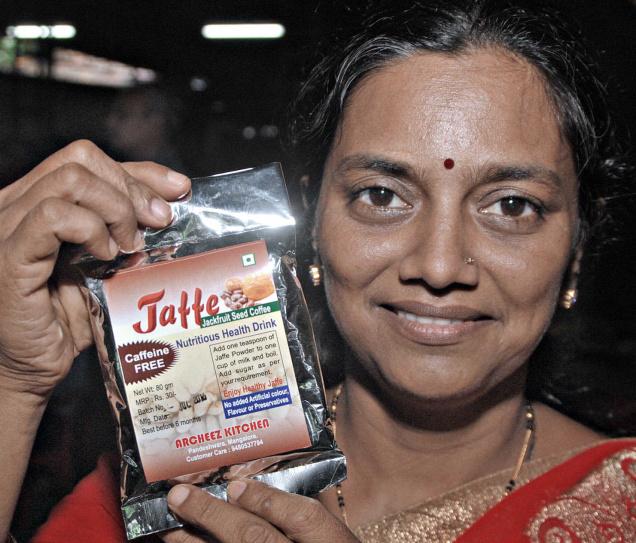
Healthy:Maithraye Shenoy displaying the ‘Jaffe powder’ made of jackfruit seeds.— Photo: H.S. Manjunath

Can powdered jackfruit seed taste like light coffee without adding any other ingredient to it?

If you cannot believe it, you ought to taste the “health drink” made by Shivanna from Sakharayapatna, of Parivarthana, a non-government organisation, in Chikkamagaluru district.

“My product is very near to coffee; it can become a substitute for coffee,” said Shivanna, who was at the jackfruit mela here on Sunday. He told The Hindu that the processed seed powder was the result of his one-year research and it was free from any stimulant like caffeine.

He said that three cups of the “health drink” could be prepared from one spoon of his new product. Shivanna has sent the sample to the Central Food Technological Research Institute, Mysuru, for analysis of carbohydrate, fibre, fat and calorie contents. “You can drink this product like you drink coffee by making its decoction,” he said.

‘Jaffe powder’

Maithraye Shenoy, a homemaker from Pandeshwara in Mangaluru, has also made a “health drink” from jackfruit seed. She has named it “jaffe powder”, which can be mixed with milk. “It was the result of a two-month research. I roast the jackfruit seed before making the product,” she said.

Meanwhile, Artocarpus Foods Pvt. Ltd., at Taliparamb, near Kannur, is already marketing jack seed powder. It can be used to make chapattis, dosas, cakes, and bread. It also makes a product from the seed as masala for chicken curry, said Shree Padre, executive editor, Adike Pathrike, a farm monthly and a crusader for jackfruit and its value-added products.

source: http://www.thehindu.com / The Hindu / Home> News> Cities> Mangaluru / Raviprasad Kamila / Mangaluru – July 04th, 2016
It’s raining oranges in Kodagu

Madikeri :

The tiny district of Kodagu was well known for its mandarin oranges in the 1970s-80s and was the largest producer of the juicy fruit in the state.

It lost its glory after 1990s as plants across the district died after contracting diseases.

However, after the year 2000, the district is on its way to gain its past glory as mandarin production in the area is swelling every year, thanks to the efforts of horticulture department and national horticulture mission.

Oranges are grown in coffee estates as a sub-crop.

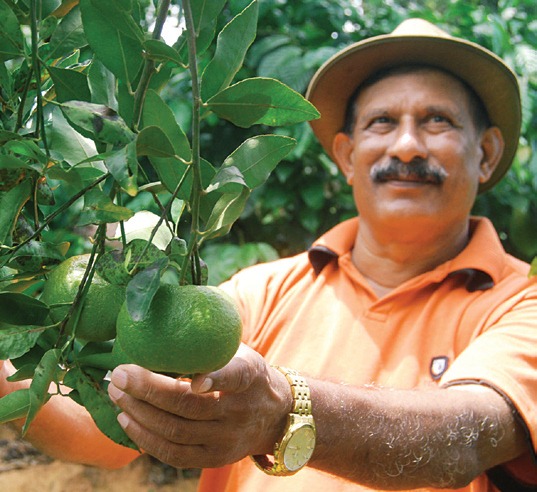
Ponnachettira Suresh displays his Mandarin oranges in Madikeri on Monday

Hundreds of coffee growers availed the facilities provided by the department and started growing mandarins.
Progressive farmer Ponnachettira Suresh, a native of Ibnivalavadi near Madikeri succeeded in growing mandarin and harvested the fruit twice a year.

This inspired many growers. Suresh says that Coorg orange is known in the market for its sweetness and is always in demand.

Suresh says, “As Nagpur oranges come to the market only in October, Coorg variety is in good demand as we get two crops in a year. At present, orange is being sold at Rs 60-70 per kg but will reduce to Rs 25-30 in October.”

Mandarin was grown in 1,320 hectares in 2013-14, which has now swelled to 1,550 hectares as the horticulture department supplied 80,000 orange plants last year.

State Horticulture Department Additional Director Paramashiva told Express on Monday that the department is providing a subsidy of Rs 16,000 per acre to growers for new plantations.

source: http://www.newindianexpress.com / The New Indian Express / Home> States> Karnataka / by Coovercolly Indresh / June 21st, 2016

Farming gains momentum in Kodagu as monsoon sets in

Intermittent rains and cloudy weather conditions over the last few days in Kodagu district have set the tone for the onset of monsoon, and agricultural activities have gained momentum.

The district received an average of 11.97 mm of rainfall on Monday as against 5.03 mm during the corresponding period last year.

Madikeri taluk received 22.95 mm of rainfall, while the taluk received 405.88 mm from January to May this year. Reports indicate that the rainfall has been uniform and widespread across the district. Virajpet taluk received 11.03 mm of rain on Monday, while Somwarpet received 1.93 mm. Hobli-wise rainfall statistics indicate that Madikeri kasaba received 17 mm, Napoklu 20.8 mm, Sampaji 13.4 mm, and Bhagamandala 40.6 mm of rainfall on Monday.

B.B. Pushpavathi, Municipal Commissioner, has appealed to people living in low-lying areas to shift to safer locations as there were forecasts of heavy rainfall across the district.

The inflow into Harangi reservoir was recorded at 258 cusecs as against an inflow of 119 cusecs the same day last year.

The Kodagu district information and publicity department said the conditions were right for the onset of monsoon in Kodagu and has buoyed the spirits of farmers and the agricultural community in general. Meanwhile, nearly 31,000 hectares of farmland will be brought under paddy cultivation this year. A release appealed to farmers to take precautionary measures against outbreak of various crop diseases by treating the seeds and saplings.

Maize is the second most important crop in the district and about 4,000 hectares was expected to be brought under cultivation. Fisheries will receive fresh impetus during the season and the authorities plan to distribute nearly 48 lakh fishlings during 2016-17 under pisciculture programmes.

source: http://www.thehindu.com / The Hindu / National> Karnataka / by Special Correspondent / Mysuru – June 14th, 2016

Environment organisations to organise ‘padayatra’ seeking funds for Cauvery River development

Allocation of money for Cauvery River development on the lines of the funds for purification of Ganges River has been sought by environment organisations.—PHOTO: M. GOVARTHAN

Olirum Erodu Foundation has teamed up with Annai Cauvery River Protection Trust to carry out remediation of environmental pollution in the Cauvery River.

The two organisations have resolved to organise a ‘padayatra’ from Talacauvery on the Brahmagiri hill in Kodagu district, Karnataka, to Poompuhar in Tamil Nadu, on July 10 to create public awareness on the need for Central and State governments to earmark funds for Cauvery River Rejuvenation Project.

They have taken the expertise of Mumbai-based Tata Institute of Social Sciences (TISS) to implement their action plan.

Pamphlets being distributed by the Trust lists a set of responsibilities of the governments that include a special drive for raising lakhs of trees in Brahmagiri range in Kodagu district for more rain at Talacauvery.

Stringent measures to prevent mixing of sewage and industrial pollutants into river water, strengthening of embankments and construction of check dams across the river to prevent draining of water accruing from monsoon rains into the sea; and formation of a separate ministry for safeguarding and developing Cauvery River.

Participants at the consultative meeting chaired by the vice-chairman of Olirum Erodu Foundation (OEF) D. Venkateswaran constituted Swami Ramananda, OEF chairman M. Chinnasamy; and secretary S. Ganesan, emphasised on allocation of money for Cauvery River development on the lines of the funds for purification of Ganges River.

A. Sridhar, Regional Project Officer (South India) with National Water Mission & Tata Institute of Social Sciences – Water Project, the special invitee for the meeting, joined other speakers in calling for nationalisation of rivers and linking of the rivers in the Southern States to begin with.

Suggestions for environmental remediation were also offered by historian Kaniyan Balan, coordinator of Erodai K. Sudakar, Secretary of Tamizhaga Vivasayigal Sangam Subbu, and organising secretary Logusamy.

source: http://www.thehindu.com / The Hindu / Home> National> Tamil Nadu / by Special Correspondent / Erode – June 13th, 2016

Human Rights Commission bats for Green Patch, to save 3 tree species

In an unusual act, the State Human Rights Commission (SHRC) has stepped in to save three tree species, especially in Coorg. It has asked the state government to withdraw its notification that included the three species, Hebbevu (Melia dubia), Belanji (Acrocarpous fraxnifolious) and mango, in the list of 23 trees exempted from the forest act which forbids tree felling.

The commission decided to act as the March 2015 notification was being misused to fell these trees rampantly in Coorg by the timber mafia. The commission, besides directing the authorities to check cases where the notification has been allegedly misused, sought a report by the state government. SHRC passed the order on May 21 after hearing a complaint filed by local activist K A Ravi Chengappa.

It’s an unusual action for the SHRC which deals with human rights violations, to take up the cause of maintaining green cover.

But this has been done considering it as one of key aspects supporting human existence. Chengappa is fighting an uphill battle to retain the greenery in Coorg. He has filed petitions with the High Court, Supreme Court and SHRC.

He had earlier filed complaints with the forest department and the Lokayukta too.
Chengappa said, “The order was being blatantly misused by those in illegal timber trade. Some forest officials were also handin- glove with them.” He said, “Only tree species grown by farmers in Coorg – like lemon, coffee and sapota (sapodilla) were exempted earlier (2002 and 2004). Now though including new species requires legislation, three species were included by the state government last year. Because of this exemption, Belanji which is a fine soft wood and which has grown naturally, is being felled rampantly. Wild mango, which is spread across forests and yields high value wood, is being rampantly cut and transported from forests. Even those in private lands are cut and transported. These species are spread across Coorg, Chikkamaga lur and Mangaluru which are part of Western Ghats. The government notification has proved detrimental and over 30-40 lakh trees face the threat of being cut.”

CG Hungund, SHRC member who has taken up the case, said, “The state government notification has many loopholes.

Prior to such orders, there should have been a mechanism of self-declaration by the land owners in place. This could have given figures on the number of trees. But now, there is no such thing. The trees are cut and transported haphazardly from the reserve forests. There is no proper mechanism to monitor the cutting and accountability is absent. Hence the government has been asked to withdraw the order as it may prove dangerous to state forests.”

Hungund has asked the chief secretary and principal chief conservator of forests to reconsider the notification and submit an action taken report within six weeks. Though the petitioner was successful in making government withdraw mango from notification, the other trees are being felled, SHRC brass said.

source: http://www.bangaloremirror.com / Bangalore Mirror / Home> Bangalore> Others / by Chetan R, Bangalore Mirror Bureau / May 28th, 2016

Scientist brews a green idea to give coffee growers their due

Arshiya Bose, founder, Black Baza Coffee

Bengaluru:

Verdant forests, picturesque mountains, lush coffee plantations — for many, Coorg is the perfect place to unwind. However, it was a different quest which took Arshiya Bose to the coffee land. A PhD holder in geography and environmental science from the University of Cambridge, she visited Coorg as part of a research project. Her mission — to make coffee production environment-friendly.

Realizing not all is well with the current production process — use of pesticides, exploitation of farmers, growth of coffee in the sun instead of shade — Arshiya, 32, started looking for ways to make it sustainable. She wanted to address these problems by adopting a holistic approach that ensures the well-being of both the environment and the coffee producers. The result — Black Baza Coffee, an entrepreneurial idea currently being incubated at the NS Raghavan Centre for Entrepreneurial Learning (NSRCEL), IIM Bangalore. The centre mentors innovators and supports their ventures.

During her research, Ashriya got the opportunity to work with forest dwellers and tribal communities in the Western Ghats, which helped her get closer to her goal. “I studied the social and environmental impacts of coffee production and found there were a number of problems no one was doing anything about. Traditionally, coffee in India has been grown under the shade of trees. But now, it is grown directly under the sun’s harsh rays, which adversely impacts biodiversity. Also, the trade market is extremely unfair to the producers, with the exploitation levels being very high. To fix the loopholes in the social and environmental ecosystem, I started Black Baza Coffee,” said Arshiya, who has tied up with many producers.

So far, the Kolkata resident has got 35 coffee producers on board, of whom 31 are marginal farmers from Biligiriranga Hills in Chamarajnagar. All of them are small growers —they own farms spanning less than 25 acres. “Under our partnership, we promise to buy coffee from farmers, support them through agronomic training and quality improvement and build safeguards for unforeseen price crashes. Many small growers are exploited and we hope to be the most fair buyer of their product ensuring they get their due,” said the young entrepreneur.

Explaining the potential of the idea, professor Suresh Bhagavatula, chairperson, Entrepreneurial Ecosystem Development, NSRCEL, IIMB said, “Coffee is among the top five most popular legally traded products in the world, including oil. It is a $90 billion industry and supports about 75 million people. While India is among the top 10 coffee-producing nations, it accounts for about 3.5% of the world exports. Unlike the rest of the world where sustainability and fair trade are becoming important for consumers, it is yet to catch on in India”.

“Black Baza Coffee would like to market the produce from farmers who practice sustainable methods for production. Consumption of coffee in India has started to increase, which will make it more feasible for ventures such as BBC to be established and serve the local markets as well,” Suresh added.

MUTUAL BENEFIT

We make conversational agreements with farmers and enter into a mutual understanding with them to grow coffee under certain kinds of trees, restrict the use of pesticides and protect their water resources. In return, Black Baza Coffee guarantees to buy coffee from these farmers at a higher premium

source: http://www.timesofindia.indiatimes.com / The Times of India / News Home> City> Bangalore / Shilpa Baburaj, TNN / May 25th, 2016

Pepper production at Somwarpet may fall by 25 percent, experts estimate

Somwarpet :

Though the pepper growing area has been increasing in the district, the production is badly hit by drought this year. Experts estimate the yield could come down 20-25 per cent in the current season.

Pepper cultivation has become popular as prices increased more than three-fold in four years – from Rs 200 a kg to the current Rs 700. According to the Horticulture Department, pepper is grown on 10,857 hectares in the district, and approximately 5,000 tonnes of yield is expected.

District horticulture assistant director Pramod told Express on Tuesday that pepper production will be lower by at least 20-25 percent this year owing to drought. Normally the district receives the first rainfall of the year during February-March, but this year 70 per cent of the district failed to get rainfall even in April.

Pepper vines perish

In the parched areas of the district like Yedavare, Yedavanadu, Banavara, Kodlipet, Siddapura, Balele and Tithimathi, young pepper vines have wilted and died.

In many estates affluent growers were able to save the vines as well as their other crops using sprinklers. N K Palangappa, a small pepper grower in Gonikoppa, told Express that he lost nearly 50 per cent of his crop this year as he has no irrigation facilities. He said he was earning more income from pepper than from coffee, but this year it will not be be possible.

Karnataka is the largest pepper producer in India by overtaking Kerala two years ago.

Karnataka accounted for 33,000 tonnes of pepper last year, Kerala 28,000 tonnes and Tamil Nadu 9,000 tonnes. The total pepper production in India was 70,000 tonnes last year.

Spices Board marketing director S Kannan said the production of pepper in India is estimated at 53,000 tonnes this year. He said nearly 20-25 percent of the pepper crop has been lost in Karnataka and more than 30 per cent in Kerala.

source: http://www.newindianexpress.com / The New Indian Express / Home> States> Karnataka / by Coovercolly Indresh / Express News Service / May 25th, 2016

‘Environment-friendly industries to get help’

Minister questions absence of Spices Board in Kodagu

Assistance will be given for the setting up of environment-friendly industries in Kodagu district, said Satish Jarkiholi, Minister for Small Scale Industries.

Speaking at a review meeting here on Tuesday, the minister assured that financial assistance will be given for the setting up of small scale industries.

“There is an ample of opportunities for the setting up of food cluster, apiculture, fruit processing and juice units in the district. Land can be purchased at the market rate for the government projects,” he added.

The minister said that special emphasis will be given for the change in khata at industrial area in Kushalnagar. The MoU signed during the investors’ meet in the district will be implemented, he added.

“Black pepper is cultivated on a large scale in the district. The district should have had a Spices Board. Why has it not been set up so far?” he asked.

Deputy Commissioner Meer Anees Ahmmed said that 50-acre land has been identified in the district and all efforts are being made to set up a unit of the Spices Board.

Ketolira Fancy Ganapathy appealed to the minister to provide financial assistance for the setting up of food cluster, apiculture, piggery and fruit processing units in the district.

Textile park
B N Prakash, District Commerce and Industries Association president, said that there is a need to set up an environment-friendly textile park in the district. A tiles factory at Madikebeedu has been closed down. There is a need to revive the tiles industry and promote pottery in the district.

The minister, who spoke to mediapersons later, said that government facilities have failed to reach all sections of the society. “Hence, there is a need to publish the report of the socio-economic survey conducted by the government last year,” he insisted.

source: http://www.deccanherald.com / Deccan Herald / Home> District / Madikeri – DHNS, May 25th, 2016

Pre-monsoon rainfall perks up coffee growers

To restrict further crop damage caused by dry weather

Bengaluru :

The recent pre-monsoon rainfall in key coffee growing regions of Karnataka and Tamil Nadu is expected to help restrict damage to the 2016-17 crop, which has been impacted by the prolonged and higher than usual temperatures and delayed blossom showers.

The rainfall over the past few days has provided some relief to growers of arabicas, the premium and mild coffee variety, besides being seen as beneficial for the pepper crop, largely grown as a key intercrop in the coffee estates and arecanut plantations in the region.

“The plantation districts of Coorg, Chikmagalur and Hassan have received widespread rains over the past few days. The rainfall will help contain the damage caused by the delayed arrival of blossom showers,” said Baba PS Bedi, Chairman of the Karnataka Planters Association.

Blossom rain

Timely arrival of pre-monsoon showers is crucial for the blossoming of the coffee floral buds. Traditionally, the robusta and arabica variety growing areas should receive pre-monsoon showers for a good blossom by March 15 and April 15 respectively.

However, the blossom showers were delayed this year and were erratic in some areas, thereby hurting the prospects of the robusta variety. “It is too early to quantify the impact of delayed showers on robustas,” Bedi said.

Though some growers had taken up sprinkler irrigation for the robustas, the inadequate availability of water due to deficient rainfall in the last two years did pose a challenge to them. The coffee growing regions started receiving widespread rainfall from the first week of May, and some regions continue to receive rains. “It rained even today,” said N Bose Mandanna, a large grower in Suntikoppa near Madikeri in Coorg, on Thursday.

The rain has helped Arabica blossom and the crop should be good, provided there is no significant incidence of the pest – the white stem borer, Mandanna said. However, the delayed rainfall has already hurt the prospects of robustas in some areas, which cannot be reversed.

“It has been raining in most of the growing areas in Karnataka where coffee has blossomed,” said Y Raghuramulu, Director of the Balehonnur-based Central Coffee Research Institute. The rain should help in setting of the crop. Even the coffee growing areas of Tamil Nadu have received rain since last week, which is very good for the arabica crop, he said.

Crop estimate

“If only the rains had arrived two to three weeks earlier, there would not have been much impact,” Raghuramulu said, adding that the Coffee Board has started the estimating the crop size for 2016-17 based on the blossom, which is likely to be finalised by end-June.

After two years of good harvest, coffee is facing an off-year for the 2016-17 season starting October. The Coffee Board has estimated the 2015-16 crop at 3.5 lakh tonnes, a 7 per cent increase over the previous year’s 3.27 lakh tonnes.n

source: http://www.thehindubusinessline.com / Business Line / Home> Economy> Agri-Business / by Vishwanath Kulkarni / May 12th, 2016

For the love of coffee

Is the modern day coffee cultivation threatening our biodiversity? Read on to find out how you can responsibly source your favourite morning cuppa

It’s the quintessential breakfast drink, the morning elixir, the ambassador for good days and the one drink with absolute power to wake you up. Yes, our morning cuppa coffee is what we all look forward to wake us up from a slumber hangover.

But, what if we didn’t have coffee anymore? Or, if the modern day production of coffee is impacting forests and wildlife, in turn, affecting our consumption? Alarming isn’t it?

ArshiyaBoseKODAGU03may2016

Arshiya Bose has set out on a quest to responsibly source coffee without making an imprint on our environment. She started Black Baza Coffee in an attempt to save biodiversity. Technically, coffee is grown under a marquee of trees.

But, because of deforestation, coffee is now grown under direct sunlight, giving way to monoculture which affects our biodiversity levels drastically. “After my Ph. D., I started spending time at coffee landscapes in India, mostly Coorg,” says Arshiya, a wildlife scientist.

“We found that compared to other parts of the world where forests had been clear-felled to grow coffee, India had retained forest trees and planted coffee underneath the shade of these trees. This meant that coffee farms in India have supported all kinds of beautiful biodiversity for decades. The challenge arises because, since the 1970s onwards, many farms have been removing shade trees in the hope of better coffee yields. The trade-off here is that the yields of coffee are actually higher when coffee is grown under direct sun (which is why in high coffee producing nations like Brazil, Vietnam etc., there are no shade trees). This was the problem we were trying to address. How can we make it economically viable for farmers to grow a more ecologically-friendly coffee?”

The first step involves identifying farms in places like Kodagu and B.R. hills, based on factors like potential of the farm to support biodiversity and willingness to participate in conservation projects. A conservation agreement is then drawn up with the farms that include maintaining 100 trees per acre, protection of water sources, restricting the usage of chemical pesticides and maintaining 60-80 per cent shade cover which means no cutting of tree branches.

“In 2009 I met a young scientist – Claude Garcia, a French, who spoke fairly good Tamil,” recalls Arshiya. “He told me: ‘if we can’t achieve biodiversity-friendly farming with coffee we probably can’t achieve with any other farming system either’. That sentence stuck on as I believe that coffee is the perfect crop to experiment with. Coffee gets the attention of people and then becomes a way to engage someone who previously never cared about conservation. I always say: we want to bring conservation to everybody’s breakfast table.”

Black Baza Coffee is already available at natural and health food stores, where they partner with like-minded cafes and institution who would want to serve great coffee with a story.

The bean cause -  Working together for that perfect cuppa
The bean cause – Working together for that perfect cuppa

Aesthetic packaging and cheeky questions on their cover makes Black Baza Coffee a unique product. “What does moth-friendly coffee taste like?” “What does Otter-friendly coffee taste like?” – are some of the questions you get to see on their packages. “All of our coffee varieties are a tribute to the charismatic plant and wildlife species that share the Western Ghats landscape with coffee,” says Arshiya, “For example, the Otter coffee comes from two riverside farms in Kodagu where we are protecting the Cauvery River from effluents and degradation of riverside vegetation. The Luna Moth is a magnificent indicator of ecological health as well. So while we could test our coffees in the lab for chemical residues etc. (which we do), we also go out to the farm and count Luna moths or Ficus trees or Otters because these species tell us the whole ecological picture – lab tests don’t tell us whether farms are biodiversity-friendly or not.”

Black Baza Coffee now works with 30 farmers and there are over three lakh small-medium growers in India. While Arshiya isn’t sure about the future of the model in India, she is positive and fiercely relentless about being a major coffee player that makes biodiversity-friendly coffee a household staple instead of an exception.

source: http://www.thehindu.com / The Hindu / Home> MetroPlus / by Rehna Abdul Kareem / May 03rd, 2016