Category Archives: Agriculture

New disease-resistant paddy and castor seeds to be released soon

The new KPR-1 paddy and HCH-6 seeds have been developed by scientists at UAHS, Shivammoga

Yield in the case of traditional varieties said to be declining by the year owing to disease

Farm trial of new varieties have been completed

They are just awaiting official approval for release

Their yield has also been found to be higher than traditional varieties

Scientists at the University of Agricultural and Horticultural Sciences (UAHS), Shivamogga, have developed disease-resistant varieties of paddy and castor seeds.

The new paddy variety is called as KPR (Karnataka Ponnampet Rice)-1. The yield of paddy has come down drastically in recent times in Malnad and central Karnataka regions owing to blast disease, which is caused by a fungus called Magnaporthe grisea.

The infection affects the plant’s growth and slows down the process of grain maturity.

The KPR-1 has been developed by the scientists at Agricultural and Horticultural Research Station of the university in Ponnampet. As part of the initial evaluation trial, a total of 1,450 paddy varieties were cultivated in plots prone to the blast disease. However, some IET-21214 plant variety is said to have shown stiff resistance to blast disease. The parentage of KPR-1 variety is from IET-21214 variety and it has been developed under breeding method.

The Tunga variety of paddy, which is also known for its resistance to blast disease, is most popular among the farmers in Malnad and central Karnataka region.

The yield of Tunga variety is found to be around 45 to 50 quintals an acre and it is 55 to 65 quintals an acre in the case of KPR-1 variety. T.H. Gowda, Director of Extension of UAHS, Shivamogga, told The Hindu that the field trial of KPR-1 was conducted on the plots owned by farmers in Virajpet, Ponnampet and Mudigere. The average yield in the case of KPR-1 is said to be about 20 per cent more than the Tunga and other blast-disease resistant varieties. The KPR-1 variety has shown resistance to brown hopper disease also, he said.

The castor seed oil, considered as one of the major industrial oil seeds variety, is widely cultivated in dry regions of Chitradurga, Davangere and Tumakuru districts. However, the yield of castor seed has been waning owing to fusarium wilt and white fly infection.

Scientists at zonal agricultural and horticultural research station of the university at Hiriyur have developed a disease-resistant and high-yield variety of castor seed named HCH (Hybrid Castor Hiriyur)-6, which is a fusion of DPC-9 and TMV-6 varieties. If cultivated as a solo crop, the yield of HCH-6 variety is said to be around 18 quintals a hectare of land, while it was around 13-14 quintals a ha in other existing varieties.

As part of the farm trial, Lakshmanappa, a farmer from Holalkere in Chitradurga district, who had cultivated HCH-6 variety of castor in his land, said that the yield had increased by around 22 per cent and the plants were free from wilt infection.P. Narayanaswamy, Director of Research, UAHS, Shivamogga, said that KPR-1 paddy and HCH-6 castor seeds would be released after getting approval from the State-level Variety Release Committee and the Central Sub-committee on Crop Standards, Notification and Release of Varieties. The seeds of both the varieties would be released by June, 2016, he said.

source: http://www.thehindu.com / The Hindu / Home> National> Karnataka / by Veerandra P.M. / Shivamogga – December 26th, 2015
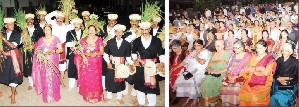
Mysuru Kodava Samaja and Kodagu Gowda Samaja Celebrate Huthari Festival

Members of Kodava Samaja, Mysuru, seen carrying the new paddy crop during Huthri festival celebrations at Sree Cauvery Educational Institutions premises in Kuvempunagar last evening. Picture right shows a section of community members.
Members of Kodava Samaja, Mysuru, seen carrying the new paddy crop during Huthri festival celebrations at Sree Cauvery Educational
Institutions premises in Kuvempunagar last evening. Picture right shows a section of community members.

Mysuru :

Huthri, the harvest festival of Kodagu, was celebrated with traditional fervour and gaiety in city yesterday by Mysuru Kodava Samaja and Kodagu Gowda Samaja respectively.

The Kodavas, who had gathered in large numbers at Sree Cauvery Educational Institutions premises in Kuvempunagar here, worshipped Goddess Lakshmi and welcomed her in the form of grains by reaping the new paddy crop. They sang the harvest (putthari) song and danced merrily.

Dressed in traditional costumes, the Kodava men and women, young and old, performed their dances like Kolaat, Bolkaat, Kathiyaat, Kappeyaat, Pareyakali and Ummathaat.

They worshipped Lord Igguthappa and Goddess Cauvery before reaping the new paddy crop amidst chanting of ‘Poli Polio Deva,’ firing three times in the air and bursting of crackers to celebrate the occasion. The festival is observed either in the month of November or December on full moon day of Rohini Nakshatra.

The Samaja had made arrangements to distribute the new paddy and thambittu prasadam to all those present.

Kodava Samaja President Moovera K. Kuttappa welcomed and spoke about the significance of the festival. Ponjanda Lovely Appaiah compered. Samaja Vice-President Ballyamanda M. Nanaiah, Hon. Secretary Mandira P. Kalaiah, Joint Secretary Chottekalapanda Prema Uthaiah and other office-bearers of the Samaja were present. The office-bearers of various other Kodava Associations in city too took active part in making the celebrations a grand success.

Meanwhile, the members of Kodagu Gowda Samaja too celebrated Huthri in a similar manner at the Samaja premises in Vijayanagar here.

source: http://www.starofmysore.com / Star of Mysore / Home> General News / Friday – November 27th, 2015

Forest dept may acquire land in Kodagu to reduce man-elephant conflict

ForestKF13oct2015

To reduce man-elephant conflict, especially in Kodagu, the Forest Department is keen to acquire land from people and has joined hands with Wildlife Trust of India (WTI) in this regard.

The department wants to acquire about two kilometre of land belonging to the Huvinkadu and Faith coffee estates, which is part of the Kutta-Tiranahalli corridor, which in turn is part of the Nagarahole-Brahmagiri elephant corridor link. “Elephants use this stretch and we want to acquire it to reduce man-animal conflict,” Manoj Kumar, Chief Conservator of Forests, Kodagu, told reporters here on Friday on the sidelines of a workshop on ‘Dealing with leopards and elephants in human-use landscape’ here organised by Wildlife Conservation Society-India Programme (WCSIP).

“Landowners are demanding Rs 20 lakh for an acre. Hence, we have approached the WTI to map the area, ascertain land width and find out if that is necessary because there is another route through Wayanad which is also frequented by elephants,” he said.

To further reduce man-elephant conflict, the Forest Department will soon hold meetings with officials in forest departments of Kerala and Tamil Nadu on how to strengthen the Nilgiri Biosphere Reserve. The 6,000-sq km biosphere reserve presently houses 6,000-odd elephants. The last meeting in this regard was held in December 2014.

“We will hold meetings with the deputy and assistant conservators of forests of the two states to assess ground reality and undertake research. There is a need to know how many elephants can the biosphere hold and for how long. It’s crucial since this is the only habitat left for elephants. That will also help strengthen corridors,” Kumar added.

Prithviraj Fernando, Trustee and Scientist at the Centre for Conservation and Research, Sri Lanka, stressed the importance of ensuring safe habitats for elephants. “Case studies in India, Malaysia and Sri Lanka have shown that elephant relocation has not been very successful. Relocation is temporary and shifts the problem from one area to another,” he said while speaking on human-elephant interaction.

Fernando, who has been working on elephant conservation in Sri Lanka for many years now, said there was a huge population of jumbos in the island nation, and 70 people and 250 elephants died in conflict every year.

Vidya Athreya, Senior Research Fellow at WCSIP, spoke on human-leopard interaction and Ranjeet Jadhav, a journalist at Mid-Day, Mumbai, spoke on ‘Reporting human-leopard interactions in Maharashtra: A case study’.

source: http://www.deccanherald.com / Deccan Herald / Home> City / DHNS, Bengaluru – October 10th, 2015

‘Pashu Bhagya’ implemented in Kodagu

Pashu Bhagya, the state government’s scheme aimed at providing subsidy for farmers for daiy farming and to set up cattle, sheep, poultry and piggery units has been implemented in Kodagu district.

The scheme will benefit small and marginal farmers in leading a self-sufficient life. Small and marginal farmers are entitled to a subsidy of 25 per cent on an investment of Rs 1.20 lakh per unit availed from banks. Farmers belonging to the Scheduled Caste and Scheduled Tribe communities will be entitled 50 per cent subsidy.

Department of Animal Husbandry Deputy Director, Dr C Nagaraj said, a pair of cow will be provided under the scheme to each beneficiary and the unit cost is fixed at Rs 1.20 lakh. Under piggery unit, four pigs can be reared and the unit cost is Rs 94,000. For sheep rearing, 11 can be reared under the scheme. For poultry unit, 500 fowls can be rearerd and the unit cost is Rs 85,000.

The target under dairy farming in Kodagu district is 78 beneficiaries. This includes 42 general, seven SCs and three STs. The target of beneficiaries for sheep rearing is 88. Fifty one beneficiaries will be given subsidy for taking up piggery.

The target for poultry unit is 20 beneficiaries in the districts, he added.

source: http://www.deccanherald.com / Deccan Herald / Home> District / Madikeri – DHNS, October 08th, 2015

Farmer on Padayatra to Bengaluru to ensure Kodagu remains green

Manju Chinnappa and team began walking from Talacauvery to Bengaluru to stress need to save the district’s ecosystem.

ManjuChinnappaKF04oct2015

This farmer has been walking for 11 days to take his fight against environment degradation in Kodagu district. Manju Chinnappa, 37, started his padayatra from Talacauvery on September 18. Chinnappa, a native of Hudikeri, started the movement after severe drought that affected Virajpete this year. A Bcom graduate, Chinnappa says, “Even from my early days, I wanted to work towards the preservation of the culture and tradition of my motherland. Over the years, the district has seen several atrocities on land, deforestation and cultural aggression. The main aim of this walkathon is to bring to the attention of the social and economic problems that Kodagu district faces today. I hope it motivates people to preserve the culture and sanctity of the native people.”

Chinnappa has managed to cover close to 25 kms everyday and en route he is celebrated by the people of that particular village who walk with him for a few kilometres to express their support. On Monday, he reached Mysuru. He also gives awareness talks on how to keep the heritage of the district alive.

A founder of the United Kodava Organisation that was formed in 2011 to focus on preserving the environment and heritage of the place, he says, “We know merely submitting a resolution to the state government might not bring much change. We wanted to make a noise through this padayatra to get the attention of as many people as possible. We hope to reach Bengaluru by October 4 and we want to submit a memorandum to the chief minister regarding our demands.” His plan is to cover a distance of 414 km considering he has taken a route inside Kodagu within the villages to spread his message. After reaching Bengaluru, the final leg will start at 9 am from Jnanabharathi campus (Bangalore University) where the local Kodava population will join him in the walk up to 20 kms that will culminate at the Kodava Samaja in Vasantha Nagar. The local Kodavas will come in their traditional dress to show their support to Chinnappa.
Chinnappa says, “In the name of tourism, several trees are being removed which has harmed the people living in that region. Our main resolution is to put pressure on authorities to stop the conversion of wetland not only in Kodagu but across the state. Many infrastructure plans by the state government have destroyed the ecology of the district completely and we want to draw everybody’s attention to this.”

The Kodava community in the city is all set to welcome Chinnappa. They have also started a Facebook page to update the information of padayatra from time to time.

Children are also taking part

Route plan

Talakaveri-Igguthappa Temple-Madikeri-Bayarambada-Virajpet-Gonnikoppa-Anechowkur-Hunsur bypass- Mysuru-Srirangapatna-Mandya-Chennapatna-Bidadi-Jnanabharathi-Kodava Samaj, Bengaluru

source: http://www.bangaloremirror.com / Bangalore Mirror / Home> Bangalore> Others / by Vandana Kamath, Bangalore Mirror Bureau / September 30th, 2015

From Assam to Hassan in search of work

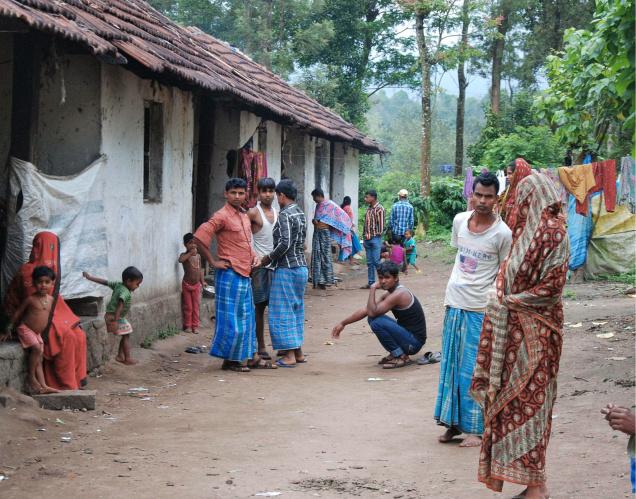
More than 5,000 people from Darang and neighbouring districts of Assam have found work in plantations of Belur and Sakleshpur taluks.— Photo: Prakash Hassan

Assam may be famous for its tea gardens, but a good number of Assamese workers have found employment in the coffee estates of Chikkamagaluru and Kodagu.

More than 5,000 people from Darang and neighbouring districts of Assam have come to work in plantations of Belur and Sakleshpur taluks. Many more work in estates spread over Chikkamagaluru and Kodagu districts.

“We hardly find jobs in our hometown. If we get work for a week, we remain jobless for next few weeks,” said Habizur Rahman (25), who has been working in Hasurugudda Estate of IBC company near Arehalli in Belur taluk for the last four years. Both men and women are enrolled as contract workers in estates for a daily wage of Rs. 228. In Assam, women hardly get the opportunity to earn in fields, he said.

The wave of migration started five years ago, when a manager of an estate in Belur taluk came in contact with planters in Kodagu, where workers from Assam had begun to arrive. “Those days we were struggling to get local people to work. We were looking for people who could work. The first batch of 25 people came from Assam five years ago. As they got work for the entire year and wages were better than what they got in their homeland, they brought more people from their State,” said Fazlur Rahman, manager with IBC estate.

Election trips

The manager pointed out that many planters have employed Assamese as they are hard workers, though they are not well-versed in the skill of maintaining coffee. These workers have brought their family and all of them make a trip to their homeland during elections. “Voting is significant as there is a serious issue of illegal migrant voters from Bangladesh,” said Shwahidul Islam, who always keeps his voter’s identity card in his pocket.

However, the workers are unhappy with the poor facilities provided in the estates. Around two or three families are forced to settle in one house with plastic sheets to separate them. For over 80 families there is only one toilet, in one of the estates visited by The Hindu .

“We repeatedly demand for proper facilities, but our cry does not reach the people concerned. If anyone falls sick, we neither get paid holiday nor medical expenses reimbursed,” said Habizur Rahman.

The district administration has set up a tent school for children of migrant workers, but they find this of no use. “We need a proper school where our children can get education from teachers who know Hindi,” said Marina Khatun, one among the women workers in the estate.

source: http://www.thehindu.com / The Hindu / Home> National> Karnataka / by Sathish G.T. / Hassan – September 27th, 2015

New team for United Planters’ Association of Southern India

N. Dharmaraj, President and D.Vinod Sivappa, Vice - President
N. Dharmaraj, President and D.Vinod Sivappa, Vice – President

Mysuru :

N. Dharmaraj was elected as the President and D.Vinod Sivappa as Vice- President of United Planters’ Association of Southern India (UPASI) for the year 2015-16 at the Annual General Meeting of UPASI held on Sept.24 at Coonoor, Tamil Nadu.

Dharmaraj has over 41 years of experience in plantation business, working with companies like Brooke Bond, Unilever etc. He is currently the Chief Executive and Whole-time Director of Harrisons Malayalam Ltd.

Dharmaraj was Chairman of the UPASI Tea Committee and Chairman of the UPASI Commodities Exchange Limited. He was a member of the Tea Board of India and Founder-Convener of the Golden Leaf India Awards (TGLIA). He is currently a Member of Tea Council of South India constituted by the Tea Board as also a Member of the Core Committee of the Tea Board of India.

Vinod Sivappa, son of former President of UPASI (late) D. Sivappa in the year 1970-71, hails from a coffee growing family for more than 160 years. Vinod Sivappa was on the Committees of Codagu Planters’ Association and also was the Chairman of the Karnataka Planters’ Association. He is involved in many sporting activities. He is a Director of many organisations and various companies, according to a press release from Ullas Menon, Secretary General, UPASI.

source: http://www.starofmysore.com / Star of Mysore / Home> General News / September 27th, 2015

Annual Kail-Poldh get-together held at Kodava Samaja

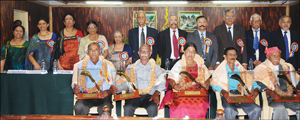
The senior members of Kodava Samaja, Mysuru (sitting from left): Machura N. Kaveriappa, Napanda U. Aiyappa, Kakamada Ganga Chengappa, Bottolanda M. Ponnanna and Ponjanda S. Arjuna, who were felicitated with a shawl, garland and memento at the annual get-together held at Field Marshal K.M. Cariappa Community Hall in city yesterday, are seen with (standing from left) Ponjanda Lovely Appaiah (Hon. Secretary, Sree Kaveri Kodagu Mahila Sangha); Thambanda Neena Devaiah (Jt. Secretary, Kodava Samaja); Balyamanda Sarasu Nanaiah (President, Sree Kaveri Kodagu Mahila Sangha); Chembanda Nanjamma (President, Kodagu Sahakara Sangha); Mechanda Mithra Karumbaiah; Mechanda M. Karumbaiah (President, Kodava Samaja); chief guest Kambeyanda C. Biddappa (retired Senior Vice-President, ITC); Moovera K. Kuttappa (Vice-President, Kodava Samaja); Kekada M. Belliappa (Hon. Secretary, Kodava Samaja); Kuppanda P. Subbaiah (Treasurer, Kodava Samaja) and Prof. Kambeyanda C. Belliappa (Chairman, Sree Cauvery Educational Institution)

Mysuru :

The annual Kail-Poldh get-together was celebrated at Field Marshal K.M. Cariappa Community Hall in Vijayanagar 1st stage here yesterday under the auspices of Kodava Samaja, Mysuru.

The day-long programme began with Ayyalapanda Pattu Pemmaiah performing Ayudha Puja to the traditional weapons of Kodavas. Kail-Poldh festival is celebrated in Kodagu during the end of the paddy sowing. Kail means weapon or armoury and Poldh means worship. The festival also signifies the day that men should prepare to guard their crop. Hence, on the Kail-Poldh day, the weapons are taken out of the puja room, cleaned and puja is offered.

Kambeyanda C. Biddappa, retired Senior Vice-President, ITC Ltd., who was the chief guest, felicitated eminent Kodavas and senior members of the Samaja in recognition of their service to the Samaja and the society.

Speaking on the occasion, K.C. Biddappa said that higher education was the most important enabler for all-round development of a community. He then said it was unfortunate that while Kodava students in urban areas are doing well academically their rural counterparts are lagging behind and needed help.

“These rural poor Kodava students need support from the community, and organisations like Kodava Samaja, Coorg Education Fund and Deena Bandhu Charitable Trust should help poor Kodava students without making merit the only criteria,” he added.

Stating that in most of the district head quarters every community has hostels to help their poor students to study with free boarding, lodging and financial support, he rued that there was not a single Kodava hostel any where. “If only we were to have Kodava hostels in Madikeri , Mysuru and Bengaluru, a lot of poor Kodava students would have benefited and progressed,” he opined.

Referring to the dwindling population of the community in Kodagu, he said Kodavas are losing relevance in their own homeland and that the Government does not bother because Kodavas are not a vote-bank.

Stating that Kodava population in Kodagu is just between 80,000 and 90,000, he said to become relevant Kodavas needed to take the support of all the moolanivasis of Kodagu like Peggade, Iri, Amma Kodava and other original inhabitants.

“We should all unite and take up our cause under one umbrella to create a sustainable and significant vote-bank, then only the Government will respond to our demands,” he said.

Biddappa reiterated that Kodavas must be united and said if Kodavas have to survive then they should focus on higher education and support poor Kodava students.

The senior members, who were felicitated by the Samaja are: Napanda U. Aiyappa, an exserviceman; Machura N. Kaveriappa, also an exserviceman; Bottolanda M. Ponnanna, who runs a private business; Ponjanda S. Arjuna, retired Circle Inspector and recipient of Chief Minister’s and President’s Medal and Kakamada Ganga Chengappa, who runs Swastha, a school for specially-abled children in Sunticoppa, Kodagu and recipient of Rajiv Gandhi Manav Seva Award for service to special kids. The above achievers were introduced by Mandira P. Kalaiah, Ammatanda Madhu Medappa, Machanda S. Muthappa, Thambanda Neena Devaiah and Kekada M. Belliappa respectively.

Replying to felicitations, the senior members, who are actively involved in the Samaja activities, called upon the Samaja, area-wise Kodava Associations and the community members to preserve and promote the unique Kodava art, culture and tradition by encouraging the Kodava youth to come forward and pursue the same.

On the occasion, various scholarships instituted by the Samaja members were presented to meritorious Kodava students (from 7th std. to Post-Graduation) and achievers in sports.

Kattera A. Kariappa, former President of Kodava Samaja and President of Deena Bandhu Charitable Trust, Mysuru, who also spoke, sought the support of the Samaja members to the Trust, which has been helping poor and needy Kodava students in their studies.

Earlier, Keethiyanda Kavya Kuttappa, Ketolira Bhavani and Appanderanda Thara rendered the invocation. Samaja President Mechanda M. Karumbaiah welcomed and presided. Treasurer Kuppanda P. Subbaiah read the names of the deceased members after which a minute’s silence was observed as a mark of respect to the departed souls.

Ponnachanda S. Bheemaiah read the names of the scholarship awardees.

Vice-President Moovera K. Kuttappa introduced the chief guest.

Ponjanda Lovely Appaiah compered and proposed a vote of thanks.

Hundreds of Kodavas attended the day-long get-together which concluded with sports and games for the members and their children in the afternoon session.

source: http://www.starofmysore.com / Star of Mysore / Home> General News / Monday – September 07th, 2015

Assamese Workers Fill Labour Shortage in Kodagu Estates

Madikeri :

They have worked in the tea gardens of Assam but in Madikeri they are tending the Coffee plants. Labourers from Assam working in coffee plantations in Kodagu have become a common sight since the past two years.

It is in south Kodagu that more number of Assamese labourers find work in houses and estates.

A few days ago, nearly 200 people arrived from Assam and were divided in teams to meet the demands of the local agents.

According to the labour department officials, there are seven labour camps in and around Kodagu where these people stay.

A few big planters will host some of the Assamese labourers in their own camps in the estates.

In Kodagu, over the years, shortage of labourers have been very severe and existing workers have been demanding more salary and benefits. In 2011, the acute shortage of labour and the high demands of local labourers had put the planters in a spot.

Earlier, the planters were getting labourers from Sullia in Dakshina Kannada and Arasikere in Hassan district, but the Assamese labour comes much cheaper than the usual lot, the officials added.

A labour contractor from Dakshina Kannada, Rajappa Gowda, who takes labourers from Sullia and Puttur every week, says Kodagu has a heavy demand for labourers.

Many escape the labour work in the estates and get into more cozier jobs as servants at home-stays.

But the migrants tend to stay for longer as they get all the benefits, from schooling for their children and higher social security.

Former vice-chairman of Coffee Board of India, Bose Mandanna, told Express that though Assamese workers do not know the scientific work of coffee cultivation, those who settle here learn how to spray, borer tracing and other works. Since all migrants show records like BPL cards, voter IDs and other records, it is the responsibility of the officials to trace fake cards, he says.

However, according to Codava National Council president N U Nachappa, these workers are all Bangaldeshis possessing fake documents. He recalled the protests held early this year urging officials to verify the labourers’ antecedents.

A coffee planter from Gonikoppa told Express, “Since we are getting Assamese labour, demand for more salary from workers who come from far away places cease.”

Another planter from Suntikoppa in Somwarpet taluk said many estates would run into trouble if the Assamese labour did not flow into Kodagu.

The police department have asked all coffee growers to check the documents and collect photos of workers and their family members and submit copies to them without fail.

source: http://www.newindianexpress.com / The New Indian Express / Home> States> Karnataka / by Express News Service / August 24th, 2015

Capricious Nature Worries Farmers

Madikeri :

The rain deficit in Kodagu, the origin of Cauvery river, has become a major cause of worry for the farmers here.

As far as the monsoon is concerned, the rainfall seems to be following an erratic pattern.

Heavy rain lashed the district in the beginning of the monsoon causing havoc. Later, it slowed down causing a drought-like situation.

Generally, in the 90-day monsoon season, the rainfall was sufficient for farmers as it was enough to fill the Harangi reservoir. But this year, the situation is different.

Though Harangi is full, Krishna Raja Sagar (KRS) reservoir is yet to be filled as the crest gates in Harangi were opened only once.

Kodagu district received 60 cm of rain in the first 10 days of the monsoon causing floods.

In July and August, rainfall was deficient by 70 and 60 per cent respectively.

Cloud seeding was taken up in Kodagu six years ago, but it was not conducive with the weather here.

According to figures available with Express, the average expected rainfall in January was 5 mm, but the district received 0.3 mm; February – 3.2 mm (5.6 mm expected); March – 37.4 mm (14.7 mm); April – 133.4 mm (73.5 mm); May – 191.4 mm (146 mm); June – 804 mm (486 mm); July – 366 mm (938 mm) and till August 20 – 164 mm (250 mm).

This erratic rainfall seriously impacted the water requirements of paddy, coffee and pepper crops.

The total average rainfall from January to August should have been 2,100 mm, but Kodagu has recorded 1,710 mm. The district is facing a deficit of 300 mm rainfall.

A minimum of 600 mm rain is required on a weekly basis to fill the reservoirs in Kodagu.

source: http://www.newindianexpress.com / The New Indian Express / Home> States> Karnataka / by B C Dinesh / August 24th, 2015