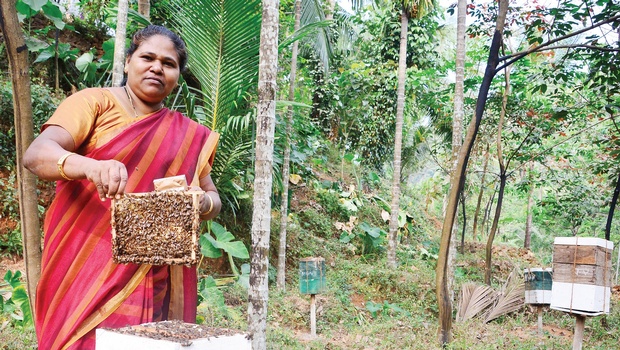
It is 9 pm. Outside their house at Panathady in Kasaragod district in Kerala, Aleyamma and her husband Siby are hurriedly placing beehives inside a van. Later, they climb in and the van sets out towards the Coorg district in Karnataka, which is only 30 km away. Once there, they quickly place the hives in three-foot-high stands, below trees, at a distance of three metres. “We have to do this before the sun comes up,” says Aleyamma. “Because at sunbreak, the bees would want to come out in search of nectar and pollen. And if we keep the hives shut they will die of asphyxiation.”
Aleyamma is a breeder who practices migratory beekeeping. Once the honey is harvested at all the hives placed near her house from January to March, she sets off to Coorg and does bee farming there. “Somehow, the quality of the honey is far better there,” she says.
But there is a reason for that. In Kerala, the major source of nectar is from the leaves of the rubber tree. “This is called unifloral honey,” says Dr Stephen Devanesan, principal scientist, All India Coordinated Research Project on Honeybees and Pollinators, Kerala Agricultural University. “But in Coorg, the hives are placed in forests where there is diverse flora. So, the quality of this multi-floral honey is much better.”
However, the collection of honey is not an easy process. First the bees have to be warded off using smoke. Then the honeycombs are removed from the hive. With the help of a honey extractor, the honey is taken out of the cells and stored in containers. All this has to happen in less than an hour, before the bees start stinging the person.
“In the beginning, the stings used to hurt a lot and there would be swelling as well,” says Aleyamma. “But now, though there is pain, there is no swelling. This is my bread and butter, so I have learnt to tolerate the aches,” she adds.
The biggest problem with honey is that it crystallises and ferments. To avoid this, Aleyamma uses the double-boiling method. In this technique, she pours water into a large container. Then she places a smaller bowl, which contains honey, inside it, resting on three bricks. The bottom container is heated, so that the temperature inside the smaller bowl reaches 45 degrees centigrade. Then the honey is taken out, and put through a sieve, to get rid of wax particles, dust and pollen. Following this, it is reheated to 65 degrees centigrade for about 10 minutes. “After the honey cools, it is filtered,” says Aleyamma. “Once this is done, the honey will last for years, without going bad.”
Interestingly, Aleyamma is the only woman beekeeper in Kerala. Last year, she produced 40 tonne of honey, thanks to the 5,000 colonies of Indian and Italian bees that she has.
And thanks to this high productivity, Aleyamma was recently conferred the Stephen Memorial Award for the best beekeeper of 2014 by state Agriculture Minister KP Mohanan. This award has been instituted by the Federation of Indigenous Apiculturists.
To get a high productivity, Aleyamma depends a lot on the Tamil workers, who are experts at bee collection. “They are sincere, hard-working and not afraid of being stung,” she says.
Aleyamma also credits her success to a workshop which she attended. This was conducted by Devanesan, along with Dr K Prathapan, director of the State Horticulture Mission. Devanesan says: “I have imparted training to Aleyamma and other breeders on how to maintain the health of the bees, manage colonies, and do high-tech apiculture. Today, they are all doing well.”
Like most good things in life, Aleyamma came to bee breeding by accident. When she got married and went to stay at her in-laws’ home in Thodupuzha, she saw beehives for the first time in the backyard. In the mid-1990s, she and Siby decided to move to north Kerala to improve their economic prospects. They tried pepper farming and rubber cultivation.
“It did not do well,” she says. “That was when I thought about bee farming. And now, here I am, the only woman in Kerala doing this work.”
source: http://www.newindianexpress.com / The New Indian Express / Home> Magazine / by Shevlin Sebastian / February 28th, 2015
Orders stoppage of tree-felling until MoEF approval
Protestors against the illegal felling of more than 50,000 trees in Kodagu for the sake of a power transmission line have a reason to smile. Ahead of their hearing by the Karnataka High Court, the National Green Tribunal’s order on Friday in a separate case seems to have revived their hopes of protecting the trees.
Order on activist’s PIL
The National Green Tribunal (NGT), on Friday, ordered all agencies to refrain from felling trees while executing linear projects in forest areas, unless an approval under the Forest (Conservation) Act 1980 was obtained. The NGT ruling was a response to a petition filed by Maharashtra-based activist Milind Pariwakam who objected to the National Highway Authority of India (NHAI)’s project of widening of NH-6 and NH-7 in the Vidarbha region. This would involve felling trees and diverting forest land through the fragile Tadoba Tiger Reserve in Maharashtra. The NGT ruling is likely to have a nationwide impact in preventing diversion of forest land for non-forest purposes.
The NGT clearly stated that all linear projects like railway lines, development of roads, canals and laying of transmission lines through forests must obtain permission from the MoEF under FCA -1980. Although the Chennai Bench of NGT had refused to stall the project last year, activists hope that the latest order will have an impact.
Speaking to Bangalore Mirror, Sajan Aiyappa, coordinator of the Save Cauvery Campaign, said, “Previously, when we approached the NGT’s Southern Bench, it had dismissed the petition on technical grounds and so we approached the High Court. The case has been posted for hearing on Monday. However, we welcome the order by the NGT in Maharashtra. We hope that the order will force authorities to take note of the seriousness of the issue and safeguard the fragile eco-system of Kodagu.”
The activists clarified that they were not against the project, but only concerned about the felling of 50,000 trees which would have a catastrophic impact on the rainfall of Kodagu. This, they say, would adversely affect the flow of water to the Cauvery and in turn affect the availability of potable water in Mysuru and Bengaluru.
Felling continues
“Despite the case being posted for hearing before the High Court, the authorities, a few days ago, cleared many trees within the limits of coffee estates. We have submitted scientific reports on the variety of species of trees in plantation areas. The court must take note of this and help us in safeguarding the eco-system,” yet another activist said.
source: http://www.bangaloremirror.com / Bangalore Mirror / Home> Bangalore> Others / by Niranjan Kaggere, Bangalore Mirror Bureau / February 23rd, 2015
The State Forest department is preparing a report on ways to mitigate the impact on the environment in Kodagu, when the 400 KV high tension power line is laid.
The report on the environment mitigation plan comprises short-term and long-term measures.
The measures are being listed keeping in mind development and protection of green cover.
It will be sent to the government by the end of this week, which will then be forwarded to the Power Grid Corporation and the Union government for funds and approval, Principal Chief Conservator of Forests (wildlife) Vinay Luthra told Deccan Herald.
Some of the listed measures include organising anti-depredation camps, building better barriers, not disrupting the existing waterholes, providing natural fodder spaces for animals, not using weapons against animals and if carrying weapons, getting them registered with the Forest department to ensure that animals are not harmed, not coming in contact with animals, not indulging in afforestation activities, not camping inside forest areas, reducing loss of green cover as much as possible and in regard to work in forest areas, ensuring that all permissions have been obtained and following rules like no-stay inside the forest during night hours, not hunting, not entering restricted forest area without permission and so on.
The report plans to ensure that no human or animal casualty is reported, but in the last 30 days two people have died due to man-elephant conflict and one person sustained injuries while working near coffee estates.
The power line from Mysuru to Kozhikode will pass through Kodagu. Of the 210-km line, 50 km will pass through coffee and paddy fields in Kodagu and the rest is through pristine Western Ghats regions – touching borders of Nagarahole Tiger Reserve, Dubare and Devamachi Reserve Forests.
This line is part of the central power grid project and will supply power to many southern regions, including Bengaluru.
Due to protests, this project been delayed by over five years. Lines have already been laid till Mysuru and Kerala, except some patches in Wyanad. It was to be completed in 2007, but was stalled. Work started again in November 2014.
During a meeting of agitators from Kodagu and power corporation companies last week, Energy Minister D K Shivakumar affirmed that the project would not be held back or delayed further. Shivakumar said that the project was important for Bengaluru and industries, to ensure 22-hour power supply daily, especially during summers. But agitators from Kodagu said that it was a scam. C P Muthanna, a retired colonel in the Army and president of the Coorg Wildlife Society, pointed out that there was already a 220-KV line in the region, which can be upgraded to 400 KV and used, instead of occupying fresh land and axing over 50,000 trees for the new line.
DH News Service
source: http://www.deccanherald.com / Deccan Herald / Home> State / by Bosky Khanna, Bengaluru / DHNS – February 17th, 2015
IIHR is targeting 35,000 hectares of paddy land mostly left fallow for 6 months to grow vegetables
If things go according to plan, Kodagu, the land of coffee and pepper, may turn into one of the major destinations for high-value vegetable cultivation a few years from now.
A survey conducted by the Indian Institute of Horticultural Research (IIHR) showed that paddy was being cultivated on about 35,000 hectares of plain land in the hilly district of Kodagu. Most of this is being left fallow for six months from October to March after the monsoon. Vegetable experts in the IIHR want to make best use of the land during the “off- season” by motivating people to take up vegetable cultivation.
“It is possible to cultivate vegetables during the off-season as their water requirement is not as huge as paddy,” says A.T. Sadashiva, Principal Scientist in the IIHR’s vegetable Crops’ Division. Also, the weather in Kodagu is similar to that of Ooty, where vegetables are in high demand, he said. Above all, vegetable farming fetches at least one-and-a-half times more returns than paddy, he says.
Preliminary work towards promotion of vegetable cultivation has already begun. The IIHR has developed model farms on about 50 hectares in different areas of Kodagu where high-value hybrid varieties developed by it are being cultivated. “We have also held four field days since 2012 in different areas such as Suntikoppa, where cultivation of different vegetables at the model farms has been showcased. Observing the overwhelming response to such events, we plan to have two more such field days shortly,” he says, while expressing confidence that it may be possible to encourage farmers to take up vegetable cultivation on a minimum of 100 hectares this year.
At present, vegetables like okra, tomato, beans, yard-long beans and chillies are being promoted, while other vegetables such as carrot will be introduced in the next phase, he says. Onion cultivation has also been introduced on an experimental basis.
The marketing network for the vegetables in Kodagu is not advanced. The IIHR is in talks with the State Horticulture Department, which has promised to provide facilities for sale of vegetables in different parts of the district, Mr. Sadashiva says, adding that plans are also afoot to sell the vegetables to other districts and States as and when the production increases.
It is possible to cultivate vegetables during the off-season as their water requirement is not as huge as paddy
A.T. Sadashiva Principal Scientist, IIHR
source: http://www.thehindu.com / The Hindu / Home> News> Cities> Bengaluru / by B.S. Satish Kumar / Bengaluru – February 22nd, 2015
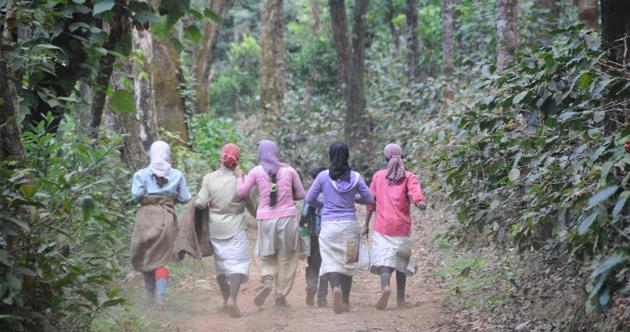
Homebound Migrant workers return to their sheds after the day’s work at a coffee estate near Madikeri, Coorg. – GRN SOMASHEKAR
Though migration of labour from the east has helped revive the plantations in southern India, questions remain on the long-term implications, Vishwanath Kulkarni reports
As the harvest season starts in Coorg, Karnataka, coffee planter MC Kariappa has a lot of issues to contend with — productivity, weather and, the biggest worry of all in recent times, paucity of labourers. So when a dozen labourers from Assam landed at the gates of his coffee plantation at Madapur in January, at the start of the harvest season, Kariappa heaved a sigh of relief.
Though not adept at, or trained to work in coffee plantations, these migrant labourers -– both men and women — proved useful for Kariappa in harvesting Arabicas, the mild and premium variety of coffee. “Some of them are as good as the local workers, picking up to 100kg of ripened coffee a day,” says Kariappa, relieved that the harvest this year went off smoothly.
Migrant workers are now a common sight in Coorg’s coffee plantations, especially during the harvest season, as the country’s key coffee-growing region has been facing an acute shortage of labour over the past few years. Traditionally, plantations in Coorg and Chikmagalur attracted migrant workers from the drought-prone regions of North Karnataka and the plains of neighbouring Mysuru. This pool of labour now increasingly prefers urban centres such as Bengaluru, as jobs in malls, petrol bunks and garment sector are better paying. There is less toil too, compared to work in the plantations.
“Most of the worker quarters in my plantations were vacant until these people [migrant workers] landed here,” says Kariappa. Adds N Bose Mandanna, former vice-president of the Coffee Board and a planter in Suntikoppa: “Without improved labour availability, we would have been in a soup.” There are no official figures, but the number of workers from Assam and other eastern parts of the country migrating to Karnataka’s plantations are commonly believed to run into ‘thousands.’
The movement of labour is not towards Karnataka alone. Plantations across South India, including those in Tamil Nadu and Kerala, now depend on the labourer from eastern or north-eastern India.
A ‘healthy’ phenomenon
The daily wagers at Coorg’s coffee plantations largely come from Assam, while tea gardens in Tamil Nadu’s Nilgiris, and the Kerala estates growing coffee, spices, coconut and rubber get their workforce from Arunachal Pradesh, Tripura, Jharkhand, Odisha and West Bengal.
In the other two southern states — Andhra Pradesh and Telangana — the migration is confined to urban areas.
This was the case elsewhere in the south too, with migration initially confined to urban job sectors such as construction, security services and jewellery-making. The plantations have recently emerged as a favourite destination for the migrant unskilled labourer and the trend is seen to be gaining momentum now. It helped that connectivity between the two corners of the country improved with the addition of train connections.
“Growth in the South is creating employment opportunities. And migration is a healthy sign for the economy,” says Gopinath Parakuni, founder and General Secretary of CiviDep India, a non-governmental organisation working among labourers in the plantation, construction and garment sectors.
It helps that mechanisation has not caught up with plantations, as it has elsewhere in the agriculture sector for tasks such as land preparation, sowing and harvesting. In Punjab and Haryana, where farms were once a favourite destination for labourers from Bihar and Uttar Pradesh, mechanisation has taken over, leading to falling numbers of migrant farm workers.
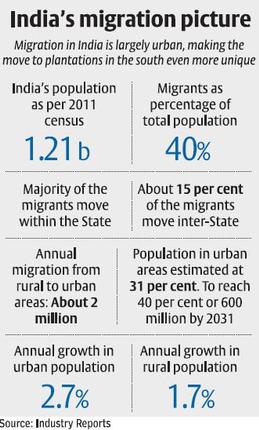
Rural migration mirrors a larger trend in the country, with about two million migrating annually from rural to urban areas and vice versa, says Ram B Bhagat, Professor and Head, Department of Migration and Urban Studies, International Institute of Population Sciences, Mumbai. In other words, about two per cent of India’s 1.21 billion population migrates every year. Half of the population is under the age of 25 and migration helps them secure jobs and livelihoods.
Inflection point
In all the southern States, the arrival of migrant workers was preceded by the movement of the local workforce to urban job markets.
In the Nilgiris, the tea sector had for decades depended on farm hands from the southern districts of Tirunelveli, Ramanathapuram and Salem. In 1999, the labour unrest in two estates set off several changes.
Workers moved to the plains and the knitwear cluster of Tirupur began to emerge as a hot destination for jobseekers back then. “This was followed by the boom in the IT services sector, which created allied jobs. The workers realised that plantation wages could not match the package offered in the urban markets. The rest is history,” says an executive from the plantations industry, who declined to be named.
Though officials from the local tea industry were unable to provide any figure, it is estimated that over 50,000 migrant workers currently work in the Nilgiris.
Tea plantations in Kerala traditionally employed labourers from Tamil Nadu, but are increasingly replacing them with migrants from the eastern and north-eastern parts of the country.
Every day, trains bring over 1,000 migrant workers, mostly unskilled casual labourers, who arrive with the help of friends, relatives or labourer-turned-labour contractors. They are immediately absorbed into the urban job markets in the far corners of Kerala, which is today home to nearly 25 lakh migrant workers — the largest pool in the southern region.
A third of the migrants joins the construction sector, while not that many find work in agriculture.
In the past five years, though, a sizeable number of them have found work in the plantation sector, including rubber estates. After the recent fall in rubber prices forced farmers to leave trees untapped, the migrant workers had to look elsewhere for work.
Moreover, “individual, homestead farmers prefer local workers,” points out Jose Sebastian of the Thiruvananthapuram-based Gulati Institute of Finance and Taxation. “Migrant workers are not much preferred on the rubber plantations,” adds Ajith BK, secretary of the Association of Planters Kerala. “Rubber-tapping demands specific skills and requires staying close to the plantation, reporting to work before daybreak and a long-term commitment, as it is not a seasonal harvest,” says Ajith. But in other plantations, the dependence on migrant labour has increased.
For a better life
Noor Mohammad has come to Coorg for the second time this year, seeking work in the plantations. This time, the 25-year-old has brought along his wife and younger brother. “It is good working here in these estates,” says Mohammad, who hails from Darrang in Assam.
He was initially brought to the plantation by a labour contractor or raj mestri. Similarly Asadullah, another worker in his mid-50s, has brought along his family from Guwahati. Back home, the likes of Mohammad and Asadullah own small plots, cultivating rice and vegetables. It is a hand-to-mouth existence, worsened by the violent unrest caused by the Bodo movement.
Life is better in Coorg. The migrants are paid on a par with their local peers, based on the quantity of coffee beans picked daily. This is different from the wages specified under the Plantation Labour Act, which is in effect during the rest of the year. The more the labourers pick, the more they earn — a major incentive. Estate owners pay ₹3.50 to ₹5 for one kg of coffee beans picked. The rates are higher when labour is scarce and time is running short for the harvest.
Many workers tend to remit their earnings back home on a weekly basis. Noor Mohammad and his family plan to save about ₹50,000 during the current season. While many return home at the end of the two-three-month harvest period, others stay back for work such as weeding and trimming.
They get accommodation on the estates and wages are paid according to the Plantation Act, which includes benefits such as provident fund, insurance and gratuity. A male labourer is paid ₹270 a day, and the female counterpart gets ₹230. “Back home, it is difficult for women to go out for work, even in their own rice or vegetable fields,” says Mohammad.
The wage structure is similar in the Nilgiris. “I was earning a daily wage of ₹95-100 back home, but am now getting more than ₹250 a day,” says Rabi, an Assamese working in a tea estate. Industry associations say there is no discrimination in the package or amenities offered to migrant workers. “They are provided accommodation, crèche and all other benefits on a par with the locals,” said the industry executive.
Social dynamics
In Kerala, migrant workers earn as much as ₹700 a day, but their living conditions are not as good as the local labourers. Although squalid, the lodging is often offered for free or at low rates, so the labourers accept them unquestioningly. Factors such as low literacy and unfamiliarity with the local language act as a barrier to integrate with the local community.
In Coorg, locals say they work in harmony with the migrant workforce. “They work on their own and we are on our own,” says Sundri, a local who has been working in coffee plantations for several years.
But experts warn that rising migration can lead to socio-economic issues. In Kerala, which ironically is a major source of manpower for West Asian countries, the locals are increasingly voicing concerns about the alleged rise in law-and-order troubles due to the migrant population. Incidents such as the one in early February where three workers from West Bengal were arrested for allegedly killing a hotel employee in Kozhikode are fuelling such fears. This has prompted the Kerala police to create a database of migrant workers, including their photographs and fingerprints.
In Karnataka, the recent arrest of a terror suspect hailing from Assam has triggered concerns. Plantation associations have advised members to insist on documents such as identity cards from the labourers as a precautionary measure. In the Nilgiris too, the situation is similar.
“It is difficult to do a background check of these people. We do not know if there is infiltration, but there is all-round concern about engaging them. We can’t shoo them away either. Estate managements maintain a register, but it is still not organised,” a planter said on conditions of anonymity.
Though the arrivals of migrants have increased the workforce, the long-term implication on the social fabric remains to be seen, Mandanna adds. This would depend on on how long they would stay back and whether they pick up the local language and integrate well with the local population.
With inputs from LN Revathy, KPM Basheer and KV Kurmanath
source: http://www.thehindubusinessline.com / Business Line / Home> Features / by Vishwanath Kulkarni / February 16th, 2015
Though bitter in taste if eaten raw, Dendrocalamus brandisii in Coorg has been since slowly making it to the local menu
Till recently, it was like any other species of bamboo that dotted the vegetation. The locals have for long a fair penchant for the edible varieties of bamboo shoots but no liking for the abundantly available Burma bamboo. Nobody dared to give the bamboo shoot a try for fear of it being poisonous.
The turning point, however, came when a team of scientists from Institute of Wood Science and Technology (IWST) in Bangaluru visited Coorg to propagate the vegetarian properties of Dendrocalamus brandisii. Based on their over a decade long research on the Burma bamboo species, for the first time it was disclosed that bamboo shoot eschewed by the people of Coorg and adjoining areas for over a century in fact is considered among one of the top 10 edible bamboo species in the world.
Unlike the Chinese species, although bitter in taste if eaten raw, Dendrocalamus brandisii in Coorg has been since slowly making it to the local menu list.
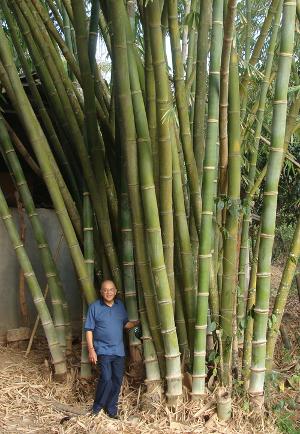
“It is surprising that in Coorg, where this species was first introduced nearly a century back in 1913, the shoots have not been commercially exploited even though shoots of other species like B. bambos and D. strictus found in natural forests in Coorg have been utilised in some form or other. Pickles made from B. bambos are traditionally an important delicacy in Kogadu cuisine,” says senior scientist Dr Syam Viswanath (in pic), spearheading the research at IWST.
Much of the ignorance about the high level of edible properties of Burma bamboo has to do with the fact that its value as an edible material has never been recognised in Coorg. The common perception has been that the shoots of the bamboo species are poisonous. Further, absence of any information about the nutritional benefits, processing and consumption of the bamboo shoot have been the main reason for underutilisation of D. brandisii or Burma bamboo.
In China, D. brandisii bamboo shoots species is cultivated in Hangzhou province. The emerging shoots are harvested and after removal of the sheath, it is sliced into thin pieces and consumed raw like salad. In case of D. brandisii in Coorg, the shoots are bitter due to higher content of cyanogenic glucosides and need to be processed before they are ready for consumption.
Sowmya C , Ph.D scholar working on edible bamboo shoots in Tree Improvement and Genetics Division at IWST has found out that the nutritional composition of some of the common bamboo species exploited for edible shoots like B. balcooa, B. nutans, B. polymorpha, Melocanna baccifera found in North-eastern states is on-par with D. brandisii grown in Coorg.
The protein and carbohydrates contents in 100 gm of fresh bamboo shoot are about 2.31gm and 4.90 gm, respectively. Consumption of 100 gm of fresh shoots will supply adequate amount of protein essential for the body. The D. brandisii shoots are also rich in dietary fibre, 4.03 gm/100gm, higher than other commonly available vegetables. Dietary fibres are proven to have beneficial effects on lipid profile. It also helps in management of hypertension and obesity.
Culinary experiments with the Burma bamboo shoots have revealed that simple cooking techniques like pressure cooking and steaming can remove the bitterness in the bamboo shoots in comparatively lesser time than traditional methods like 48-72 hours of soaking in water.
Besides, the newly found edible properties of Burma bamboo by people of Coorg, the culms ofthe bamboo species have long been used in construction works, making of furniture, farm implements, baskets, handicrafts and for making ‘chandraki’ in sericulture industry. The bamboo has also the potential of making incense sticks by the agarbatti industry.
Due to its good physical and mechanical properties and thorn less character, it can be introduced in suitable agro-climatic zones like Coorg for raising compact plantations, in landscaping and in homesteads. Moreover the vegetative propagation of this species using rhizomatous side branches from culms is a simple cost effective multiplication technique according to Dr T.S. Rathore, Head, Tree Improvement and Genetics Division, IWST, Bangalore. IWST has also developed techniques for macro and micro propagation of this species for large scale commercial exploitation.
Director IWST Dr Ramakanth says, “Dendrocalamus brandisii is among the 19 commercially viable bamboo species identified by the National Mission on Bamboo Application (NMBA). This is based on assessment of inherent characteristics of the bamboo found suitable for end users.”
The very fact that it is fast growing, makes Burma bamboo ideal for exploitation in farm forestry and agro forestry in humid tropics. Its good physical and mechanical properties makes it a much sought after species by locals for farm construction, making ladders, fencing, small furniture, basket making and sericulture industry.
“Though National Bamboo Mission (NBM) and NMBA have rightly prioritized Dendrocalamus brandisii, it is essential to ack-nowledge the commercial potential of this underexploited species and aspects of value addition to effectively utilize and popularise this natural bio-resource in other suitable agroclimatic zones of India,” underlines Dr Sunder Naik, retired Indian Forest Service officer and President of Bamboo Society of India.
source: http://www.bangaloremirror.com / Bangalore Mirror / Home> Others> Sci-Tech / by Agencies / February 11th, 2015
Can a temperate fruit like the apple be tamed to grow in the tropics?
That it’s a distinct possibility has been shown by Mandi-based senior fruit scientist Chiranjit Parmar, with help from a few farmers in the state. Though experimentation is still at the trial stage without reaching commercial production, it has opened up new possibilities to challenge the dominance of Jammu & Kashmir and Himachal Pradesh over this fruit.
But what’s interesting is that Himachal apple saplings planted here are in a confused state! While apple trees bear fruit in five or six years in Kashmir and Himachal Pradesh, they’ve started flowering and bearing fruit within two years of planting, in Bengaluru and Somwarpet in North Kodagu.
In Dakshina Kannada, retired banker Krishna Shetty is still waiting to savour the fruits of his labour. “They’ve started flowering. I should be able to harvest apples next year,” he says. The prolonged monsoon and pest attack here have stopped them from yielding the desired results, he adds. Shetty planted 50 saplings at his farm in Hirebandady, near Uppinangady.
He said the plant can be grown in regions where the temperature ranges between 10 degree Celsius and 30 degree Celsius. “In Indonesia, growers prune leaves and get about 60 tonnes of apples per hectare. In our country, pruning is not done and the yield is limited to 6 tonnes per hectare. After three years, the yield is still limited. I need further guidance from scientists,” he said.
Calistha D’Silva from Abburkatte, Somwarpet, who planted seven trees three years ago, says one of them bore fruit within the second year, and without much care. “If I’d taken care, they may have yielded better results,” he said. “The fruits were small, but tasty. Parmar, who visited my farm, said the trees have achieved tremendous growth, which would take six years in Himachal.” This year, he’s planting eight trees in his garden.
Nagananda K from Mahalakshmi Layout, Bengaluru, has three apple trees in his terrace garden. “I’ve planted a few on my farm at Basavanahalli, Ramanagaram. The trees here have shown better results with good care, whereas at my farm, it isn’t so encouraging, probably due to lack of care,” said Nagananda. His trees also bore fruit within two years.
What started this experimentation was Parmar’s visit to Batu, Indonesia, situated almost at the Equator. This area has now acquired the reputation of an apple-producing region. After getting inputs from farmers there about this “horticultural wonder”, Parmar started thinking of the possibilities of repeating this in some parts of South India — where there is no winter season.
Shetty says the absence of winter helps growers here get two crops a year, unlike in Kashmir and Himachal Pradesh, since there’s no dormancy due to winter.
During his visit to the United Kingdom in 2010, Shetty saw apple trees in house yards. “I started thinking, why not at my home, but couldn’t get much ahead. Then I saw an article on Parmar in Adike Patrike. That started the whole process,” said Shetty.
Shetty gets his supply of plants from Himachal Pradesh, and a consignment of 2,500 saplings of five varieties reached him on Monday. “Earlier, there were takers for about 500 saplings, and the numbers are growing. Unfortunately, those who take saplings don’t give me feedback,” he said.
As of now, in Karnataka, apples are being grown on a trial basis in Dakshina Kannada, Kodagu, Tumkur, Bengaluru, Tarikere, Vijayapura and Chamarajanagar.
“The experiment has been a success. We’ve sought inputs from the University of Agricultural Sciences, horticulture department, to find out which variety is suitable for commercial cropping. But there’s been no response,” adds Shetty.
With Kodagu, a major coffee growing district, welcoming the entry of apple cultivation, success has been partial in some villages in Somwarpet taluk. Horticulture department senior assistant director Sudheendra Rao told TOI that officially, Kodagu is not an apple zone, but some growers cultivate them out of interest.
TP Sandesh, agricultural standing committee chairman of Kodagu Zilla Panchayat, got a few planted in his farm at Madapur village. As did Shashikala Raj of Masagodu village in Somwarpet. They claim the plants are flowering but the blossoms are falling without yielding fruit. Other small farmers, like Kushalappa of Kamballi village and Puttaraju of Sulimalthe, say the yield is poor.
“If the department takes interest, apples could become a good support crop in Kodagu,” the farmers say.
source: http://www.timesofindia.indiatimes.com / The Times of India / Home> City> Mangaluru / by Stanley Pinto, TNN / February 04th, 2015
Can a temperate fruit like the apple be tamed to grow in the tropics?
That it’s a distinct possibility has been shown by Mandi-based senior fruit scientist Chiranjit Parmar, with help from a few farmers in the state. Though experimentation is still at the trial stage without reaching commercial production, it has opened up new possibilities to challenge the dominance of Jammu & Kashmir and Himachal Pradesh over this fruit.
But what’s interesting is that Himachal apple saplings planted here are in a confused state! While apple trees bear fruit in five or six years in Kashmir and Himachal Pradesh, they’ve started flowering and bearing fruit within two years of planting, in Bengaluru and Somwarpet in North Kodagu.
In Dakshina Kannada, retired banker Krishna Shetty is still waiting to savour the fruits of his labour. “They’ve started flowering. I should be able to harvest apples next year,” he says. The prolonged monsoon and pest attack here have stopped them from yielding the desired results, he adds. Shetty planted 50 saplings at his farm in Hirebandady, near Uppinangady.
He said the plant can be grown in regions where the temperature ranges between 10 degree Celsius and 30 degree Celsius. “In Indonesia, growers prune leaves and get about 60 tonnes of apples per hectare. In our country, pruning is not done and the yield is limited to 6 tonnes per hectare. After three years, the yield is still limited. I need further guidance from scientists,” he said.
Calistha D’Silva from Abburkatte, Somwarpet, who planted seven trees three years ago, says one of them bore fruit within the second year, and without much care. “If I’d taken care, they may have yielded better results,” he said. “The fruits were small, but tasty. Parmar, who visited my farm, said the trees have achieved tremendous growth, which would take six years in Himachal.” This year, he’s planting eight trees in his garden.
Nagananda K from Mahalakshmi Layout, Bengaluru, has three apple trees in his terrace garden. “I’ve planted a few on my farm at Basavanahalli, Ramanagaram. The trees here have shown better results with good care, whereas at my farm, it isn’t so encouraging, probably due to lack of care,” said Nagananda. His trees also bore fruit within two years.
What started this experimentation was Parmar’s visit to Batu, Indonesia, situated almost at the Equator. This area has now acquired the reputation of an apple-producing region. After getting inputs from farmers there about this “horticultural wonder”, Parmar started thinking of the possibilities of repeating this in some parts of South India — where there is no winter season.
Shetty says the absence of winter helps growers here get two crops a year, unlike in Kashmir and Himachal Pradesh, since there’s no dormancy due to winter.
During his visit to the United Kingdom in 2010, Shetty saw apple trees in house yards. “I started thinking, why not at my home, but couldn’t get much ahead. Then I saw an article on Parmar in Adike Patrike. That started the whole process,” said Shetty.
Shetty gets his supply of plants from Himachal Pradesh, and a consignment of 2,500 saplings of five varieties reached him on Monday. “Earlier, there were takers for about 500 saplings, and the numbers are growing. Unfortunately, those who take saplings don’t give me feedback,” he said.
As of now, in Karnataka, apples are being grown on a trial basis in Dakshina Kannada, Kodagu, Tumkur, Bengaluru, Tarikere, Vijayapura and Chamarajanagar.
“The experiment has been a success. We’ve sought inputs from the University of Agricultural Sciences, horticulture department, to find out which variety is suitable for commercial cropping. But there’s been no response,” adds Shetty.
With Kodagu, a major coffee growing district, welcoming the entry of apple cultivation, success has been partial in some villages in Somwarpet taluk. Horticulture department senior assistant director Sudheendra Rao told TOI that officially, Kodagu is not an apple zone, but some growers cultivate them out of interest.
TP Sandesh, agricultural standing committee chairman of Kodagu Zilla Panchayat, got a few planted in his farm at Madapur village. As did Shashikala Raj of Masagodu village in Somwarpet. They claim the plants are flowering but the blossoms are falling without yielding fruit. Other small farmers, like Kushalappa of Kamballi village and Puttaraju of Sulimalthe, say the yield is poor.
“If the department takes interest, apples could become a good support crop in Kodagu,” the farmers say.
source: http://www.timesofindia.indiatimes.com / The Times of India / Home> City> Bengaluru / by Stanley Pinto, TNN / February 04th, 2015
(Reuters) – It’s 10 o’clock in the morning and a dozen workers are uprooting coffee plants, piling them in the corner of a field at M.G. Bopanna’s plantation in southern India where they lie ready to be burned.
The plants are bursting with green cherries but inside their hard bark lurk destructive white stem borer beetles. The bushes have to be destroyed to prevent the tiny winged creature from threatening Bopanna’s entire crop of arabica coffee.
The beetle, which bores through plants’ bark and feeds on their stems, is thriving this year due to unusually warm weather and scant rains in arabica growing areas in India, the world’s sixth biggest coffee producer.
If the hot spell continues and the pest continues to spread, India’s coffee crop could fall to its lowest in 17 years when the harvest starts in October, pushing up global prices that are already rallying due to drought in top exporter Brazil.
The damage caused by the beetles is so severe that Bopanna has hired an excavator to uproot affected bushes on his 63 acre plantation at the hill station in the tropical forest of the Western Ghats, west of high-tech hub Bangalore.
“Every time we think we have uprooted all the infected plants, then after a few weeks we find more,” says Bopanna, 69, who has tended the plantation bought by his father for nearly four decades.
“Earlier whenever there was an outbreak, we used to uproot five to 10 plants per acre. This year I have uprooted more than 200 plants per acre,” he said.
There is no effective pesticide to control white stem borers, so the state-run Coffee Board advises farmers to uproot and burn infested plants to limit their spread.
“You may take all precautions, but if your neighbour is lethargic then white stem borers will fly from your neighbour’s plantation,” said N. Bose Mandanna, a grower from Madikeri who has removed all affected plants from his 34 acre plantation, five kilometres west of Bopanna’s field.
SCANT RAIN
In most years heavy rainfalls and low temperatures restrict the spread of the white stem borer. But this year southern Karnataka state’s Kodagu and Chikmagalur districts, which account for two-third of India’s total coffee production, have received half the usual rainfall since the start of monsoon season on June 1.
The state run weather department said earlier this month that rainfall in July and August is expected to remain below average.
“The pest infestation will rise quickly if rainfall remains subdued in the next few weeks,” says Mandanna, a fourth-generation arabica coffee planter.
India’s arabica coffee production could drop as much as 20 percent in the 2014/15 season to 60,000-70,000 tonnes, said a spokesman at Ruchi Soya, a coffee exporter.
That would pull down India’s total coffee output, three quarters of which is exported, to 260,000 tonnes, the lowest level since 1997/98, estimates Ruchi Soya.
Italy, Germany and Belgium are the main buyers of Indian coffee and usually pay a premium for it over global prices. Starbucks, J.M. Smucker Co and Kraft Foods Group are leading buyers of arabica.
ARABICA TO ROBUSTA
Bopanna and other farmers are replacing affected plants with new seedlings, cultivating instead a robusta variety that is cheaper than arabica but resistant to white-stem borer.
“I would love to have an entire coffee plantation with arabica, but I have to consider earnings as well. How I would pay workers if the pest damages my entire arabica crop?” asks Bopanna, who is planning to convert 16 acres to robusta this year.
Arabica coffee is typically roasted and ground for brewing and can range widely in quality, with some reaching the highest levels. Robusta, on the other hand, is more bitter and either processed into instant coffee or added to a roasted blend to reduce the cost.
India, which started coffee cultivation in 1670 with seven smuggled beans, produced mainly arabica until a few decades ago. Now arabica accounts for just one third of India’s total output compared to 82 percent in 1950.
That share will fall further unless the Coffee Board develops new arabica varieties that can withstand white stem borer, says Marvin Rodrigues, former chairman of the Karnataka Planters’ Association.
“Farmers can’t absorb shocks of white stem borer,” said Rodrigues said.
“It is not hurting just one year’s income; it is squeezing four year’s earnings.”
Coffee seedlings start flowering and produce cherries only after four to five years, meaning the impact of this year’s pest infestation will persist in India’s arabica production for at least that long.
Besides, arabica is also a labour-intensive crop at a time when wages are rising quickly due to labour shortages yet yields around half the cherries of robusta.
“Though robusta prices are lower than arabica, it is economical to have robusta. You can recover at least input cost even during bad year,” said Sundaram Ramasamy, executive director at Amrutha Coffee.
For Bopanna though, this year’s crop will be costly.
“Hopes of a bumper crop flourished with widespread flowering in March, but white stem borer ruined those expectations,” he said.
“I was expecting a crop of 15 tonnes, now harvesting 10 tonnes seems difficult.” (Reporting by Rajendra Jadhav; Editing by Rachel Armstrong)
source: http://www.reuters.com / Reuters – edition U.S. / Home / Madikeri , India / by Rajendra Jadhav / June 23rd, 2014
Ponnampet Agricultural Research Station has been conducting research on varieties of paddy developed by Directorate of Rice Research, Hyderabad, This year, it has conducted test on 184 varieties of paddy.
The station has been conducting research on paddy that are suitable for cultivating using water from canals, Malnad, Plateau region.
The Directorate of Rice Research conducts study on paddy which are suitable for various climate and recommends for its cultivation. The Ponnampet Research Station through its research have found that KPR 1 and KPR 2 variety of paddy are suitable to hilly region and rain-fed farming in Kodagu.
Speaking to Deccan Herald, senior subject expert B Manjunath said that scientists were recommending Thunga variety for Kodagu. As as alternative to Tunga, KPR 1 and KPR 2 varieties have been developed. These two varieties have resistance to ‘paddy blast’ or ‘benki roga.’ The varieties will be released during next June. KPR 1 variety grows 110 to 115 centimetre long. Farmers can harvest within 145 days of harvest. The yield per hectare is 55 to 60 quintal.
On the other hand, KPR2 is a small paddy variety. The rice is known for its aroma. The paddy grows 90 cm long. There is good demand for this fragrance paddy. Progressive farmers like Suju Karumbaiah, S C Thimmaiah, K M Poovaiah, K M Dali Changalla have cultivated this variety in Kodagu. “The centre has been guiding the farmers on new paddy varieties and its cultivation. The centre also guides farmers in dairy farming, pisciculture, piggery, and pepper cultivation by taking up extension activities,” said Manjunath.
source: http://www.deccanherald.com / Deccan Herald / Home> District / DHNS – Gonikoppa – December 19th, 2014
WELCOME. If you like what you see "SUBSCRIBE via EMAIL" to receive FREE regular UPDATES.
Read More »