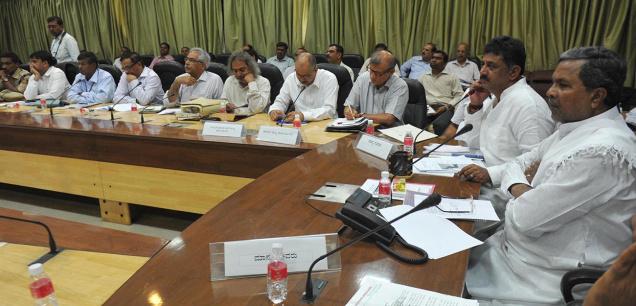
Chief Minister Siddaramaiah and Energy Minister D.K. Shivakumar at a meeting to discuss the power line project, in Bangalore on Tuesday /. Photo: Sampath Kumar G.P. / The Hindu
Expert panel to submit report in 15 days
Chief Minister Siddaramaiah has decided to constitute an experts’ committee to examine alternative possibilities to drawing a high-tension power line from the Kaiga nuclear power plant to Kerala through the catchment area of a tributary of the Cauvery in Kodagu.
The decision comes in the wake of prominent people from Kodagu opposing the project in its present form.
The proposed committee, to be headed by an expert from the Central Power Research Institute, will be given 15 days to look into the concerns of people of Kodagu and submit a report.
An assurance was given by the Chief Minister to legislators and environmental activists from Kodagu who met him at his home office here to seek a change in the route of the proposed power line pass, in public interest.
Coorg Wildlife Society president Col. C.P. Muthanna (retd.), who was part of the delegation that had more than a hour’s discussion with the Chief Minister, told reporters that the proposed committee would comprise wildlife ecologist R. Sukumar, Principal Chief Conservator of Forests, and water expert Rajendra Singh.
He alleged that the project, to be implemented by Power Grid Corporation of India Ltd., would result in devastation of 156 hectares of coffee estate and 104 hectares of paddy cultivation area near Virajpet besides 23 hectares of forests. “The area through which the proposed line is to pass has such a thick green cover that each acre of coffee plantation has 350 fully grown trees,” he said, and expressed concern that nearly 53,000 trees would have to be felled if the power line route was not changed.
He said that leaders from Kodagu had suggested that the power line be drawn underground through the “forest fire line” that runs for 23 km. This would also reduce the length of the power line, he said.
The Chief Minister assured the delegation of taking up the issue again for discussion after the experts’ committee submits its report, he said.
The former Speaker K.G. Bopaiah, MLA Appachu Ranjan and MLC M.C. Nanaiah were part of the delegation.
source: http://www.thehindu.com / The Hindu / Home> News> National> Karnataka / by Special Correspondent / Bangalore – April 30th, 2014
Senior scientist and expert on apple cultivation from Himachal Pradesh Dr Chiranjit Parmar expressed confidence that in Karnataka, especially Kodagu, apple cultivation will be successful as the weather here is suitable.
Parmar, who was on a State tour, told reporters here on Monday that efforts are on to grow apples in Tumkur, Bangalore, Uppinanagady in Dakshina Kannada and Somwarpet in Kodagu.
He said Karnataka is better than Himachal Pradesh for apples as the growers here will get the yield twice a year compared to the northern state where it is once a year due to snow.
“Since three years, efforts are on to grow apples in Karnataka and it has been successful as the weather is conducive,” he said.
Parmar tasted the apples grown in Sulimlathe of Abbukatte in Somwarpet in the district.
Apple growers of Kodagu C R Shivakumar and Krishna Shetty of Uppinangady accompanied Parmar during his tour.
source: http://www.newindianexpress.com / The New Indian Express / Home> States> Karnataka / by Express News Service – Madikeri / April 22nd, 2014
Coorg is all about coffee./ by Special Arrangement / The Hindu
Celebrating the bliss of Coorg with all its splendour
Kodaimelanadu or Kodagu or Coorg: the name itself conjures up images of verdure — gushing cascades, babbling brooks, green hills, gorgeous dales, gurgling rivers all together flaunting the munificence of Mother Nature. Oh! Add some coffee plantations. A compulsive coffee drinker like me cannot find a better place than Coorg for a sip of delight. After an hour’s drive from Mysore, our chauffer announces that we are entering Coorg.
The scenery is mesmerising. The winding roads take you through a maze of greenery. At every labyrinth, you meet a collage of colours which explode into shades of green, brown and yellow. The roads seem to have no particular destination. They just lead you from one part of paradise to another. As we squint though the green fabric, we pass plantations of coffee, cardamom and pepper which merge with forests, foliage and fauna. There are no villages, no people, no shops, and no cars. We deliberately slow down to take in the moment. It is an ode to nature. No wonder it has been attributed the sobriquet ‘Scotland of the East’.
Coorg is all about coffee with a fair amount of cardamom and pepper thrown in. As we drive in, the sylvan surroundings hit us. Our destination is Siddapur. After following the Orange County signage the car finally enters the resort. After a short break, we decide to take a tour of this secluded paradise. The whole district seems a tree shadowed coffee estate, dotted with a few market places with speedy bars, pork shops and elegant vegetable displays.
As we travel, we learn more about coffee: its history, its getting smuggled into India and the difference between arabica and robusta. There is an overwhelming feeling of seclusion. From a distance you can spot a coffee pod, but it is difficult to spot your immediate neighbour. All this time, I am in a clicking frenzy to capture the intricacies of nature.
Coorg is a paradise for bird-watchers and accounts for nearly 25 per cent of the avian population of the State. Our guide announces the names of each and every bird. At times he replies to their calls in a simulated tone. After spending a few hours, trying to know the avian diversity of Coorg, we head towards the splendid Abbey Falls. Tucked away between private coffee and spice estates, Abbey Falls offers a splendid backdrop for a weekend picnic. As one makes one’s way past stocky coffee bushes and tall trees entwined with pepper vines, the falls make a sudden and dramatic appearance as they cascade down into limpid pools to join the river Kaveri. A combination of unprecedented rain the previous night and the steep path make the trek difficult. An army of clouds envelopes the hill, a sight worth beholding.
I try out some Kodava food on my way back to the resort. The central dish of Kodava cuisine is meat, with a fine underpinning of rice. I taste the irresistible pandi curry, a subtle pork dish, cooked well by adding a local fruit, Kanchampali. This mouth-watering dish represents the specialness of Kadava dishes and is hard to find outside Coorg. The dry spices are roasted before grinding them, giving a toasty flavour to the thick curry. I return to my luxurious cottage after having a refreshing tour of the place. It is dark now, and the sky is clear. I step out of my room and walk towards the woods, on a stretch of road with no artificial light. The moon shines brightly and the trees are laden with millions of fireflies; the woods seem decked up for some fat Indian wedding.
This is my first trip to the Western Ghats, and I very enthusiastic to discover them. Next day, at six in the morning, I spring from my bed to go deeper into the mist laden, verdant hills. Murthy, our guide ushers us through a forest which abuts the resort. It is Dubare Reserve which encompasses an area of 50,000 acres — the home of the pachyderms. Majestic rosewood, teak and other hardwood tree species stand around us like sentinels. Giant parasitic vines (that uncannily resemble monstrous creatures) are swathed around large banyan and other trees in a macabre bond. The forest keeps getting thicker and more enchanting. Walking fearlessly in the forest, brushing against the small vines and lopping branches out of the way, eyes constantly hovering to spot any wild animal, marking the footmarks of the elephants — turns out to be the most enchanting leg of the trip. The coracle drifts on the green waters, gauging the moods of the river and the pristine surroundings. / by Special Arrangement / The Hindu
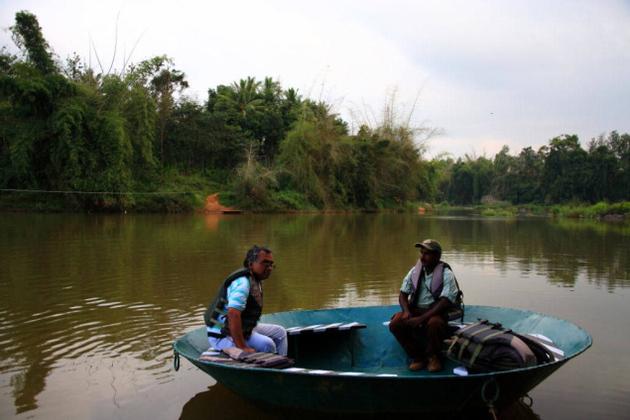
We walk down to the Kaveri, the river flowing unmindful of the inter-State row over her waters. We take our seats on a coracle, to drift on the green waters, gauging the moods of the river and the pristine surroundings. “Sir, apart from this beauty, Coorg is gifted with a very rich history,” says our guide, adding, “The British gifted coffee to Coorg. The first estate was established way back in the 1850s by an Englishman John Frawler. Along with coffee, pepper abounds here, growing as a vine allowed to climb the shade trees. Coorg pepper is considered to be the best in the world, sir.”
He then tells us about the invincible Kodava people. “Coorgis are said to be descendents of the Greeks. Neither Tipu Sultan, nor the British could conquer this land.”
Coorg has a long history of battles. The Madikeri Fort is a living testimony to that. Built first as a mud fort by Mudduraja in the last quarter of the 17th century, it was later rebuilt in granite by Tipu Sultan who named the site Jaffarabad. In the North-east corner at the entrance are two life size masonry elephants, while a church stands in the south-east corner. The fort offers panoramic views of the city from its walls. The centuries-old Madikeri Fort with its stone ramparts also houses a prison. Among the other architectural treasures that Coorg boasts is the Omkareshwara temple built by king Lingaraja in 1820, in a mosque-like style, with an impressive central dome and four minarets, which are surrounded by Basavas, or sacred bulls. On the top of the dome sits a gilded ball with a weathercock.
Another splendid place to see is the Raja’s seat. It is a small pavilion with a garden surrounding it, offering a view of the green valley below. As the legend goes, the kings of Coorg spent their evenings here along with their consorts. The spectacular view from here of the melting sun, parrot-green fields and the far stretching mountains will take one’s breath away. We return to the Orange County Resort, a little break from this oasis of tranquillity. The last Kodava dinner by the lake under the bright sky is waiting for us: a luxurious setting created by candles, stars and sounds of silence. The next day I insert a packet of aroma rich Coorg Coffee in my luggage. As for the greenery, it is etched in my thoughts, to recollect in the days to come.
source: http://www.thehindu.com / The Hindu / Home> Features> MetroPlus> Travel / by Aakash Mehrotra / Delhi – April 20th, 2014
The famous loose-jacketed mandarin orange was as much a part of the fabric of Coorg as the coffee alongside which it was planted
_______________________________________________________________
Owned and managed by the Ramapuram family of Kerala, Orange County Resorts and Hotels is based on the ‘Spirit of the land’ philosophy that showcases the nature and culture of the regions where it is operational. The first Orange County Resort that opened at Coorg in 1994 was built on the theme of coffee, spice and plantation life to reflect the true spirit of Coorg, and is situated amidst 300 acres of coffee and spice plantations. It is flanked on one side by the Dubare Reserve Forest and the river Cauvery on the other.
Link to the land
Reminiscing on the days of old, Cherian Ramapuram, director, Orange County Resorts and Hotels says, “The Orange County – Coorg resort was built on the plantation owned by our family from 1926. In the 90s, Coorg was not known outside Karnataka. The location was extremely beautiful, packed with history and culture. Orange trees are usually inter-planted along with shade trees for cultivating coffee. So like coffee, Coorg produced the best oranges in the country, till a virus attacked them about 18 years ago. The huge, sweet, loose jacket oranges turned into small tight skinned sour ones. The resort was christened when the oranges were good.”
The brand opened its second resort at Kabini in 2007. Inspired by the local ‘Kadukuruba Hadis’, the architecture of this tribal themed resort was crafted to transport its guests into a tribal setting from which they can enjoy the spectacle of Asia’s largest biosphere.
Cherian Ramapuram adds, “With location and luxury coming together in such a happy union, Orange County Resorts offers guests a true ‘Spirit of the land’ experience. Plantation stays are unique because they are a combination of an exclusive lifestyle, while touching the soul of the land. It also gives one an opportunity to see how the precious commodities that they buy or use in the day-to-day life are cultivated. We give the guest a very unique experience of living like a ‘Planter’ for the stay. They get to go for a signature tour of the plantation, plantation trail, nature walk, etc., which are unique to this part of Coorg.”
The resort’s main target is the discerning traveller. Cherain Ramapuram feels that the guest profile shows a continuous evolution. Today’s guest is more educated tastes become more refined as they travel around the world. While there is no specific special interest groups in this segment, the discerning traveller looks for experiences like this. He says, “We do not promote stays or even holidays. We promote Exclusive Local Experiences.”
Community is core
Orange County’s Kabini property has been selected by National Geographic Traveller among the top 25 Eco Lodges in the world. The company takes guest feedback and suggestions very seriously. “This is evident from the feedback that you can see on sites like Tripadvisor. All these comes wrapped in highest standards of responsibility in tourism,” says the proud hotelier.
His brother Thomas Ramapuram, joint director, Orange County Resorts and Hotels elucidates on the sustainable hospitality measures the company has initiated. “The concept of responsible tourism comes naturally to Orange County Resorts. It is, after all, an extension of the vision and philosophy of the House of Ramapuram whose values are broad, contemporary and inclusive.”
The government has now made CSR mandatory part of a company’s revenues. But Orange County has long supported community development. “Over 60 per cent of our staff at both resorts are from the surrounding local areas. We constantly strive to engage with local village heads in community development programmes. We also conduct Structured Community Development Programmes on an annual basis like for example, scholarships, toilets in villages, road work, etc,” says Thomas Ramapuram.
He adds, “We believe that education is the most powerful weapon which you can use to change the world. So we have formally adopted the local school at Coorg in Karadigod Village. We are also in the process of adopting the school in Kabini (H.D.Kote Village), however we have not received a formal government approval for the same. Through adoption we have implemented various initiatives like computer facilities, better play grounds, hiring quality teachers etc. This is an ongoing continuous process and our vision is to develop these schools into world class institutions of learning.”
The brand has also adopted technological innovations to make the guest experience a seamless one. “Our indigenously developed central reservation systems compares with the best in the industry. It allows for easy storage, access and transmission of information. Our systems allow us to have an intimate knowledge of each of our guests even before they step into our properties.”
It is rare to find a two resort brand in the world today that has 60 per cent of their clients booking directly with us (as opposed to booking through a OTAs or a tour operator). We are able to achieve this through our powerful database management systems and processes.”
Being a traditional brand with a strong focus on ethics, values and other old fashioned ideas, has not stopped the brand from embracing technology and leveraging its tremendous power to deliver a superior guest experience. “Technological innovation is a core value at Orange County Resorts,” reiterates Thomas Ramapuram.
As for the brand’s foray outside Karanataka, Cherian Ramapuram says that it has not been easy to build and run resorts in the state itself. “While we have not yet looked seriously outside, we are keeping our eyes open for opportunities. We have two more locations where we have land in Karnataka. We are looking out for options outside the state and the country too,” he optimistically sums up.
source: http://www.financialexpress.com / The Financial Express / Home> Travel & Tourism / by Steena Joy / Mumbai – March 11th, 2014
SUMMARY
The famous loose-jacketed mandarin orange was as much a part of the fabric of Coorg as the coffee alongside which it was planted.
———————————————————————————-
Owned and managed by the Ramapuram family of Kerala, Orange County Resorts and Hotels is based on the ‘Spirit of the land’ philosophy that showcases the nature and culture of the regions where it is operational. The first Orange County Resort that opened at Coorg in 1994 was built on the theme of coffee, spice and plantation life to reflect the true spirit of Coorg, and is situated amidst 300 acres of coffee and spice plantations. It is flanked on one side by the Dubare Reserve Forest and the river Cauvery on the other.
Link to the land
Reminiscing on the days of old, Cherian Ramapuram, director, Orange County Resorts and Hotels says, “The Orange County – Coorg resort was built on the plantation owned by our family from 1926. In the 90s, Coorg was not known outside Karnataka. The location was extremely beautiful, packed with history and culture. Orange trees are usually inter-planted along with shade trees for cultivating coffee. So like coffee, Coorg produced the best oranges in the country, till a virus attacked them about 18 years ago. The huge, sweet, loose jacket oranges turned into small tight skinned sour ones. The resort was christened when the oranges were good.”
The brand opened its second resort at Kabini in 2007. Inspired by the local ‘Kadukuruba Hadis’, the architecture of this tribal themed resort was crafted to transport its guests into a tribal setting from which they can enjoy the spectacle of Asia’s largest biosphere.
Cherian Ramapuram adds, “With location and luxury coming together in such a happy union, Orange County Resorts offers guests a true ‘Spirit of the land’ experience. Plantation stays are unique because they are a combination of an exclusive lifestyle, while touching the soul of the land. It also gives one an opportunity to see how the precious commodities that they buy or use in the day-to-day life are cultivated. We give the guest a very unique experience of living like a ‘Planter’ for the stay. They get to go for a signature tour of the plantation, plantation trail, nature walk, etc., which are unique to thispart of Coorg.”
The resort’s main target is the discerning traveller. Cherain Ramapuram feels that the guest profile shows a continuous evolution. Today’s guest is more educated tastes become more refined as they travel around the world. While there is no specific special interest groups in this segment, the discerning traveller looks for experiences like this. He says, “We do not promote stays or even holidays. We promote Exclusive Local Experiences.”
Community is core
Orange County’s Kabini property has been selected by National Geographic Traveller among the top 25 Eco Lodges in the world. The company takes guest feedback and suggestions very seriously. “This is evident from the feedback that you can see on sites like Tripadvisor. All these comes wrapped in highest standards of responsibility in tourism,” says the proud hotelier.
His brother Thomas Ramapuram, joint director, Orange County Resorts and Hotels elucidates on the sustainable hospitality measures the company has initiated. “The concept of responsible tourism comes naturally to Orange County Resorts. It is, after all, an extension of the vision and philosophy of the House of Ramapuram whose values are broad, contemporary and inclusive.”
The government has now made CSR mandatory part of a company’s revenues. But Orange County has long supported community development. “Over 60 per cent of our staff at both resorts are from the surrounding local areas. We constantly strive to engage with local village heads in community development programmes. We also conduct Structured Community Development Programmes on an annual basis like for example, scholarships, toilets in villages, road work, etc,” says Thomas Ramapuram.
He adds, “We believe that education is the most powerful weapon which you can use to change the world. So we have formally adopted the local school at Coorg in Karadigod Village. We are also in the process of adopting the school in Kabini (H.D.Kote Village), however we have not received a formal government approval for the same. Through adoption we have implemented various initiatives like computer facilities, better play grounds, hiring quality teachers etc. This is an ongoing continuous process and our vision is to develop these schools into world class institutions of learning.”
The brand has also adopted technological innovations to make the guest experience a seamless one. “Our indigenously developed central reservation systems compares with the best in the industry. It allows for easy storage, access and transmission of information. Our systems allow us to have an intimate knowledge of each of our guests even before they step into our properties.”
It is rare to find a two resort brand in the world today that has 60 per cent of their clients booking directly with us (as opposed to booking through a OTAs or a tour operator). We are able to achieve this through our powerful database management systems and processes.”
Being a traditional brand with a strong focus on ethics, values and other old fashioned ideas, has not stopped the brand from embracing technology and leveraging its tremendous power to deliver a superior guest experience. “Technological innovation is a core value at Orange County Resorts,” reiterates Thomas Ramapuram.
As for the brand’s foray outside Karanataka, Cherian Ramapuram says that it has not been easy to build and run resorts in the state itself. “While we have not yet looked seriously outside, we are keeping our eyes open for opportunities. We have two more locations where we have land in Karnataka. We are looking out for options outside the state and the country too,” he optimistically sums up.
source: http://www.financialexpress.com / The Financial Express / Home> Travel & Tourism / by Steena Joy / Mumbai – March 11th, 2014
Revenue Minister V Srinivasa Prasad said he would visit Kodagu district to assess the misuse of sections 79(a) and (b) of the Karnataka Land Reforms Act.
The sale of plantation land to non-agriculturists to set up resorts and cottages would also be looked into, he said.
Replying to a calling attention motion from Janata Dal(S) floor leader M C Nanaiah in the Legislative Council on Thursday, the Minister said the government was committed to the protection of plantation land in Kodagu.
Nanaiah said plantations where coffee, cardamom and rubber are grown had been exempted from the purview of the Act.
“Revenue officials, deeming these plantations to be non-agricultural land, have been allowing its sale. According to the rules, such lands cannot be sold to non-agriculturists. The buyers plant saplings of coffee, banana and cardamom to show that they are using the land for agriculture and construct resorts,” Nanaiah said.
6,000 Acres Sold
The floor leader said the going price of an acre of plantation land was `40 lakh. Already, over 6,000 acres has been sold to non-agriculturists in Kodagu district and 3,000 applications to register properties were pending before the Revenue Department, Nanaiah alleged.
“The Kodavas are becoming aliens in their own homeland. Forest cover is being eroded due to mushrooming of resorts. There is danger in store if plantation land in catchment areas of the Cauvery is sold to non-agriculturists,” Nanaiah warned.Promise of ActionResponding to Nanaiah’s statements, the Minister declared that those revenue officials who were allegedly hand-in-glove with land sharks and fixing land deals would be dealt with an iron hand.
source: http://www.newindianexpress.com / The New Indian Express / Home> States> Karnataka / by Express News Service – Bangalore / February 21st, 2014
EMPOWERED: Attending one of the seminars organised by IISR’s Cardamom Research Centre (CRC) at Appangala in Kodagu on spices cultivation was a turning point in Mrs. Prema Ganesh’s life./ Special Arrangement / The Hindu
Agriculture is no more a male dominated sector, as many women have shown that they are second to none in this field. “Women can be successful agriculturists, if they are supported with timely technological interventions by scientists and encouragement from family”, says Dr. M. Anandaraj, Director of the Indian Institute of Spices Research (IISR), Kozhikode.
Mrs. Prema Ganesh from Maragodu village, Kodagu District, Karnataka is a role model for other women in this field.
Several problems
When she ventured to take over her coffee and black pepper plantation in 10 hectares a decade ago, several problems started surfacing, especially the low productivity of crops, making agriculture a non profitable enterprise.Keen to overcome them, she happened to attend one of the seminars organised by IISR’s Cardamom Research Centre (CRC) at Appangala in Kodagu on spices cultivation.“It was a turning point in my life,” recollects Ms Ganesh.
The scientists at CRC assured full technological support to her ventures. A team from CRC visited her plantation and identified some major production constraints such as high plant density per unit area, prevalence of diseases and pests, problems like spike shedding in black pepper etc.They provided a complete package of practices to be followed including thinning of excess plant growth to maintain optimum spacing among them, adoption of basin management techniques like application of organic manures, micronutrient application, earthing up and mulching for various crops.“In the case of black pepper, special recommendations like basin irrigation at the rate of 40-50 litres of water at 4-5 times per vine at an interval of 5-7 days during May-June in case of delayed monsoon, regulation of shade by pruning the support trees to provide minimum 50-60 per cent exposure to sunlight were suggested,” says Dr. S J Ankegowda, Head, CRC, AppangalaFor diseases and pests, spraying of two rounds of Bordeaux during June and August/September and one round of drenching with 0.2 per cent Copper Oxy Chloride (COC), and need based application of insecticides were also recommended.Trees like balangi, palawan and silver oak were planted at a spacing of 15×15 feet (random) to provide adequate shade to the crops.In addition she readied several rainwater harvesting pits of 10 feet length, 1.5 feet width and 1.5 feet depth between the coffee plants.These pits also serve as compost pits where all the farm wastes are dumped for two years to decompose after which they are removed and applied as organic manure to coffee and pepper, substantially reducing the cost on purchase of farm yard manure.
Composed husks
Ms. Ganesh makes use of composed coffee cherry husk, a by-product of coffee pulping, after mixing with cow dung as an additional source of organic manure.Annually she spends Rs. 35,000 per acre as operational cost and gets about Rs. 25 lakhs a year as net income from both black pepper and coffee. Reducing manual labour was an important initiative by her.“First thing they did was to lay motorable roads inside the plantation. This has reduced the strain in carrying the harvested produce in bags by labourers.Before the roads were laid, a labourer would take about 30 minutes to carry the bag to the main road for loading it on the lorries.“The physical strain was quite heavy. But now this has considerably reduced since the vehicles can come into the plantation,” says Dr. Ankegowda.
Underground irrigation
Another initiative was the underground pipe-lining for irrigation. Today the entire plantation has well connected irrigation line ready for irrigation all through the year.For more details readers can contact Mrs. Prema Ganesh, Prema Estate, Maragodu Village, Madikeri, Kodagu district- 571 201, Ph: 08272-241555, or Dr. S. J. Ankegowda, Head, IISR Cardamom Research Centre, Appangala, Madikeri-571201, Karnataka, mobile: 09663069241 and phone: 08272-245451.
source: http://www.thehindu.com / The Hindu / Home> News> S & T> Science / Farmers Notebook> Karnataka / by M.J.Prabu / February 26th, 2014
The State government has drawn up plans to create 32 in the forests, especially in Kodagu, Shimoga, Udupi, Dakshina Kannada, Chikmagalur and Mysore districts, for protecting both the people residing within the forests and wild animals.
After the Cabinet Sub Committee on Forest discussed these issues, Law and Parliamentary Affairs Minister T.B. Jayachandra, who chaired the meeting, said that this would be tabled before the State Cabinet and then sent to the Union government for approval.
Mr. Jayachandra said that the Union government had, in its guidelines to the States, suggested that there should be a 10-km zone near each human habitat where big construction activity, power lines of more than 11 kVA, big resorts and industries could not be allowed to come up.
However, small constructions such as homestays could be allowed.
He said that the zones could be just one, two or three kilometres away from the habitats.
Asked whether these guidelines were binding on the State government, he said that there was no law to regulate such activities in the State.
He said that the State forest officers would discuss the issue with the Union government and convince it of the workable alternatives, based on specific reasons.
Wherever it was difficult to implement the guidelines, the State government would strive to get relief to the people, he said.
Objection
The committee also discussed the situation arising out of a case filed by the Goa Foundation before the Green Bench of the Supreme Court at Chennai.
The committee decided to file an objection within 10 days to the demand of the Goa Foundation that the Kasturirangan Committee report, which was notified by the Union government, be implemented.
Mr. Jayachandra said that the notification had adversely impacted development activities worth Rs. 25,000 crore in the Western Ghats. Works of the Indian Institute of Science, the DRDO and a unit for the manufacture of unmanned aerial vehicles in Challakere of Chitradurga district had been stopped due to public protests.
source: http://www.thehindu.com / The Hindu / Home> News> National> Karnataka / by T. S. Ranganna / Bangalore – February 03rd, 2014
Kodagu district qualifies to be an eco-sensitive zone with its picturesque landscapes, coffee plantations, and more importantly as it is the principal catchment of Cauvery river, said members of Coorg Wildlife Society here on Thurdsay. The catchment area provides almost 50% of the total water flow into the river.
“It’s in national interest that the district gets the tag,” the members said. Its environment and ecology are under serious threat due to development projects for Kerala, urbanization and invasive tourism.
Tourism is flourishing in Kodagu but the need of the hour is a set of strong regulations, officials pointed out. “Tourist resorts are mushrooming here without proper clearances. They occupy pristine landscapes and consume massive amounts of water. There should be a cap on further licences for resorts until there is a proper evaluation on the carrying capacity for tourism in the district,” said Col C P Muthanna, president, Coorg Wildlife Society.
Land conversion and urbanization are other major threats to Kodagu. Plantations and agricultural lands are increasingly being converted for commercial purposes, affecting the landscape. “Kodagu is one lung space which is increasingly being clouded,” said Suresh Heblikar of Eco Watch, Centre for Environment and Sustainable Development. “Do not overexploit Kodagu in the name of development,” said Heblikar, urging the government to take care of all aspects while thinking of economic development of the region.
Main demands
* A stretch of 55 km through Kodagu has been earmarked for Mysore-Kozhikode power line. At least 2000 trees have been felled along the 5-km stretch of reserve forests. There is another 50-km stretch, of which 30km is coffee plantations, which has to be cleared for this power line. That calls for cutting of 50,000 more trees. This area, close to Nagarahole National Park, could now more instances of man-animal (elephant) conflict. Significantly, this area of South Kodagu is also the catchment of Lakshmantheerta river which is the primary water source for Mysore and an important tributary of the Cauvery. Ongoing work for this power line needs to be suspended with immediate effect.
* There are plans to connect Mattanur airport to Mysore and Bangalore through Kodagu with a four-lane highway, which again will involve massive tree-felling operations.
*A rail link between Kushalnagar and Kerala is being planned through Kodagu, for which funds have been sanctioned. The line may be extended once work is over on the announced stretch, which will destroy the landscape and affect indigenous communities of Kodagu.
* MoUs signed during the Global Investors Meet in 2012 needs to be reviewed and permission granted only to the projects which will benefit Kodagu without damaging its ecology.
source: http://www.articles.timesofindia.indiatimes.com / The Times of India / Home> City> Bangalore> Power Line / TNN / January 17th, 2014
Writers and literature lovers visiting this hilly town are clamouring for honey, and staying away from its liquor stores and bars.
Bee-rearing is popular in and around Madikeri, and stalls selling honey are doing brisk business during the 80th all-India Kannada Sahitya Sammelana. The three-day gala ends on Thursday.
About 20 shops in the vicinity of the literary carnival trade in honey. On a normal day, they sell 30 to 50 kilos. Over the past two days, sales have doubled.
Ashok, Secretary of the Coorg Progressive Beekeepers Co-operative Society, said, “Each shop has asked for 500 boxes. Each box holds 12 one-kg bottles.”
Despite the demand, vendors have not hiked their prices. “A kilo of pure honey in a sealed bottle costs `220. The price is `180 otherwise,” Ashok said.
Honey production peaks between March and June. “This is actually off season. We are struggling to meet the demand,” he said.
There are 1,100 bee-keepers in and around Madikeri, and 6,000 in Kodagu district.
Chandappa, head master of a government school in Bijapur district and a conference delegate, said, “We don’t get honey in our districts. That’s why we are taking home some.”
The visiting writers and literature buffs aren’t giving good business to liquor shops, though.
Thimmappa of National Wines on the Madikeri main road feels the guests are not the drinking type.
“On normal days, we sell seven to eight boxes of whiskey, with each box containing 12 bottles. Since Monday, the number has come down to four or five,” he said.
Traffic diversions for the literary carnival have also had a negative impact on the liquor business, he said.
Madappa, another liquor shop owner, said visitors from North Karnataka don’t drink.
“A small number come for wine and ask about the percentage of alcohol in it,” he said.
The weather is not helping the liquor business either. “It has become warm over the past week, and that is one of the reasons our customers have just one or two pegs of whiskey,” said Madappa.
The temperature in Madikeri on Wednesday afternoon (4pm) was 26 degree Celsius, not warm at all by the standards of northern Karnataka districts, where temperatures touch 40 degrees. Madikeri has about 30 liquor stores and bars.
Pure for sure?
Rajashree, owner of a honey shop in Madikeri, offered tips on how to test the purity of honey. “Take a cup of water and put a drop of honey in it. If the honey is pure, it goes to the bottom, but if it is adulterated, it spreads,” she said. The second trick is to use paper. “Dip a piece of paper in the bottle. If the honey is pure, the paper will not get wet,” she said.
source: http://www.newindianexpress.com / The New Indian Express / Home> States> Karnataka / by Rashmi Belur and Ashwini M. Sripad – Madikeri / January 09th, 2014
WELCOME. If you like what you see "SUBSCRIBE via EMAIL" to receive FREE regular UPDATES.
Read More »