The government will provide 50 per cent subsidy to farmers to put up solar fences on their farms, said Minister for Forests B. Ramanath Rai on Thursday, as an obstacle against entry of wild animals and to reduce man-animal conflict
During his visit to the Karnataka Pradesh Congress Committee (KPCC) office here, the Minister told presspersons that the department had put up elephant-proof trenches and installed solar-powered fences around some stretches of the reserve forests and national parks. “This is part of the Karnataka Sustainable Forest Management and Bio-diversity Conservation Programme. However, if farmers want to get solar fences installed by private companies, we will grant them 50 per cent subsidy,” he said.
The Minister said his department was not against development. However, only such projects that will directly benefit people will be permitted. People who submit applications for land in deemed and reserve forests should keep in mind the various rules governing forests in the State.
The Minister said the process of resolving the confusion over the C and D categories of land (degraded forest land) had commenced. “According to the law, there is no provision to regularise encroachments on forest land after April 27, 1978. However, we have received over one lakh applications seeking regularisation of land. A Cabinet subcommittee has been formed to study the issue and take a decision,” he said.
Posts to be filled
He said 700 posts in the department would be filled shortly. “The department is also encouraging farmers to grow sandalwood. We are giving away saplings at Re. 1 and Rs. 2 each to farmers. These farmers will also get an incentive of Rs. 10, Rs. 15 and Rs. 20 for each sapling annually, in the first, second and third year respectively, to ensure its growth,” the Minister said.
source: http://www.thehindu.com / The Hindu / Home> News> National> Karnataka / by Special Correspondent / Bangalore – January 03rd, 2014
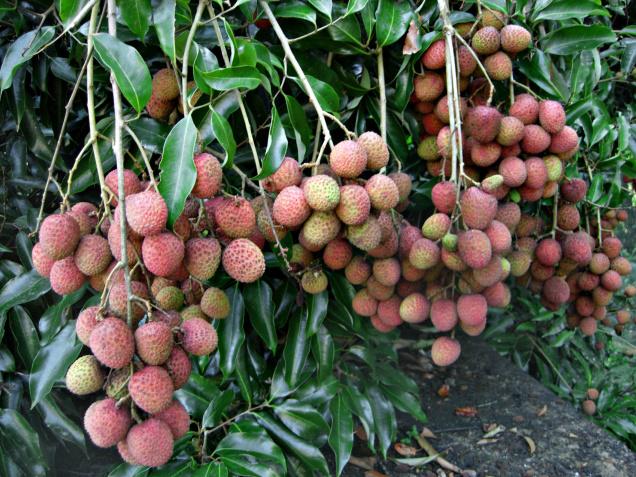
Litchi grown in Kodagu during the off-season can be marketed across the country, says an expert.
Growers in Kodagu, faced with pest attacks on coffee and diseases in cardamom, orange, and banana crops, had something to look forward to during the Litchi Field Day organised by the Central Horticultural Experiment Station (CHES) at Chettalli in the district recently.
About 50 progressive growers attended the event. A field visit to litchi orchards of the CHES in Chettalli gave the growers exposure to cultivation methods. CHES scientists apprised the growers about the soil requirements, fruiting, flowering pattern, and yield of litchi.
P.C. Tripathi, head of the CHES, made a presentation on the prospects of litchi cultivation in Kodagu. He said litchi matures in the off-season, during November-December period, in Kodagu, unlike in traditional cultivation areas in north India where it matures during May and June. As this was the off-season, the fruits were in demand in the market. He told The Hindu that litchi grown in Kodagu during the off-season could be marketed across the country.
The current price of litchi is around Rs. 150 a kg. Litchi cultivation had picked up in Kodagu in the last four years, he said. A grower had planted 900 plants in Chettalli area, he said.
Income from litchi cultivation could augment the annual income of growers who were left to fend for themselves due to the volatility of coffee and pepper prices, Dr. Tripathi said. A small litchi tree could yield between 30 to 50 kg of fruits while bigger ones could yield more than 2 quintals, he said. India is ranked second in the world in litchi production, after China. In India, litchi is grown on nearly 75,000 hectares with a yield of 4.83 lakh tonnes. Bihar, West Bengal, Uttar Pradesh, Jharkhand and Uttarakhand are the major litchi growing States in the country. At the programme, growers raised queries on profitability and feasibility of litchi cultivation.
Planters including N. Bose Mandanna, Col. Kumar (retd.), B.D. Manjunath, Vijay Devaiah and Shambhu Chengappa participated in the programme. Scientists of the CHES, Indian Institute of Spices Research, Appangala, near Madikeri; Coffee Board, Chettalli; and Krishi Vijnana Kendra, Gonicoppa, as well as government officials were present.
source: http://www.thehindu.com / The Hindu / Home> News> National> Karnataka / by K. Jeevan Chinnappa / Madikeri – December 26th, 2013
‘Huthari’ festival was observed with grandeur and traditional fervour in Kodagu district on Sunday.
The Huthari celebrations began at the Igguthappa temple and ‘prasadam’ was distributed. Sheaves of paddy were taken from the temple to mark the beginning of the festival in the district.
Later, people in the district visited paddy fields in a procession in their traditional attire and harvested the crop after offering prayer. Before harvesting, they shouted slogans ‘Poli Polio deva’ and fired three times in the air and burst crackers.
Kolata
Members of Pandeera family, Kodava Samaja and Sri Omkareshwara temple organised ‘Huthari’ kolata as a part of Huthari festival at Old Fort premises in Madikeri on Monday.
Bettageri Pandeera family members presented Kolata and ‘Bolakat,’ on the occasion.
Speaking on the occasion, Pandeera family member Monnappa said that kolata has been performed from the time immemorial. There is a need to continue the tradition. Huthari festival brings all the family member together for celebrations. New year
Lt General (retd) B C Nanda said that Huthari festival is new year for the Kodavas.
Festivals play a vital role in conserving the culture and traditions of the region. Kodava Samaja president Moovera Subbaiah, Vice President Mandepanda Rathan Kuttaiah and others were present.
source: http://www.deccanherald.com / Deccan Herald / Home> District / Napoklu-Madikeri, DHNS , December 16th, 2013
Scientist from Indian Horticulture Research Institute Dr A T Sadashiva has said that the climate in Kodagu is conducive for growing vegetables.
Speaking at a session held at agriculture technology week organised by Krishi Vigyan Kendra, Gonikpppa on Wednesday, he said that after the harvest of paddy, about 35,000 hectare of land will be left as it is. Vegetables can be cultivated in the paddy field after the harvest.
He further said that Indian Horticulture Research Institute has brought out sachets of improvised seeds of different varieties of vegetables.
Steps will be taken to make these seeds available at all places, he said and added that these vegetables could be grown in kitchen garden and also on earthen pots, he said.
Senior scientist T S Aghora said that 96 varieties have been developed in 23 vegetables. Best varieties are available in tomato, chilly, cucumber, pumpkin and beans.
A beans variety called ‘Arka Sharat’ is considered as the best variety. Vegetables like cabbage, red chilly and red carrots which are grown in Ooty can also be grown in Kodagu.
District Horticulture department Deputy Director S N Sudhindra said that the department will bear 50 per cent of the expenditure of the farmers for growing vegetables. A subsidy of Rs 13,000 per acre is available under Krishi Vikas Yojana, he said.
He further said that a subsidy of Rs 1,500 per bee hive wil be provided for the apiculturists.
A honey park will be developed at Bhagamandala to encourage apiculture.
Scientists Dr S S Hebbar, Dr Shrinivas Rao, Progressive farmer C P Sathish from Somwarpet, Gonikoppa Krishi Vigyan Kendra Director Dr P C Tripathi and others were present.
An exhibition on food products and agriculture equipment was held on the occasion.
source: http://www.deccanherald.com / Deccan Herald / Home> District / Gonikoppa – DHNS, December 11th, 2013
With the traditional coffee growing area in the country almost reaching its saturation point, new and non-traditional areas are coming up.
Currently, the three southern states Karnataka, Kerala and Tamil Nadu dominate coffee production. However, Andhra Pradesh and Odisha are also joining the group.
According to the Coffee Board of India, the three southern states account for about 92 per cent of the total coffee growing areas in the country.
While Karnataka leads the pack in terms of coffee growing with an area of about 53 per cent, Kerala accounts for 28 per cent followed by Tamil Nadu with 11 per cent. Now the governments in Andhra Pradesh and Odisha are showing keen interest to popularaise the coffee production.
“In both the states, coffee plantation is expected to come up in an additional area of over 10,000 hectares by the end of the 12th plan period,” a senior officer from Coffee Board told Express. People living in hilly areas like Munumuluru, Chintapalli (E), Chintapally (W) and Arakuvalley in Andhra Pradesh and Koraput in Odisha have taken to coffee plantation.
At present, the number of coffee producers in Andhra Pradesh stand at about 115,877 and about 45,715 in the neighbouring. According to the Coffee Board officials, the total post blossom estimate of coffee production for 2013-14 was pegged at about 3.47 lakh metric tonnes.
Both the states are expected to contribute about 6,230 metric tonnes. At present, the total planted area accounts for about 58,131 hectares in AP and about 3,835 hectares in Odisha. Vijayan Rajesh of United Planters Association of South India, however, said the attempt to popularaise coffee growing in AP and Odisha, was only of ‘social interest rather than any commercial interest.’
source: http://www.newindianexpress.com / The New Indian Express / Home> States> Karnataka / by M Venkatesh – ENS – Bangalore / October 17th, 2013
An apiculture park will be set up at Bhagamandala in Kodagu district to revive apiculture in Karnataka, Horticulture Minister Shamanur Shivashankarappa said on Thursday.
He told reporters here that the park would come up on six acres at Bhagamandala. The department would distribute 20,000 boxes to Jenu Kurubas, a tribe that has expertise in honey cultivation and extraction.
According to him, Rs. 60 lakh had been earmarked in the current fiscal to promote apiculture. “At present, the honey production is around 800 metric tonnes but it is possible to increase it to 8,000 metric tonnes per annum. Besides awareness, training would be imparted to the local tribe to promote apiculture. There is a lot of scope for promoting apiculture in Uttara Kannada, Dakshina Kannada and other Malnad districts,” he said.
Neera Policy
The minister said the department has submitted a proposal to the Finance Department to announce a policy on neera.
“An amendment to the State Excise Act is necessary to allow the tapping and selling of neera in the state. Already, steps have been taken to promote value-added products from the neera like palm syrup, palm jaggery and palm sugar. Now it is up to the Finance Department to table a bill in the State Legislature to pass the Neera Policy,” he said.
Proposal Submitted
He said the state government has submitted a proposal to the Union government seeking release of Rs. 100 crore to revive coconut plantations in several districts.
“Thirty per cent of the coconut plants have perished due to pests and failure of monsoon. The department is educating the farmers of rain-fed areas to go for alternative crops,” he said. According to him, the department has given Rs. 12,000 per acre to farmers for loss of coconut plants.
Auction Centres
Shamanur said two flower auction centres set up in Tumkur and Davangere would be inaugurated soon. The Department of Horticulture has provided the infrastructure but it would be managed by the Karnataka Agricultural Marketing Department.
“Floriculture is no longer a profitable venture following competitions from the African countries. In recent years, Kenya and Ethiopia have emerged as leading flower export countries after the European countries. Despite this, many flowers are being exported from Karnataka thanks to the department’s support. Fifty per cent subsidy is being given to entrepreneurs under the National Horticulture Mission to promote floriculture,” he said.
Census
He said the census of horticulture crops’ areas under cultivation and production were in progress in Bagalkot, Belgaum, Bellary, Chitradurga, Davangere, Gulbarga, Hassan, Kolar, Mysore, Shimoga and Tumkur districts. According to him, Rs. 5 crore had been earmarked for the purpose. “Nearly 50 per cent of the work has been completed,” he said.
source: http://www.newindianexpress.com / The New Indian Express / Home> States> Karnataka / by Express News Service – Bangalore / November 22nd, 2013
Govindappa Jayaram from Kodagu district has been elected as Chairman and K Kurian from Chikmagalur district as Vice Chairman of Karnataka Planters’ Association.
Jayaram and Kurian got elected at the 55th Annual General Meeting of the Karnataka Planters’ Association.
The following have been elected to executive committee of KPA: Chikmagalur District – H.T. Pramod, Shirish Vijayendra, Mahesh Shashidhar.
Kodagu District – A.A. Ponappa, N. Bose Mandanna, M.A. Sampath (Corporate Seat).
Hassan District – V. Murali (Corporate Seat) and Baba P.S. Bedi.
Small Growers seat – Kodagu District – Dr M.M.Chengappa.
source: http://www.thehindubusinessline.com / Business Line / Home> Industry> Agri-Biz / by Anil Urs anil.u@thehindu.co.in / Bangalore – November 17th, 2013
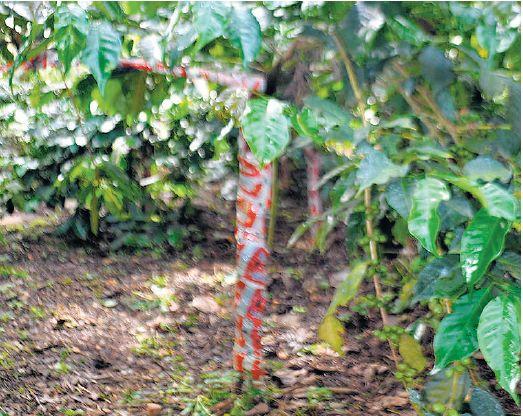
Better solution: An arabica plant stem wrapped with cellophane tapes to prevent it hosting the white stem borer on a coffee estate in Kodagu. / The Hindu Results are good, says Coffee Board; some planters raise environmental concerns
An ingenious method has been found to control the ruinous white stem borer in coffee estates where the arabica variety is grown. But coffee planters are split over the effect of the solution with some even questioning its impact on the environment.
According to A.K. Bhandari, coffee planter and former President of the United Planters Association of Southern India, wrapping the stem of the arabica plant with cellophane, called poly wrap, helps in containing the borer menace. The wrap prevents the female beetle from laying eggs in cracks and crevices of the plant.
“We came across this solution some two-and-a-half years ago when some planters used old plastic to wrap the stems. It prevented the borer from laying eggs and controlled the spread of the pest,” he said.
Coffee white stem borer, Xylotrechus quadripes, is a pest found in arabica coffee causing huge yield loss. A blackish brown coloured beetle, it can also be found on rosewood, sandalwood and teak.
Ten to 12 days after the female beetle lays the eggs on the stem, the larvae enter the woody tissue and burrow up to the roots. This leaves the plant impaired and the only known solution is uprooting the plant totally and burning it.
“Poly wrap physically stops the insect from laying eggs on the plant. Growers had, at one point of time, wrapped plants with old fertiliser bags. Now, they have begun to use strip wraps and the results have been good,” said Jawaid Akhtar, Coffee Board Chairman.
History traces the borer menace to 1837 and the first reference was made in 1838 by H. Stokes, Mysore Commissioner. In 1868, the Madras Commissioner had reported the ravages of the borer in Mysore and Coorg.
YIELD LOSS
“We have been suffering from the borer menace for over a decade now. It has affected arabica production. In some estates, nearly 50 per cent of plants had to be uprooted,” said Bose Mandanna, a grower in Kodagu and former vice-chairman of Coffee Board.
The borer menace has resulted in arabica production stagnating around one lakh tonnes annually for almost a decade after rising to a record 1.21 lakh tonnes in 2001-02 (October-September) season. Its share in total coffee production (robusta makes up the rest) has decreased from over 50 per cent in the 1980s to around 30 per cent now.
This year, out of the estimated 3.47 lakh tonnes production, arabica output has been pegged at 1.11 lakh tonnes. However, growers expect it to be lower than 90,000 tonnes.
“The poly wrap seems to be working very well. Most of the growers have reported 99 per cent success. About 10 estates can be taken and the experiment tried for 2-3 years,” said Bhandari.
The Coffee Board had sent an advisory on the poly wrap but not much progress seems to have been made.
“Labour shortage is the reason why poly wrap has not picked up. Also, there was short-supply of wraps. That has ended now as supply is ample. Results are encouraging and the wrap does not affect the plant’s growth,” said Akhtar.
But, there are voices of dissent too.
“The poly wrap was tried in small pockets and it has not been successful when tried on a large-scale. It prevents plants from growing. The bark growth is stunted and we feel this is not a scientific solution,” said the Karnataka Planters’ Association Chairman, Nishant Gurjer.
Some of the corporates involved in growing coffee have now begun to experiment the method. “We have begun the poly wrap on Coffee Board’s suggestion and are assessing the results,” said an official of Tata Coffee at its Margolly estate in Kodagu.
However, concerns are being raised over its effect on the environment.
“When the poly wrap gets old, it could lead to environment problems since it won’t disintegrate easily,” said Mandanna.
Gurjer agrees. “Plastic will add to the mechanical damage to the plants,” he said.
Other growers say that until a better solution is found, the poly wrap method should continue.
source: http://www.thehindubusinessline.com / Business Line / Home> Industry> Agri-Biz / by M. R. Subramani subramani.mancombu@thehindu.co.in / November 07th, 2013
Blending well: India Estates Blend, Tata Starbucks’ latest product for the Indian market. Mumbai :
Tata Starbucks has launched a coffee blend exclusively for the Indian market, on the occasion of the first anniversary of the opening of its first store in Mumbai. Called India Estates Blend, the coffee is sourced from the finest arabica beans produced at Tata Coffee’s four estates in Chickmagalur.
Tata Starbucks, a 50:50 venture between Tata Global Beverage and US-based Starbucks Corporation, has also set up a coffee roasting and packaging plant at Kushalnagar in Karnataka’s Kodagu district with a capacity to produce 375 tonnes.
The company chose India Estate Blend after testing various coffees across Tata’s estates in Kodagu and Chickmagalur. It will be sold at Tata Starbucks outlets for blending or consumption at home, according to the company’s Chief Executive Officer, Avani Saglani Davda. “Home bean consumption is catching up and India Estates Blend has been lined up for this,” she said. To be sold in packs of 250 g, the coffee will be available with six other varieties such as Home Blend, Italian and Addis Ababa.
It’s a long journey for the blend. The coffee beans are picked up from shady canopies in Kodagu and Chickmagalur estates and sent to Starbucks’ sourcing department in Seattle. This is the second blend brought out by the firm after the India Espresso Roast, sourced and roasted locally. The espresso is a popular product at Tata Starbucks stores across the country.
“The Starbucks sourcing department analysed the coffees and finalised the blend. The feedback is encouraging,” said Davda. The new blend is the first step Starbucks and Tata Coffee are taking to develop and improve the profile of Indian-grown arabica coffees in the global market. India Estates Blend is a medium roast coffee with a herbal juiciness and a chocolate finish. Tata Starbucks currently operates 24 stores across Mumbai, Delhi and Pune. “We will soon open an outlet in Bangalore,” a company official said.
(The writer visited Tata Starbucks’ Kushalnagar plant at the invitation of the joint venture firm).
source: http://www.thehindubusinessline.com / Business Line / Home> Companies / by M.R. Subramani / Mumbai – October 21st, 2013
There is good news for the Forest department, which is striving to clear encroached forestlands. Villagers, who had encroached upon Subraya sacred grove, in Korangala village, near Bhagamandala, have voluntarily decided to vacate the land and have submitted a letter of consent in this regard.
On survey number 106, behind Subramanya temple, in Korangala, there is sacred grove of 59.34 acres. Six persons, who had encroached upon 8.70 acres of land, have decided to vacate it voluntarily.
N S Bojappa (two acres), N J Somanna (1.5 acres) N N Kalappa (1.50 acres), J S Subraya (two acres), B N Lokanath (1.5 acres) and N N Jnanashekar (0.20 acre) have handed over the land to the Forest department. In a meeting held in front of Nangaru Ainmane, the villagers handed over a letter of consent to ACF C Shashi. Following the development, T B Somappa (0.50 acre) and K D Seetha (two acres), who had encroached upon Ayyappa sacred grove at Sannapulikotu, have also decided to vacate the land.
Speaking to Deccan Herald, J S Subraya said, “Our ancestors had encroached upon the sacred grove land, knowingly or unknowingly, and we were cultivating coffee and cardamom. The forest officials brought the issue to our notice. So, we decided to vacate the land and help conserve forests.”
There are approximately 13,371 acres of sacred grove lands in Kodagu district. Some of them have been encroached upon by local farmers. There is no exact statistics on the encroachment.
However, we can identify the encroached land, said Shashi. “We are trying to convince the villagers to vacate the land on their own. Basavanna Devara Bana Samithi had issued notices to farmers, through its lawyer, urging them to vacate the encroached land at Valnoor-Thyagathur Basavanna Sacred Grove.
Now, we have written letters to all sacred grove committees, seeking details and have asked them to vacate encroachers. If the encroachers fail to vacate voluntarily, we have to do it legally,” he said.
source: http://www.deccanherald.com / Deccan Herald / Home> District / by Srikanth Kallammanavar, Madikeri / DHNS / October 24th, 2013
WELCOME. If you like what you see "SUBSCRIBE via EMAIL" to receive FREE regular UPDATES.
Read More »