This is the first initiative taken by the Board to provide an opportunity for better price realisation
Coffee Board of India, an autonomous body under the ministry of commerce, has signed a memorandum of understanding with National Spot Exchange (NSEL) to launch a warehouse receipt based electronic spot market for coffee beans. This is the first of its kind initiative taken by the Board to provide an opportunity for better price realization and educate them about quality assessment.
Currently, over Rs 2,000 crore worth of coffee is traded in physical form at the farm gate level. Agents of exporters collect the beans at the estates and transport it for curing. Earlier, ABN AMRO and ITC had tried to provide online trading platforms for coffee, which did not work well, the coffee growers said.
As per the MoU, the NSEL will conduct online trading of coffee beans for both raw and cleaned coffee. It has tied up with coffee curing companies for curing of coffee post the online transaction. NSEL has set up two warehouses at Kushalnagar in Kodagu district and Chikmagalur in Chikmagalur district for storing coffee on behalf of the growers.
“The aim of this partnership is to ensure that small and medium coffee growers get an opportunity to sell their coffee online. We will provide them quality assessment and grading facilities at their farm gate with the help of Coffee Board. The growers are free to fix their own prices. There will be no fee to the growers for online trading. We will charge the buyers a small commission,” an official of NSEL said.
The partnership between Coffee Board and NSEL is also aimed at providing market linkages and relevant back-end infrastructure, education, training and technical advice to growers. The Coffee Board will carry a mobile laboratory to conduct the grading of coffee beans at the farm gate. The price will be discovered based on transparent electronic bidding. After the online trading is carried out, NSEL will deliver the beans at the doorstep of buyers or curing works through its transport network, he said.
The NSEL is also in the process of providing finance. Federal Bank, Standard Chartered and ICICI Bank among others have approached NSEL for providing finance on the warehouse receipts.
Ramesh Rajah, president, Coffee Exporters’ Association of India said, “It is an excellent idea. The seller will know how much price he will get for his coffee. However, there are many glitches involved in online trading.”
He said issues like Rule 7B, VAT and transaction costs would have to be sorted out properly. As the sale of cured coffee attracts taxation, the growers will not come forward to sell through online platform. The NSEL and Coffee Board will have to sort out these issues, he said.
NSEL has till now added 54 commodities on its online spot-trading platform.
source: http://www.business-standard.com / Business Standard / Home> Companies> News / by Mahesh Kulkarni / Bangalore – June 28th, 2013
Sudden depression in bay of Bengal coupled with intensified south west monsoon has brought cheers on the farmers and water resource officials as the region failed to receive much rain last week. On Monday suddenly the skies opened up and rain started pouring .
Meanwhile, Kodagu district administration has declared holiday for the schools and colleges on Tuesday in the wake of heavy rain being witnessed by the region. Even Mysore district received rain on Monday.
Along with the farmers , the engineers of the water resource department who were worried about the dwindled inflow into the dams are a relived lot with the inflow into all the four dams in the Cauvery delta increasing considerably.
Especially the inflow into KRS dam which slumped down to less than 3500 cusecs after a week of inflow ranging between 10000 and 15000 . This is expected to increase by tomorrow morning following heavy rain in Kodagu district , the core area of the Cauvery catchment . An engineer of the water resource department said the inflow into KRS dam was 3223 cusecs on Monday evening against an outflow of 1195 with the dam’s level standing at 79.96 ft against the maximum height 124.80 ft.
However inflow is anticipated to rise considerably by tomorrow afternoon with the rain lashing the Cauvery catchment area , the engineer added.. According to director state meteorology department Puttanna though the Kodagu is yet to record heavy rainfall, district is expected to receive more rain in the coming days. “Today, the rain is more due to low pressure in bay of Bengal and from tomorrow onwards the monsoon rain will continue to occur” he added .
Last year average rainfall in Kodagu in June was 375.6 mm, but this year it has recorded 498.4 mm rainfall and this has raised hopes of region receiving good rain this year . Even inflow into Kabini dam increased suddenly on Monday evening with inflow reaching 11968 cusecs with the water crossing 2275.50 ft mark against the dam’s maximum height of 2284. A dam engineer told TOI that the inflow may increase and cross 16000 cusecs by Tuesday morning due to reports of Kerala’s Waynad district receiving heavy rain in the last 12 hours. Even the water level in the Harangi dam is slowly inching towards it’s maximum height of 2859 ft with the level on Monday evening standing at 2831 .45 ft . with an inflow of 1095 cusecs . ” Water level in Kabini dam may reach it’s maximum level in next four five days if the inflow continues to remain at 16000 cusecs” the engineer added.
source: http://www.articles.timesofindia.indiatimes.com / The Times of India / Home> City> Mysore / by MB Maramkal, TNN / June 24th, 2013
Indian coffee estates are moving slowly to gain US’ roasters interest.
As a first step, the Sethuraman Estates located at Magundi in Chikmagalur after showcasing its produce at various speciality coffee events in the US has now become the first Indian coffee estate to get ‘R Grade’ certificate.
‘R Grade’ certificate are given for washed robusta coffees by the Coffee Quality Institute (CQI) which is an arm of Speciality Coffee Association of America (SCAA).
getting premium
The SCAA recently tested Sethuraman Estate’s robusta coffee submission at the CQI and found to have all the required quality parameters. This certificate facilitates the estate to sell and charge a high premium in the US .
The certificate and recognition allows Sethuraman Estates to sell its entire submission of 15 tonnes speciality robusta in the US market spread over a year by using the CQI and SCAA logo.
“The ‘single-origin estate-branded’ coffee of Sethuram Estates has so far fetched a premium of over 30 per cent over the domestic market prices. Currently the domestic washed robusta coffees is trading at Rs 145 a kg,” said Nishant R. Gurjer, Managing Partner, Sethuraman Estates.
entering US
“This certificate and recognition will allow us to enter the lucrative US café market as well,” he added.
The Sethuraman estate located at Chikmagalur began in operations in the 1950s. In the US market, the company is marketing estate-branded coffees – the Sitara Parchment Robusta and the Ne Plus Ultra of Robusta coffee brands.
The US, a traditionally arabica-consuming country, is slowly replacing it with robusta coffees and few companies have initiated moves to source from various countries for create blends.
shift to robusta
This has led to the Coffee Quality Institute, which used to certify only Arabica coffees, now has introduced separate certification for robusta coffees.
ratings
According to the institute’s finding of Sethuraman Estates, the following are the rating with baseline score of 7.14. Aroma 7.58 , flavour 7.42, aftertaste 7.42, acidity 7.83, mouth feel 7.42, balance 7.50, Uniformity 10, clean cup 10 Sweetness 7.42 cupper points 7.58.
Gurjer said, “We entered the US market in 2006 by exporting just two containers (36 tonnes) and so far have reached the level of 8 containers (144 tonnes) of speciality robusta coffees.”
source: http://www.thehindubusinessline.com / Business Line / Home / by Anil Urs anil.u@thehindu.co.in / Bangalore – June 21st, 2013
A Soliga man told Survival, ‘In my village, Hosapodu, we are very happy that we can continue with our work’.
The confiscation of honey was in direct violation of the 2006 Indian Forest Rights Act, which recognizes the rights of India’s tribal peoples, such as the Soliga, to live in and from their forests, and protect and manage their land.
Tribal peoples like the Soliga have been living with and protecting the wildlife in their forests for countless generations. However many forestry officials still believe that forest and tiger conservation requires the removal of all people from the forests. These prejudices often make foresters unwilling to respect tribal rights – especially the right to make a livelihood from the forest. The recent court victory exposes this injustice and the necessity for the rights of India’s tribes to be respected.
The Soliga tribe of Karnataka made history in 2011 when their rights to their forests were recognized, even though they lie inside a tiger reserve. The community has been caring for the forest and harvesting its produce – including honey – for countless generations. After their rights were recognized one village established a collective to get a fair price for their honey.
More Soliga villages are awaiting the recognition of their forest rights and local organizations Keystone, Atree and the Soliga Abhivriddhi Sangha (Soliga Peoples’ Collective) are supporting them in the process.
Despite severe constraints from forestry officials, the Soliga remain determined to manage, harvest and protect their forests sustainably for current and future generations.
source: http://www.survivalinternational.org / Survival / Home / June 19th, 2013
Landslides reported from various parts of the district The rains have intensified in Kodagu district. All taluks including Madikeri received heavy rainfall on Monday.
The overflowing ponds, streams and rivers have brought smiles on the faces of farmers. Rise in the water level in Kootuhole check dam, Chikli and Harangi reservoirs have helped to solve water crisis in the district. Vehicle users were put to hardship on water logged roads.
Landslides have been reported from different parts of the district. There has been disruption in power supply following damage to electric wires. Kodagu district recorded an average of 39.65 mm rainfall till 8 am on Monday, whereas that received on the same day last year was 25.65 mm. The district has received 560.28 mm rain from January till date, against 291.47 mm rain recorded last year. Madikeri taluk has received 56.40 mm rainfall in the last 24 hours, Virajpet taluk — 36.38 mm and Somwarpet taluk — 26.18 mm rainfall.
The water level at Harangi reservoir on Monday was 2817.31 ft as against the maximum level of 2859 ft.
Telemetric rain gauges
Kodagu district has 48 telemetric rain gauges, of which 38 rain guages are functioning. The gauges are located at Sudarshan guest house, Avandur, Bhagamandala, Galibeedu, Karada, Mundrotu, Napoklu, Naladi, Sampaje, Talacauvery, Moornadu and Dabbadka in Madikeri taluk, Somwarpetm Koodige, Kushalnagar, Madapura, Shanivarsanthe, Suntikoppa, Harangi, Shanthalli, Soorlabi, Koodlipet in Somwarpet taluk, Virajpet, Ammathi, Kurchi, Karmadu, Kallalla, Maldare, Mathigodu, Moorkallu, Nagarahole, Ponnampet IB, Srimangala, Thithimathi, Siddhapura in Virajpet taluk.
The telemetric centres at Karike, jail in Madikeri, Anekadu, Dubare, Huduguru, Kargodu in Somwarpet taluk, Balekovu, Devamachi, Makutta, Vatekolli in Virajpet taluk have been damaged.The State has proposed to install telemetric rain gauges in 98 gram panchayats in the district, of which 23 rain gauges have been already installed, said District Statistician Prameela.
In the backdrop of heavy rains forecast by the meteorological department, Additional Deputy Commissioner (In-charge) G Prabhu, in a press release has said that head teachers have been entrusted with the responsibility of declaring holidays to schools.
source: http://www.deccanherald.com / Deccan Herald / Home> District / DHNS – Madikeri, June 17th, 2013
Coffee Board, Central Coffee Research Institute (CCRI) conducts walk in interview for the recruitment of Senior Research Fellow posts in DBT sponsored project. Eligible candidates can attend walk in interview on 24-06-2013 at 10.30 AM. More details regarding educational qualifications, age limit, selection and application process are mentioned below…
Coffee Board Vacancy details:
Name of the Post: Senior Research Fellow
Age Limit: Candidates upper age limit is 30 years as on 11-06-2013.
Educational Qualification: Candidates must possess M.Sc or M.Sc (Agriculture) in Biotechnology or related subject in biological sciences from a reputed University.
Selection Process: Candidates will be selected based on interview.
How to Apply: Interested candidates can attend walk in interview along with application, bio-data, copies of all required certificates and same in original, passport size photograph held at The Divisional Head, Plant Biotechnology Division, Unit of CCRI, Dr.S. Radhakrishnan Road, Manasagangothri, Mysore-570006 on 24-06-2013 at 10.30 AM.
Date & Time of Interview: 24-06-2013 at 10.30 AM
For more details regarding age, qualifications, pay scale, selections and other information contact the Coffee Board .
Hameed Huq of Tata Coffee told CNBC-TV18 that he expected an increase in their production of Arabica crop by 30 percent. However, he anticipated a flat growth in its Robusta crop.
Hameed Huq , Managing Director, Tata Coffee
Tata Coffee expects its Arabica crop production to increase 30 percent this year, while it aims to maintain Robusta production at last year’s levels in FY14.
Robusta variety of coffee accounts for 70 percent of the company’s total production, while Arabica accounts for 30 percent, Hameed Huq, managing director, told CNBC-TV18.
In company’s standalone accounts, 20 percent revenues are from plantations while 55-60 percent is from instant coffee production.
Since a majority of its revenues are from instant coffee production, Huq said that the fall in raw coffee prices would only benefit the company.
Also read: How industries fared in April 2013: CARE Research
Below is the edited transcript of his interview to CNBC-TV18.
Q: Reports indicate that coffee output in India could suffer due to inconsistent rains at the start of the year. Could you throw some light on the coffee output for the entire seasons? What will the prices be?
A: On coffee output, we harvest Arabica first and then go on to Robusta. We are looking at almost 30 percent increase in Arabica production over the previous year.
Last year, there was an acute drought across most of Karnataka which impacted the crop. We are not seeing that. On Robusta growth, we are looking at maintaining last year’s levels. We had a very large crop last year which again is reflective of the general industry.
The crop will not be lower next year. In fact, it definitely should be higher than harvest in the season that ended.
Q: You are dependent on 70 percent of your raw material needs on Robusta. Have the prospects for that improved with the rates?
A: I will cover that in two things. In Tata Coffee , 70 percent of our plantation is Robusta and 30 percent is Arabica. We had a very good Arabica crop last year. The Robusta prices have not slid as much as Arabica.
If you look at Tata Coffee’s standalone accounts, plantation coffee constitutes less that 20 percent of our turnover. Over 56-60 percent of our turnover actually comes from instant coffee.
To that extent, whether coffee prices are moving slightly, easing up, doesn’t really impact Tata Coffee anymore because it is not totally a coffee plantation company.
However, overall also the coffee plantation is doing well, but there has been easing of prices. Q: What is the percentage of your expenses accounted by raw materials?
A: If you look at our consolidated accounts, 83-85 percent of our turnover is based on green coffee being purchased out.
If there is any easing in prices, it adds to the business and its margins. Within the space of instant coffee, anything between 65-70 percent cost is related to green coffee.
So, when you see this easing of prices, generally it is favourable to Tata Coffee, not the other way round.
Q: You closed FY13 with a margin improvement due to benign raw material prices. How are you expecting margins to pan out in FY14? Can we expect some further improvement? Any guidance or target that you could help us with?
A: We don’t give guidance. But if you look at the basic fundamentals, we are largely driven on two of our major businesses by green coffee prices. Both of them have softened.
We have just commissioned an expansion program at Theni where our instant coffee plant exists and the capacity is going up by 30 percent. The plantation has gone on stream for the same.
source: http://www.moneycontrol.com / Moneycontrol> News> Business / CNBC TV18 / June 10th, 2013
Coffee planters should think twice before using chemical fertilisers and pesticides. More emphasis has been given to environment and bio-diversity in the international market, said NABARD General Manager C P Appanna.
He was speaking after inaugurating a workshop on ‘Quality improvement, value addition and importance of butterfly rearing in coffee production’, organised jointly by Institute for Social and Economic Change (ISEC), Norwegian Institute of International Affairs (NUPI), Oslo, Agricultural University, Bangalore , Kodagu Krishi Vijnanigala Vedike, Swastha organisation and Chai Kadai, Bangalore in Madikeri recently.
“We have been growing coffee in a conducive environment in Kodagu. However, coffee from Kodagu is not getting good price in the international market. At the same time, we must get certified from an international agency on the quality of the product, to get better price for coffee,” he said.
Test
“By rearing butterflies, we need to establish the fact that no environment hazard activities have been carried out in the coffee estates. Many western countries refused to import agriculture products from India, owing to chemical content found in it,” he added.
He gave a clarion call to the farmers to adopt organic farming.
source: http://www.deccanherald.com / Deccan Herald / Home> District / Madikeri,DHNS – June 06th, 2013
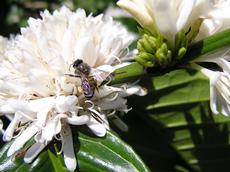
Bees of the Apis cerana (eastern honeybee) species pollinate coffee flowers. Farmers can increase the services of pollinating insects with particular cultivation methods. (Photo: J. Ghazoul / ETH Zurich)
By Peter Ruegg
No food for the human race without bees? It is not quite as straightforward as that. A case study by ecologists from ETH Zurich in a coffee-growing area in India reveals that pollinating insects are just one production factor among many. Farmers have several possibilities to increase their harvest.
All over the world, bees are dying and insect diversity is dwindling. Only recently, both the media and scientists expressed fears that insect pollination is in decline, which jeopardises food security. The (lack of) pollination has thus become a sound argument for the protection of species and natural habitats, and organic farming.
ETH-Zurich researchers from the group headed by Jaboury Ghazoul, professor of ecosystem management, set about investigating this argument by studying the influence of pollinator insects on coffee harvests in an agroforestry system at coffee plantations in the province of Kodagu in southern India. They also included soil and forest management, environmental factors such as water and soil fertility, and tree cover for the cultures in their study.
The research group thus obtained a different picture of the role of pollinators to the popular perception of this cultivation system of “no bees, no harvest”. According to their findings, pollinator bees are merely one production factor among many and to some extent coffee farmers can increase the productivity of their plantations independently of the insects. The results of the study have just been published in the journal PNAS.
Important but not the only factor
“Pollinators are important for coffee farmers,” stresses Ghazoul; “as far as effective coffee growing and increasing harvests are concerned, however, they are much less important than irrigation or liming, for instance.” This encapsulates one of the central findings from coffee farming in the Kodagu province.
Coffee is grown in a traditional agroforestry system in the region. As coffee plants must not be grown in direct sunlight, they are planted in the forest’s undergrowth or the shade of large, isolated trees. The coffee plants all bloom at the same time after heavy rains between February and March and three species of bee pollinate the flowers: the giant honeybee Apis dorsata, Apis cerana and the solitary wild bee Tetragonula iridipennis. The giant honeybee is the largest and most important pollinator, forming large colonies and needing the thick branches of tall trees to bear the weight of their nest.
Greater yield through irrigation and limestone
In order to harvest more coffee, however, the farmers have got other options than merely banking on the work of bees, as Ghazoul discovered. They can increase the yield through liming, irrespective of bee density. And instead of relying on rainfall, it is worth the farmers’ while to induce flowering with artificial irrigation. “It is particularly in a farmer’s interests to irrigate his plantations at a different time to other farmers in the vicinity,” says Ghazoul. After all, this will turn his plantations into bee magnets. This concentrated pollination increases the yield from the plantation enormously, the ETH-Zurich researchers reveal in their publication. It is a different story if the rain makes all the coffee plants in the region flower at the same time, however: the bees spread out over a wide area, the pollination is less effective and the harvest is poorer.
Trend towards deforestation
In an agroforestry system, the farmer also has another trick up his sleeve: felling trees or the forest to shed more light onto his coffee plants, which also increases the harvest. In doing so, however, he destroys the habitat of the giant honeybee (Apis dorsata).
A farmer who combines both courses of action is especially successful, initially unaffected by the disappearance of the large bees on his own plantation. Only when all farmers opt for this course of action do things take a turn for the worse. “From a plantation perspective, it makes sense to remove trees and increase yields,” says the ETH Zurich professor. “But if every farmer goes for the same option, they will all suffer the consequences of poor pollination because the giant honeybee will disappear.”
Sure enough, the researchers observed gradual deforestation in the Kodagu experiment area. Ghazoul is convinced that the farmers will lose Apis dorsata in the long run and thus – unless they take countermeasures – their valuable contribution towards coffee pollination. “It remains unclear whether the other two species of bee could compensate for this loss.” However, the farmers’ predicament is not hopeless, he says. They could domesticate Apis cerana, a very close relative of the European honeybee, and place beehives on the plantations, which would guarantee the pollination service without becoming dependent on Apis dorsata. The drawback: this absolves the farmers from their responsibility for the forest and trees. “The farmers are thus free to decide whether they want to have trees on their land or not,” stresses the ecologist, which spells bad news for nature conservation. “But good news for farmers. They have got possibilities to increase their harvest and sustain or even improve their existence.”
Unexpected threat from exotic tree species
The traditional forest trees face another danger. Farmers often replace felled local trees with the exotic Australian silver oak (Grevillea robusta), which provides the coffee plants with the shade they need. Moreover, it grows quickly and has a straight trunk, which farmers can use to grow pepper as the spice can be harvested more easily on the trunks. The sale of pepper and wood from the silver oaks is a way for the farmers to supplement their income.
However, the farmers are increasingly beginning to realise that the exotic tree also has its drawbacks. For one, its leaves barely decompose, covering the ground and coffee plants and thus becoming a breeding ground for harmful fungi and bacteria. It might also influence the nutrient cycle, which one of Ghazoul’s doctoral students is currently looking into. The silver oak leaves probably slows the nutrient cycle, preventing the coffee plants from receiving enough nitrogen in the long run, which eventually affects the harvest.
The example case of coffee growing in the province of Kodagu is interesting from a research perspective as it brings home how bees, farmers, their farming methods and natural occurrences influence and depend on each other. In this respect, the insects are not the sole influential factor in this agricultural system.
Ten principles for the reconciliation of nature and humankind
Teaming up with other scientists, ETH-Zurich professor Jaboury Ghazoul has defined ten principles that should help reconcile the conflicting interests of agriculture, nature conservation and other stakeholders with regard to a sustainable agricultural land use. The principles, which were published in the journal PNAS, include training farmers in cultivation methods that can be adapted to changing conditions. Another principle advocates taking different levels into consideration for a landscape approach, namely the landscape level itself and the individual farm level. In the example case in India, another principle is significant: the clarification of rights and responsibilities. For instance, the cultivated land belongs to the local farmers but not the trees, which belong to the state. This can cause conflicts. The principles should help to use an approach geared towards the landscape.
Further reading
Boreux V, Kushalappa CG, Vaast P, Ghazoul J. Interactive effects among ecosystem services and management practices on crop production: Pollination in coffee agroforestry systems. PNAS. 2013 May 21;110(21):8387-92. doi: 10.1073/pnas.1210590110. Epub 2013 May 13.
Sayer J, Sunderland T, Ghazoul J et al. Ten principles for a landscape approach to reconciling agriculture, conservation, and other competing land uses. PNAS 2013 110 (21) 8349-8356; published ahead of print May 21, 2013, doi:10.1073/pnas.1210595110.
source: http://www.ethlife.ethz.ch / ETH Life / Home> News Archive> Science / by Peter Ruegg / June 04th, 2013
Though agriculture was the main occupation in Kodagu district, the drastic decline in number of farmers have created a fearful situation.
According to 2011 census data there are 19,447 farmers (barring coffee estate owners). This account to 3.50 per cent of the total population in the district.
There were 38,838 farmers during 2001 census.
Paddy was the main crop in Kodagu district other than coffee. Maize, yard long beans, ground nuts, green chilly, and ginger are also grown in the district.
The district had 31.97 per cent of farmers in 1961. This slowly reduced to 23.55 pc in 1971, 23.31 pc in 1981, 19.91 pc in 1991, 7.08 pc in 2001 and 3.50 pc in 2011.
There has been drastic decline in number of farm labourers in the district. According to the latest census data, there are 12,546 farm labourers registering 2.26 per cent of the total population.
About 15.07 per cent of the total population were labourers in 1991. A total of 1,245 persons are engaged in self employment in the district. This account to 0.22 per cent of the total population.
Coffee growers have not been marked separately during the census. As a result, there is no correct figures on coffee growers. Coffee has been considered as plantation and is being included in ‘other’ category.
Other than agriculture, and coffee, there are no other sectors which generate employment in the district.
With the decline in rainfall, agriculture activities have been affected in the district. Many have deserted their farm land and have migrated to other districts in search of employment.
“There was no shortage of rainfall in Kodagu district. Inspite of having conducive atmosphere for growing crops, many have not been given priority to grow food crops.
The decline in number of farmers is a dangerous trend,” said in charge technical officer of agriculture department Ramesh.
He said “youth migrate to other districts in search of employment.
None are showing their interest in agriculture. Only aged persons are engaged in farming.
Having unable to take up farming activities, several paddy fields have remained unused in the district.”
source: http://www.deccanherald.com / Deccan Herald / Home> District / by Srikanth Kallammannavar, Madikeri / DHNS – May 29th, 2013
WELCOME. If you like what you see "SUBSCRIBE via EMAIL" to receive FREE regular UPDATES.
Read More »