Category Archives: Agriculture

Bringing the fruit of Himalayas to Ghats

‘The trick is to confuse the plant to think it is summer all along and make it bear apple through the year’
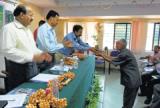
Though cheery and blithe in countenance, 74-year-old Chiranjit Parmar, a horticulture scientist from Himachal Pradesh, hopes to radically change the agricultural landscape of the region. After having observed the success of apple cultivation in Batu, Indonesia, Mr. Parmar wants to introduce the fruit, hitherto associated with cooler climes, in the tropical humidity of Karnataka.

“It is an experiment. And like all experiments, it can also fail,” he told the group of farmers who had assembled in the city on Saturday for his seminar on ‘Apple cultivation in Karnataka’.

The idea sounded incredulous to farmers who had travelled from as far away as Kodagu. Apple – whose mass cultivation is associated with regions on the foothills of the Himalayas such as Shimla and Kashmir — needs to have a chilly weather for it to bear fruit in the summer. How then was it supposed to survive in a region where temperatures rarely go below 12 degrees Celsius?

“The trick is to confuse the plant. The broad principle is that just after the sapling experiences chilling in Himachal or Kashmir, it is transported here. As there is not much of a temperature change here during winter, the plant thinks it is summer all along and bears fruit through the year,” Mr. Parmar told the befuddled farmers.

He illustrates this with a picture of cultivation in Indonesia, where, while half the apple orchard bears fruit, the other half is bare. “Crops can be regulated easily, as the leaves can be removed fully to stimulate winter. While in Himachal, we get six to seven tonnes of apple per hectare, in Indonesia, they get 65 tonnes and throughout the year,” he said.

So far, the experiment has seen small orchards set up in Tumkur, Somwarpet, Sringeri, and Uppinangadi – all through saplings sent by Mr. Parmar. In his first visit to the region, he said the results were encouraging, and in Tumkur, the plants were already bearing fruit within two years. “In Himachal, apple trees take five years to bear fruit. Here, it grows faster and incessantly into very tall trees as there is no crop fall or dormancy during winter,” he said.

Challenges

However, the tropical climate also brings with it a set of problems that is yet to be scientifically dealt with. For example, trees are susceptible to a variety of diseases and insect, while methods to reduce the tree height and grafting of trees needed to be worked out.


‘The trick is to confuse the apple tree to think it is always summer’

source: http://www.thehindu.com / The Hindu / Home> National> Karnataka / by Staff Correspondent / Mangalore – April 22nd, 2013
Agarwood a boon for plantation owners

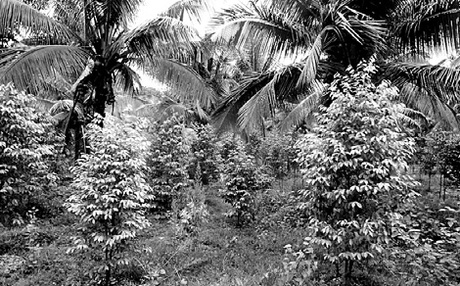
Agarwood trees grown in Dakshina Kannada | Express Photo

Plantation and coffee estate owners in Kodagu, Hassan, Chikmagalur and Dakshina Kannada finally have a reason to cheer despite the decreasing prices of their produce.

For the last five to six years, a wonder plant agarwood has replaced the conventional silver oak in many coffee estates bringing handsome dividends to growers.

Agarwood is a high value commercial crop which is in great demand in national and international markets.

The tree is used to make ittar (natural perfume oil) and perfume.

The outer part of the stem, which is of low quality is used to make incense sticks and in paper manufacturing industries.

An agarwood sapling is easy to grow as its maintenance is inexpensive and it gives yield in eight years.

Traditionally, almost all coffee growers in India plant silver oaks as an intercrop providing shade to other plants. Recently, coffee plantations in Western Ghats and Malnad region have started planting agarwood. The origin of the tree can be traced to the evergreen forests of Southeast Asia.

Agarwood was first introduced in South India by Vanadurgi Agarwood India Limited (VAIL) which was formed with its shares distributed among planters, promoters and Vanadurgi Flavours and Extracts (P) Limited.

The company is exclusively involved in the planting, processing and marketing of agarwood.

VAIL Managing Director K N Dharmendra Kumar told Express that the company has distributed more than one million agarwood saplings to 5,000 plus growers across eight districts in Malnad region.

The company has entered into a buy-back agreement with farmers to provide good seedlings, technical guidance, artificial inoculation, setting up of processing units and purchase of their inventories.

He said that 150 to 200 agarwood trees can be planted in one acre plot of coffee, arecanut or coconut plantation.

Anil Ponnappa, a progressive coffee planter in Madapura said he has planted 600 agarwood trees supplied by VAIL in his coffee estate. Another agarwood grower N Vishwanath in Sagar, Shimoga district said he has planted 15,000 saplings on his dry land a year ago. “Agarwood is a good alternative to other crops whose prices are falling these days,” he added.

Agarwood is costlier than sandalwood in the international market as it is in great demand in Gulf countries.

A sandalwood tree takes at least 25-30 years to fully grow while an agarwood takes tree takes only 8-15 years.

The inner stem (resinous) of agarwood is valued at `10,000 per kg while agarwood oil costs Rs 10 lakh per kg in the international market. Agarwood is priced according to the density of wood, resin, purity, aroma and colour.

source: http://www.newindianexpress.com / The New Indian Express / Home> States> Karnataka / by Coovercolly Indresh / ENS – Somwarpet / December 02nd, 2012

Karnataka coffee belt gets good blossom showers

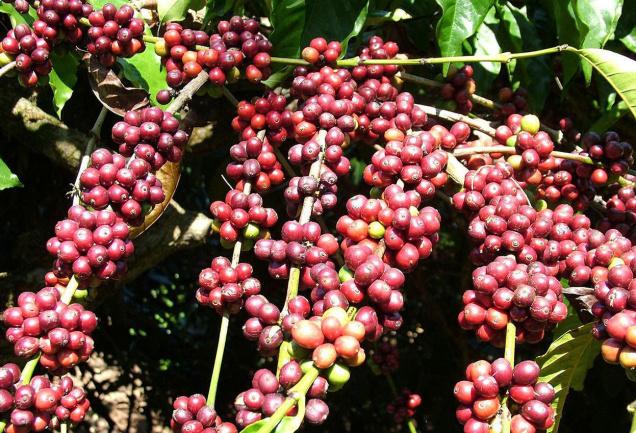
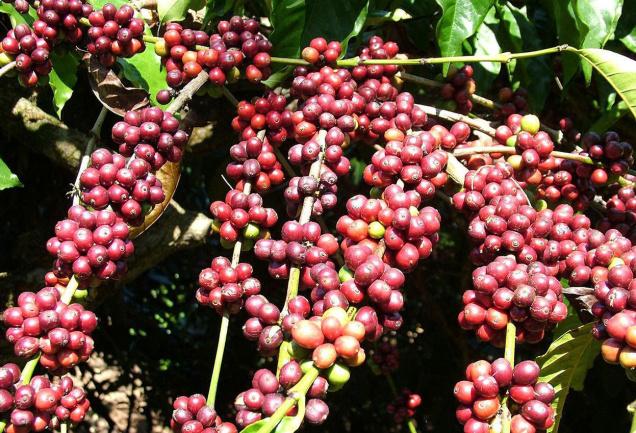
Bright outlook: Ripened coffee berries at a plantation in Karnataka. /.  (a file picture.) / The Hindu
Bright outlook: Ripened coffee berries at a plantation in Karnataka. /. (a file picture.) / The Hindu


Bangalore :

Coffee-growing regions of Kodagu, Chikmagalur and Hassan in Karnataka have received good blossom showers.

“Blossom shower in the coffee belt in Karnataka is very good this year. Very good for Arabica as compared to poor to patchy rains last year,” Bose Mandana, a senior coffee planter from Suntikoppa in Kodagu told Business Line.

MARCH SHOWERS

“Rain in February, especially during mid-harvest, was worrisome, but March shower has been heavy and this has made us comfortable for the next three to four weeks,” he added.

In Kodagu rains have been good in Napoklu zone comprising Murnad, Madikeri and Napoklu whereas Gonikoppal zone, which comprises Virajpet, Gonikoppal, Kutta and Balale, needs additional showers.

For robusta, south Kodagu got early showers in February and now has received moderate March showers.

In Chikmagalur and Hassan districts, March rains have been well distributed. “Due to timely showers and moisture status being good, many planters have begun applying manure in their estates. This year, they have been able to save on irrigation,” said Mandana.

According to Nishant Gurjer, Chairman, Karnataka Planters’ Association and a grower from Chikmagalur said “Early rains in February and subsequent rains in March have been good for overall crop production.”

“Rains in the last two months have been good for robusta. Stressed period for Arabica was cut short and there was initial apprehension among the growers over early rains. But March rains, however, have been beneficial,” he added.

Last crop year (2012-13), the Coffee Board had estimated the post-blossom estimate at 3,25,300 tonnes (arabica 1.04 tonnes and robusta at 2.21 tonnes).

As for the final crop forecast, the Board has estimated 3,15,500 tonnes, of which Arabica is 1,00,225 tonnes and robusta at 2,15,275 tonnes.

source: http://www.thehindu.com / The Hindu / Home> Industry> Agri-Biz / by Anil Urs anil.u@thehindu.co.in / Bangalore, March 15th, 2013

Honey is not ‘sweet’ for farmers

Kodagu, which was once famous for honey, now produces just a few tonnes from what it used to produce annually nearly two decades ago. However, the apiculturists are facing several problems in the district.

There is ample opportunity for beekeeping in Bhagamandala. A few farmers are engaged in apiculture. However, in the recent years, farmers from Kerala keep the beehives in the coffee estates and collect honey and take it to their hometown for sale. This has become a headache from the local farmers.

Apiculture was taken on a large scale in Bhagamandala during 1990. The farmers started rearing malliferous bee brought from Kerala. The drastic decline in the production of honey was due to sacbrood disease affecting the honeybees.

Now, apiculture has started reviving in the district. Farmers from Kerala have started keeping beehives in the coffee plantations after taking permission from the owners. A few plantations have 100 to 150 beehives.

In Kerala, honey is produced only from rubber tree flowers. As there was no great demand for such honey, natural flowers are available in plenty in Bhagamandala region. Hence, growers from Kerala have started keeping their beehives in Kodagu.
A honeybee starts the honey making process by visiting a flower and gathering some of its nectar.

In the process of gathering nectar, the insect transfers pollen grains from one flower to another and pollinates the flower.

There is a great demand for ‘Coorg honey.’ The beehives from Kerala is kept in the plantations at Cherangala, Thannimani, Thavoor and others areas. In the past, the apiculturists were getting 25 kg honey from one beehive. However, now its has been reduced to three kg, said apiculturist.

At a time when apiculturists in Kodagu are getting ready to revive apiculture by availing loan from the banks and financial assistance from the government, honeybees and beehives from Kerala entering the district has become a headache. Gram panchayats should initiate suitable measures in this regard, said the farmers.

source: http://www.DeccanHerald.com / Home> District / Napoklu, DH News Service / April 04th, 2013

‘Demand for bamboo is on rise’

BambooKF30mar2013Bamboo cultivation will fetch good income for the growers, said Chief Conservator of Forest Keshavamurthy.

Speaking at a workshop on bamboo organised by the Bamboo Society of India, Kodagu Model Forest and Forest College, he said the bamboo can be grown inside the coffee estates as well. Bamboo is used in furnitures, as a fodder for animals and in preparations of medicine. The demand for bamboo is on rise in the international market.

He said that bamboo is grown on five lakh hectare land in the State. The demand for bamboo is 26.26 lakh tonne. Bamboo sticks are used in the preparation incense sticks. Along with growing ginger, farmers can also grow bamboo.

Forest College dean Dr N A Prakash also spoke. Additional Principal Chief Conservator of Forest (retd) Dr K Sundar Naik also spoke. Bamboo growers Dr L C Sona, Sanjeev, Ahammed and Sandeep spoke.

source: http://www.DeccanHerald.com / Home> District / Gonikoppa, DHNS / March 29th, 2013

Centre plans boost for cardamom biz

Agriculture Minister Sharad Pawar reviews the functioning of Cardamom Research Centre in Madikeri, Karnataka

Agriculture Minister Sharad Pawar today reviewed the functioning of Cardamom Research Centre in Madikeri in Karnataka.

Pawar, who is on a two-day tour of the Indian Council of Agricultural Research (ICAR)-affliated institutes in Karnataka, is scheduled to return to Delhi on Saturday.

On Sunday last, Pawar had taken ill at a public function near Sangli in Maharashtra and had to be air-lifted to Pune. “He is fine now and travelling,” a close aide of Pawar said.

Cardamom Research Centre, Appangala, is located in Hervanadu village of Madikeri Taluk, Kodagu, Karnataka on the Madikeri- Bhagamandala Road, 8 km from Madikeri, in an area of 17.4 ha. The CRC Appangala is the only ICAR Research Centre working on cardamom, has been playing an important role in conducting research on cardamom and cardamom-based cropping systems, for increasing cardamom productivity.

During 2012, the centre celebrated its 50th anniversary and has been working closely with many stakeholders for development of the crop.

“I recall with nostalgia the day the centre was handed over to us in 1986 with “Queen of Spices” as the mandate crop. The release of the first IISR cardamom variety ‘Kodagu Suvasini’ in 1997 followed by ‘IISR Avinash’ and ‘IISR Vijetha’ in 2001 was a watershed in CRCs research agenda.

Subsequent research endeavours included our commitment to deliver technologies for sustainable use and evolve varieties tolerant to pests and diseases, climate change, drought etc not only for cardamom but also for black pepper. The technology to get sustainable production of black pepper despite delayed monsoon is well-accepted and appreciated by planters of this region.

Germplasm collection and conservation has always been our forte and the CRC now has in its fold around 436 accessions of cardamom, making it one of the largest germplasm collections in the world besides being the National Active Germplasm Site (NAGS),” M Anandaraj, Director, Indian Institute of Spices Research Said recently.

source: http://www.Business-Standard.com / Home> Markets> Commodities> Foods & Edible Oils / Press Trust of India / New Delhi, March 29th, 2013

Karnataka coffee belt gets good blossom showers

coffeeKF16mar2013
Bright outlook: Ripened coffee berries at a plantation in Karnataka. (a file picture.)

March rains have been well distributed

Bangalore , MARCH 15:
Coffee-growing regions of Kodagu, Chikmagalur and Hassan in Karnataka have received good blossom showers.

“Blossom shower in the coffee belt in Karnataka is very good this year. Very good for Arabica as compared to poor to patchy rains last year,” Bose Mandana, a senior coffee planter from Suntikoppa in Kodagu told Business Line.

MARCH SHOWERS

“Rain in February, especially during mid-harvest, was worrisome, but March shower has been heavy and this has made us comfortable for the next three to four weeks,” he added.

In Kodagu rains have been good in Napoklu zone comprising Murnad, Madikeri and Napoklu whereas Gonikoppal zone, which comprises Virajpet, Gonikoppal, Kutta and Balale, needs additional showers.

For robusta, south Kodagu got early showers in February and now has received moderate March showers.

In Chikmagalur and Hassan districts, March rains have been well distributed. “Due to timely showers and moisture status being good, many planters have begun applying manure in their estates. This year, they have been able to save on irrigation,” said Mandana.

According to Nishant Gurjer, Chairman, Karnataka Planters’ Association and a grower from Chikmagalur said “Early rains in February and subsequent rains in March have been good for overall crop production.”

“Rains in the last two months have been good for robusta. Stressed period for Arabica was cut short and there was initial apprehension among the growers over early rains. But March rains, however, have been beneficial,” he added.

Last crop year (2012-13), the Coffee Board had estimated the post-blossom estimate at 3,25,300 tonnes (arabica 1.04 tonnes and robusta at 2.21 tonnes).

As for the final crop forecast, the Board has estimated 3,15,500 tonnes, of which Arabica is 1,00,225 tonnes and robusta at 2,15,275 tonnes.

anil.u@thehindu.co.in

source: http://www.thehindubusinessline.com / Home> Industry> Agri-Biz / by Anil Urs / Bangalore, March 15th, 2013

Govt is committed to provide sites for siteless, says district-in-charge minister

District in-charge minister M P Appachu Ranjan said the state government is committed to provide sites for the siteless, who have been residing on paisari land for generations.

Speaking to presspersons here on Monday, he said an amendment has been brought to the Land Revenue Rules and has been sent for approval in view of providing facilities for those who have been residing on paisari land. “Once the process is complete, all those who have been residing on paisari land in Kodagu, Dakshina Kannada, Shimoga and Chikmagalur districts will get sites.

Action

Stringent action will be initiated against those who had regularised paisari land.
However, all those who have encroached upon government lands recently will be evicted,” he said.

Cheque

The minister presented a cheque for Rs 15 lakh, released under CM’s special fund to Madapura Kodava Samaja.

Zilla panchayat member B B Bharathish, BCM department officer Puttaraju, Madapura Kodava Samaja member M A Ponnappa, M C Bopaiah and others were present.

source: http://www.DeccanHerald.com / Home> District / DHNS, Madikeri / February 20th, 2013

Tribal families to get Anthyodaya card

Deputy commissioner Dr N Prasad has directed the officials to make arrangement for the distribution of Anthyodaya Anna Yojana (AAY) ration card, in the district.

Chairing a meeting here recently he said tribals are residing in a large number at Virajpet and Somwarpet taluks. The tribals are still leading a deplorable condition.

Anthyodaya

Food and civil supplies deputy director Naveed Ahammed said about 5,047 ration cards have been already distributed under Anthyodaya Anna Yojana (AAY). At least 6,000 more AAY ration cards will be distributed shortly.

Social Welfare officer Lakshman J Ganti said that 301 houses which were sanctioned during 2008-09 are under progress. During 2010-11, as many as 350 houses were sanctioned. About 320 beneficiaries have been identified and the proposal has been sent to the ITDP director for approval.

Power

Additional DC Dr N Shivashankar said that electricity connection should be provided to the anganwadi centres. The revenue officials should look into the issue.

Women and child welfare deputy director J P Lingaraju said: “We have already deposited fund to the Chescom to provide electricity connections to the anganwadi centres.”

Assistant commissioner G Prabhu, agriculture department joint director Shivamallu, mines and geology department deputy director Haris and tahsildars were present.

source: http://www.DeccanHerald.com / Home> District> Madikeri / DHNS, January 28th, 2013

Drought, a blessing in disguise for Karnataka coffee growers


Harvested Arabica coffee berries drying in sunlight at a plantation.
Bangalore , JAN. 4:
The drought in neighbouring districts has helped Karnataka’s coffee-growing regions get sufficient labour for picking coffee. This is because farming has been affected in the drought-hit areas. Besides, the slowdown in sectors such as mining and constructions has helped. The coffee belt of Kodagu, Hassan and Chikmagalur are getting many more workers from Mysore, Tumkur Chitradurga and Davangere.

“Easier labour availability has made coffee-picking manageable this season. Availability of workers between December and February is crucial for us to pick coffee and this year there is no dearth of labour,” Bose Mandana, a senior coffee planter from Suntikoppa in Kodagu, told Business Line.

“This year, however, since the crop is lower than the original estimate, we may need less labour,” he said.

LOWER WAGES

Due to more workers being available, wages have fallen by Rs 50-100 a day per person. Coffee-growers are paying Rs 200-250 a day, depending on the nature of work.

Labour shortage in the last three years had forced coffee growers to pay workers between Rs 250 and Rs 300 a day.

“In the last two to three years, we had to literally run behind the contractors to get workers. But this year, it is their turn to knock on our doors for estate-related jobs. This season, I am getting 20 to 30 calls per day, asking if I need workers,” said Mandana. Marvin Rodrigues, former Chairman, Karnataka Planters Association (KPA) and a grower from Hassan, said: “This year, we are getting people slightly more easily than the last few years. We are paying around Rs 200-210 for temporary workers.”

Nishant Gurjer, Chairman, KPA, and a grower from Chikmagalur, said: “This year, labour supply is plentiful and people are coming to work on the estates.”

“We are also getting quite a few experienced workers, who had worked in the estates earlier but had moved over to the mining and construction sector. Since these sectors are not doing too well now, they have returned.”

anil.u@thehindu.co.in

source: http://www.TheHinduBusinessLine.com / Home> Industry> Agri-Biz / by Anil Urs / Bangalore, January 04th, 2013