Category Archives: Agriculture

Nutrition food card to Jenukurubas

Madikeri, Feb 4, 2012, DHNS:
The state government has started a programme to distribute nutritious food for Jenukuruba and Koraga community members in the state.

Jenukuruba community members are found in Kodagu, Mysore and Chamarajanagar districts and find it difficult to carry out their living during monsoon. Hence, they are given nutritious food for six months in a year.

Every family is given 15 kg ragi, 2 kg tur dal, one kg horse gram, 2 kg jaggery, one litre oil and 30 eggs. There are 3,105 Jenukuruba families in the district. The nutritious food is given to 2,064 families in Virajpet and 1,041 families in Somwarpet. A sum of Rs 28 lakh is spent on Jenukuruba families in the district. The TDP officer Ganti said all the families are given a nutrition food card.

source: http://www.DeccanHerald.com / Home> Districts / DHNS / February 04th, 2012

The Bandipur-Brazil corridor

In Bandipur: dung sold at Rs 3,000 a lorry load.In Brazil: a ravaged coffee crop. Asks NITIN SETHI : what’s the relation?

Hangala was selling cow dung Auctioning
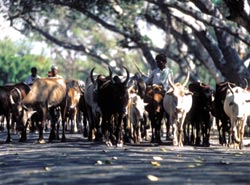
— (Credit: Photographs: M D Madhusudan

It’s hard to tell who was the first in the village to really strike upon the business idea. But very soon everyone in Hangala was part of it. The sleepy and dry village at the periphery of Bandipur National Park, Karnataka, had in a mere two year’s time, transformed itself into the nerve centre of a booming trade.

Hangala was selling cow dung. Auctioning it, quite literally, and making millions. The buyers came from other parts of Karnataka — from Tamil Nadu and Kerala, as well. Those were years of boom, the 1990s. It isn’t too bad, even today; though you are quite likely to get this wistful remark from the village’s residents today: “The high point of the trade lasted for about five years and we all made good”.

Hangala was not the only one to prosper from dung trade; the other 74 villages on the periphery of the park also thrived on it. And unknown to them, the trade was fuelled by happenings in Brazil.

Hangala, or any other village for that matter, never came to know how. They didn’t care to, or needed to, say villagers, they just wanted to make the best of it. For, the region was in dire straits then. Rains had failed Karnataka repeatedly. 60 per cent borewells had gone dry in Hangala and the village’s rainfall-dependent agriculture was on the verge of collapse.

The villagers, like most others in the region, grew low- yielding crops of millets and pulses. The average annual family income was as low as Rs 17,000. The money to be ploughed in to agriculture on the other hand was huge; labour, manure, fertilisers and seeds had to be bought before the monsoons. “Cash strapped, we perpetually ran to the local moneylenders,” says Kalappa. Interest rates ranged from 60-340 per cent annually. Even if drought spared them one year, there would always be the crop-depredating wild pigs and elephants to deal with. As an alternative some farmers opted for cash crops, cotton and castor. The crops were to some extent resistant to depradations by wild animals and brought them instant cash. But only so much.

Everyone in the region was looking for better opportunities. And, when coffee prices around the world shot up in the early 1990s, the villagers found a way out of their difficulties. These were the years when the flurry of activity at coffee markets across the world matched the fury with which the frost struck and destroyed Brazilian coffee.
High on coffee After crude oil and metals, coffee is the hottest selling commodity in the international market. The annual global exports exceed US$12 billion. About 60 countries trade in it, and Brazil, the largest grower contributes approximately 30 per cent of the global production.

Brazil’s annual coffee production is, however, prone to recurrent bouts of frosts and droughts. In fact, frosts have severely damaged Brazil’s coffee crop 31 times in the last 172 years. The frequency of the attacks have increased during the last few decades. And, in the mid-1960s and the mid-1990s Brazil suffered the worst, losing 50 per cent of its exports.

Each time the golden rule of the free market came into effect: when supply of goods reduces, prices shoot up. In fact, prices rose quite dramatically as coffee was (and continues to be) the centre of a international speculative trade, which keeps its prices volatile. The beneficiaries of this sudden rise were bound to be coffee farmers in minor producer countries, such as India (which produces 3-4 per cent of the coffee grown globally), with their produce steady in times of global slump.

But Indian growers were in no position to benefit in the 1960s. For, the farmers had to compulsorily sell their produce to the state-run Coffee Board at a fixed price. However, things were different in the 1990s: the Coffee Board had lost its control over the coffee growers. Now, the latter minted money.

And how?
The value of India’s average annual coffee export rose by 158 per cent between 1989-93 and 1994-98, although the corresponding increase in export volume was only 36 per cent. Profits soared by as much as 834 per cent, much of it shared between coffee farmers of three contiguous districts: Kodagu in Karnataka, Nilgiris in Tamil Nadu, and Wayanad in Kerala. For, about 45 per cent of India’s 3,467 square kilometres expanse of coffee-growing areas falls within these districts, which together produce 57.2 per cent of India’s coffee. While the going was good, farmers increased the land under coffee plantations. There was a problem though: manure. Indian coffee growers prefer organic manure, which gives their produce a distinct taste and value. The ever-increasing plantations now needed larger volumes of it. The obvious source: cattle. But coffee growers were loath to let cattle graze on fertile and valuable lands that could alternatively be brought under coffee, yielding even more profits.

Dung had to be managed from outside the plantation area.

Bright idea
If coffee growers couldn’t keep cattle on their highly priced land, couldn’t someone else? It is difficult to say who thought of it first; the fact remains that the entire region cottoned on fast. Coffee growers prospected and hit upon the well-connected villages around Bandipur. A good choice: livestock was abundant, agriculture was nominal, and land was not intensely used, and therefore very cheap. Here was a source for manure, loads of it.

What must have clinched the ‘deal’ was that most villages on the northern boundary of the national park had free access to the park forests. So fodder was not a problem. The pact struck, an inter-state trade in cow dung took off.

Villages such as Hangala began auctioning their dung for as high as Rs 3,000 a lorry load. Brazil’s ill luck and the vagaries of international commodity trade had brought the region unexpected riches. Hangala alone produced 39 tonnes of dung daily at the peak. Of this, it sold 16-24 tonnes — an average of 4 truckloads every day. Here was a business with no recurring costs; the fodder was ‘stolen’ from forests. “And the cattle were bought dirt cheap from Ooty. We didn’t need high milk-yield varieties, just ones which could amble through the adjoining forests and defecate” says Kalappa, a resident of Hangala.

Simple rules governing dung collection came into effect: all dung that fell in the cattle shed belonged to the cattle-owner; that deposited while cattle grazed in the forests was gathered by dung collectors (including women who found a formal occupation, finally). Dung collectors sprung up. So did agents, lorry managers, suppliers, brokers — a supply chain.

The village council in Hangala decided it should also get a share of the trade proceeds and began auctioning off streets and public places for dung collection. Exclusive collection rights were auctioned off at nine public locations — including the cattle pound and eight streets cattle used to reach grazing grounds. “We thought auctioning would bring money to the village for its development,” says H S Nanjappa, zilla panchayat member. After all, the annual trade from this village alone was worth about Rs 65 lakh.

The fact that much of the village manure was going out did not impact farming: the money earned helped purchase government-subsidised fertilisers.

Over time, villagers bought more cattle; the bovine population increased in all the villages participating in the trade; in some, by as much as 30 to 40 per cent over just five years. And in a few villages the growth rate of livestock shot up as high as 13-17 times greater than the national average livestock growth rate for the same time period.
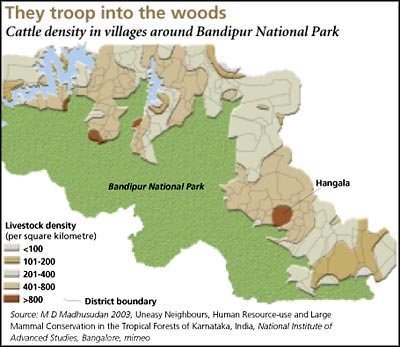
All this cattle grazed in the forest, with people following, avidly
collecting. The only alternative for grazing, common pasture lands, had anyway long disappeared. Additionally, most villages were now cropping marigold, turmeric, cotton and sunflower, which produce no consumable waste. “And even where ragi (finger millet) is grown, it’s a hybrid that produces very little hay,” says A Obireddy, principal scientist, National Dairy Research Institute, Bangalore. The forest was the cheapest, and at times the only, source of fodder for the thousands of cattle.

And today
Brazilian coffee is doing extremely well. Indian coffee growers face their worst crisis ever in 30 years. But the dung trade has acquired a steam of its own. “We now sell dung to Kerala for ginger, chilly, tea and many other crops. It’s not as voluminous as before, but prices have risen by almost Rs 1,000 in the last two years,” says M C Subbappa of Mangala village, which depends entirely upon dung trade (only about 10 of its 200-odd families own land). “What other options do we have?” he asks, as his 20-odd cattle rush home, tended by a labourer he pays Rs 5,500 annually. “I have had a daughter married off with this money. My son can work in the fields elsewhere because my future is secure.” “Our dependence on moneylenders has reduced considerably,” says Nagamma, a local tribal leader.

In Hangala too, the trade is flourishing. In the day, the village wears a desolate look: most men are out with their cattle. “Some are also trying for a few hybrid cows, for milk. The grass this side of the forest has been over-grazed. I tell them not to sell all their manure but what’s to stop them? Its not illegal,” says Nanjappa. Villagers recollect a local politician trying to stop the dung trade, even as his own henchmen made money off the trade.

It’s not illegal to sell cattle for meat either and there is a huge demand from across the border in Kerala. “Well, some do sell their cattle for a good price,” reluctantly accepts Kalappa. The village has more than 6000 cattle and nearly 5000 sheep and goats; there is enough meat to sell. A single cow can fetch up to Rs 8,000 for meat in Kerala. “Sometimes people who want to supposedly protect the cows from slaughter impound our cows at the Kerala border. But I guess they have to also fit into the business, right?” smirks Mallikarjun of Mangala village. He then goes right back to what he thinks is best for him: tending his cattle.

Inputs from E Vijaylakshmi
source: http://www.downtoearth.org.in/ Home> Features/ Issue October 31st, 2004

Govt move attracts more paddy growers

Madikeri:

The support price for paddy this year has attracted more farmers to sell their paddy production directly to the government agencies. Hence, this has increased the government’s paddy sock in Kodagu district.The state government has fixed the price per quintal of paddy at Rs 1,110 for ‘A’ grade variety, the government will add Rs 250 subsidy for this and the farmer will get Rs 1,360 per quintal.

The medium quality paddy will get price of Rs 1,080 plus Rs 250 and the aggregate amount of Rs 1,330. Farmers are selling their paddy production directly to agricultural produce marketing committees (APMC) in Madikeri, Gonikoppal and Kushalnagar. “The purchase started last month. So, for 882 quintals in Madikeri,1,192 quintals in Gonikoppal and 113 quintals in Kushalnagar, and in total 2187 quintals of paddy, is sold in APMC,” explained Jayadevaraje Urs, executive, District Food And Civil Supply Corporation Ltd.
Private buyers could not compete with the price, they cannot provide any subsidy and farmers are rushing towards APMC centres as the facility is scheduled till March-end. Later, there is no guarantee whether the same price will be continued by the government. The subsidy will be given to farmers on the basis of 18 to 20 quintals of production per acre and up to the maximum limit of 100 quintals only. The quality test is a compulsory process and moisture test will be done before the paddy is purchased from farmers.”The farmers should bring paddy in gunny bags and each bag should contain only 50 kg. They should also bring certification from the respective village accountants that the paddy is grown during 2011-12.

They should produce record of rights of property. The APMC will give acknowledgement for receiving the paddy and the cheque will be sent to the bank account of sellers within a week,” said Bellu Somaiah, president, APMC, Madikeri.Thalur Kishore Kumar, a farmer from Bettageri, expressed happiness over the government’s new support price. He said that he sold 25 quintals of paddy at Rs 1,300. “When I asked private dealers, they were willing to offer him only Rs 750 per quintal. The government’s new policy has provided the farmer an opportunity to make profit and has encouraged the cultivation of more paddy during next season,” he added.

source: http://www.articles.timesofindia.indiatimes.com / City> Mysore/ TNN / January 14th, 2012

Upasi annual meet delayed, but sees many youngsters taking part

COONOOR: Oct 23rd
Ministers give it a miss at the last minute

The Annual Plantation Conference hosted by the apex association in the South – The United Planters Association of Southern India (Upasi) appears to be losing its sheen in recent years.

Union Ministers, who have confirmed participation, have in the last 4-5 years given the event a go at the last minute leaving Upasi to find either a local Member of Parliament or the Chairperson of one of the commodity boards stand-in to inaugurate the conference.

This year, the association postponed the event by more than a month to October 23 and 24, hoping to get the Union Commerce Minister, Mr Anand Sharma, participate in this annual conference.

People in the know of developments say that for the first time in the history of Upasi has the conference been postponed by over a month. (It has for the last four-five decades been conducting the event by mid-September as a ritual).

When this did not materialise, the association sought time from the Union Minister for Rural Development, Mr Jairam Ramesh, and the Minister for Labour and Employment, Mr Mallikarjun Kharge. Though Mr Jairam Ramesh had confirmed his programme, it is learnt that he could not make it at the last minute.

The postponement of the conference, it now appears has not brought about the desired effect.

The association even departed from its usual format of arranging the commodity outlook session a day-ahead of the annual conference.

Over dependence on the elected representatives and ministers, missing schedule-deadline in the conduct of the annual meet seems to have taken its toll on the attendance at this year’s meet with more than half the members giving it a miss.

YOUNG MINDS

A visible, yet welcome change was the presence of plantation owners’ children taking part in all the deliberations this year, eagerly listening to the older generation.

Mr M.D. Balakrishna, former Upasi President (1988-89) and a coffee planter from Chikmagalur, said, “Earlier, the meets were orderly, for the corporate brought their professional work culture in managing the events and organising them. The annual meets used to be held much early, before the crop year commenced. Now only few corporates are in the sector; many have withdrawn. With their absence, the onus is on the plantation owners and few service providers to managing the meets annually.”

Plantation owners have two issues on hand – manage the trade body and manage their estate besides coping with the changing national and global policies. This has delayed the younger generations to actively involve on both platforms.

Many plantation owners’ children do work in different industries such as banking, managing cafes or at different value chain of commodity processing before going back to managing their estates. This has also delayed them to take a plunge in serving the trade bodies.

Talking about the diverse talent younger generation is bringing to the trade bodies, Mr Marvin Rodrigues, Vice-Chairman, Karnataka Planters’ Association (KPA) and a planter from Hassan, said, “youngsters are coming back to the plantation sector after having worked at industries. For me, managing labour shortages on the estate has taught me good HR skills.”

Mr Bose Mandana, former Vice-Chairman of the Coffee Board and a coffee planter from Kodagu, said: “We have come long way to reach a stage in managing our trade bodies ourselves. When total export controls were in place, we had limited or no role to play in marketing the produce. Now, we are free to manage, but problems are plenty.”

source: http://www.thehindubusinessline.com / L.N. Revathy > Anil Urs / October 23rd

India witnesses rise in coffee exports

The Coffee Board of India has revealed that the country’s coffee exports in the 2010-11 coffee year have increased by about 34% to 3.58 lakh tons, compared to 2.68 lakh tons in 2009-10 coffee year.

The board has attributed the jump in coffee exports to the rise in global demand. According to the data from the board, Coffee exports in value terms increased to $1.048bn from $577.98m on higher realizations.

The coffee shipments of the country rose by 30% to 2.92 lakh tons, compared to 2.24 lakh tons in the corresponding period last year in the first nine months of the current calender year, reported Press Trust of India.

The exports from the country in the April-September period of the current fiscal also rose by 25% to 1.92 lakh tons from 1.53 lakh tons in the year-ago period.

India, which largely exports coffee to Italy, Germany, Russia, Belgium and Spain, accounts for 4.5% of the global coffee output, but exports 70% to 80% of this.

source: http://www.markets.drinks-business-review.com / by DBR staff writer/ October 04thy, 2011


Caf’e Civet day

In a pretty little camp in Coorg, you can find one of the world’s most expensive coffees. The rider: it comes in the guise of cat poop

Kari Beckoo (so called in Kannada) or Kopi Luwak is one of the most expensive, most aromatic coffees in the world. Internationally, it can fetch anywhere between Rs 15,000 and 20,000 a kilo. A cuppa will set you back by a cool Rs 2,000. For something so obviously exclusive, Kopi Luwak (as it is known in Indonesia and the Philippines), has very down to earth origins.

Type: Food discovery
Best from: Bengaluru
You need: 2 days

Coffee beans drying in the sun are a common site on most house terracesin the area and estates. Pics/ AMrita Bose

It comes from the poo of the civet cat. Our visit to the Civet Creek Camp, located 18 km from Madikeri, the district headquarters of Kodagu or Coorg, was centred around an agenda very different from that of regular tourism. We were hot on the trail of the Asian Palm Civet cat and its bowel movements to inspect it from a purely epicurean perspective. The Palm Civet cat’s droppings, left under coffee plants, are responsible for one of the most expensive and aromatic coffees in the world.


The Palm Civet Cat feeds on ripe coffee berries that are partly digested
and worked on by enzymes before being discarded in its excreta.

Bordered by reserve forest area and frequently visited by civet cats, Civet Creek Camp was started three years ago on an eight-year-old coffee estate that offers accommodation only in tents. Pitch your own tent in the open or borrow one under a shack and you are all set to play (boy or girl) scout. Warm up with rope walking, air rifle shooting, trampling, or spider walking or just lie on the web at night to watch the stars.

We timed our visit with the beginning of the coffee picking season — just after December; usually the time when civet cats eat ripe coffee berries. Although the owner Madappa warned us about the difficulty of finding droppings since the season was almost over, we were determined.

Mission poo
The area frequented by civet cats was near a waterfall in a forest area bordering a village called Awandur. Getting there involved trekking a distance of four kilometres on foot. We set out early in the morning with our guide Vasu, who is considered a poop-spotting expert.

The trek involved meandering through narrow coffee estate pathways, through terraced fields, passing by thatched roofed homes and watching coffee beans drying in the sun while scarecrows stood guard next to a couple of new homes under construction. Here, the scarecrows help ward off the evil eye and bring in good luck.

Like a hound strong on the trail of blood, Vasu was on high alert by now, poking around in coffee bushes as we trudged uphill next to a meandering stream fed by a waterfall. On the way, we spotted a giant Shikakai tree — a natural detangler for hair — the black sooty sap of which is extracted for incense sticks and the occasional cardamom plant.

Vasu explained that Coorg was originally known for its cardamom plantations, not coffee, but dwindling labour forces in recent years, and the vulnerable nature of cardamom plants had given way to hardy coffee plantations of Arabica and Robusta varities.

A rare species of a fiery coloured snail found in forests nearby

A cat with good taste
Suddenly, Vasu disappeared under a thick coffee shrub only to emerge with what looked like sticky peanut chikki. A little squeamish, we approached it with trepidation. Strangely odourless, the poop contained half-eaten coffee beans.

Enzymes in the cat’s digestive system work on the beans, breaking them down before it’s excreting from its body. The part-digested beans are separated from the dung by washing them thoroughly, and keeping them in water, before drying and roasting them.

The fact that this coffee is completely organically processed, and that the civet cat is one with good taste (it picks only the best coffee beans for consumption), goes a long way in determining the delicate flavour and the aroma associated with this frightfully expensive coffee.

Although the estate doesn’t produce enough to brew or sell this coffee on a largescale basis, the coffee board is willing to accept it at between Rs 3,000 and 5,000 a kilo.

Expensive stash
Eventually, we made it back to Civet Creek Camp in a happy daze, clutching at our prized discovery now neatly sealed in a plastic bag. Oh, and the regular coffee beans drying in the sun that Coorg is oh-so-famous for? We couldn’t care less. The writer travelled to Civet Creek Camp on invitation.

Bored of expensive cat potty? Here’s what you can do in and around Civet Creek Camp
Talakaveri: The birthplace of River Kaveri and a known pilgrimage site, Talakaveri is located on the Brahmagiri hills. The river originates as a spring and feeds into a tank where pilgrims bathe.


Jumping on a trampoline is one of the acitivities offered here.

Dubare Elephant Training Camp: Located about 40 km away from Civet Creek, this elephant training camp is run by the Karnataka Forest Department. It houses elephants that are trained under naturalists, and doubles up as a tourist spot. It’s located on the banks of the River Kaveri, with the Dubare Reserve Forest as a backdrop.

Tourists are allowed to participate in a three-hour interaction with elephants which begins with their grooming and scrubbing, feeding them and taking them on a 45-minute ride in the jungle. Resident naturalists will also give you a lowdown on all you need to know about these pachyderms. You need to reach the camp by 8.30 am.

Abbey Falls: Also known as Abbi or Abbe, this waterfall is located in a private coffee estate among pepper trees, about seven km away from Madikeri. A hanging bridge opposite the waterfall offers a breathtaking view.

Kaveri Nisargadhama: A picnic spot on an island formed by river Kaveri is a nature resort with a deer park, orchidarium and a forest full of bamboo, teak and rosewood. The island can be accessed via a hanging bridge. You can rent out tree houses run by the forest department.

Stock up on Coorgi delights
Coffee Powder: A mix of Arabica and Robusta, you can buy filter coffee from the Coffee Board or local shops at Madikeri.

Coorgi Pork Masala: The perfect aid to making the famous Coorgi Pandhi or Pork Curry. Also don’t forget to buy a bottle of black vinegar extracted from Kachampuli, a wild, tart fruit. This vinegar gives that distinct black colour and tangy flavour to the Pandhi curry.

Spices: Stock up on nutmeg, star anise, pepper and cardamom.

Civet Creek Camp FAQs
It only offers tent accommodation with common bathrooms. The camp organises treks to nearby waterfalls, mountain peaks and coffee estate walks. You can request for a special trek to spot civet cat droppings along with estate coffee pickers. Night treks can be organised too. Rs 1,350 per night per person gets you two breakfasts, lunch, dinner and barbeque with unlimited coffee, tea or juice.

Call: 9845827010
Email: civetcreek@gmail.com


Getting there

BY ROAD: Karnataka State Road Transport Corporation (KSRTC) Volvo buses, known as Airavat, leave Bengaluru every day at 2 pm, 4 pm and 11 pm, and take you to Coorg in five hours. Frequent buses from Mysore are available too. Take any bus going to Talakaveri or an auto rickshaw, and get off at the Betegeri village junction to get to Civet Creek Camp.

BY RAIL: The nearest rail head is Mysore which is connected to all major cities and is two-and-a-half hours away from Madikeri.

BY AIR: The nearest airport is Mysore (120 km) followed by Mangalore (135 km) and Bangalore (250 km).

BEST TIME TO GO:  The best time to visit Coorg is between October and March. The weather is pleasant during the day but temperatures may dip at night. Carry a jacket.


source: http://www.mid-day.com / by Amrita Bose / 2011.03.06 / Place: Mumbai

Kodagu’s Oranges in Kerala

The oranges that usually come up for harvest at the beginning of the rainy season have seen a great demand this time round.

Kodagu’s oranges in Kerala
Kodagu’s juicy oranges are famous across the country. The fruit which is harvested twice a year, has now entered the market. In fact, the fruit has found a huge market in neighbouring Kerala. TOwing to the delay in monsoon, most farmers and traders are now busying themselves with Kodagu’s oranges.

Several traders are buying oranges in a wholesale manner at Kottamudi, Hodawada, Murnadu and other places near Napoklu. They then transport them to Kerala.
The oranges that are harvested from the winter find a larger demand in the local markets than the oranges harvested in the rainy season.

The oranges from the rainy season are priced between Rs 20 and Rs 30 per kilogram.
Orange yield has come down drastically in the recent past. The size of the fruit has gotten smaller, but they still retain the true Kodagu orange flavour, points out Hodawada’s orange trader Hamsa.

Still, orange crops have had their share of troubles. In the recent past, they have been afflicted with a pest and that has affected orange produce. It is imperative that coffee estate owners pay greater attention to orange crops.
C N Suresh


source: http://www.deccanherald.com / Supplements / Spectrum / Miscellany

Forest Dept plans Survey to Protect ‘Devarakadu’

The Forest Department has decided to conduct a survey to protect Devarakadu in association with the local villagers by evicting the encroached Devarakadu after monsoon.
The survey will be carried out in association with revenue department. Speaking to presspersons here on Tuesday, Kodagu Circle Conservator of Forest K B Markandeya said “government had earmarked Rs 8 lakh to preserve Devarakadu. The government had also assured to release additional Rs 20 lakh.” 

Devarakadu spreads from half acre land to 350 acre land in Kodagu. Some of the Devarakadu lands have been encroached upon. It has been decided to evict the encroached land in association with local villagers. In this background, a joint survey will be conducted in association with revenue department. As Devarakadu RTC, survey number and other documents are with revenue department, joint survey will be conducted, he informed.

He said: “It has been decided to mark the boundary of Devarakadu by constructing a permanent fence. Instead of forest department taking a unilateral decision, it has been decided to consult Devarakadu committee office-bearers and then chalk out plans on the development of Devarakadu.”

1214 Devarakadu

Ponnampet Forest College Prof C G Kushalappa said Kodagu district has 1,214 Devarakadu spread in 2,550 hectare land. “There is one Devarakadu for every 300 acre land. Such a vast Devarakadu is not found anywhere in such a small land. In Kodagu, 165 Gods are worshipped in Devarakadu in Kodagu,” he informed.

The Devarakadu committee will fetch 90 per cent of the income by selling fallen trees in Devarakadu. “About 10 per cent will be given to the government. The funds can be utilised by the committees for the development of temples in their vicinity.”

Devarakadu have been declared as reserve forest in 1887 itself. Even 150 years ago, our forefathers were protecting Devarakadu. Hunting and felling of trees in Devarakadu is banned, he added. “We do not have complete information on the encroachment of Devarakadu. As Forest law is strong, it will not be evict the encroached area,” he said.

Prof Kushalappa said those who have voluntarily evicted the encroached Devarakadu land have been conferred on ‘Devarakadu mithra’ award. Kadanooru Devarakadu committee was given a financial assistance of Rs 10,000 for best maintenance.


source: http://www.deccanherald.com / Madikeri / DHNS / Jun 15th


Its Coorg Oranges vs Nagpur Oranges in Kodagu District

Now a days, Kodau-Nagpura oranges are highly discussed topic in Kodagu. The revival of Coorg orange under National Horticulture Mission and purchase of Rs 2.43 lakh worth Nagpura orange plants have given food for discussion in Kodagu.
Coorg orange which received global recognition.  dh photoCoorg orange has global recognition and has attracted the attention of the customers at the global level due to its colour and taste. In 1960s, oranges were grown in 50,000 to 60,000 hectare land. However, over the years, disease attacked orange plants. As a result, the land under orange cultivation was reduced to 3,000 to 4,000 hectares. After the price of coffee rised in the international market, orange estates have disappeared in Kodagu. 

Based on the proposal of the horticulture department on the need for reviving oranges in Kodagu, the Central government released a sum of Rs one crore in 2009-10. The Horticulture department purchased Nagpura orange plants instead of Coorg Orange plants. According to officials in Horticulture department, Kodagu-Nagpura varieties are one and the same.

However, after Indian Horticulture Research Scientists reported that Nagpura variety of orange plants are not suitable for the weather in Kodagu, the discussion on Coorg and Nagpura oranges have increased. Though elected representatives from BJP tried to ascertain the fact that both the varieties are same, Congress and JD(S) are demanding Lokayukta probe into the misappropriation in the purchase of Nagpura orange plants.
Under National Horticulture Mission, 2.43 lakh Nagpura variety of orange plants have been distributed. A sum of Rs 47 lakh have been spent over it. However, distributing Nagpura variety of orange plants in a hurry without giving any information to the growers have given room for suspicion.

Another interesting thing is that the department had given advertisement in local newspaper for the supply of orange plants. However, in the tender, individuals from Hassan and Shimoga have taken the tender to supply the plants.

However, horticulture department is supporting its stand on the distribution of Nagpura variety of orange plants. In the beginning, Chettallu Horticulture Research Institute had agreed to supply 10,000 orange plants. As the demand was more, it was necessary to purchase Nagpura plants.

The geography of Kodagu is different. Kodagu receives six months rain and the temperature does not rise. However, Nagpura oranges grow under 40 degree celsius weather. With the Kodagu weather, the colour and taste of orange may vary feel scientists.

The taste of Coorg orange can not to compared with Nagpura orange, said a senior officer.

Some say that horticulture department runs eight nurseries in Kodagu and spend Rs 15 lakh annually.

Instead of purchasing 2.43 lakh Nagpura variety of orange plants, the department could have developed plants in its own nurseries in a phased manner.

However, we can not brush aside the fact that globally recognised Coorg orange will be a thing of past if Nagpura oranges start giving yield within three to four years in the district.

source: http://www.deccanherald.com / Madikeri / DH News Service / Oct 21st

Kodagu: Land of Coffee, Oranges

Kodagu is on the eastern slopes of the Western Ghats. It is a hilly district with the lowest elevation in the district at 900 meters (2,900 ft) above sea-level.
Kodagu district is bordered by Dakshina Kannada district to the northwest, Hassan district to the north, Mysore district to the east, the Kannur district of Kerala to the southwest, and the Wayanad district of Kerala to the south. 

Kodagu is on the eastern slopes of the Western Ghats. It is a hilly district with the lowest elevation in the district at 900 meters (2,900 ft) above sea-level.

The highest peak, Tadiandamol, rises to 1,750 meters (5,700 ft), with Pushpagiri, the second highest, at 1,715 meters (5,600 ft).

The main river in Kodagu is the Cauvery. The Cauvery starts at Talacauvery, located on the eastern side of the Western Ghats, and, with its tributaries, drains the greater part of Kodagu. In July and August, rainfall is intense, and there are often showers into November. The principal town, and district capital, is Madikeri, erstwhile Mercara. Other significant towns include Virajpet and Somwarpet. The district is divided into the three taluks: Madikeri, Virajpet and Somwarpet.

SUSTAINABLE LIVING

A seed collective in Malnad

The Malnad Forest Garden and Seed Keepers’ collective was born in 2001 as a network of seed exchange groups focused on celebrating and endorsing biodiversity. From 2003, the collective began promoting sustainable livelihoods through conservation-oriented enterprises. The seed collective officially registered as a trust in 2008. Vanastree’s office is located in Sirsi town, but the collective has members scattered across Malnad (hilly region of the Western Ghats) as well as in the narrow coastal belt and in the eastern fringes of the Ghats.
Vanastree’s objectives arose out of concerns for the economic stability of the region and the danger of losing its small-scale, traditional food production system to the forces of globalisation. Vanastree, which translates as “Women of the Forest” in Kannada, also emphasises the traditional role of women in conservation.
Vanastree’s activities include: Forming a decentralised regional seed bank and one in Sirsi town; building an internship programme, supporting collective members in creating a variety of home-based conservation enterprises. These include production of value-added foods based on local cuisine, sales of crafts and other items, camps
and eco-homestays.
(vanastree.org)


All for organic agriculture

Sahaja Samrudha started as a farmer initiated group to exchange ideas, seeds and share knowledge on sustainable agriculture. It  was the culmination of individual efforts into a more exciting and powerful force to make sustainable agriculture a way of life for the farming community. Samrudha has been establishing contacts, building networks, facilitating exchange of experience and developing programmes based on the needs of farmers of specific regions.
(sahajasamrudha.org)

Send your comments to: spectrum@deccanherald.co.in or Spectrum  c/o Deccan Herald, #75 M G Road, Bangalore-560001


source: http://www.deccanherald.com / Supplements / Spectrum/ Know Your District /