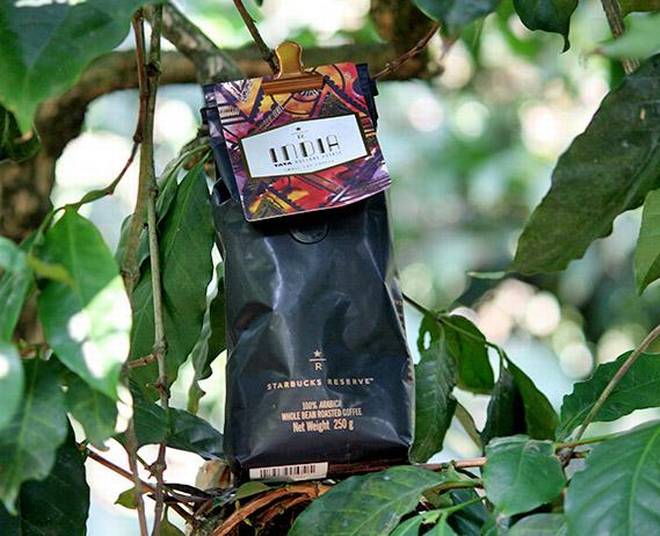
Coffee grown in the hills of Karnataka is making its way to the Starbucks Reserve store in Seattle
Coffee is undergoing something of a transformation in India. Local beans, grown in the country, are finally making it onto store shelves, where provenance and growing techniques are emphasised. Meanwhile, a certain section of savvy consumers trawls the Internet, searching for new ways to brew their daily cuppa using a range of different home-grown beans, each of which comes packaged with tasting notes that emphasise subtle flavours.
Meanwhile, an ocean away, India’s coffee prowess was given a different stamp of approval, when last October, Starbucks sold Indian coffee for the first time at its flagship Starbucks Reserve store in Seattle, the city in which the brand was founded. The coffee came from Tata’s Nullore estate in Kodagu, Karnataka, and was the company’s first microlot coffee. While Tata has 19 plantations in Kodagu (spread over 7,300 hectares), this was the first time that the company’s arabica beans made it to international shelves.
Microlot coffee refers to beans that are generally the best of the estate, and are those that imbibe flavours of the terroir. Arabica is one of two types of coffee beans, and is prized for its flavour, lower caffeine content and almost twice the concentration of sugar than is found in robusta. As a result, arabica is more expensive, and harder to grow.
Place of origin
Walking around the Nullore plantation’s block 19 (where the beans grew), what strikes you is the sense of calm that comes with standing in the midst of a 505-acre estate.
The microlot that was ultimately produced got its flavours from plants and trees that fruit bats propagate, while they make their homes in the silver oak trees above that provide shade to the arabica plants below. This two-tier system allows the coffee to grow under a canopy of trees, which includes jackfruit, pepper vines and fruits such as orange and lychee. On a tour of the block, Mandana, plantation manager, says, “We collected the coffee berries separately from eight hectares of this [block], where the fruit bat population is high.”
Changing trends
The story of the coffee though, goes beyond its growth, and rather is the story of how Tata Coffee is responding to changing customer demands, especially at the high-end, where international coffee drinkers are willing to spend between $10-30 to buy beans with unique tasting notes. Sunalini Menon, a well-known coffee cupper, who is also an independent member of the Tata Coffee board, has been instrumental in galvanising the plantation managers to experiment with microlot coffee. Chacko Thomas, the deputy CEO and executive director, says, “As a result of Nullore, we have 150 [microlot] experiments in progress.” Processing aside, the recognition has showed employees, that the beans grown in Kodagu can be cupped alongside the best in the world.
source: http://www.thehindu.com / The Hindu / Home> Life & Style> Food / by Aatish Nath / March 30th, 2017
At a time when ground water table is depleting in Kodagu, Pradhan Mantri Krishi Sinchayee Yojane will be a boon for conserving the ground water. The Agriculture department has been getting ready to conserve water in 25 gram panchayats.
With the recede in rainfall, the ground water table in the district has depleted drastically. Water would be available by digging 100 feet, 10 years ago. Now, even after sinking for 300 to 400 feet, water is not available in the district.
Though Pradhan Mantri Krishi Sinchayee Yojane came into effect last year, the department has decided to implement it effectively during the current year. The Union government, based on satellite images, has identified a few areas in Western Ghats where water conservation activities can be taken up. Accordingly, percolation pits will be dug in 81 villages in these gram panchayats.
The beneficiaries whose land is identified in the satellite image will get Rs 60,000. The amount could be used for sinking the pits, removing the silt of the pit, development of the pit in the next five years, said an official from Agriculture department.
To increase the ground water table, even ‘Thottilu Gundi’ will be constructed in coffee estates. The work on construction of vented dams, planting of silver trees would be taken up under the scheme. Kodagu district would get a sum of Rs 3.17 crore for five years. If the scheme is implemented effectively, then water table would increase in the district, said officials.
Under the second phase, 11 villages of three gram panchayats in Madikeri taluk, the percolation pits have already been dug. With this, the recharge of ground water table would be taken up during the monsoon. 15 metre long, 15 metre wide and three metre-deep pits have been dug.
In the third phase, 10 gram panchayats in Somwarpet taluk have been selected. In 2018, nine gram panchayats in Virajpet and five gram panchayats in Madikeri will be included.
Agriculture department officer Robert told DH: “Decline in rainfall has depleted ground water table. It is a challenge for the growers in Malnad to safeguard the long term crops. Percolation pits help check erosion of fertile soil. “The department will not select the farmers. Based on the satellite image, the survey number farmer will be the beneficiary.”
DH News Service
source: http://www.deccanherald.com / Deccan Herald / Home> District / by Aditya K A / DHNS- Madikeri, January 28th, 2017
The entire Kodagu district should be declared as eco-sensitive zone, said Coorg Wildlife Society president Col (retd) C P Muthanna.
Speaking at an interaction with various organisations on conservation of environment here on Wednesday, he said, “River Cauvery is the lifeline of entire South India. Around 8 crore people are dependent on the river, which also supports more than 600 industries. With the increase in attack on environment, River Cauvery is drying up. To prevent this, the entire district should be declared as ecosensitive zone.”
Land conversion
He added that in the name of urbanisation, about 2,800-acre land has been converted for commercial purpose in the last 10 years in the district. “There is a need to arrest the opening of new layouts, resorts, homestay, construction of railway lines and illegal sand extraction. About 54,000 trees were felled to lay high tension line to Kerala,” the colonel reminded.
He said permission should not be given for the setting up of new resorts in the district. The construction of a mini aerodrome and a cricket stadium in the district would be opposed by the Coorg Wildlife Society. The society will also oppose any move to divert the Kongana river.
Stating that the laying of the Mysuru-Kushalnagar railway line will affect the ecology of the region, he said infiltrators from Bangladesh earlier used to arrive in the district in buses. With the introduction of train services, they will arrive on trains.
Air Marshal (retd) Nanda Cariappa said there is a need to conserve land and environment for future generation. “The land is not being converted for commercial purpose in Kerala, however, the land is being converted for commercial purpose indiscriminately in Kodagu district,” he concurred and added that there has been a rise in wild animals-man conflict in the district.
He expressed concern over tigers entering human habitations in the district.
source: http://www.deccanherald.com / Deccan Herald / Home> District / DHNS- Madikeri, February 16th, 2017
Four elephants from Mathigodu elephant camp in Kodagu district left for Uttarakhand on Monday. The elephants have been sent to Jim Corbett Tiger Reserve as per the MoU signed between the Karnataka and Uttarakhand governments.
The elephants that left for the north Indian state are Thunga (15), her two-year-three-month-old calf Karna (7) and Bheeshma (7). Mahouts Gopal, Rama and Lingappa, are accompanying the pachyderms.
The elephants halted at Kallabettu forest in Hunsur on Monday evening and will resume their journey on Tuesday morning, said Mathigodu RFO Kiran Kumar. He said the elephants will travel by lorry. The mahouts will be with the elephants till they get accustomed to the new environment, said the RFO.
Elephant Thunga is the daughter of Varalakshmi, who is at the elephant camp. Karna is the son of Chamundi who was captured at Dandeli. Bheeshma is an orphaned elephant who was found on the periphery of Veeranahosahalli. He was separated from his mother and was reared by mahouts at the camp.
source: http://www.deccanherald.com / Deccan Herald / Home> State / DHNS- Gonikoppa (Kodagu District) / February 21st, 2017
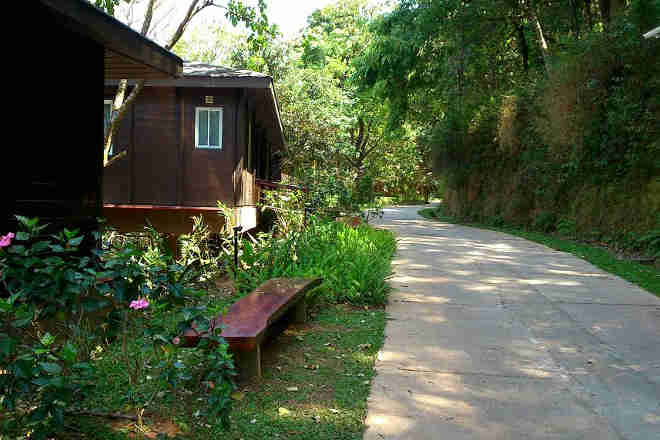
Ibnii Coorg is nestled on 120 acres of which 50 acres is being used for coffee plantation
Ibnii Coorg, an eco luxe resort located in Coorg (Kodagu) district of Karnataka, has become the first hospitality project in India to receive the IGBC Platinum certification for energy and resource-efficient, sustainable, cost-effective buildings.
source: http://www.financialexpress.com / The Financial Express / Home> Lifestyle> Travel Tourism / by Steena Joy, Madikeri / February 21st, 2017
Ibnii Coorg, an eco luxe resort located in Coorg (Kodagu) district of Karnataka, has become the first hospitality project in India to receive the IGBC Platinum certification for energy and resource-efficient, sustainable, cost-effective buildings that impose minimal stress on the environment. The resort is also gearing to get its LEED (Leadership in Energy & Environmental Design) certification by April.
The Indian Green Building Council (IGBC), part of the Confederation of Indian Industry (CII) was formed in the year 2001.The rating systems are based on the five elements of nature (Panchabhutas) and are applicable to all five climatic zones of the country.
Ibnii Coorg is nestled on 120 acres of which 50 acres is being used for coffee plantation. The resort has just finished with its first coffee harvest. Speaking exclusively to FE Online, Dr Sherry Sebastian, director, Ibnii Coorg, informed, “In the last 60 years, no pesticides have been used on this land. So it is an ecological and biodiversity hotspot. Very few trees were cut during construction of Ibnii Coorg. We are also very actively involved in rainwater harvesting as we have three large water catchment areas. We harvest nearly five million litres of water every year. Apart from a waste management plant, we have a state-of-the-art Sewage Treatment Plant (STP) too to further minimise our dependency on fresh water. The treated water is used for landscaping and other utilities. Ibnii is also a vehicle free zone with only electric buggies used for internal movements. Guests are encouraged to walk around the resort.”
The resort also has introduced other ecological initiatives such as an inhouse tailoring facility where many articles are created out of recycled materials like shopping bags out of used cement sacks and bubble wraps; use of steel fruit and vegetable crates in the kitchens instead of the conventional plastic crates; use of drop pops in the restaurants in place of finger bowls for washing hands. The resort is also part of a new project with Madikeri town for making a road using recycled plastic from the resort.
Ibnii Coorg also has TieCop, its Environment Conservation Programme.
Dr Sebastian added, “We also want our supply chain to be eco sensitive – so we source only from vendors who have the same sensitivity towards the environment. Presently, we source the coffee for the resort from Halli Berri, a fourth generation all woman owned concern coffee estate in Chikmagalur with a similar vision towards sustainability, but soon we hope to be able to use our own coffee. We have a vegetable garden where we source most of the vegetables for our salads. Another bigger vegetable garden is being created which is expected to give us around 14 tonnes of vegetables.”
The resort has a robust waste segregation system where the organic waste is used in a vermicompost to generate high-yield, organic manure which is in turn used in the green house to grow fresh organic vegetables and fruits.
source: http://www.financialexpress.com / The Financial Express / Home> LifeStyle> Travel Tourism / by Steena Joy ,Financial Express, B2B / Madikeri – February 21st, 2017
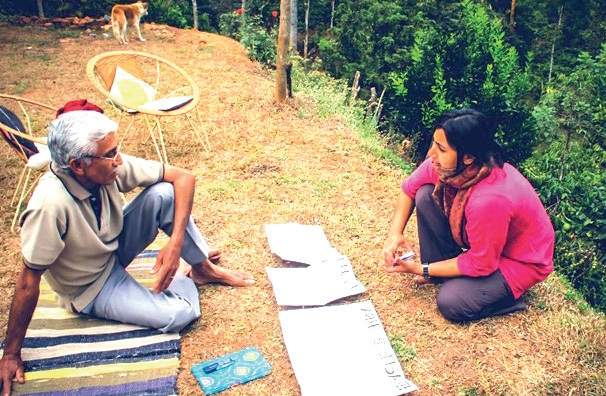
Some of the coffee tasted bland, others were a bit over-the-board bitter. The 33-year-old Arshiya Bose, social entrepreneur and owner of Black Baza Coffee who was in Kochi recently to hold a coffee-tasting session, says that there is no short cut to making a good cuppa of coffee.
So, Arshiya takes her students on a trip on the perfect ways of making coffee. At the end of the session, she introduces them to the Black Baza Coffee, which is warm and has the lure of a refreshing evening drink. What’s unique with this coffee is not only the way it is processed, but that the beans are grown in the most fertile of soils in India – right next to the Kodagu and B R Hills in Karnataka, where the river Cauvery flows in all its glory.
Karnataka-based Arshiya Bose is currently on a mission to promote this coffee, which is grown under large tree canopies, right next to the river beds. According to her, Indians have forgotten the taste of original and eco-friendly coffee, and has hence taken it upon herself to bring back the lost glory.
“Indians drank one of the most unique coffees in the world. In the past, the coffee beans, especially in Karnataka, were grown under forest covers and under shades of trees.
However, constant deforestisation forced our farmers to grow coffee directly under the sunlight,” she said. According to her, this method was detrimental to the environment (as it encouraged deforestisation), and also led to early maturation of the coffee beans, which supposedly also lead to a compromise in quality and taste.
For this, Arshiya got in touch with farmers who were growing coffee beans in Karnataka.
“ This is how we zoomed in on Kodagu and B R Hills. We said we would buy their produce and sell it across the country, if they were willing to heed to the eco-friendly norms. They agreed. So, they started growing coffee under available trees and were given the responsibiltiy to look after it too,” says Arshiya.
Right now, Arshiya’s Black Baza Coffee, named after the small bird of prey found in heavenly dense forests of South and South East Asia, is sold across the country. In Kochi, it is available at Pepper House Cafe.
source: http://www.newindianexpress.com / The New Indian Express / Home> Cities> Kochi / by Princy Alexander / Express News Service / February 05th, 2017
All SOS organics products are made from crops that are completely rain fed, chemical free and using natural farming and sustainable agricultural techniques.
A quick look at SOS Organics website and you will realize that there is something more than natural and organic in their varied products. Gur Shakkar, Khandsari sugar as alternatives to white sugar and sweeteners, soapnuts as natural cleansers, environmentally sound beeswax candles devoid of soot/smoke, home care products made of native plant oils, herbs and natural essential oils – these catch your immediate attention. All these products are made from crops that are completely rain fed, chemical free and using natural farming and sustainable agricultural techniques.
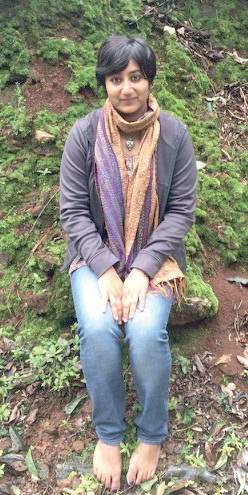
The Alternative spoke to its founder, Amrita Chengappa about her venture in Uttarakhand.
A little bit of everything to nourish and heal
Pulses, flour, millet, spices, herbs, pickles, jams, marmalades and honey, tea, as well as beeswax candles – there is a little bit of everything needed to lead a healthy life. Amrita says, “Our line of natural cosmetics is based on apricot kernel oil, and includes soaps, hand creams, face creams, body and foot scrubs, lip balms, and body oil. All items are made with beeswax and precious essential oils and are free of chemicals and hormones.”
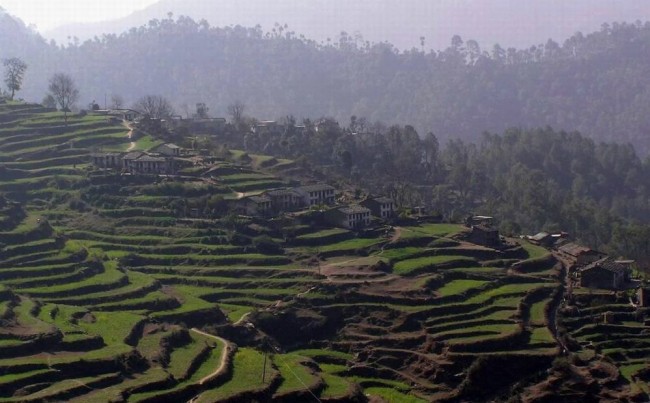
Himalayan terrace farms are the source of SOS organic products Courtesy: SOS organics Facebook page
In Uttarakhand, farmers have very small land holdings that are completely dependent on rain. So instead of asking the farmers to grow one particular type of crops, say only rice or millet, Amrita has encouraged mixed farming. “We are targeting indigenous low input crops that they have been growing over the last hundred years. We encourage them to grow a little bit of everything so that it all adds up to become a basket full of goodness to nourish and heal the body,” says Amrita.
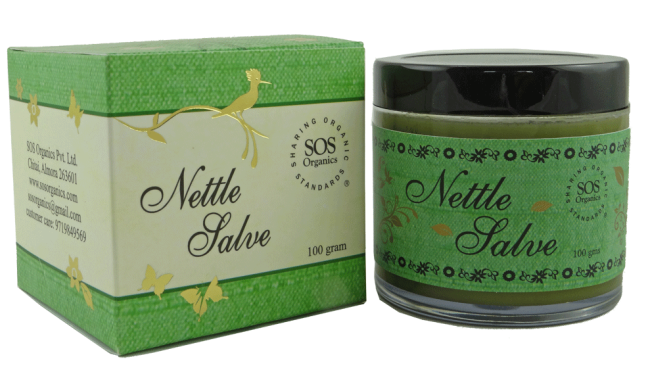
Their latest products are based on the humble nettle which has an abundance of health benefits. “One day we became aware of just how much nettle was growing all around us in the wild and nobody was using it. After some in-depth research that took us all the way back to Milarepa, who lived on nettle soup for years while meditating in a Himalayan cave, we began experimenting and created nettle tea and nettle flakes,” says Amrita.
The Inspiration
Amrita and her husband who have set up a village unit in Uttarakhand have been closely working with locals there.
“We had the inspiration to move to the Himalayan foothills in 2002, with only an idea to work in a village and bring meaningful employment in the area,” says Amrita. She adds, “We have found that the specific environmental conditions of the Himalaya produces incredible crops. The mineral content in the soil adds to the quality of the crop and it has many medicinal properties as well.”
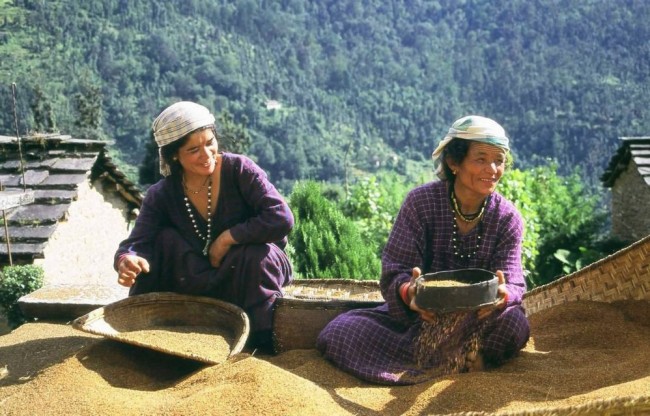
One of the main issues in the state has been a lack of employment opportunities. So they decided to set up a self-sufficient unit at Kumaon. “My main concern was employment of the local ladies as I believe that all over India it has always been women who run the show and they deserve to be empowered,” adds Amrita.
Happiness that comes with healthy living is the only true happiness! Courtesy: SOS Organics Facebook page ita at this point also mentions,“We did not want to take something or destroy anything from the environment, rather our emphasis has always been on the preservation of biodiversity and environment, and the providing of holistic technologies to ensure highest quality.”
Every village needs to be self-sufficient
The company strongly believes in Mahatma Gandhi’s saying that every village needs to be self-sufficient. Their entire unit runs on rain water harvesting. And they work with local small scale farmers from over 70 villages in the Himalayan region.
Amrita further adds, “SOS Organics is an ongoing experiment dedicated as a model for holistic sustainable living in the villages of the Himalaya.”
In addition to the farming techniques, natural processing and product development have also been undertaken. The Foundation is presently deeply involved in special holistic milling techniques, sun drying and sun-UV-radiation, ventilation drying, dehydrator development for low temperature drying, vacuum packing and systematic moisture proof storing of raw material. An extensive initial product line of natural farming produce has been developed and tested in the market and is now available online and in select holistic outlets.
Engaging community and being in tune with rural life
“The problem in the hills is that you cannot do anything that has a lot of volume because the lifestyle is different. We have six hour working days for the ladies as on most days they have to go home, collect water, cut wood etc. Plus in the winter it gets darker soon and the area where we live there are leopards and other wild animals,” she says.
So they had to modify their business model, making it in tune with the local life and with less stringent deadlines. They also make sure to celebrate local holidays and to stay connected with the community in all possible ways. “Our aim has always been to make the business model sustainable for everyone from the consumer to the person actually engaged in making these products. We make the people working here comfortable and the orders are worked around this,” says Amrita.
Challenges
Amrita says, “So much of the incredible knowledge of the Himalayan people is in danger of getting lost. The older living generations have often not been able to pass on their wisdom to the younger people as they have set out to live everywhere else than in their own village, embracing modern life and technology.”
She adds,“The scary thing is that we do not have a proper understanding of traditional knowledge system and what we are replacing it with does not seem to make the grade. People here feed millet to animals as they have been told the white rice is aspirational. We are striving to work against this kind of a mindset.”
Future Plans
“We very much live in the here and now, which is full of experiencing, learning, and understanding. New insights and inspirations happen on their own and we are always ready to say yes! – and embrace yet another venture,” concludes Amrita.
source: http://www.thealternative.in / The Alternative.in / Home> Magazine> Lifestyle / by Usha Hariprasad / Juine 18th, 2015
As Karnataka roils over the Kaveri water dispute, the underlying cause is lowered climate resilience of the agro-forestry ecosystem in Kodagu’s coffee plantations
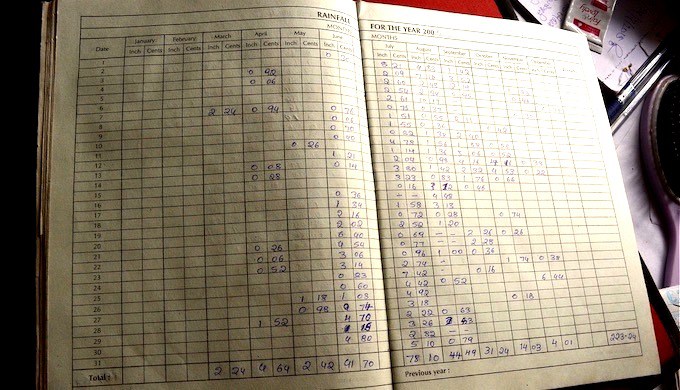
Coffee farmer B. B. Thammaiah’s rainfall record (Photo by S. Gopikrishna Warrier)
Coffee planters in the hill district of Kodagu in Karnataka are meticulous in keeping rainfall records in their estates. For some, the data goes back for decades. Their numbers tell the story of changing rainfall patterns, an indicator of climate change. The changing patterns also have an impact on the way they grow coffee, which has an effect on climate resilience in the hills and the plains.
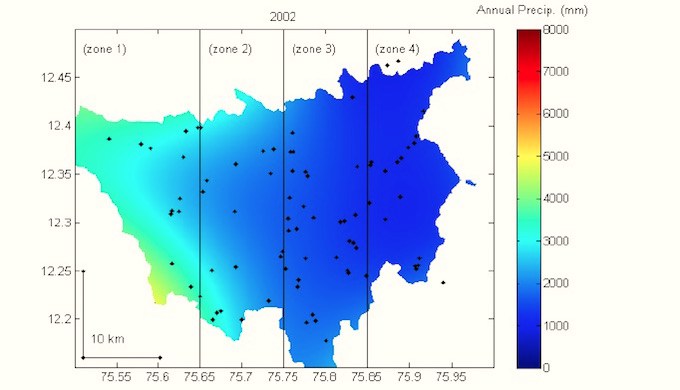
Due to the presence of this decentralised network of rainfall measuring stations, it is easier to obtain a nuanced picture of the precipitation trends for Kodagu, earlier known as Coorg, than in other parts of India. The average annual rainfall varies from above 5,000 mm in the western edge of the district to 1,200 mm in the east.
This data was used as part of the baseline survey by an international collaborative project to study the unique coffee agro-forestry system of Kodagu district. The College of Forestry at Ponnampet in Kodagu, as a participant in the Coffee Agro-forestry Network (CAFNET) project, has analysed the rainfall data of over 60 years from 116 coffee farms.
“Keeping meticulous rainfall data is part of the culture we inherited from the British,” said C.G. Kushalappa, university head for forestry and environment sciences at the College of Forestry.
The CAFNET report noted that the length of the rainy season had decreased by 14 days over the past 35 years. It also noticed a strong fluctuation in annual rainfall with an apparent cycle of 12 to 14 years.
Low rainfall in coffee land
Whether it is due to being the lowest point in this cycle or an El Nino changing rainfall patterns, 2015 and 2016 have been years of low rainfall in Kodagu. This is the second year of deficit rainfall in Kodagu. During 2015, it was deficient by 19%. As a result, the storage in the Krishna Raja Sagara dam reservoir, built across the Kaveri River immediately downstream of Kodagu district, has a 31% deficit this year.
On the ground measurements by coffee grower K.K. Naren in Kunda village near Ponnampet confirms this. “Our normal rainfall is 90 to 100 inches (2,200 to 2,500 mm). This year we have got 38 inches, whereas by this time we should have received 70% of the year’s rain.”
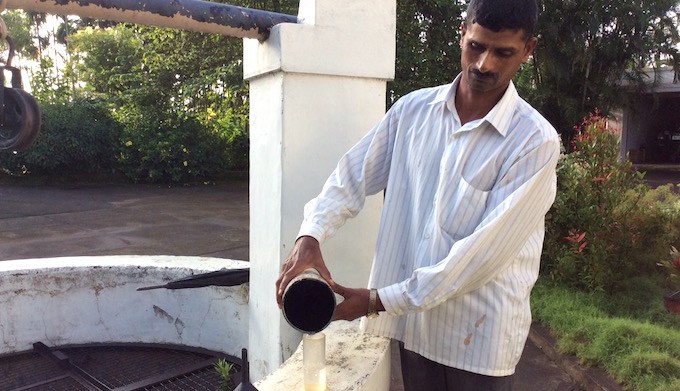
A farm worker measures rainfall in K. K. Naren’s coffee farm. (Photo by K. K. Naren)
Coffee planters are confused by the erratic rainfall of recent years. “Rain and weather patterns have become increasingly unpredictable in recent years,” said M.B. Ganapathy, head of plantations for Tata Coffee. “Even though the quantum does not seem to have changed, the rainfall is not well distributed any longer. There are long dry periods followed by heavy rain and high-velocity winds. This has made farm management difficult for us.”
Blossom showers affected
According to coffee farmer B.B. Thammaiah of Kolagadalu village, the erratic rainfall has meant that blossom showers, which usually take place between February and April, are missing in some years. This has an impact on coffee production, since this helps coffee flowers to blossom, ensuring good yields later in the year.
There is an ecological impact of this, according to Kushalappa. When the blossom showers became erratic, coffee farmers started irrigating during these months. For traditional coffee cultivation, it was a combination of mixed-shade trees plus blossom showers that gave a good yield. When the blossom showers were replaced by irrigation, the shade from the trees did not matter. The farmers’ dependence on the native trees decreased, resulting in their proclivity for letting the native trees die. These trees are being replaced by silver oak.
See: Bringing coffee back into the shade
There is also an issue of ownership that is leading to the clearing of forests. Thammaiah’s farm is in Kolagadalu village, not far from the western crest of the plateau deep in a forested valley. His farm receives more than 5,000 mm of rainfall every year. While in the valley floor he continues to grow rice as his forefathers did, he cultivates coffee in the shade of the forest trees. Though the forest may not be as thick as it was during his grandfather’s time, he plans to conserve it.
The landscape of Thammaiah’s farm is typical of what the people of Kodagu inherited. While historically joint families cultivated the rice paddies where they owned the land, they used the forest for collecting mulch and firewood and grazing cattle. The families do not have property rights over the trees, which belong to the government.
Economics of silver oak
Silver oak, on the other hand, can be planted, cut and sold. M.C. Cushalappa, a coffee farmer from Siddhapura, said that silver oak yields a two-fold benefit to coffee farmers. One, it can supplement the family’s income in times of need. Two, its straight trunk can be used as a support for pepper vines, which bring more additional income. With no ownership and no economic stake on the native trees, farmers do not have an incentive to keep them alive.
Cushalappa’s family has paid the price of the native trees to the government and obtained ownership over them. “This encourages me to maintain the native tree species in my farm, unlike most of the other farmers in Kodagu.”
The coffee agro-forestry system of Kodagu is of immense importance ecologically; not only does it provide climate resilience to the hill communities but provides water to millions downstream through the Kaveri. The current acrimony over the waters of the Kaveri between Karnataka and Tamil Nadu have led to violent protests.
There is a problem though. Unlike in other parts of the country where the forests are fully under the control of the forest department, in Kodagu they are under the combined control of the department and thousands of coffee farmers. It means that it is difficult to give them a protected status. It is not as if the forest department it always the best protector; but uniformity in control has the potential to improve conservation practices.
Geographical location of coffee farms where rainfall data has been collected for 70 years and a map of rainfall distribution generated with these data points as an exmple for the year 2002. ( Image by College of Forestry, Ponnampet)
“The majority of forests in Kodagu are not notified and hence for their upkeep thousands of coffee farmers have to be incentivised,” a forest department official said, speaking on condition of anonymity. “About 90% of the catchment of the Kaveri river before the Krishna Raja Sagara reservoir is in Kodagu. There is need for a mindset change so that the farmers conserve the native trees and biodiversity.”
Through the CAFNET study, the ecosystem services could be quantified. “We looked at the role of native trees and silver oak to study their hydrological impact. Our team studied how much of the rain was intercepted, how much came through the stem, how much got run off, and how much got recharged,” noted Kushalappa.
The magic of native trees
The study found that increasing the proportion of exotic species such as silver oak in the shade cover composition had little impact on rainfall interception since trees intercept less (1% to 6%) than coffee plants (9% to 22%). Although there are lower quantities of water from native tree plots going to rivers than from the exotic tree plots, the higher contribution of evaporated and transpired water from native trees have a positive impact on the microclimate. Further, large canopy and deep-rooted systems of the native species help in the percolation of water to deeper aquifers, mainly during the monsoon.
Thus, native trees held the rainwater as it fell torrentially, and released it gradually into the rivers. At the same time they created a climate-resilient environment in the farms.
The mixed agro-forestry systems also helped in sequestering carbon. The CAFNET studies showed that Arabica coffee grown under the shade of mixed species sequestered more than the reference forests. Arabica coffee grown under silver oak sequesters marginally less than Robusta grown under native trees. Robusta grown under silver oak sequesters substantially less than the other combinations.
The missing blossom showers could be adding to the reasons for coffee farmers opening their canopies. On the flip side, the farmers’ actions could result in more carbon in the atmosphere, making rainfall more erratic in Kodagu.
source: http://www.indiaclimatedialogue.net / India Climate Dialogue / Home> Impacts / by S. Gopikrishna Warrier / December 27th, 2016
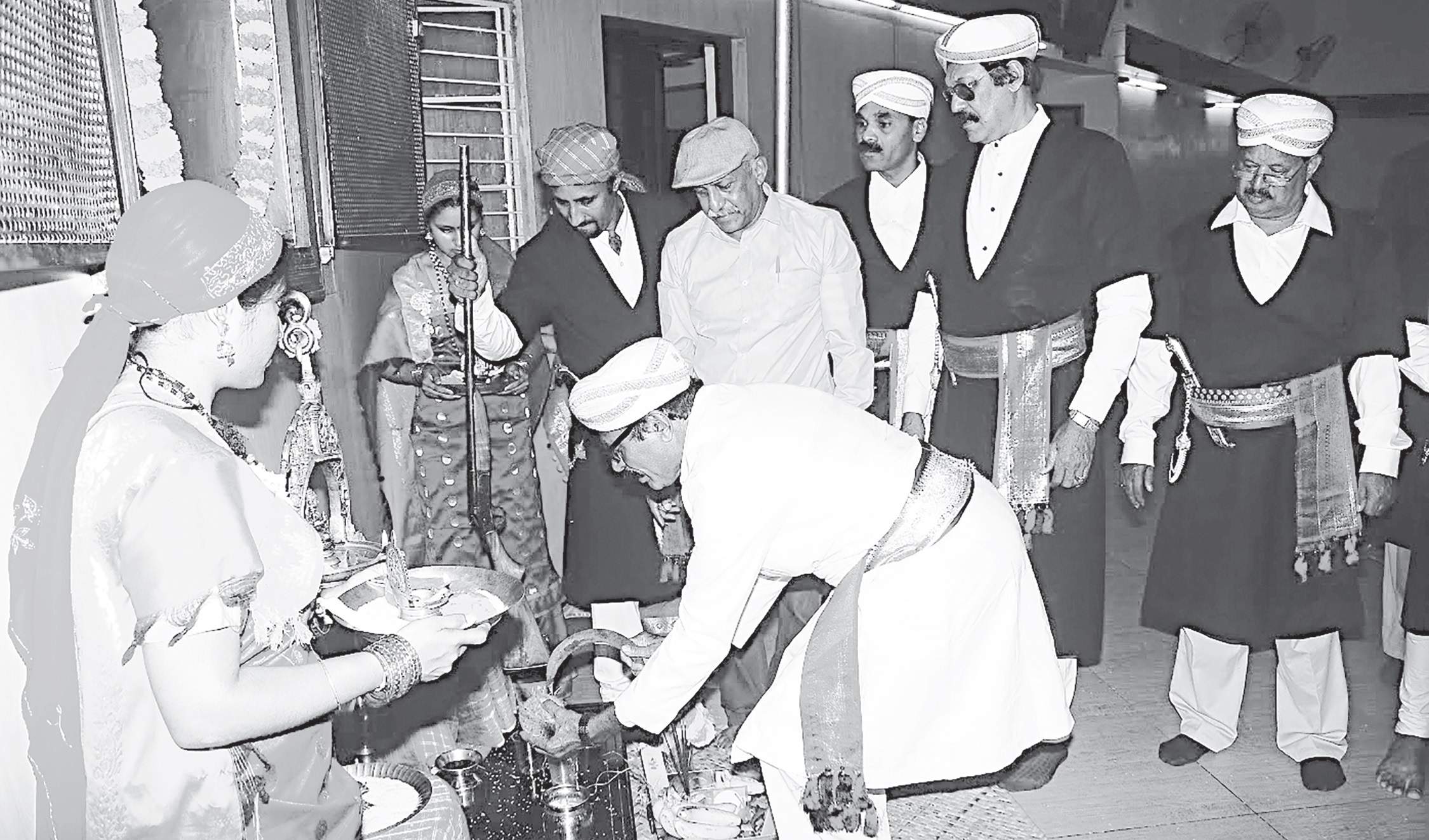
Codava National Council (CNC), led by its president N U Nachappa, celebrated Puttari (Huttari), the harvest festival of Kodagu at a paddy field of Uthappa at Chikkabettageri near Kushalnagar on Tuesday.
The festival symbolises the homecoming of ‘Dhanya Lakshmi’. The Codava National Council members, wearing traditional attire, participated in the celebration.
Before cutting the paddy sheaves, the members offered prayers and offered by tying the leaves of ‘Arali,’ mango, jack, ‘Kumbali’ and cashew- nut.
After the ‘Nere Kattuvo’ ritual, the participants walked in a procession to the paddy fields accompanied by the ‘Dudikottpat’ (dudi is a small drum of Kodavas). Nachappa cut the paddy sheaves and initiated the celebrations. Before harvesting, they shouted slogans ‘Poli Polio Deva’ and fired three times in the air.
The Codava National Council members presented traditional Kolata, ‘Pareya Kali,’ ‘Chowkata’ and other cultural programmes, adding colour to the festivity. ‘Payasam’ (sweet) was prepared from the new rice and was offered to the God.
Mouth-watering dishes like ‘Thambut,’ ‘Adikehittu,’ ‘Kadubu,’ ‘Payasam’ and others were savoured on the occasion.
Later speaking to reporters, N U Nachappa said the Kodavas should be entrusted with the constitutional security. The government should announce autonomous status to Kodava land.
source: http://www.deccanherald.com / Deccan Herald / Home> District / DHNS – Kushalnagar, December 14th, 2016
As Kodavas retreat to their Kodagu homes from the hurry-burry of the city to rest and celebrate the annual harvest festival, there are some who will be celebrating the Puthari (also known as Puttari and Huttari) festival in the city this time.
“It is hard for me to head back home this time because Puttari falls mid-week,” says Pratvii Ponnappa, who is born and brought up in Bengaluru but usually heads back to Coorg to celebrate the festival. “My father will be going to Coorg, but I will be staying back and celebrate it on the day local Kodavas decide”.
“Celebrating in Coorg means coming together with your family, celebrating in the city means coming together with your community,” Pratvii says.
M T Subbaiah, administrative officer of Kodava Samaja, says, “We have 13,000 Coorgis in the association. This year there will definitely be more celebrating the festival with us since it falls on a week day.” Around 3,000 to 4,000 people are expected to attend this year’s Samaja festival.
Puthari, which means the paddy festival, will be celebrated on December 13 this year. Last year it was in the end of November.
On the day of the festival, family members assemble in their ancestral house or ‘Ain Mane’, which is decorated with flowers, mango and banana leaves.
The children play with fire crackers and in an “auspicious hour” the eldest of the family hands a sickle to the head of the family.
The auspicious time is decided by the Igguthappa temple.
The family together head to the paddy field. A woman leads the procession holding a lit lamp in her hands. A paddy stick is cut and a gunshot is fired to mark the beginning of the harvest. The chanting of “Poli Poli Deva” is recited and the paddy is stacked in odd numbers to be carried home and offered to the gods.
Small bundles of paddy straw are handed to the family members, which are received as a symbol of prosperity.
Since there are no paddy fields in and around the city, the Kodava associations usually get paddy from Coorg and distribute them among the people who come to celebrate. This year, the Kodava Samaja will be celebrating it on Tuesday evening.
The programme will commence at 6:30 pm when all the members will gather for an annual awarding of scholarships and for a speech by community leaders. By 7 pm, everyone will gather in a small 10*8ft piece of paddy land in the office premise to follow the customary ritual. At 9 pm special foods such as thambuttu (made of mashed bananas and roasted rice powder and topped with grated coconut and melted ghee), kadaumbuttu (rice dumplings with coconut milk and ghee), holige (flatbread from flour, jaggery and ghee) and puttari payasa (from rice, coconut milk and jaggery) will be served.
Kishoo Uthappa is heading to Coorg today for the festival since he has grown a small amount of paddy in the field for this festival and he does not want to miss it.
“I am an entrepreneur so I can take off whenever I want,” he says. “Most importantly, I don’t want my children to miss the festival.”
source: http://www.newindianexpress.com / The New Indian Express / Home> Cities> Bengaluru / by Regina Gurung / Express News Service / December 10th, 2016
WELCOME. If you like what you see "SUBSCRIBE via EMAIL" to receive FREE regular UPDATES.
Read More »