Category Archives: Green Initiatives / Environment

ICRISAT launches new portal to share agricultural information

Hyderabad :

City-based International Crops Research Institute for the Semi-Arid Tropics (ICRISAT) has launched today EXPLOREit@ICRISAT (exploreit.icrisat.org), which makes large volumes of agricultural scientific knowledge and information easily accessible to the public.

“We are doubly excited — not only have we given easier access to all of ICRISAT’s 40 years of scientific research through EXPLOREit, but we have achieved this through the MultiProfiler concept, a revolutionary way of making information accessible,” ICRISAT Director General William D Dar said.

We found that typical websites are too restrictive in giving access to information, and do not present the information in ways that are easy for people to view the detail of the content.

ICRISAT’s new MultiProfiler concept provides information through multiple navigations and creates easy to view profiles on the subject areas,” explained Joanna Kane-Potaka, ICRISAT Director of Strategic Marketing and Communication.

“Sharing publicly-funded agricultural information in the most accessible way is critically important to achieve our agricultural development goals of reducing rural poverty, increasing food security, improving human health and nutrition, and ensuring more sustainable management of natural resources,” Dar said.

EXPLOREit is now to become the main source of ICRISAT’s scientific information with profiles of all topics, systems, crops, locations and resources where it works.

“It sets a new standard for sharing of information, and therefore promotes collaboration. To achieve this, ICRISAT has made a momentous leap in its use of technology with EXPLOREit-a dynamic site that feeds information from databases using tags and harvests information from other websites,” an ICRISAT release said.

source: http://www.thehindubusinessline.com / Business Line / Home> Industry> Agri-Biz / by PTI / September 26th, 2013
Growers find novel ways to keep away wild elephants

Wild elephant menace in the coffee plantations in various parts of Kodagu has been increasing every passing day. The reason for the increase in the elephants entry into coffee plantations is the jackfruits and bananas grown in the coffee plantations, which draw attention of the elephants in search of food. In order to save their coffee plantations from elephants, coffee growers have begun to destroy banana and jackfruit yields in their plantations
ElephantKF07sept2013
Wild elephant menace is rampant in Aiguru, Kandanakolli, Kodlipet in Somwarpet taluk and Srimangala, Ammathi, Ponnampet in Virajpet taluk. Forests in these areas mostly comprise of teak wood which is why elephants are falling short of food. In addition, the water pits dug to supply water to coffee plants too are inviting elephants to enter coffee plantations to drink water. Repeated requests of the villagers to the forest department to chase elephants back to the forest have gone futile. It can be recalled that a two wheeler rider was killed by a wild elephant near Aiguru a fortnight ago.

Disappointed over the lukewarm response from the forest department and the failure of solar fencing, now the coffee growers have found their own ways to keep away the elephants by destroying fruit bearing plants like banana and jackfruit in their estates. One can view jackfruits piled up on the roadside near Aiguru on the way from Madikeri to Somwarpet. Growers hope the elephants to hog these jackfruits instead of entering into their plantations.

In fact, some of the growers have also made attempts to cut jackfruit trees, but could not as they do not posses the trees rights. In many estates, the coffee growers have cut the banana plants.

Speaking to Deccan Herald, coffee plantation labour Murugesh said that with the broken solar fences, the coffee growers have no other option but to cut jackfruit and banana plantations.

source: http://www.deccanherald.com / Deccan Herald / Home> District / by Srikanth Kallammanavar / Madikeri, DHNS / June 20th, 2013

Birds, frogs and civet coffee in Madikeri

What comes to mind when you think of Kodagu or Madikeri? Coffee, homestays, waterfalls, elephant camps, Tibetan settlements, meaty-pork stews? How many of us know that Kodagu, unlike the other districts of Karnataka, is home to a range of wildlife species? And in particular, birds and reptiles?
KodaguKF06sept2013
I found the answers in a plantation located in Galibeedu village, Madikeri. I visited a 25-acre plantation, in which coffee, pepper, cardamom and vanilla are cultivated for a two-day stay. It is run by a North Indian couple who quit their jobs 20 years ago to develop this piece of land into an eco initiative that can be enjoyed by all.

The plantation is dense with coffee and other spices grown under the inter-cropping method. Guests are accommodated in tents and a handful of cottages. Locally grown organic food is served to them. The entire plantation is run on solar power, bringing it as close to the nature as possible.

The plantation also serves Civet Coffee, which is made out of beans that are defecated by the civet, a wild cat, that feasts on ripe coffee berries. The beans are washed, sundried and roasted to yield maximum aroma. Due to the enzymatic activity and the touch of amino acids in the Civet’s gut, these beans acquire unique flavours—making it less bitter, more aromatic and hence one of the most expensive and exclusive kinds of coffee in the world.

The night called for a few pleasant surprises—the deafening sounds of the crickets followed by a soothing array of fireflies. Though their charm might be ephemeral, they have a magical effect on you. I tried so hard not to blink, fearing the loss of a few glints. The minimally-lit tents with below 10-watt bulbs paved a perfect setting for this magical moment.

The plantation is an ornithologist’s delight. I spotted the Malabar Whistling Thrush, Woodpeckers, Racket Tailed Drongos, Fly Catchers and Kingfishers among several tiny birds. The plantation is also home to stick insects, hibernating butterflies, tree frogs and leaf frogs. Some belonged to the Lateralus family and are endemic to the Western Ghats region. The frogs were a sight to behold; they changed colours, had shiny-green skin, big, bulgy eyes and had perched themselves on twigs as if waiting for us to visit them.

My two-day stay passed away in a blur and I decided to walk down to the much talked-about stream surrounded by birds about five kilometres away before departing. As I trekked down, the clouds got thicker and darker. I spotted a flock of birds, all different in colour and kind, perched on a tree. It suddenly began to drizzle and the birds in search of shelter, flew from one tree to the other at once. The swarming birds flew low, making it one of my most colourful memories—tints of hidden orange and blue, reds and greys exposed—a flying rainbow indeed.

Ignoring the rain and time, I soaked and hiked at my own pace. When I got back, I was the only one for breakfast and I had missed out on my last dig at the sumptuous avocados too! Oh well!! What more can one ask for when you had the experience of a flying rainbow?

source: http://www.deccanherald.com / Deccan Herald / Home> Supplements> Spectrum / by Aishwarya Madineni, DHNS / September 03rd, 2013

Forest officials drive back elephants into Kodagu forests

The two-day operation to drive wild elephants back into forests by the forest department in South Kodagu in progress | Express photos

The two-day initiative of the Forest Department to drive wild elephants back into the forests came to an end on Saturday.

On Friday, the operation commenced in the presence of chief conservator of forests, Kodagu circle, Brijesh Kumar Dixith, Deputy Conservator of Forests (DCF), Virajpet division, Malathi Priya, Deputy Conservator of Forests, Nagarahole wildlife division, Gokul, assistant conservator of forests and range forest officials and staff from all the forest department divisions of Kodagu district.

14 Jumbos Driven Back to Forests

The teams were able to chase away 14 elephants from Devarapura and Nokya Gram Panchayat limits, ACF Belliappa told Express.

On Saturday, the teams were unable to spot even one elephant.

He said the teams will continue to ensure the elephants do not return.

“The operation will be continued next week in Pollibetta areas. Movement of vehicles and people will be restricted through publicity arrangements,” he said.

Belliappa added that most elephants entered South Kodagu either from Mauvkal or Nagarahole forests.

Need for Public Help

The operation involved tamed elephants, special task force staff, wildlife staff from Nagarahole, Virajpet division forest officers and staff along with watchers. General public and police also extended required assistance to the department.

Chief conservator of forests, Kodagu circle, Dixith told reporters here on Saturday that as per the elephant census taken last year, as many as 6,000 elephants were located in the state. In Kodagu region, covering Gonikoppa, Thithimathi and Maldaare areas, as many as 100 wild elephants are troubling people, he said.

“Another 32 elephants are permanent residents of BBTC coffee estates in Siddapura. These should be captured and shifted,” he said. However, before their capture, a few technical and legal aspects need to be addressed, he said.

In Bramhagiri wildlife sanctuary, 30 elephants on the Kodagu-Kerala border have been identified that need to be captured and sent back into forest cover, he said. All these issues have been brought to the notice of Forest Minister Ramanath Rai, Dixith added.

source: http://www.newindianexpress.com / The New Indian Express / Home> States> Karnataka / by Express News Service – Madikeri / July 29th, 2013

Harangi garden to open on August 15

Harangi Reservoir, one of the most important water bodies in the Cauvery basin, will soon get a garden modelled after the Brindavan Gardens of Krishna Raja Sagar Dam, thereby fulfilling a dream that has been pending for decades.

The idea of a park came about when R Gundu Rao was the chief minister. However, once he stepped down, the project was sidelined and came to a standstill.

Later, when M P Appachu Ranjan became MLA and then District Minister, he put in all his efforts to make the dream a reality. He was supported by then minister for Major Irrigation Basavaraj Bommai who gave his nod for the project.

Bommai also came down to Harangi Dam and laid the foundation stone for the about `4 crore project.

MLA M P Appachu Ranjan told Express that the project was one of his major achievements as a minister in the BJP government.

Executive engineer of Harangi Reservoir Phalanethraiah and manager Nagaraj told Express that the park would be inaugurated on August 15.

source: http://www.newindianexpress.com / The New Indian Express / Home> States> Karnataka / by B C Dinesh / ENS – Madikeri / June 21st, 2013

Kodagu district minister assures grants for relief works

Kodagu District In-Charge Minister Dr. H.C. Mahadevappa is seen inspecting the damaged Mysore-Madikeri road yesterday. Former Minister T. John, MP H. Vishwanath and others are seen.

Madikeri :

Kodagu District In-Charge Minister Dr. H.C. Mahadevappa, who visited the district yesterday, inspected the damaged road at Boikeri village linking Mysore and Madikeri. He also visited Thayagaraja Colony in Madikeri town where houses were damaged due to heavy downpour.

Later, speaking to press persons at Sudarshan Guest House, Dr. Mahadevappa, who holds the PWD portfolio, said that as per the preliminary report submitted by the district administration, the district has incurred a loss of at least Rs. 24 crore due to heavy rainfall. Based on the consolidated report, the government is committed to sanction funds to take up relief works, he said.

Stating that the district had received more than double the amount of rainfall than last year by this time, he said that the average rainfall this year till date was 219.79 cms (86.54 inches), while it was 91.67 cms (36.03 inches) last year. “I am aware the heavy downpour has adversely affected normal life. I have directed the DC to undertake relief work on a war footing,” he said.

Gabion technology for Madikeri road repair

Karnataka Road Development Corporation Limited (KRDCL) Managing Director R. Srinivas, speaking to press persons here yesterday, said that there were two options to repair the massive breach in Mysore-Madikeri road at Boikeri village – either build a concrete retaining wall or use the Gabion technology. “Senior officials have been told to inspect the spot and submit a report, based on which repair work will be undertaken,” he said.

The highway work between Sampaje and Maani, which is progressing in a slow pace, will be expedited to complete by May 2014, Srinivas said.

What is Gabion technology

A gabion is usually a box filled with concrete or sometimes sand and soil for use in civil engineering, road building, and military applications. A gabion wall is a retaining wall made of stacked stone-filled gabions tied together with wire. Gabion walls are usually battered (angled back towards the slope) or stepped back with the slope rather than stacked vertically. The most common civil engineering use of gabions is to stabilise slopes against erosion. Other uses include retaining walls, temporary floodwalls and silt filtration from runoff.

source: http://www.starofmysore.com / Star of Mysore / Home> General News / July 29th, 2013

Forest officials drive back elephants into Kodagu forests

The two-day operation to drive wild elephants back into forests by the forest department in South Kodagu in progress | Express photos

The two-day initiative of the Forest Department to drive wild elephants back into the forests came to an end on Saturday.

On Friday, the operation commenced in the presence of chief conservator of forests, Kodagu circle, Brijesh Kumar Dixith, Deputy Conservator of Forests (DCF), Virajpet division, Malathi Priya, Deputy Conservator of Forests, Nagarahole wildlife division, Gokul, assistant conservator of forests and range forest officials and staff from all the forest department divisions of Kodagu district.

14 Jumbos Driven Back to Forests

The teams were able to chase away 14 elephants from Devarapura and Nokya Gram Panchayat limits, ACF Belliappa told Express.

On Saturday, the teams were unable to spot even one elephant.

He said the teams will continue to ensure the elephants do not return.

“The operation will be continued next week in Pollibetta areas. Movement of vehicles and people will be restricted through publicity arrangements,” he said.

Belliappa added that most elephants entered South Kodagu either from Mauvkal or Nagarahole forests.

Need for Public Help

The operation involved tamed elephants, special task force staff, wildlife staff from Nagarahole, Virajpet division forest officers and staff along with watchers. General public and police also extended required assistance to the department.

Chief conservator of forests, Kodagu circle, Dixith told reporters here on Saturday that as per the elephant census taken last year, as many as 6,000 elephants were located in the state. In Kodagu region, covering Gonikoppa, Thithimathi and Maldaare areas, as many as 100 wild elephants are troubling people, he said.

“Another 32 elephants are permanent residents of BBTC coffee estates in Siddapura. These should be captured and shifted,” he said. However, before their capture, a few technical and legal aspects need to be addressed, he said.

In Bramhagiri wildlife sanctuary, 30 elephants on the Kodagu-Kerala border have been identified that need to be captured and sent back into forest cover, he said. All these issues have been brought to the notice of Forest Minister Ramanath Rai, Dixith added.

source: http://www.newindianexpress.com / The New Indian Express / Home> States> Karnataka / by Express News Service – Madikeri / July 29th, 2013

Paddy transplantation begins in Kodagu

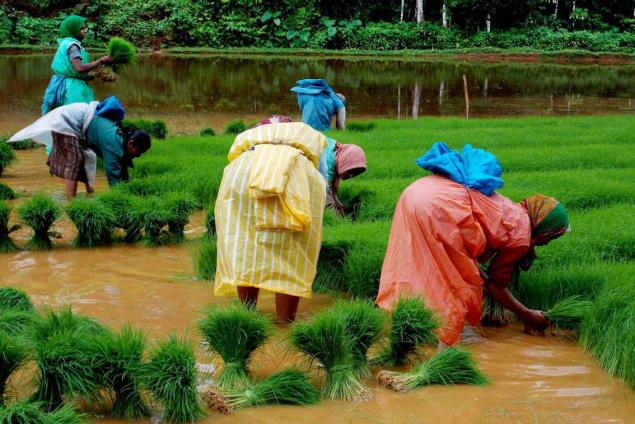
Women readying paddy seedlings at a nursery in Napoklu in Kodagu for transplantation./ The Hindu

Paddy transplantation has begun in the right earnest in Kodagu district, thanks to the copious rainfall which has far exceeded last year’s figures in the corresponding period.

Many farmers are steadfastly continuing the avocation against odds such as expensive labour, high input costs and irrational prices.

Transplantation has started in Napoklu and surrounding areas. Paddy seedlings are ready for plucking in the district and the works are expected to gather momentum in a couple of days, says Deputy Director of Agriculture, Kodagu, Ramakrishna. The target for paddy cultivation was 35,000 hectares of which 1,360 hectares had been covered till date, he told The Hindu.

Farmers in remote villages still depend on agriculture in Kodagu though it is not financially viable for most of them. However, the sheen associated with paddy transplantation where a large group of men and women sang to chorus to mask the tiredness of work cannot be seen any longer.

One would compete with the leader to match his speed of transplantation even if it rained hard. A big column in the middle of the paddy field would be left vacant to facilitate the ‘Nati Vota’, wetland sprint, in which youth would take part with great glee. It used to be the custom in the past. Not many indulge in ‘Nati Vota’ these days. The vacant column used to be covered up with seedlings after the sprint.

According to Monnanda Somaiah, a farmer from Napoklu, expensive labour costs, apart from the shortage of workers, had made many farmers give up agriculture in villages. Many of them had sold off cattle and some had converted fields into housing sites.

Farm mechanisation was a process yet to catch up in the district, though a few progressive farmers had discovered its utilities. Elephant attacks would result in destruction of paddy crops in the district in the recent years.

Fertilizer had replaced cow dung and other leafy manures that were organic, says Subbaiah, another farmer from the same region.

Paddy transplantation would pick up in Virajpet taluk, which had the largest areas in terms of coverage, in a few days as seedlings were ready for plucking, Mr. Ramakrishna said.

Not so long ago, the extent of paddy fields was considered a sign of high social status. Coorg mandarin (orange) cultivation had become popular enhancing one’s social status later onwards.

Coffee holding now symbolises the social status in Kodagu. Paddy crop is seen as goddess Lakshmi as the ‘Puttari’ of ‘Hutri’, the harvest festival for the people of Kodagu, is directly connected with it.

Cutting the paddy sheaves and taking home by chanting ‘Poli poli deva…’ meant appeasing goddess Lakshmi to give them a bountiful crop and abundance. Decrease in the paddy cultivation has robbed the harvest festival of its glory, says, Mr. Somaiah.

Kodagu received 1,602.1 mm of rainfall from January this year till 8 a.m. on July 18. It is more than last year’s figure of 732.89 mm.

Madikeri taluk received 2,372.24 mm, the highest among three taluks, in the same period this year. It was 1,049.2 mm last year. Virajpet taluk received 1,146.61 mm (622.19 mm) while Somwarpet taluk received 1,287.4 mm (527.27 mm).

source: http://www.thehindu.com / The Hindu / Home> News> National> Karnataka / by K. Jeevan Chinnappa / Mysore – July 21st, 2013

Migratory Birds from Nigeria flock to Kodagu

The guests from Nigeria have arrived in Kodagu. Its now their season to enjoy the mother nature, who are found aplenty in plantations, paddy fields and wherever you can see. It does not mean they are newcomers to Kodagu. They arrive here as guests on every monsoon since the past several decades.They will arrive in the future too. Now, you will wonder who these Nigerian guests are. If you want to see them, they are aplenty at Moornadu, Napoklu and Virajpet who fly in flocks between huge trees; they are none other than migratory birds from Nigeria or the locals call them as Bellakki, because they are white like snow.

If you go to see, its customary for the migratory birds to arrive in hilly range of Kodagu at the onset of monsoon, who take refuge from heavy gales and torrential rains. However, there have been a little changes in the recent past. It doesn’t rain like before here owing to which a few bird remain here. Moreover, no sooner monsoon sets in, these Nigerian migratory birds flock here and make nests in huge trees and busy themselves in procreation.

These birds that arrive in Kodagu take shelter in Napoklu, Moornadu and Virajpet. They are merrily made their nest in huge trees in towns and are least concerned of human activities on earth. These birds fly across blue sky, make nest and busy in laying eggs, a scenic sight indeed. If you view these migratory birds high on huge trees, it reminds of falcons of Mandya.

A few migratory birds were cited in the huge trees located at Napoklu.They returned to their bases after hatching and returned with newborn chicks.The number of migratory birds increased since then as the food was found aplenty and none troubled them. The flocks increased over the years and began settling in huge trees not only in Napoklu, but also in Hakattoor, that lies on Moornadu – Madikeri road. These birds shifted to localities of Moornadu, Napoklu and Virajpet as huge trees were felled in Hakattoor.

These migratory birds arrive in flocks during May – June at the onset of monsoon and settle in the huge trees of Napoklu, Moornadu, Virajpet (nearby KSRTC bus stand) in town.

These birds busy themselves in building nest from dry leaves and small bits of wild vegetation that they source from nearby coffee and cardamom estates. The female bird remains in the nest, lays eggs and hatches them, while the male bird brings food for them from fields nearby. The female bird feeds the newborn that shot is a cherished shot for any cameraman.

The birds get aplenty food such as worms, insects etc when the farmer tills the paddy field. The newborn learn to fly and collectively fly all over without bothering to the people and chaos in the city. These birds make their return journey along with the confident chicks to their homelands. They will only return during next monsoon. The city-folks do not bother these migratory birds in procreation that makes them to come back in next season.

source: http://www.newskarnataka.com / Home> Cities / by B M Lavakumar / July 18th, 2013

Rainfall inches to a record high in Kodagu

Madikeri :

Heavy rain lashed Madikeri town on Saturday evening bringing traffic to a screeching halt in many areas. On the Sri Omkareshwara temple road, several vehicles were submerged. Girish, from Mallikarjunanar, who was in a Maruti Omni with his wife and son were forced to get out of their vehicle and brave the rain when water entered their vehicle. “We had no choice but to get out, as water had entered the car. Even inside the car we were shivering with cold.” he said.

Earlier, the town experienced light showers. But later in the day it was bright and pleasant, until evening.

The Pushpagiri hilly belt in north Kodagu comprising Mutlu, Hammiyala and Kumbaragadige villages received more than 100 inches of rain during rain star Aridra this year. Today, the rain star Punarvasu starts

Aridra rain this year has broken all previous records in these villages. In the last 20 years, Aridra rain record had not crossed 70 inches in these villages. In 1993, it was 51 inches. The heaviest rainfall was recorded in 1994 at 70 inches in these villages between tail-end of June and July first week.

C N Somesh, parpathehegar, in Sri Omkareshara temple, who hails from Mutlu village said that this is the first time that the villages have received such rain.

The averge rainfall in Kodagu so for reached has been 50 inches, 50% more compared to last year’s figure of 25 inches. In Somwarpet taluk it was 39 inches this year while last year it was 19 inches.

Water level in Harangi reservoir has touched 2855.95 out of 2849 feet. The inflow is 11,497 cusec and the outflow is 11,600 cusec.

source: http://www.articles.timesofindia.indiatimes.com / The Times of India / Home> City> Mysore> Kodagu / TNN / July 07th, 2013