Category Archives: Historical Links / Pre-Independence

Mysuru Kodava Samaja, Kodagu Gowda Samaja To Celebrate Huthri Fest Tomorrow

HuthuriKF23nov2018

Mysuru:

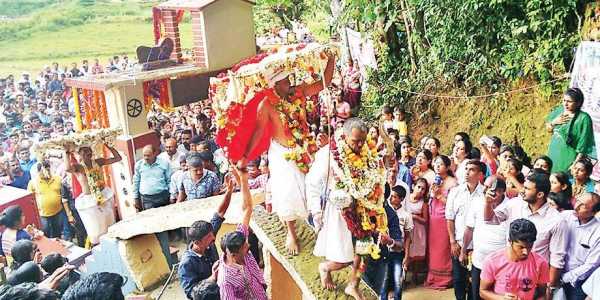
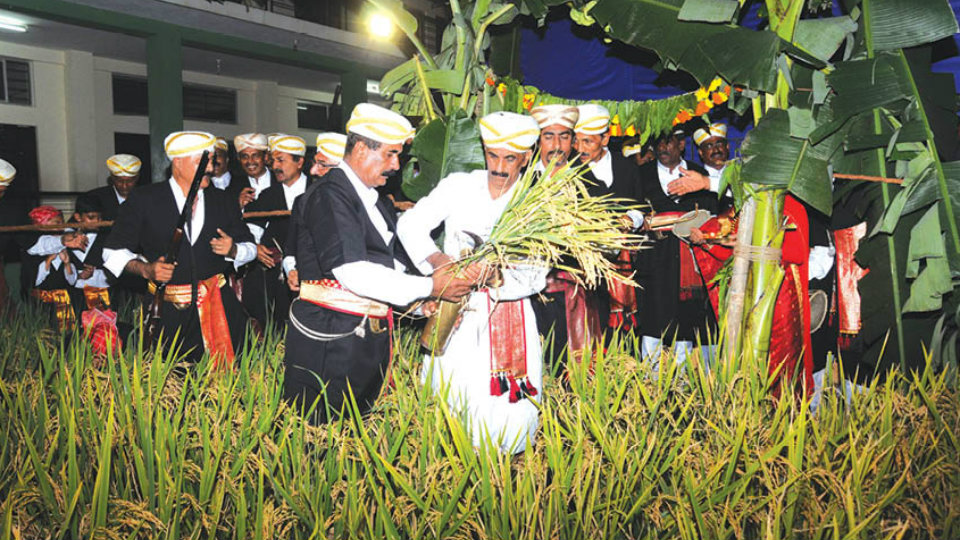
Kodava Samaja, Mysuru, will be celebrating Huthri, the harvest festival of Kodagu, tomorrow (Nov.23) at Sree Cauvery College Grounds in Kuvempunagar from 5.30 pm onwards.

On the occasion, traditional Kodava dances will be presented. ‘Nere kattuva’ ritual will be held at 7.30 pm; reaping new paddy crop (Kadiru) at 8.30 pm; distribution of thambutt prasada at 9.30 pm.

As in the previous years, Puthari Eedu was held from Nov.18 daily at 6 pm at the Samaja premises in Vijayanagar where traditional Kodava dances are practiced. The Eedu programme, sponsored by various Kodava Sanghas, will be held this evening also.

While Ketolira Ravi Belliappa trains the young and old male dancers in Bolkaat, Kolaat, Kathiyaat and Pareyakali, Kullachanda Vinutha Kesari imparts training to girls in Ummathaat.

Thanks to Kodava Samaja, Mysuru, for strengthening the community bonding and preserving the Kodava culture and tradition by holding such events and encouraging the youngsters.

The main event in traditional Kodava attires will be held during Huthri celebrations tomorrow evening at Cauvery Institutions premises.

Gowda Samaja

Huthri festival will also be celebrated under the auspices of Kodagu Gowda Samaja, Mysuru, at its premises in Vijayanagar 2nd Stage here tomorrow from 7 pm onwards. ‘Nere kattuva’ ritual will be held at 7.45 pm; reaping of new paddy crop (Kadiru) at 8.45 pm. There will be distribution of Kadiru also, according to a press release from Samaja Hon. Secretary K.S. Ganapathy.

source: http://www.starofmysore.com / Star of Mysore / Home> News / November 22nd, 2018

Madikeri Old Fort in a shambles

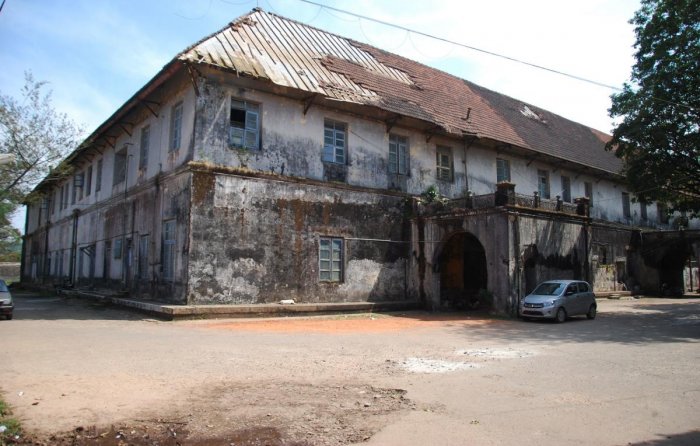
The roof of the Old Fort main building is on the verge of collapse in Madikeri.

The lack of basic amenities is haunting several tourists places in Kodagu district. The Madikeri Fort, referred to as ‘Palace’ situated on the heart of the city, should have attracted a large number of tourists. However, the crumbling structure is disappointing tourists.

The roof of the fort is on the verge of collapse. The walls have not seen whitewash or paint for several years. The rooms, where soldiers were staying during the king’s reign, have collapsed completely. Weeds have covered the fort premises.

With the damage to the roof, rainwater enters the fort. Plastic sheets have been used to protect it from rainwater. With this, the history of Madikeri fort will soon disappear.

Historians have expressed concern over the lack of maintenance by the Archaeological Department. They fear that a few remaining traces of history will soon enter the pages of the history.

Haleri ruler Mudduraja built a mud fort and palace in the 17th century. Later, Tipu Sultan rebuilt it using stones and renamed it as Jaffarabad. In 1790, Dodda Veerarajendra conquered the fort. In 1834, the fort came under the reign of the British.

The palace that was built by Linga Raja Wodeyar II houses government offices. With the increase in the density of people, the palace is in a deplorable condition. The Zilla Panchayat office, MLA’s office, Agriculture Department, district library, court complex and Bala Mandira are functioning from the palace itself.

Chandan, a tourist, said “Hundreds of vehicles visit the fort premises daily. Due to the pressure, the fort is losing its identity. Without any maintenance, the huge doors are losing charm. The visitors have also disfigured a few of the carvings. Even the cannons are not preserved. We are disappointed by watching this fort.”

An officer said, “We fear to work here during monsoon. The Zilla Panchayat and the court complex will be shifted shortly.”

source: http://www.deccanherald.com / Deccan Herald / Home> State> Mangaluru / by Naina J A / DH News Service / November 13th, 2018

Bengaluru handbag brand looks to Karnataka’s Kodagu district for inspiration

Inspiration drawn from fashion capitals like Paris or Japan in the business of design is routine. However, when you hear of a handbag collection that is inspired by the Kodagu district of Karnataka, the offbeat element is intriguing. Bengaluru-based luxury handbag label, Aranyani, has launched a line of totes, hobos and clutches that narrate design influenced by Kodagu’s landscape and culture.

“This collection tells the story of Kodagu, its flora and fauna, and culture seen through the eyes of its princess Victoria Gowramma, the first Indian royal to have landed in Britain in 1952. The bags are made with goat’s leather and handloom from Salem,” said CEO Haresh Mirpuri, who launched the label a year ago.

“Kodagu is known for its 250 species of birds like peacocks and birds of paradise that have translated into our design story in the form of motifs and colour schemes. The waterfalls of the mountain province, the nari-mangala or tiger wedding culture and medallions worn by brides at their wedding have been woven into the collection story,” he explained.

Interestingly, Mirpuri was stranded in flood-stricken Kodagu while working on this collection. “My brand draws inspiration from nature for all our lines. Stranded in Kodagu during its recent heavy monsoon and witnessing the devastation first-hand made me realize that we need to be serious and champion the cause of nature,” he said.

The Bengaluru brand has a celebrity client list that includes names like Hollywood singer Vanessa Williams and Bollywood actor Chitrangada Singh and comes in the price range of Rs 8000-75000.

Currently, it is retailed at flagship stores in Bengaluru, Surat and New York. Soon, they will expand to Delhi and Bali.

source: http://www.economictimes.indiatimes.com / The Economic Times / Home> Panache / by Smita Balram, Economic Times Bureau / October 11th, 2018

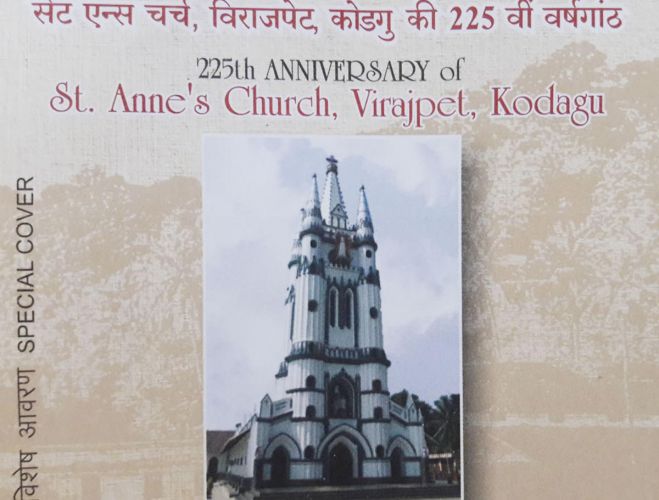
Special postal cover on St Anne’s Church released

The special cover on St Anne’s Church.

The Department of Posts released a special cover on the two-century-old St Anne’s Church in Virajpet on Tuesday, on the occasion of the 225th anniversary of the church.

Church Chief Priest Madalai said that it was the need of the hour to protect historical monuments.

During the release of the special cover at the Taluk Head Post Office in Virajpet, he said that the Church stands testimony to a history of 200 years.

The landmark is one of the tourist destinations in the district. The church being featured in the special cover has encouraged the thought of preserving historical monuments.

Head Post Office, Madikeri, Superintendent S R Nagendra said that the special cover on St Anne’s Church will be available at all post offices across the country from August 8.

Nagendra meanwhile handed over the special cover to Fr Madalai.

Fr Roshan Babu, Fr Isaac Ratnakar and Sr Janet Pinto were present among others.

source: http://www.deccanherald.com / Deccan Herald / Home> States> Districts / DH News Service,Virajpet / August 07th, 2018

Cauvery Gallery may soon become a reality

CauveryKF30jun2018

The Cauvery River Gallery, which was proposed to be established in the city, five years back, may finally be a reality with Chairman of the Karnataka Knowledge Commission and former chairman of ISRO K Kasturirangan announcing that he has spoken about the project with Chief Minister H D Kumaraswamy, in Bengaluru, recently.

The formation of the Cauvery Tourism Development Authority was mooted in March 2015 and the idea of the Cauvery River Gallery was discussed in the first meeting of the authority, chaired by then Tourism minister R V Deshpande, in June 2015. Neither of them materialised so far, even though the previous chief minister was a native of Mysuru district, the nucleus of the Cauvery River basin.

According to the annual report (April 2016 – March 2017) of the National Academy of Sciences of India (NASI), River Cauvery is among the most sacred rivers in the southern region of India and is thought to be the Dakshina Ganga, on account of its diverse characteristics and attributes.

“Originating from the Brahmagiri Hill in the Western Ghats and flowing towards the Bay of Bengal, the river travels along Karnataka and Tamil Nadu in the southeastern direction. River Cauvery is well inscribed in Tamil and Kannada literature because of its sacredness. Bathing in waters of Cauvery is a traditional belief. The striking Shivanasamudram falls of Cauvery River is the second biggest waterfalls in the country.

At the request of Minister for Higher Education and Tourism, Government of Karnataka, K Kasturirangan, Chairman of Karnataka Knowledge Commission, requested Manju Sharma, former president of NASI, to establish a Cauvery Gallery on the lines of Ganga Gallery and Brahmaputra Gallery.

Manju Sharma, with the consent of the NASI Council, sent a preliminary intent proposal to establish a high-quality gallery that captures the etymological, ecological, cultural, heritage and social characters of River Cauvery,” the report states.

The Cauvery Gallery can be established with the help of the National Council of Science Museums (NCSM), Kolkata, and the financial support of the department of Tourism, Government of Karnataka. Interactive multimedia with diorama, animation, graphics and the 3-D display will be used to make the gallery interactive and interesting for visitors, the report states. At present, there is a gallery for River Brahmaputra in Guwahati, in Assam, and a gallery for River Ganga at Allahabad, in Uttar Pradesh .

The gallery is expected to showcase the life, culture and biodiversity along the Cauvery River from its birth in Talacauvery of Kodagu district till it reaches the Bay of Bengal at Poompuhar (now Pombuhar) in Nagapattinam district of Tamil Nadu. It splits into two, twice, and forms the islands of Srirangapatna and Sivanasamudra in Karnataka.

Kasturirangan has said that he held talks with Chief Minister Kumaraswamy on setting up of the gallery on the Karnataka Exhibition Authority Grounds (Dasara Exhibition Grounds) in Mysuru and a detailed project report would be prepared soon.

In 2016 itself, Karnataka’s Tourism department and the NASI had signed a memorandum of understanding to set up the gallery at Mysuru. Then, the Tourism department officials and NASI experts had decided to establish the gallery on the premises of the Karnataka Exhibition Authority (KEA) complex. The project was scheduled to be completed in six to nine months and was expected to be a major tourist attraction in the city. The KEA complex is also yet to be constructed.

source: http://www.deccanherald.com / Deccan Herald / Home> State> Mysuru / by T.R. Sathish Kumar, DH News Service, Mysuru / June 28th, 2018

Karnataka: God’s own forests watch over Kodagu

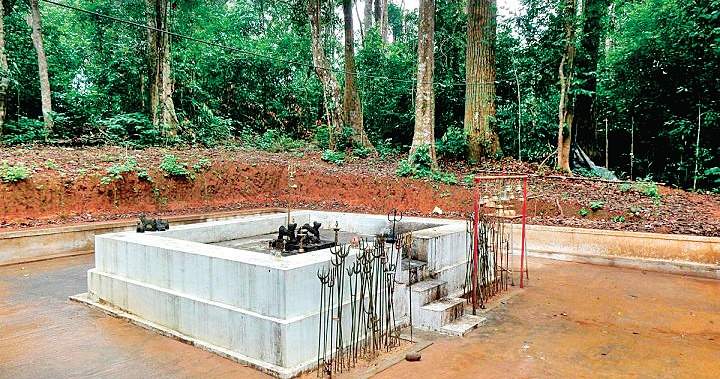
Devara Kadu, or sacred groves, are a binding force between families and different communities of Kodagu district. Of late, encroachments are depleting this forest cover

Rituals being conducted during a Devara Kadu festival

Mangaluru :

Rumbustious, uncut, proud, magnificent trees; a plinth on which idols of folk deities sit alongside miniature terracotta sculptures of cattle, a harmless silence taken over by tweets of birds and insects – welcome to Devara Kadu temples situated amidst thick, unkempt forests of Kodagu. Ecological havens in every village of the district, Devara Kadu or the sacred groves are a binding force between families and different communities of the district.

The Malnad region is dotted with such sacred grooves. While Devara Kadu fall under the protected forests, they are treated as sacrosanct by the people resulting in the prohibition of felling, lopping or clearing of trees and even weeds. Light, water, air, earth, wind – the five elements — are glorified at these abodes of nature and paganism (nature worship) is revered and celebrated once a year at these groves.

‘Kadu Aiyappa’ is one of the ancient deities worshiped at Devara Kadu. “He (Kadu Aiyappa) chose solitude and a simplistic life in the wild, which is why he is till date worshiped amidst the virgin forests,” explains historian Bacharaniyanda Appanna.

Kottialu Eshwara Devara Kadu at Garakeri

Bhadrakali, Bhagavathi, Naga, Aiyappa, Eshwara, Ajappa are the common deities worshipped in Devara Kadu and each deity has a folk story connecting them closely to the villagers. The folk deities are revered as protectors and guardians of villages they are nestled at. “The place of Hathur, which is on Gonikoppal-Mysuru highway, has been a witness to many accidents. But these accidents have not killed a single person as Goddess Vana Bhadrakali of Hathur Devara Kadu, has protected them all,” says Kokkanda Belliappa, a villager of Hathur who like others here believes in the power of the Goddess.

Currently, there are nearly 1,214 Devara Kadu in Kodagu covering an area of 4,614 hectares and, 18 native communities are involved in worshiping 165 folk deities. “There have been a lot of encroachments. The deities are not as feared as before leading to these encroachments. However, the forest department is vigilant towards these offenders and we have taken several measures against such encroaches,” explains DFO Manjunath.

Nevertheless, in the past decade, Devara Kadu have been reduced to less than 9,000 acres from the original 15,000 acres, according to a survey on Devara Kadu.The ‘Devara Kadu Habba’ or the sacred grove festival, which takes place mostly between April and July (some annually and others biannually), is helping preserve the groves. “The ‘Eeroli Bana’ at Thaaka village of Cherambane is a Devara Kadu of Lord Aiyappa and is spread over 800 acres. It is believed that Kadu Aiyappa Swamy had stayed at this grove for two days. The grove is highly revered by the villagers and the fear of god is still existent, which has prevented encroachments. During the annual Devara Kadu festival, the villagers take a holy dip at the stream flowing in the grove. Entry to this grove is banned otherwise. A team of medical students had visited the grove in 1982 to conduct some research, but they could not proceed into the grove after a certain point,” says Appanna, a villager.

During the Devara Kadu festivals, the virgin groves echo with the praise of the deities. The spirit dance, sacrifices, ex-voto offerings (an offering given in order to fulfil a vow), grandeur god dance are just a few highlights. Prema, a resident of Hathur village, enters the Devara Kadu of Vana Bhadrakali with a trident. She explains, “I am offering the trident to the goddess as a thanks-giving for granting my wishes. People offer cattle to the goddess too.” The spirits of the folk deities are invited into the human body and these spirits listen to the problems of the villagers and provide solutions. The spirits also offer guidance to the village heads to help lead the village towards betterment, the villagers believe.

Even though Kodagu has one sacred grove for every 300 acres, the highest in the state, the groves are still depleting. The pressure of economic returns from plantations has resulted in their depletion. Yet, to some extent, the spiritual connections with these ecological havens are keeping them alive.

History
Granting of sacrosanct status to forests dates back to the Indus Valley civilisation. In Kodagu, kings considered a stretch of forest sacred and cared for the folk deity who in return protected his land. Devara Kadu of Kodagu falls under the tropical evergreen forest belt

Beliefs
Felling, lopping, clearing of fallen branches, plucking of weeds, pruning or burning of trees is prohibited in Devara Kadus. It is believed that offenders will be punished with death by the folk deity. Spirit dance, sacrifice, ex-voto offerings are common practices followed during Devara Kadu festivals.

Depletion
In all, 15,000 acres of Devara Kadu have today reduced to less than 9,000 acres due to continuous encroachments reported in the past decade. Immigration and economic returns are seen as major causes for encroachments.

source: http://www.newindianexpress.com / The New Indian Express / Home> States> Karnataka / June 17th, 2018

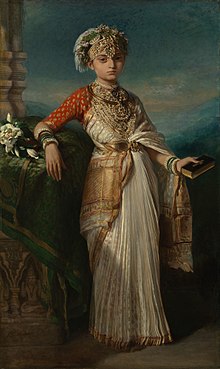
FRANZ XAVER WINTERHALTER (1805-73) Princess Gouramma (1841-1864) Signed and dated 1852

Princess Gouramma (1841-1864) Signed and dated 1852

Oil on canvas | 153.2 x 91.8 cm (support, canvas/panel/str external) | RCIN 403841

Durbar Corridor, Osborne House

PrincessGowrammaKF10jun2018

Description
Winterhalter was born in the Black Forest where he was encouraged to draw at school. In 1818 he went to Freiburg to study under Karl Ludwig Sch?ler and then moved to Munich in 1823, where he attended the Academy and studied under Josef Stieler, a fashionable portrait painter. Winterhalter was first brought to the attention of Queen Victoria by the Queen of the Belgians and subsequently painted numerous portraits at the English court from 1842 till his death.

Princess Gouramma (1841-64) was the daughter of the ex-Raja of Coorg. She was baptised in the Chapel at Buckingham Palace on 1 July 1852 and took the name ‘Victoria’, with Queen Victoria as her Sponsor. She had been considered a suitable bride for the Maharaja Duleep Singh whose portrait is also in the Royal Collection (RCIN 403843), but he declined to marry her. In 1860 she married Colonel John Campbell.

Here the Princess is depicted in Indian dress and rich jewellery, leaning on an Indian table. She is holding a Bible, an allusion to her conversion to Christianity.

Signed and dated: F Winterhalter / 1852.
Provenance
Painted for Queen Victoria

source: http://www.royalcollection.org.uk / Royal Collection Trust / Home> Collection> Explore The Collection

Going the Parsi way

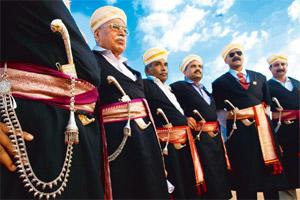
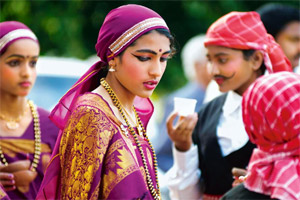
Parsis of the south: Scenes from the centenary celebrations of the Kodava Samaja Bangalore earlier this month. Photographs by Aniruddha Chowdhury/Mint.

Fair-skinned, educated and Westernized, they are the Parsis of the south. And their numbers too are declining— from 175,000 in 1992 to 125,000 in 2010 (Bureau of Economics and Statistics). Kodavas, or Coorgis, are concentrated in Coorg, Karnataka, which the British turned into a major district of coffee plantations. The land is also known for its mist-cloaked hills scented with honey, cardamom and oranges.

Kodavas are more numerous than India’s Parsis, Bahá’ís and Jews but that’s no solace. “We might vanish by 2030,” says Chepudira M. Thilak Subbaiah, president of the Kodava Samaja Bangalore that held its centenary celebrations in early November. “Young Kodavas are educated workaholics and don’t care about families. They don’t want more than one child.” According to Subbaiah, Bangalore has the largest population of Kodavas (35,000) after Coorg (70,000).

“The concern is not so much of losing at a numbers game,” says Sarita Mandanna, whose debut novel Tiger Hills was set in Coorg at the turn of the 20th century, “but the risk of losing an entire way of life, and the land as we once knew it.”

Kodavas are warrior-caste Hindus but their festivals and rituals are different. They have no priest, no holy fire and no dowry in weddings. They are great pork eaters. They worship Kaveri, the river that originates in Coorg. With a literacy rate estimated at 80%, their vocabulary is a mix of Persian, Sanskrit, Hindi, Kannada, Tamil and Telugu. Almost everyone has an estate—it could be 1 acre or 500 acres. Some say they migrated from the Kurd region in West Asia, others claim they are descendants of Alexander’s army. Traditionally a martial race, they have produced army icons like K.S. Thimayya and K.M. Cariappa. Other notable Kodavas are athlete Ashwini Nachappa and VJ Nikhil Chinappa.

Explaining the reason behind the dwindling numbers, the Bangalore-based author, Prof. P.S. Appaiah, says: “Until 1950, families had at least half a dozen children each. After the government introduced family planning, the Kodavas showed the most enthusiasm. General Cariappa himself would tell us not to go beyond two children. He said that we couldn’t afford to make India a jam-packed stadium.”

KodavathiJun052018

The Kodavas have been known for their well-knit joint families. “With better education and exposure, Kodavas are opting for smaller families, a trend that’s evident in most of educated India,” says Mandanna. “With land no longer jointly held within a family, but being parcelled into smaller acreages, it’s no longer viable to support a large brood of children.”

Young people are moving to cities like Bangalore, Mysore and Mumbai, where many have found their calling in the IT industry. “Many Kodavas are finding it hard to find suitable life partners within Kodavas, which forces them to marry non-Kodavas or stay as singles,” says Kishor Cariappa, moderator of KodaguCommunity.com, a site where people discuss topics ranging from marrying outside the community to Kodava cuisine.

A woman married to a Kodava is not considered a Kodavathi, but the children of the marriage are Kodavas. “Not so if a Kodava woman marries outside, in keeping with traditions observed in most of the country,” says Mandanna, whose sister married a Tamilian Brahmin. “Marrying within the community has its advantages in terms of a shared cultural background, but it is no guarantee of happiness, and I think a lot of the older Kodavas have come to recognize that.”

Despite the alarmists, there is no scare of extinction yet. “We are not going down like the Parsis,” says Mumbai-based art director Dipti Subramani, a Kodava who married outside her community. “I think we can maintain our present numbers.”

How can they be increased?

“We’re asking people to have more babies,” says Subbaiah. “Instead of criticizing young people marrying non-Kodavas, we must open our arms to people from other communities and not treat them as ‘outsiders’,” says Cariappa. However, some have other concerns. “If the Kodava population too goes up,” says Appaiah, “imagine what will be India’s fate.”

source: http://www.livemint.com / LiveMint / Home> Live / by Mayank Austen Soofi / November 25th, 2011

Codavas On A Mission To Nourish Cauvery Back To Health

Snapshot

Codavas are seeking living entity status for Cauvery – the lifeline of South Karnataka-Tamil Nadu.
______________________________________________________

As politicians try to gain political mileage out of the controversy over the sharing of Cauvery river water between Karnataka and Tamil Nadu, Codavas – the original inhabitants of Kodagu – have embarked on a novel journey. This could one day give Cauvery river, the lifeline of South Karnataka and Tamil Nadu, the ‘living entity status’ like Ganga, Yamuna and Narmada. It will be also on the lines of the special status that Whanganhi River of New Zealand, which is very dear to the original inhabitants Maori tribe, enjoys.

Called “Codavas separatists”, these inhabitants have been demanding a separate state since 1957. In fact, Kodagu enjoyed ‘C’ Grade statehood before Independence. Consecutive state governments in Karnataka have not protected the antiquity of Codavas and did nothing to give them special status despite being a miniscule minority in terms of population, allege the Codava National Council (CNC) activists.

Several times they had objected to the way river Cauvery is being abused and overexploited for socio-political and economic reasons. “We have been pointing out to the government that Cauvery river is not in her full health and we need to take corrective measures, but none of the governments did anything. Which is why we have organised a vehicular jatha, a convoy of vehicles with Codavas and Codavathis (women Codavas) from Talacauvery (birthplace) of Cauvery river to the last point of the river in Poompuhar in Tamil Nadu. This is an awareness campaign to let people know how the Cauvery is shrinking and how to nourish her back to her pristine beauty and girth,” said CNC president N U Nachappa.

River Cauvery is one among seven sacred (sapta nadi) rivers of the Vedic period and they are Ganga, Yamuna, Sindhu, Saraswati, Narmada, Godavari and Cauvery. Thankfully, other rivers are now under rejuvenation process with Prime Minister Narendra Modi pledging his full support to the rejuvenation and cleansing of Ganga. This has motivated the states like Haryana, Punjab, Gujarat, Andhra Pradesh, Goa and Maharashtra to take up rejuvenation of their rivers seriously.

However, Karnataka has not done anything to protect Cauvery river despite the river losing girth and inflow steadily. At many places, it is being polluted. “This apathy has hurt us, and after many failed appeals we have decided to kickstart a people’s movement to save Cauvery. She takes birth in our district and nourishes several lakhs of hectares of land and quenches the thirst of the crores of people. It becomes our responsibility to let the people know her condition. She nourishes our crops and has two southern rice bowls for India, one in Mandya in Karnataka another in Thanjavur, Tamil Nadu. She is the lifeline of the south,” says Nachappa.

There are already instances where the governments in Uttarakhand, Madhya Pradesh and even New Zealand are giving rivers a new lease of life by according “living entity” status. River Saraswati disappeared centuries ago and such a thing should not happen to Cauvery, say Codavas, who took part in the expedition.

The CNC has urged the governments of Karnataka and Tamil Nadu, the United Nations Organisation and the International Water Dispute Tribunal to accord special status to the Cauvery river. The five-day jatha to Poompuhar from Talacauvery also witnessed visits to temples of Tamil Nadu that are built along the course of the Cauvery river. “It was not just evoking the divine grace for the river’s welfare but we also talked and engaged with the local people on the importance at Salem, Rasipuram, Tiruchirapalli, Thanjavur and Myiladuthurai.”

As per the legends, great Sage Agastya had his seat of learning in Kodagu on the banks of Cauvery. Until 1956, Kodagu was politically a powerful C grade state of the Indian Union. Codavas consider the reorganisation of states under the State Re-organisation Act, 1956 a great geo-political catastrophe of the 20th century for them. Cauvery and Kodagu were synonymous with each other.

R Sridhar, a scholar on Cauvery in Bengaluru, analysed why Cauvery is losing girth. “In the name of development, we have reduced the value of our rivers, which is a general situation. In the Cauvery basin, we have killed many tributaries like Arkavathi and Kanva rivers. While Arkavathi was killed at its source in Bengaluru by drying the river and creating housing projects, Kanva river has been reduced to a rivulet, and most part of the year except in monsoons, it is dry. I remember the Tamil Nadu government making a case with the Supreme Court stating that the Cauvery river was contaminated with sewage and industrial effluents and chemicals. But I still think the Cauvery river gets an inflow of 740 thousand million cubic feet (TMC) water during a typical monsoon season. But the utilisation of river water has trebled in the last 20 years, which is why Cauvery has slendered down in girth. Check dams have been constructed in many districts along the Cauvery’s course in Karnataka and Tamil Nadu to store water, another reason for it to become slender. But it is never too late for taking up a drive like the CNC has taken up, which is laudable.”

However, things are presently fluid as the governments have demanded constitution of a Cauvery river water management board of which shape of things to come is not certain, Sridhar said.

President of the Delta Farmers Forum at Tiruchirapalli, Pandit Ramdas, hailed the expedition. “This is the first effort that has kindled hopes of better future for the river Cauvery and also to the users of her waters. I am sure the governments will take notice of it. Codavas are not only martial heroes but also die-hard conservationists of their heritage land, their efforts to conserve the river Cauvery was a heroic event just like their innumerable wars with invaders which they won”.

*Route Map of the Mission on Cauvery was Talacauvery in Kodagu – Mysore, Hogenakkal, Dharmapuri, Mettur Dam, Salem, Rasipuram, Namakkal, Paramathiveleur, Mohnaur, Tottiyam, Musiri, Mukkombu, Srirangam, Tiruchirapalli, Thanjavur, Ayyampettai, Papanasam, Kumbakonam, Mayiladuthurai, Sempanarkoil, Mudikandanallur, Melayur and Poomphar (Cauvery Pattinam) the final destination.

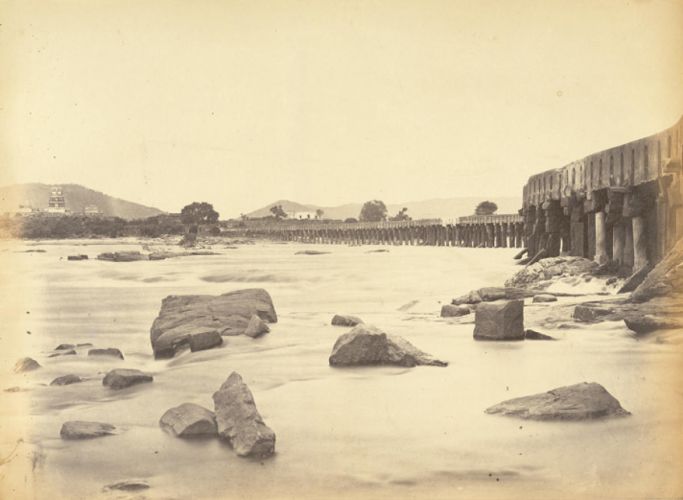
*Cauvery jatha as they called it was fascinated by the site where world’s first dam built over sand by the legendary Tamil emperor Karikala Cholan during 1st century AD. This grand Anekat, dam is built across river Cauvery Vennar at Kallanai and still stands.

*With this expedition the Codavas have begun a new people to people friendship with Tamil Nadu, while the politicos on both states choose to take the political route to the Cauvery water sharing and in the bargain foment and fuel inter-state unrest.

*What is living entity?

The concept of river being given the same rights and duties as a human being is new to India, the first to do was Equador in South America its constitution provided this right to many rivers within in its geographical area, recently New Zealand gave such rights to Whanganui River. The river will have all the rights and duties that a citizen has. The rivers endowed with such status will not be treated as property of the state or a nation but will have right to exist, persist, maintain and regenerate its vital cycles. The river will have its own identity and will get the same protection that the human beings get.

Raghuram hails from coastal Karnataka and writes on communal politics.

source: http://www.swarajyamag.com / Swarajya / Home> Ideas / by M Raghuram / June 03rd, 2018
Care for Some ‘Monsooned Malabar’? You’ll Love This Celebrated Coffee!

Among the foods that find a place on India’s GI tag registry list is a celebrated coffee that few Indian know about but which has a loyal following in the West — Monsooned Malabar.

Recently, West Bengal’s rasgulla officially became “Banglar Rosogolla” after the coveted Geographical Indication (GI) tag was bestowed on Calcutta gentleman Nabin Chandra Das’s luscious creation — a status hitherto enjoyed by only one other sweet from the state: the Joynagar Moa.

And its not just these iconic sweets. India’s GI registry has an assortment of culinary delights that can arrest any gastronome’s imagination and are often emblematic of a place or community.

Among the foods that find a place on this prestigious list is a celebrated coffee that few Indian know about but which has a loyal following in the US and Europe — Monsooned Malabar.

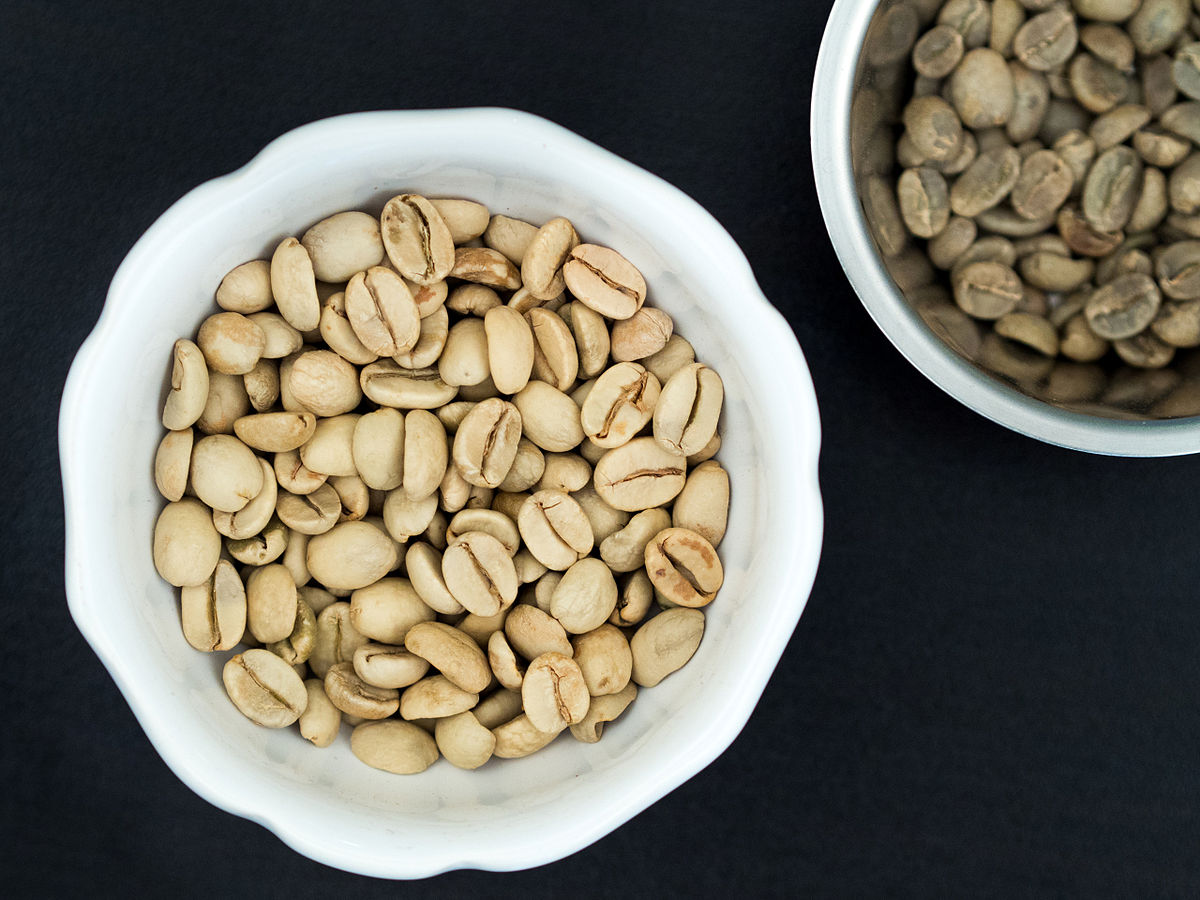
The pale-coloured Monsooned Malabar arabica, compared with green Yirgachefe beans from Ethiopia. /  Photo Source
The pale-coloured Monsooned Malabar arabica, compared with green Yirgachefe beans from Ethiopia. /
Photo Source

A singularly delicious coffee, the Monsooned Malabar had an accidental beginning. In the colonial era, British ships sailing to Europe around the Cape of Good Hope would find vast changes in the characteristics of their packed coffee, thanks to the salty moisture in the wooden cargo hold.

Losing their original taste and green colour during the 4-6 month long journey, the coffee beans would turn pale, attaining a brown straw-like colour and a pungent, musty flavour. Surprisingly, European coffee-drinkers seemed to prefer this heavy-bodied brew.

As transport improved with time (motorised liners began completing the journey in 20 days) and exposure to sea wins reduced, the beans began to stop changing en route. European consumers noticed that the coffee was losing the distinctive monotone flavour they were used to and asked for the aged coffee, which they thought tasted better.

MonsoonedMalabar02KF29may2018

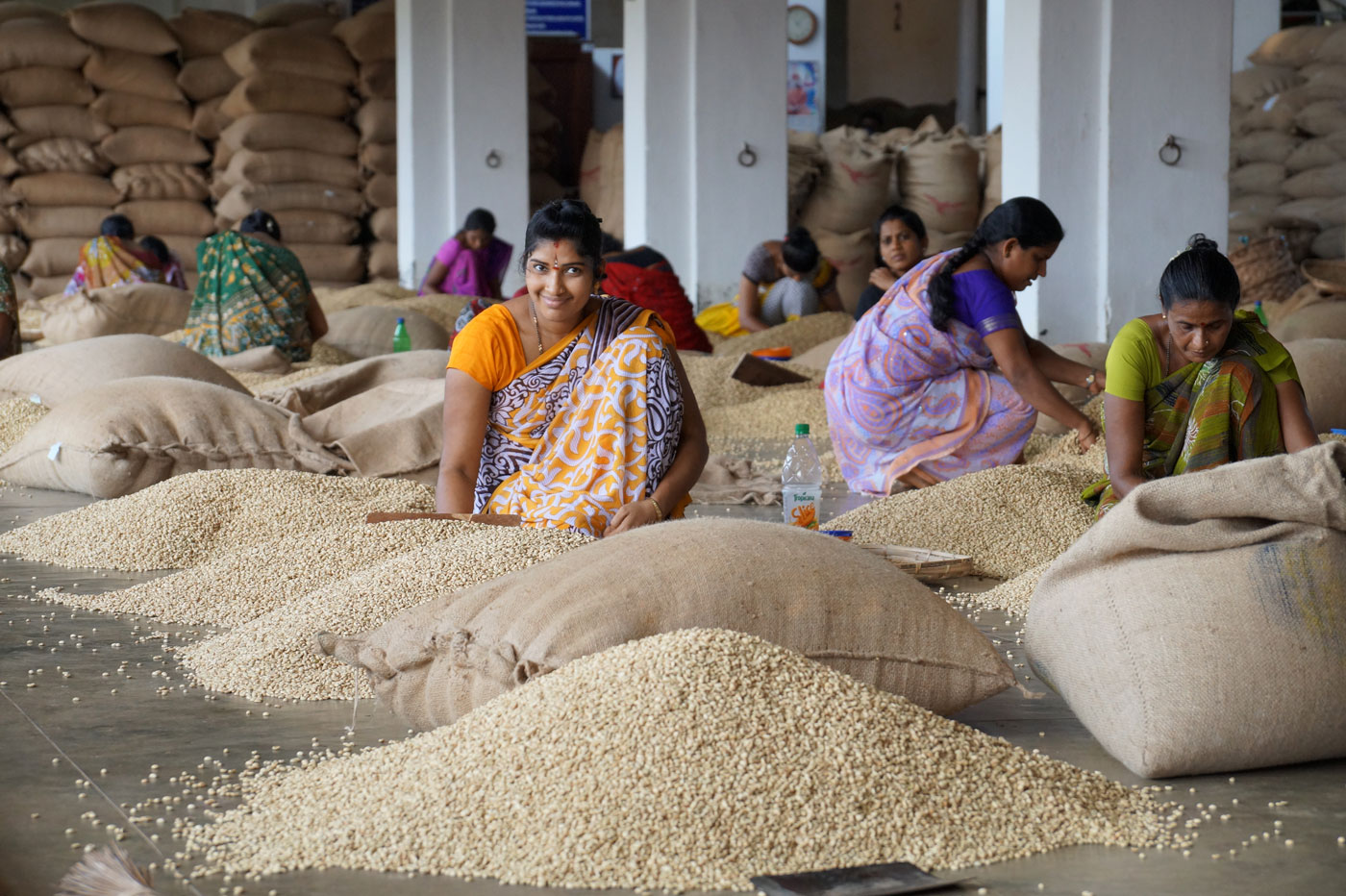
So, cultivators on the Malabar coast devised a new process to simulate the conditions that produced this unique coffee. Called Monsooning, this technique involves spreading out sun-dried beans in open-sided, cement-floored warehouses.

For the first week to 10 days, the coffee beans are turned over with wooden rakes every day. Next, the beans are arranged into “windrows” i.e jute sacks filled with coffee beans stored in rows with a passage-like space in between for the monsoon wind to blow through.

The coffee is then exposed to rain-bearing tropical winds from the Arabian Sea that lash the Western Ghats between June/July to September/October. Each batch goes through this process three times before the next batch of coffee is put on the floor.

This moisture-laden air triggers slight fermentation, causing the beans to swell to double their original size, turn pale and brittle. The absorption of moisture also reduces the inherent acidity found in popular varieties such as Arabica and Robusta. The result is a bold flavoured coffee with a smooth earthiness.

After the factory opens for regular workers with the end of the monsoon season, the beans are “polished” (the outer skin is removed) and graded, before being manually sorted to remove defects,. It is then bulked, fumigated and packed for export.

MonsoonedMalabar03KF29may2018

Over the years, Monsooned Malabar has become a much-in-demand component in several fine espresso blends (especially in the Scandinavian and German speciality roasted blends) to which it lends weight, body and its unusual chocolatey flavour. It is also sought by major international brands such as Nestle Nespresso, Benecke Coffee and Grecof.

Interestingly, Aspinwall & Co. Ltd., owned by the erstwhile royal family of Travancore, is a major exporter of the Monsooned Malabar and processes over 3,500 tonnes of coffee this year!

So have you decided when you want to head out and have a taste of your first cup of Monsooned Malabar?

(Edited By Vinayak Hegde)

source: http://www.thebetterindia.com / The Better India / Home> Food> History> Lede / by Sanchari Pal / May 14th, 2018