Category Archives: Historical Links / Pre-Independence

The Day War Was Declared On Coorg

CoorgWar01may112018

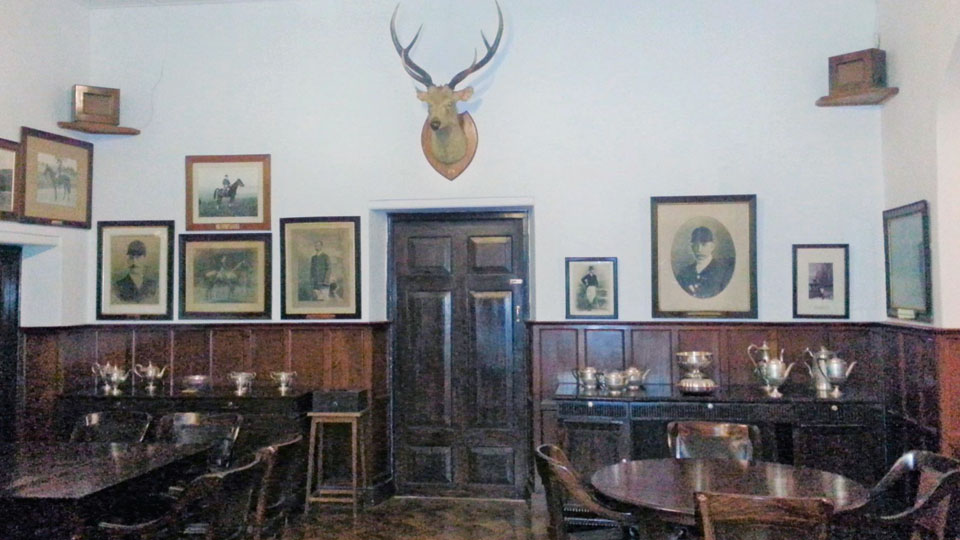
Courtesy our friends Pemmanda Jepu and Jemy Ganapathy, we spent four wonderful days at the Ooty Club, a place steeped in colonial history. The trophies, the silverware, the honour lists and the photographs of the ‘Masters of the Fox Hunt’ date back to early 1840s.

During our stay, I got an opportunity to read a well-documented book titled ‘Ootacamund – A History,’ written by Sir Frederick Price in 1908, which is otherwise kept in the safe locker. Only two copies of this book exist. I was particularly interested in the visit of Governor-General Lord Dalhousie to Ooty in 1856, few details of which I had gathered while writing about Victoria Gowramma. However, what I stumbled upon was even more interesting — Governor-General William Bentinck’s journey to Bangalore, Mysore and Ooty in 1834. This trip was primarily to coordinate the attack on the ‘problematic’ Raja of Coorg: Chikka Veerarajendra.

Chikka Veerarajendra and the East India Company were at loggerheads since 1830. Governor-General William Bentinck, who was more interested in reforming India than in annexing new territories, had to finally deal with the Raja of Coorg who had dared the British by keeping in custody one of their emissaries — Kullapalli Karunakaran Menon.
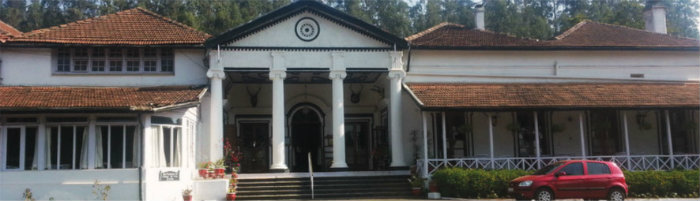
A frontal view of the Ooty Club, which was originally Sir William Rambold’s Large House.

Lord William Bentinck set out from Calcutta on 3rd February 1834 on board the Curacoa to Madras. Bentinck reached Madras on 15th February 1834 and journeyed to Bangalore via Vellore. Travel those days was by horse carriages, bullock carts, palanquins and on horseback, with frequent camping en route.

He wanted first-hand assessment of the situation in Coorg, and for this purpose, the Commander-in-Chief Sir Robert O’Callaghan was in attendance. Strategies on military action against Coorg were finalised in consultations with Sir Robert O’Callaghan while at Bangalore. The Governor-General also had administrative issues concerning Mysore to be discussed. The reason for him to visit Ooty for an extended stay was to improve his rather poor health.

Lord Bentinck stopped over in Mysore and was put-up at the precursor to the Rajendra Vilas Palace atop Chamundi Hill, which was originally built by Robert H. Cole who was the earlier British Resident at Mysore (1811-1827). Bentinck set out for Ooty and it was while camping at Gundlupet on 15th March 1834 that he officially declared war on Coorg. Col. James Stuart Fraser was in overall command. Coorg was encircled from three fronts. Chikka Veerarajendra surrendered on 10th April 1834 and Coorg was annexed by the East India Company. Incidentally, Coorg was the only province to be added to the John Company during William Bentinck’s tenure, for which he came under criticism back home in England.

Lord Bentinck’s entourage reached Ooty on 22nd March. At Ooty the only suitable accommodation for the Governor-General and his staff was ‘Sir William Rambold’s Large House.’ It was a grand hotel built in 1832 by an influential British entrepreneur named William Rambold. However, Rambold soon ran into financial difficulties. The hotel was frequently rented for extended periods of time by senior officers of the East India Company. It was in 1842 that ‘Rambold’s Large House’ became the Ootacamund Club, or the Ooty Club. During Lord Bentinck’s sojourn in Ooty, Lord Babington Macaulay arrived at the hill station on 25th June 1834. The Governor-General and Macaulay met each other for the first time at Rambold’s Large House. Macaulay chose a small cottage nearby where he lived for several months to draft the Indian Penal Code (IPC).

Governor-General Bentinck stayed on in Ooty till the end of September 1834. On his return journey he again passed through Mysore and reached Bangalore on 9th October. He sailed aboard the Curacao on 26th October from Madras and reached Calcutta on 14th November 1834.
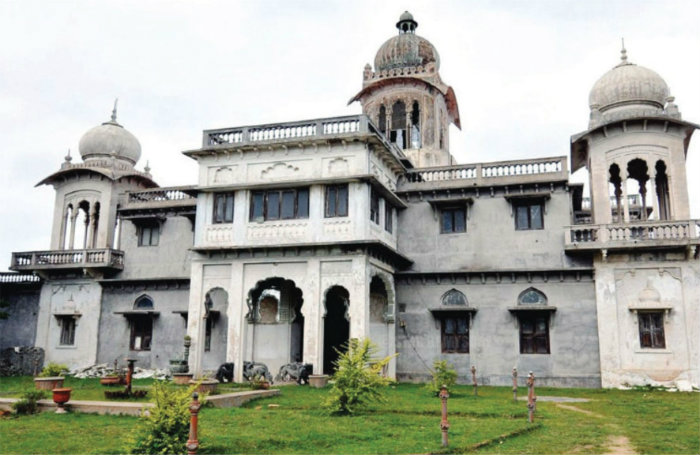
Rajendra Vilas Palace atop Chamundi Hill, Mysore.

I checked on Lord Dalhousie’s sojourn in Ooty from 7th March 1855 to 29th October 1855. Dalhousie’s visit was also for health reasons, and he was due to retire soon. However, he was not too comfortable in Ooty, and shifted to Kotagiri.

During Dalhousie’s stay in Nilgiris, one of his ADCs took permission to visit Coorg, where the ADC’s brother was a coffee planter. It was in 1852 that Dalhousie had reluctantly given permission to the ‘rascally Raja of Coorg’ to travel to England along with his daughter Gowramma.

The ADC, on his return, narrated an amusing incident to his boss. Coorg being a rather remote province, news from the outside world took time to percolate. Very often, wild rumours floated amongst the small but growing community of British planters and officers. One such rumour was that the British and their allies had lost the Crimean War, and that Queen Victoria and her family had fled to India! However, Dalhousie who had had a temporary telegraph line installed at Nilgiris had already received the news that the British and their allies had in fact wrested Sevastopol from the Russians.

On his journey back to Calcutta, Dalhousie stopped over in Bangalore during early November 1855, and was the guest of Sir Mark Cubbon. Dalhousie narrated the ‘Coorg rumour’ to the British officers, much to their amusement. After inspecting the troops, he formally announced the British victory at Sevastopol. Fast forward, 2014: Vladimir Putin has Crimea back in the Russian fold.

About the author: C. P. Belliappa, born in 1946, is a Chemical Engineer. Currently settled in Coorg, he is known for his writings on issues pertaining to Kodagu. Four of his books — Tale of A Tiger’s Tail & other Yarns from Coorg, Nuggets from Coorg History, Victoria Gowramma: The Lost Princess of Coorg, and Tongue of the Slip, have been published by Rupa Publications.

source: http://www.starofmysore.com / Star of Mysore / Home> Feature Articles / by C.P.Belliappa / March 2018
Cauvery: A time to pause

The role played by Kodagu, which has nourished and nurtured the Cauvery over time, needs to be recognised.

The Supreme Court of India has determined the manner in which the waters of the Cauvery river are to be shared among the beneficiary States. In its recent judgment on the long-pending issue, the court virtually pulled the proverbial rabbit out of the hat. The decision has received with muted acceptance, understandably, by all concerned, and some token opposition.

The Cauvery dispute has been a long-standing issue among the States, each one trying to tweak the 1924 Agreement forged during the British administration. Much water has flowed down the river since, and each State was trying to secure the best deal for itself.

A noteworthy aspect is that the matter has engaged some of the brightest minds, be it engineering, law, administration or politics, and the fortunes of many rose and fell at each turn of events. The din has for the present subsided. The bigger and immediate challenge now is to save the river to ensure lasting harmony and sustained development of the beneficiary States of Karnataka, Kerala, Puducherry and Tamil Nadu.

Amid all the arguments, the role played by Kodagu district in Karnataka, which has nourished, nurtured and nursed the river over time, has hardly been recognised or acknowledged.

Kodagu is part of the lower Western Ghats and at its highest point, is around 5,000 feet above sea level. Originally administered directly by the British from Madras, it became a Part ‘C’ State at the time of Independence, with its own legislature and Ministers. Subsequently, after the Reorganisation of States it became the smallest district, with a wealth of natural resources. It is in the Brahmagiri hills of Kodagu that the Cauvery rises and disappears, till it is seen again outside the boundaries of the district. The scenic beauty of the Brahmagiri range is a feast for any nature-lover. A mind-boggling phenomenon can be seen between October 14 to 17 every year unfailingly, when the Cauvery, which is nowhere to be seen, suddenly gushes forth from a spring and then swells into the river that bestows its bounty on millions of people along the way, till it reaches the Bay of Bengal in Thanjavur district of Tamil Nadu.

Kodagu has the largest acreage under coffee in the country, with one of the Tata companies owning approximately 40,000 acres. Trees of vintage growth, bamboo, pepper vines, spices, fruits and other agricultural produce make Kodagu a nature’s paradise. Kodagu hosts many species of wildlife, including the tiger, making it an attractive tourist destination.

Kodavas, the numerically small Hindu ethnic community, are different from neighbouring communities in their costume, language, and social practices. Suffice it to say that they have distinguished themselves in many fields and contributed to India significantly. This, however, is not about the Kodavas.

Journey to Tamil Nadu

Abundant green cover in Kodagu is of vital importance as this will ensure that the district receives sufficient rainfall to bring the river to life and flow in all its glory up to Tamil Nadu. Unlike Himalayan rivers, which are snow-fed, the Cauvery depends primarily on the Southwest monsoon. The river is impounded at the Krishnaraja Sagar dam, outside Mysore, conceived and constructed during the British period by the legendary engineer Sir M. Visvesvaraya. From here water is released, reaching Tamil Nadu, where it is stored in the Mettur Dam (Stanley Reservoir). Further release of water is dependent on the agricultural requirements of farmers downstream.

It would be facile to assume that the court decision has solved all problems and that the States concerned will live happily ever after. In a year when there is copious rainfall in Kodagu and the Cauvery is in spate, Karnataka releases water freely, making a virtue out of necessity. There is then no need for any water- sharing formula. It is only in years when rainfall in Kodagu and the catchment of the Cauvery is below par that the problem arises. This results in constant wrangling, and heated arguments between the States over the quantity of water released, the timing of the release and the manner of release, often resulting in violence. Matters get worse if the ‘deficit’ year happens to be an election year. This is the real issue and to date no satisfactory acceptable formula for sharing the distress has evolved, nor is a sound mechanism in place, for delivery in such situations.

It would be relevant to examine data for the decade 2007-2008 to 2017-2018 relating to release of water. Flows received from Karnataka were measured at the Mettur Reservoir up to 2012-13, and from 2013-14, at the Biligundlu gauging site maintained by the Central Water Commission. Against an annual 205 tmc ft (thousand million cubic feet) at Mettur, only 69.727 tmc ft was realised in 2012-13. At Biligundlu, against an annual figure of 192 tmc ft, the receipt in 2015-16 was 15.385 tmc ft. In 2016-17 the figure was 69.316 tmc ft and in 2017-18 it was 113.084 tmc ft. The statement shows that in the preceding decade there was deficit in four years. This is a matter of concern.

Reason for ‘deficit’

The main reason for deficit is reduced rainfall in the catchment area of the Cauvery in Kodagu district, mainly on account of loss of ‘green cover’. One needs to understand the reason for this loss. It is stated that construction of high tension power lines across Kodagu required felling of large number of mature trees, which reduced the ‘green cover’ substantially along the alignment. Perhaps that was the price to be paid for providing sustained power supply to areas beyond Kodagu. But who paid the price? The farmers in Karnataka and Tamil Nadu were the ones directly affected, along with all those areas that depend on assured water supply, such as Bengaluru which supports major industrial activity and large populations. In recognition of this need, the Supreme Court has specifically earmarked a certain quantity of water for Bengaluru.

Disturbing news

A matter of serious concern is news that certain infrastructure projects have been lined up for implementation in Kodagu. Two railway lines are planned: the Mysore-Kushalnagar-Madikeri (Makkandur) line and the Thalasssery-Kodagu-Mysore line. Four National Highways are planned. These are the Mysore-Kodlipet-Sunticoppa-Madikeri- Gonikoppal- Kutta-Mananthawadi; the Bangalore-Bantwal highway via Kushalnagar and Madikeri; Pannathur-Bhagamandala-Madikeri, and Mattanur-Gonikoppal- Thithimathi-Hunsur. This will connect the new Mattanur airport to Mysore and Bangalore at a cost of Rs. 1,000 crore. Additionally, existing roads are to be upgraded into four-lane highways.

These projects will undoubtedly result in the felling of a large number of trees, constant influx of persons transiting Kodagu without any concern or commitment for the local environment, increasing issues of waste disposal and management. Many other unacceptable activities will disturb the ethos of Kodagu and its natural environment.

The question to be asked is whether Kodagu, which is the major watershed and catchment for the Cauvery, requires these projects that are likely to cause more harm to the beneficiary States, while bringing only marginal and doubtful benefits. The ryots in the Thanjavur delta of Tamil Nadu that covers vast acreage, the farmers of Mandya in Karnataka, the drinking water supply needs of burgeoning cities such as Bengaluru and Chennai and many areas in the other States will be affected by any reduction in the flows of the Cauvery. There is no indication that the long-term impacts of these actions have been considered. No consultation with local communities appears to have been done. The impression at the ground level is that a very short-sighted view has been taken, and these projects have been mooted at the instance of local politicians as part of vote bank politics, in some cases backed by lobbies eager to monetise the natural wealth that will need to be extracted before implementation.

The way forward

It is clear that India needs to walk the ‘development path’. The right way is ‘sustainable development’, which does not appear to be the case in respect of the above-mentioned projects. The waters of the Cauvery have nourished downstream civilisations for centuries. It is the life blood of the States that now comprise the region. The time has come to save the river, bring back its glory as a provider and nourisher of humans, enabling them to live in peace, harmony, and rise to their full potential in every sphere of endeavour. There is no case for inter-State political one-upmanship or victory or loss for any group. The goal and cause are one…. save the Cauvery for the good of all, for all time to come, by taking a long-term view. Everyone needs to be on the same page.

The following steps need to be taken immediately.

1. Suspend all infrastructure projects, proposed or under implementation, for six months or a year. This short postponement will give time to study the issues necessary for saving the Cauvery.

2. Set up a competent neutral body to assess the real need for connectivity through Kodagu with contiguous areas and examine alternative options.

3. Identify the best option that will cause least damage to the environment and catchment of the Cauvery.

4. Having completed the above three tasks, arrange for a ‘carrying capacity study’ to be done by a credible professional body.

5. On the basis of the findings of this study, the implementation of projects should be supervised by an empowered body to be named the ‘Kodagu Sustainable Infrastructure Projects Board’, with the Deputy Commissioner of the district as Chairman, and the representatives of different agencies and local non-officials as members, to ensure timely implementation in accordance with project specifications.

6. Quarterly meetings of Chief Secretaries of the four States to be convened by the board to update them on the progress and the status of safeguards for the Cauvery.

The need of the hour is statesmanship, avoiding political short-sightedness. It should not become a case of winning the battle of sharing the Cauvery waters and losing the war of saving the river for posterity.

The author, who retired from the Indian Administrative Service, has written this as a concerned citizen. Email: sonnabel@gmail.com

source: http://www.thehindu.com / The Hindu / Home> Opinion> Open Page / by P.M. Belliappa / March 18th, 2018

Kodagu’s encounter with the missionaries

OldKodaguKF07mar2018

When East India Company annexed Kodagu in 1834, there were no schools in the erstwhile kingdom, and none of the locals had any formal education. Lt Col James Fraser, a political agent of the company decided to open vernacular schools in Madikeri, Virajpet and Kushalnagar. Kodagu now has one of the highest literacy rates in Karnataka.

People of Kodagu took to education enthusiastically and encouraged both boys and girls to study. The British, in their policy of ‘enlightened self-interest’, supported education and introduced English along with Kannada. By 1850s, there were a number of educated locals taking up jobs in the government especially in the police, forest and revenue departments, and later in the armed forces.

However, in Kodagu, the credit for furthering education goes to two German missionaries from the Basel Mission. They were Rev Hermann Moegling and Rev Georg Richter. Moegling came to Kodagu in 1853. He first came to Mangalore in 1836 and established a seminary and a school. He not only mastered Kannada but also started the first Kannada newspaper Mangaluru Samachara in 1843.

Lt Col Mark Cubbon was the chief commissioner of Kodagu at the time, and he encouraged Moegling to establish the first Protestant church and a school in Madikeri in 1855. Georg Richter arrived at Kannur in 1855 with a group of Basel missionaries. Within days, he was sent to Mangalore where he started teaching in the Basel Mission English School started by Moegling. He was an exceptionally good teacher and was soon popular amongst the locals and the Europeans. Before coming to India, Richter spent time in London to improve his English and learn the latest teaching methods.

The book by Albrecht Frenz, Georg Richter: His Work in Kodagu on the Basis of Official Reports, provides insights into Richter’s journey to India, his journey from Mangalore to Kodagu and his work in Kodagu. During his time in Kodagu, Richter plunged himself into serious work, teaching as well as helping Moegling in setting up a settlement for Christian converts in Anandapur, where a coffee estate was being developed. In 1858, Richter married Armella, the daughter of Bernhard Schmid, who worked in Tirunelveli and Ooty. When Moegling returned to Germany in 1860, Richter took his place. The book also gives details of Richter’s work in the field of education in his capacity as principal of Government Central School, Madikeri, which he helped establish in 1869.

He later took over as inspector of schools in Kodagu. His wife helped him in his work and she focussed on encouraging girl students. One of the skills she taught them was needlework. Richter took an interest in learning about locals and their history. His book, Gazetteer of Coorg, published in 1870, is a comprehensive recording of social, cultural, historical and geographical aspects of Kodagu.

He was an avid photographer and the book by Albrecht Frenz has compiled the photographs taken by Richter during the 1860s in Kodagu, Nilgiris, and in parts of Tamil Nadu and Kerala. Richter and Armella returned to Germany in 1896. Richter has left an indelible mark on Kodagu by his quintessential work in the field of education, and the seminal recordings about Kodagu in the Gazetteer of Coorg.

source: http://www.deccanherald.com / Deccan Herald / Home> Supplements> Spectrum / by C.P. Belliappa / March 05th, 2018

Retain sanctity of traditional dance, experts urge Kodavas

Kodava Sahitya Academy makes suggestions on `Ummathat’

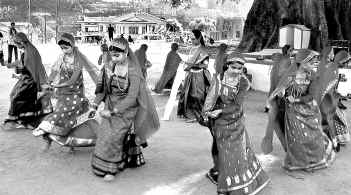
Traditional glory : Dancers performing a traditional dance of Kodagu.

Madikeri :

Kodavas have a unique culture and their folklore too is distinct from others. “Ummathat”, a special dance, a mixture of folklore with a dainty touch of medieval and modernity, performed by Kodava women, is a case in point.

Kodava women lag behind in variety of dances vis-a-vis men. Men attired in traditional costumes perform “Bolakkat”, “Peeliyat”, “Chowriyat”, “Kappeyat”, “Pareyakali”, “Kolatt”, and “Kombatt” whereas women dressed in colourful saris perform “Ummathat”.

There was a debate whether these dances should be performed in public or only at Kodava religious and cultural ceremonies.

The Karnataka Kodava Sahitya Academy, which had organised a seminar on “Ummathat” at Devanageri in Virajpet taluk recently, has come up with some suggestions concerning “Ummathat”. A decision was taken to maintain a uniform pattern of “Ummathat” in future.

Some of the suggestions are: Ummathat should not be performed in open or public functions or in front of the tableux as it loses sanctity. The dance shall be performed only in venerable places. Dancers shall remove footwear, wear traditional “bottu podiya” (a grand sari with rich brocade) while performing the dance.

The songs, an assortment of over 12 songs, sung in different tunes, will be retained without giving it a touch of modernity, was another decision taken at the seminar.

The “taleyatakki bolakk”, a brass plate containing a burning lamp sprinkled with rice, will replace the woman dressed up as Goddess Cauvery in the middle. The seminar arrived at a decision to formulate enough programmes in future to foster “Ummathat”.

Pace and rhythm

Akhila Kodava Samaja president Matanda C.Monnappa agrees with most of the suggestions that “Ummathat” must be nurtured. There ought to be a touch of modernity to go with it, he says. Increasing the pace of songs to match the rhythm will make it more attractive. At the same time, changes should not dilute the original nor affect the decorum of the dance. It should not portray women in poor light.

No one is sure of the origin of the songs or the nuances of “Ummathat”. Most people believe the songs were compiled by the late Haradasa Appacha Kavi several decades ago. Certain songs are contained in the book written by Kavishishya Haridasa Mukkatira S. Poovaiah. Late Puggera Karumbaiah, who was instrumental in reviving the “Ummathat” in the early Seventies, too had contributed to the dance form.

Origin of Ummathat

According to Puggera Aiyappa, a senior citizen from Devanageri, Ummathat was practised centuries ago though there are no records available to prove it. Mr. Monnappa says his 95-year-old mother (who passed away recently) used to sing “Ummathat” songs.

Other dances performed by men such as “Bolakkat” have religious sanctity. Bolakkat is offered to the deity unlike “Ummathat”, Mr. Monnappa said.

Similarly, dances such as “Peeliyat”, “Chowriyat” and “Kombatt” are performed at the religious places where the deities are worshipped. “Ummathat” and “Bolakkat” were performed in public in the past even in New Delhi. It had drawn criticism.

source: http://www.thehindu.com / The Hindu / Home> Karnataka> Madikeri / by Staff Correspondent / July 20th, 2005

Winds of change hit Kodavas

The Kodavas were always a martial race with a pronounced colonial hangover (Agency Photo)

It’s an impressive roll call. Field Marshal K M Cariappa, Gen Thimmaiah, B C Nanda, M P Ganesh, Prasad Bidapa, Len Aiyappa….The Kodava community, from southwestern Karnataka, has always punched above its weight in Indian public life. Kodavas rose high in the Indian Army; they excelled at sport, particularly hockey and flourished in the coffee trade. But that was then. Today, the Kodavas are buffeted by the winds of change. Modernity and migration are taking their bewildering toll on a people that set great store by tradition.

This is the context of renewed demands for a separate Kodava autonomous region, which would give them a separate place of their own, in keeping with their claims of being vastly different from everyone else. For this would also accrue all the benefits that go with a distinct identity. The men are strikingly handsome and their women appealing winsome. Their customs and traditions too are quite different from those in the rest of the region,one being that an uncle usually marries his niece. For nearly two decades, the Codava National Council (CNC) has been fighting for autonomy and the issue is back on the agenda with regular dharnas and sporadic protests at the state legislature.

The Kodavas were always a martial race with a pronounced colonial hangover. Their loyalty to the British meant they found secure footing in the armed forces. Even though they had few officers and mainly made up the rank and file, the Army had a significant Kodava presence. No longer. Kodava recruitment at the Bangalore Army headquarters, which caters to Karnataka, Kerala, Mahe and Lakshadweep, fell steadily from 85 in 2001-02 to 28 in 2007-08. Today, the highest-ranking Kodava officer is a lieutenant-general and they have just a few major-generals.

The once-famous Coorg Regiment has suffered too. Twenty-five years ago, every Kodava family could proudly list several of its men in uniform. That’s history. Sons prefer to head for engineering colleges now or professions more lucrative than the Army, say recruitment officers.

It is the same with sport and the Kodava’s once-legendary skill on the hockey field. M P Ganesh, the first Kodava to captain the national team, heads a list that also features ace players such as M M Somaiah, B P Govinda, Len Aiyappa and Mandepanda Monappa. The community always enjoyed and excelled at traditional war games such as pareya-kali and shakti-kolu. This is why Ganesh, who started playing hockey late, was deemed a natural.

Army hockey teams, particularly those that played for the Madras Engineering Group, had several Kodavas. They were robust, used to walking to school several miles a day. And they had the right temperament for the game. But now, hardly any Kodavas play hockey, says Ganesh. “High coffee prices, other employment opportunities and a more sedentary lifestyle have led to a lack of interest in the game,” he says.

Today, the Kodava’s passion for hockey surfaces only during the annual tournament in Madikeri, the town in the Kodagu district that Kodavas regard as home. The tournament is hosted by one Kodava family or clan. Other families and clans play for pride and honour. Women are allowed to compete. National and state players are welcome but Ganesh says they are nothing like yesterday’s Kodava hockey stars. “Players should be picked up from here and coached,” he suggests. Eight Kodavas play in the Karnataka team today, but none in the national team. Len Aiyappa was the last to distinguish himself at the national level.

It is hardly different in the former Kodava mainstay, the coffee plantation. Once upon a time, almost every Kodava family owned a coffee estate, or part of it, ranging from a few acres to vast swathes of land. Coffee is cultivated on roughly 2.5 lakh acres in Kodagu, says M C Nanaiah, a member of the state legislative council, but the Kodavas no longer rule the roost.

Many Kodava families are selling off their ancestral homesteads and estates and migrating to Bangalore or Mysore. The trickle grew to a flood after coffee prices slumped a few years ago. Kodavas are also converting their palatial bungalows into home-hotels, burgeoning business ventures for sure but emblematic of their decision to swap a timeworn culture for modern commerce.

The winds of change are sweeping the little district, bearing the scent of the white coffee flowers. The Kodavas are hanging up their hockey sticks and Army boots. Many argue that it is all to the good for a community to change with the times, embracing newer professions such as IT and science. For the Kodavas, the change may be eagerly sought but bewildering.

deepa.bhasthi@timesgroup.com

source: http://www.timesofindia.indiatimes.com / The Times of India / News> India News / by Deepa Bhasthi / TNN / November 02nd, 2008

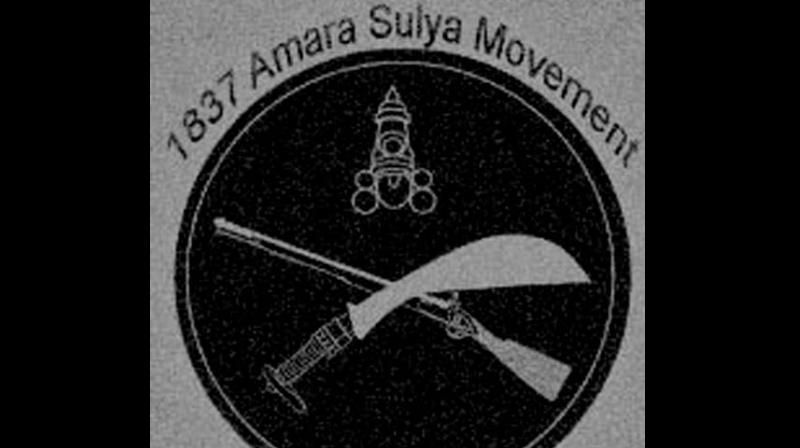
1837: When the rebel flag fluttered high

In 1837, this anger turned to action for freedom and the British suffered a temporary defeat, says N.S. Deviprasad Sampaje, Writer.

The Jangama Kalyanaswamy's flag used during the Sullia rebellion was hoisted by Guddera (Guddemane) Appaiah against the British in 1837 was later adopted as the Kodagu Gowda coat of arms. They are also called Arebhashe Gowdas
The Jangama Kalyanaswamy’s flag used during the Sullia rebellion was hoisted by Guddera (Guddemane) Appaiah against the British in 1837 was later adopted as the Kodagu Gowda coat of arms. They are also called Arebhashe Gowdas

Mangaluru:

It was the first armed uprising against the British, which took place 20 years before the First War of Indian Independence in 1857. The men who laid down their lives in this uprising of 1837 in Mangaluru are not forgotten.

The Tulunadu Rakshana Vedike and several others organisations marked the 179th anniversary of the uprising on Tuesday at Bavutagudda, where the rebels hoisted the Indian flag to mark their victory over the British on April 5, 1837.

“The people of Kodagu and Canara (coastal Karnataka) were unhappy with the British for various reasons. In 1837 this anger turned to action for freedom and the British suffered a temporary defeat,” recalls writer, N.S. Deviprasad Sampaje.

Mr Sampage , who wrote the book ‘Amara Sulliyada Swatantrya Sangrama,’ detailing this early struggle for freedom, says it was a mass movement and not restricted to some villages or caste.

“It received unprecedented support from the people of Dakshina Kannada. However there were efforts to tone it down by labelling it ‘Kalyanappa na Katakayi, or ‘loot of Kalyanappa’.

But in reality it was a major movement for freedom in the region, which scared the British. The reports of the then Collector of Dakshina Kannada, Leven, reveals this,” he says.

The rebellion was led in Kodagu by leaders such as Aparampara, Kalyanappa and Putta Basappa and continued in Sullia, Puttur before culminating in Mangaluru, the seat of the British Collector.

It is said the rebels held control of the city for 13 days before British reinforcements arrived in Mangaluru and recaptured it.

But it took two months more for the British to arrest the rebels and hang them in public to silence the movement.

“The government must do a proper study of the entire movement so people get to know its importance,” emphasises Mr Sampaje.

source: http://www.deccanchronicle.com / Deccan Chronicle / Home> Nation>Current Affairs / by Gururaj A. Paniyadi, Deccan Chronicle / April 06th, 2016

Scouring the Kodava attic

AppannaKF02feb2018

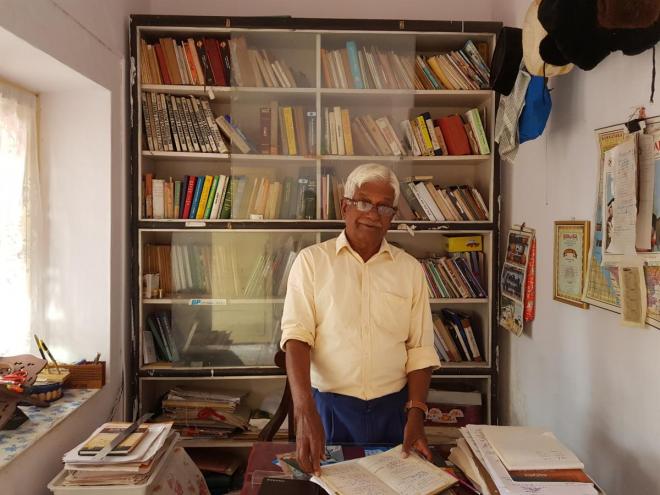
Passionate about relics and all things old, this retired History lecturer’s face brims with excitement as he shows his collection to the tourists and attempts to provide a theatrical demonstration of the artefacts. Bacharaniyanda P Appanna, a native of Kushalnagar, is a hoarder of historical artefacts that are exclusive to Kodagu. History comes alive in his house not just through the artefacts, but also through his energetic tale-telling enactment.

The history and culture of Kodagu have been an enticing topic for professional and amateur researchers alike. For most of these researchers, the abode of Bacharaniyanda P Appanna is a treasure trove of knowledge, resembling a theatre of history.

The dwelling

Appanna invariably accompanies while the curious visitor explores his collection. Taking you through a small room, he points out at an ordinary bulb. Switching it on, he says, “This bulb has been functioning from January 1, 1973.” Such is his precision and enthusiasm for age-old things. One is welcomed by a huge bookshelf at the entrance of his house. There is a kurikutt – a single piece vermilion and turmeric holder made of wood, hanging beside a brass lamp inside the house. Below this lies a chanduka, a compartmented wooden case.

Sitting beside these dateless artefacts, he says, “I have been hoarding historical objects for over 30 years now. Students and professionals from around the globe come here to learn about the significance of these artefacts.”

Appanna travels to the interior parts of Kodagu and scrutinises each village to source his artefacts. He is interested in exploring old ancestral houses, and says, “I mostly visit age-old houses owned by the elderly. Requesting their permission, I first scrutinise the attic and then the backyard to find the valuables.” Thereby, he acquires innumerable authentic and priceless artefacts for his collection.

Appanna has thoroughly researched and named the artefacts correctly, some in Kannada and the rest in Kodava language. Since his house cannot accommodate all the artefacts, some are placed in a makeshift shed outside the house.

Several Kodava weapons hang inside the house. They include the amb kathi, meembal, vodi kathi and a variety of rifles strung along with a line of bullets. Spirited, he precisely enacts how the Kodavas used these weapons, and explains, “Amb kathi was designed for the ladies, who were skilfully trained to use them. The meembal was used for fishing.”

Showcasing hobbies

His makeshift shed is home to antique vessels, vintage knitted baskets and stone measures to name a few. Explaining the functionality of sekala, a huge mud pot with pores in its inner lining, he says, “It was the steam cooker of the bygone era.” He then lines up a few measuring bowls, pare, pani and sair, and explains, “One pare is 10 sair, one pani is two sair…” These are local measuring units of the bygone days. Similarly, he lines up a few stone weights and goes on to explain their units, which include pare and batti.

Furthermore, he introduces the kota kudike, a mud pot that used bamboo leaves and wet sand placed at its bottom to preserve meat and fish for five to six days. He also possesses a wooden device used to make nuputtu, a famous Kodava dish. Next is the batte bari, a knitted basket, that acts as a wardrobe. Showing one of the ancient ones, he says, “This belonged to the wife of Kaliyat Ajappa, a cult deity.” Likewise, he shows more items such as the pombana (coin holder), maal pott (jewellery holder), ele thatte (ancient tray), etc.
He also possesses the ceremonial dowry items given to women during their weddings.

In the backyard, equipment related to agriculture and fishing is arranged. The design of the ancient fish trap is sure to enthral the viewers. Bacharaniyanda house is open to all enthusiasts who want to experience the culture of Kodagu and the visitors’ names are jotted neatly in his diary with dates. Appanna can be contacted on 9480730763.

source: http://www.deccanherald.com / Deccan Herald / Home> Supplements> Spectrum / by Prajna G R / January 22nd, 2018

A Slice Of History

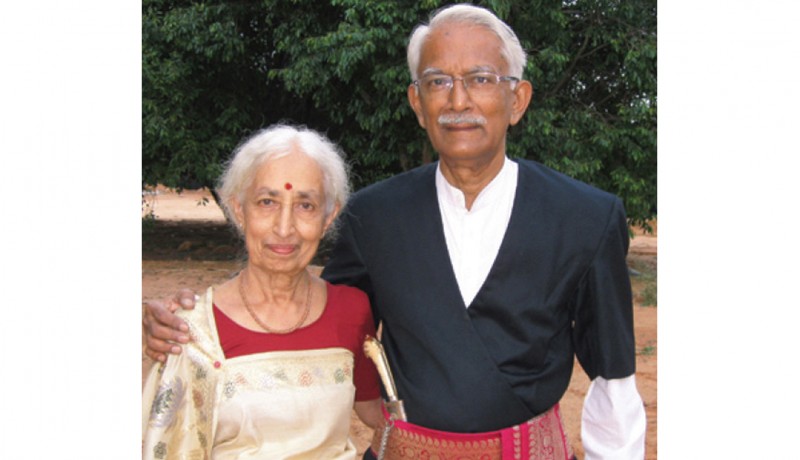
Boverianda Nanjamma and Chinnappa

Boverianda Nanjamma And Chinnappa Recollect The Efforts Of Their Late Grandfather In Documenting The Folklore And Songs Of The Kodava Community.

Much as we admire him and are inspired by him, we have never seen our grandfather Nadikerianda Chinnappa; he died before we were born. We—Nanjamma and Chinnappa—are cross cousins. The narrative of our grandfather that follows is based on the recollections of our parents, aunts and elder cousins, gleaned from casual conversations over the years.

Our grandfather, who worked with the police, had gone to a remote village, riding his horse across a stream and through a forest path to investigate a quarrel over the ownership of a strip of land. On his way back, he stopped by the stream to eat the akki (rice) roti sweetened with jaggery his wife had packed for him. The sun was setting behind the hills and had painted the skies in brilliant hues of red and gold. Captivated by the scene, Nadikerianda Chinnappa sat lost in thoughts, when he heard the distant sound of Kodava dudi (small handheld, hourglass-shaped drums). Mounting his horse, he set out to locate the origin of the drumbeats. He found four men seated around a bonfire singing Kodava folk songs, practising for Puthari, the harvest festival. It was getting dark but he waited for them to finish. Recognising that our grandfather was in the police, the singers touched his feet respectfully. Our grandfather took the leader of the team home on his horse.

This was not uncommon; his wife Nanjavva knew he had brought a singer home for the night. She made a bed for the visitor in the attic and served them a hot meal with a drink of frothing toddy. Refreshed, grandfather and the singer sat in the hall; while the singer sang a ballad, Chinnappa transcribed the words late into the night. After many such sessions with various singers, he had a good collection of Kodava songs sung during weddings, funerals and festivals, and ballads in praise of deities and heroes.

Himself a good singer, Chinnappa’s passion for Kodava songs and ballads prompted him to transcribe them. During his travels around Kodagu as a police officer in the early 1920s, he observed that the unique customs and traditions of the Kodava community were being forgotten or altered. Chinnappa feared that Kodava traditions and songs that had been handed down orally over generations would be lost because of the dominance of English, and the influence of the cultures of neighbouring areas. So, he decided to document them.

Late in the evenings, after work, he neatly wrote down all the songs, proverbs and riddles by the dim light of a kerosene lamp, while smoking his favourite cigars. When he started documenting the customs and traditions, he consulted his mother Ponnavva who was well-versed in them. Meanwhile, his wife would read the draft first to ensure that it was clear to a layperson. If there were parts she did not understand, Chinnappa rewrote them. It used to be said that the waste paper basket would always be full in the morning.

British officials in Coorg—as Kodagu was called by them—got his draft reviewed by some prominent Kodavas. On their recommendation, C S Sooter, commissioner of Coorg, authorised financial assistance to publish it. Chinnappa chose the name Pattole Palame, meaning ‘silken lore’, for his book, which was first published in 1924. The 6th edition was printed in 2012.

Pattole Palame is a precious document of the heritage of the Kodava community. In the second edition published by the University of Mysore in 1975, the editor describes it as “one of the earliest, if not the earliest, extensive collection of folklore of any Indian community written in an Indian language by an Indian”.

The text of Pattole Palame is in Kannada and the folk songs, proverbs, etc, in it are in Kodava thakk, the language of the Kodavas, an oral language written using the Kannada script. Nearly two-thirds of the book consists of folk songs transmitted orally down generations, which are sung even today. Traditionally known as Balo Pat, these songs are sung by four men beating dudi. The songs have haunting melodies and evoke memories of times long past. Kodava folk dances are performed to the beat of many of these songs, which are a rich source of information on the culture, language and history of the Kodava people.

Chinnappa himself began translating Pattole Palame into English but could not complete it, as he died of cancer in 1931 at the age of 56, a few months after his retirement. It was in 2003, nearly 75 years after Pattole Palame was first published, that we, his grandchildren, translated it into English and published it.

Although he was best known for Pattole Palame, Chinnappa’s major literary work as a poet was Bhagavantanda Paat, his translation of the Bhagavad-Gita into the Kodava language, composed in the style of Kodava folk songs, published in 1929.

When Grierson, a British linguist, embarked on the first Linguistic Survey of India (1913 to 1920), he looked for knowledgeable representatives of the various Indian languages. Chinnappa, who was fluent in both English and Kodava thakk, was chosen for the Kodava language. As required, he translated the parable of the ‘Prodigal Son’ into Kodava thakk and narrated it, and sang his own poem, Sri Moola Kanniye, an ode to river Kaveri. These were recorded in 1922 on gramophone records; copies of the recordings were kept in the British Library in London and the Madras Museum. They were digitised recently by the Linguistics Department of the University of Chicago.

Born in 1875, Chinnappa was the fifth of eight children. After matriculating in Madikeri, he went to Mangalore for further studies. But when his elder brother Subbayya died suddenly, Chinnappa returned to Kodagu to take on family responsibilities. In accordance with Kodava tradition, he married Subbayya’s widow, Nanjavva.

His career took many twists and turns. A teacher at first, then a revenue inspector, and then an officer in the Coorg Regiment of the Army, he joined the police department when the regiment was disbanded in 1904, and rose to the rank of a prosecuting inspector.

Our grandfather was fond of sports. He was a bowler in the All Coorg XI Cricket team, which in those days consisted mainly of Englishmen. When he played billiards at Victoria Club in Virajpet, his British opponents would often swear under their breath on losing a game to him. On one such occasion, Chinnappa lost his patience, broke the billiards stick on his knee and threw it on the floor. This was a very daring act for an Indian in those days.

Chinnappa was also involved in establishing the Police Officers’ Cooperative Society, Coorg Cooperative Society, Coorg Central Bank and the Coorg Education Fund. He was fond of children and always carried peppermints in his pockets. He was a caring father to his own three children, the two stepchildren by his elder brother, and to his deceased sister’s daughter, whom he and Nanjavva adopted. He sponsored the education of many poor children, and there were always a few students boarding in his residence, free of cost.

Our grandfather was a man of vision and talent, and was self-driven. He was a folklorist, poet, police officer, sportsman, historian, singer, philanthropist, and caring householder. Above all, he was a man who lived life to the fullest and left a lasting and invaluable legacy for his people in his writings.

The authors are translators and scholars of Kodava studies

Featured in Harmony — Celebrate Age Magazine
August 2016

A-slice-of-history

source: http://www.harmonyindia.com / Harmony / Home> Columns / August 2016

Warrior Women of Coorg

Veena Poonacha’s recent book on three Kodagu women chronicles a significant journey into the changing fortunes of women in India, says Geeta Seshu

“At the age of 15, my great-grandmother travelled every day to supervise the construction of our family home, sustaining herself only on curd-rice and dry fish. Though my grandmother was widowed at the age of 39, she lived alone with a pistol under her pillow and built the family fortune. My mother went back to her roots and devoted her life to education.”

Meet Dr Veena Poonacha. And meet her great-grandmother, Ponamma, her grandmother, Subamma, and her mother, Neelamma. And don’t stop here. Meet all the courageous, intrepid women of the Kodava (Coorgi) community who helped carve out a unique race of warriors in the land of a thousand hills.

Dr Veena Poonacha, Director of the Research Centre for Women’s Studies (RCWS) at Mumbai’s SNDT University, has devoted many years to a study of the status of women in Coorgi society. She has drawn inspiration from the rich lore of oral history and the amazing collection of letters and photographs from her family and clan for her book, “From the Land of a Thousand Hills: Portraits of three Kodagu women”, published in December 2002 by SPARROW, the Sound and Pictures Archives for Research on Women.

“My mother was a great storyteller. She literally fed us with stories of her mother and her grandmother and of life in the Kodava/Coorgi community. I merely retold their stories,” says Poonacha.

Indeed, the folk literature is replete with the rich cultural and social history of Coorg. Coorg, or Kodagu as it is now known, is the smallest district in Karnataka. It has beautiful forests and verdant hills that house the landowning warrior community that even now forms a significant part of the Indian army. They were free of the pernicious caste system and taboos. While paddy was the primary crop, the economy was monetised under the British and coffee was introduced in 1845. Land relations changed and traditional inheritance laws, that hitherto maintained that land devolved from one generation to another, were replaced by the colonial policy wherein ancestral property was transferred from father to son.

Consequently, gender relations underwent a major transformation. In the past, the family owned the land and was maintained by both men and women of the community. Women never lost the right to return to their maternal home. Child (pre-pubertal) marriages, prostitution and polygamy were not known. Women were educated and enjoyed a respected status in the community.

The folklore of the Kodavas celebrates the involvement of the women in cultivating the land and reaping the harvest; of their confident initiatives in love affairs and even of their bravery in dealing with clan enemies and eking out a living in inhospitable terrain inhabited by wild animals. The ballad, ‘Polladevira Aiyappa’ tells of Chiyavva of the Kelappanda Okka (clan) who encounters a tigress when she goes to the jungle to fetch wood. She kills the tigress and captures her cubs. Then, referring to the social practice of honouring a man who kills a tiger, she demands to be similarly honoured by her community.

It was not easy for Poonacha to write about her family. Though she has done extensive research on the women of Coorg, co-authored a book on domestic violence (‘Responses to domestic violence in Karnataka and Gujarat’) and written on gender and human rights, these were largely academic pursuits.

“I first thought of preparing archival material for SPARROW. But when I began working on it, the names of my grandmother and great-grandmother kept coming up,” she says. Their histories span 82 years, from the late 19th century to the mid-20th century, and end with the marriage of Neelamma in 1950. Clearly, Ponamma was a larger than life figure. She got married at the age of 13 and then set about building the family fortunes against all odds. She taught herself English and inculcated the value of education in her vast family.

Subamma, a gentler version of her mother Ponamma, struggled throughout her life. She was widowed young. But this did not prevent her from learning all the arts and excelling at playing the violin. She was a shrewd businesswoman and made wise investments that saw her family through the collapse of the banks and the crash in coffee prices in the 1930s. Though she lost her vision in later years she still fought a bitter legal battle to retain control of her marital property.

Subamma’s daughter, Neelamma, was initially not keen on marriage but wanted children. She made the first move in her relationship with her husband, Subiah, quaintly referred in the book as Willie, an English nickname. A large part of the book is devoted to the letters exchanged between Neelamma and her husband. The couple discussed women’s rights, education and their hopes for a bright future. The letters also provide a fascinating insight into the minds of two educated, socially enlightened people during the Freedom Struggle and as India gained Independence.

For Poonacha, writing about her mother Neelamma was not an easy task. For one, her own version of her parents differed considerably from that of her brothers. “We need to see our parents as human beings,” she feels. Gaining a perspective into the lives of her ancestors, and through them, into that of her community, Poonacha’s book chronicles a significant journey into the changing fortunes of women in India.

Geeta Seshu is a Mumbai based freelance journalist who writes on development issues.

source: http://www.indiatogether.org / India Together / Home / by Geetha Seshu / January 01st, 2003

Kodavas: One of the few tribes in India allowed to possess a gun without a licence

A Kodavn takes aim: a shortage of bullets threatens his way of life

An acute shortage of cartridges is threatening the way of life of the Kodavas, a martial race living in Kodagu (Coorg) district in south-west Karnataka. The Kodavas are one of the few tribes in India allowed to possess a gun without a licence. Cartridges are sold like any other commodity in Janata bazaars, cooperative stores and by private traders throughout the district.

But every time a fresh consignment of cartridges is received by the 36 licenced ammunition dealers, long queues are formed in front of these shops. The cartridges are rationed and usually-one box is allotted per person. At least four private dealers have closed shop because of the shortage.

C.U. Kalappa, president of one of the Janata bazaars, told India today in Mercara: “We had indented for 20,000 cartridges but the Government supplied us only 5,000. Now there is such a big rush for them that quarrels are frequent.” Of course, there are no shoot-outs as bullets have become a scarce commodity. Of the district’s demand of two-and-a-half lakh cartridges, the Government was able to supply only 1.3 lakh last year.

Shortage of bullets had been reported in the past few years after the Government banned manufacture of ammunition by private dealers and made the Government ammunition factory at Kirki the sole supplier. But it is only now that the shortage is being felt acutely and has restricted certain rituals of the Kodavas for whom guns are as common as ploughs.

Exception: The Kodavas have been exempted from the Indian Arms Act right from the time it was introduced by the British in 1834. The British made an exception for this tribe in appreciation of their valiant support to them in their fight against Tipu Sultan. Of the 3.8 lakh people living in Kodagu, almost every family possesses a gun, some even ten. The only regulation is that the Kodavas should obtain an exemption certificate from the Government, which gives them the right to possess any gun without a licence. Borkar, the district superintendent of police said: “In the past five years 12,189 exemption certificates have been issued. We can roughly estimate that about 40,000 weapons are in the district.”

Kodagu is perched on the summit of the Western Ghats and its numerous hills are covered with thick forests. Panthers, tigers, wild boars, bisons and elephants abound in large numbers and the Kodavas are adept hunters. The 1973 Wild Life Preservation Act put an end to one of the important traditions of this tribe. But even now, clandestine hunting goes on.

Legend has it that in the good old days no Kodava was allowed to cultivate a handlebar moustache unless he had shot a tiger. Even as late as 1970 there were nine forests reserved specially for hunting and licences were issued to people who wanted to shoot tigers. Today most of the ancestral houses are decorated with stuffed bisons or boar heads and tiger skins.

The Kodavas are one of the few races in India who worship a god for sports and hunting called Sarthau. Every year a special festival called Kiel Poldu (worship of arms) is held in which Kodavas perform poojas for their guns and swords. Every festival is usually accompanied by a shooting competition in which three coconuts are placed and the men are expected to knock them down. The Kodava festive dress, a black robe with a white turban, is embellished with jewelled guns and swords.

The men usually carry an ornamental dagger and a sharp sword. According to tradition, whenever a male child is born two rounds of ammunition are fired in the air. When a male member dies, two rounds are fired simultaneously and if it is a female, only one round. During the death ceremony, every time a group of mourners pay homage to their dear departed, a round is fired.

Complaint: Because of the acute shortage of cartridges, these customs have to be curtailed drastically. The more affluent families still observe these customs with the full paraphernalia and usually buy the bullets in ‘black’ at double the controlled price. Said B.D. Ganapathy, a noted Kodava writer: “We don’t use the guns as indiscriminately as before because of the cartridge shortage. But it has not drastically affected our culture because we are still willing to buy cartridges from other sources. But I don’t know how long we can continue.”

Said K.N. Ponappa, vice-president of the Mercara Kodava Samaj: “Our major complaint is that our crops are systematically being destroyed by wild animals and we are helpless because of the Government Act banning shooting. The Government must modify these laws.”

The present law stipulates that if a wild animal is troubling a village then the forest officer should be called to shoot it. But one planter said: “Who can afford to wait till a government officer comes to shoot the animal?” Many planters kill the animal themselves and have a feast at dusk.

source: http://www.indiatoday.in / India Today / Home> News> Magazine> Coorg / by Raj Chengappa / November 20th, 2013