Are Kodavas (Coorgs) Hindus? The answer is both ‘yes’ and ‘no’. If one defines Hinduism as a way of life, then Kodavas are Hindus. If one looks at Hinduism from a rigid caste-centric angle, then Kodavas are not Hindus.
Sarvepalli Radhakrishnan (1888-1975), former president of India, who was one of the most erudite scholars of all times, had said: “Hinduism is not a religion, but a commonwealth of religions. It is more a way of life than a form of thought. The theist and the atheist, the sceptic and the agnostic may all be Hindus if they accept the Hindu system of culture and life. Hinduism insists not on religious conformity but on a spiritual and ethical outlook of life. Hinduism is not a sect but a fellowship of all who accept the law of right and earnestly seek for the truth.”
The concept of Hinduism as propounded by Radhakrishnan was lofty and incorporated the essence of the ancient Indian civilisation. But in the present era of ‘Mandal’ and ‘Kamandal’ politics, it is caste which determines the Hindu identity.
Kodavas are a unique race of people who live in Kodagu (Coorg, as the British called it), the smallest district in Karnataka. Very little is known about the origin of this community of warriors who have lived on the slopes of the Western Ghats of South India from time immemorial. This land-owning community known for its martial traditions, has a distinct culture that is strikingly different from that of the neighbouring cultures.
If caste is used as the yardstick to ascertain whether Kodavas are Hindus, then this small community, numbering less than two lakh, are certainly not Hindus because they do not belong to any Hindu caste and there is no caste system among the Kodavas.
Another important factor which characterises the Hindu caste system is the belief in the supremacy of Brahmanism. Judged from this yardstick too, Kodavas are not Hindus because there is hardly any role for Brahmins in the various Kodava ceremonies related to birth, marriage and death. It is the elders in the community who conduct all rituals.
Kodavas are basically ancestor and nature worshippers. Every Kodava is a member of a patrilineal okka (clan) that has descended from a common ancestor. The Karanava, the first ancestor of the clan, is revered as a god, and Kodavas worship the ancestral spirit, their Guru Karona.
While their ancestors are their guiding spirits, Kodavas consider their elders as their living guides. The youngsters greet their elders by touching their feet three times and the latter invoke their ancestors when they bless them.
Every ancestral home (ainmane) invariably has a kaimada, a small shrine nearby, where prayers to ancestors are offered. The ancestral homes face the east, and Kodavas start their daily chores by opening the main door of the house and saluting the sun in prayer. And idol worship is non-existent. A lamp (bolcha) or hanging lamp (thook bolcha) is lit, both at dawn and dusk, to invoke the blessings of the ancestors. The lamp is kept in the nellakki nadu bade (central hall in the ancestral home).
The sacred area around the lamp is empty and no idol or photograph adorns the space. The same goes for the space where meedi (offerings to the ancestors) is kept. Most of the important decisions are solemnised in front of the lamp. However, in recent years, in some ainmanes, framed photos of Hindu gods are kept in these sacred spaces.
There are no idols in the kaimada, the central place of ancestor worship, where the annual ritual of Karonang Kodpo is held in memory of the ancestors. A few kaimadas have figurines resembling humans, to represent their ancestors. To sum up, Kodavas believe that there is a direct link between the living and their ancestors.
Major deviation
Kodavas worship river Kaveri as water and not as an image. During Kaveri Sankramana to celebrate the birth of the river, goddess Kaveri is symbolically represented by a decorated coconut or cucumber.
Another major deviation from mainstream Hinduism is the practice of meedi offerings for ancestors which consist of food items, including non-vegetarian dishes like pork, the signature dish of the Kodavas. Along with the food, liquor is also offered to invoke the blessings of ancestors. This practice is inconsistent with the rigid notions of ‘pollution’ practiced by orthodox Hindus.
Though Kodavas had maintained their own religious identity of ancestor and nature worship, things began to change after 1600 AD with the advent of the Lingayat or Haleri kings in Kodagu. The Haleri Rajas built Hindu temples and appointed deva thakkas (temple headmen) to propagate their faith among the Kodavas. Tulu and Kannada-speaking Brahmin priests were brought from outside Kodagu to perform pooja at these temples.
Over the years, temples dedicated to deities such as Bhagavati or Muthappan have come up in Kodagu. These deities mainly belong to the neighbouring Kerala. Igguthappa, the god dedicated to rain and harvest, was also one such belonging to Kerala. Kodavas also worship a few spirit deities like kulika, pashana murthi etc who belong to Tulunad or Kerala.
In today’s circumstances, it is essential that we maintain our Kodava identity instead of trying to embrace mainstream Hinduism where we do not belong. The belief in ancestor and nature worship is much more rational and scientific, compared to belief in myths and rituals which are alien to Kodava religious practices. It is best they tribe remains Kodavas and not Hindus.
(The writer is a senior journalist and author based in Bengaluru)
source: http://www.deccanherald.com / Deccan Herald / Home> Panorama / by P T Bopanna / February 17th, 2017
The invigorating aroma of the coffee blossoms carried by chilled breeze, the midnight green ambience along the loopy roads… it is not just the abundant natural beauty that makes Kodagu a distinct place. Its people — the Kodavas — with discrete culture and heritage, boost the glory of this coffee land.
Be it the language (Coorgie), cuisine, attire or rituals, Kodava culture moves away from the humdrum reckoning a distinct ethnic identity. And safeguarding this ethnicity while preserving their way of life is the architectural legacy known as the ain mane or ballya mane.
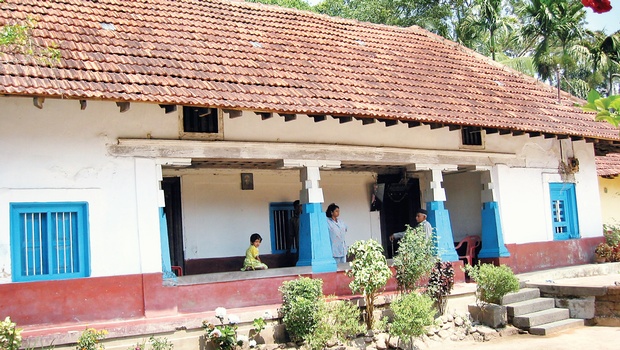
Ain Manes (ain in Coorgie translates to original) are the ancestral heritage homes of the Kodavas that reflect the eminence of a sanctum sanctorum. With quintessential framework, an archetypal heritage home comprises traditionally-carved wooden pillars, bricked white and red walls, intricately-carved wooden doorways and windows. With a typical style, each of them has an unmatched old-world charm.
Every corner of the house is given a name and holds mythical importance. With two types — the othe pore (single roofed house) and mundh mane (courtyard house) — the traditional features of ain manes include kannikamba (a sacrosanct pillar), kayyale (verandah), aimaras (wooden slabs in the verandah), machi (wooden ceiling), mundh (open courtyard) and kannikombre (worship room). Most of the ain manes have kaimadas – a sacred shrine built to worship the ancestors. Since the existence of nuclear families, there were outhouses built around the premises called ale pore.
While the interiors reflect somber and subdued beauty, its exteriors manifest valour and strength. As Chakku Chengappa, a member of Nadikerianda clan, explains, “Hidden and safeguarded amidst the estate were the fort-like structures of ballya mane (ballya means huge); built in this manner to prevent an ambush from enemies. The entrance to the ain mane has many sections. There is a long curvy oni (alley), bakka pare and ala pare (extensions of the alley), which lead to the verandah.”
Nonagenarian Nadikerianda Muthamma adds, “The Kodava women were known to be beautiful, and this is why ain manes needed to be protected at the time of British rule. However, today the ain manes play an important role in reuniting families.”
“Much more than just a roof over the head, ain manes are an important part of the tangible heritage of the native community of Kodagu,” write Boverianda Chinnappa and Nanjamma in their book Ainmanes of Kodagu. Built in the ancestral or the jamma land, the ain mane is a binding force that is a pillar of strength — both literally and figuratively. Many findings state that the inception of the concept of ain mane dates back to eighth century.
The origins
“The early settlers of Kodagu stayed in forests as a family. Due to feudal fights, it was common for people with the same bloodline to stay together in a small thatched hut. These settlements grew in size and became stronger, which made the ruling king seek their support. In return, the king gifted them land, which is the jamma land. As their living conditions improved, they built a strong fort-like structure on the jamma land, which came to be known as ain mane or ballya mane,” explains Boverianda Nanjamma.
However, the architectural style takes its root from Kerala. She adds, “Kodagu grew paddy abundantly but depended largely on Kerala for other commodities. During the travel for exchange of commodities, the Kodavas were pleased by the Kerala architectural style and there flowed workmanship from Kerala to build the ain mane.”
While there are over 900 clans in existence in Kodagu, not all of them have an ain mane. Nanjamma explains, “During the research work for our book, we found out that many deteriorating ain manes were never rebuilt.” According to their findings, only 40% of the ain manes were renovated keeping the tradition intact and the rest did not see the light of the new era.
Today, there are over 400 ain manes in existence and each of them belongs to a patriarchal clan, which is recognised by unique family names known as mane pedas. They bustle with ritualistic celebrations during festivities including Putthari, Kailpodh and annual kola (spirit dance). “The annual hockey matches conducted between families shed light on the revival of ain manes,” opines Kayapanda Shashi Somaiah, a journalist in Kodagu. Nonetheless, the revival of the ain manes are not just a process of renovation of age-old structures but also a resurgence of Kodava culture.
Unity in diversity
The Kundyolanda clan, which has 35 families, has its ain mane in Kolakeri village that was recently renovated to its pre-eminence. The rituals followed in this ain mane are uncompromising and many. “It is a family temple for us. We strictly adhere to the rituals and it is mandatory for women to wear traditional Coorgie saree and vastra (veil) over the head while entering the house. Apart from this, there are various other restrictions followed religiously in the ain mane,” explains Kundyolanda Dinesh, owner of a hotel.
They have a 400-year-old othe pore ain mane with 14 rooms, but there is no one residing here. However, it is made sure that lamps are lit twice a day and the house is maintained meticulously. “Each nuclear family of the clan takes turn to maintain the house and no one can back out from their duties,” he explains.
The Nadikerianda clan, with over 40 families, has a mundh ain mane in Karada village, which bustles with ritualistic activities during the festivals. A diligently maintained heritage home, it reflects the glory of the past and is keeping alive the culture and traditions. A 350-year-old house, it has a kaimada and a snake shrine in its premises. With 10 rooms, it has a beautifully-carved wooden window frame and a small wooden post box at the entrance. The huge mundh open to the skies is supported by four wooden pillars — all carved differently.
The Arapattu Mukkatira clan has their ain mane in Kadanga village. With 13 rooms, the uniqueness of this ain mane is that it has two mundhs and two kayyales. A 300-year-old structure, it is said that the temple treasure from the village Bhagavathi Temple was locked safely in a wooden treasure box kept in the attic of this ain mane. This wooden treasure box still lies in the attic. “We are a clan of 45 families. The age-old rituals are still in practice here. The renovation of the house is soon to take place with help from all the family members,” explains Katty Uthappa, deputy manager of a bank.
The Biddanda family has the ain mane built in the property gifted by King Veeraraja in 1795. With eight partitions in this mundh mane, there is a kaimada close by and the pictures of ancestors of eight generations can be seen hanging on the wall at the entrance. “One of our ancestors, Sarvakayaka Bopanna, was very close to the king. His (Bopanna’s) tombstone is right next to King Veeraraja’s tombstone,” explains Biddanda S Ganapathi, a retired navy officer.
The ain manes are a matter of pride to the Kodavas and are unique to their ethnicity. This uniqueness in architecture has been adopted by many resorts in Kodagu that woo the tourists. However, ain manes do not just demonstrate pride but bespeak culture. They are the souls of Kodava rituals, and their revival provides a surety to Kodavas’ customs and legacy.
source: http://www.deccanherald.com / Deccan Herald / Home> Supplements> Spectrum / Prajna G R / January 24th, 2017
by Mandetira N. Subramani, President, VeKare Ex-Servicemen Trust, MysoreM N Subramani
Most of the Ex-Servicemen of yore, who joined the British Indian Armed Forces during early 1940s, and participated in World War-II, are no more. However, there are still numerous widows of World War-II veterans, around 70 odd years of age, living in Mysore and Kodagu region, who narrate their helplessness and pathetic stories.
It was customary for men of yesteryears to marry a life partner who is younger to them by 10 to 15 years. It is quite but natural that most of such wives become widows and may live for 10 to 15 years, or even longer, after the demise of their husbands. Trends have changed. The present day men don’t mind marrying a life partner elder to him by 3-5 years and the educated ladies consider it as out of fashion and a mismatch to marry men who are 3 or 4 years elder to them.
Reverting to the subject of helplessness of widows of World War-II veterans, a gentleman barged into my office a few days ago with a complaint that his 76-year-old mother, living in a remote village called Kiggal, near Murnad, Kodagu (erstwhile Coorg), is not being granted defence family pension even after a lapse of 12 years after the demise of his father, due to some vague reasons projected by the Army’s EME Record Office, Secunderabad. The hapless widow happened to be one Mrs. Kaveriamma, widow of a World War-II veteran, Naib Subedar Ballachanda Nanjappa Ayyappa.
Mrs. Kaveriamma & late Nb Sub B.N. Ayyappa.
I being not only an Ex-Serviceman myself but also a son of a World War-II veteran who served in the Corps of EME and died unsung and unheard 22 years ago, decided to help the Late Nb Sub Ballachanda N.Ayyappa’s widow Kaveriamma with whatever little bit of knowledge and expertise I had gained during the course of taking up the cause of Ex-Servicemen and widows of Ex-Servicemen since the past 22 years after I quit the Armed Forces.
I believe in “seeing is believing.” Hence, I told late Naib Sub B.N. Ayyappa’s son, Ganapathy, that I wished to see his mother Kaveriamma personally, without doubting his (Ganapathy’s) version of the pathetic story of his mother. Without a second thought, Ganapathy informed me that his 76-year-old mother has been suffering from all sorts of old age ailments and that if I wished to see her, I would have to visit his ancestral Ballachanda House in Kiggal village in Coorg, which is well over 150 kms from Mysore. He also suggested that I could accompany him the following day itself to his village to see his mother. Though there was a clash of opinions between my mind and heart regarding his suggestion, I decided to listen to my heart, which is always weaker than the mind. The widow’s old age and ill health became a priority over my next day’s assignments and engagements all of which I had to abort.
It was indeed a huge expedition on the next day. It took almost nearly three-and-a-half- hours to reach the 100-year-old ancestral house of late Nb Sub Ayyappa in his village, which resembled a bit of British architecture. However, it took me waiting for nearly two hours to get the audience of the grand-old-lady, as she took time to wake up from her sleep, get ready and come out of her bedroom with the support of her son. B.A. Kaveriamma, widow of late Nb Sub B.N. Ayyappa.
During the waiting period, in Kaveriamma’s house, I had to perforce spend my time speaking to an 87-year-grand-old gentleman, who was resting in his easy chair. I was amused when he kept showing extra attention and courtesies to me than what I really deserved. This grand-old-gentleman, however, kept firing some uncomfortable questions to me such as, when did I join the Armed Force? When did I quit? Why did I quit? What was the last rank held by me? What I have been doing after quitting the forces etc… etc… as if I were put in a witness box for some crime committed by joining the Armed Forces! If someone around my age had asked me those questions, I would have blown my trumpet about my life in the Armed Forces, my last rank held as equivalent to one of those one star or two stars rank etc. But, I held back, because, in my subconscious mind I saw something very special in him that made me to tell him only the truth, including the last rank held by me, that is, Sergeant in the Indian Air Force.
While answering all the questions fired at me by this grand-old-gentleman, I was also looking at the walls of the huge verandah to deter him from firing anymore questions. However, I found some old photographs of late Naib Sub Ayyappa’s father, who was a Sub-Inspector of Police during the British regime, hung on the wall. Among the numerable old photographs on the walls, I also noticed a certificate framed and hung in a remote corner, which I could not read because of the size of the certificate, and my failing eye sight. I was compelled to remove the framed certificate and read it just out of curiosity. To my surprise, it was a citation of a gallantry award, that is, “Mention in Dispatches” awarded to Flight Gunner Sgt. Ballachanda N. Medappa.
Ex-Warrant Officer B.N. Medappa, M-In-D
I became very curious and asked Ganapathy as to who this Flight Gunner was ? Ganapathy pointed out at the grand-old- gentleman who was sitting on the same easy chair busy reading a Kannada daily Mysooru Mitra and said, “he is my father Nb Sub Ayyappa’s younger brother Ex-Warrant Officer of the Indian Air Force.” I realised that he is really an ‘Ex-Air Warrior,’ a term commonly referred to all Ex-Air Force personnel of late. I too sometimes proudly call myself as an Ex-Air Warrior to my advantage but it proved to be otherwise all the time with my retired rank ‘Ex-Sergeant.’
In the meantime, the widow of Nb Sub Ayyappa managed to come up to the verandah with the support of her son. As per the customs of the Coorgs’, I touched her feet to seek her blessings, and took a few photographs of her from my worn camera. After speaking to her for a few minutes I casually told her that I would try to resolve her defence family pension issue, at which she nodded her head casually, without any anxiety or hope of receiving it in the near future. I understood that she was fed up of trying for her defence family pension for the past 12 years.
On our way back to Mysore from Coorg after having met the widow, my thoughts were more on the unassuming Ex-Air Warrior I met that day than the problem of the widow of World War- II veteran Ayyappa. I tried to make a guess as to how many such great war heroes were still living or dead, unheard and unsung, among the tiny Kodava Community besides the number of General Officers this tiny Coorg District has produced till date. I even started calling up all my fauji friends, as if there was an impending war.
All armed forces veterans who served three decades ago know that there was a separate Coorg regiment, which largely included people from non-Kodava backgrounds while the Kodavas themselves served in different other regiments; this is in keeping with the Army’s non-bias policy. Field Marshal Kodandera Cariappa of the Rajput regiment and General Kodandera Thimayya of the Kumaon regiment are the most distinguished Army men among the Kodavas. Other illustrious Kodavas from all ranks lead from the front in their own way, not only during wars but also in war-like situations and counter insurgencies.
Lt. Gen. Apparanda Aiyappa is best remembered for his contributions towards the Corps of Signals and towards Bharat Electronics Limited. There were several war heroes as well such as Nadikerianda Bheemaiah, a JCO who was the first among Coorgs to be awarded the Vir Chakra for conspicuous bravery in J&K Operations during 1947, and Air Marshal Cheppudira D. Subia, a daring fighter pilot, was awarded the Vir Chakra during 1950 for his courageous and relentless attacks on the enemy targets which has largely contributed to the successful capture of Garais in Jammu & Kashmir.
Squadron Leader Ajjamada B. Devayya (known as the ‘wings of fire’), a fighter pilot of rare acumen, was awarded the Maha Vir Chakra after the 1965 Indo-Pak War, posthumously. Lt. Col. Ganapathi Puttichanda Somaiah (then known as the ‘Major who kept his cool’) was awarded the Maha Vir Chakra for his conspicuous bravery of fighting against the militants under odd condition while deployed in Sri Lanka as part of Indian Peace Keeping Force.
Lt. Col. Anjaparavanda Ganapathy was decorated with Vir Chakra for his valour during the 1965 war. Maj. Gen. Kuppanda Nanjappa and Colonel Mandettira Ravi were decorated with Vir Chakra for their valiant display of courage and gallantry in the face of the enemy on land during the 1971 Indo-Pak war. Sqn. Ldr. Mandepanda Ganapathy was awarded Vir Chakra for shooting down one of the first Pakistani Sabre Jets, which intruded into Indian air space during the 1971 war.
Wg. Cdr. Ballachanda Karumbaya is another war hero to be decorated with the Vir Chakra for displaying his gallantry in the air during the 1971 war. The youngest among the above said war heroes is the then Capt. Baleyanda M. Cariappa to be decorated with Vir Chakra on 21st June 1999 for displaying repeated acts of valour, bold leadership, unparalleled courage, leading from the front and devotion beyond the call of duty in the face of the enemy.
Kodagu being one of the smallest districts across India, today boasts of the highest density of devoted, daring, dedicated, disciplined and duty-bound gentlemen soldier officers, with many adorning the highest echelons of the defence services in India.
At any given point of time, till 1980, the number of persons serving the forces far exceeded the proportion of any other set of people from any other region in India. The contribution of Coorg to the cause of the nation has been phenomenal and Armed Forces Martyrs from Kodagu District are innumerable.
The appended list of Army General Officers the tiny District of Kodagu [population 5 lakh and population of Kodavas is about 1.3 lakh] has produced over the last 65 years is testimony to the fact that the District is a cradle of mighty Generals:
1. Field Marshal Kodandera M. Cariappa, OBE; 2. General Kodandera S. Thimayya, DSO; 3. Lt. Gen. (Retd.) Apparanda C. Aiyappa PVSM, MBE; 4. Lt. Gen. (Retd.) Biddanda C. Nanda PVSM, AVSM, ADG; 5. Lt. Gen. (Retd.) Codanda N. Somanna PVSM; 6. Lt. Gen. (Retd.) Bittianda K. Bopanna PVSM, AVSM, VSM; 7. Lt. Gen. (Retd.) Ballachanda K. Chengappa; 8. Maj. Gen. (Retd.) Guddanda C. Somanna; 9. Maj. Gen. (Retd.) Kongetira M. Chengappa; 10. Maj. Gen. (Retd) Kotera C. Bheemaiah; 11. Maj. Gen. (Retd.) Codanda K. Karumbaya SM; 12. Maj. Gen. (Retd.) Cheppudira I. Jay Appachu AVSM; 13. Maj. Gen. (Retd.) Somaiyanda K. Kariappa AVSM, YSM; 14. Maj. Gen. (Retd.) Madaiyanda M. Belliappa AVSM, VSM; 15. Maj. Gen. (Retd.) Bovverianda M. Aiyanna; 16. Maj. Gen. (Retd.) Bachamanda A. Cariappa; 17. Maj. Gen. (Retd.) Moovera C. Nanjappa AVSM, VSM; 18. Maj. Gen. (Retd.) Kuppanda P. Nanjappa AVSM, VrC; 19. Maj. Gen. (Retd.) Kelapanda B. Swaraj; 20. Maj. Gen. Kodandera Arjun Muthanna; 21. Maj. Gen. Paruvangada M. Cariappa VSM.
Courtesy: Star of Mysore
source: http://www.exservicemen.in / Ex-servicemen India / Home> India> News> Views, Articles / by M N Subramani / October 19th, 2012
Kodava elders hope the festival of Kailpodh will encourage the community’s youth to enter international sporting events
Image credit: Shawn Sebastian and Tejaswi Dantuluri
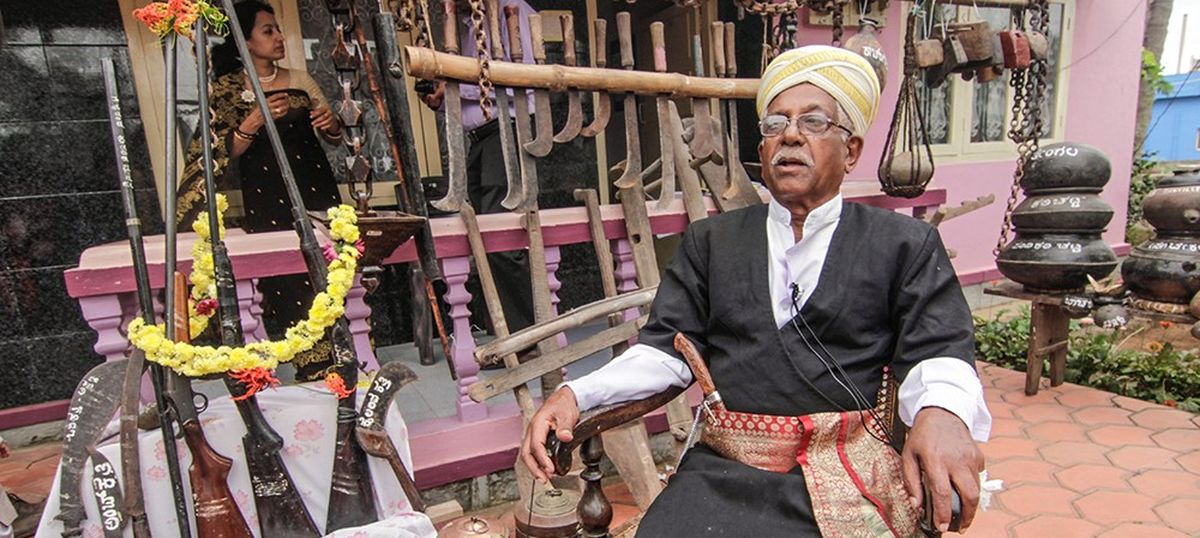
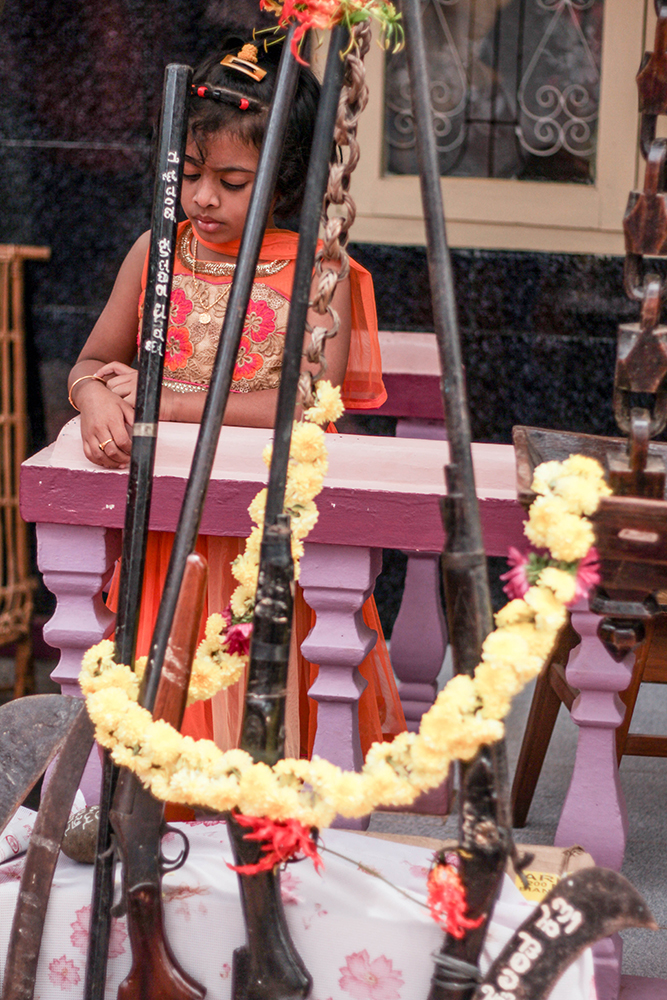
Deep in the sanctum of his 150-year-old ancestral home, Lokesh Achappa is surrounded by weapons. Dressed in a Kupya, the traditional Coorgi outfit of knee-length black overcoat, a gold and maroon sash with an ornate, carved silver dagger tucked in its folds, Achappa prays to an array of weapons: an antique double-barrel, a .22 mm rifle, traditional daggers and swords, all garlanded with flowers and smeared with sandalwood paste.
Once the ritual is complete, he steps out of the house, and a series of thundering gun shots reverberate across the valley.
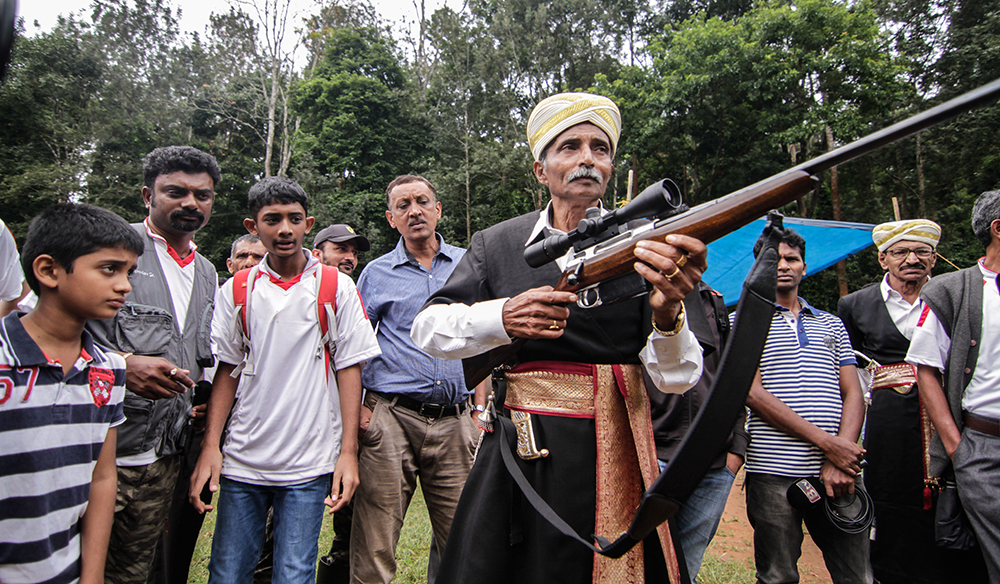
Coorg, a district in Karnataka famous for its coffee, is home to the Kodavas, a martial hill tribe with a population of less than six lakh. Historically, the community has shared a deep connection with its weapons. Valiant guerrilla fighters and agriculturists, the Kodavas once defended territories with locally made bow-and-arrows. With the advent of firearms, guns became central to Kondava life. Weapons appear frequently in important social customs: births and deaths in the Kodava tribe are announced with gunfire, every newborn touches a bow and arrow, as initiation into the tribe. At the annual harvest festival of Puttari, one of the most important events on the Kodavas festival calendar, everyone in the valley opens fire.
Weapons are also celebrated at Kailpodh, the annual Kodavas (or Coorgi) festival in the first week of September which marks the end of hardships for the agrarian community – once the paddy has been transplanted. During the festival, Kodavas clean and worship weapons to express their gratitude for the protection they have offered.
“The period is a time for jubilation when distant families get together,” local resident Ashik Appanna explained.
Image credit: Shawn Sebastian and Tejaswi Dantuluri
With the tightening of gun regulation laws, the ban on hunting, and due to large-scale migration of younger generation Coorgis, many have predicted that the Kodava weapon culture will disappear altogether. Elders of the Kodava community are hoping that festivals like Kailpodh will encourage young Kodavas to return to their traditional shooting skills.
Gun Rights and Regulations
In 1861, the British administrators granted Kodavas an exemption from the Arms Act, for their support to the East India Company in administrative and military affairs.
“Gun ownership is a birthright for us,” said Appanna Bacharinanyanda, an 80-year-old retired lecturer who exhibits antique Kodava weapons and utensils in his front yard every Kailpodh.
Bacharinanyanda says the Kodavas never “misuse” guns. He expresses a deep apprehension over the government’s attempts at over-regulating weapons: “These days authorities have started demanding bribes to grant us the exemption certificate, which is completely unacceptable.”
With the Wildlife Protection Act of 1971, hunting has been prohibited in India. The legislation came as a big blow to the Kodavas, for whom hunting was an integral part of life and survival.
Naveen Bidappa, a young Kodava lawyer, pointed to a photograph in his house of a man named Tiger Thimmaiah. In the picture, Thimmaiah stood next to a tiger he had killed and then tied to a tree.
“He shot 12 tigers, hence the name,” smiled Bidappa.
Since tigers posed the biggest menace for livestock, tiger hunters were once highly venerated figures in the Kodavas society.
“Narimangala (tiger-marriage) was a big tradition in the olden days,” he said. “The tiger hunter was married to the tiger he killed, and villagers would offer them gifts and cash as a mark of respect.”
Changing relevance of gun culture
In early September, scores of Kodava youth assembled at a school ground at the Coorgi village of Chettali. Each carried a gun.
Bidappa, a 70-year-old elder from the community, walked into the ground filled with curious onlookers, and shot a coconut hung several yards away to inaugurate the annual shooting competition that coincides with Kailpodh. He hit the bulls-eye with a single shot.
“Shooting skills are in our blood,” he said, shrugging at the crowd’s deafening cheers.
Over the last few years, shooting competitions that were once limited to households have turned into larger events, with an increasing number of shooting enthusiasts showing up from all over Coorg.
“Our aim is to prepare and pass down shooting skills to the younger generation,” Bidappa said.
Over the next five years, local shooting competition organisers plan to develop a shooting range in the village to groom young shooters, and train them for national shooting competitions.
“Festivals such as Kailpodh have found a new meaning in changing circumstances,” he said.
A Kodava shooting competition. Credit: Shawn Sebastian and Tejasvi Dantuluri
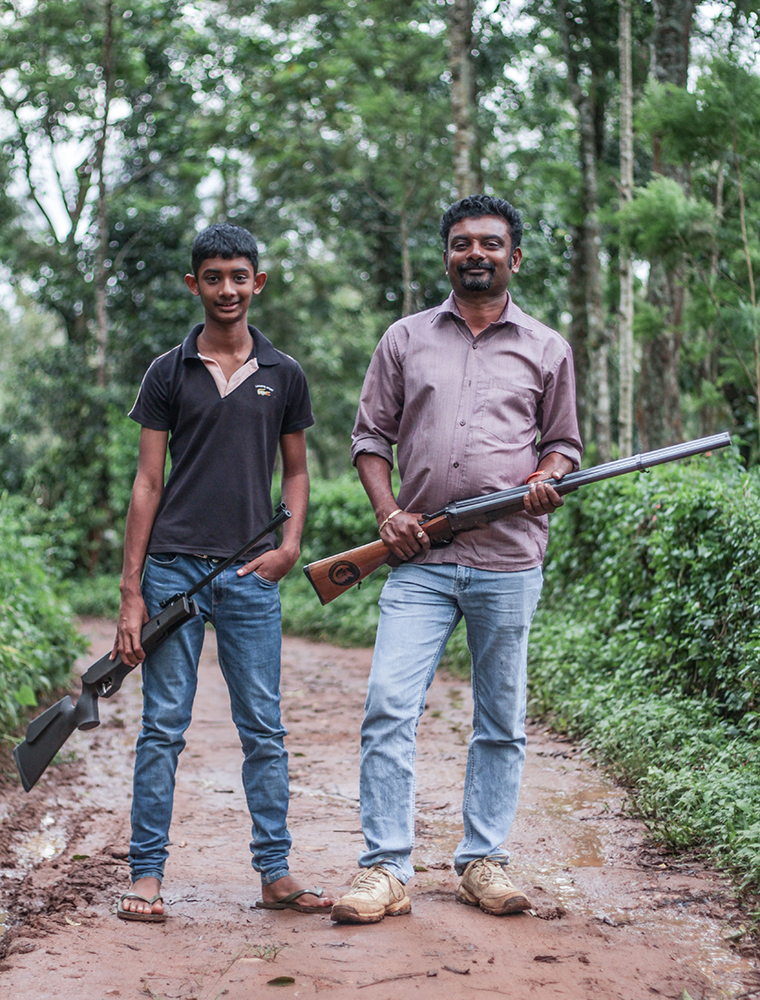
Fifteen-year-old Lakshan Ayyappa is a widely recognised face at Kodavas shooting competitions. He is the great-grandson of Tiger Thimmaiah, but has also established himself as an ace shooter in his own right – he has won more local competition prizes than he can remember.
“My target is to make it for 2020 Tokyo Olympics,” he said. Ayyappa first learnt to shoot at the age of five. He was taught by his mother.
“Whenever I see a new gun, I discuss it with my dad,” he said. “I know everything about its make, calibre, range, the cartridges used. I feel by the time we are born, we are already half trained.”
Like in Punjab, it is usual for Kodava households to send a member of their family to join the military. Many attribute this to early affinity Kodava youngsters develop with weapons.
Credit: Shawn Sebastian and Tejasvi Dantuluri
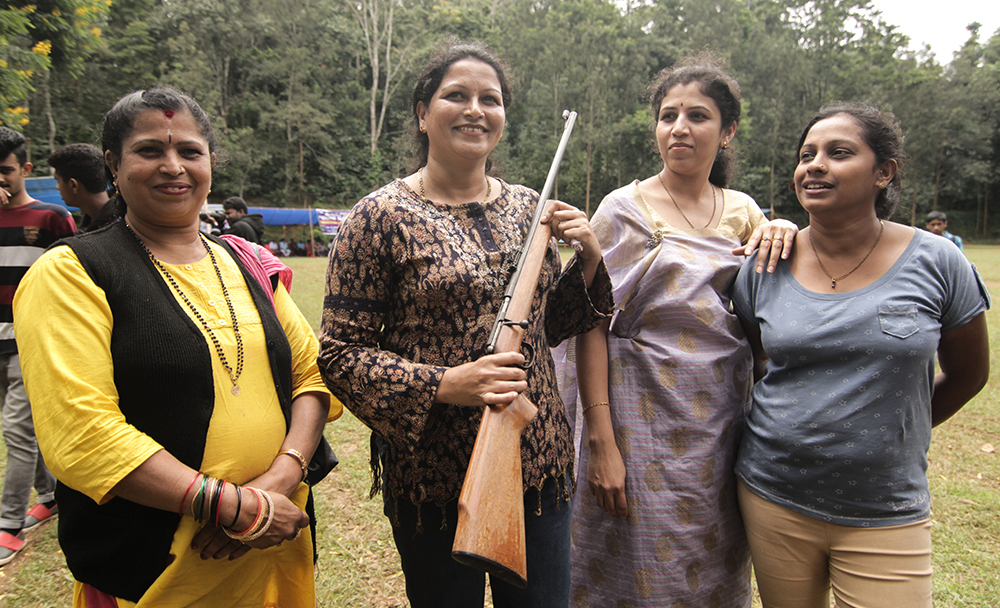
Shooting is not a male sport in the Kodavas tribe. Kodava women traditionally kept guns to protect their families when the men left for hunting and battle. Everyone from septuagenarian grandmothers to 16-year-old girls participate in local shooting competitions.
Credit: Shawn Sebastian and Tejasvi Dantuluri
Shooting is not a male sport in the Kodavas tribe. Kodava women traditionally kept guns to protect their families when the men left for hunting and battle. Everyone from septuagenarian grandmothers to 16-year-old girls participate in local shooting competitions.
Credit: Shawn Sebastian and Tejasvi Dantuluri
Several modern-day sports like shooting and archery have been born of indigenous communities across the world. In India, the attempts at unearthing such indigenous talents have been poor.
A few notable exceptions are people like Laxmirani Manji, from the Santhal tribe in Jharkhand who represented India in archery at the 2016 Rio Olymipcs, and Limba Ram of Ahari tribe in Rajasthan, an Arjuna awardee archer who represented India at three Olympics. If they are given enough support and attention, many modern-day Tiger Thimmaiahs might emerge from Coorg.
We welcome your comments at letters@scroll.in.
source: http://www.scroll.in / Scroll.in / Home> Magazine> After the News / Point & Shoot
As the martial Kodava race gets together to celebrate the annual harvest festival, Puthari, on Tuesday in their homeland Kodagu, they have reason to feel optimistic about their future.
The Karnataka government has initiated an ethnographic and socio-economic survey to see whether the community qualifies for the tribal status. It’s the second time the survey has been taken up, a response to the alarming decline in population.
“Our department has been doing the survey for the past two weeks. Apparently, the culture and traditions of the Kodavas are akin to tribals but the government cannot grant them the status unless the survey establishes it,” said P Manivannan, secretary, social welfare department.
The Centre has also considered a long-pending demand to include Kodava thakk, the Kodava language without a script, in the Eighth Schedule of the Constitution and a notification has been issued to initiate the process.
In 2011, the UPA government directed the then BJP government to take up the survey following petitions by the Codava National Council (CNC), which has been spearheading the community’s cause. It was put on the backburner for political reasons.
AICC general secretary Oscar Fernandes, along with Brijesh Kalappa, legal adviser to the Karnataka state government, recently impressed upon chief minister Siddaramaiah to order the survey to protect the race.
“Our community is dwindling in numbers very fast for many economic and sociological reasons. The population of Kodagu district is around 5 lakhs, of which Kodavas are not more than 65,000. There is an urgent need to sustain the Kodava genus constitutionally under Articles 340 and 342 of the Constitution that provide for recognizing ethno-linguistic tribal minority nationality,” CNC president N U Nachappa said.
Kalappa said: “When the last survey was taken up around two decades ago, many Kodava leaders, including prominent political leaders, had opposed it because they felt it was demeaning for the race, renowned for gallantry and sportsmanship. But now there is a sense of awareness among the community because they’ve realized it’s inevitable.”
The survey report will be given to the government by early next year and the Centre will take a final call based on the recommendations.
Earlier Kodavas were seen in large numbers in civil services, police and other government jobs but their numbers have dwindled owing to lack of reservation. Though they have been granted Other Backward Classes (OBC) status in the reservation schedule of the state government for jobs and higher education, Kalappa said his community has not gained much since they have to compete with the politically powerful Vokkaliga community that they share under 3A category.
Will Kodavas qualify?
Some anthropologists said Kodavas, as a race, are progressive and different from other tribes. “They cannot be compared to tribes like Bedar, Hakki-Pikki and Kadu Kuruba, among others,” said A K Ravesh, a researcher studying socio-cultural anthropology in Kodagu. The Kodava marriage and funeral rituals, among other things, portray a distinctive culture. A former minister also felt that Kodavas will not gain much if they are granted tribal status since the combined reservation for all STs is just 3% compared to 4% under OBC offered by the state government.
Scheduled Tribe tag
The Constitution does not provide a definition of a Scheduled Tribe. Artice 366 (25) mentions “such tribes or tribal communities or parts of or groups within such tribes or tribal communities as are deemed under Article 342 to be Scheduled Tribes…” According to the website of the Union ministry of tribal affairs: “The criterion followed for specification of a community as Scheduled Tribes are indications of primitive traits, distinctive culture, geographical isolation, shyness of contact with the community at large, and backwardness”.
source: http://www.timesofindia.indiatimes.com / The Times of India / Home> City News> Bangalore News / TNN / December 13th, 2016
The Kodavas hail from Kodagu district, which was merged with Karnataka in 1956.
Till then, Kodagu was a ‘C’ category State, and was administrated by the Central government.
Later, as Kodavas migrated to urban centres such as Bangalore, they formed an association to preserve their culture and traditions, which are unique.
The Bangalore Kodava Samaja is one such organisation, formed to safeguard Kodava identity. The Samaja is all set to celebrate its centenary year, come November 11.
The Samaja has its roots in an organisation called ‘Kodagu Sangha’ which was formed in 1911 with 30 members, part of eight Kodava families in the City. The Sangha was rechristened Kodava Samaja in 1962.
Mysore King Jayachamarajendra Wodeyar is said to have gifted an acre of land at Vasanthnagar, near Palace Grounds to the country’s first Field Marshal K M Cariappa in 1960. The Field Marshal donated the land to Kodagu Sangha which was headed by the IGP of the then Mysore State, Rao Bahadur Pemmanda K Monnappa.
A small ‘Samudaya Bhavan’ was constructed between 1962 and 1966. It was in 1975 that a commercial complex was built in the premises. In 1986, a sports and recreation club was constructed. Much later, in 1993-95, the old Samudaya Bhavan was demolished and a new auditorium was constructed at a cost of Rs one crore.
Today’s Kodava Samaja has a Field Marshal K M Cariappa Bhavan, a General K S Thimmayya Bhavan, Haridasa Appaccha Kavi auditorium, Cauvery Hall and a roof garden.
The Kodava Samaja celebrated its platinum jubilee in 1986. In 2007, the Samaja celebrated the silver jubilee of Cauvery school. The sports and recreation club organised a State-level hockey tournament. The Samaja also organised many Kodava festivals.
Contribution to education
In 1981, the Cauvery school was established in Indiranagar in the land donated to the Samaja by the then chief minister R Gundu Rao. In 1996, Pre-University and undergraduate courses were also introduced.
A management college was also established in HAL II Stage. Bangalore has over 40,000 Kodavas. As many as 12,000 of them are members of Kodava Samaja. The centenary celebrations will be held at Palace Grounds between November 11 and 13. Scion of the Wodeyar family, Srikantadatta Wodeyar, will be the chief guest on November 12.
source: http://www.deccanherald.com / Deccan Herald / Home> Supplements> Spectrum / by K M Ashok Kumar / November 07th, 2011
In the northern part of the Mahadevpet quarter of Madikeri town lies a royal graveyard, unbeknownst to many. Gaddige is a set of three regal mausoleums built in the Indo-Saracenic style and enclosed within a compound. Upon each of these rectangular structures is a large dome and four turrets. Two kings of Kodagu (Dodda Vira Rajendra and Linga Rajendra) and their queens lay buried in the two larger identical structures and a third smaller one has the remains of the chief preceptor (Rudrappa) of the kings.
Beside these three tombs, at a little distance away but within the same enclosure, are the tombs of a father-son duo Biddanda Bopanna (Bopu) (1769-1807) and Biddanda Somayya (1800-1879). They had served Kodagu and its kings as sarva-karyakaras, or army generals. While Bopu was the general under Dodda Vira Rajendra (1789-1809), Somayya was the general under Chikka Vira Rajendra (1820-1834). Both tombs have the statue of a Nandi upon it.
Under the Kodagu kings, jamma ryots (farmers by inheritance) held their farmlands by military tenure. The word jamma came from the Sanskrit word for birth, janma. Every able-bodied male jamma ryot had to compulsorily serve in the king’s army. Known as chaudigaras, they worked for 15 days at a time. Around 10 to 100 soldiers served under an army chieftain called the jamedar and a number of jamedars served under an army officer called karyakara. The karyakaras worked under a sarva-karyakaras, or the general. The karyakaras and the sarva-karyakara wore a kombu toppi, a gold zari-bordered red turban with a kombu (horned emblem) in front.
A Kannada inscription states that Biddanda Bopu of Bavali village entered the Raja’s service through palace duties on the fifth day of the new moon of Magha month in the Keelaka year (1788). He worked for 19 years until the year Prabhava, bravely risking his life while fighting wars against Tipu Sultan of Mysore and hunting elephants, tigers and other wild animals, to ultimately become a sarva-karyakara. The Biddanda family originated in Kokeri village in Kodagu nearly three centuries ago. In this Kokeri house lived brothers Medappa and Poonacha. Medappa was a member of the local village panchayat and he married Chaniyapanda Subbavva in 1768. They had a son Bopu, who was born in 1769 on what was deemed to be an inauspicious day by the panchayat members. It was decreed that the son’s face was not to be seen by the father and that the mother was not to be allowed into the house. Hence, the mother and the son lived with the maternal family in Podavada village.
Chronicles of the pastUnfortunately, after some time, both Medappa and Subbavva passed away. The orphaned boy was then brought to the Kokeri Biddanda house by his uncle Poonacha. In 1788, at the age of 19, Bopu joined the king’s army. He worked hard and rose through the ranks to become a karyakara. Poonacha and his wife passed away and their two daughters were married into other families. In 1795, the king transferred Poonacha’s property, which was called ‘Mookanda Bane’ (pasture), to Bopu and his paternal relatives for the military services they had rendered.
Bopu moved from Kokeri to Bavali where he built a ‘Nalkett Mundmane’ — a traditional country house (mane) with four blocks (nalkett) built around an open central courtyard (mund). This became the ‘Biddanda Ainmane’, or ancestral home, in Bavali. One can find description of many events pertaining to Karyakara Biddanda Bopu in Reverend Hermann Moegling’s Coorg Memoirs.
In 1799, the Fourth Anglo-Mysore War broke out between Tipu Sultan and the British. When the British laid siege upon Srirangapatna, the erstwhile capital of Mysore kingdom, Dodda Vira Rajendra sent his treasurer Karnika Subbayya and his officer Karyakara Bopu to invade the Tulu region, which was then a part of the Mysore State. Bopu led the Kodagu army and defeated Sadri Behari and Mir Mohammed who held the Kodial (Mangalore) district. Soon, Kodagu occupied Mangalore, Barkur, Bantwal, Bellare, Viragamba, Udiavara and other regions. Karnika Subbayya came to hold and govern Kodial at that time.
Eventually, news came from Srirangapatna that Tipu Sultan was killed and that Mysore was taken over by the British. Later, Kodagu was made to evacuate the Tulu region and return it to Mysore. Karyakara Bopu was later made the sarva-karyakara of Kodagu. Biddanda Somayya was born in the year Roudri (1800) to Bopu and his wife Mayavva. Bopu died in 1807 at the young age of 38 years. In commemoration of his remarkable army tenure, the king of Kodagu ordered that Bopu be entombed near the royal tombs of Gaddige.
Somayya joined the Raja’s army in 1821. Like his father, he rose through the ranks to become a sarva-karyakara. In 1834, Kodagu got into a conflict with the British. Under him, the Kodagu army was able to inflict damage upon the British army initially. But Chikka Vira Rajendra, the last king of Kodagu, chose to surrender to the British. He was then exiled and the British took over Kodagu.
In those days, the British decreed that all the native officers would be retained in service. But Sarva-karyakara Somayya refused to be in the service of the new government and thus, retired early instead. After his retirement, Somayya lived in the Bavali Biddanda Ainmane and got involved in farming. But he did have one last wish. After his death, he wanted to be buried beside his father and before the rajas of Kodagu. The British allowed this and refused to have anybody else, including any surviving relatives of the rajas, to be buried in the Gaddige area. Somayya died on August 16, 1879. His tomb was erected in Gaddige with the permission of the Chief Commissioner of Coorg. There is a separate graveyard for other members of the Biddanda family in Bavali as well. While the tombs lie neglected today, their history and significance continue to throw light on the history of our people.
source: http://www.deccanherald.com / Deccan Herald / Home> Supplements> Spectrum / By Mookanda Kushalappa / November 08th, 2016
In the hills of Coorg in Karnataka lies Madikeri, the town that gives a military feel & charms with its orderliness
Where order prevails: View from the Raja’s Seat garden; The church in the Fort, now an ASI Museum; Two of the Royal Tombs; The Sri Omkaresvara Siva Temple Photos by the writers
Hugh and Colleen Gantzer
At first glance, Madikeri looks as precise and orderly as a cantonment. In a way, that’s what it is. According to a coffee-planter, “If you throw a stone in Madikeri, you’ll hit a General. If you throw two stones, you’ll probably get a brace of Colonels, bristly moustaches and all!” This could account for the military look of this cottage-dotted town in the hills of Coorg in Karnataka. Madikeri’s narrow, winding roads were meant for brisk walkers and horses. We felt this when we drove through the town to the Palace Fort.
It certainly is a Fort, with thick walls and deep gates. At the far end of its grounds, next to two enormous effigies of elephants is a board that proclaims:
“Mercara was founded by Prince Mudduraja of the Haleri dynasty in 1681 and named after him as Muddurajanakeri. This later became Madikeri by the locals. The British called it Mercara.”
At one corner is a steepled building, now a museum with hero-stones standing erect in the yard. We walked across this former Anglican Church. The light streaming in through its beautiful stained glass windows added to its meditative ambience, ideal for a museum. And, in a fitting tribute to India’s revered Field Marshal Cariappa, the former little vestry had been dedicated to the memory of this unforgettable army chief. He was a Coorgi, a Kodava.
From such shrines to the past, we drove down into town and parked at the gate of a living shrine: the impressive Sri Omkaresvara Temple.
Officially this is a Siva temple of the Lingayats but there are distinctly Islamic idioms in its eclectic architecture. It has a central dome with minarets at the four corners, surmounted by their own, smaller, domes. It is possible that the influence of Tipu Sultan had a lasting impact on the architects of this temple. It was built by Lingaraja II in 1820, just 21 years after Tipu Sultan died in Srirangapatna. We saw the Islamic influence even in other Lingayat monuments crowning a green hill referred to as Gaddige. A plaque installed at the foot of one of the plinths read ‘Royal Tombs’. Built in the Indo-Sarcenic (sic!) style, these monuments with domes and minarets, hold the mortal remains of Kodava Royalty and court dignitaries.
The central tomb is of Dodaveerarajendra and his queen. To the right is the tomb of Lingarajendra built by his son Chikkaveerarajendra in AD 1820. To the left is the tomb of the royal priest Rudrappa, built in 1834.
Nearby are buried two royal officials, Biddanda Bopu, who died fighting Tipu Sultan, and his son Biddanda Somaieh. Clearly these warrior people opposed anyone who tried to cub their freedom to decide their own future.
Our immediate future, however, was constrained by the weather. We looked up at the roiling clouds above us. These were threatening but it hadn’t rained. We decided to rush down to Abbi Falls before a storm boxed us in.
Abbi was spectacular. Even though the water was not gushing in its roaring monsoon fury. it foamed and cascaded over rocks, frothing and surging before pouring into a large pool, and then flowing under a suspension bridge. The falls are well worth visiting but do treat that forest path with a great deal of respect.
It was almost sunset when we reached Raja’s Seat, a popular public garden with horizon-stretching views of the plains. Had the ancestors of the Coorgis battled across those lowlands? We began to think about the origin of the Kodavas.
Their traditional masculine dress of a turban, long coat, sash and curved dagger points strongly to a Middle Eastern connection. The Kodavas have no temples or pujaris, they conduct all their religious or social ceremonies themselves, and revere their ancestors. The Kurds of the Zagros and Taurus mountains of Turkey, Iran and Iraq are also known for their proud and independent nature. Were they the ancestors of the Kodavas? ‘Kurd’ and ‘Kodava’ have a certain similar ring. A popular theory claims that they are the descendants of people who were part of the army of Alexander the Great.
That could explain the very no-nonsense character of their mountain home, Madikeri.
source: http://www.tribuneindia.com / The Tribune / Home> Spectrum> Travel / October 23rd, 2016
An 81-year-old statistician in the city, along with her husband, is on a mission to preserve, protect and promote the Kodava culture. The Kodavas are an ethno-lingual community from Kodagu.
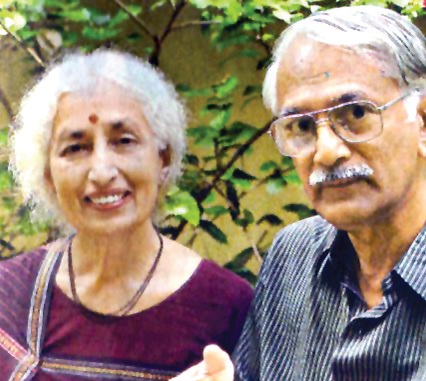
“As we went around Kodagu, we noticed many homes in a dilapidated situation and thought why not document this important element of our tradition to help preserve them,” says Nanjamma Chinnappa, who travels with her husband Boverianda Chinnappa, 82, for the project.
This extensive field work saw them cover around 434 ainmanes (traditional houses) of the Kodavas besides around 250 of 15 other communities like the Goudas, Heggades and Gollas, which account for about 40% of the ainmanes that once stood.
Ainmanes are the ancestral homes of the native communities in Kodagu, with unique architectural styles.
“Our criteria in considering a house as an ainmane was that it should have a traditional structure and be functional. Functional in the sense that it should be where the family members continue to come together for festivals like annual offerings to ancestors, ‘Puthari’, ‘Kail Poldu’ and ‘Kaveri Changrandi,'” the Coorg Person of the Year – 2006 explains.
Nanjamma has a Masters degree in Statistics from the Madras University and a post-graduate degree in Statistics from the Indian Statistical Institute, Kolkata. She was a visiting fellow at the University of Cambridge, England.
After 20 years of service in the Canadian Federal Department of Statistics, she retired in 1995 as the Senior Statistical Advisor.
Her husband, a mechanical engineer, was working as a consultant in Canada.
Nanjamma and Chinnappa moved to their native Kodagu after retirement and translated their grandfather Nadikerianda Chinnappa’s book, Pattole Palame into English. Pattole Palame includes the customs, traditions and folk songs of the Kodavas. Their translation was published in 2003.
“Our grandfather in the 1920’s sensed the impact of English would lead to Kodavas forgetting our traditional folk songs. So, he decided to translate them into English for the benefit of the coming generations,” says Nanjamma.
Nadikerianda passed away before he could finish the translation work, which is when the couple took over the project.
Their translation, was the fruit of nearly eight years of work, consulting elders and singers of folk-songs in many parts of Kodagu.
It was this field experience that prompted Nanjamma and Chinnappa to work on their second book Ainmanes of Kodagu.
The publishing of the book also led the Kodava duo to moot the idea of starting a website – www.ainmanes.com.
The objective of the website is to document the current status of the traditional ainmanés of all the communities in Kodagu and thereby contribute to the archival records of the heritage and oral history of the people.
“We realised that it is extremely difficult to document information and the photographs of all the ainmanes in a book. We wanted this work to be available to the people in our lifetime,” adds the 81 year-old statistician.
The Chinnappas have had a great response to their efforts on the website. “At least 40-50 people have personally written to us appreciating our work,” say the researcher-couple.
source: http://www.newindianexpress.com / The New Indian Express / Home> Cities> Bengaluru / by Jijo Jose / August 30th, 2016
3000-yr-old site discovered during temple renovation.
The megalithic site was discovered by chance during the renovation of the Sri Manjunatha Temple at Siddalingapura-Arasinakuppe.
Mangaluru:
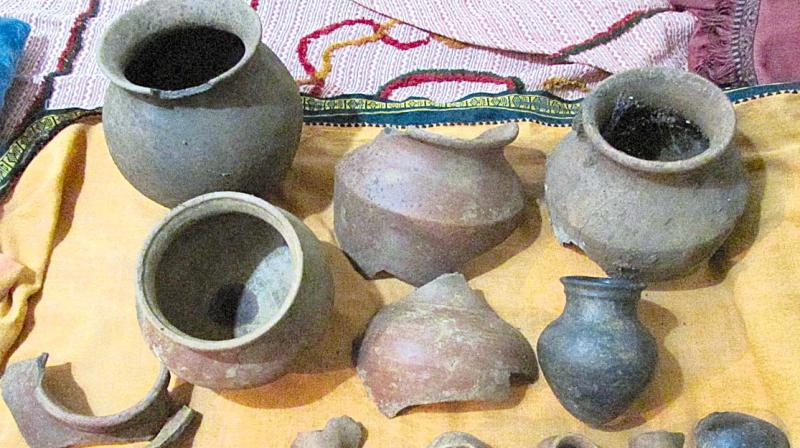
A megalithic burial site comprising a Menhir, and a complex of dolmens with unique pottery, possibly dating back to around 3,000 years, has been discovered near the Cauvery river at Siddalingapura- Arasinakuppe in Kodagu.
While a dolmen is a square stone structure with primary or secondary bone remains and pottery covered by a mega capstone, a Menhir is a large upright undressed stone standing on or near the burial site.
The megalithic site was discovered by chance during the renovation of the Sri Manjunatha Temple at Siddalingapura-Arasinakuppe, while land was being levelled behind it. A more detailed inspection was carried out by a team from the Department of Ancient History and Archaeology, MSRS College, headed by department head, T Murugeshi.
“We found a complex of dolmens buried in the soil with each having its own stone circle. There could be hundreds of dolmens. One has been damaged and is being used as a dumpyard,” Prof Murugeshi told Deccan Chronicle. The Menhir, which is 3.15 meters tall and one meter wide, is reportedly the tallest found in the region.
“This is clearly a megalithic site. But more excavation is needed to clearly understand the things found here. The pyriform black jar found here is a rare one. Such jars were used to bury the remains of the head of a community, a priest or some important person at the time,” the professor explained.
The department of Ancient History and Archaeology at the college intends to excavate the site.
source: http://www.deccanchronicle.com / Deccan Chronicle / Home> Nation- In other news / by Gururaj A Paniyadi / August 17th, 2016
WELCOME. If you like what you see "SUBSCRIBE via EMAIL" to receive FREE regular UPDATES.
Read More »