Category Archives: Historical Links / Pre-Independence

Pioneering steps

Perceptive vision Kodagina Gouramma

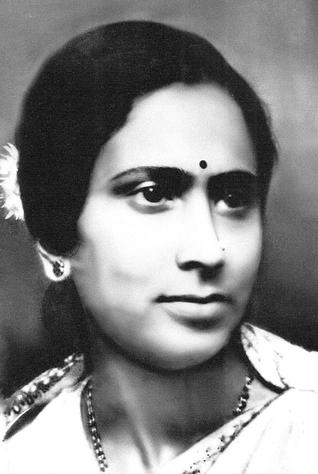
Kodagina Gowramma was a significant writer with a modern and progressive vision. As we remember this writer on her 100th birth anniversary, it is with pride that we recall her efforts to forge a meaningful artistic destiny for herself

It is hard to believe that one hundred years have passed since the birth of Kodagina Gowramma, that is Ms. B.T.G. Krishna (1912-1939). The remarkable woman, who was all of 27, when she passed away, grappled with the issues of modernity that are relevant even today. She could empathise with the angst of the individual, while probing deeply into the socio-political aetiology of the same. She represents the positive effects of the much denigrated western education system. The fact that she lived in Coorg which was relatively free from the shackles of Indian orthodoxy must have abetted her intellectual development and social attitudes. Her ideology was truly feminist, at a time when feminism was in its infancy even in the West.

Gowramma, has two collections of short stories to her credit, “Kambani” (Tears) and “Chiguru” (Blossoms), both of which were published posthumously. The response of her contemporary writers and literary critics was appropriately laden with emotion and appreciation, even though she did not get the critical and analytical tributes that were rightfully due to her. This fact is exemplified in the elegiac poem composed by Bendre, one of the foremost poets of Kannada. A pen portrait by Da. Baa. Kulkarni, who had fraternal feelings for Gowramma, was more about her persona than her work. Gowramma refers to such writings as “hollow compassion”. Gowramma was truly a product of the turbulent times that she lived in. She studied in a convent, played tennis and indulged in swimming even after her wedding, learnt Hindi in a remote town, corresponded with the important writers of her times, women as well as men, and she was deeply influenced by the independence movement. She went to the extent of inviting Mahatma Gandhi to her place and donated all her ornaments. Actually, she was much more emancipated than most of the characters that inhabit her stories. This, however, did not transform her into a firebrand revolutionary, out of tune with the ground realities of her times.

Her oeuvre is more concerned with the unsaid and unattainable, rather than idealistic portrayals. Hers was a nascent universe that contained the seeds of change, which later sprouted in the novels of Triveni, decades later. Most of her stories deal with the problems faced by young women on the verge of marriage or in the immediate aftermath of that event which is often cataclysmic for many of them. Any act of rebellion or protest results in tragic consequences.

However, the author succeeds in puncturing the male ego and creating a sense of guilt. Her stories transgress the boundaries of caste and religion and cast aspersions on the fundamentalist agenda as early as the first few decades of the previous century. The story “Aparaadhi Yaaru” (Who is the criminal) which delineates the angst of a young woman ostracised by the orthodox Hindu society and saved by a Muslim girl and her family, concludes with a newspaper report: “The fact that a Hindu woman has embraced Islam, has caused lots of anguish to the Hindus of the town. A meeting of the prominent Hindus of the town, presided over by Mr. Nagesha Rao, has resolved to take care, that such an event does not recur .” The ultimate irony is that it was this Nagesha Rao, who seduced Parvathi the protagonist of the story and drove her to the brink of suicide before she was saved.

Stories such as “Vaaniya Samasye”, “Aahuthi”, “Manuvina Raani” et al, focus on similar problems and try to offer solutions that are modern and progressive. The author is aware of the fact that some of them may be impractical for her own times, and does not shy away from portraying the aredevilry of her characters.

Gowramma displays excellent control over the modes of narration. She adopts many techniques such as narrating a story through letters, non-linear structuring of events, a balanced outlook which does not indulge in brash criticism of men and a keen interest in facets of life other than the plight of women. Her style is neither verbose nor unduly sentimental. She does not indulge in overt philosophising even though her stories are illuminated by a progressive social vision. Kannada writer Vaidehi, takes cognition of Gowramma’s balanced worldview and the multiple ways in which her artistic vision combines with emotional and the intellectual, in a perceptive preface that she has written for the volume of Gowramma’s stories in Mareyalagada Kathegalu series..

These stories are more enduring than the fiction of some of her senior, male contemporaries. Her world is peopled by young adolescent girls who are enraptured in their dreams as manifest in their innocent prattle which is often shattered by harsh realities. Gowramma is relevant by the intrinsic merits of her stories rather than their historical significance. Of course, the latter is undisputed. A competent translation of these stories into English and other Indian languages would be a fitting tribute to this great writer who transcended the constraints of her context and forged a meaningful artistic destiny for herself.

source: http://www.thehindu.com / The Hindu / Home> Books / by H.S.Raghavendra Rao / March 01st, 2012
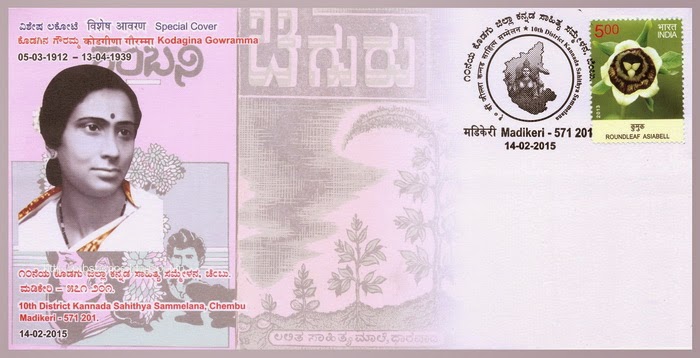
Kodagina Gowramma

A special cover was released on Kodagina Gowramma on 14th February 2015 at the 10th District Kannada Sahithya Sammelana at Chembu, Madikeri.

Born on 5th March 1912, was a social worker and disciple of Mahatma Gandhi.

PhilatelyKodaginaGowrammaKF26jul2016

Cover Code: KTK/27/2015
Courtesy: Suresh Rao, Bengaluru.

source: http://www.mbstamps.blogspot.in / MB’s Stamps of India / March 21st, 2015

The roots of Kannada in Kodagu…

KannadaKodaguKF26jul2016

The coffee land is all set to witness the 80th Kannada literary meet scheduled to begin on January 7, after a long gap of 32 years. Earlier, Madikeri has witnessed two literary meets – the 18th literary meet in 1932 under the leadership of D V Gundappa and the 54th literary meet in 1982 under the leadership of Dr Shambha Joshi.

Interestingly, despite being one of the smallest districts in Karnataka, it has a wide variety of culture as well as languages that include Kodava, Arebashe Gowda and Malayalam, yet the region has managed to retain the flavour of State language.

If one goes down the pages of history, the little district with unique weather and culture has contributed immensely for the development of Kannada language. The Ganga – Kongwala – Hoysala and Haleri dynasties, perhaps laid the strong foundation for Kannada through inscriptions way back in the 9th century. In the 10th century, Nagaverma had created ‘Chandombudi’ and ‘Punyashrava,’ according to the reference available at ‘Kodagu Sahithya – Sanskrithi Darshana,’ published by Kodagu District Kannada Sahithya Parishat.

During the Chengalva dynasty, the third Mangarasa had published ‘Jayanrupa Kavya’ and ‘Samyukta Kaumudi’ (1508), while his cousin Nanjunda had written ‘Kumara Ramana Kathe.’

There are documents to prove that the first epic ‘Rama Vijaya Kavya’ was written by Devappa, a Jain poet in 1540. Similarly, Dodda Veera Rajendra, who ruled Kodagu between 1789 and 1809, has the credit of documenting history titled ‘Rajendra Name’ in Kannada. The II Linga Rajendra, who ruled Kodagu between 1810 and 1820 had written a book pertaining to land in Kodagu entitled ‘Lingarajana Shisthu.’

The 19th century

The leading name of 19th century pertaining to literature is that of Panje Mangesh Rao, who served as a teacher in Kodagu in 1920s. He had penned poems pertaining to Hutthari festivities among other literary works. In fact, he was the president of All India Kannada literary meet held in Raichur in 1934.

Haradasa Appacchha Kavi, popularly known as the Adi Kavi of Kodagu had penned many plays including ‘Savithri,’ ‘Yayathi,’ ‘Kaveri’ and ‘Subramanya’ in Kodava language. The same were translated to Kannada language by Dr I M Muttanna, who also hailed from Kodagu.

Kodagina Gowramma

The first woman story writer in Kannada literary field, Gowramma, hailed from Kodagu and she is known as ‘Kodagina Gowramma.’ Born in Madikeri in 1912, she did her early schooling in Madikeri and married to B T Gopalakrishna in 1928.

From 1931, she wrote a number of articles and stories in the name of ‘Mrs G T G Krishna’. Most of her stories were based on the theme of women’s problems. However, she passed away in 1940 when she was just 28 years old. When Mahathma Gandiji arrived at Kodagu, she had invited Gandhiji to her home and she had donated her jewellery for the cause of freedom.

Bharathisutha

A teacher by profession, ‘Bharathisutha’ was the pen name of S R Narayana Rao. Based on the life story of Kodagu ruler Siribai Dodda Veerappa, he had written ‘Huliya Haalina Mevu,’ which was later made into a film by the same name.

His other stories too have been made into films and they include ‘Girikanye,’ ‘Edakallu Guddada Mele’ and ‘Bayalu Daari’ among others. His work on ‘Solle Haraduva Rogagalu’ (Diseases transmitted by mosquitoes) and ‘Giliyu Panjaradolilla’ (The parrot is not in the cage) earned him Central government award and Karnataka Sahithya Academy award respectively.

Kittel’s footsteps

Rev Fr Ferdinand Kittel, who contributed immensely to the field of Kannada literature has left indelible marks in Kodagu, prominent among them include the Kannada – English dictionary.

A German missionary, who served in Kodagu church (presently knownn as Shanthi church) between 1871 and 1876, was the first parish priest of the church. Rev Kittel started learning Kannada after going around the coffee land, says the present parish priest of the church.

DH News Service

source: http://www.deccanherald.com / Deccan Herald / Home> District / by Srikanth Kallammanavar / Madikeri – DHNS, January 05th, 2014

Remembering those who fought for freedom

A rare document from 1931 reveals the role played by freedom fighters from Kodagu

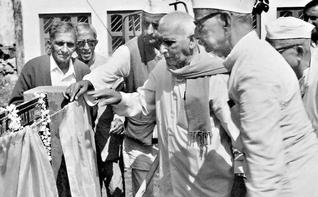
Legacy: A picture of freedom fighters with Mallengada Chengappa (right) at the laying of the foundation stone for the Freedom Fighters' memorial in Gonicoppa on December 16, 1998.
Legacy: A picture of freedom fighters with Mallengada Chengappa (right) at the laying of the foundation stone for the Freedom Fighters’ memorial in Gonicoppa on December 16, 1998.

A rare document from 1931 obtained by The Hindu here speaks volumes about people from Kodagu district who were in the forefront of the freedom struggle under the leadership of Mahatma Gandhi.

The people of Kodagu had issued a ‘manapatra’ then, a letter of honour, commending and saluting the 98 brave men and women who revolted against the British, following the footsteps of the Father of the Nation. They had taken part in the satyagraha in 1930-31 and were incarcerated.

Pandyanda Belliappa, Kollimada Karumbaiah, Chekkera Monnaiah, Makki Krishnaiah, Mallengada Chengappa, Abdul Gafoor Khan, Ajjikuttira Chinnappa, Ponnimada Machaiah, Kalengada Chinnappa, K.M. Subraya, Puliyanda Subbaiah, V. R. Thammaiah, Bidarur Madaiah, Chokira Madappa, Poojari Muthappa, Pandikanda Madappa, H.R. Krishnaiah were some among the people honoured by the people of Kodagu in 1931. Puliyanda Subbaiah, who hailed from Maggula village, was a true Gandhian till his death. He wore Khadi and counselled patience whenever a rift arose among people. So was V.R. Thammaiah, another Gandhian, who also hailed from the village. Elders say that H.R. Krishnaiah even refused to apply for pension after Independence saying if the Government recognised his contribution, it should come to his doorstep and give him the pension papers.

Even women did not lag behind. Kotera Accavva, Balyatanda Muddavva, Mukkatira Bojamma, Machimanda Medakka, Appanderanda Kalamma also joined the freedom struggle. The manapatra given to them on March 11, 1931, stated that they had been imprisoned for preaching the message of Mahatma Gandhi and taking part in the satyagraha.

The manapatra further stated that the people of Kodagu would not be able to offer them (the freedom fighters) privileges such as ‘Jahagir’, ‘Umbali’ — both land grants for service rendered — or ‘Pinchani’ (pension), but would carry forward the noble message of freedom struggle, support and abide by it.

A sentence read significantly that “Bharata mateya makallada Kodaginavaru drohigalalla, Bhartada veera putra putriyaru embudannu prapanchakke saridiri”. This meant “the people of Kodagu, who are the children of mother India, are not traitors. You have heralded a message to the world that you are valiant sons and daughters of India.” The people who were mentioned in the manapatra at the function presided by Biddanda Subbaiah, also had taken a pledge to follow the ideals propounded by Gandhiji such as ‘swadeshi’ and liquor prohibition.

A section of people might feel that some people of Kodagu supported the British. But it cannot be forgotten that Guddemane Appaiah Gowda who had fought the British was hanged at the Fort here by the British on October 31, 1837, much before the Sepoy Mutiny took place.

Kodagina Gowramma had offered all her jewellery to Gandhiji when he had visited here soliciting peoples’ support for continuing the freedom movement in the early 1930s.

It is an unfortunate irony that the Freedom Fighters’ memorial, the work for which started at Gonicoppa 12 years ago and the Guddemane Appaiah Gowda memorial, of which works are now underway, are yet to be completed.

_______________________________________________________________

The ‘manapatra’ saluted the 98 men and women who revolted against the British

The work on the Freedom Fighters’ memorial at Gonicoppa started 12 years ago

_________________________________________________________________

source: http://www.thehindu.com / The Hindu / Home> Karnataka / by Staff Correspondent / Madikeri – August 15th, 2010

Kodagu palace brings alive fading memories

KodaguPalace01KF04jul2016

Madikeri :

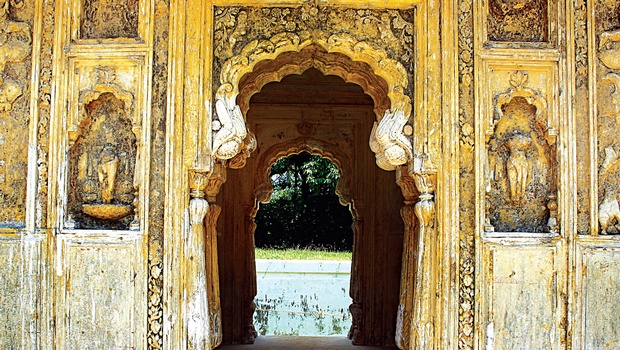
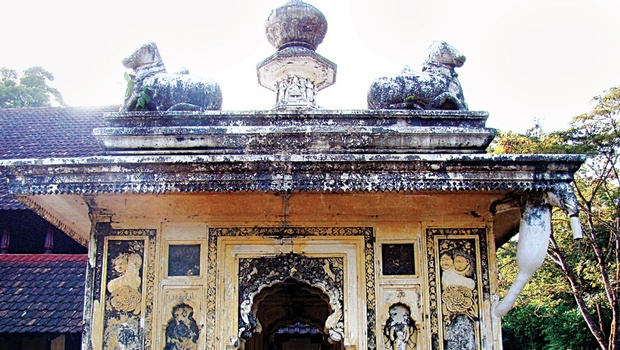
The Nalkunadu palace in Yuvakapadi, 30 km from Madikeri, was built in the late 18th century by Doddaveera Rajendra, a king of the Haleri dynasty. The last king who lived there, Chikaveera Rajendra, was immortalised in fiction by the celebrated Kannada writer Masti Venkatesa Iyengar. The palace is also called Nalnad aremane in Kodava parlance.

KodaguPalace02KF04jul2016

The palace is now attracting a huge number of tourists. Its unique features include a mantap where marriages were solemnised. The palace stands atop a hillock next to Tandiyandamol, the highest peak of district. (This breathtaking expanse is drawing bigger numbers after it was featured as Mugilupete in the hit Kannada film Gaalipata).

KodaguPalace03KF04jul2016

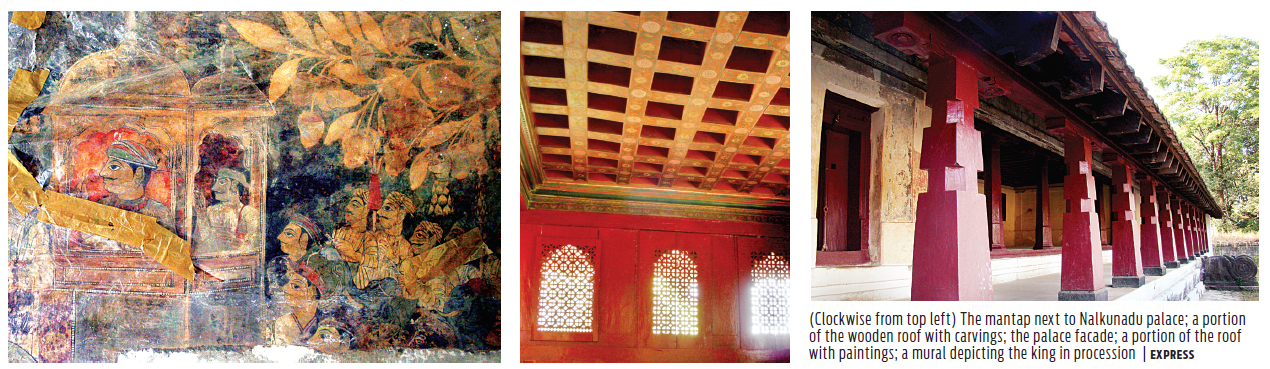
Built in brick and mortar, the palace is about 65 feet wide, and has a spacious verandah. The ground floor has a wooden roof with carvings, depicting flowers, vines, dancing girls, musicians, and a king and queen. The style is Indo-Saracenic. A 6×10 ft mural depicts the king in a procession, but it is damaged. Four dark rooms at the back, historians say, were used as a prison.

A spacious darbar hall, several baths and chambers for the king and queen are still in evidence. In 1796, king Doddaveera Rajendra married Mahadevammaji, his second wife, at the mantap here.

Some walls have lime carvings of the two-head mythical bird Gandabherunda, elephants, and lions. Artists from Rajasthan and Mysore were brought in for the special carvings, some of which have been ravaged by time. Similar architecture is seen at the Madikeri Omkareshwara temple.

Surrounded by lush greenery, the palace had a copper kalasha (cupola) on its roof which, elderly people say, is now obscured.

source: http://www.newindianexpress.com / The New Indian Express / Home> States> Karnataka / by Coovercolly Indresh / July 03rd, 2016

A tale with a sharp edge

Watershed moments

MeriyandaAinmaneKF28jun2016

Near the 10th mile from Virajpet is the traditional Ainmane homestead of the Meriyanda extended family. It is reported that several generations ago an unmarried lady, addressed as Balliavva, raised her brothers’ children. The descendants of the boys among them are part of the Meriyanda clan today. According to Gappu Ganapathy, a member of the Meriyanda clan, one historical family member who was called Maanichcha Moli (master), had 2 wives and 6 sons. The eldest among the boys was Meriyanda Medappa, affectionately called Medu, whose mother was from the Marichanda family. Four of his 5 younger brothers were known as Chettichcha, Kunjappa, Aiyappa and Ponnappa.

Medappa, who was a government official, was made a Dewan under Linga Rajendra, the Raja of Kodagu between the years 1811-1820. However, it is said that Medu was a Dewan only for 18 days. During a particular battle when Medu was stationed at the Nalnad palace, he sent his brother Chettichcha to the western border of the Kodagu kingdom. In the meantime, Medu’s rival had spread rumours to the Raja that Medu had sent his brother to the enemies in order to sell them official secrets.

Following this, Medu was charged with treason and made to run around the palace. The intention was to make him run into the king’s oidekatthi, a traditional sword also known as the ayudha katthi, which was positioned in the courtyard in a manner that it would slit open the runner’s neck. However, Medu ducked while he ran into the sword; so it was only his scalp that was cut off. Although he was only unconscious, the palace servants assumed he was dead and told the Raja so.

Twist of events
Meanwhile, Chettichcha won the battle and the news made the Raja regret his decision. Medu, who was revived by a toddy drawer returned to the palace a few days later and was honoured with the Raja’s oidekatthi bearing the small, embossed, golden ‘lin’ seal of the Raja stamped upon it. This sword, made peculiar by the rare stamp, originally had an ivory hilt; but was replaced by a wooden handle when it broke. The most commonly found seals of the Kodagu Rajas bear either of the Kannada syllables ‘vi’ or ‘lin’. While ‘lin’ belonged to Linga Rajendra, the ‘vi’ belonged to his elder brother and predecessor Dodda Vira Rajendra.

In the early 19th century, 3 paintings of Dewan Medu and the Kodagu Raja were commissioned. While the recipient (Dewan Medu) looks the same, the Raja appears to be different in each of the paintings. We can speculate that Linga Rajendra himself adopted different styles as he aged or they were actually different Rajas, probably Dodda Vira Rajendra (1789-1809) and Chikka Vira Rajendra (1820-1834), under whom Medu would have served as an official and advisor.

On canvas
In these paintings, Medu wears a red cloth head-dress, which has projections in front, and a thin kombu mishe (handlebar moustache), kept by the accomplished brave men of those times. He wears ear rings and is dressed in a white coloured kuppya (a traditional, long-sleeved tunic) with an ornate knife, called the piche katthi, secured in his chele (waistband).

Even the Rajas don’t seem to be spared by rules of propriety; in this case, they had to have something held in their right hands when seen in public. They are either holding hunting falcons or holding what appears to be some sort of a flower or a jewel in their right hands. While the original paintings have been kept elsewhere for safekeeping and preservation, black and white copies have been put up for display in the ancestral house. A spear of the olden days, known as barchi, has also been kept there.

Family heirlooms, such as these paintings and swords, which are part of a heritage, are to be preserved for posterity. A number of similar beautiful paintings had been commissioned by the Kodagu Rajas, especially between 1792 and 1834, and given to different families across Kodagu. It is however unfortunate that we are not aware of the identity of the artists who drew them.

Likewise, the ayudha katthis issued by the Rajas bear their respective syllabic regal insignia. One good specimen of a sword with the ‘vi’ syllable has found its way to the London Museum in the United Kingdom, where it is on display today.

source: http://www.deccanherald.com / Deccan Herald / Home> Supplements> Spectrum / by Mookonda Kushalappa / June 28th, 2016

Brijesh Kalappa bats for Memorial for Devati Parambu Martyrs

Kodavas visiting Bhagamandala remember Devati Parambu martyrs by offering a leaf or flower at the spot for the last 231 years!

Mysuru :

Following the recent protests by Codava National Council (CNC) and continuous demand by Kodava community for a Memorial at Devati Parambu, AICC Spokesperson and Legal Advisor to Government of Karnataka Brijesh Kalappa has expressed his support for the same.

In a press release, Brijesh Kalappa has said that Devati Parambu is a site that witnessed the massacre of thousands of Kodavas in 1785. Each and every Kodava child has been told at sometime or the other of this massacre at Devati Parambu and, therefore, no visit to Bhagamandala is complete unless a leaf or flower is offered at this site by each visiting Kodava.

Just as the holocaust holds a special significance for the Jews alone, the massacre at Devati Parambu has significance in each Kodava heart. The fact that Kodavas are ancestor worshippers makes this memory even more sacred, he said.

Stating that the Indian Constitution ensures space for each and every individual irrespective of caste, religion, sex or belief, Brijesh said that the Kodavas deserve to have a memorial befitting the scale of the massacre.

Both the Centre and the State are enjoined to have such a Memorial, he said and added that the Memorial was not acrimonious in nature.

“We do not seek revenge nor do we seek retaliation. We only seek to mourn the passing away of our departed with dignity,” said Brijesh Kalappa.

source: http://www.starofmysore.com / Star of Mysore / Home> General News / June 17th, 2016

Freedom fighter of Gandhian mould from Kodagu at 103 — A Profile

Supreme Court Advocate Brijesh Kalappa (second from right), who called on veteran freedom fighter M.G. Chengappa at his Yadavagiri residence in city, is seen with Prof. K. C. Belliappa (extreme left), Chairman, Sree Cauvery Educational Institutions in Kuvempunagar, Chengappa's wife Sharada and daughter Prema.
Supreme Court Advocate Brijesh Kalappa (second from right), who called on veteran freedom fighter M.G. Chengappa at his Yadavagiri residence in city, is seen with Prof. K. C. Belliappa (extreme left), Chairman, Sree Cauvery Educational Institutions in Kuvempunagar, Chengappa’s wife Sharada and daughter Prema.

Mysuru :

Kodagu district, having a rich forest cover and River Cauvery, the lifeline of crores of people, is a blend of natural beauty and serenity.

Kodagu, apart from its many uniqueness and natural beauty, is widely known for its hundreds of warriors who fought for the country against the British and other social evils.

One such great warrior is Malavanda G. Chengappa, 103, residing in the State’s cultural capital Mysuru, which is a matter of pride for we citizens. Chengappa, who fought for the nation’s independence, was jailed by the Britishers. He also waged a battle for liquor ban and created widespread awareness campaigns on the necessity for banning liquors.

Born to Malavanda Ganapathy and Seethamma, a farmer couple from Balyamandur village near Ponnampet in South Kodagu, M.G. Chengappa developed the spirit of fighting for just causes at a young age.

Inspired by his maternal uncle K.C. Karumbaiah (a former MP), he jumped into freedom struggle at the age of 18 years. His sister Akkamma too was a freedom fighter, who joined hands with the then Kodagu District Congress President M.G. Kuttappa in fighting for various causes post-independence.

Chengappa was among the prominent leaders, who fought against the British in Kodagu. Chengappa and other freedom fighters were arrested by the British in 1932 and sent to Kannur Central Jail, from where he was shifted to Tiruchirapalli jail.

During his stay in the jail, Chengappa came across several associates of revolutionary freedom fighter Bhagat Singh and expressed his willingness to join them. But due to various reasons, he had to stay back in Kodagu.

In the pre-independence days, the farming community was in deep distress and Chengappa’s family too was not an exception. His family members became helpless when they needed money to get him released from jail. Ultimately, they had to sell a plough (negilu) and a copper vessel to raise enough funds for his release.

Chengappa’s Mysuru connection: M.G. Chengappa has a long connection with Mysuru as he used to take part in Seva Dal camps that were being held at Subbarayanakere grounds, along with other freedom fighters namely Chekkera Monnaiah and Ajjikuttira Chinnappa. The city’s then renowned advocate M.S. Ramaiah had let out his house for camp participants.

Gandhiji’s pat: Mahatma Gandhi, during his freedom struggle campaign in Karnataka, had visited Sri Ramakrishna Ashrama in Ponnampet when Chengappa was one among the volunteers who were picked for taking care of the Mahatma.

With this, Chengappa got an opportunity to know more about Gandhiji. Chengappa, who served Gandhiji tirelessly, was patted by the Mahatma on his back for his meritorious work.

The large number of liquor-loving people in Kodagu was a cause of worry for Chengappa. So he launched a social campaign calling for a liquor ban. Chengappa’s contention was that liquor consumption habits among the people would lead to devastation of their families, besides becoming a bane to the society.

Fearing that alcoholism would push families to the streets besides destroying the future of youth community, Chengappa launched a relentless campaign seeking a ban on liquor.

A vegetarian to the core, Chengappa’s family members say that pure vegetarian diet is the secret of Chengappa’s long life and health.

Chengappa’s patriotism can also be seen in his outfit as he only wears khadi. This centenarian has kept himself away from non-vegetarian diet and liquor.

At present, Chengappa is staying with his wife Sharada and daughter Prema at Chaitra Apartment in Yadavagiri.

It is a matter of pride for Mysureans that a centenarian freedom fighter, who led an ideal life throughout, is residing amidst us.

His niece Dr. Latha Muthanna has penned about the life of this Kodava warrior in her book “Lopamudra’s Daughter.”

Brijesh Kalappa calls on Chengappa: AICC Spokesperson and Supreme Court Advocate Palachanda Brijesh Kalappa, who was in city recently, called on Chengappa at Yadavagiri and enquired about his health. He was accompanied by his father-in-law Prof. Kambeyanda C. Belliappa, Chairman, Sree Cauvery Educational Institutions in Kuvempunagar and former VC of Rajiv Gandhi Central University, Itanagar, Arunachal Pradesh. Chengappa, when asked about his health, is said to have replied, “I am quite good” which speaks volumes of his spirit.

source: http://www.starofmysore.com / Star of Mysore / Home> General News / June 02nd, 2016

Celebrations at Kodagu’s ancestral home

Madikeri:

The 450 years old Mund Mane and Ain Mane (traditional ancestral house) belonging to the Mukkatira family in Arapattu village is now being used as the venue for conducting cultural events.

Kannada Sahitya Academy on Saturday organised a cultural event in this magnificent edifice of Kodava culture, heritage and history.

It was the first programme organised at the house other than family members. The house was safeguarded by the family members.

Ummathat by women, Bolkat, Kolat and Pareyakali by men attracted the villagers who attended the function.

Academy president Biddatanda Thammaiah said, he was happy to conduct cultural programmes in ancestral houses of Kodavas which are unique in their design and structures. ”It gives a new feeling and new ambience for both organisers and the audience.

If any other Kodava family has such traditional house, please inform the academy so that we can have cultural programmes there too,” he appealed.

Mukkatira family consists of 200 members settled across the district and outside. They will all gather at this house to celebrate Keilpold, Cauvery Sankramana and Huthari festivals. The offerings to “Guru karona” is also performed by all members of the family.

Former minister MC Nanaiah who attended the programme said the Mund and Ain Mane homes are symbols of prestige for Kodavas.

Mangaluru University professor and Kodava Study Institute head Kodira lokesh said, as many as 1050 Kodava families , 530 Ain Mane and 80 Mund Mane exist in Kodagu. It is a matter of pride for the Mukkatiraa family that it has 2 Mund Mane homes, he said.

source: http://www.timesofindia.indiatimes.com / The Times of India / News Home> City> Mysore / TNN / May 29th, 2016

Inaugration of ‘Amar Jawan’ War Memorial in Kodagu on Apr.30

Madikeri :

The War Memorial ‘Amar Jawan’ at Cherangala village, Cauvery Janma Bhoomi Trust premises in Bhagamandala, will be inaugurated on Apr. 30 at 10.30 am, under the aegis of Cauvery Janma Bhoomi Trust as part of annual celebrations of Thavaruru Koota.

Justice Santosh Hegde, Justice V. Gopal Gowda, Lt. Gen. (retd.) C.N. Somanna, Lt. Gen. (retd.) B.C. Nanda and Air Marshal (retd.) K.C. Cariappa will be the chief guests.

MLA and former Speaker K.G. Bopaiah, Lt. Gen. B.S. Jaswal, Maj. Gen. G.D. Bakshi will also be present on the occasion, according to a press release from M.C. Ravi Kumar, Managing Trustee of the Trust.

source: http://www.starofmysore.com / Star of Mysore / Home> General News / Thursday – April 28th, 2016