Category Archives: Historical Links / Pre-Independence

Madikeri Palace is a ‘protected monument’

The Archeological Survey of India had declared Madikeri Palace as a ‘Protected Monument’ way back in 1920. The Palace was constructed by the Haleri rulers.

MadikeriKF30jun2014

With this, the row over ownership of the Palace has received a new twist.

H C N Odeyar, claiming to be the descendant of Haleri rulers had recently written to the Deputy Commissioner claiming the right over the ownership.

He had even questioned the ownership of the Palace. According to the available documents, the fort compound wall, and two huge artifacts of elephants belong to the ASI.

There is no reference to the ownership of the Palace. The land where the Palace is constructed is a paisari land (government land).

Hence, it had created confusion on the ownership of the Palace.

In the backdrop of Odeyar’s letter, Deputy Commissioner Anurag Tiwari had directed the Archeological Survey of India and Department of Archeology and Museum to produce the documents related to the Palace.

Accordingly, the ASI could get the notification of Coorg Chief Commissioner dated November 26, 1920. According to the notification, the Fort and two artifacts of elephants are protected monuments under Ancient Monuments Protection Act -1904.

To give a large space to the office of the Coorg Chief Commissioner, the palace was dropped from the notification of protected monument.

The notification on the Palace was denotified in 1924.

The DC has directed the ASI and Department of archeology and museum to procure documents on the handing over of the Palace and issue a fresh notification.

Heritage site

Deputy Commissioner said that the the Deputy Commissioner’s office and Zilla Panchayat office which are now functioning from the Palace building will be shifted shortly.

Once all the government offices are shifted, then the Palace building will be developed as a heritage site.
The ASI has been directed to prepare a blue print for the development of the Palace.

source: http://www.deccanherald.com / Deccan Herald / Home> District / by Srikanth Kallammanavar / Madikeri – DHNS, June 29th, 2014
Mysore flour mill owner gets possession of palace

Nagaraju’s dogged fight over a period of 18 years for his ancestral property began from scratch

Claiming to be a descendent of the erstwhile rulers of Kodagu, a flour mill owner from Mysore has now gained possession of the historic 17th century palace and fort which is predominantly in the heart of Madikeri town.

“My efforts of 18 years have ended with the President of India ordering that the palace belongs to me,” a beaming H C Nagaraju, the owner of the flour mill in Shivarampet, told Business Standard.

He has displayed a notice in his shop that says: “As per the order of His Excellency President of India, the Mercara Palace belongs to H C N Wadeyar.” It quotes the order No.F.No.1-204/2013-RTI (Hq) dated 26-9-2013, Government of India, Janpath, New Delhi.

This is the latest notice displayed in his shop to inform his customers of his successful fight, in addition to already putting up copies of other documents and photos of his forefathers belonging to the erstwhile Haleri dynasty of Kodagu.

Nagaraju’s dogged fight for his ancestral property began from scratch, from corresponding on the issue with a number of authorities like the Departments of Archaeology, and the state and Central governments and moving the courts. Before approaching the courts, he began to acquire documents from various sources, including the British Library in London to establish that he descended from the Haleri rulers.

“My father often told me that we belong to the Kodagu royal family and the Madikeri Palace belongs to us, based on what his father and grandfather had told him,” he said, narrating how he began to establish his right over the palace and the surrounding fort in Madikeri. “To establish what my forefathers were saying, we had swords, shields, palm leaf manuscripts in our house which my father gave away, finding them of no use,” he adds.

Calling himself H C N Wodeyar, he has displayed his claim he is the Maharaja of Coorg and owner of the Madikeri Palace. According to him, his lineage starts from Queen Devajammanni, wife of Lingaraja. The palace, which witnessed rebellious uprisings against the colonial rulers in 18th century, it presently houses the Kodagu’s Deputy Commissioner’s office within the fort.

“They have agreed to shift to a new place and hand over possession to me,” he said, adding he intends to convert his ancestral palace into a tourist attraction. Beside the palace stand two life-size statues of elephants that attract people who visit the monument.

Lingaraja succeeded the famed Dodda Veera Rendra Wodeyar (1780-1809), the hero from Kodagu history, as the Coorg Raja. His successor Viraraja was deposed in 1,834 following which the British annexed Kodagu and exiled the last of the rajas, bringing an end to the nearly two-century-long reign of the Haleri dynasty that came to power in the 17th century, in the district nestling amidst the lush Western Ghats, known for coffee and oranges, besides elephants.

source: http://www.business-standard.com / Business Standard / Home> Current Affairs> News> Et cetera / by Gouri Satya / Mysore – May 04th, 2014

King Wants to Take Over Kodagu Palace

H C N Wadiyar, the Maharaja of Coorg, has strongly objected to opening of Balamandira inside the Mercara Palace without his permission.

In a letter to the Kodagu Deputy Commissioner, he claimed he is the owner of the palace as his ancestors did not transfer it to the then Government of Mysore or the Government of India.

He said Archaeological Survey of India officials had stated that the fort at Madikeri and two masonry elephants are being protected by the ASI, adding state government offices are still functioning in the palace.

He clarified the British government had not given any letter pertaining to the transfer of the palace to the government.

He said he wants to take over the palace soon.

source: http://www.newindianexpress.com / The New Indian Express / Home> States> Karnataka / by Express News Service – Mysore / May 04th, 2014

On William Bentinck’s trail

OotyKF28apr2014
Governor-General William Bentinck’s trip to Bangalore, Mysore and Ooty in 1834 when he coordinated the attack on the ‘problematic’ raja of Coorg, Chikka Veerarajendra is well-documented in the book titled ‘Ootacamund-A History’, written by Sir Frederick Price in 1908.

Chikka Veerarajendra and the East India Company were at loggerheads since 1830.

Governor General William Bentinck who was more interested in reforming India than in annexing new territories, had to deal with the Raja of Coorg who had dared the British by keeping in custody one of their emissaries, Kullapalli Karunakaran Menon.

A long sojourn

Lord William Bentinck set out from Calcutta on 3 February 1834, on board the Curacoa to Madras.

He wanted a first-hand assessment of the situation in Coorg and for this purpose, the commander-in-chief Sir Robert O’Callaghan was in attendance.

The Governor General also had to deal with administrative issues concerning Mysore. The reason for him to visit Ooty for an extended stay was to improve his rather poor health.

Bentinck reached Madras on 15 February 1834 and set out for Bangalore via Vellore.

In Bangalore ,strategies on Coorg were finalised in consultations with Sir Robert O’Callaghan.

Lord Bentinck halted in Mysore and was put up at the precursor to Rajendra Vilas Palace atop Chamundi Hill, which was originally built by Robert H Cole, the earlier British resident at Mysore.

Bentinck set out for Ooty via Gundlepet, and it was while they were travelling on 15 March 1834, that war was declared on Coorg.

Lord Bentinck’s entourage reached Ooty on 22 March. At Ooty, the only suitable accommodation for the staff of the Governor-General and that of the Commander-in-Chief was “Sir William Rambold’s Large House”, which was a grand hotel built in 1832 by an influential British entrepreneur named William Rambold.

However, Rambold soon ran into financial difficulties. The hotel was rented frequently by senior officers of the East India Company.

It was in 1842 that Rambold’s Large House became the Ootacamund Club, or the Ooty Club.

During Lord Bentinck’s sojourn in Ooty, Lord Babington Macaulay arrived at the hill station on 25 June, 1834.

The Governor-General and Macaulay met each other for the first time at Rambold’s Large House.

Macaulay chose a small cottage nearby where he lived for several months to write the Indian Penal Code.

Governor-General Bentinck stayed in Ooty till end of September 1834.

On his return journey, he again passed through Mysore and reached Bangalore on 9 October.

He sailed aboard the Curacao on 26 October from Madras and reached Calcutta on 14 November 1834.

Wild rumours

There are also records of Lord Dalhousie’s sojourn in Ooty from 7 March 1855 to 29 October 1855.

Dalhousie’s visit was primarily for health reasons. However, he was not too comfortable in Ooty and soon shifted to Kotagiri.

During Dalhousie’s stay in Nilgiris, one of his ADCs took permission to visit Coorg, where his brother was a coffee planter.

It was in 1852, that Dalhousie reluctantly gave permission to the Raja of Coorg to travel to England along with his daughter Gowramma.

The Aide-de-camp (ADC), on his return, narrated an amusing incident to his boss. Coorg being a rather remote province, news from the outside world took time to percolate.

Very often, wild rumours floated amongst the small but growing community of British planters. One such rumour was that the British and their allies had lost the Crimean War and that Queen Victoria and her family had fled to India!

However, Dalhousie who had a temporary telegraph line installed at Nilgiris had already received the news that the British and their allies had taken Sevastopol from the Russians.

On his journey back to Calcutta, Dalhousie stopped in Bangalore during early November 1855, and was the guest of Sir Mark Cubbon. Dalhousie narrated the Coorg rumour to the British officers and after inspecting the troops, he formally announced the fall of Sevastopol.

source: http://www.deccanherald.com / Deccan Herald / Home> Supplements> Spectrum / by CP Belliappa / April 2014 (28th)

Kodagu fighting to maintain its existence

The glorious credentials of Kodagu, one of the smallest districts in the State, appears to be on the wane, and the land of Kodavas is literally fighting to maintain its existence in many ways.

Kodagu was a Part ‘C’ State, one of the 10 such regions carved out after the country got Independence, before its merger with the then Mysore in 1956. The others were Ajmer, Cooch Behar, Bhopal, Bilaspur, Delhi, Himachal Pradesh, Kutch, Manipur and Tripura.

Different scenario
As a State, Kodagu had proved that smaller States could ensure all-round development. The current scenario is different. People cry foul over the “imperviousness” of the elected representatives and the powers that be in terms of attention to the district’s development.

Rapid urbanisation, cash crops being affected by diseases, fluctuating prices of the crops, poor road and power infrastructure, lack of clarity on land tenures, and destruction of forests on the pretext of development haunt the people. Drinking water and regular power supply, telecommunication network and transportation facilities, educational institutions, anganwadi centres and hospitals in villages are still a far cry. Monsoon brings its own misery to the district. None is sure whether or not the next Member of Parliament representing Kodagu (which is part of the Mysore Lok Sabha constituency) would be available to sort out the district’s problems. “Look at the state of roads from Hunsur to Gonicoppa,” said P.T. Bopanna, veteran journalist who has focussed on the issue of lack of development in the district on his web portals.

Politicians cannot remain oblivious to the problems Kodagu is facing, K.G. Ajith, a resident of Madikeri, said. They ought to pay attention and be held accountable, he said.

In 1952, elections were held for the 24 seats of the Coorg legislative body amid stiff opposition to the merger plans. The Congress won 15 seats and Independents (opposing merger) won nine seats. C.M. Poonacha of the Congress became the Chief Minister and K. Mallappa was the Home Minister. Under various circumstances Coorg was merged with the then Mysore in 1956.

Merger
The merger followed the recommendations of the States Reorganisation Commission led by Fazal Ali. All through the Poonacha regime, the relationship between the government and the people was exemplary and cordial, according to C.M. Ramachandra, the former Chief of Bureau of The Hindu in Bangalore.

In 2008, the Delimitation Commission merged parts of the Somwarpet Assembly constituency with Madikeri and Virajpet constituencies, reducing the number of Assembly segments in the district to two. The reason attributed was low population figures.

After being with the Mangalore Lok Sabha constituency, Kodagu was included in the Mysore Lok Sabha constituency.

The Codava National Council led by N.U. Nachappa, which launched a struggle some 22 years ago, has diluted its demand for a statehood to Kodagu. The council now seeks an autonomous status for Kodagu within Karnataka. “The CNC will restore the glory of Kodagu,” Mr. Nachappa said.

source: http://www.thehindu.com / The Hindu / Home> News> National> Karnataka / by J. Jeevan Chinnappa / Bangalore – April 20th, 2014

Forum to raise funds to convert Sunny Side into a memorial

The Tipu Sultan Nagarika Vedike Kodagu district unit has said that the unit was ready to raise funds from the public to pay Rs 7,80,541 to the Transport department to get the custody of Sunny Side, ancestral house of General K S Thimmaiah.

It was a long pending demand to convert Sunny Side into a memorial.
ThimmaiahKF13apr2014
Addressing a press meet, district unit President K M Kunhi Abdulla said, that the government had announced that Sunny Side would be converted into a memorial eight years ago. However, it has not seen any progress. After the death of General Thimmaiah, his wife had sold the building to the Transport department.

However, owing to lack of maintenance the building was in a deplorable condition. The government should respond to the demands of the people.”

Kannada and Culture department has already written to the government to pay Rs 7,80,541 to take over the building. “If the government fails to initiate measures to convert the building into a memorial, a protest rally will be held in Bangalore. We will extend our support to the Field Marshal K M Cariappa and General Thimmaiah Forum.”

Former chief minister H D Kumaraswamy said that the State government had earmarked Rs 1 crore in the budget in 2006. “The respective BJP and Congress governments failed to convert the building into a memorial,” he said.

source: http://www.deccanherald.com / Deccan Herald / Home> District / DHNS – Madikeri, April 04th, 2014

Tales from the hills

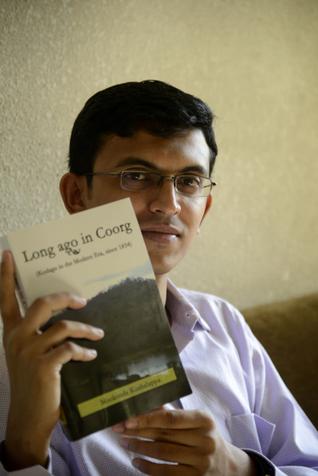
History has always been a reigning passion for this 27-year-old software engineer who also makes iphone apps, blogs, sketches, writes poetry and edits on Wikipedia. / Photo: V. Sreenivasa Murthy / The Hindu

Mookonda Kushalappa’s novel is a fascinating account of a beautiful land

Mookonda Kushalappa takes you back to the year 1834, offering you an account of a beautiful, complex place and its multi-faceted people

“I was brought up in Bangalore but my grandfather lived in Coorg and I used to visit it often. I was fascinated by the place and began reading a lot about it and there was a hunger in me to tell its story.”

So he did. His novel Long Ago in Coorg delves into the history of Kodagu in the modern era beginning from the invasion of the British East India Company in 1834 and going all the way to the present day existence of the Kodagu district. “Some of the interesting aspects of the book include the Coorg War of 1834 fought between the British and the Coorgs, the rebellion of 1837 where a pretender tried to claim the throne of Kodagu and the Gandhian movement in Kodagu,” adds Nitin.

History has always been a reigning passion for this 27-year-old software engineer who also makes iphone apps, blogs, sketches, writes poetry and edits on Wikipedia.

“The past fascinates me,” he says adding that the distinct culture and tradition of Coorg, which makes it an eclectic melting pot of sorts added to his fascination for the place. “The culture is essentially Dravidian with West Asian influences and fantastic theories abound about the place.”

In addition to this book, he has written another, also based on Coorg history, “The book is called The Early Coorgs and is based on Kodagu’s mythology, prehistory and early history before 1600,” he says.

On future plans he shrugs, “Well, honestly I don’t plan anything long term, I take one day at a time. I try to be different and do what I like. But yes, more writing will definitely happen.”

source: http://www.thehindu.com / The Hindu / Home> Features> MetroPlus> Society / by Preeti Zachariah / Bangalore – April 02nd, 2014

MP admits sacrificing sheep, fowl in reserve forest

Mysore and Kodagu MP A H Vishwanath admitted to media persons, on Tuesday, that he sacrificed one sheep and a fowl at the shrine of Handikere Chowdamma, in Kachuvinahalli Reserve forest.
SheepKF19feb2014
He has also allegedly violated law by entering the Reserve forest without permission. Range Forest Officer Devaraj said, the MP and his family had obtained oral permission to visit the shrine in the Reserve forest. “However, they were asked not to perform any pooja,” he said. While Assistant Conservator of Forests (ACF) Shivashankar Swamy said, “Following a request from the MP, the department had made arrangements to ferry 15 members of the family, besides giving them adequate security. Permission was given on humanitarian grounds. No complaints have been received in this regard.”

Vishwanath, along with MLA H P Manjunath, was in Neralekuppe, on the fringes of the forest, in the taluk, supervising the feast, where non-vegetarian food was served. The feat had been organised for his followers and Congress party workers. People were arriving in various vehicles, including trucks, up to 4 pm and 5,000 people attended it, according to one estimate.

Surprisingly, leaders from opposition parties also savoured the food and enjoyed Vishwanath’s hospitality. JD(S) candidate in the last Assembly election Kumaraswamy, who lost against Manjunath, and BJP candidate Annaiah Nayak were prominent among the guests. Vishwanath brushed aside questions, if it was a election campaign feast. He said, “There is no politics in hosting this lunch. My wife had made a vow to the deity to make some offerings during the last Assembly elections. We are fulfilling it. We have offered pooja to the deity and sacrificed one sheep and a fowl,” he said.

Replying to a question, he said, three days back he also fulfilled a vow to Periyapattanadamma at Periyapatna. “I have see, to which goddess I have to fulfil a vow in Madikeri,” he quipped.

Hunsur town’s famous caterer Raghu had prepared the food. He said, four quintals of rice, 500 kg mutton and 700 kg chicken was used.

source: http://www.deccanherald.com / Deccan Herald / Home> District / Hunsur (Ramesh District) / February 04th, 2014

Cariappa’s 115th birth anniversary today

Bangalore :

The 115th birth anniversary of the first commander-in-chief of independent Indian armed forces, Field Marshal K M Cariappa, will be observed at the Bangalore Kodava Samaj on Tuesday. Major general Dr K M Bheemaiah will be the chief guest.

Enlisted in the Army in 1917, Cariappa fought the World War II from 1939 to 1944. He served as Indian high commissioner in Australia and New Zealand till 1956. He was honoured with the Field Marshal rank on April 28, 1986. Kodava Samaja Bangalore, which is organizing the birth anniversary celebrations, was established in the year 1911 after Cariappa donated one acre of land to it at Vasanthnagar. He had got this land from Mysore Maharaja in recognition of his distinguished military service to the nation.

source: http://www.articles.timesofindia.indiatimes.com / The Times of India / Home> City> Bangalore> Field Marshal / TNN / January 28th, 2014

115th birth anniversary of Field Marshal K.M. Cariappa celebrated

KariappaKF03feb2014
Govt. urged to expedite construction of War Memorial in city

Mysore :
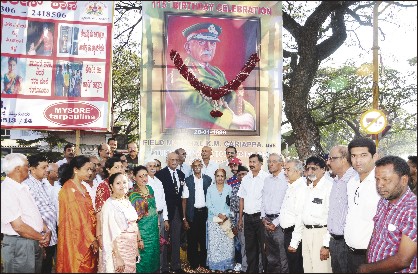
Kodava Samaja, Mysore, had organised a function to celebrate the 115th Birth Anniversary of Field Marshal K.M. Cariappa at the Circle named after him here this morning.

Maj. Gen. (Rtd.) C.K. Karumbaya, SM, paid glowing tributes to the first Commander-in-Chief of the Indian Army and urged the Government of Karnataka to expedite the construction of the War Memorial near the DC office in city. Capt. Sharma urged to include the life story of the Field Marshal in the school curriculum.

Earlier, the gathering offered floral tributes to the portrait of the Field Marshal.

Samaja President M.M. Karumbaiah welcomed. Samaja Hon. Secretary K.M. Belliappa, former Presidents of the Samaja Dr. A.A. Kuttappa, K.A. Kariappa and P.S. Ganapathy, Chairman of Cauvery Educational Institutions Prof. K.C. Belliappa, Sri Kaveri Kodagu Mahila Sangha Hon. Secretary P. Lovely Appaiah, Kavya Kuttappa, office-bearers and members of the Samaja and also of the Kodava Samaja Cultural and Sports Club were present at the programme along with some public. On the occasion, sweets were distributed.

It may be recalled, VeKare Ex-Servicemen Trust, Mysore, headed by M.N. Subramani as its President, was the first Ex-Servicemen NGO to propose a War Memorial in city way back in the year 2000 and the same was accepted by the district administration which earmarked a plot in front of ncc Gp hqs behind dc office. The NGO, which pursued the matter till 2007, had also suggested installing a statue of the Field Marshal at the Field Marshal K.M. Cariappa Circle.

source: http://www.starofmysore.com / Star of Mysore / Home> General News / January 28th, 2014