The santhe is a precursor to the India International Coffee Festival./ File Photo: H. Vibhu
BMRCL wants to create a cultural hub at the Rangoli Metro Arts Centre
This weekend, take a stroll down the M.G. Road boulevard, home to the Rangoli Metro Arts Centre. Get reintroduced to the coffee bean, learn more about the art of coffee — right from the plant to its energising beverage form — shop for not just coffee powder but also jewellery made of coffee beans, and peek into the coffee museum.
Organised by the Women’s Coffee Alliance India, a coffee lover’s collective that aims at empowering less privileged women in the coffee production chain, the event, ‘Coffee Santhe’, is slated to be held on January 11 and 12 between 2.30 and 8.30 p.m. Events include displays on coffee and beans, arts and crafts competitions for children, and a latte art competition, said Sunalini Menon, coffee quality control expert. “People don’t even know what a coffee plant looks like. We’re also selling coffee plants such as the Robusta and Arabica varieties,” she said.
The santhe is a precursor to the India International Coffee Festival, to be held from January 21 to 26 in the city, organised by India Coffee Trust and the Coffee Board.
Other events to be held over the weekend include storytelling by Deeptha Vivekanand, a storyteller from Ever After, who will perform at the Rangasthala Auditorium. Held along with the Kid and Parent Foundation, the sessions will be held on the second and fourth Saturday of every month. Also on the schedule are interactions with septuagenarian Malathi Rao, who will entertain children with her vast knowledge trove, and a photo exhibition organised by the Akshaya Patra Foundation featuring photographs of children.
Vasanth Rao, general manager (finance) at Bangalore Metro Rail Corporation Ltd., said the plan is to transform this stretch into a vibrant arts and cultural hub. “We are clear we do not want to feature any social/political activism. This should be a place that showcases excellence, and we want it to explore more niches and give people an unusual experience,” he said.
source: http://www.thehindu.com / The Hindu / Home> News> Cities> Bangalore / by Staff Reporter / Bangalore – January 11th, 2014
The 5th India International Coffee Festival, the flagship event of the coffee sector, will be held in Bangalore from January 21-25.
The event is being organised by the India Coffee Trust and promoted by the state-run Coffee Board of the Union Commerce Ministry. About 1,000 delegates and 10,000 visitors are expected to participate.
“We have two additions to the event: there will be ’Launchpad’ for launching new blends, products, services and technologies. The other would be coffee themed quiz,” Coffee Board Chairman Jawaid Akhtar told reporters here.
For the first time, the Board will give away the ‘Barista Championship’ awards for best roaster, curer, exhibitor and for latte art, he added.
With the ‘Changing Face of Coffee’ as theme of the festival, the event would comprise of conference and exhibition on the coffee sector.
The conference aims to capture the changes taking place in the coffee sector and will discuss current trends related to production as well as take a close look at the prevailing market scenario.
It will focus on issues such as health aspects of coffee, innovative and alternate channels of coffee delivery to consumer among others.
There will be workshops on processing, brewing, roasting, espresso making, cooking with coffee, art on silk and coffee entrepreneurship.
A trip to Coorg, called ‘Coffee Trail to Coorg,’ will be conducted at the end of the festival.
The first three editions of the festival were held in Bangalore, the traditional coffee capital of the country, whereas the fourth edition was organised in Delhi.
Karnataka, Kerala and Tamil Nadu are the major coffee producing states in the country.
source: http://www.thehindubusinessline.com / Business Line / Home / by PTI / New Delhi – January 09th, 2014
The world coffee tree map, shows Yemen the first country of coffee tree
by Fakhri al-Arashi
Through out the international coffee conference all over the world , Japanese coffee traders classified Yemen as the homeland of coffee and the first source of the coffee tree in the world. The Japanese adore coffee, much akin to westerners’ passion for wine. Despite its small quantities, the quality and price of Yemeni coffee have earned it a special category in the Japanese coffee market. The sole coffee store in Tokyo that serves Yemeni coffee offers cups from $15-$19.
Ibrahim Moka is an organization in Japan consisting of 22 members. It is also a coffee brand, whose name derives from a Yemeni entrepreneur who found himself in a position to respond to Japan’s interest in Yemeni coffee.
Over the past five years, the 22 members of the Ibrahim Moka association visited Yemen in order to learn more about the reality of the coffee farms and growing regions in Yemen. “Driving to Bani Ismael far atop the Haraz mountains, the group crossed 9km in 7 hours, pushing off-road through hard, mountainous terrain,” said Ibrahim, one of the group’s hosts. “We were traveling in an old Toyota Land Cruiser, and we eventually reached a point 5500 feet above sea level. Once we safely concluded our journey, the head of the Japanese team said, ‘we do not have these cars in Japan, but they were made for Yemen’s mountains.’”
While the trade volume of Yemen coffee to Japan does not reach levels of commercial profitability, Japan is still the major importer of Yemeni coffee. Three business companies in Yemen find the Japanese market very attractive to develop their business with Japan. Al-Kabous reported that their company exports between 150,000 – 160,000 tons of Yemeni coffee quarterly. Recently, al-Kabous shipped 142,000 tons of coffee to Japan.
In 2005, Ibrahim Moka paid a visit to Japan, where he visited a 200 year-old coffee shop in Tokyo. He also visited the affiliated museum. “I am a coffee businessman, but during my visit to the coffee museum, I was impressed by the layout, design, courtesy and presentation in the museum” said Ibrahim. The visit included a coffee-tasting session in which each person is entitled for 2 small cups of coffee.”
Ibrahim had the chance to visit the Japanese coffee association, which consist of 270 members. At the meeting, he presented Japan with a map of the history of coffee growth in Yemen, including its rises, falls, and challenges. Ibrahim came to know the good reputation of Yemen’s coffee in the roadmap of the coffee business in Japan. The Coffee museum even contains Yemeni post stamps reflecting coffee trees as a promotional tribute to Yemeni coffee.
“The price of coffee increased because of packaging and product selection. Buyers were looking to Yemen as the source of coffee, and for the love of coffee the Japanese designed specific pricing categories,” said Ibrahim. Yemeni coffee ranked first in terms of quality, though Jamaican coffee wins in terms of packaging. Yemeni coffee lacks certain final touches, but despite this it is still the most expensive coffee in Japan.
Over the past years, the Japanese coffee association has sought opportunities to help Yemeni farmers to increase coffee yields. “There were many Japanese associations working in Yemen on this task, and they tried to offer Yemeni farmers special tools to improve the quality and quantity of coffee they could produce. This even included offering training courses to the farmers and vendors,“ said Ibrahim. Recently, Yemen has had even more problems with its coffee production due to the political turmoil.
When we look to the past, we see a Japan very much involved in Yemen. They would spend days in tours of the old city, and some diplomatic missions would visit Sana’a’s hot baths (also known as the Turkish baths).
Japanese investors and visitors continued supporting Yemeni women in rural areas and they provided Yemen with equipment to support farmers in the rural areas as well. Ibrahim concluded, “I like Japan very much, and I have seen that each thing in the world has a place in Japan. I like the politeness and humility of the Japanese community.” We hope that Yemen can enjoy more of this country and its wonderful people in the future.
source: http://www.nationalyemen.com / National Yemen / Home> Business & Economics / December 08th, 2013
Coffee Board of India will organise the National Barista Championship from January 16 to 18 in the city to identify technically skilled and best Baristas in the profession.
According to a release from the Coffee Board of India, the competition will focus on promoting professional excellence in coffee value chain, strengthen and encourage skill development and also promote the Café Culture in India. The event is being conducted also because there are many café chains coming up in the city and this is becoming another profession option for youngsters. The event will be hosted at Mantri Square, Sampige Road, Malleswaram.
The final round of the championship will be held on January 24, during the India International Coffee Festival 2014 at Hotel Lalit Ashok here. The event will be conducted as per the rules and regulations of World Barista Championship.
source: http://www.deccanherald.com / Deccan Herald / Home> State / Bangalore, DHNS – January 14th, 2014
The Coffee Board has been reconstituted after a two-month delay.
Many new faces figure in the revamp, which happens once in three years.
The Union Ministry of Commerce and Industry through a Gazette Notification dated January 6 has announced the revamped board that will be in place till three years from January 6 to January 5, 2016.
According to the notification, N.K. Pradeep, Shri Nandi Estate, Chekanahally Belur Taluk, Hassan, Karnataka; Anil Kumar Bhandari, Suntikoppa, Kodagu, Karnataka; Immanuel T. Rampuram, Chatnahalli Estate, Siddapura South Kodagu, Karnataka will represent large growers.
Jabir Asghar, Bangalore, Karnataka; B.S. Jayaram, Bidarahalli Post, Mudigere Taluk, Chikmaglur, Karnataka; D.M. Vijay, Hangaravalli Post Aldur, Chikmagalur, Karnataka; A. Thara Aiyamma, Neela Estate, Balele, Kodagu, Karnataka; Vijay Jagirdar, Bangalore, Karnataka; Vasantha Lakshmi Narayana, Near Andhra Bank, Pitapuram Colony, Visakhapatnam, Andhra Pradesh; C.P. Varghese, Chittemalil, Malankara, Nenmeni, Sultan Bathery, Wayanad will be small growers’ representatives.
Representatives of coffee trade interests are D. M. Purnesh, Classic Coffee & Spices Pvt. Ltd., Bangalore, Karnataka. Dr. S. M. Kaverappa, Haletaluk, Napoklu, Kodagu, Karnataka. Ramesh Rajah, M/s. Ramesh Exports Pvt Ltd, Bangalore, Karnataka.
Representatives of curing establishment: A. N. Devraj, Avaathi Post, Chikmagalur, Karnataka. K. A. Ibrahim, Suntikoppa, Madikere Kodagu, Karnataka.
Representatives of labour interests: G. Bhaskar, Jeyammal Street, Ayyavvo colony, Aminjikarai, Chennai, Tamil Nadu. N. M. Adyanthaya, President INTUC, Karnataka & Vice President National INTUC, Nagi Towers, Kadri Hills, Mangalore, Karnataka. Prof. K. P. Thomas, Kakkathottathil House, Kottayad Road, Sultanbethery, Wayanad, Kerala. R. Chandrasekharan, President INTUC, Kerla Branch, Ayikkumathu House, Sooranad North, Sooranad Kollam Kerala.
Representatives of coffee growing States other than principal coffee growing States: K. V. Satyanarayana, Additional Chief Secretary, the Secretary in-charge of the Agriculture Department, Government of Tripura. Rajesh Prasad, Commissioner Industries & Commerce, Assam.
Representatives of consumer’s interest Uma I. B. Shankar, Hosmane Extension, Chikmagalur, Karnataka. Iftekhan Khan, 28, New Ashonknagar, Agra, Uttar Pradesh.
Representatives of instant coffee manufacturers: C. Rajendra Prasad, Chairman & Managing Director, CCL Products (India), Ameerpet, Hyderabad, Andhra Pradesh.
Eminent Personality in the field of research /marketing/ management/ promotion of coffee: Peter Mathias, Kelagur Estate, Sunkasale Post, Mudigere Taluk, Chikmagalur, Karnataka.
source: http://www.thehindubusinessline.com / Business Line / Home> Industry> Agri-Biz / by Anil Urs anil.u@thehindu.co.in / Bangalore – January 13th, 2014
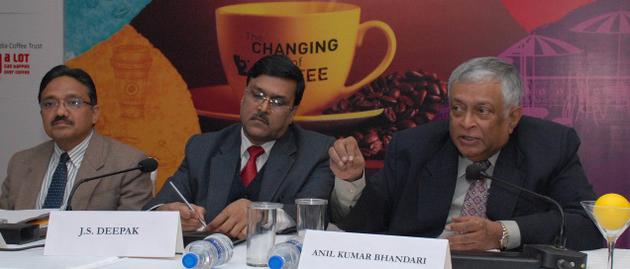
Shipments up 37% since October; re-exports too rise Gathering steam: (From left) Jawaid Akhtar, Chairman, Coffee Board of India; J.S. Deepak, Additional Secretary, Ministry of Commerce and Industry; and Anil Bhandari, President, India Coffee Trust, addressing a press conference, in New Delhi, on Thursday. /— Kamal Narang / The Hindu
New Delhi :
The pick-up in coffee exports since October will help shipments in the current fiscal exceed last year’s levels, says the Coffee Board. Coffee exports in 2012-13 stood at 2.98 lakh tonnes.
“Exports have picked up since October and we expect total shipment in the current financial year to cross last year’s levels,” said Coffee Board Chairman Jawaid Akhtar.
He was speaking to reporters after announcing the launch of the fifth edition of the India International Coffee Festival to be held in Bangalore during January 21-25.
The stability in prices witnessed in recent months coupled with the rebound in demand from traditional buyers in Europe is seen aiding exports.
Since October, coffee exports are up 37 per cent at around 66,264 tonnes against last year’s 48,346 tonnes in the same period.
However, since April shipments in the current fiscal are up 6 per cent at 2.22 lakh tonnes against 2.09 lakh tonnes in corresponding last year.
“Exports of value-added and instant coffees have risen sharply in recent years, resulting in higher margins and realisations,” said J.S. Deepak, Additional Secretary, Commerce Ministry.
Re-export of coffee has also picked up and is likely to exceed last year’s level of 90,000 tonnes in 2013-14. Akhtar said domestic consumption continues to rise at 5-6 per cent annually, driven by both in-home and out-of-home consumption.
Domestic consumption is estimated at around 1.2 lakh tonnes. The rising popularity of chains such as Café Coffee Day, Barista Lavazza and Costa Coffee among the younger generation has made coffee drinking more fashionable.
Anil Bhandari, Chairman of the India Coffee Trust, said the coffee festival is expected to attract over 1,000 delegates, including from overseas. Every alternate edition of the bi-annual event would be organised in the producing region, mainly Bangalore, Bhandari said.
The previous edition of the coffee fest was held in Delhi in 2012.
source: http://www.thehindubusinessline.com / Business Line / Home> Industry> Agri-Biz / by The Hindu Burea vishwanath.kulkarni@thehindu.co.in / New Delhi – January 09th, 2014
Coffee lore may not be marked by more than about a hundred years after the bushy crop made the three districts of the erstwhile Princely State of Mysore its home. Not many may recollect the happening of the centenary of its arrival in the State, if at all the event was celebrated. Residents of the old residential areas of Mysore city may remember the middle-aged, Khaki-clad, bicycle-borne, vendor sporting pith hat in the style of a hunter, peddling coffee seeds under ‘his’ brands of a) Chikamagalur Coffee, b) Giri Coffee (meaning Bababudangiri) and c) Coorg Coffee, delivering the material at the doorsteps nearly 60 years ago. The much-awaited coffee seed peddler vanished unheralded with the passage of time, leaving his captive customers, connoisseurs of refined tastes of Mysore, high and dry.
An unforgettable phase of the history of coffee in Mysore city, however brief, was marked by the presence of a) coal-fired, manually operated coffee-roaster with a capacity to roast a couple of pounds (equivalent to one kilogram) of coffee seeds and b) hand-operated grinding device in most of the middle-class households in order to brew fresh coffee, particularly to appease the grandpa and grandma in the joint-families, now not known to the younger generation of our times. The two most-prized equipments have since gone to the junk-yard (gujari).
The coffee planters may be concerned with a) the timely showers, particularly the April showers coinciding with the blooming of flowers on the bushes, b) the afflictions bugging the bushes and lately, c) the onslaught of jumbos devouring the lush green plants in a jiffy, but the city-dwellers are hell-bent on having their cuppa. The labour class (if there be one such class still in society) as well as the truant white-collared gentry in government offices must gulp the addictive drink more frequently than the limits prescribed by the physician. They couldn’t care less if the brew was loaded with the objectionable chicory and with disregard to right proportions of plantation ‘A’ and Robusta as well as peaberry, not to talk of adulterants.
Bangalore is shortly hosting the fifth edition of the India International Coffee Festival in which more than 1,000 delegates are expected to take part in the five-day global event, apart from attracting more than 10,000 visitors. The festival may augur well for MNCs of the coffee world, but the kick got out of the now-defunct coffee roaster and coffee grinder cannot be matched by brands such as ‘Starbucks.’ Coffee is unarguably the only unifying agent that abhors discrimination in society.
source: http://www.starofmysore.com / Star of Mysore / Home> Editorial / January 10th, 2014
Avani Saglani Davda, the CEO at Tata Starbucks Ltd since September 2012, has played a key role in the development of the joint venture between Tata group and Starbucks Corp, which runs the world’s largest coffee chain.
The company recently entered South India by opening a coffee outlet in Bangalore. In an interview with Business Line, Davda shares the joint venture’s plans for the India market. Edited excerpts:
Now that you have entered South India, how many stores are you planning in this region?
In addition to the flagship store at Koramangala (Bangalore), Tata Starbucks will open two more stores by the end of this year in Bengaluru. It is an important city entry that demonstrates our long-term commitment to expand across India and we will continue to work thoughtfully to build a strong foundation and open stores quickly.
The South is primarily a coffee drinking market. Can we expect any specific flavour for both food and beverages here?
We are committed to delivering a locally relevant Starbucks experience to our customers; one that reflects the Starbucks brand as well as India’s rich culinary heritage. Our store here in Bangalore will introduce a strong mix of international favourites as well as specially designed food offerings to reflect local flavours. Additionally, our store offers a broad beverage portfolio to include a wide range of Starbucks signature espresso-based beverages and Starbucks VIA Ready Brew.
We will introduce the India Estates blend to consumers in Bengaluru. This blend is Tata Starbucks’ special country-specific coffee, developed thoughtfully with Tata Coffee for the Indian market and reflects the high quality Arabica coffee available in India. Created to celebrate our first anniversary in the country in October 2013, this coffee captures the essence and rich heritage of the Indian coffee history. Additionally, with our entry in the Indian market, we launched the Indian Espresso Roast which is sourced locally through the coffee sourcing and roasting agreement between Starbucks and Tata Coffee.
What will be the price range of the food and coffee at the India stores?
We strive to price our products competitively based upon the assessment of how we can provide high-quality products and an uncompromised experience.
We understand how important it is to our customers that they receive a high quality experience at an appropriate value, and we believe that our approach to value holistically balances the experience we provide customers with our need to effectively run our business.
You had a target of 50 stores in 2012. Are you revising this number?
Since our foray into the Indian market in October 2012, we have launched 30 stores across Mumbai, Delhi NCR, Bengaluru and Pune.
We are overwhelmed by the way in which our customers have embraced us. With a little over one year of being in operation in the country, I can assure you that our business in India continues to exceed our expectations.
We work to balance the need to run the business effectively while ensuring that we deliver the highest-quality Starbucks experience to our customers.
It’s not only about running several stores across the geography, but to nurture each store to provide the experience and deliver the brand promise to customers – every day.
What kind of investment you have planned for 2014 in India? When do you plan to break even?
We are committed to India for the long-term and the JV will invest long term in the development of our partners (employees), coffee growing communities and the neighbourhoods we serve. Our business in India continues to exceed our expectations and we remain focused on a long-term, disciplined growth in this dynamic market to establish a strong presence here, delivering an elevated coffeehouse experience to our customers in India.
What has been the experience so far? Are you revising your footprints here?
Our journey over the last year has been very gratifying and the venture has attracted acclaim from Indian consumers. This journey has only just begun and we will continue to work to exceed the expectations of our customers.
We are confident in our ability to build and grow the Starbucks brand in India, and continue to remain excited about the opportunities India presents for our business.
anil.u@thehindu.co.in
source: http://www.thehindubusinessline.com / Business Line / Home> Companies / by Anil Urs and K. Giriprakash anil.u@thehindu.co.in / November 27th, 2013
Get ready to battle for the best espresso at the National Barista Championship to be conducted by Coffee Board in January 2014. K Basavaraj, head of quality control division and the convener of the championship said, “Till last year, the championship used to be conducted by the Speciality Coffee Association of India (SCAI). The Coffee Board has now taken over from this year because we have the expertise, and the championship can be organised better.”
The championship is organised to identify people with the best barista skills. “We invite individuals who are working at various cafe chains to participate in this competition. Even house wives or people who know the art can participate. These people can get an entry into the competition if they know the espresso method of brewing,” explained Basavaraj.
According to him, today there are many youngsters who are taking interest in the job of a brewmaster and many have become professionals in coffee making. “This competition will, in a way, give them recognition. They can also be placed in top cafes. Many previous barista champions are now working in Dubai and such other places. The 2014 championship will be conducted as per the rules and regulations of World Barista Championship 2013. This competition coincides with the India International Coffee Festival, which will probably be held on January 21st and 22nd 2014. A couple of international jury members will select the finalist. This will also give the winner a good international platform,” he said and further added, “We have a another competition named Latte Hot Championship where the best design on the coffee will win the prize.”
Whether this national level championship will lead the participants to World Barista Championship? “We are yet to discuss about it, which will be done after this championship,” he said.
To participate
Go to www.indiacoffee.org for the application form. If interested, submit your entries before January 3, 2014 to participate in the qualifying round which is to be held on January 16, 17 and 18. Registration cost: `500.
source: http://www.newindianexpress.com / The New Indian Express / Home> Cities> Bangalore / by A Sharadhaa / Bangalore – December 10th, 2013
Local flavour: Tata Starbucks recently launched the Indian Estates blend./ Photo by Janak Bhat
Innovation has been the watchword for coffee brand Barista Lavazza, and this is highlighted in Amore, an art-themed menu for India. The menu pairs food and coffee, and the selections are presented using pop art. The company regularly does thematic menu launches. Last year it tied up with fashion designer Rina Dhaka to launch Milano Collezioni, a fashion-inspired menu. The art work for Amore was done by Arrested by Art, a Delhi-based art boutique. And, Barista Lavazza is not the only coffee outlet that is introducing new concepts and innovation to woo Indian customers, particularly the youth.
Tata Starbucks recently launched the India Estates blend, an addition to its Indian Espresso Roast blend. Sourced and roasted in India, this blend is part of the company’s strategy to deliver locally relevant experiences to its customers. The company recently introduced Pumpkin Spice Latte, a Starbucks classic. And, to complete the experience, it is offering a wide range of merchandise, including a mug designed specifically for India. Internationally, Starbucks’s country and city mug series is quite popular.
Cafe Coffee Day (CCD) introduced Friends of Frappe, a new menu comprising beverage and bite-sized snacks focused on the Indian market. The special menu offers Bestie Combos, which pairs a snack and beverage like Amore does.
With coffee culture becoming popular in the country, the number of cafes has been growing fast. At least 200 outlets have been opening every year, for the past five years. The market is estimated to be worth Rs.1,000 crore, and growing at around 15-20 per cent annually. It is said that India can take another 2,000 cafes in the near future.
Santhosh Unni, CEO, Costa Coffee India, said coffee shops “have become the favoured hang-out zone for the youth and the preferred meeting place for a wide profile of people”. “It highlights not just a shift in taste, but a cultural shift as well, where young, affluent Indians are more interested in global trends than ever before,” he said. “The increase in disposable income and shifting lifestyle preferences are the key drivers of the growth being witnessed in the Indian coffee market.”
Traditionally, India is tea-drinking, with the coffee to tea ratio being 1:7. India consumes only 80gm of coffee per capita, as against six kilo per capita in Italy. The current boom in India is coming from two distinct trends—middle-class consumption and out-of-home consumption.
“Consumer acceptance is actually driving the growth in consumption, as well as the café culture,” said Nilanjan Bhattacharya, COO (India and SAARC), Barista Lavazza. “Globalisation, expanding base of the middle class, rising disposable incomes, changing lifestyle patterns, coupled with exposure to international trends through films, advertising, youth community sites and personal blogs are all factors which are driving this trend and the shift in consumption patterns.”
Tata Starbucks sees a huge opportunity in sourcing and roasting local premium Arabica coffees for international consumption. Tata Coffee ensures that the coffee supplied to Tata Starbucks is 100 per cent locally sourced and roasted. Tata Starbucks is a joint venture of Starbucks Corporation and Tata Global Beverages.
All the major players in the Indian cafe market are trying to maximise the customer’s experience in the cafe. CCD has around 30 outlets uniquely designed to hook the youth. The company is active on social media, using the platform to gather feedback from customers. It also holds coffee-tasting sessions for customers.
Avani Davda, CEO, Tata Starbucks, said the “Starbucks Experience” is built on three basics: “our products, our places and our people”. “Our offerings, in-store experience, and store design reflect the community gathering place that Starbucks is known for,” she said. “Customers come for coffee, stay for the inviting warmth and return for the very human connection.”
K. Ramakrishnan, president (marketing), CCD, said the company had coffee plantation trails at its resort—The Serai in Chikmagalur, Karnataka. Tata Coffee, too, is popularising coffee plantation trails at some of its exquisite estate bungalows in Karnataka.
Costa Coffee launched Costa Laughaccino, a stand-up comedy series by leading artists from India and the US. They also organised Costa Rhythm and Brew, where the likes of Leslie Lewis, Rabbi Shergill, Indus Creed and Indian Idols performed at Costa cafes.
Barista Lavazza reached out to the customer with its Click-a-Coffee photography contest. The best 100 photographs chosen by ace photographer Pradeep Dasgupta will be brought out as a coffee table book. The company also has Friendship Jam, an event for music lovers and amateur bands. The company has been hosting Penguin book launches. The first book to be released was Shobhaa De’s Sethji. Barista Lavazza also brought out a new coffee, named after the book’s title character, for the launch. During the launch De tweeted: “Sethji coffee—go for it guys. It’s seriously yummmmm. Even the book reads better after a mug or two of the brew….”
Visibility, too, is top on the list for the cafe chains. “We have established our outlets at different locations such as places of tourist interest and hill stations to catch the attention of the customers,” said Ramakrishnan. “CCD has outlets all over, from religious places such as Vaishno Devi, Haridwar and Rishikesh to places near Metro stations in Delhi. We also have outlets in Austria and the Czech Republic.”
And, the coffee boom is good news not just for the well-heeled. Costa Coffee’s special HR initiative provides employment to the physically challenged, including the hearing-impaired. The company invests in special training for these employees. Store managers, shift managers and many in the senior management are schooled in sign language to ensure better coordination with the special employees. Currently, 15 per cent of Costa Coffee employees are special, and the company plans to raise it to 25 per cent by the end of next year.
EXPANSION PLANS
Cafe Coffee Day: First cafe at Brigade Road, Bangalore, in 1996. More than 1,500 cafes today. Target: 2,000 cafes by 2015.
Tata Starbucks: Born in October 2012. Has 25 cafes across Mumbai, Delhi and Pune. Probable next stop: Bangalore. Also looking at Tier-II cities.
Costa Coffee: Came to India in 2005. 100th store opened at Carter Road, Mumbai. Target: 300 cafes by 2015. Recent cafes: Chandigarh, Ludhiana, Agra and Jaipur. Coming soon: Hyderabad. Looking closely at Tier-II & Tier-III cities.
Barista Lavazza: First store at Basant Lok, New Delhi, in February 2000. Aiming at Tier-II and Tier-III cities. Recent cafes: Patiala, Surat, Visakhapatnam, Jaipur and Nagpur.
source: http://www.week.manoramaonline.com / The Week / Home> Business / by Abhinav Singh / Monday – November 25th, 2013
WELCOME. If you like what you see "SUBSCRIBE via EMAIL" to receive FREE regular UPDATES.
Read More »