Indian tennis legend Rohan Bopanna reflects on his journey in the sport from a late start in Coorg to Grand Slam success and becoming World No.1 in doubles at the age of 43.
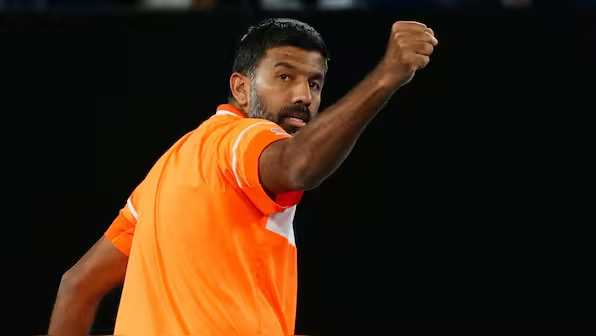
Rohan Bopanna officially retired from tennis in November 2025 at the age of 45. Image: Reuters
In an interview with ATP Tour last year after his retirement announcement, Rohan Bopanna had this to say when asked about his career – “I think my career is a story of patience, discipline and self-belief.”
He wasn’t exaggerating. Ask any sports psychologist worth his or her salt and they will tell you that Rohan Bopanna’s tennis career can be a case study in those three simple and yet absolutely invaluable qualities – patience, discipline and self-belief. After all, he went from almost quitting the sport in 2021 to enjoying the best phase of his career in which he won the Australian Open men’s doubles title in 2024 and became the oldest man to climb to the very pinnacle of the ATP doubles rankings.
With Bopanna bringing the curtain down on his tennis career last year, Indian tennis bid adieu to the last of the “Fab-Four” who conquered the Grand Slams. A look back at his incredible journey in which he truly peaked past the age of 35 and continued to play at the highest level despite “no cartilage” in his knees due to “severe long-term wear and tear”, makes for fascinating reading.
The tennis journey, for Rohan, began later than most others who take up the sport professionally. Studies have shown that most tennis pros pick up the sport between the ages of four and seven. Rohan was 11 when he started playing tennis – an age when most of his peers were already mastering tactical and technical skills. Most coaches will tell you that it is very, very difficult for someone to start playing tennis at 11 and then go on to become a professional player on the Tour. It takes significant talent, training, investment and also mental toughness. In his case it was the challenges that drove him to excel.
“I started playing tennis relatively late at age 11, though sports were always central to my life in Coorg. Initially driven by curiosity and competition, I quickly fell in love with the individual challenge of being on court and figuring things out on my own,” Bopanna told Firstpost in an exclusive interview.
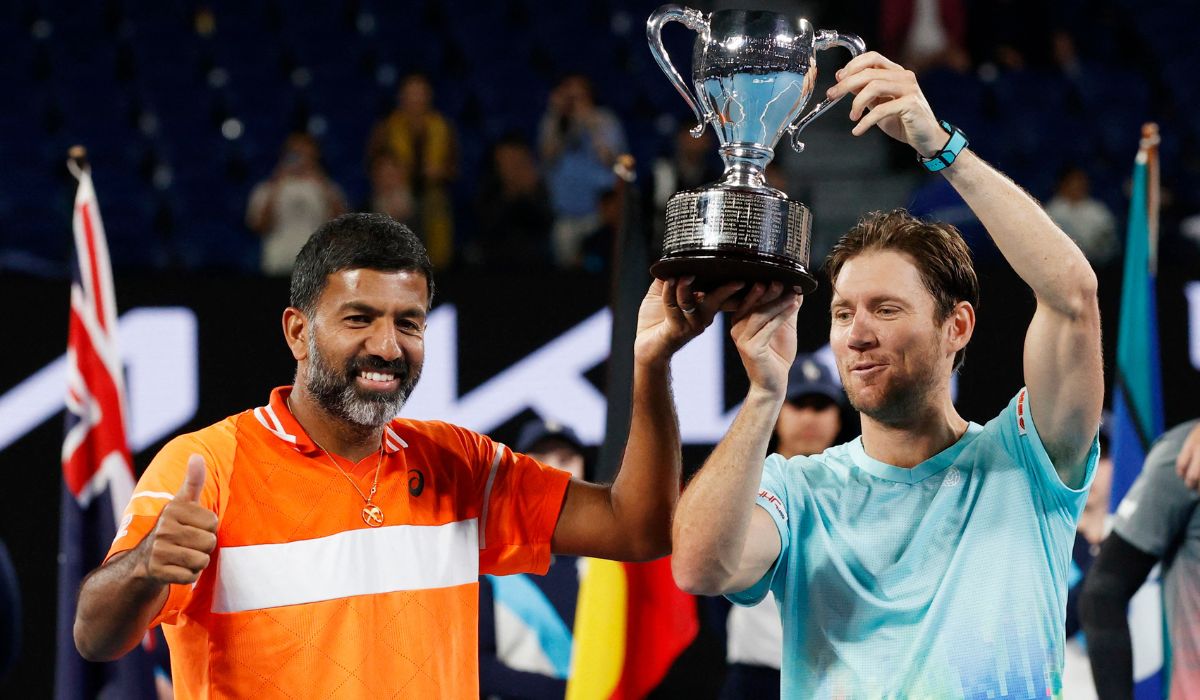
Rohan Bopanna won the Australian Open men’s doubles title in 2024 at the age of 44. Image: Reuters
Bopanna on forming Indo-Pak Express with Aisam
Bopanna was born and grew up in picturesque Coorg. Dubbed “the Scotland of India”, Coorg is of course famous for its coffee plantations, moss-covered hills and stunning Western Ghats landscapes. What it is not known for are tennis academies. His father played a pivotal role in helping him pursue his passion, including building a tennis court on their coffee plantation estate in Coorg. That gave him the wings he needed to fly. He moved to an academy in Pune when he was 14 and had to go through quite the grind. Though he turned professional in 2003 and played both singles and doubles (reached a world ranking of 213 in singles in 2007), it wasn’t until 2010 that he really understood the path he needed to exclusively follow – the path of the doubles game. In 2010 Bopanna reached the final of the US Open men’s doubles with Aisam-ul-Haq Qureshi, the other half of the famous “Indo-Pak Express”. And that was what convinced Bopanna that he needed to focus on the doubles game.
“Reaching the 2010 US Open final with Aisam was a major turning point. It gave me the clarity that I could compete consistently at the highest level in doubles. I decided to commit fully to the format to maximize my strengths,” Bopanna further told Firstpost.
The Indo-Pak Express followed up that US Open success with the 2011 Paris Masters title. The duo in fact, went on to win titles on all three surfaces (grass, clay and hard) and the list includes the 2011 Stockholm Open, the 2011 Halle Open, the 2010 South Africa Tennis Open, and the 2014 Dubai Tennis Championships. Bopanna and Aisam subsequently also reunited in 2021 after a seven-year split. Overall, across doubles and mixed doubles (in which he won the 2017 French Open title) the list of Bopanna’s tennis partners makes for very impressive reading. It includes Mahesh Bhupathi (played with him in the 2012 London Olympics), Leander Paes (played with him in the 2016 Rio Olympics), Divij Sharan (won the 2018 Asian Games men’s doubles gold medal with him), Edouard Roger-Vasselin (reached the 2013 Wimbledon semi-finals with him), Matthew Ebden (won the 2024 Australian Open with him), Aisam, along with Ivan Dodig, Denis Shapovalov, Pablo Cuevas, Florin Mergea, and N Sriram Balaji. In the mixed doubles he played alongside the likes of Gabriela Dabrowski (won the 2017 French Open title with her), Sania Mirza (reached the 2023 Australian Open final and the semi-finals of the 2016 Rio Olympics), Timea Babos (reached the 2018 Australian Open final) and Rutuja Bhosale (won the 2022 Asian Games mixed doubles gold medal with her).
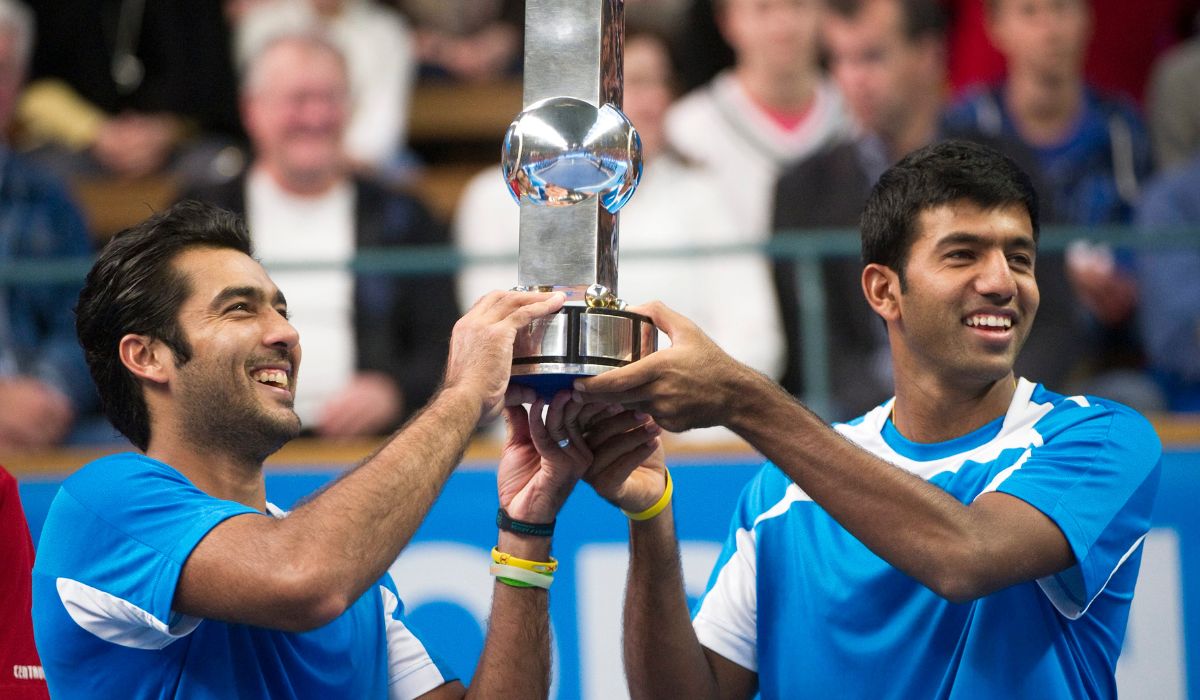
Aisam-Ul-Haq Qureshi of Pakistan and a young Rohan Bopanna celebrate a win in 2011. Image: Reuters
“I shared a natural chemistry with Mahesh Bhupathi and Aisam-ul-Haq Qureshi that translated into great results. In mixed doubles, playing with Sania Mirza was special because our deep friendship built a foundation of trust on the big stages,” Bopanna further shared with Firstpost.
Notably, Rohan and Aisam launched the “Stop War, Start Tennis” peace campaign and were conferred with the 2010 Arthur Ashe Humanitarian of the Year award for promoting peace through tennis.
When Bopanna came close to quitting tennis
Like any other professional sports career, Bopanna’s too, saw some real dark lows. He came very close to quitting the sport twice – once in 2019 and then again in 2021. The first was after he discovered that he had “no cartilage” left in his knees, which of course severely affected his mobility and left him in a lot of pain. Bopanna in fact has gone on record in the past to say that he was having two to three painkillers a day. What really helped was Iyengar yoga – something he began practising during the Covid pandemic, doing one and half hour sessions, four times a week. The second really low phase was when he just wasn’t managing to win matches post Covid. The “hard quarantine” he was under in Melbourne was beginning to take its toll. After the Covid lockdowns were lifted and he went back to pro tennis, Bopanna lost his opening seven tour-level matches, going five months without a win. The then 41-year-old seriously contemplated retirement at the time. It is famously documented how a conversation with his wife, Supriya, who asked him to treat this as “a new challenge rather than a limitation” made him change his mind. What followed was the best phase of his career. It was then that Bopanna, as he told ATPTour.com- “started playing my best tennis.”
“Tennis has made me mentally resilient, teaching me to stay grounded through both success and failure. Beyond the court, I am grateful for the global community I’ve built; I have friends in nearly 50 countries who offer a perspective on the world that goes far beyond the tour,” Bopanna further told Firstpost.
Anyone who has tracked Bopanna’s career will, of course, be curious to know just how it felt to have that incredible second wind, where he found himself as the oldest first-time world number one in men’s doubles, at 43 – something that he ensured for himself when he and Ebden beat Argentina’s Maximo Gonzalez and Andres Molteni in straight sets at the 2024 Australian Open. So, what did that mean to him? I had to ask him that.
“Reaching World No. 1 was special because it represented longevity and the belief that age is not a limitation if you take care of your body and stay hungry for success,” was Rohan’s answer – something that can well be a mantra for youngsters who are just picking up the sport.
Of course, Bopanna and Ebden didn’t just stop there – they went on to win the whole thing, beating Simone Bolelli and Andrea Vavassori in the final. He was 43 years, 10 months, and 24 days old. This was a significant achievement for Bopanna, who in 17 previous appearances at the Australian Open had never progressed beyond the third round in the men’s doubles draw. It was also yet another indicator of just how successful the late blooming phase, if one can call it that, was for one of Indian tennis’ biggest legends. The cherry on the cake (though technically the announcement was made one day before the final) was Bops being conferred with India’s fourth-highest civilian honour – the Padma Shri. He had come a long way from deciding to focus on the doubles game in 2010. A few smart decisions yielded great returns in ensuring that he continued to remain a force to be reckoned with well into his 40s.
“The 2010 US Open gave me the initial belief. The second turning point came much later when I invested in a full-time physio. Prioritizing recovery and smarter scheduling allowed me to extend my career and play my best tennis into my 40s,” Bopanna further told Firstpost.
Bopanna reveals his sweetest victory
Apart from his achievements on the Tour, Bopanna has served Indian tennis diligently over many, many years. Apart from winning two Asian Games gold medals – one each in the men’s doubles and mixed doubles – he has represented the country in three editions of the Olympics (2012, 2016, 2024) and also played Davis Cup for India over two decades – from 2002 to 2023, collecting the Arjuna Award (2018) and of course the Padma Shri (2024).
So, I asked him – “You have two Grand Slam titles under your belt, but you also have two Asian Games gold medals and won multiple Davis Cup matches. Looking back at your career, if you had to pick the sweetest victory of them all, which one would it be?”
This is Bopanna, who famously told the chair umpire that a ball that had been ruled out when struck by his opponents in a crucial phase of the final of the 2023 US Open men’s doubles had actually touched his elbow. No one saw that happen and the point had already been awarded to Bopanna and Ebden. So, I was of course expecting an honest answer.
“The Australian Open title is a career highlight as the culmination of years of effort. However, representing India in the Davis Cup or Asian Games always carries a unique emotional value,” the two-time Grand Slam champion said.
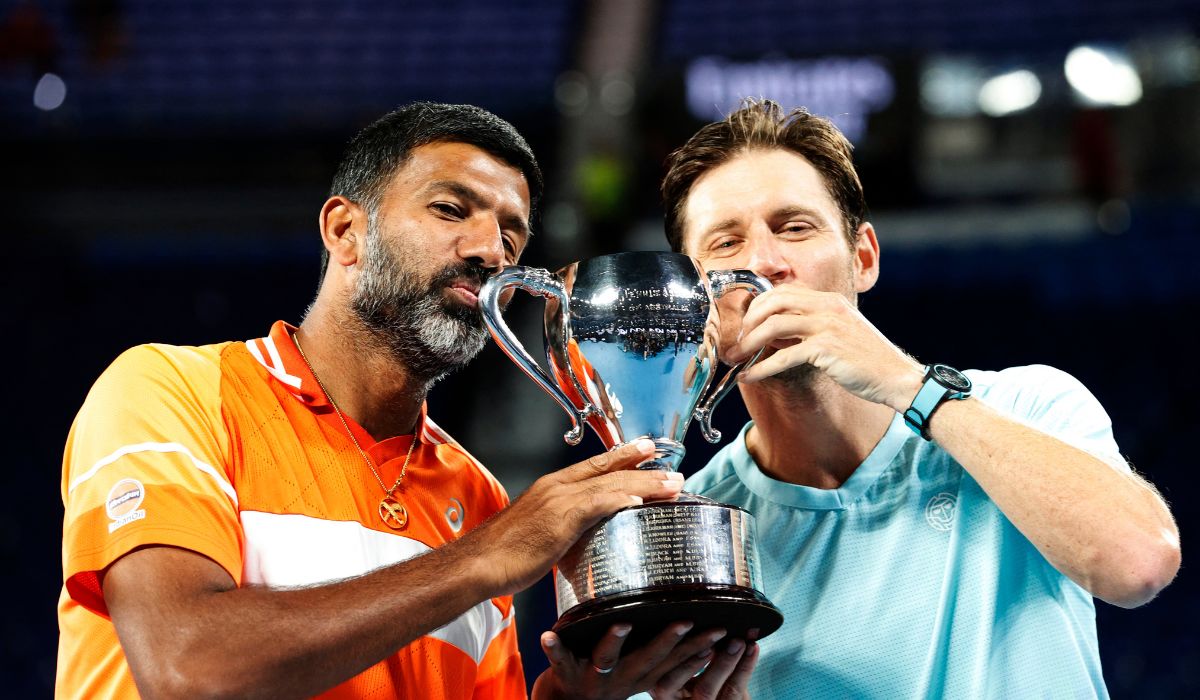
Bopanna and Australia’s Matthew Ebden celebrate the men’s doubles final win at Australian Open. Image: Reuters
Post retirement, Bopanna’s biggest focus now is to help Indian tennis as best as possible. The Rohan Bopanna tennis academy is doing some great work, targeting structured coaching pathways for youngsters that fuels holistic development and high-performance training and mentorship. And you can bet that three of the core personal values being taught there are – patience, discipline and self-belief.
source: http://www.firstpost.com / FirstPost. / Home / by Akaash Dasgupta / April 27th, 2026


