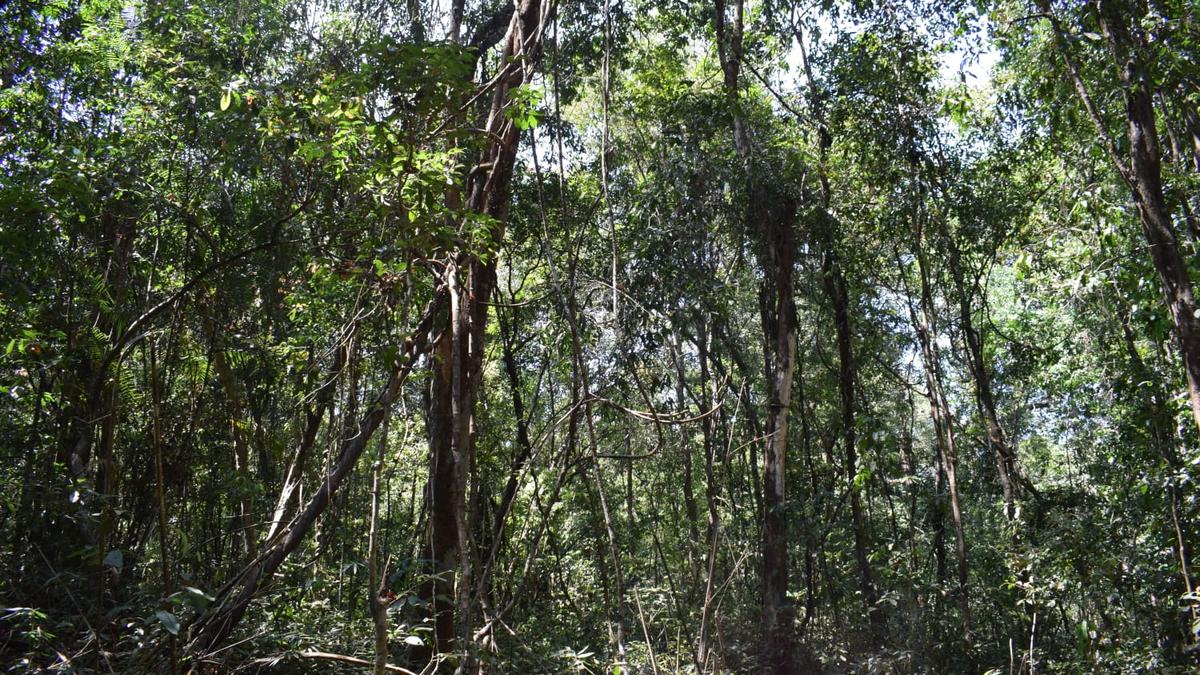
A study by researchers of the French Institute of Pondicherry at the Uppangala forest in Kodagu, Karnataka, showed how lianas, or creeper vines, hold key to framing green legislation. | Photo Credit: Special Arrangement
With their knack for piggybacking towering trees in evergreen forest ecosystems to access sunlight and nutrients, the lianas, a type of creeper vines, may appear to have patented a survival guide to grow and thrive inside the deep jungles.
Research at the French Institute of Pondicherry (IFP) offers new insights on the “intelligence” of this flora species and the dynamics at play in the liana–host interaction networks that could be crucial determinants of conservation strategies and for robust green legislation.
The study, set in the Uppangala evergreen forest in central Western Ghats of Kodagu district, Karnataka, led by Vincy K. Wilson, IFP associate researcher and researcher N. Ayyappan, delved into the survival traits and adaptive tricks of lianas, from minimalist sustenance to extroversion in networking with other tree species.
According to the researchers, despite the increasing number of liana studies in India, few have examined the distribution and association of hosts with lianas, or liana–host interaction networks to determine their functional significance and conservational value.
“Our objective was to fill the knowledge gap about the diversity, abundance, and network structure of liana–host interactions in response to logging disturbance in a typical wet evergreen forest”, said Ms. Wilson.
The study focused on lianas spread in an area demarcated into six one ha plots — four plots that had been selectively logged and two unlogged compartments. Before the 1988 ban on logging, specifically in the 1974-83 period, the site was subjected to extensive manual logging of trees, predominantly the dipterocarpus species.
Presenting a comparative investigation of the biodiversity variation of regeneration in the logged and unlogged sites in the Western Ghats, the IFP research found that the total regeneration density was 1,860 individuals, and species richness was 98 species representing 31 families. Logged sites had higher Shannon and Simpson diversity indices. Five species, namely Humboldtia brunonis, Vateria indica, Knema attenuata, Dipterocarpus indicus, and Psychotria nigra, collectively accounted for 36% of the overall density and exhibited a greater important value index.
While approximately 40% of the adult tree species at the logged site and 46% of the unlogged site were not represented in the regenerating species, the occurrence of ten species that are considered rare in unlogged plots was found to be more prevalent in logged sites.
Liana-tree interactions are a good indicator of nestedness (high frequency of interactions) and a sign of a robust system that allows species replacement. On the contrary, anti-nestedness points to fragility, where the removal of a single element in the network can potentially lead to a system collapse.
A striking aspect of the lianas is how they achieved the goal of height, instead of breadth, by willingly sacrificing supporting tissue, said Ms. Wilson, who had a few months ago, shared some research findings at a presentation, “Green Genius: Nature’s Amazing Tricks to Survive and Thrive”, at the Alliance Francaise.
“Their aim is to reach the canopy where they will get light… so they do not invest in lateral branches unlike trees”, she noted.
A significant takeaway from the IFP study was that a higher density and diversity in the logged sites may only signify robustness at a superficial level, as a deeper probing of modularity and nestedness, showed that logged systems exhibited anti-nestedness, low connectors, high modularity, high specificity — all clear signs of a fragile system.
“This understanding is important for implementing good laws. We need to continuously monitor the system to know the forest dynamics and the network properties in order to evolve appropriate and robust conservation laws and interventions”, said Ms. Wilson.
source: http://www.thehindu.com / The Hindu / Home> News> Cities> Puducherry / by Dinesh Varma / March 30th, 2026

