Retired Col. Madeyanda C. Appanna (Rajappa), son of late M. K. Chengappa and a resident of KHB Colony, Hootagalli, Mysuru, passed away yesterday. A native of Ballamavati in Napoklu, Kodagu, he was 80.
He leaves behind his wife, two sons and a host of relatives and friends.
Last rites were performed at Muktidhama in Vijayanagar 4th Stage this noon.
source: http://www.starofmysore.com / Star of Mysore / Home> Obituary / April 02nd, 2023
The following are the new office-bearers of Kodava Students Association (KSA), Mysuru: Iychettira Bheemaiah – President; Maletira Laksh Dechamma – Vice-President; Ponnappa Bepadiyanda – Secretary; Iychettira Bhumika – Joint Secretary; Karun Karera – Treasurer; Viharika Appaneravanda – Joint Treasurer and Gowthami Kokkalemada – Cultural Leader.
source: http://www.starofmysore.com / Star of Mysore / Home> News / March 31st, 2023
Indian rally pair of Mangaluru’s Jason Deepak Saldanha and co-driver Thimmu Uddapanda Bopanna from Kodagu made a stunning international debut by winning the national RAAT Thailand Rally Championship in their class at the Kanchanaburi stages here on Sunday.
Driving a Suzuki Swift 1.6L six-speed stock car in the RC2.1 class for Team Rally Insight, the top Indian rallyists made their way to the top of the class while achieving a creditable overall fourth among a strong field of 56 entries in different classes, including the top Rally 1 Super 4w drive class.
Beating rivals with superior and powerful cars, the Bengaluru pair, who recently took part in the South India Rally, performed beyond expectations.
With limited options, and only a few minutes of testing the new car and the new terrain, they excelled with a display of controlled speed and fine rally skills in the final six special stages ton Sunday and improved to fourth overall and first in their class, apart from the second place in the 2WD Cup that are held concurrently.
They clocked 1hr and 17 minutes.
The two Indian coffee planters will return to take part in the six remaining rounds of the Blueband Sports FMSCI Indian National Rally Championship (INRC) under Dark Don team but will also explore opportunities to extend their international experience.
(This story has not been edited by Devdiscourse staff and is auto-generated from a syndicated feed.)
source: http://www.devidiscourse.com / Devidiscourse / Home> News> Sports> Article / by PTI , Kanchanapuri / March 26th, 2023
B R Rathnaker Shetty, senior advocate of Virajpet and organizations was unanimously elected president of District Bantara Sangha in their general body meeting held at Agnonima resort, Virajpet on Sunday, January 8. He is active in several local groups.
The elections were held in the meeting presided over by their former president Narayana Rai. Balakrishna Rai and Narayan Rai were elected honorary presidents. Shabarish Shetty, Virajpet was elected chief secretary. The new office bearers and presidents of five taluks were elected during the meeting.
B Rathnaker Shetty who fought the highest number of cases in Virajpet and Kodagu courts was felicitated in his office for his special achievements by Virajpet taluk, Tuluverena Janapada Koota.
District committee members B M Ganesh, Divya, Bharath Rai, Vinod Poojary, B G Anita, Sharath Rai, Ganesh Perambadi and taluk president K C Shabarish Shetty were present.
source: http://www.daijiworld.com / Daijiworld.com / Home> Karnataka / by Daijiworld Media Network – Kodagu (EP) / January 10th, 2023
According to a report by global business analysts Euromonitor International in January 2022, coffee consumption in Saudi Arabia grew by 4 percent per year between 2016 and 2021. File
Riyadh :
The coffee industry in Saudi Arabia is set to receive a huge boost after the Kingdom’s Cabinet approved the sector joining the International Coffee Agreement.
The move will see the industry join the world’s top producers of the commodity to keep coffee prices high and stable in the market, mainly using export quotas to steer the prices.
Approval for the move comes after Saudi Arabia designated 2022 “The Year of Saudi Coffee” in the wake of local production hitting 1,810 tons in the previous 12 months, according to the Saudi Press Agency.
According to a report by global business analysts Euromonitor International in January 2022, coffee consumption in Saudi Arabia grew by 4 percent per year between 2016 and 2021 and is forecast to increase by a further 5 percent annually up to 2026, reaching an expected consumption of 28,700 tons each year.
In a bid to boost the Kingdom’s coffee production, the Public Investment Fund launched the Saudi Coffee Co., which aims to ramp up production by more than 700 percent within five years.
Saudi Arabia is among the top 10 countries in terms of coffee consumption. According to the SPA report, the Kingdom imports approximately 70,000-90,000 tons of coffee every year and Saudis spend more than SR1 billion (266.3 million) on coffee.
The Ministry of Environment, Water and Agriculture is working to make the Kingdom self-reliant by increasing domestic production and increasing the industry’s contribution to the national gross domestic product.
In order to achieve these goals, the ministry has established a coffee research unit at the Agriculture Research Center of Jazan province. The unit provides guidance to coffee farmers and helps them resolve issues they face in the cultivation and production of good-quality coffee.
The coffee tree is grown in 70 countries worldwide and is an important source of income, with the bean produced in southern Saudi Arabia considered one of the most delicate types.
Moreover, an agreement was signed in 2018 between the Kingdom and the International Fund for Agricultural Development to provide technical assistance to improve the coffee strain.
The ministry also launched the Sustainable Agricultural Rural Development Program to promote coffee cultivation on a large scale.
In the past few years, coffee bean farms in Jazan have been given special attention as support for farmers has increased, and special care has been given to the Khawlani bean, which is one of the world’s finest coffees.
There are currently more than 2,500 Khawlani coffee plantations with a total of approximately 400,000 trees — although current production is mostly consumed locally.
source: http://www.arabnews.com / Arab News / Home / March 29th, 2023
Sakamma embodies the true spirit of Swadharma and entrepreneurship. She found her calling, created a successful enterprise, and contributed to the society.
Credit: Nammuru.com
It is that time of the year when people across the globe do their bit by putting out messages celebrating International Women’s Day and supporting gender diversity and inclusion. A time when people unilaterally wax eloquently on what it takes to empower women.
Empowering women to be independent and pursue their entrepreneurial dreams has been getting significant push and support in the recent past. While this is commendable, our history has several stories of women whose entrepreneurial journey is replete with tenacity, vision, and ambition. Such women entrepreneurs are truly inspirational, and remain eternal role models.
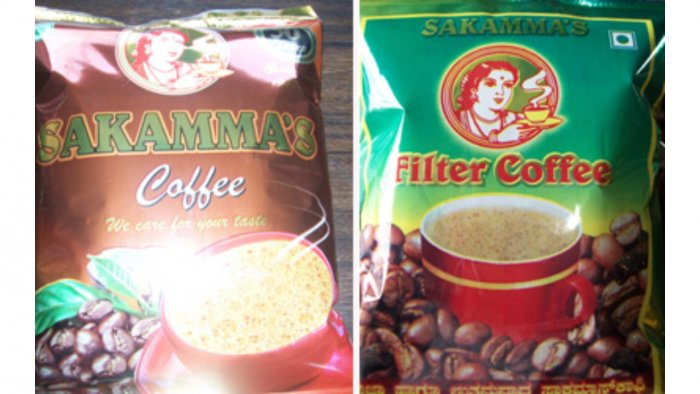
One such lady whose commendable journey has inspired thousands of people, including me, is Coffee Pudi (Coffee Powder) Sakamma. Her name is not often heard in the annals of Indian entrepreneurs. Sakamma’s Coffee Works became a household name in the 1920s. Kannadigas for long have had a tryst with coffee. Sakamma Coffee Works played a pivotal role in the early 20th century bringing authentic cured and powdered coffee to the people of the princely state of Mysore. Sakamma did not stop after building a successful coffee business. She used her learnings to help plan the industrial development of the princely state.
Sakamma had an interesting journey which started with being one of the very few girls who passed the secondary school examinations of the Mysore Province almost a century ago. She was married off young due to financial constraints, and lost her husband just a few years into marriage.
Her husband was a very rich coffee planter from Somavarapete, in Coorg (Kodagu). Widowed at 18, Sakamma decided to put her education to use, and began running the coffee estate. She shifted to Bangalore, and opened a coffee curing cum powdering unit near Bull Temple Road in 1920. Very soon, her coffee mix was a hit throughout the city, and Sakamma Coffee Works became an integral part of Bangaloreans’ life. Inspired by the overwhelming response, the young entrepreneur set up centres in different parts of the city. Her success got her the nickname Coffee Pudi Sakamma.
Sakamma’s journey has left a deep impression on me. Her true genius lies in the fact that she used her understanding of business, people, and resources well to involve in social causes. Recognition of her extraordinary entrepreneurial capability came by way of an invitation by the then government of Mysore to help plan the industrial development in the state. Sakamma invested and founded the Kuruhina Shetty Kendra Sangha and Hostel in present-day Basavanagudi, and even set up a choultry (an inn for travellers) near the hostel called Sakamma Bhavan.
Not stopping there, Sakamma went on to break other glass ceilings too, and became the first woman to be nominated to the erstwhile Mysore Representative Assembly in 1928. She won several awards and recognitions for her stupendous achievements. Sakamma embodies the true spirit of Swadharma and entrepreneurship. She found her calling, created a successful enterprise, and contributed to the society in her own way.
Business and entrepreneurship are inherently weighed on their level of success and profitability. Often, as entrepreneurs who have built empires, we are too busy chasing more profits. It is very easy to be caught in our own trappings of profit-chasing and business success — they make a heady concoction. In this chase, we miss involving the society and the community around them into our model of growth.
I believe that there is no trade-off between these two — these are not either-or. The reality is that no person (or no business!) is an island. Every entrepreneur must incorporate the good of the community and the society into building a profitable business. This only happens when you identify your Swadharma (or purpose), and embed it deep into the heart of the business that you are building.
At 1Bridge, the rural enterprise that I run, our purpose is to improve the incomes of rural entrepreneurs and unleash their entrepreneurial energies. Our success solely depends on the growth of the local community of entrepreneurs and their earnings, and this drives our business growth. This approach is fundamentally different from that of corporate social responsibility (CSR) or a philanthropic ‘giving back’, but one that weaves the ‘social’ aspect of ommunity development into the enterprise model of sustainable growth.
It is, of course, much harder to find models at this intersection, but isn’t entrepreneurship all about taking on tough challenges head on? This is certainly one challenge that I feel is worth solving.
(Madan Padaki is Co-founder, Global Alliance for Mass Entrepreneurship, and President, TiE Bangalore.)
Disclaimer: The views expressed above are the author’s own. They do not necessarily reflect the views of DH.
source: http://www.deccanherald.com / Deccan Herald / Home> Opinion / by Madan Padaki / March 14th, 2023
Whisk away your friends and folks to the mystical mountains of Coorg for a truly splendid wedding celebration. Step into your fabled forever surrounded by grandeur, nature’s bounty and impeccable hospitality.
The infinity pool at Coorg Wildnerness Resort & Spa bedecked for your special day.Delightful delicacies from the talented chefs of Coorg Wilderness Resort & Spa set at the decks of the resort.Helping you create beautiful memories amidst the hills of Coorg. Take your vows as the hills and valleys of Coorg stand witness.A dining experience like no other, at Habba, the resort’s multi-cuisine restaurant.
Gone are the days when wedding celebrations were limited to the grandest banquet hall in your hometown. Today, couples are going the extra mile to ensure their fairytale nuptials are an endearing memory that guests will relish for years to come. And what better way to craft a dreamy wedding than to fly to an exotic location? Allow us to introduce you to the Coorg Wilderness Resort and Spa. A grand luxury resort tucked amidst the lush wilderness of Coorg, this destination boasts every ingredient in the recipe for delightful weddings.
Be it a lavish occasion or an intimate affair, the experienced staff ensures your special day is every bit as perfect as you imagined. With inspired cuisines presented in grand buffet spreads or elaborate course banquets, trust that every whim and fancy of yours will be catered to.
Let wilderness celebrate with you! Our outdoor deck bedecked with wedding finery.
The resort brightens the canvas of festivities with an array of delightful services including experienced florists, decorators, photographers, live entertainment, and much more.
A peek into the property
The 4th of Paul John Resorts and Hotels’ premium luxury properties, Coorg Wilderness Resort and Spa offers 60 acres of virginal wilderness. The resplendent banquet hall—The Queen’s Court—proffers 2,000 sq ft of splendid space, ideal for pre-wedding festivities and kickstarting the celebrations with some pomp and show. Proceed to The Grand Ballroom to exchange your vows. This stunning, pillarless area of 3,500 sq ft with regal ceilings that tower high at 18 ft promises the perfect backdrop and grandiosity for the big day. One can also choose from the wide array of outdoor venues, be it by the infinity pool surrounded by hills and valleys, or the immense deck set right in the midst of lush wilderness or even at the peak of a hill with the setting sun as witness.
For that stylish, glamorous evening! The Grand Ballroom in its grandest finery.
In addition to the larger-than-life celebratory venues, the accommodation elevates the experience further. For starters, the luxurious European-style suites which span over 1,350 sq ft are tailor-made for a truly exotic experience. They feature plush interiors, electric fireplaces and large bay windows which promise a glimpse of the fleeting sights of nature and offer unmatched views of the famed hills of Coorg. The cosy studio rooms are reminiscent of elegant chalets nestled amidst the dense woods.
In a nutshell, the property harbours 52 stately studio rooms and 52 palatial suites to ensure your guests revel in the creme-de-la-creme of hospitality. We’re talking divine views, heated floors, cosy-chic decor and unbridled luxury.
An assortment of amenities
Spruce up the wedding festivities with the property’s unique offerings like a coffee-tasting experience, treks through untrodden trails, fish feeding, a rejuvenating dip in the infinity pool, and unparalleled proximity to the flourishing flora and fauna. The property also guarantees a treat for the palate with its myriad dining options. For a South Indian and coastal feast, head to ‘Vembanad’. To sample the bar menu, head to Tipsy, or enjoy sumptuous finger food and all-day dining at ‘Habba’.
Let wilderness celebrate with you! Our outdoor deck bedecked with wedding finery.
That’s not all: you can also pamper your guests with some tender loving care at the resort’s 18-room spa block with advanced traditional and western treatments.
Just a two-hour drive from the Kannur Airport, and three kilometres from the town of Madikeri, the resort is conveniently located and ensures all the tourist attractions are just a stone’s throw away.
source: http://www.vogue.in / Vogue, edition India / Home> Weddings / published by Coorg Wilderness Resort and Spa / by Yashita Vashishth / March 30th, 2023
5 varieties of Indian Coffee get GI Certification, a recognition that helps growers to get the maximum price for their premium coffee.
The Department for Promotion of Industry and Internal Trade, Ministry of Commerce and Industry, Government of India has recently awarded Geographical Indication (GI) to five varieties of Indian coffee. They are:
Coorg Arabica coffee is grown specifically in the region of Kodagu district in Karnataka.
Wayanaad Robusta coffee is grown specifically in the region of Wayanad district which is situated on the eastern portion of Kerala.
Chikmagalur Arabica coffee is grown specifically in the region of Chikmagalur district and it is situated in the Deccan plateau, belongs to the Malnad region of Karnataka.
Araku Valley Arabica coffee can be described as coffee from the hilly tracks of Visakhapatnam district of Andhra Pradesh and Odisha region at an elevation of 900-1100 Mt MSL. The coffee produce of Araku, by the tribals, follows an organic approach in which they emphasise management practices involving substantial use of organic manures, green manuring and organic pest management practices.
Bababudangiris Arabica coffee is grown specifically in the birthplace of coffee in India and the region is situated in the central portion of Chikmagalur district. Selectively hand-picked and processed by natural fermentation, the cup exhibits full body, acidity, mild flavour and striking aroma with a note of chocolate. This coffee is also called high grown coffee which slowly ripens in the mild climate and thereby the bean acquires a special taste and aroma.
The Monsooned Malabar Robusta Coffee, a unique specialty coffee from India, was given GI certification earlier.
In India, coffee is cultivated in about 4.54 lakh hectares by 3.66 lakh coffee farmers of which 98% are small farmers. Coffee cultivation is mainly done in the Southern States of India:
Karnataka – 54%
Kerala – 19%
Tamil Nadu – 8%
Coffee is also grown in non-traditional areas like Andhra Pradesh and Odisha (17.2%) and North East States (1.8%).
India is the only country in the world where the entire coffee cultivation is grown under shade, hand-picked and sun dried. India produces some of the best coffee in the world, grown by tribal farmers in the Western and Eastern Ghats,which are the two major bio-diversity hotspots in the world. Indian coffeeis highly valued in the world market and sold as premium coffee in Europe.
The recognition and protection that comes with GI certification will allow the coffee producers of India to invest in maintaining the specific qualities of the coffee grown in that particular region. It will also enhance the visibility of Indian coffee in the world and allow growers to get maximum price for their premium coffee.
source: http://www.indiaeducationdiary.com / India Education Diary.com / Home> National News / May 17th, 2023
Directed by Sanjay Sharma, Thimayya & Thimayya produced by Rajesh Sharma also features Anant Nag, Diganth, and Aindrita Ray.
A still from Thimayya & Thimayya
Shivarajkumar-starrer Vajrakaya (2015) marked model-turned-actor Shubra Aiyappa’s first step in the movies. After a long gap of seven years, she is back in Kannada cinema with Thimayya & Thimayya, which is set to release this week. “I had a film, titled John Seena, directed by Suni, which had me playing a unique role. Unfortunately, it did not take off,” says Shubra.
Directed by Sanjay Sharma, Thimayya & Thimayya produced by Rajesh Sharma also features Anant Nag, Diganth, and Aindrita Ray. When asked about the delay between her acting assignments, Shubra says, “When I entered the cinema, I didn’t have any formal training in acting. So I went to the New York Film Academy to do an acting course. Then, there was the pandemic, which gave people the feeling that I took a really long break. In fact, I did have some roles come my way, but I couldn’t really take them up. It was only Thimayya & Thimayya that excited me enough to get back to the cinema.”
Owing to the sabbatical, many might not know of Shubra’s passion for acting. “In my head, I’m an actor. But the sabbatical did not prove my acting capabilities. In fact, at NYFA, I topped the class. But practically, things didn’t work out the way I wanted them to. So when I got a call from makers of Thimayya & Thimayya, I was happy and excited,” says Shubra, who adds that she is optimistic and feels that everything happens for a reason.”This is my time. Hope people notice my performance in Thimayya & Thimayya, and it will be a good restart to my career.”
Talking about her role in Thimayya & Thimayya, the actor says that her character ‘Sowmya’ is similar to who she is. “When I got the narration from Sanjay Sharma, I felt the character was some. I am a very ambitious person. I am very organised. In the film, I play the hero’s backbone, mainly because he doesn’t have these attributes. It is my character that stabilises him and puts the character back on track. I play an important role in his journey.”
Talking about ad filmmaker-turned-director Sanjay Sharma, Shubra, who understands the world of modelling and advertising, says, “Sanjay understands the importance of the right work ethic, and the value of time. I felt he was a perfectionist, who never tolerated mediocrity. He ensured all the actors gave their best. It was nice to work with somebody like him. It was like going back to film school.
With Thimayya & Thimayya, Shubra also fulfilled one other dream and was dubbed for herself in the film. “I’m happy to have dubbed for Sowmya,” says Shubra, listing out the roles coming her way post her sabbatical.
Apart from the Rishi-starred Ramana Avatara, Shubra will also be seen in the Tamil film, Aganya. “The film is about a father-daughter relationship, and I am working with Aadukalam Naren on the project. I have 10 days of portions to shoot. Meanwhile, I hope Thimayya & Thimayya reminds people that Shubra exists, and more opportunities come my way,” she signs off.
source: http://www.newindianexpress.com / The New Indian Express / Home> Entertainment> Kannada / by Express News Service / November 22nd, 2022
Bengaluru-based omnichannel coffee startup HumbleBean Coffee has launched a Coffee Academy in Coorg to educate people about the ‘complexity and diversity of a humble bean like coffee’.
Bimal might seem like a regular barista. But he’s not content to simply brew and serve cups of coffee. He wants every customer to know what they are going to sip.
“I make sure they know their cup of coffee. I ask about the kind of taste they are looking for, and how strong they want their coffee. Most of the time, they go ahead with what I recommend even if they have something else in mind,” he says.
After losing his job at a high-end restaurant during the pandemic, Bimal joined HumbleBean Coffee as a barista. With no prior expertise in the sector, he was enrolled in a specialised course at HumbleBean. The course helped him understand the beverage better—starting from its plantation to the multiple brewing methods.
HumbleBean Coffee runs a small brew bar tucked away under the lush green cover of Bengaluru’s Lavelle Road. On a regular day, you might find Bimal sniffing and tasting a sample from every cup he brews.
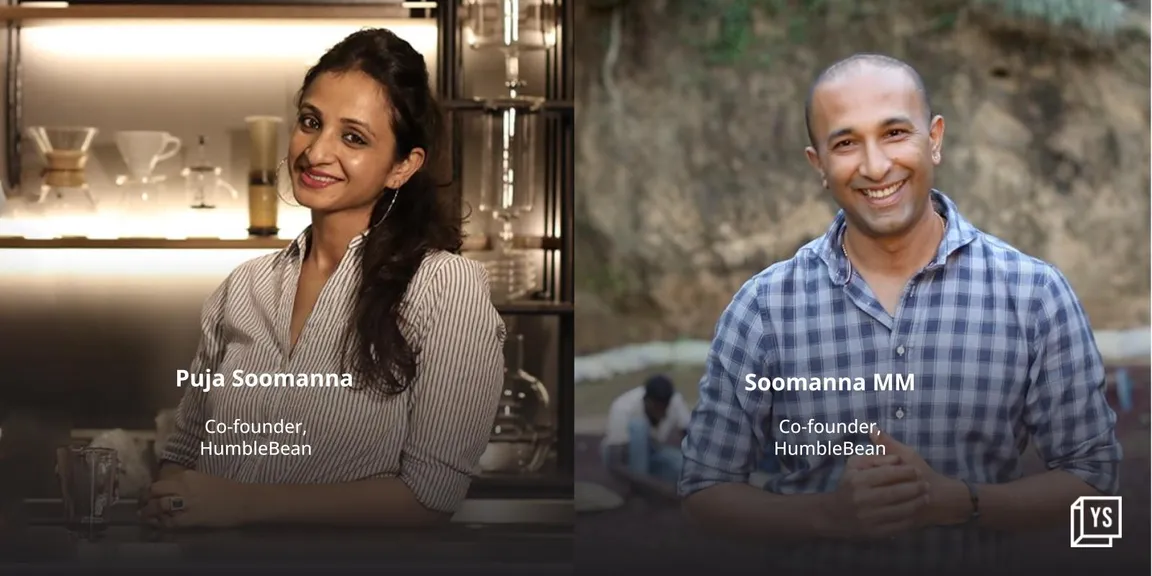
HumbleBean Coffeeis the brainchild of Soomanna Mandepanda and Puja Soomanna. Since 2017, the couple has been on a mission to make coffee consumption a more enjoyable and mindful experience. Their idea is to educate more people about the complexity and diversity “of a humble bean like coffee”.
In 2021, they launched the HumbleBean Coffee Academy in Coorg to spread coffee literacy among the masses. The academy offers short-term courses for coffee enthusiasts, home brewers, students pursuing hotel management, and coffee entrepreneurs.
The team of 22 people, including the co-founders, brew bar staff, and coffee academy experts, is based in Coorg and Bengaluru. At present, HumbleBean has only one coffee brew bar in Bengaluru and an online B2C channel that sells coffee beans of different types and roasts. A new coffee concept store is underway in Indiranagar which would replace the manual brew bar in a few weeks’ time.
As per filings with the Registrar of Companies, HumbleBean made a revenue of approximately Rs 1.1 crore in FY21.
In July 2022, the coffee startup raised an angel round of Rs 4.5 crore from undisclosed investors.
Today, as Soomanna, Co-founder of HumbleBean, prepares his favourite pour-over, he recalls the days when he felt the need to clean up the coffee ecosystem.
_______
“I wanted to get into the coffee ecosystem to build an Indian coffee company of global standards. I also wanted to orient farmers towards quality and help them to stay invested in agriculture,” he says.
HumbleBean Academy, Coorg
________
Spreading coffee literacy
The main objective behind the coffee academy was to ensure everyone in the coffee ecosystem was well informed about the beverage.
The team began by addressing the absence of a feedback system for farmers who grow coffee. A feedback mechanism was essential to bring changes in their farming practices and improve the quality of the produce.
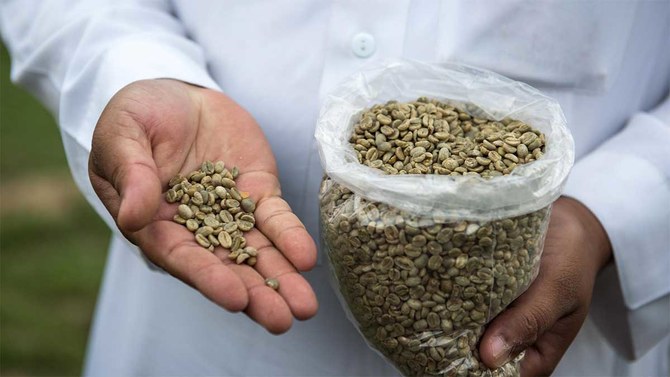
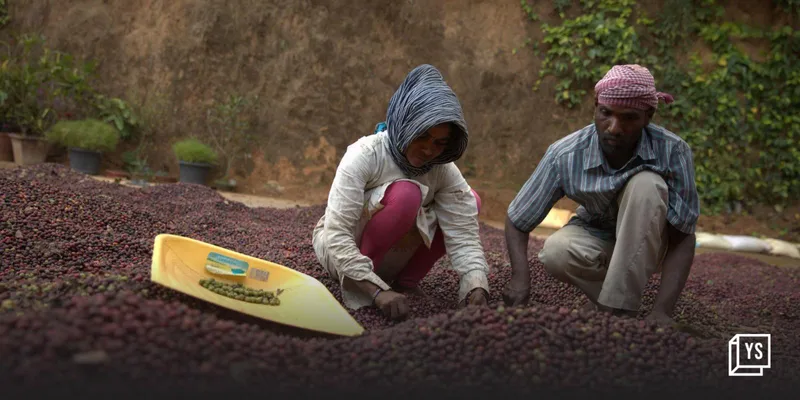
“More than 85% of coffee farmers in India, mostly small and medium farmers, have never tasted their own coffee. They are unaware of how their coffee is appreciated around the world,” Soomanna says.
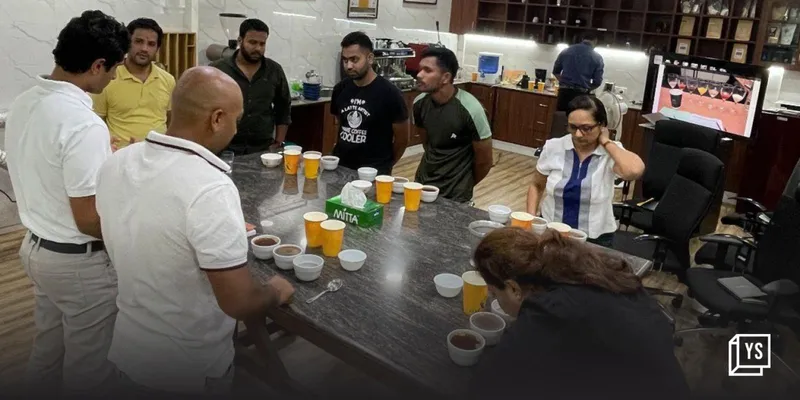
The coffee academy receives free coffee samples from more than 100 farmers across the country. The team prepares extensive reports on the sample quality and offers suggestions to farmers. The farmers bring in suggested changes in farming techniques and send new samples to the academy for further assessment.
“We test the samples again and buy their lot if the quality matches our parameters. Most of the time, we ask the farmers to quote a price instead of us fixing the price,” says Puja, Co-founder of HumbleBean, who looks after the B2C and hospitality side of HumbleBean.
The academy offers courses that focus on the art of brewing, food pairing with coffee, and more. These courses can be as short as one day or three days (for beverage enthusiasts) or as long as three months (for students in hotel management colleges). They are priced between Rs 10,000 and Rs 35,000.
HumbleBean has collaborated with a hotel management college in India to offer these courses for a semester.
Puja believes there is a need to train baristas in the early years of hotel management.
“Being a barista is more than serving a cup of coffee, especially today when manual brewing is finally getting recognised. That’s why we deliberately choose people who do not have any knowledge of coffee and are more receptive to knowledge,” she says.
Puja looks after the barista training course with Gaurav Ganapathi. A certified Q grader (a type of coffee evaluator), Gaurav leads the Coffee Academy in Coorg. He has been in the coffee industry since 2014 and previously worked with Tata Starbucks.
_________
“Coffee is one of the most sustainable industries in the world; there is almost no carbon emission in the production process. The coffee academy is helping everyone in the ecosystem understand coffee as a plant better—its diversity in terms of species and types, different brewing techniques, and more,” Gaurav says.
Pastry chef Sana Kabra, who joined the HumbleBean team in March 2022, works closely with Puja and Gaurav and leads the food pairing courses at HumbleBean.
“Food pairing is an important part of the coffee experience. What kind of pastry would go best with a pour-over, what should be the level of the roast or grind of your coffee to make it go well with a croissant…these things require mindful consumption and a lot of trial and error,” Sana says.
Overcoming the pandemic
Like any other brick-and-mortar business, HumbleBean was hit hard by the pandemic. Their first manual brew bar in Residency Road, Bengaluru, launched in 2019, was shut down due to operational difficulties.
Around the same time, the brand collaborated with a high-end retail outfit GoNative to set up its model brew bar on Lavelle Road.
The HumbleBean team took the pandemic as an opportunity to study and gather data about customer perception of manually brewed coffees, and coffees served from small and medium farms, and studied the unit economics of a coffee brand. They also worked on creating a range of coffee beverages and the delivery mechanism.
“During this lean time, we also consolidated our backend work, the academy, small and medium farm outreach, plantation management, flavour science with regards to food pairing along with coffee. We built a solid core team of subject matter specialists in plantation management, roasting, and flavour science. Most of them are third-generation small farmers who have spent time in large coffee companies,” Soomanna says.
Brewing a bright future
According to a report published by Research and Markets, Indian retail coffee is largely dominated by the southern region and is projected to reach over $253.8 million by 2025, growing at a Compound Annual Growth Rate (CAGR) of 21.04% from 2017 to 2025.
HumbleBean aims to tap this growing market while competing with major global brands like Starbucks, Barista, Tim Hortons, and Indian brands like Blue Tokai, Third Wave Coffee Roasters, Araku etc.
“We know about the competitive landscape but we also know that everyone who walks into our cafe either knows their coffee very well or is passionate to learn more about coffee. We are banking primarily on word of mouth over other marketing strategies,” Soomanna says.
HumbleBean plans to launch its concept store in Indiranagar, Bengaluru. It would also serve as the second location for the coffee academy and as the second manual brew bar.
The startup also has plans to expand to other countries in the Asia-Pacific region.
“The final goal remains the same: establish HumbleBean as an Indian global brand that is sustainable, grounded, and invested in the place of production,” Soomanna says.
(The copy was updated to correct a typo in the name of the co-founder)
source: http://www.yourstory.com / YourStory.com / Home> Startups / by Pooja Rajkumar / September 20th, 2022
WELCOME. If you like what you see "SUBSCRIBE via EMAIL" to receive FREE regular UPDATES.
Read More »