All posts by admin

No let-up in rain in Kodagu, several houses damaged

Harangi reservoir outflow increased to 25,000 cusecs owing to heavy rain in the catchment area, say irrigation officials; IMD issues orange alert for Kodagu district.
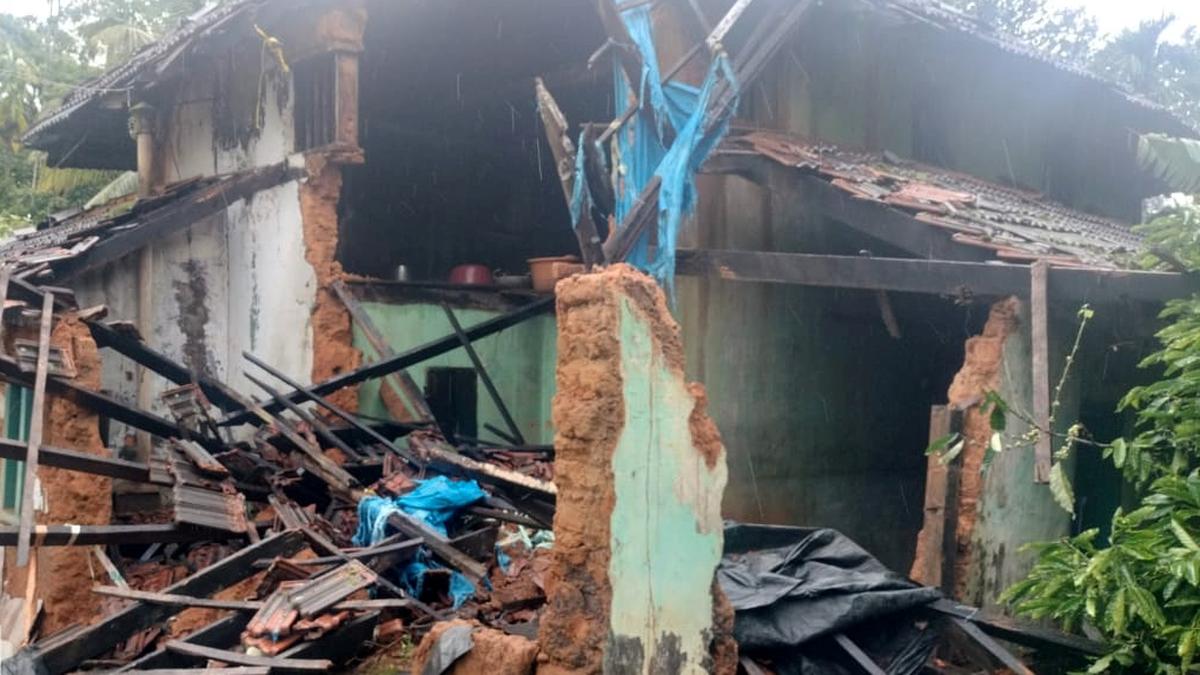
A house damaged due to incessant rain at Kurchi village of Srimangala Hobli in Kodagu district on Sunday. | Photo Credit: SPECIAL ARRANGEMENT

The hilly district of Kodagu continued to be battered by incessant rains, with widespread damage to property reported during the last 48 hours.

The India Meteorological Department (IMD) has forecast more rains for the district and issued an orange alert.

There were incidents of telephone and electricity poles being uprooted and collapsing onto residential buildings, vehicles, or blocking roads and disrupting traffic movement on Sunday.

A portion of the Anganwadi centre in Harduru village in Somwarpet was damaged when a giant tree collapsed in the early hours of Sunday due to heavy rains and a gale that lashed the region.

A family in Madegodu village in Shanivarsanthe was shifted from their house as its walls developed major cracks. A portion of the house also collapsed, and the authorities who took stock of the situation declared the building unfit for occupation due to the imminent threat of complete collapse. The family was shifted to a room behind the house.

Similar reports have emerged from Emmemadu in Napoklu, Uluguli in Suntikoppa, Hoskote, Sampaje, Guddehosur in Kushalnagar and other places. In Surlabbhi village, heavy rains and gales damaged the tiled roof of the local higher primary school.

In Koodumangaluru village, Kushalnagar, a family of two was relocated as their house was damaged due to incessant rains, and the walls were on the verge of collapse when the officials visited to assess the rain damage.

Residents of Biligeri in Somawarpet were shifted to a relief centre as the water level in a local water body was steadily increasing, threatening to maroon the village.

Meanwhile, the Irrigation Department announced that outflow from the Harangi reservoir has been increased to 25,000 cusecs due to heavy rains in the catchment area of the river. Officials from the Revenue Department visited the area near the dam to take stock of the security. This is because the Yadavanadu bridge has submerged due to an increase in outflow from the dam. The public has been advised against venturing close to the dam, and the approach roads have been barricaded as a security and safety measure.

In Kanive village, Kushalnagar, the suspension bridge across Cauvery river was in danger of being submerged. Hence, the officials have erected barricades to prevent people from using it. Similarly, tourists were restricted from visiting the Rameshwara temple due to the surge in water level of the river.

Meanwhile, the Chamundeshwari Electricity Supply Corporation (CESC) said that damage to electricity poles and interruptions to power supply were reported at many places due to multiple incidents of tree falls. However, efforts were on to restore power, and the staff were working on a war-footing to restore normalcy, it added.

The district has received a cumulative rainfall of 89.11 mm during the 24-hour period ending 8.30 a.m. on Sunday. Some of the places which recorded very heavy rains include Napoklu (80.2 mm), Bhagamandala (117.2 mm), Ammati (91.5 mm), Shanthalli (238 mm), Hudikeri (191.8 mm), Srimangala (166 mm), Ponnampet (60 mm) among others.

source: http://www.thehindu.com / The Hindu / Home> News> India> Karnataka / by The Hindu Bureau / July 27th, 2025


Taluk offices to be set up at Ponnampet, Kushalnagar soon: Karnataka Revenue Minister Krishna Byre Gowda

Karnataka Revenue Minister Krishna Byre Gowda on Friday said that the construction of new Taluk Administration Buildings (Prajasaudha) in Ponnampet and Kushalnagar in Kodagu district will begin shortly.

He was speaking to media persons during his visit to the district. The Minister noted that though the two taluks were created more than 7 years ago, taluk offices have not yet been constructed, and said that the projects for the same would be expedited.

The government has sanctioned ₹8.65 crore each for the two buildings, and the tender process has been completed, he added.

Mr. Byre Gowda also inspected the proposed sites for the buildings and visited a bridge near Balyamandur. He said that the government was accelerating efforts to scan and digitally preserve original land ownership records across taluk offices to ensure landowners have guaranteed access to their documents.

“Preserving land records and making them accessible at the fingertips of landowners is the core objective of the Land Security Scheme,” said the Minister. The initiative aims to prevent loss, tampering, or forgery of land records, which often leads to disputes, he added.

With regard to digitisation of land records, the Minister said that the department has already scanned 33.5 crore pages of land records against the target of completing the scan of 100 crore pages of documents and records across Karnataka. This, he said, would serve as a legal guarantee for land records.

Mr. Byre Gowda emphasised the need for strict implementation of recent reforms in the Revenue Department and urged officials to adopt modern technology to deliver citizen services efficiently.

On the issue of recurring landslides in Kodagu, the Minister said that the government will allocate ₹50 crore for constructing retaining walls. The funds will be released soon by the Chief Minister, he added.

The Minister said full ownership rights would be extended to rightful landowners, and records dating back 30 to 40 years would be rectified where necessary, offering a long-term solution.

MLA for Virajpet A.S. Ponnanna apprised the Minister of rain damage in Kodagu district. Deputy Commissioner of Kodagu Venkat Raja, ZP CEO Anand Prakash Meena, and officials from PWD and various other departments were present.

source: http://www.thehindu.com / The Hindu / Home> News> India> Karnataka / by The Hindu Bureau / July 25th, 2025

July 24 : Rangabhoomi Trust Kodagu

‘Coffee with Drama’ event, reading of play ‘Nijamahatma Baba Saheb,’ written by Addanda Cariappa, Panchavati Gardenia Hotel, Lakshmipuram, 5 pm.

source: http://www.starofmysore.com / Star of Mysore / Home> Events Today / July 24th, 2025

K’taka Government aid to bring body of Kodava man from Guyana

Babu was working as a staff nurse at a hospital in Guyana for the past two years. He was availing treatment at the same hospital since July 3. However, he passed away due to heavy internal bleeding and a heart attack on July 14.

Representative image showing a dead body.Credit: iStock Photo

Madikeri: 

The state government has provided Rs 3.60 lakh to bring back the body of P B Girish Babu Pale, a native of Madenadu village in the taluk, who passed away in Guyana of South America recently. 

Babu was working as a staff nurse at a hospital in Guyana for the past two years. He was availing treatment at the same hospital since July 3. However, he passed away due to heavy internal bleeding and a heart attack on July 14.

His wife Janaki, living in Bengaluru along with their two-year-old son, had requested the government for assistance to bring back his body to India. The expenses will be to the tune of Rs 12 lakh, she had said.

Accordingly, a request was placed before Chief Minister Siddaramaiah by the NRI Forum. The chief minister has sanctioned Rs 3.60 lakh from the government. The hospital has agreed to bear the rest of the amount, it is said.

Karnataka NRI forum vice president’s special duty officer H S Satish has stated that the body of Girish Babu will be flown from Guyana to India, with the help of the Indian Embassy and the office of the High Commission in New Delhi, India.

source: http://www.deccanherald.com / Deccan Herald / Home> India> Karnataka / by DHNS / July 24th, 2025

Crime chronicles: Harini Nagendra’s best-selling series gets new instalment

Writer Harini Nagendra’s newest instalment in the best-selling series, Bangalore Detectives Club, sees protagonist Kaveri solving mysteries across 1920s B’luru & the forests of Kodagu

The cover of Into The Leopard’s Den

An elderly woman lies bleeding out on the floor of her ramshackle hut – an intruder turning her home inside out in search of something she refuses to surrender. As this mysterious killer discovers the object and flees, she clutches a picture of Bengaluru’s famous female detective Kaveri. Thrusting it into the hands of a boy who discovers her, she breathes her last with a plea on her lips – find the killer.

Into the Leopard’s Den (`499; Hachette), the fourth volume of writer Harini Nagendra’s best-selling cosy mystery series, Bangalore Detectives Club, dives straight into the tangled knots of this mystery, with the now pregnant 21-year-old detective, Kaveri, determined to unravel them all.

This time, the case leads her to the lush coffee plantations of Kodagu, leaving her motley crew of inquisitive neighbour aunty Uma, street urchin Venu and housemaid Anandi to investigate in Bengaluru. “While staying in the house of coffee plantation owner Lakamma, she learns of stories of a ghost leopard terrorising the place and scaring the workers away. At the same time, an exploitative British plantation owner’s life is in danger from multiple attacks,” explains Nagendra.

As an ecologist, the author’s environmental concerns come to the forefront stronger than in the previous three instalments, addressing colonialism’s ecological destruction alongside the murder mystery. “You get an insight into the time – the British expanded coffee production into the forest a lot but at a huge cost – the exploitation of labour, but also an ecological cost to the landscape,” she explains.

The Bengaluru of a century ago comes alive in these pages as the reader is transported to places that are familiar yet different. Nagendra explains her fascination with the period, nestled between two world wars and intimately associated with detective fiction from Agatha Christie’s Poirot stories to Miss Marple, Sharadindu Bandyopadhyay’s popular Byomkesh Bakshi series, and more. “The 1920s were a very interesting period in Bengaluru because while the rest of India was actively involved in the independence struggle, the Mysore Maharajas had a mediating influence here. While most books about the period have focused on Bombay, Delhi, and Kolkata, I wanted to talk about what it was like to live in Bengaluru at the time.” she explains.

Nagendra also makes it a point to include real women from the time (such as journalist Kalyanamma) or characters inspired by real women, with Lakamma being based on ‘coffee pudi’ Sakamma, an influential businesswoman.

This, with Kaveri’s independent, intelligent, and headstrong character, turns stereotypes of women of this period on its head. “A feminist discussion runs through the entire series because Kaveri is very strongly what we would call a feminist in these times. There were also a lot of independent women stepping out of the house for the first time in the 1920s,” says Nagendra, adding that at the same time, many, like her mother, grandmother and mother-in-law, were denied higher education. For her, imagining a character like Kaveri is partly a way of setting history right.

Kaveri and her doctor husband Ramu’s relationship, from a newly-wed couple to expectant parents, is a sweet and heartwarming thread in the series. Nagendra reveals that this loving yet nuanced depiction of an Indian arranged-married couple was a deliberate decision, keeping both her local and global readership in mind.

“There is often a feeling that Indian relationships are exploitative, always involving subjugation. I wanted to write about a regular but happy marriage of those times,” says Nagendra, adding, “Ramu is a traditional man, raised in a traditional family, married to an independent woman whom he didn’t really understand very well. But he wants to be supportive and over time, he understands her better, I’ve been enjoying seeing their relationship grow.”

source: http://www.newindianexpress.com / The New Indian Express / Home> Bengaluru / by Mahima Nagaraju / July 23rd, 2025

Karnataka rains: Below normal rain in July puts Kodagu district on alert for ‘dreaded’ August

Heavy to very heavy rains in August means the hilly district ends up receiving 20 to 30 days of precipitation within a week, resulting in wide-spread damage to property, localized flooding and crop loss, apart from landslides.

A below-normal rainfall in Kodagu during July tends to be followed by heavy to very heavy rains in August.  | Photo Credit: Special Arrangement

Notwithstanding the comfortable storage positions in the major reservoirs of the Cauvery basin in Karnataka, the catchment area in Kodagu district has received below normal rain in July, and has triggered an alert in the district administration.

Reason?

A below-normal rainfall during July tends to be followed by heavy to very heavy rains in August. The hilly district ends up receiving 20 to 30 days of precipitation within a week, resulting in wide-spread damage to property, localized flooding and crop loss, apart from landslides.

Though it is not the rule, public memory of the devastation caused in 2018, and similar trends in the following two to 3 years, has kept residents and officials on edge.

Hence, there is a heightened alert in Kodagu every time the rainfall is below normal in the district. The district tends to be pro-active for emergency response, identifying areas vulnerable to flash floods or landslides, and conducting a dry-run of emergency response with the involvement of the National Disaster Response Force, State Disaster Response Force and other departments, to handle any eventuality.

At a recently convened meeting of the District Disaster Management Authority, Deputy Commissioner Venkat Raja cautioned officials against complacency due to lull in rainfall in July. He issued clear instructions to all officials to remain vigilant until the end of August.

The Deputy Commissioner pointed out that while there was heavy rainfall in the last week of May and throughout June this year, the rainfall in July has been below normal. Hence, he impressed upon officials the possibility of heavy rains in the coming days, and the imperatives of taking appropriate precautionary measures in their respective jurisdictions.

The DC called for additional precautions to be taken to protect anganwadi, school, and college buildings, apart from protecting livestock. “Attention should also be paid to preventing damage to government buildings from falling trees,” he added, and called for precautionary steps, such as trimming of branches.

The Deputy Commissioner advised informing the Forest Department in advance if there are trees in a hazardous condition.

Engineers from the Public Works Department and Panchayat Raj Department have been instructed to work in tandem with the tahsildars, who have to keep the authorities informed of rain-related damage in their respective localities. Additionally, the Deputy Commissioner instructed tahsildars to carry out spot inspections.

District Superintendent of Police K. Ramarajan suggested that forest check posts be opened at various locations, including Anechowkur and Maldare, and called for deploying police personnel at these check-posts for better coordination.

Chamundeshwari Electricity Supply Corporation (CESC) engineers were instructed to ensure additional poles and transformers are available for installation wherever required.

Tahsildars, taluk panchayat executive officers, Additional Deputy Commissioner R. Aishwarya, CESC engineer Ramachandra, and officers from various departments participated in the video conference.

According to Karnataka State Natural Disaster Monitoring Centre (KSNDMC), Kodagu has received 468 mm of rainfall from July 1st to July 21st, which is 21% below normal, and is under deficit category. In the taluks, Virajpet has received 295 mm, which is 44% below normal, Ponnampet has received 366 mm, which is 30% below normal, and comes under deficit category.

source: http://www.thehindu.com / The Hindu / Home> News> India> Karnataka / by The Hindu Bureau / July 22nd, 2025

Kodagu Student Muskan Sufi’s Debut Poetry Book Nominated for International Award

pix: kannada.hindustangazette.com

Mysuru/Chandigarh:

“This Too Shall Pass,” a debut poetry collection by Muskan Sufi, a young Kodagu student studying in Mysuru, has earned international recognition after being nominated for the prestigious Indie Authors Award 2025, held in memory of American poet Emily Dickinson. The book is now available for purchase online on Amazon.

Muskan Sufi, a student of English Literature and Psychology at St. Philomena’s College, Mysuru, hails from Virajpet in Kodagu and belongs to the Kodava Muslim community. Her literary achievement has drawn attention not only for its quality but also for the quiet determination that brought her recognition at a young age.

Published by the internationally acclaimed Bookleaf Publication, This Too Shall Pass was born out of Muskan’s participation in the publisher’s “21 Poems in 21 Days” challenge. She surpassed expectations by writing more than 28 poems, which resulted in a 50-page collection of emotionally rich, thought-provoking verse.

Her poems explore themes of pain, healing, nature, death, and the complexities of human emotion. With modern and socially conscious subjects, Muskan’s writing brings to life the inner turbulence of individuals and the beauty of life’s fleeting moments. She uses simple yet powerful language, aiming to connect souls and provide hope to those facing life’s darkest times.

Thousands of poets participate in Bookleaf’s global poetry initiatives, and the top entries are selected for book publication and nomination to the Indie Authors Award. Muskan’s nomination has created a ripple in the English literary community, marking a proud moment for the Kodava Muslim community.

Expressing her joy, Muskan said, “I joined the challenge after coming across the campaign on social media. I’ve always loved writing English poetry, but I never imagined my poems would be published or nominated for such a prestigious award. It’s given me great motivation to pursue more literary work.”

Muskan is the daughter of Duddiyanda H. Sufi and Masuda Sufi, who head the DHS Group of Companies in Virajpet. Her father also serves as the president of the Kodava Muslim Association (KMA).

Muskan’s poetry book, This Too Shall Pass, is now available for purchase on Amazon.

source: http://www.hindustangazette.com / The Hindustan Gazette / Home> News> Latest News / by The Hindustan Gazette / pix:kannada.hindustangazette.com / July 21st, 2025

AGM of Gokulam Kodava Sangha on Aug. 3

The19th Annual General Body Meeting (AGM) of Gokulam Kodava Sangha will be held on Aug. 3 (Sunday) at 10.30 am at Kodava Samaja first floor, Gen. K.S. Thimayya Road, Vijayanagar 1st Stage here.

Iythichanda Muddaiah, Sangha President, will preside.

Get-together:

The AGM will be followed by a get-together function at 11.30 am.

On the occasion, members’ children, who have excelled in the field of education (7th std., 10th std., II PUC, Graduation, Post-Graduation and Technical Courses), will be honoured.  Those eligible may submit their marks card and certificate copy before 5 pm on Aug. 1 to the Sangha Secretary.

For more details, contact Sangha Secretary Chendanda Navin on Mob: 94816-02557.

source: http://www.starofmysore.com / Star of Mysore / Home> In Briefs / July 19th, 2025

‘Kodava Food Festival’ at Hyderabad’s ITC Kohenur : A warm hug from Kodagu

Bringing the rich and rustic Kodava food to our palates, Chef Smitha Kuttayya impressed our hearts and tummies at Golconda Pavilion, ITC Kohenur.


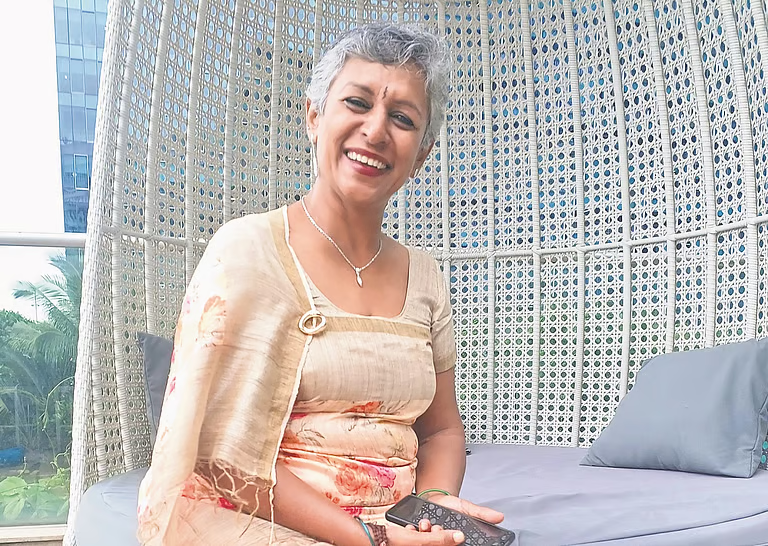
Lush green landscapes, ethereal waterfalls, and aromatic coffee plantations… wouldn’t you like to be in Coorg every single day? Well, a delicious fragment of Kodava culture presented itself on our plates at the Kodava Food Festival in Golconda Pavilion, ITC Kohenur. Chef Smitha Kuttayya, who looked stunning in her Kodagu-style saree, treated us to what was no less than a delightful feast right from the hills of her beloved homeland. She told CE, “The unique distribution of flavours and the use of local ingredients such as kachampuli, a local vinegar, is what makes Kodava cuisine stand out.”

Chef Smitha Kuttayya

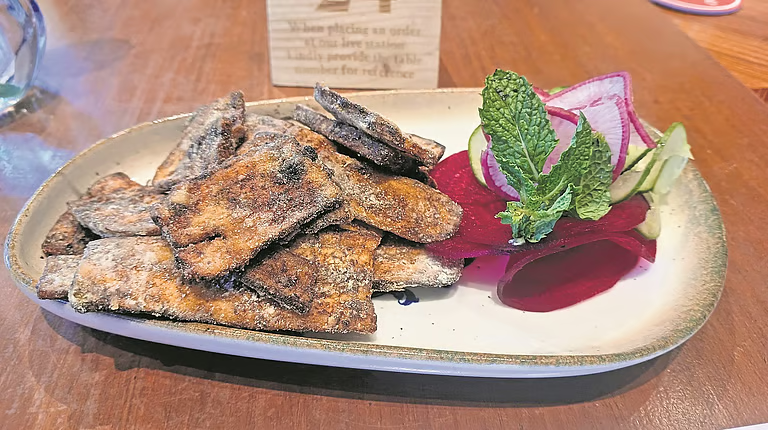
We started off with the Balekai Barthad, plantains marinated in kachampuli, shallow-fried and coated with rice flour. This dish was simply superb, with the right amount of sourness, crisp and texture. Its non-vegetarian counterpart, Meen Barthad, where the fish was marinated in kachampuli, chillies, and salt, was just as irresistible, with everyone going back for more. The Bollary Barthad, shallow-fried cucumber with spices and green chillies, was moderately spicy yet soothing. The Nallamalu Erchi and Koli Barthad — lamb and chicken fry respectively — stood out. The lamb, with subtle hints of cinnamon and cardamom, took you on a flavour ride. “Traditional Kodava cooking uses minimal oil for meat, relying on the lard instead. We also don’t favour overly spicy food, and because of our proximity to Kerala, we love using coconut; almost every dish has it,” Chef Smitha explained with a chuckle.

All the dishes were plated so professionally, but Chef Smitha revealed that this is the effect of modernity; traditional Kodava cuisine draws from its warrior culture, which prioritises bulk cooking for sustenance and togetherness. But then there are commonalities too — a staple loved across the southern states, the dosa appeared in its Kodava avatar: Neer Dosa. We had two versions: one filled with veg poriyal, the other with prawns marinated in kachampuli. Though quite full, we were treated to more of that famed Kodava hospitality.

Chef Smitha brought out Otti (Kodava-style akki roti) and Kadambuttu (steamed rice balls) served with six curries. The Kootu, a mixed vegetable stew, matched the rainy Hyderabad mood perfectly, while the Kaad Mange, a tangy seasonal mango gravy, became an instant favourite. The spicy Meen Curry melted in the mouth, but the Koli Kanni, a chicken curry rich with coconut, cardamom, cloves, and pepper, stole the show. But no Kodava meal is complete without Pandi Curry or pork curry. While the other curries paired well with the Otti, the Pandi Curry was perfect with the Kadambuttu; the grainy rice balls with soft, flavourful pork created a textural celebration in the mouth. Among the vegetarian curries, the Baimbale Curry, made with tender fermented bamboo, burnt onions, and roasted rice, was the winner.

Now, both Hyderabadis and Kodavas love their rice, and so we had Erchi Pulav, a coconut-based lamb pulav which brought back the flavours of the hills, especially when paired with Mango Pachadi. The Vegetable Pulav was just as good. The spiciest dish was the Onkkerchi, or dry-shredded pork, due to the generous use of bird’s eye chilli.

It left us craving something sweet and so we had Thambuttu, mashed ripe bananas blended with roasted rice flour. With a generous drizzle of ghee, this dish was traditional perfection. “A woman is central in the Kodava household. During Puthari, our harvest festival, we make Thambuttu and offer it first to the married daughters, praying for their well-being,” shared Chef Smitha. The meal concluded with Kaskase Payasa, a delicious poppy seed kheer that was so good, it was hard to stop at one helping.

We were 800 km away from Coorg that day, but after tucking into that delightful spread, we felt miles closer to the hills. 

source: http://www.newindianexpress.com / The New Indian Express / Home> Hyderabad / by Nitika Krishna (headline edited) / July 19th, 2025

Mobile crematorium eases struggle of tribals to bid farewell to loved ones in Kodagu

Over 1300 families in the panchayat no longer need to travel 10 kilometres for cremation services, said the former Panchayat Development Officer Srinivas.

The mobile crematorium being used across Hosuru grama panchayat (Photo | Special arrangement)

Madikeri :

While births are celebrated, deaths cause not only grief but also stress as relatives, especially from underprivileged communities, struggle to give their loved ones a decent goodbye. However, a unique initiative has give solace to tribal residents of Hosuru grama panchayat in Kodagu.

This has become a model panchayat in the district for introducing the first mobile crematorium enabling smooth final rites of the departed.

“In Hosur Gram Panchayat, a majority of the population lives in modest line houses, often without access to land or essential facilities to perform the last rites of deceased family members. This lack of resources, particularly the absence of a cremation ground, caused not only emotional stress but also led to tensions between different communities over the use of limited space,” explained Srinivas MD, the former Panchayat Development Officer of Hosuru GP who envisioned the concept of a mobile crematorium. Srinivas is currently serving as Assistant Director of Ponnampet Taluk Panchayat.

Realizing the urgent need for a decent crematorium, Srinivas alongside other panchayat officers approached the Lions Club of Gonikoppal seeking their support. A mobile crematorium unit worth Rs 10 lakh was donated to the panchayat by the Lions Club. “This was in 2023 and I approached the then DC and obtained approval for 50 cents of land to serve as a designated cremation site. Further, utilizing Rs 5 lakh from the 15th Finance Commission grant, the infrastructure to manage and maintain the unit was established,” he recalled.

To ensure that the project was implemented in a structured and sustainable way, a dedicated committee to oversee the operation of the unit was formed even as a WhatsApp group to manage service requests efficiently was created.

“This digital coordination allowed timely deployment of the unit and maintained transparency in operations. As a result of these well-coordinated efforts of the panchayat, over 1300 families in the panchayat no longer need to travel 10 kilometres to Virajpet or Gonikoppal towns for cremation services. Particularly for daily wage workers residing in line houses, the nearby availability of the cremation facility has proven to be a great relief. Over 60 cremations have been respectfully carried out directly at the homes of the deceased using the mobile unit. The service has also been extended to neighbouring villages upon request,” he explained. He hopes that this model is adapted by all the Grama Panchayats to ensure a better society.

source: http://www.newindianexpress.com / The New Indian Express / Home> Karnataka / by Express News Service / April 10th, 2025