All posts by admin

Tribals Karnataka Convention on Apr 25

Mysore:

More than 1000 tribals would take part in the first tribals’ convention to be held in Karnataka here on April 25. The convention is focussing on legalising forest land, distribution of `Anthyodaya’ ration cards for tribals, site and rights and self-respect of tribals. The convention will be inaugurated by President of Tribals Rights� National Forum MP Bajuban Riyang, Forum State General Secretary G C Bayyareddy told reporters.

He said there were more than eight crore tribals in the country.The tribals had no self-owned land nor houses and were residing in the outhouses of farm owners. The names of the tribals do not find a place in the voters’ list and they were deprived of government facilities, he said. More than 1,000 tribals from Mysore, Chamarajanagar, Kodagu, Dakshina Kannada, Uttara Kannada,Udupi, Chikkamagalur, Shimoga and Ramanagar Districts would participate in the convention

source: htttp://www.ibnlive.in.com / PTI /Apr 22nd,2011

First Woman IFS Officer Muthamma Passes Away

C B Muthamma, the first woman Indian Foreign Service (IFS) officer, died here on Wednesday. She was 85. 

She passed away in a private hospital where she was undergoing treatment, her family members said.

Chonira Belliappa Muthamma was born Jan 24, 1924, in Kodagu. In a career that began in 1949, she served as ambassador and high commissioner to a number of countries. She retired in 1982.

Muthamma had fought against gender bias in the foreign service and had taken the Indian government to court in 1979 for bypassing her for the coveted foreign secretary’s post.

Though the Supreme Court dismissed the petition, it noted that there was truth in Muthamma’s contention that there was gender discrimination in the foreign office.

Muthamma brought out in the form of a book essays she had written over the years. Titled ‘Slain by the System – India’s Real Crisis’, it was published in 2003.

She had also co-authored a book on Kodava cuisine.


source: http://www.bangaloremirror.com / IANS / Thursday  Oct 15th, 2009

Surgery Pumps New Life into Her

Wockhart doctors perform rare operation that helps 13-year-old girl’s left ventricle pump more blood to the body


Looking at her sitting with quiet dignity, facing the glare of harsh lights, you would never guess what her tiny heart has been through.

Indira, 13, a farmer’s daughter from Kodagu, was born with her heart on the right side of her body, while the heart’s pumping chambers and arteries had got inter-changed.

She got a ‘new life’ after Dr Devananda from Wockhardt Hospital and his team performed three surgeries her – all within a year which has worked miracles for the child.

Ever since she was a year old, Indira used to fall sick frequently. She made trips to many hospitals, where she was prescribed medicines for for ailment. When she grew older, she had difficulty in breathing and used to turn blue after even after a little work.

Options open

Fortunately, Dr Devananda met her and explained to her family that surgery was the only chance for her survival.
Indira’s heart was unable to pump blood to the entire body as her ventricles had got interchanged. The right ventricle pumps blood to the lungs and the left ventricle to the rest of the body. As her left ventricle wasn’t strong enough to pump blood at required pressure, doctors had to train her heart by creating obstructions in the blood flow to increase blood pressure.

There have been only a handful of cases in the world where the ventricle has been trained to pump blood after the age of 12. As her parents could not afford the surgery, the Needy Heart Foundation stepped in along with Wockhardt Hospitals to facilitate the same. The final step, the ‘double switch’, was completed successfully. The girl was on artificial ventilation for two weeks as she had developed pneumonia after her surgery, on May 26 this year. Before the final surgery, doctors had given her a 25-50 per cent chance of survival. But Indira insisted she wanted the surgery and her parents relented.

Dr Prakash Vemgal, who monitored her after surgery till her discharge, spoke about how, after the tubes were removed from Indira’s mouth and she could speak, she told doctors that her birthday was on June 16.  A surprise party was arranged for her and she cut the cake.

After speaking to the press, she quietly left with her mother in an autorickshaw.

source: http://www.bangaloremirror.com / Bangalore Mirror Bureau / Monday, Sept 22nd, 2008

A Tiger Wedding in Coorg, India

A Tiger Wedding in Coorg, India

The Illustrated London News,   Dateline: December 06th, 1873

A TIGER WEDDING IN COORG.
“The small province of Coorg, in Southern India, is situated among the mountains that separate Mysore from the Malabar coast to the west. Its late Rajah, being of cruel and treacherous misrule, was deposed in 1834, and the Coorgs, being put to the vote, unanimously desired to become complete subjects of the British Government. In 1852, the deposed Rajah visited England, accompanied by his daughter Gauramma, and paid his former enemies the compliment of seeking for her an English and Christian education. In June 30, 1852, she was baptized, the Queen herself standing sponsor, and giving her the name ‘Victoria.’ The Princess Victorian Gauramma, who was a constant visitor to her Majesty at Osborne and Windsor, eventually married an English officer of the name of Campbell. She died in 1864; her tyrant father lies buried in the Kensal-green Cemetery.
“A good description of Coorg will be found in ‘Eastern Experiences,’ by Mr. Lewin Bowring, late Resident or Governor of Mysore. The natives are distinguished for their fine appearance and warlike temper. They are skillful hunters, being trained for this from infancy; at the birth of a boy, the first thing done is to place a little bow and arrow in his hands, and to fire a gun outside the house, thus initiating his career as a huntsman and warrior.
“In the accompanying illustration there is abundance of music, feasting, torchlight, and dancers; and the owner of the mansion is brought in with triumph to graces the festival.
“A curious ceremony takes place when a tiger has been shot by a Coorg man. Tigers are not numerous in the country, and this ceremony has only occurred twice within the past four years. On the last occasion, March 9 of this year, the successful huntsman was Mr. Colovanda Carriapah, Head Sheristadar of the Mercara Talook. In this ceremony the man is wedded to the soul of the dead tiger.
“As shown in the Illustration, he is seated under a canopy in full warrior costume. On each side are placed his weapons and the household emblems of plenty, vessels of rice and milk, and burning lamps, analogous to the Masonic corn, wine and oil. So he sits, receiving the homage and congratulations of his relatives and friends. Each scatters a few grains of rice over his head, and gives him a sip of milk from a brass vessel resembling a teapot, and makes an offering in money, varying in value according to the means of the donor. The hero of the day is afterwards carried in triumph round the tiger, which is suspended to a high bamboo grame in the garden. The officers and ladies of the regiment stationed at Mercara, who reside in the late Rajah’s palace, were specially invited to attend.
“Mr. Carriapah is a native Coorg gentleman of high merit and distinction. He wears the gold Coorg medal, which was presented by the British Government to his father, for suppressing an insurrection in South Canara. Our correspondent would further testify to Mr. Carriapah’s unvarying support of English education among the Coorgs. A wealthy and influential man, he spares neither time nor money in this cause, and has, at his sole expense, erected schools for Coorg girls as well as boys, and has on several occasions received the thanks of the Government of India, as well as of the local Government of Mysore and Coorg.
“We are indebted to Captain Belford Cummins, of the Staff Corps at Mercara, for the sketch we have engraved.

source: http://www.harappa.com

Baban Triumphs

Bangalore’s Baban Khan won the 1400-1600cc race in the four-wheeler category in the VASA Autosports autocross event here on Sunday.
Suhem MK of Coorg took the second spot while Amjad Ali of Mudigere finished third. Rajshekar of Bangalore clinched the Novice class ahead of the second-placed Harsha Natraj of Mysore.

Results:
Two-wheelers, Novice class: Mohammad Asif (Tumkur) 1; Shaan (Hassan 2; Salman Baig (Tumkur) 3. Expert class: Madhu S (Tumkur) 1; Rajendra RE (Shimoga) 2; Mohammad Azgar (Mysore) 3. Intermediate class: Rajendra RE (Shimoga) 1; Madhu S (Tumkur) 2; Syed Dastagir (Shimoga) 3. Indian Open: Tanveer (Mysore) 1; Madhu S(Tumkur) 2; Mohd Azgar (Mysore) 3. Local Boys: Syed Dastagir (Shimoga) 1; Rajendra RE (Shimoga) 2; Nathaniel Soans 3.

Four wheelers, 1400-1600cc: Baban Khan(Bangalore) 1; Suhem MK(Coorg) 2; Amjad Ali (Mudigere) 3. Novice Class: Rajshekar(Bangalore) 1; Harsha Natraj (Mysore) 2. 1001cc-1400cc: RD Patel (Mudigere) 1; Baban Khan (Bangalore) 2; Veeresh Gowda Kalasha (Mudigere) 3. Novice class: Divakar (Mudigere) 1; Lokesh Gowda(Bangalore) 2. Upto 800cc: Rajshekar (Bangalore) 1; Baban Khan (Bangalore) 2. Ashok (Mudigere) 3.

Novice class: Sree Hari (Mudigere) 1;  Divakar 2. Indian Open class: RD Patel (Mudigere) 1; Rajshekar (Bangalore) 2; Ashok (Mudigere) 3. Novice class: Harsha Natraj (Mysore) 1; Kiran (Bangalore) 2. Ladies class: Ashika (Bangalore) 1; Harshitha Gowda (Bangalore) 2; Veena Ponnappa (Mysore) 3.
Fastest driver: RD Patil (Mudigere). Best rider: Tanveer (Mysore)


source: http://www.deccanherald.com/ Shimoga / DHNS / Jun 13th

Biography of Robin Uthappa

Read Biography of Robin UthappaRobin Venu Uthappa, born 11 November 1985 in Kodagu,Karnataka is an Indian cricketer. His father is Venu Uthappa, an international hockey referee and mother Roselyn is a home maker hails from Kozhikode. He made his One-Day International debut in the seventh and final match of the English tour of India in April 2006. He had a successful debut, making 86 as an opening batsman before being run out. It was the highest score for anyIndian debutant in a limited overs match.

Uthappa first came to the public’s attention when he made 66 for India B against India A in the Challenger Trophy in 2005. The following year, in the same tournament, Uthappa made matchwinning 93-ball 100 against the same team which propelled him in the big league. Previously, he had been a member of the India under-19 team that won the Asia Cup. Once a wicketkeeper-batsman, his List A batting average of near 40 with a strike rate of approximately 90 has made him regarded as something of a limited overs cricket specialist.

He was recalled to the ODI side in January 2007 for the series againstthe West Indies where he smashed a 70 from just 41 balls.

He was selected in the 15-member squad of the Indian Cricket team for the 2007 Cricket World Cup held in the West Indies in March-April 2007. He played in all 3 group games, but only scored 30 runs in total as India suffered a shock defeat to Bangladesh and a loss to Sri Lanka resulting in the team not qualifying for the Super 8 stage.

In the sixth ODI of the NatWest Series 2007-2008, he scored a sensational 47 of 33 balls to take India to a thrilling victory, keepingIndian hopes alive in the 7 match series that they were trailing 2-3 before the match. Used to batting as an opener, in this match he came in at the unfamiliar position of no 7. When he came at the crease India were 5 down for 234 after 40.2 overs, still needing 83 from less than 10 overs. After Dhoni got out in the 47th over with the Indian score at 294, Uthappa kept a cool head to take India to the target with two balls to spare in a remarkable victory.

Uthappa also scored a crucial 50 against Pakistan in the 20-20 World Cup in South Africa, when India were tottering at 36/4. India subsequently won the match in bowl out 3-0.

He is known for his trademark ‘walking slam-bang’ shot.

Uthappa played for Karnataka institute of cricket (KIOC) – under the guidance of Irfan Sait who runs the cricket camp.

source: http://www.yasni.com


Debut Author Creates A Whole New World in “Scotland of India” with her Book ” Tiger Hills”

Arts Interview  :  SARITA MANDANNA

Tiger Hills author Sarita Mandanna on buzzine.com
Some authors like to create new worlds. Others like to reflect in a world they are most familiar with. Sarita Mandanna chose to dab a little in both, creating a new world while also staying close to home in her debut novel Tiger Hills, which just hit bookstands in 18 countries and is being translated in 14 different languages, including French, Italian, Spanish, Catalan, Hebrew, Hungarian, Dutch, Russian, Slovenian, and Greater Chinese.
A native of Coorg, Sarita’s hometown provides the stunning setting of Tiger Hills. According to her, Coorg is often described as the “Scotland of India,” ergo providing an ideal backdrop for the romanticism of her story. WhileTiger Hills is quite the fictional tale about Coorg, there are a few truths to share about Sarita, such as her degree from the Indian Institute of Management, as well as an MBA from the Wharton Business School. After working as a private equity investor in New York, Sarita moved to Canada in 2010. When she finally wrote and completedTiger Hills, the novel was long-listed for the 2011 Man Asian Literary Prize and was a 2011 TV Book Club pick in the United Kingdom.
Every so often, I choose to drift from the narrative storytelling and offer you, the reader, a chance to observe a conversation in almost complete entirety. In such situations, it is far more compelling for you to feel a part of the conversation and take whatever messages, if any, you choose to take as opposed to me taking liberties of determining what is important and what is not.
With that, enjoy the conversation I had with Sarita. She is more than a promising talent; Sarita is someone who I believe will go places with her writing talents, and I certainly hope that, after reading her story below, you will go out and support her by buying her book or recommending her work to a friend. Either way, enjoy!
Parimal M. Rohit: Let’s start with the most interesting of observations. You reportedly garnered the highest advance for a debut novel. How did that come about? What was it about the story that made Penguin India believe in your story that much to pay you a high fee up front?
Sarita Mandanna: That is a question best reserved for Penguin India! It was a huge honor, of course, to have my debut novel published by Penguin and for them to express the confidence in it that they have. They were the first to come on board, and Tiger Hills has since been sold in 18 countries to date. As far as the actual amount is concerned, there have been many conjectures in the Indian media–suffice it to say that, had I received but a fraction of the amount I was supposed to have, I would be on a very expensive vacation, lounging on a beach somewhere right now!
PMR: Funny! As for the story itself, the title is very revealing, especially to those who know of the true setting of Tiger Hills in India. Tell us about the world you built and how you brought it to life through your words…
SM: Tiger Hills is named for a fictional coffee plantation in Coorg, which is a beautiful part of Southern India. It’s where I’m from–my family traces roots here for centuries. I love it dearly, and when I began to write Tiger Hills, I knew that Coorg would be the setting, and none other. Tiger Hills begins in 1878 and spans the next 70-odd years, through World War II and beyond. It traces the lives of Devi and Devanna, two childhood friends, inseparable until Devi meets Machu, a tiger-killer and a man of much honor and pride. It is the relationship between the three that sets into motion a series of events that change all three lives, with consequences that affect generations to come. While Coorg forms the highly personalized canvas of the story, the characters in the novel all struggle with universal themes. What do we do when thrust into circumstances not of our choosing? Tiger Hills explores the nexus between fortitude and acceptance, the choices we make, and the far-reaching impact they can carry.
PMR: What made you choose the time period?
SM: I wanted to write a story that was almost classical in structure–something with a large narrative arc. Tiger Hillsspans almost the entire lifetime of the central protagonist, Devi, beginning with the day of her birth and following her through maturity and into her dotage. To cover that length of time necessarily meant that the novel had to start decades in the past. The early 1900s were also a particularly interesting period in Coorg. Coffee-planting had become widespread, introduced by English and European settlers in the mid-1800s, and there was a significant influx of wealth into the region. There was a whole new generation of Coorgs still wedded to the old ways but simultaneously Westernized, being sent overseas to study, etc. That intermingling of cultures, especially in the context of the time, was intriguing enough that I wanted to explore that in the course of the novel.
PMR: Are there any characters in the book you most identify with? Anyone a fictitious representation of who you are in real life?
SM: All the characters are fictional in the aggregate but draw in bits and pieces from people I have known. As far as any of the characters representing me–not really. Devanna is bookish, and I can certainly identify with that. Devi is headstrong and, well, no surprises there either. Other than that, no, they are all completely fictional!
PMR: What do you want the reader to feel as they read the book? How about the feeling after they complete it?
SM: I take it as the ultimate compliment when people tell me that Tiger Hills is a page-turner and that they were unable to put it down. It’s also fantastic when they tell me that they found themselves exploring a new world and that they were angry, they were sad, they were laughing out loud as they read; that they were so invested in the characters that they find themselves thinking about them well after the last page is turned.
PMR: Any prospects of selling the movie rights?
SM: I haven’t really given it much thought.  I’ll cross that bridge when it I come to it, I suppose.
PMR: As this is your debut, what was the writing process like? Was it much more difficult or enduring than you realized? What did you learn from the process that’ll help you with your next book?
SM: Tiger Hills was five years and counting in the making. I wrote it while living and working in New York City. It wasn’t an easy time–while deeply satisfying in the aggregate, there were also days when I seriously questioned my sanity for taking this on.  Extracting yourself from the immediate world–the physicality of it–and immersing yourself in one of the imagination takes a bit of transitioning, and it was all the more challenging in the case of Tiger Hills because I was working full-time as well. While work took priority, I wrote in all the spare time that I had, even correcting drafts while on the treadmill. I’d write late at night, after the work day …and on all the weekends when I wasn’t working. I don’t think writing the next book is going to be particularly easier or different. I just hope it doesn’t take another five years and that I get a bit more sleep during the process than I did while crafting Tiger Hills!
PMR: Speaking of your next book, do you have any ideas of what it will be about (assuming you are planning for a second book, of course)? If there is another book, is it still in idea phase, or are you already writing?
SM: I’m in the process of researching an idea. It is still early days, and it is in very nebulous form right now. I’m excited about it, though, and am looking forward to plunging into the writing once more.
PMR: Finally, tell us about your background.
SM: I was always an avid reader, and while I did think that I would write, it was very much a “one day, some day” kind of aspiration. About seven years ago, after a particularly draining week, I came back home from work itching for a creative outlet and to do something completely removed from what I did during the day. I booted up my laptop and simply began to write. That initial output became a short story, followed by six more in rapid succession, and formed the springboard to Tiger Hills.

(Photo Credit: Dan Abramovici)
source: http://www.buzzinebollywood.com / by Parimal M. Rohit / Mar 18th, 2011


Keeki Thammaiah

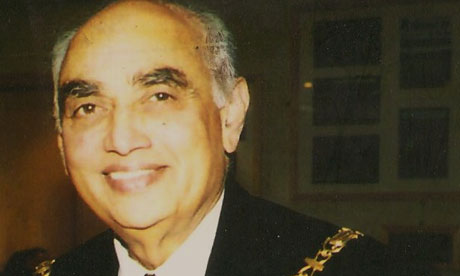
Keeki Thammaiah obituary

Keeki Thammaiah 

The trappings of office were relished by Keeki Thammaiah as they echoed his native Karnataka ceremonial attire

My friend the lawyer, educationist and local politician Keeki Thammaiah, who has died of a heart attack aged 76, became the first Asian mayor of Harrow, north-west London, in 2000.

He came to politics relatively late when elected as a Labour councillor in 1994. As mayor, he demonstrated his skill in working with people across the divide of politics, race and class. He relished the ceremonials – the robes and chains – not only because of his innate respect for the office but also because he felt comfortable with these trappings. Their lavishness echoed the ceremonial attire of his native Coorg in Karnataka, south India, particularly that of the traditional kupya chaleworn by Coorg men – long black tunics with red and gold brocaded cummerbunds from which intricately worked swords in gold and silver were slung.

Keeki came from an affluent landowning family, and after qualifying as a lawyer served as an advocate in the courts of justice in Bangalore. He arrived in Britain in 1964, drawn by the vibrancy of its contemporary culture (listening to the Beatles for the first time was clearly a defining experience), as well as its legal traditions. He taught business law at institutions including Westminster College for a number of years.

Keeki and Naila, his wife of 40 years, kept an open house, and visiting Indians – dignitaries, students and tourists – enjoyed the warmth of their hospitality. A champion of Karnataka culture, with its rich tradition of Kannada literature and performing arts, Keeki supported initiatives that helped younger generations living in Britain to engage with this culture. On the day before his death, he and Naila had hosted a reception to launch an initiative to promote Karnataka and its artistic heritage.

He is survived by Naila, his son, Ponnu, and two grandchildren, Adit and Alok.

source: http://www.guardian.co.uk / by Nima Poovaya-Smith / The Guardian / Thursday, May 19th, 2011

Zulfi Syed to get Hitched Next Year

Bυt the model-turned-actor is уеt to find hіѕ girl

Hіѕ humble, shy and a low-profile nature mаkеѕ hіm different from others. Bυt, all these qualities haven’t really hеƖреԁ model-turned-actor Zulfi Syed, who was last seen in the film Deshdrohi. Such an persona has not only kept hіm away from the limelight, but has also deterred hіѕ filmi career from taking οff. Tο this he ѕауѕ, “I know іt’s vital to market yourself well when you have so many competitors, but I аm very weak in my PR skills. I’ll do it when I come up with something really ехсеƖƖеnt.”

Film buffs have not seen hіm since Deshdrohi. Qυеѕtіοn hіm whу, and he аnѕwеrѕ candidly, “I didn’t do any film after Deshdrohi because nothing fаѕсіnаtіnɡ came my way. In view οf thе fact thаt I believe in quality work, I thουɡht іt’s better to concentrate on modelling and fashion shows rаthеr than opting for something that ԁοеѕ not have substance.” Earlier Zulfi had revealed that he would be ‘doing an action movie soon,’ but that has not happened. Clearing the air, the actor ѕауѕ, “Thе scripting administer is going οn, and I аm just waiting for it to complete. I mау ѕtаrt shooting soon.”

FаѕсіnаtіnɡƖу, in hіѕ time in the industry, Zulfi has also managed to maintain a sqeauky сƖеаn persona. “If you have to survive, you have to do quality work. Whаt matters are the scripts and quality of the films. Controversies give you your five minutes of fame, but people will commence to see you in a different persona,” he states.

Thе actor was in the limelight in the reality ѕhοw Bigg Boss Season 2. Qυеѕtіοn hіm if he is game for another such ѕhοw, and he ѕауѕ, “I would Ɩіkе to be part of an adventure ѕhοw. I had an offer tοο, but couldn’t do it as I was busy with my restaurant business, which I аm looking to expand. Thеу will serve road food from all over the world.” Sο, is Zulfi a good cook tοο? “I have a degree in hotel management, I аm a good chef and a big foodie tοο,” he quips.

Along with hіѕ work, thеrе’s something еƖѕе on hіѕ priority list. “I рƖοt to get married in 2012. Bυt, I’m still in search of a girl who is homely and is a good cook tοο.”

source: http://www.whatisnew.in / Jun 16th, 2011 / by Elina Priyadarshini Nayak (Bombay Times) Jun 17th, 2011

Kodava Goes Filmi

Kodava goes filmi

He’s a Bengalurean who now calls Mumbai his home. Meet Kodava hottie Gulshan Devaiah who has taken Bollywood by storm with his performances in Shaitan and Dum Maaro Dum. Well-spoken, funny and passionate, Gulshan plays KC, a wild child whose parents don’t know his true colours in Shaitan. “He’s always living life on the edge. He loves women, flirts and sleeps around with them. But inside, he’s a very insecure person.”

But Gulshan’s the complete opposite of KC when it comes to women. “When I was in PUC, I’d have a bunch of girls waiting for me. I was incredibly shy and needed a lot of courage to talk to them. I’m also a non-violent guy who thinks fights are emotionally draining. I just like sitting at home and being by myself.”

Gulshan was born and brought up in Bengaluru. “I studied at Cluny Convent and then at St Joseph’s PUC. I wasn’t particularly good at studies and even failed my second PUC! I also lived in a rough neighbourhood where people would randomly get beaten up. Once, I got beaten up by a guy who used to like a girl that I would chat with!” he laughs.

But what saved him was the fashion world. He went onto study fashion at NIFT. “I worked in the fashion business for 10 years. I taught fashion at a college, started a business and even freelanced.” However, Gulshan gave it all up to follow his childhood dream — acting. He wasn’t new to acting when he entered B-Town. This drama enthusiast started doing theatre at a very young age. “I would come up with my own acts for school functions. I even did a lot miming and solo acts (which was called ‘mono acting’ back then!). I did semi-professional theatre with a Kannada troupe. I’ve been active in amateur English theatre since 2000,” says Gulshan who is now busy with his play Butter and Mashed Banana.

While there have been talks about Shiv and Neil puckering up in Shaitan, Gulshan laughs, “Mine’s the real kiss and nobody’s talking about it! It’s a proper Hollywood type one!”

The Bengaluru boy adds. “I miss my mom and dad a lot. When I visit Bengaluru, I miss India Coffee House in its original place. The atmosphere and dosas — were just awesome!”

source: http://www.deccanchronicle.com / Tabloid / Jun 21st, 2011