Category Archives: Women/Girls (wef. Sept 03rd, 2022)

Kodava Development Corporation Soon: CM

Bommai inaugurates Appachattolanda Cup Kodava Hockey Festival at Napoklu

Madikeri:

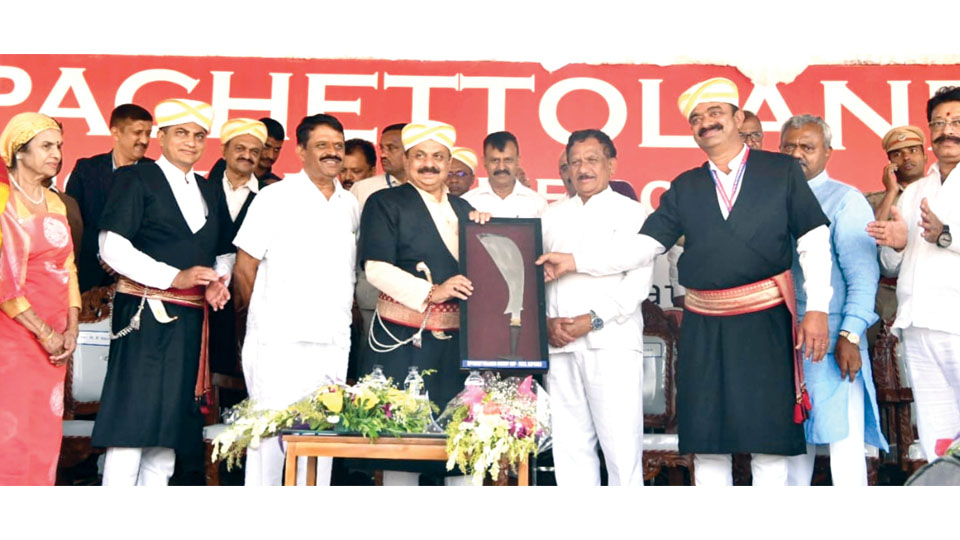
Chief Minister Basavaraj Bommai said that Kodava Development Corporation, a long-pending demand of the people of the district, will be a reality soon.

“I will issue an order on the setting up of the Kodava Development Corporation at the earliest,” he said after inaugurating the Kodava family hockey tournament hosted by the Appachattolanda family at General Thimayya Stadium in Cheriyaparambu of Napoklu last evening.

“Kodavas are physically strong and protect the nation. The Government is committed to the welfare and growth of the Kodava community and the Kodava Community Development Corporation that will strive exclusively for the overall development of the unique Kodava community has been a long-pending demand from the community and steps would be taken to realise it,” he added.
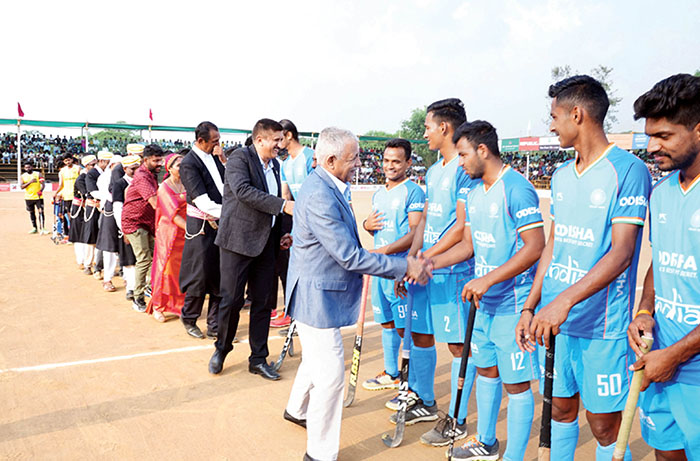
Picture shows former Indian Team hockey coaches M.P. Ganesh and A.B. Subbaiah greeting the players.

Heaping praises on the concept of a family hockey tournament, the CM said that the concept is wonderful and unique and brings Kodava families under one roof. “Kodava families are well-knit families. At a time when relationships are waning, the tourney has helped bring together families. Families should be united and relationships should bring together the people,” he said. “This is a special tournament as it is organised by the Kodava families. These families enjoy a good relationship, and family bond and the heritage of the Kodava community is being promoted through the game of hockey. The culture, tradition, and practices of the Kodavas unite all. Their attire and food are special,” he added.

“It is happy to note that this tournament is going on for the last 23 years. Families must unite and relationships must prosper. This is the culture of India. This kind of tournament is not seen anywhere in the world. Hence, the State Government has released Rs. 1 crore for the tournament,” Bommai said.

The hockey festival is being held from Mar. 18 to Apr. 9 on three grounds and a record 336 families or teams have registered for it. This is the 23rd edition of the event which had a four-year break from 2018 onwards owing to natural calamities in the district followed by the COVID-19 pandemic.
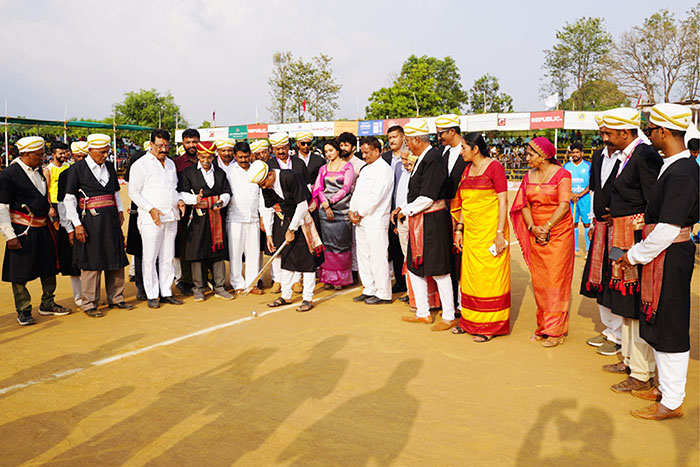
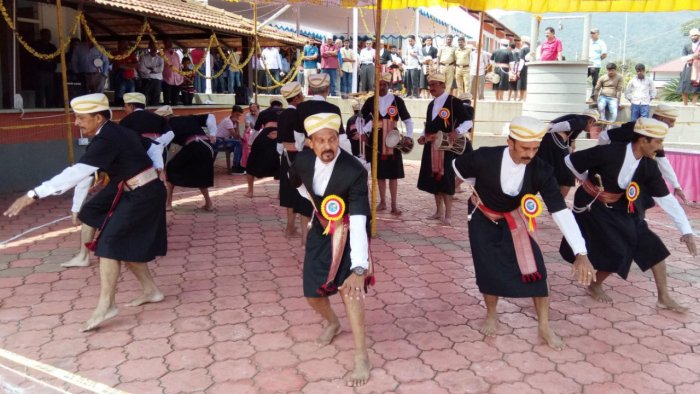
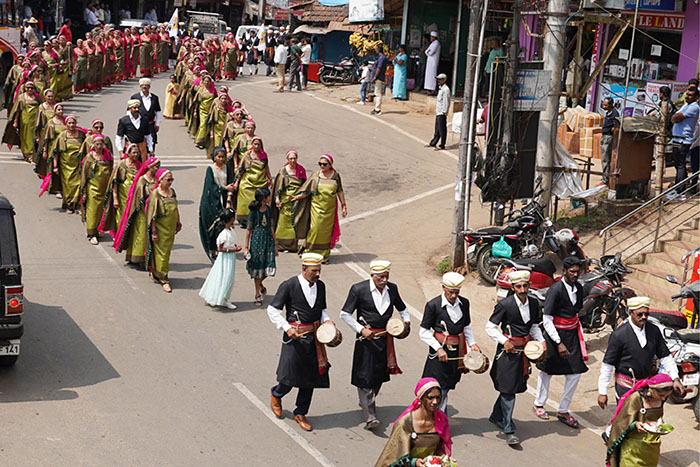
Earlier, the tournament began with a grand procession. Besides this year’s participants, the family teams which have participated in the tournament in the previous years also took part in the procession. Heads of the family teams gave the green signal for the hockey festival by firing 23 rounds of gunshots in the air.

The idea of a family tournament to bring together different Kodava families was conceived by the late Pandanda Kuttappa, popular as Kuttani, and the first edition was held in 1997 and has since then grown into a major event. The first exhibition match was held between the 37th Coorg Field Regiment and Kodava Academy-11. The second exhibition match was held between Indian Junior Hockey team and Karnataka team consisting of Olympian players from Kodagu.
The CM was felicitated by handing over a silver hockey stick and silver ‘odikathi’ on the occasion. Bommai was dressed in Kodava attire, complete with ‘Kupiya-chele’, ‘peechekathi’ and ‘mandethuni’. Several cultural programmes were performed.

Minister S.T. Somashekar, MLAs K.G. Bopaiah, Appachu Ranjan, MP Pratap Simha, MLC Suja Kushalappa, former MLC Veena Achaiah, DC Dr. B.C. Satish, SP Ramarajan, ZP CEO Akash, ADC Nanjundegowda, CCF B. Niranjan Murthy, Kodava Hockey Academy Director Cheeyanda Satya, Hockey Festival Convener Appachattolanda Manu Muthappa, Appachattolanda family Pattedara Erappa, ex-Advocate General and Congress leader A.S. Ponnanna, Bangalore Kodava Samaja President M.T. Nanaiah, Padmashri Rani Machaiah, former hockey coaches M.P. Ganesh and A.B. Subbaiah were present.

source: http://www.starofmysore.com / Star of Mysore / Home> News / March 19th, 2023
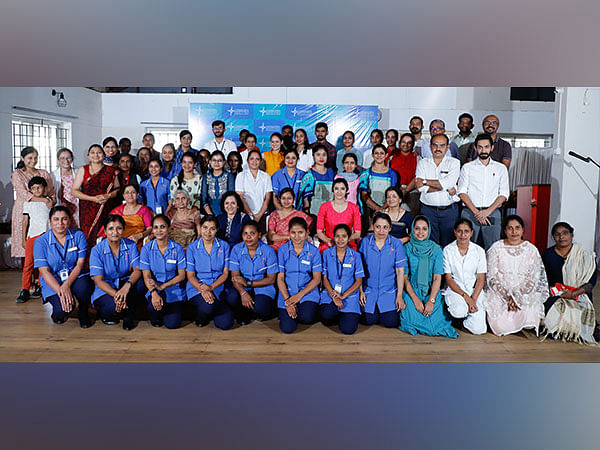
Empowering Women’s Health: Lopamudra Hospitals mark International Women’s Day

Empowering Women's Health: Lopamudra Hospitals mark International Women's Day

Gonikoppal (Karnataka) :

On the occasion of International Women’s Day, Lopamudra Hospitals, Gonikoppal organized a special event to celebrate women.

The event was graced by three renowned women from the region, Dr Gowramma Paruvangada, Consultant OBG at PNM hospitals, with five decades of practice in mother and child care, Dr. Fathima Kariappa, President of IMA Virajpet and Consultant OBG at Virajpet Nursing Home, and Uzma Jabeen, Panchayat Development Officer, the youngest in the district of Kodagu.

The event was presided over by the Managing Directors, Capt. Madappa M. A. and Dr Amrit Nanaiah M.M., a Consultant Physician at the Hospital. Dr Soumya Ganesh Nanaiah the Director of the Lopamudra Drishti Eye Hospital, a Cataract and Refractive Surgeon was present. She also emceed the event. Dr Sonia Mandappa, Consultant OBG, and Dr Trupthi Uthappa, Consultant ENT, were also present.

Speaking of their varied experiences, the Chief Guests enlightened the gathering on a multitude of topics.

Dr. Gowramma Paruvangada spoke about her long-standing commitment to serve women from rural parts of the country and her willingness to contribute more to the society at large. Dr Fathima Kariappa reminisced about how the babies she helped deliver were today doctors at the very Lopamudra Hospitals. She also emphasized the importance of women empowerment in today’s society and the role of family as an institution. Uzma Jabeen highlighted various government schemes available for women and how they could avail the benefits by contacting her.

The event was a sequel to a ‘Women’s Health Camp’ that saw more than 100 women availing the benefits of a health package curated to check overall well-being of women.

On the event of International Women’s Day, the hospital unveiled its new logo and a toll-free number for quick response. The hospital can now be reached at 1800 8333653. They also inaugurated the B Scan recently installed at the eye hospital. The B Scan is the first to be installed in Kodagu district. It can be used to assess the posterior segment of the eye in cases of media opacities and can be useful in cases of advanced cataracts

Dr Ruth Adhlaka, a Consultant Physician at the hospital, gave the vote of thanks, acknowledging the importance of such events and the hospital’s commitment to serving and empowering women.

www.lopamudrahospitals.com

This story has been provided by NewsReach. ANI will not be responsible in any way for the content of this article. (ANI/NewsReach)

This story is auto-generated from a syndicated feed. ThePrint holds no responsibility for its content.

source: http://www.theprint.in / The Print / Home> ANI Press Release / by ANI PR-News Reach / March 09th, 2023

The food we eat: Indian power foods from sattu to millets

Every part of our country has traditional ‘power foods’ that are simple, healthy and practical. Maize, bajra, jowar, dozens of varieties of millets and many more of rice.

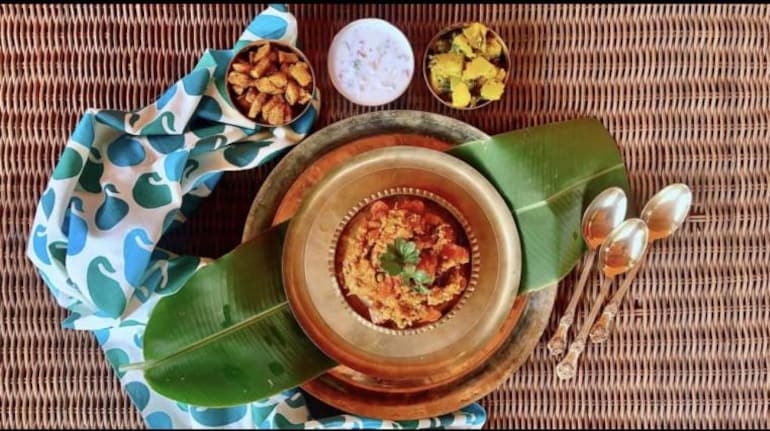
Varagu Millet Tomato Pulao. Many of India's ‘power foods’ like bajra, jowar, maize and several varieties of millets are easier to cultivate than rice or wheat. (Photo courtesy Shradha Saraf)
Varagu Millet Tomato Pulao. Many of India’s ‘power foods’ like bajra, jowar, maize and several varieties of millets are easier to cultivate than rice or wheat. (Photo courtesy Shradha Saraf)

Having visited Bihar after many years, I was on my way to Patna airport to catch the return flight to Bangalore. Like most Biharis the driver was a talker, and a good one. After depleting our views on the political scene in the country and Bihar in particular, we were still two hours from Patna. Murari asked if I had eaten.

“No.”

“Aap Litti kayenge?”

“Hahn, kayenge.”

Litti roasted over hot coals on a chill morning in January is a treat not to be missed. It is like a wheat bun filled with a sattu, onion and jeera stuffing and traditionally eaten with a favourful tomato-rich baigan bartha cooked in mustard oil. We finished off with adrak ki chai and re-joined the commotion on the road. The hearty breakfast for two cost Rs 60.

The car sped forward and my thoughts lingered in reverse gear, dwelling on the years I spent as a surgeon in a busy mission hospital in Mokama, a hundred kilometers from Patna. In the post-operative phase after any abdominal surgery when a patient asked, “Can I eat sattu?” you knew he was on his way to recovery.

In Bihar sattu (roasted and powdered channa) is considered essential to wellbeing. It is vital for all Biharis; for those who have lived and worked there too it is a thumbs-up favorite. I used to drink sattu instead of the mid-morning tea during my years there. It is high in protein, easily digested and has a cooling effect in summer months. Patient-attenders always bring dry sattu for their use. Mixed with water and some salt, and eaten with green chillis and raw onion, it is also a convenience-food that can be carried on long journeys.

Every part of our country has traditional ‘power foods’ that are simple, healthy and practical. Maizebajrajowar, dozens of varieties of millets and many more of rice. However, our palates have got used to the monotonous taste of white rice and chappatis made from polished wheat. Their blandness demands highly spiced gravies thick with grease. Much worse are the maida-based snacks, breads, buns and sugary or deep-fried foods. Maida is refined wheat flour with all its nutrients removed, providing only the calories. It should not have a place in any kitchen cupboard or should be purchased only if necessary, for occasional use. In my childhood days it was popularly known as ‘Merkin Podi’ meaning ‘American Powder.’

Healthy eating is now increasingly common among upper class but upper class is only a small fraction in a country of 140 crore people. Most Indians cannot afford the luxury of eating the right foods. They are the daily-wage-earning labour in factories, construction, agriculture, domestic and hotel work; vendors, autorickshaw and bus drivers; the safai karmacharis, well- diggers, potters, plumbers, cowherds; their old and their young. Their main concerns regarding food are the cost of food, appeasement of hunger, cooking time and expense, and taste.

Until the early 1990s, an average family was satisfied with grains, pulses and locally grown vegetables, with meat, eggs, milk and fruit used sparingly. In my career I have seen how those who ate the most basic but natural food rarely suffered from heart disease, diabetes, obesity or high blood pressure. These diseases affected those who could eat processed foods with their high content of sugar, salt, fat and chemical preservatives –  namely the privileged classes.

With globalization, the floodgates of consumerism were opened and cheap, heavily processed food became affordable. It satisfied on all counts – Good to taste, economical, satiating and without the hassles or the expense of cooking. Result: A staggering number of our citizens belonging to all social strata began to suffer from the above ailments, plus others like recurring stomach disorders, reduced fertility, dental caries, anaemia and in children the attention deficit hyperactivity disorder or ADHD.

It is disturbing to acknowledge that our country is in the grip of a huge nutritional dilemma. India’s future will be shaped as much by the health of our people as by education, job availability and a more just distribution of wealth.

Every problem comes with a remedy. Here are some which will go a long way in ensuring good health for all our citizens.

As it is with most problems, one must go to the basics.

Many of the ‘power foods’ like bajra, jowar, maize and several varieties of millets (the pearl, the finger and the foxtail millet, to name a few) are easier to cultivate than rice or wheat. They need little water. It is possible to harvest two crops a year and in the intervening months, vegetables can be grown in the fields, thus promoting crop rotation. We should be replacing rice and wheat cultivation with these grains in a nationwide project. Rice and wheat can be grown in judiciously chosen water catchment areas. Thus, we can conserve millions of tonnes of water every year and bring remarkable improvement in the nutritional status countrywide. Children will have stronger bones, teeth and muscle and will no longer suffer from anaemia.

_____________________________

KAVERY NAMBISAN is an Indian surgeon and author of books like The Scent of Pepper, A Luxury Called Health: A Doctor’s Journey Through The Art, and Cherry Red, Cherry Black. Views expressed are personal.

___________________________

source: http://www.moneycontrol.com / Money Control / Home> News> Health & Fitness / by Kaveri Nambisan / March 05th, 2023

Badminton: Ashwini Ponnappa interview – ‘I’m starting from scratch, ground zero’

Ponnappa, 33-year-old former World Championship bronze medallist, has formed a new partnership in women’s doubles with 19-year-old Tanisha Crasto.

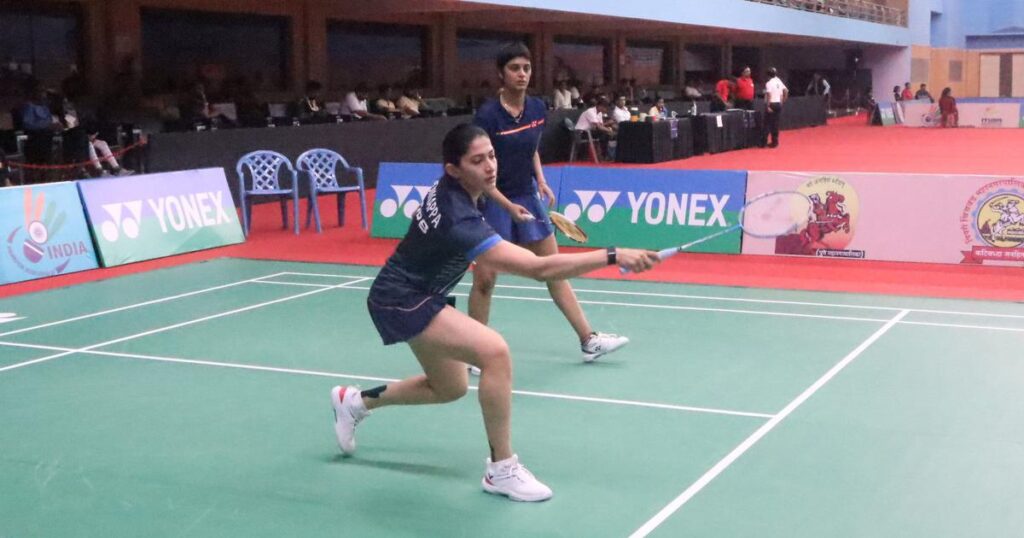
Ashwini Ponnappa along with her new partner Tanisha Crasto in Pune | Senior Badminton National Championships

Through the course of her career, Ashwini Ponnappa has been part of many firsts in women’s doubles for Indian badminton. Ponnappa and Jwala Gutta, became the first Indian women to win a badminton BWF World Championship medal (bronze in 2011). She has won gold, silver and bronze medals at the Commonwealth Games and also the women’s team bronze medal at the Incheon Asian Games in 2014. She has been part of Uber Cup bronze medal-winning squads.

But now the 33-year-old, a veteran of the sport in India, finds herself in the nascent stage of a women’s doubles partnership. In December, she made the decision to pair up with 19-year-old Tanisha Crasto for women’s doubles.

The change sees the once world No 10 women’s doubles player now find herself ranked 141 as a pair with Crasto, albeit they’ve played just two international competitions together – a quarterfinal finish at the Super 500 event in Indonesia in January, followed by a first round exit at the Thailand Open Super 300.

A third event was the quarterfinal finish at the 84th Senior National Championships, at the Balewadi Sports Complex in Pune on Sunday as they put up a good fight before losing against the in-form top-seed pairing of Gayatri Gopichand and Treesa Jolly.

It’s a long way back to the top, but in an interview with Scroll in Pune she asserted she’s looking forward to climbing back up the ladder, while also exploring a new role in commentary.

Excerpts from the interview:

How has the new partnership been working for you?

It’s good. Tanisha is young, she’s very energetic. It’s nice to play with that energy. We haven’t really had many tournaments together, we’ve played two and this is the third. But I’m excited to be here at the Nationals, it’s been a while since I played at this competition.

Earlier you had Jwala Gutta as a partner who was senior to you, then N Sikki Reddy who was not much dissimilar in terms of age. Now you have a partner who is 19. Are you also playing the role of mentor?

You could say that. I would say there’s a vast difference from when I started playing with Jwala to the youngsters now. They’ve all been playing international tournaments from when they were 17 or 18. They’ve all been there, done that. The doubles game has changed and the approach has changed. There’s not a lot of mentoring, she is good in mixed doubles and she’s done well there. Women’s doubles is a little different, but it’s good to have someone who moves into the net. She has that energy and speed on the court.

With age have you changed your approach to the game?

Of course. It’s inevitable for that to happen. I can’t be compared to a 19-year-old in terms of fitness and energy on court. I definitely have to be smarter on court towards the game in order to make sure that I can physically take the toll that badminton has on the body. I have to be very mindful of my training and how I approach the game.

Is it about the warmups and cooldowns getting longer now for you?

Yeah. Probably. But I’ve always been someone who had a longer duration for warmup. But cooldown definitely still needs to get better.

Recently we saw a different side to you – as a commentator. How was that experience?

I happened to be at the tournament and they asked me if I’d like to give it a shot. I felt no harm in doing that, although I feel that it’s not my cup of tea in terms of how I speak. I’d love to get better at it.

But I loved the experience. It was fun being on the other side of the TV. Watching players play you see things differently. You see patterns which you otherwise don’t look out for unless you’re getting ready for a match. That was interesting for me.

I sat for five matches during the Thailand Open, it was interesting for me to watch patterns match out of match. Like if one side was slower or faster, how players dealt with it. You understand that the player who is actually smarter on that day in dealing with the conditions has the upper hand. So that was very interesting that way.

Do you feel there were more expectations when you’re in the commentary box? Since people know here’s someone who has played at the highest level, is there an expectation for some insight which you’d not get otherwise?

Yeah, I am supposed to be the expert. The colour commentary part of it. It does get tricky because, that’s what I meant that it’s not my cup of tea. Not in a bad way, but being articulate about what I see, I’m not a journalist, I’m don’t have the lingo for it. So sometimes I feel, ‘what am I saying?’ Sometimes it’s so repetitive. But it was nice. Although I was a bit nervous, it was an enjoyable experience.

Is that something you’re looking to pursue later on?

Maybe later. Honestly, I don’t know. Right now, I’m definitely focusing on the game. But if I get these opportunities in between to commentate, I’ll definitely give it a shot.

What are the kind of things you and Tanisha have to do off-court just to get the chemistry going to gel on-court? And what are the targets?

This was our third tournament together. We’ve sent out entries for tournaments where we haven’t got an entry. But Tanisha will be playing in mixed doubles (with Ishaan Bhatnagar) in those tournaments. We haven’t had so much time in general to build the partnership because it is brand new, we just started. There’s still a long way to go, we still need that bonding time.

Is that, perhaps the target?

I would say the first target is to get an entry.

You mentioned the doubles game has changed. How?

Over the years the whole approach has changed. When Jwala and I were playing, we were kind of like the path-breakers in a way for doubles. There wasn’t a lot before us. Nobody we could look up to, nobody who had ever won. We had a lot of firsts together. But the game-changer has been that youngsters have been given a lot of exposure to tournaments. They’ve been playing tournaments since they are 17 – that was unheard of back then. We didn’t even have those tournaments in India.

Right now we have four international tournaments in India. You’re giving youngsters an opportunity to get that hunger at a very young age because you’re giving them a taste of what international badminton is. Also, everyone is going out, everyone is sponsored. That’s changed.

That’s why you see a lot of youngsters playing and taking it up. Otherwise, our generation, people in the past, they trained a lot, but never played tournaments. I wouldn’t say you didn’t have that talent back then, you just didn’t know. They were just training, they didn’t have the exposure, no push to go out. That has changed, and that’s why we see a rise in a lot of doubles players playing and doing well.

It’s because they’ve been pushed from a young age, getting out to participate, get that exposure, start training at a young age. These girls are 19. At that time, at 19, nobody was really encouraged to go out.

Yet you’ve remained relevant throughout this. What’s been the changes you’ve had to make in the way you approach the game to continue playing at the highest level?

I would say, I still need to get to the top. I have, in the past. But currently I’m starting from scratch. Ground zero. It’s challenging because you’ve been there and you’re coming back all the way down. It’s a reset.

source: http://www.scroll.in / Scroll.in / Home> Badminton / by Shahid Judge / February 27th, 2023

How Kodavas lost their distinct identity – Part I

Can the upcoming Census 2021 and the Karnataka assembly polls bring the spotlight on the decades-old demand of the Kodavas?

Kodavas participate in cultural competitions organised as part of Kodava Namme at Balugodu near Virajpet in October 2017. Credit: DH File Photo

What is a common thread that runs through the following names: Field Marshal KM Cariappa, former Indian hockey team captain MP Ganesh, former Union minister CM Poonacha, sprinter Ashwini Nachappa, and actor Rashmika Mandanna? More than being celebrities in their chosen field of work and belonging to Karnataka, they all trace their origins back to Kodagu district, about 250 kms west of Bengaluru.

Kodavas are a group of people who have a distinct identity — a distinction that is no longer recognised by the State! For decades now the Kodavas have been demanding they be categorised as a distinct group, and two upcoming events could bring to the spotlight on the Kodavas’ cause: the delayed 2021 Census, and the Karnataka Assembly elections.

Unique Identity

The Kodavas were recognised as a distinct ethnic group, even during and much before the reign of the Lingayat rajas who ruled the Kodagu province since the sixteenth century AD. From 1947 till 1956, Kodagu was included in the list of Part C states along with Ajmere, Bilaspur, Bhopal, Tripura, Manipur, Delhi, Kutch, Himachal Pradesh, and Vindhya Pradesh. In 1956, on the recommendations of the States Reorganisation Commission, Kodagu merged with the then Mysore (now Karnataka) state as a separate district.

We do not have evidence as regards the Kodavas’ antecedents, and it is widely believed that they were migrants to the region during the third or fourth century AD. Little is known as to where they migrated from, and what made them settle down in the place they have done so. Going by their physiognomy, and compared with the other communities that inhabit the Kodagu district, the Kodavas are quite distinct and different in many ways.

Language, Religion, Customs

The language they speak, Kodava takk, is undoubtedly a Dravidian language in terms of its grammar and syntax, and is replete with words from the other Dravidian languages, besides words from Urdu, and Farsi.

Their religious practices, traditions, and customary laws too vary a great deal vis-à-vis the other religious groups and castes that are the Kodavas’ co-habitants. The Kodavas’ primary, and almost solitary, religious pursuit has been ancestor propitiation. Every Kodava okka (lineage) traces its descent from its Guru Karanava (common male ancestor) for whom they have a kaimada (shrine) in the vicinity of their ain mane (ancestral house).

The Kodavas do not have temples, nor do they solicit the services of any priests, Brahmin or otherwise, in any of their religious practices or rituals. Their marriages, births, naming ceremonies, deaths, etc, is officiated and performed by one of their own elders, and there is no place in these ceremonies for any Hindu rituals or recitations in Sanskrit or any other language.

In effect, they have no link whatsoever with the practices of the chathur varnas (Brahmin, Kshatriya, Vaishya, Shudra) nor do they have any caste affiliation or internal caste divisions among them, but for a miniscule subgroup known as Amma Kodavas who are, ideally, considered to be vegetarians and teetotallers.

Martial Tradition

The Kodavas have had a martial tradition and have been part of the armies of the Lingayat rajas and later of the British. From the time of the rajas, the Kodavas, along with some other communities, have been the beneficiaries of the lesser taxed jamma land tenure, which mandated that they offer their services to the palace for a few days every month. Details as regards these as also many other matters concerning living conditions and life in general vis-a-vis the rulers were notified as 53 decrees/orders by the penultimate raja of Kodagu, Lingarajendra Wodeyar, in the Hukumnama published in 1811. Jamma landholding conferred the right to possess firearms without licence. This practice is prevalent even today.

The 1941 Census came and went, with most of the Kodavas not realising that they had lost, unreasonably, their unique identity. More about that in Part II.

(MA Kalam, a social anthropologist, is Visiting Professor, Centre for Economic and Social Studies, Hyderabad. The author has been researching in Kodagu since the early 1970s.)

Disclaimer: The views expressed above are the author’s own. They do not necessarily reflect the views of DH.

source: http://www.deccanherald.com / Deccan Herald / Home> Opinion / by MA Kalam / February 23rd, 2023

Mindset needs to change in governance of sports: Ashwani Nachappa

IANS Photo

Mumbai (IANS) :

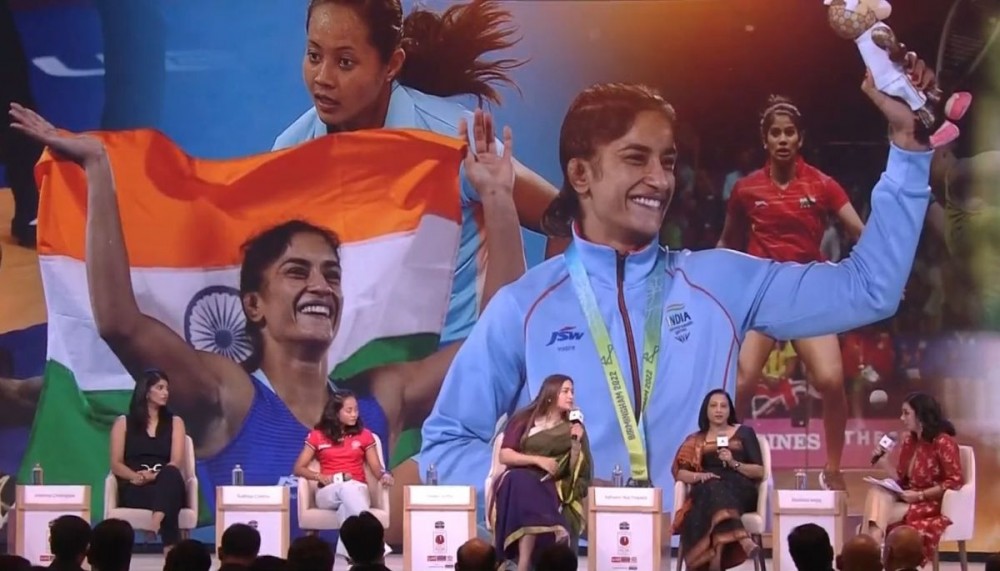
The issues and problems affecting women in sports in the country came up for discussion with Olympian wrestler Vinesh Phogat focussing on sexual harassment faced by women sportspersons and badminton star Jwala Gutta pointing at the lack of a proper attitude towards female athletes.

Former sprinter and Olympian Ashwini Nachappa pointed at the need for change in the mindset of administrators and in the governance of sports.

All these issues were raised during the ‘Fight like a Woman – Guts, Grit and Glory’ session during the second edition of ABP’s ‘Ideas of India’ summit here.

Speaking on the occasion, Arjuna Awardee and Commonwealth gold winner, Vineesh Phogat opened up about her own struggles of sexual misconduct that goes unnoticed in the field of sports.

“Every day was an internal battle to not let powerful people break you with their antics and torture,” she said.

After playing at a senior position for several years, she added “I felt in a secure position to be able to speak about the issues so girls at the start of their career don’t face what I had to go through.”

Vinesh believed that “A clean-up of society is essential for women to flourish in sports and speak about sexual misconduct.”

Jwala Gutta, also spoke about her struggles in the #MeToo movement. �

“I was threatened where ultimately I had to knock on the doors of the High Court,” she said.

“Sports in our country is considered as a good hobby or habit for girls until you win a medal, and then suddenly you become ‘Bharat ki Beti’,” added Jwala, Arjuna Awardee and Commonwealth Games gold medal winner.

The panel was further enlightened by Nachappa, former international athlete and Arjuna Awardee, who spoke about the evolution in sports over the past few decades.

“I think the process of a complete overhaul of the sports federation has begun as we see a lot more women across the sports board,” she said.

In 2010, she started the ‘Clean Sports India Movement’ with 8-9 other sportspersons to speak about the issues in the federation.

The Indian hockey player, Sushila Chanu Pukhrambam and the Pro Squash player and Arjuna Awardee and Commonwealth gold Winner, Joshna Chinappa also highlighted the positive change they witnessed.

“We have come a long way from when we started out,” they said.

Further commenting on the changes required in the sports administration in India, Nachappa said, “Its important that more professionals come into the management of sports, under an umbrella that is autonomous, which actually manages and holds federations accountable.”

Adding to this, Vinesh said, “If a sportsperson or professional leads the federation, it can create a positive impact on the industry as they understand the needs of an athlete and can even support them emotionally.”

A need for better coaches and support staff in the industry was also highlighted by the panel. “We need a good programme for coaches to overcome the lack of the same, only then we will be able make good athletes.”

The summit had an invigorating line-up of speakers with prominent figures from the world of business, politics, artists from the Hindi film industry, authors and other eminent sectors. The two-day event primarily addressed India’s stand as a burgeoning economy and global leader in shaping the future.

source: http://www.morungexpress.com / The Morung Express / Home> Sports / by IANS / February 25th, 2023

Daredevil Act By Kodagu-Born Vet Saves Leopard In Mangaluru

She sits inside a cage, goes down 25-feet deep well to bring back the feline after darting

Mysore/Mysuru:

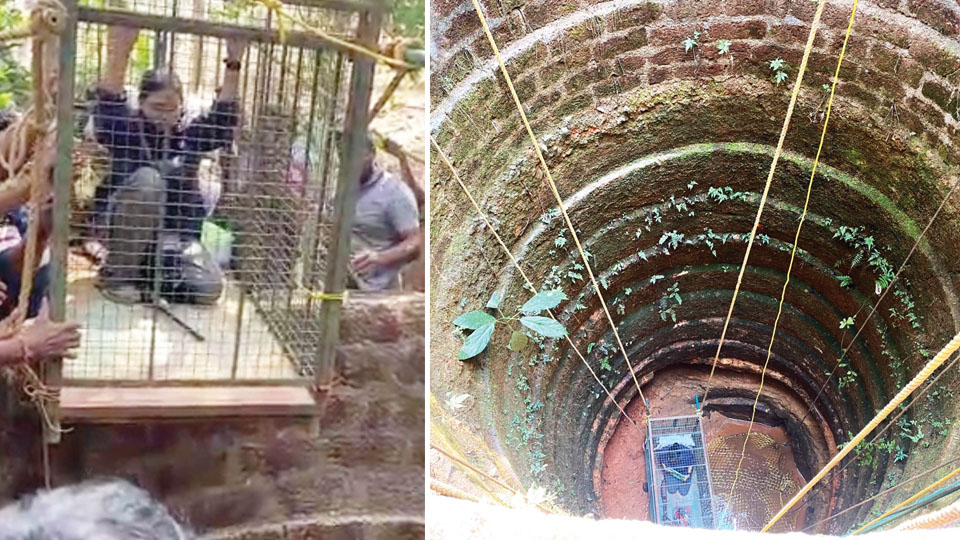
One of the most challenging and dramatic animal rescue missions has been accomplished by a Kodagu-born veterinarian Dr. Pandikanda Meghana Pemmaiah, now settled in Mangaluru. 

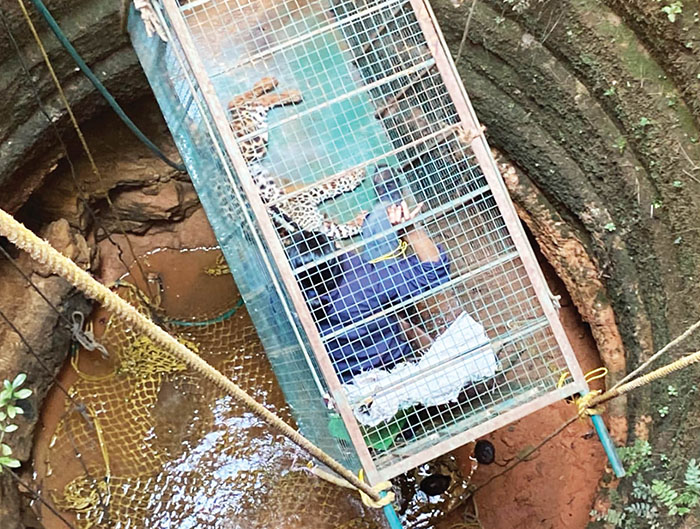
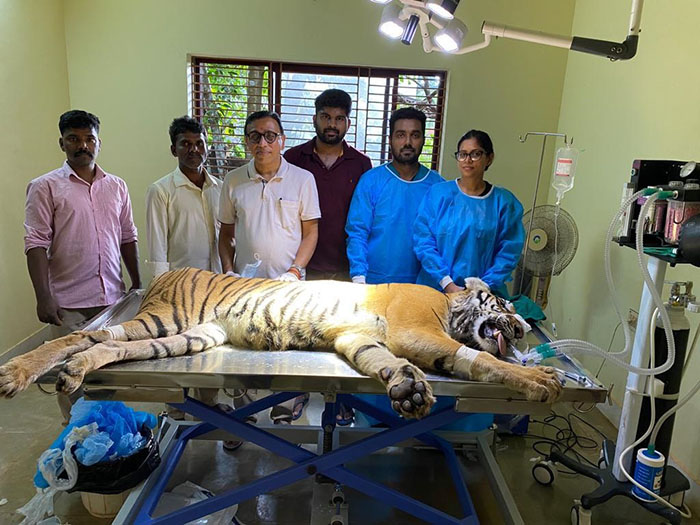
She recently saved a leopard that had fallen inside a 25-feet deep well and performed the act by sitting inside a cage that was lowered into the well to sedate the leopard that was stuck there and starving for 36 hours. She was able to pull the one-year-old feline into the same cage in a tense and dare-devil two-hour rescue operation. Her husband Dr. Yashaswi Naravi too was a part of the rescue mission. 

In fact, it was 31-year-old Dr. Meghana, who volunteered to go down the well. She told Star of Mysore that though she was scared as it was deep inside the well and the leopard was not visible from the top, the adrenaline rush to save the starving and stuck animal overcame the fear.

The incident took place near a house in Niddodi near Kateel in Dakshina Kannada, about 35 km from Mangaluru. “We got a call at 9 am on Feb. 12 from the Forest Department. We are a team from Chitte Pilli, a Wildlife Rescue and Research Centre in Mangaluru and the team comprises me, my husband and experts Dr. Prithvi Salian and Dr. Nafisa Kousar. We reached the place at 11 am with some necessary equipment for the rescue,” she said. 

After successfully tranquillising the big wild cat, Dr. Meghana being pulled up along with the tranquillised leopard inside the cage.

Failed attempts 

The Forest Department had tried to rescue the feline with a ladder and a cage, as in other instances the trapped leopard had walked into the cage when it was lowered inside a well. However, this leopard was unwilling to move, she added. 

The leopard was not visible from the top and it had taken shelter at a cosy spot that was shaped like a cave-like cavity — to avoid falling into the water — inside the sturdy well that was built with stones. The leopard was aggressive when attempts were made by the Department to drain the well water.

“Later, a different strategy was adopted and it was decided to lower a cage carrying a person to tranquillise the leopard and bring it back. We had no other choice and someone had to do it. I volunteered despite the dangers involved,” Dr. Meghana revealed. 

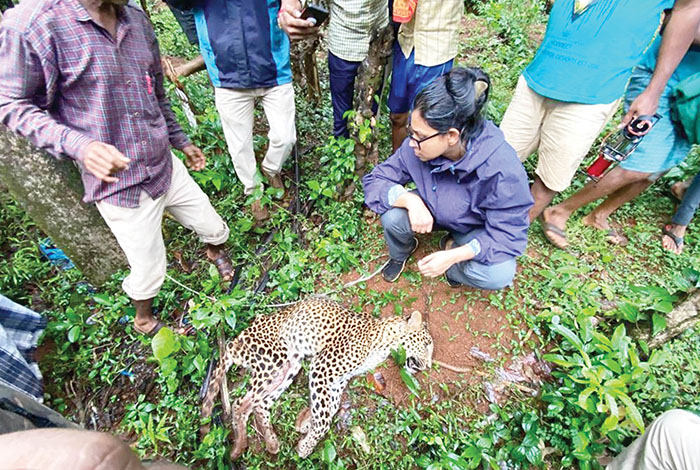
The leopard being treated after capturing in Mangaluru.

A risky mission

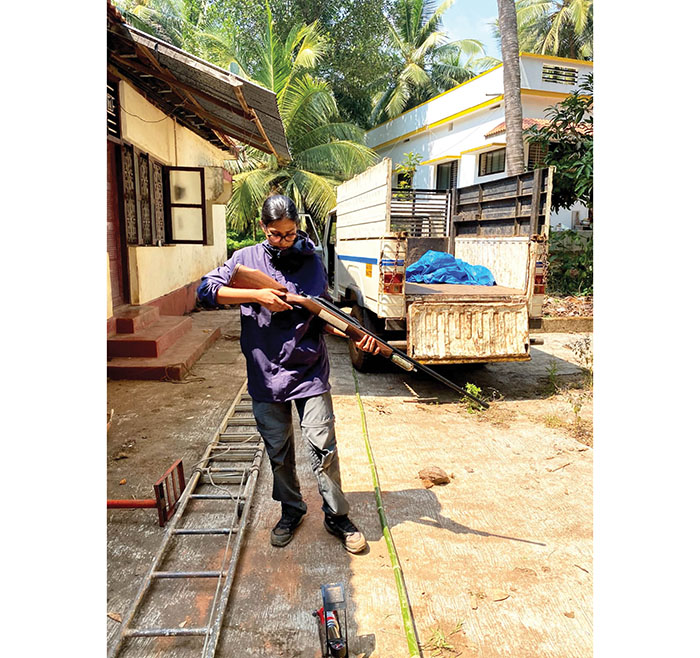
The cage was lowered by villagers, volunteers and the Forest Department staff in a coordinated action and with Dr. Meghana holding the tranquilliser gun. “We did not have a visual of the leopard and as such, it was a risky mission as no one had a clue as to how the leopard would react,” she said. 

“I waited patiently for a sight of the leopard as the cage was lowered gradually and finally I could spot the animal around 10 to 15 feet inside the well and it was growling at me though it looked exhausted without food and water. I had very little time and hence aimed the dart at the animal and shot at it. Luckily, it was a precision shot and the dart hit the feline’s thigh in the first attempt itself,” Dr. Meghana said. 

Meghana had carried about three to four syringes containing the sedating medicine as she did not know about its weight, size, health and other parameters for darting it. If she missed the aim the first time, she could well refill the tranquilliser gun with the second shot but the leopard could have moved away from the initial close proximity and there was more probability of her missing the shot. 

Growling leopard

“In fact, I had to sit inside the cage for over 15 minutes for the dart to take effect and the leopard was right in front of me. It was growling and looking at me. Slowly, the sedation process began and I tried to pull it to the cage but could not. Another youth got inside the well and helped me and we both put the 25-kg leopard inside the cage. It was a leopardess. Now when I look back, sometimes I fear what could have happened if something had gone wrong,” she said. 

So tense was the situation after the dart was fired that Dr. Meghana sat motionless inside the cage as any movement or noise would disturb the leopard and it would take a long time for the animal to get sedated. Finally, the feline fell unconscious after over 15 minutes. After the leopard was lifted back to the ground, it was checked and the vets found no external injury marks.

“It was a healthy leopard but was exhausted. After administering the required medicines for the feline to rejuvenate and get back its strength so that it has the capacity to hunt on its own, it was handed over to the Forest Department that released it back to the wild,” Dr. Meghana said.

Passion for wildlife keeps her going

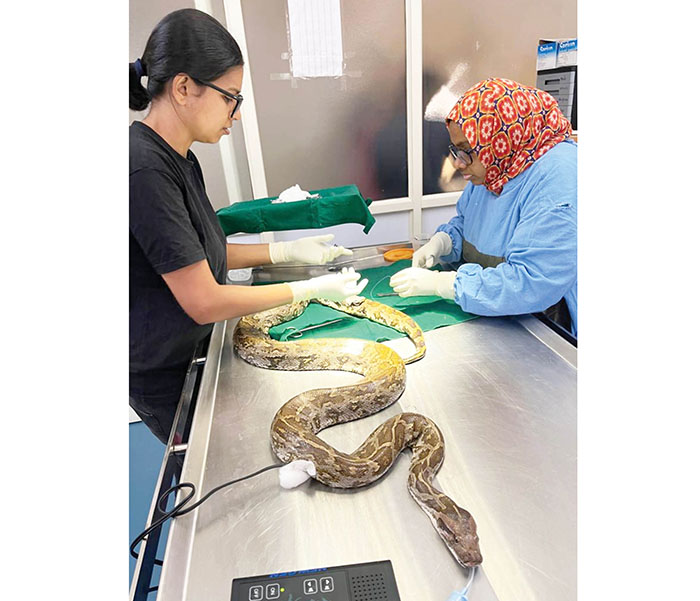
Wildlife rescue operations are nothing new for Meghana and she has been a part of many rescue operations in the last six years in Karnataka. She has been a part of many missions where she has rescued and treated tigers, owls, star tortoises, pariah kites, crows, pigeons, birds and even pythons. 

“Passion about wildlife, increasing human-animal conflicts and the resulting rescue mission keeps me going. I dread to see an animal suffering due to injuries,” she said.

Every year, she does almost 10 darting procedures after following the scientific process and protocols. But this was the first time she had to get down into a well, sitting inside a cage to rescue a leopard. She hails from Halugunda village near Virajpet in Kodagu district and studied in Bengaluru.

Dr. Meghana treating a python.

After completing her PUC from Christ College, Dr. Meghana did her BVSc followed by MVSc in Wildlife and Surgery from Veterinary College, Bengaluru. The next four years, she worked in People For Animals (PFA) as a senior veterinarian and this gave her on-hand exposure to animal rescue and medication.

Her father late Pandikanda M. Pemmaiah was a retired Superintendent of Police and her mother P.P. Sarasu and rest of the family live in Bengaluru. She married veterinarian Dr. Yashaswi Naravi of Mangaluru and both have been working at Chitte Pilli — a Wildlife Rescue and Research Centre.

source: http://www.starofmysore.com / Star of Mysore / Home> News> Top Stories / February 21st, 2023

Kodagu skier set for World C’ships

Bengaluru: 

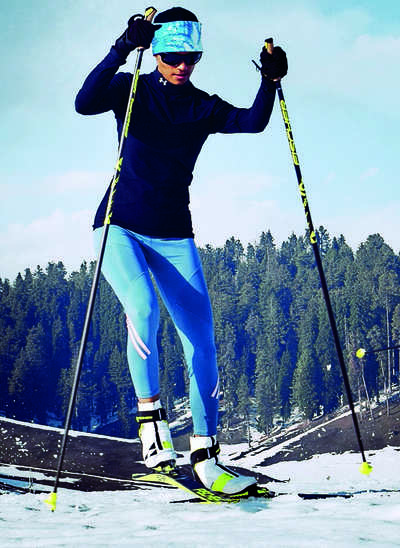
Bhavani TN is like a tourist at her native Kodagu, spending a maximum of ten days in a year. Her last visit was in September. The skier spends more time at Gulmarg in Jammu and Kashmir and Leh in Ladakh to train in snowy conditions. She has also travelled to Norway and Italy to improve her skills at her own expense in the last two years.

Each foreign training stint costs around Rs 12-15 lakh for approximately 45 days, which includes hiring a coach there, flight tickets, lodging expenses and use of facilities among others. Her parents, coffee planters, bear almost 80 percent of her expenses.


Poor facilities


“The winter sports facilities and the infrastructure in India is not enough — though developing — for us to compete against the Europeans, that is why I go abroad and train. It is expensive. We have one of the biggest mountain ranges with good snowy conditions in the Himalayas. If India has good facilities, it will be great for winter sports,” Bhavani, 27, who began practising the sport seriously around five years ago, told TOI. “Good facilities in the country can be beneficial because of the altitude, which helps in increasing stamina.”


Despite the odds, Bhavani’s dedication has borne fruit with the Kodagu girl set to compete in the 5km cross-country distance freestyle event at the Nordic Ski World Championships in Slovenia from February 21.

Qualifying for the big event did not happen overnight for Bhavani, who gave up her ski instructor’s role at the Jawaharlal Institute of Mountaineering in Jammu and Kashmir in 2021 to pursue bigger dreams.

She won gold and bronze at the Khelo India Winter Games in 2021. She also collected gold and two silver medals in the National Cross Country Skiing Championships in 2022. She featured in the recent Khelo India Winter Games, winning a gold, silver and bronze, facing some tough conditions which helped her prepare for the Worlds bash.

Earlier, she caught the attention of all last December when she clinched a silver (5km skiing) at the Raiffeisen Langlauf Cup in Italy.

Setting bigger goals


Bhavani is buoyant and has set bigger goals for Slovenia. “The World Championships is as big as the Winter Olympics. I know it is going to be tough. As of now, I am looking for a top-ten finish (5km event). If I manage to do that, I will be eligible to compete in one more event — in the 10km,” said the skier, who will leave for Slovenia on February 19.

source: http://www.timesofindia.indiatimes.com / The Times of India / Home News> City News> Bengaluru News / by Ashim Sunam / February 17th, 2023

.

Joshna claims a record 19th National squash crown

Abhay picks up his maiden crown.

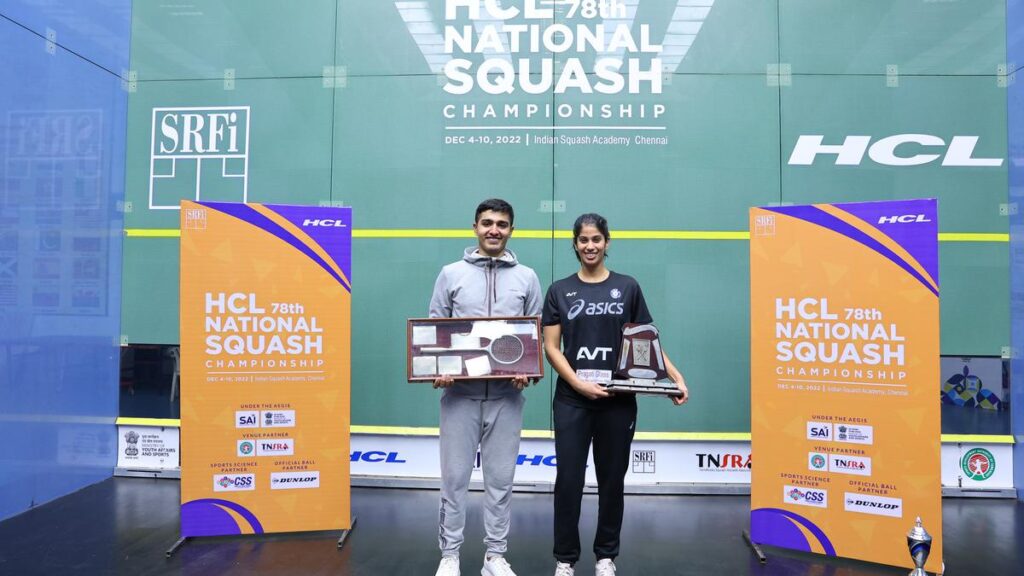
Abhay Singh and Joshna Chinappa with their reward for emerging on top in the 78th senior National squash championships in Chennai on Saturday. | Photo Credit: Special Arrangement

Joshna Chinappa kept her date with destiny by bagging a record 19th women’s title while Abhay Singh won his maiden crown in the HCL-78th senior National squash championships here on Saturday.

Joshna, seeded No. 1, overcame a strong challenge from Anahat Singh, the second seed, 11-8, 11-9, 11-9 in the final, with assured court-coverage and precise shot execution. Abhay, the men’s top seed, powered past S. Velavan (5/8) 11-13, 11-7, 11-6,11-4 in the summit clash.

A composed Joshna attacked with power and used her vast experience to deceive the 14-year-old. In all three games, the 36-year-old took a sizeable lead only to find Anahat come back strongly.

Anahat fought for every point, showing her skills on the forecourt and backcourt with delicate drops, forehand and backhand winners. But Joshna was too good on the day.

“She played a fearless game and handled the pressure well. I remembered my first finals against Vaidehi Reddy, in the 2000 Nationals here, as a 14-year-old. It feels great,” said Joshna, who was resting for four months after suffering a knee injury and took the decision to play only days prior to the Nationals.

Velavan, playing in his first final, did well to save four game points to win the first game against Abhay. But the 24-year-old, who had won three PSA titles this year, came back strongly, pushing his State-mate to both sides of court and finishing the points with backhand crosscourt placements and forehand flourishes.

“Winning the Nationals was a dream for me and winning it in my first final is great. It is certainly my biggest win and very special,” said Abhay.

K. P. Karthikeyan, Member Secretary, SDAT, gave away the prizes.

The results (finals): Men: Abhay Singh (TN) bt S. Velavan (TN) 11-13, 11-7, 11-6, 11-4.

Women: Joshna Chinappa (TN) bt Anahat Singh (Del) 11-8, 11-9, 11-9.

source: http://www.thehindu.com / The Hindu / Home> Sports> Other Sports / by K Keethivasan / December 10th, 2022

Coorgi Saree: Know why Coorg prefer this style of saree draping

Coorgi Saree: Know why Coorg prefer this style of saree draping

HIGHLIGHTS

The pallu is neatly tucked over the shoulder and saree pleats are pushed backwards, the above style of saree draping is Coorg style of adorning saree.

The above style reflects the unusually beautiful culture of Coorg.

__________

Coorgi saree hails form the neighbouring state of Karnataka and it is very popular across the globe for its unique draping style.

While wearing the saree in this style, pallu is neatly tucked over the shoulder and saree pleats are pushed backwards, this one is also called Kodagu style saree or kodava Attire.

Along with this saree, women of Coor wear a piece of cloth which looks similar to the saree on their head, called vastra.

Origin

The origin of Coorgi saree is associated with a mythological tale of the great sage Agasthya and his wife Cauvery. The legend has it, that Cauvery transformed self in a river so that, she can serve people. The sage Agasthya tried his best to stop his wife from transforming herself into a river in the process her saree pleats were pushed back. It was from that time that women from Coorg wear saris in this manner.

Why Coorg women prefer this style?

One of three reason, the fable of Sage Agasthya and his consort Cauvery is an inspiration for the women in Coorg to drape their saris in Kodagu style. Another main reason for them to wear their sari is, they feel comfortable and make it convenient for them to move around in the hilly slopes of the area and even climb trees.

The Kodagu style draping is unique

The above style reflects the unusually beautiful culture of Coorg. The pleats of the sari, which are usually in the front in other saree, here, they are tucked at the backside of the waist. Similarly, the pallu of the saree too is draped from rear to front tucked neatly over the shoulder. These look apt when work in lustrous fabrics such as silk, satin or cotton for crisp pleating.

Originally, coton fabric was used to tie the above style of saree. But, when the British people annexed Coorg, they brought numerous changes to the Coorgi sari and the style of stitching. The blouse or jacket, which is worn beneath the sari also witnessed few changes from time to time and even the neckline changed and band collar and high neckline was introduced. Fabrics such as velvet and satin and silk were also experimented with.

The coorgi sari is coupled with blouse or jacket that is available in different styles. A veil or vastra (head scarf) is added in case of a bride. There is a petticoat along with another undergarment of calf length, which is usually made using cotton wool, Coorg being usually cold.

Be it a small celebration to one own’s wedding, kodava attire is worn by every women with great pride.

These sarees are made using different kind of fabrics, which make them ideal for every season or occasion. Mostly wedding attire, the brides in Coorg wear a red colored Kodagu style saree made with golden dots and she combines it with a red blouse and a red head scarf . Accessorized well with tradtional gold jewelry and shoes and socks. The kodava attire is unique on its own.

source: http://www.thehansindia.com / The Hans India / Home> Life & Style> Fashion / by Mary Sagaya / Hans News Service / February 07th, 2023