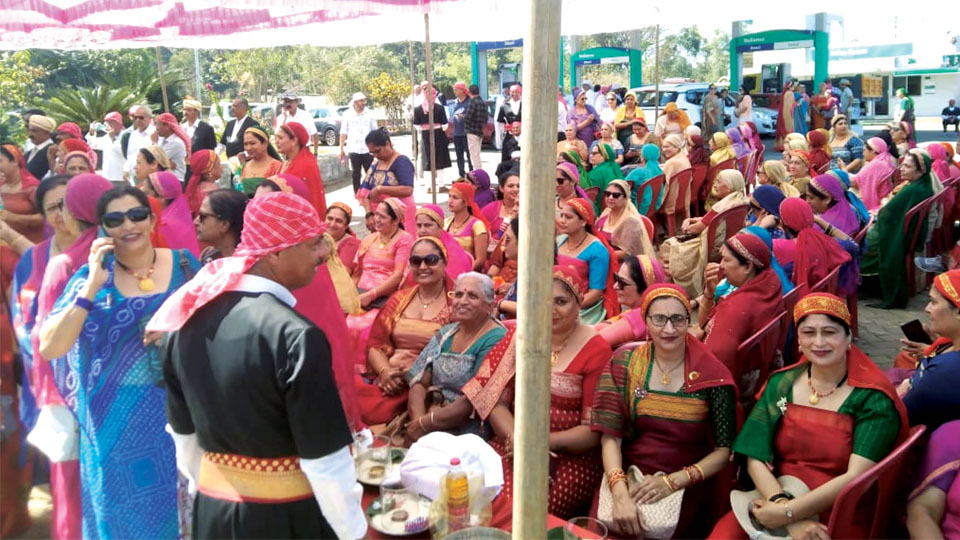
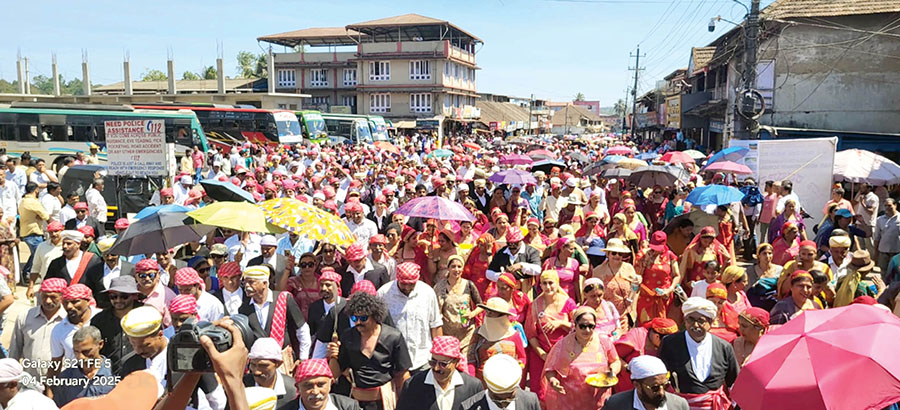
The third day of the ‘Kodavame Baalo Padayatra,’ a peace march from Kutta to Madikeri advocating for the Constitutional rights and unique cultural identity of the Kodava community, began from Ponnampet Kodava Samaja this morning.
By joining the march, participants are setting new records for a foot march, as Kodavas and Kodava language speakers set aside social, organisational and political differences to march towards Madikeri.
The march, which commenced on Feb. 2 from Kutta, reached T. Shettigeri on the first day. On Feb. 3, it continued from T. Shettigeri to Ponnampet. Today, participants paid homage at Ponnampet, garlanding the statues of the town’s founder, Diwan Cheppudira Ponnappa, and Mahatma Gandhi before proceeding to Gonikoppa. After lunch at Gonikoppa, the marchers are scheduled to reach Bittangala by evening.
The massive foot march to protest the oppression of Kodavas will culminate on Feb. 7 at the district headquarters in Madikeri, where over 40,000 people are expected to attend. The overwhelming response from Kodavas and Kodava speakers indicates a massive gathering on the final day.
Throughout the march, Kodavas are showcasing their pride in their culture and identity. Despite the scorching heat, men, women and children — some in traditional attire and others in plain clothes — are marching silently, seeking to safeguard their cultural identity and community rights as enshrined in the Indian Constitution.
Traditional welcome
The march stands against political and administrative neglect, unchecked migration, cultural and geographical loss and the denial of Kodavas’ right to practice their customs and traditions in their homeland. The camaraderie within the community has been evident, with local elders, women, family Thakkas and village elders, and community heads wholeheartedly supporting the cause.
Hospitality, an inherent trait of the Kodavas, was on full display over the past two days, as participants were spontaneously offered food and shelter all along the route. They were traditionally welcomed at various points where heads of families and aged women blessed the walkers.
A key highlight of Day-2 was the red-carpet welcome at Thuppanani and Biloor Junction leading to Hudikeri, where lunch was served at Kodava Samaja. The marchers also received warm support from Theethira family.
At Mapillethod, Kodava Muslim Alira family extended a hearty welcome, with Muslim community members gathering in large numbers to express their support. They provided snacks, buttermilk, tea and coffee, to marchers in a show of solidarity.
source: http://www.starofmysore.com / Star of Mysore / Home> News / February 04th, 2025
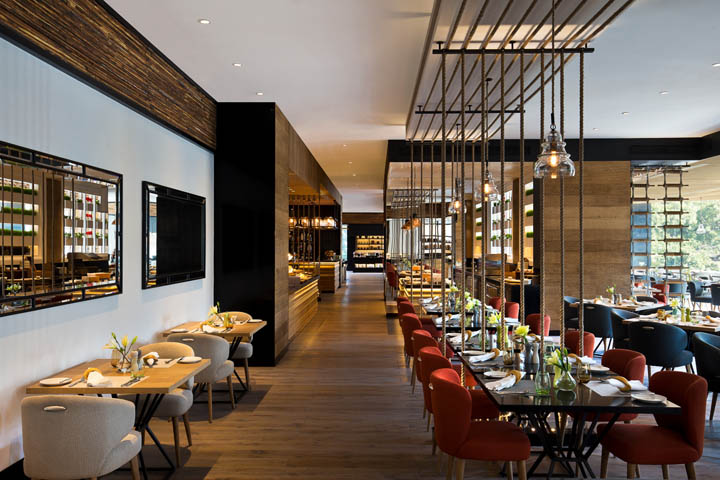
Shangri-La Eros New Delhi welcomes guests to an exceptional Chef Pin pop-up featuring the authentic Kodava cuisine crafted by Home Chef Smitha Kuttayya Boppanda from February 6 to 8, 2025.
The culinary showcase at the hotel’s international restaurant, Tamra presents cherished family recipes passed down through generations, offering diners a genuine taste of Coorg’s rich heritage. Home Chef Smitha, a classical dancer, published author, and storyteller, brings her multifaceted expertise to this unique dining experience that celebrates the traditional flavors of Kodava households.
Home Chef Smitha Kuttayya Boppanda brings to Shangri-La Eros New Delhi the culmination of a remarkable 15-year culinary journey. From her initial venture ‘Limited Overs’ to the establishment of Baked Delights and now Global Theeni, she has consistently delivered flavors that reflect her Kodagu roots. Her impressive track record of curating food festivals at renowned hotels like Taj Fisherman’s Cove and Hyatt showcases her dedication to sharing personal, memory-laden interpretations of Coorg’s rich culinary heritage.
The Chef Pin pop-up captures the essence of Coorg’s culinary heritage with a carefully curated menu showcasing the region’s bold and earthy flavors. The experience begins with starters like Nugge Elayithkande, a flavorful drumstick and potato preparation, Kumm Barthad with crispy fried mushrooms, Balekai featuring golden fried raw plantains, and the richly spiced Erchi Barthad, a mutton fry.
The mains celebrate both vegetarian and non-vegetarian specialties, including Kumbala Curry with vibrant pumpkin, Baimbale Curry with bamboo shoots, and Kaad Maange Curry with wild mango. Meat lovers can savor Kaima Curry, Erchi Curry, and the iconic Pandi Curry with succulent pork.
Accompaniments like Kadambutt, Nooputtu, and Tarkari Pulav perfectly complement the meal, which ends on a sweet note with Kaskase Payasa and Madd Kool. Paired with Coorg’s celebrated coffee, this pop-up promises a memorable journey through Kodava cuisine.
The exclusive Chef Pin pop-up at Tamra promises an intimate dining experience where each dish shares a story from the heart of Kodagu. Guests can enjoy the Lunch Buffet at INR 3,200 plus taxes per person or the Dinner Buffet at INR 3,500 plus taxes per person, making it a truly memorable experience.
source: http://www.contentmediasolution.com / Content Media Solution / Home> Business / February 05th, 2025
The initiative aims to establish 2,500 coffee kiosks and train women from self-help groups to become successful coffee entrepreneurs.
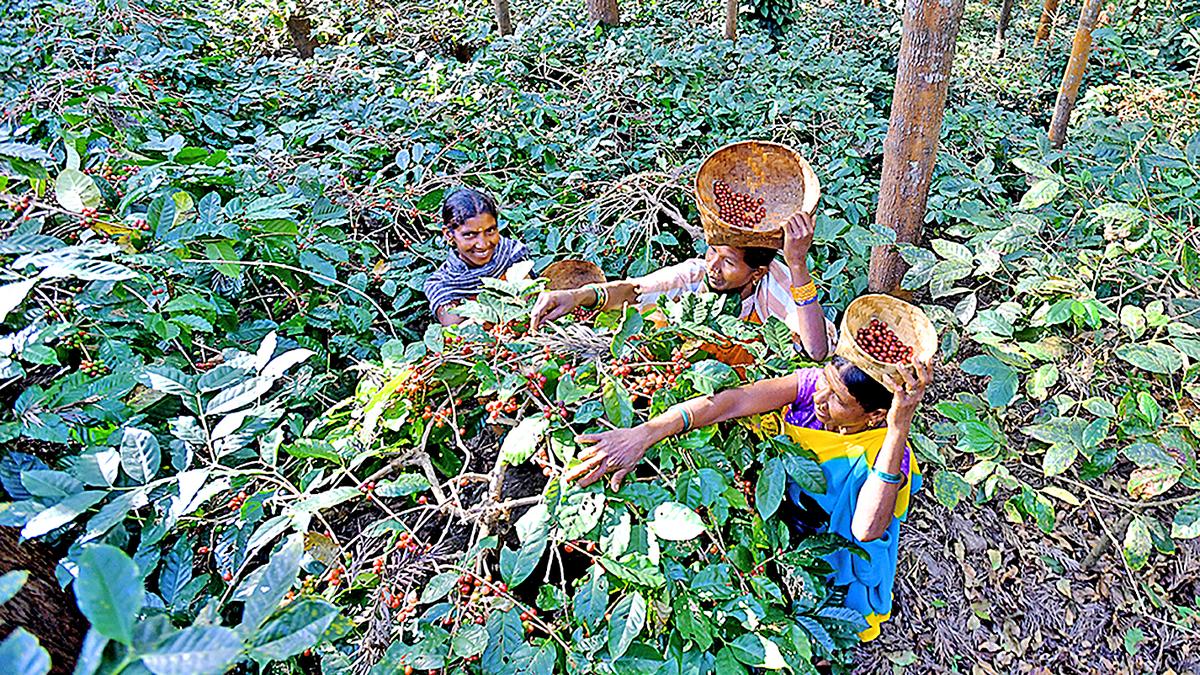
Women harvesting coffee beans. Initially, 400 women will be trained to become master trainers at the coffee board’s head office in Bengaluru. | Photo Credit: K.R. Deepak
The Coffee Board of India, in partnership with the National Livelihood Mission in Karnataka, has initiated a project to empower 1,00,000 women members of National Livelihood Mission Self-Help Groups (SHGs) across the State on coffee brewing techniques and rural cafe management.
To execute the programme, an MoU was signed between K.G. Jagadeesha, CEO and Secretary, Coffee Board, and P.I. Sreevidya, Mission Director of National Livelihood Mission. This was mainly aimed to facilitate the establishment of rural and urban cafes dedicated to offering an authentic filter coffee experience, said the coffee board on Wednesday.
“The coffee board, in collaboration with subject matter experts and in-house specialists, will work along with the Atal Incubation Centre of Coffee Board, the implementing and monitoring partner, to ensure impactful outcomes,’‘ said Mr. Jagadeesha. Ms. Sreevidya added: “This coffee micro entrepreneurial project will provide a new window of opportunities to women empowerment.”
According to the coffee board, the project will be implemented in two phases. Initially, 400 women identified by NLM will be trained to become master trainers at the coffee board’s head office in Bengaluru, who in the second phase will subsequently upskill other women at taluk and hobli levels. The initiative aims to establish 2,500 coffee kiosks and train one lakh women from SHGs to become successful coffee entrepreneurs.
The State government allocated ₹25 crore in its 2024-25 State budget to train one lakh women from NLM SHGs as coffee entrepreneurs. ‘’By supporting potential and existing entrepreneurs, it promotes gender equality, reduces poverty, and fosters opportunities for marginalised women,” Mr. Jagadeesha said.
source: http://www.thehindu.com / The Hindu / Home> News> India> Karnataka / by The Hindu Bureau / January 23rd, 2025
Jammada Preeth Appaiah, a resident of Bannimantap in city, won a silver medal in the Senior Master’s Women’s Category at the 2nd Nagraj Rao Jagdale Shooting Contest and Championship-2025.
The event was held from Jan. 12 to 26 at the Sports Authority of India Shooting Range in Bengaluru, which the Karnataka State Rifle Association organised to promote Sports Shooting in Karnataka State and to have a State Ranking. Preeth won the medal in (A-103) .177 Open Sight10 M Air Rifle Senior Master’s Women’s (NR) Category.
Preeth Appaiah is a Mysuru Sports Shooting Academy (MSSA) student. In 2023, she achieved a remarkable feat by climbing Mount Kilimanjaro, the highest mountain peak in Africa. Preeth is the wife of advocate Jammada M. Aiyanna.
source: http://www.starofmysore.com / Star of Mysore / Home> Sports / January 18th, 2025
P.T. Bopanna’s book Nanjamma Chinnappa – Chronicler of Coorg Culture looks at how the writer who passed away last year and her husband closely observed and recorded many aspects of the Kodava culture.
P.T. Bopanna | Photo Credit: SPECIAL ARRANGEMENT
The Pattole Palame (Silken Lore), originally compiled by the folklorist Nadikerianda Chinnappa in 1924, is considered a treasure trove of Kodava oral traditions, including songs, rituals, and stories that have been passed down through generations. Originally written in Kodava, it was the late Nanjamma Chinnappa and her late husband Boverianda Chinnappa who translated the work to English in 2003, making this treasured piece of literature accessible for Kodavas as well as others interested in oral literature around the globe.
As the celebrated author passed away in March 2024, writer and journalist P.T. Boppanna is set to release a book honouring her, titled Nanjamma Chinnappa – Chronicler of Coorg Culture. The book is a collage of works of Nanjamma that talks about her setting the image of a quintessential Kodavathi, her work on the architectural heritage of Kodagu, ancestral homes and Coorg cuisine. It is also a personal tribute looking at how the Chinnappa couple guided Bopanna’s journey as an author.
Speaking to The Hindu, Bopanna said that Nanjamma and her late husband worked as a team for various projects and were associated with some of his work too. “The Chinnappas were closely associated with my book and website projects for over 15 years,” he said.
Book on Nanjamma Chinnappa by P.T. Bopanna. | Photo Credit: SPECIAL ARRANGEMENT
The couple’s journey
“Nanjamma, a statistician of international repute, and her husband Chinnappa, an engineer, left for Cambridge, England, in 1974 where Nanjamma was a visiting fellow of Cambridge University. In 1975, they went to Canada to continue their careers and returned to India in 1995. Their first project after returning from Canada was to translate into English Pattole Palame, a book on Kodava culture, folk songs and traditions, written by their common grandfather Nadikerianda Chinnappa,” he explained.
Boppanna said that it took Nanjamma and her husband nearly eight years to complete the translation of the book which runs into 700-plus pages and was published in 2003. “The couple will be remembered mainly for their monumental book Ainmanes of Kodagu, on the traditional dwelling places of the original inhabitants of Kodagu. The Chinnappas believed that Ainmanes (house of elders/ancestral home) and their surroundings were sacred heritage sites that need to be preserved for future generations,” he said.
The Chinnappas are said to have visited close to 700 traditional and functional Ainmanes belonging to all communities in Kodagu and clicked 1,500 photographs during their field-work which took them five years. The book was published in 2014. “The couple also put together a website www.ainmanes.com that contains detailed information and photographs of each Ainmane visited, including oral narratives related to the Okka (clan) to whom the Ainmane belongs,” explained Boppanna.
A personal connect
The couple took a lot of interest in Boppanna’s own work on Kodava heritage and guided him in many ways, he said. “The Chinnappas were associated with my book and website projects since around 2007. They had gone through the manuscript of all my nine books, including my last book Round and About with P.T. Bopanna, published in 2022. They checked my books for grammatical and factual errors and offered suggestions for improving the content. Initially, I used to visit their home in Bengaluru. After they shifted to Mysuru a few years ago we exchanged emails and messages. They wrote the foreword for my book Are Kodavas (Coorgs) Hindus? They also wrote the afterword for my book My Coorg Chronicle,” he explained.
Boppanna said that one of the highlights of this book is the interview of Nanjamma by Dr. Nervanda Veena Poonacha, an eminent sociologist and women’s studies scholar. Veena had spoken to Nanjamma on the latter’s life journey. The foreword for the book has been penned by Dr. Sowmya Dechamma C.C., Professor, Centre for Comparative Literature, University of Hyderabad.
In the foreword of the book, Dechamma says that those who are even slightly familiar with the Kodavas of Kodagu and their increased awareness of Kodava language, culture and identity politics in the last three decades or so, would have definitely come across Nanjamma Chinnappa, her work and her ideas.
Context of their work
“On 31st March 2024, Nanjamma left us, leaving a void in the Kodava world. If an earlier generation of Kodava writers and intellectuals like Pandyanda Belliappa, I.M. Muthanna, B.D. Ganapathy, set a foundation for a discourse about the different identities of the Kodava, it was around a time when limitations of literacy and media restricted access to their work and discussions around them. The times in which Nanjamma and her husband and collaborator in her work, Chinnappa, began researching, writing and translating on the Kodavas, their work began appearing during a period of immense growth in media, combined with changes in the larger socio-economic scenario that had bearings on identity politics of the 1990s and thereafter. The opening up of the economy and large-scale migration of the Kodavas into urban centres along with an awareness of a distinct Kodava identity was the context in which Nanjamma and Chinnappa’s works were received,” she says in the foreword.
What Dechamma finds of immense significance in this volume is the interview of Nanjamma by Veena Poonacha that charts Nanjamma’s life and work. “Her review of works by Nanjamma and Chinnappa are equally valuable. Bringing together in one place the reflections and works by Nanjamma and Chinnappa is one of the best tributes possible to the life and work they were part of. Their effort in spreading indigenous knowledge associated with Kodavas and Kodagu needs us to take their work further,” she says.
Priced at ₹195, the book Nanjamma Chinnappa – Chronicler of Coorg Culture is published by Prism Books Pvt. Ltd,. and is available for purchase on online stores such as Amazon and Flipkart.
source: http://www.thehindu.com / The Hindu / Home> News> Cities> Bengaluru / by Yemen S / January 03rd, 2024
Retired IAS officer, Rathi Vinay Jha, has been selected as Coorg Person of the Year 2024 in a poll conducted by a news and tourism portal, www.coorgtourisminfo.com.
With her roots in Kodagu district in Karnataka, Ms. Rathi Vinay Jha, a former Union Tourism Secretary, had initiated several projects to “conserve Kodava culture and the martial traditions of the comunity, known for its contributions to the nation in the areas of defence and sports,” author P.T. Bopanna, who runs the portal pointed out.
He said Ms. Rathi was instrumental in setting up the virtual museum of Kodava heritage and culture, the project known as Sandooka — a treasure trove of information.
“The virtual museum is an interactive online space, brought together through material contributed by the Kodava community. Sandooka will be a living museum of Kodava culture and will be useful for future generations of Kodavas.”
“It was at the instance of Ms. Rathi, a model of Kodava ainmane (ancestral house) was inaugurated this October in Dakshinachitra Museum near Chennai,” Mr. Bopanna said.
Dakshinachitra is home to 18 traditional houses that depict the unique culture of South India. The ainmane project involved dismantling a structure built in 1852 in Kodagu and was transported to Dakshinachitra Museum, said Mr. Bopanna.
source: http://www.thehindu.com / The Hindu / Home> News> India> Karnataka / by The Hindu Bureau / January 01st, 2025
Kanthur Friends team from Murnad (Maragodu) in Kodagu from Karnataka emerged victorious in the women’s throwball championship by defeating P G Pudur team from Coimbatore in straight sets.
Meanwhile, Alif Star team from Chikkamagaluru (seen in picture below) defeated Palli Friends team from Udupi in the men’s volleyball match in a thrilling contest.
The grand finale was held in the presence of the 112-foot-tall Adiyogi at the Isha Yoga Center in Coimbatore. The winning teams won a cash prize of ₹5 lakh, bringing the event to a grand close.
Along with Sadhguru, cricket legends Virender Sehwag and Venkatesh Prasad graced the historic occasion. Thousands of spectators from India and abroad came to watch the event.
Isha Gramotsava is a two-month sports festival held across the South Indian states of Karnataka, Andhra Pradesh, Telangana, Kerala, Tamil Nadu and the Union Territory of Puducherry.
Held in over 162 rural areas, the festival saw the participation of over 43,000 players.
More than 10,000 of them were rural women, most of whom were housewives – volleyball and throwball Participated in matches.
Started by Sadhguru in 2004, Isha Gramotsava aims to bring sports and the spirit of play into the lives of rural communities.
Apart from professional players, the festival provides a platform for ordinary rural people, including daily wage workers, fishermen and housewives, to step away from their daily activities and experience the celebration and unifying power of sports.
source: http://www.mysoorunews.com / Mysooru News / Home> General / by Mysooru News Desk / January 01st, 2025
A new book says innovative thinking-on-demand is possible, if executives are given the right challenges.
Stimulating the mind
Pathbreaking “innovation happens when an area that needs transformation meets an innovator with the will and the desire to create, not follow, history”, write Rajiv Narang and Devika Devaiah in their new book, Orbit-Shifting Innovation: The Dynamics of Ideas that Create History. Narang is the founder of consultancy Erehwon Consulting Pvt. Ltd, and Devaiah is director at the firm.
The book makes a case for devising new innovation strategies that are not based on precedent or projections tied to past performance. In a chapter on “Take on an Orbit-shifting Challenge and Burn the Bridge”, the authors explain that sometimes asking a different or a broader question can lead to more efficient and interesting solutions. Edited excerpt:
All excitement around innovation is centred on getting the bigidea. Thinking out of the box is talked about with obsession. The world of innovation is full of stories of how a leader got to an out-of-the-box idea that created a transformative impact.
Nearly all of these stories are really about incidental and accidental innovation. The core question is: How do we make orbit-shifting innovation happen by design?
The reality for most organizations is that layers and layers of gravity can make it very difficult to come up with an out-of-the-box idea. Come to think of it, out of which box is the real question. For there is the organizational gravity box, the industry gravity box, the country gravity box, and the cultural gravity box. The deeper you go, the more invisible the box becomes.
Most orbit-shifting innovations did not start with an out-of-the-box idea, but with an out-of-the-box challenge, an orbit-shifting challenge.
It takes an orbit-shifting challenge to create the escape velocity needed to break through gravity. An out-of-the-box idea is a consequence. An orbit-shifting challenge leads to an orbit-shifting idea and not the other way round.
Redefine Goal Setting
To trigger orbit-shifting innovation by design, organizations need to start by going beyond performance goals. They need to redefine goal setting into a twin-track exercise: orbit-maintaining PLUS orbit-shifting goals. A powerful principle is: for every three orbit-maintaining (performance) goals, a leader needs to take on at least one orbit-shifting challenge. Adopting and institutionalizing the 3+1 twin-track goal-setting construct will unleash orbit-shifting innovation by design.
Going further, by ensuring orbit-shifting challenges are not skewed, but straddle across process, product, and business models and at all orbit-shift levels, a leader will ensure a powerful orbit-shifting portfolio: to not just build competitive advantage but sustain and grow future advantage. Twin-track goal setting is a powerful way to embed strategic flexibility into the organization’s DNA.
Triggering the Orbit-shifting Challenge
How does a leader or an organization go about uncovering and identifying orbit-shifting challenges? What are the new reference points? What triggers the identification of an orbit-shifting challenge as against a traditional performance goal?
Most traditional goal-setting exercises get rooted into the reference points of the current orbit. Last year’s achievements and industry projections become the first reference point for next year’s goals. Orbit-shifters, unlike followers, don’t reference last year and create stretch goals. They trigger orbit-shifting challenges.
Making an Exception the New Reference Point
Some followers look at the average and create stretch goals, others benchmark with the industry best practices and create catch-up goals. Orbit-shifters search for the exception, across industries and domains, and make the exception the reference point for an orbit-shifting challenge.
The Most-Watched Show
The KBC (Kaun Banega Crorepati) orbit-shifting challenge came to life when Rupert Murdoch and Peter Mukerjea asked ‘what is the most-watched TV programme in India’ and ‘not what is most-watched game show in India’. They made the exception across all TV formats as the reference point, and this went on to trigger the orbit-shifting challenge—make the Indian version of Who Wants to be a Millionaire as big as an India-Pakistan cricket match on a Sunday.
As a CEO, think about this:
Traditionalists focus on the average; they treat exceptional events/occurrences as abnormalities to be ignored. For orbit-shifters, what is an exception today could be the norm tomorrow. Acting like an orbit-shifter, look for: the absolute exceptions in your industry. What is an exception across industries? For each reference point defining the current orbit, look for an abnormality, look for an exception—within the industry and across industries.
Make the exception the new reference point of the next orbitshifting challenge.
source: http://www.livemint.com / Mint / Home / by Rajiv Narang & Devika Devaiah / February 23rd, 2014
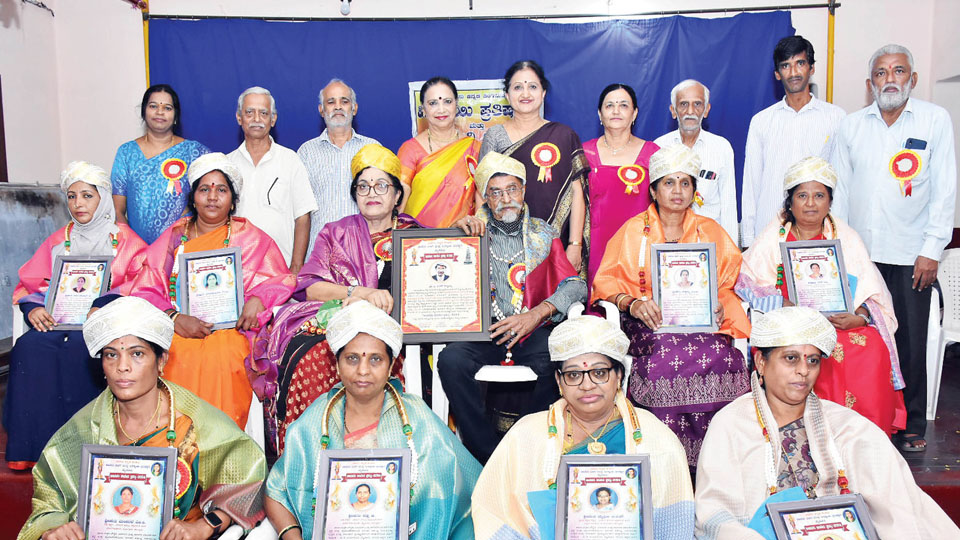
Ten teachers were felicitated and presented ‘Jeevanadi Cauvery’ awards in memory of Nambiyapanda Gowru Ponnavva at a function held in the premises of Akkana Balaga School in Agrahara in the city on Tuesday. The award presentation function was jointly organised by Cauvery Balaga and Hiranmayi Pratishtana.
Speaking at the function, writer Bannur K. Raju said it is essential that education and health must be provided to everyone without any bias like in many developed countries.
“Unfortunately in our country, both these vital sectors are in firm grip of private organisations which has deprived both education and health to poor and middle class people,” he regretted saying it has become essential that these two sectors be nationalised in the interest of majority of people in the country.
Teachers S.N. Janaki of Alanahalli Government Lower Primary School, H.D. Kote taluk; M.P. Manjula, Hunsur Govt. Lower Primary School; K. Parveen Taj, Arenahalli Govt. Urdu Lower Primary School, Periyapatna taluk; G. Ratna, Beeregowdanahundi Government Lower Primary School, Mysuru taluk; M.T. Akkamma, Ammathi Govt. Higher Primary School, Virajpet taluk; M. Rani, Head Mistress, Bharati Sthree Samaja Higher Primary School, Yadavagiri in Mysuru; T.S. Maithili, Physical Education teacher, Government Higher Primary School, Vysarajapura, T. Narasipur taluk and M.T. Saralakumari, Head Mistress, Kajoor, Somwarpet taluk were felicitated at the function with ‘Jeevanadi Cauvery’ awards.
City’s renowned Sculptor Appaneravanda Kiran Subbaiah was given a special award. ana
Noted Danseuse Dr. Tulasi Ramachandra, retired teacher A. Sangappa and artist Dr. Jamuna Rani Mirle spoke at the function.
President of Cauvery Balaga and retired teacher N.K. Kaveriamma, President of Hiranmayi Pratishtana A. Sangappa, Jnana Vignana Samiti District President H.V. Muralidhar, Art teacher Manohar, Social activist Malini R. Palaksha and teacher Anupama were present.
source: http://www.starofmysore.com / Star of Mysore /Home> News / May 23rd, 2024
WELCOME. If you like what you see "SUBSCRIBE via EMAIL" to receive FREE regular UPDATES.
Read More »