Karnataka’s Dean Mascarenhas and experienced co-driver Gagan Karumbaiah sealed their maiden Indian National Rally Championship (INRC) title with a round to spare. – IANS
Indore (MP) (IANS) :
Karnataka’s Dean Mascarenhas and experienced co-driver Gagan Karumbaiah sealed their maiden Indian National Rally Championship (INRC) title with a round to spare, even as their TSI Racing teammates from Himachal Pradesh, Aditya Thakur and Virender Kashyap, clinched overall honours at the Rally of the Highlands, the fifth and penultimate round of the 2025 season, held at the National Automotive Testing Tracks (NATRAX), Pithampur, on Sunday.
Dean and Gagan finished fifth overall on the final day, earning a crucial championship point that gave them an unassailable provisional lead and confirmed their first National title. Dean, who made his rally debut at K1000 in 2010, had narrowly missed out on the championship in 2019 by just one point.
“Incredible. It is an amazing feeling to finally win the Overall National Championship,” said Mascarenhas. “I have waited over 15 years for this moment. A huge thanks to TSI Racing and PH Sport, without whom this would not have been possible. I am especially grateful to my co-driver, Gagan, who has been phenomenal. This is a truly memorable milestone in my career.
The duo has partnered with each other since the Coimbatore Rally in 2019. Despite minor mechanical issues, Aditya Thakur and Virender Kashyap produced a composed drive to secure the rally win.
“We broke the gear mounting in the first stage today, but managed to finish the stage. There was no point pushing after that, so we focused on protecting our position and bringing the car home safely,” said Thakur. “It is a joy to drive this car, and we are delighted to get our first win for the team. Congratulations to Dean on winning the championship.”
Defending champion Karna Kadur, partnered by Musa Sherif, delivered a blistering performance on the final day to finish second overall. However, it was not enough to take the title battle into the final round, as Mascarenhas’ fifth-place finish proved decisive.
In INRC2, Jason Saldanha of Mangaluru, guided by veteran co-driver PV Srinivasa Murthy, claimed victory. Kerala’s Fabid Ahmer and Milen George produced a strong final-day charge to finish second, while Harkishan Wadia and Kunal Kashyap completed the podium.
Chettinad Sporting’s Vishakh Balachandran, with Chiranth Jain, won the INRC3 category ahead of teammates Sheshank Jamwal and Raghuram Saminathan. Anushriya Gulati, partnered by Karan Aukta, finished third, secured the Ladies Class title, and also placed an impressive ninth overall. Phoebe Dale of Meghalaya and Athira Murali completed the podium in that order
In other categories, Bhopal’s Mohammed Kaif Khan, with Jibran Ahmed, won the Gypsy Challenge, while Bengaluru’s Asool Albert John and Kodagu’s Aiyappa Bopanna clinched the Classic Challenge Cup.
Provisional results final:
Overall: 1. Aditya Thakur/ Virender Kashyap (both Himachal) TSI Racing, (01 hour, 39 minutes, 49.2seconds); 2. Karna Kadur (Bengaluru)/ Musa Sherif (Kasargod), Arka Motorsports (01:40:40.0); 3. Dean Mascarenhas (Mangaluru)/ Gagan Karumbaiah (Kodagu) (TSI Racing) (01:41:02.9).
INRC2: 1. Jason Saldanha (Mangaluru)/ PV Srinivasa Murthy (Bengaluru) Arka Motorsports (01:41:21.0); 2. Fabid Ahmer (Palakkad)/ Milen George (Kottayam), Pvt. (01:41:28.8); 3. Harkrishan Wadia (Delhi)/ Kunal Kashyap (Shimla) Arka Motorsports (01: 42:39.0).
My love affair with coffee started during the lockdown; trying new flavours and textures became an escape for me in those tough times, which has now developed into a regular morning comforting ritual with my coworkers. As I sit here penning down a love story to coffee, my colleagues can spot me sipping on a big tumbler of iced coffee. I had the chance to experience a rich story of coffee-making firsthand, one that had me appreciating this beverage even more. A 6-hour drive from Bengaluru brought me to the Tata Consumer’s plantation on the beautiful slopes of Coorg, which gave me an opportunity to discover and learn all about coffee beans.
Coorg is more than a famous hill station; it is also India’s coffee-growing region. For a coffee-lover like me, this trip became a one-of-a-kind core memory. With tiny droplets of rain and stunning natural visuals, I was transported to a rain-soaked fantasy with the fragrant rustling from the coffee plants. Here I saw the labour and commitment that go into each cup. I was lulled into feeling of calmness, one of nature’s offerings that’s impossible to replicate. Strolling down the road that goes through the plantation with miles of trees and coffee plantations in either direction, I was drawn into the story of coffee. The coffee plants are laden with a green and maroon coloured beans which hang thickly from the branches.
The plantation slopes are renowned for their Arabica and Robusta brews and are surrounded by several lakes, verdant hills, and a diverse range of flora and animals. November is considered to be the best time to pick up the berries and witness the harvest. But when a coffee enthusiast like me is roaming around so much coffee, you can’t help but crave the brown beverage. So, while explaining the foundation and motives of their campaigns and crop, the brand served to cure our coffee craving with steaming hot sips of their best-selling filter kaapis.
A 150-Year-Old Legacy
You might wonder what makes Tata Consumer Products different from its competitors. Tata’s association with the beverage dates back more than 150 years when some tenacious planters from the then-state of Mysore in South India planted the first seeds of the estates and brought coffee to the Coorg Hills. These are some of world’s best coffees, produced by the land and most importantly the local people living there.
source: http://www.elle.in / Elle / Home> Food / by Ekta Sinha / October 09th, 2023
The Annual Inter-Sangha Tennis Ball Cricket Tournament in memory of Kannambira Girish Kushalappa was organised by Kodava Samaja Cultural and Sports Club, Mysuru, recently at University and Gangothri Grounds in which 18 teams from different areas participated.
In the finals, Sri Igguthappa Kshemabivridhi Sangha, Hebbal A, emerged winner by defeating Sri Cauvery Kodava Association (Mysore East).
The winning team members are seen with chief guest Ajjikuttira T. Poovaiah (DCF retd.), Kannambira Neeta Kushalappa, Ponjanda A. Ganapathy, President, Kodava Samaja, Mysuru, Machanda Prakash Belliappa, Vice-President of the Club, Aramanamada Ponnanna, Secretary of the Club, along with Club office-bearers and others.
As part of the tournament, an exhibition match was also played between two veteran teams as Mysore North and Mysore South.
source: http://www.starofmysore.com / Star of Mysore / Home> Sports / January 29th, 2026
In the quiet village of Ullikal near Iritty in Kerala’s Kannur district, stands the ancient Vaithur Kaliyar Shiva temple reverently known as Bythoorappa by the Kodavas. As preparations begin for the annual festivities scheduled from 13 to 26th January, 2026 the temple once again becomes the focal point of an unique cultural and spiritual bond that has endured for generations across state borders.
More than a place of worship, the Bythoorappa temple represents a shared legacy between the people of Kodagu and northern Kerala. For centuries, traditions here have flowed seamlessly across geography, language and community, held together by faith and mutual respect. The administration of the temple itself reflects this harmony, being traditionally managed by a Trust comprising members of both the Kodava and local communities.
One of the most touching sights during the festival is the procession of bulls carrying offerings of rice from Kodagu. As the bulls walk steadily towards the temple, carrying grains grown by devoted hands , it feels as though the earth itself is offering thanks to the divine. There is a miraculous observation to be made here – the chosen bulls make their way to the temple without being aided – they “know” the way and wait at the destination where the rice is ceremoniously taken as an offering.
Devotees from Kodagu are welcome not as outsiders, but as family returning home. Hospitality here is instinctive, heartfelt and sacred – proof that cultural bonds can be stronger than physical boundaries. In these moments, Bythoorappa becomes more than a deity, and is a sacred guardian of shared heritage,
Among the many okkas spiritually bound by Bythoorappa, the connection of Kodandera Okka stands out rooted in our oral history that speaks of fear, faith and deliverance. Elders recount a grieving period when a Kodava Raja , driven by suspicion and authority, ordered the killing of young boys belonging of a particular clan. As the shadow of death loomed over the Kodandera lineage, an elderly woman of the Gummatira Household is believed to have turned to Lord Bythoorappa in prayerful obeisance.
With no power to resist and nowhere else to seek refuge, she made a solemn vow to the deity, pleading for the lives for the children of her clan and promising lifelong devotion in return. It is legendary folklore that the boys were spared. The clan survived. And with that survival, a sacred bond was sealed.
That vow did not end with her lifetime. Even today a fixed quantity of rice from Kodandera okka is offered at the Bythoorappa temple, faithfully continuing a promise made generations ago. The offering is modest and made with unwavering sincerity. Each grain standing as silent testimony to gratitude, remembrance and the power of belief, which is not ritual alone, but history placed gently at the feet of the divine.
Bythoor, also known as Baithur, represents faith well beyond stone and sanctum. It is History remembered through faith, a testament of centuries of respectful camaraderie and a symbol of harmony rooted in devotion. As long as prayers rise from both the hills of Kodagu and the plains of Kerala, Baithur will continue to stand as a living bond between the two communities united by solemn belief and heritage.
source: http://www.clnews.in / Coffeland News / Home> Articles / by Kodandera Mamatha Subbaiah / January 21st, 2026
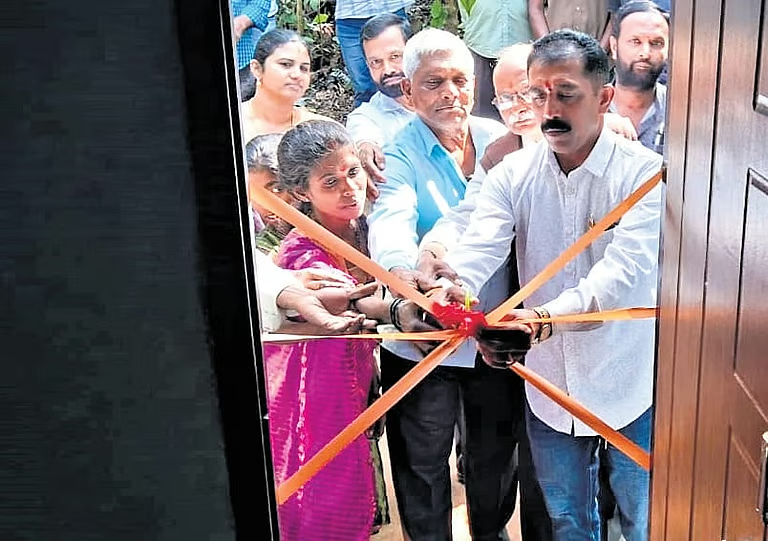
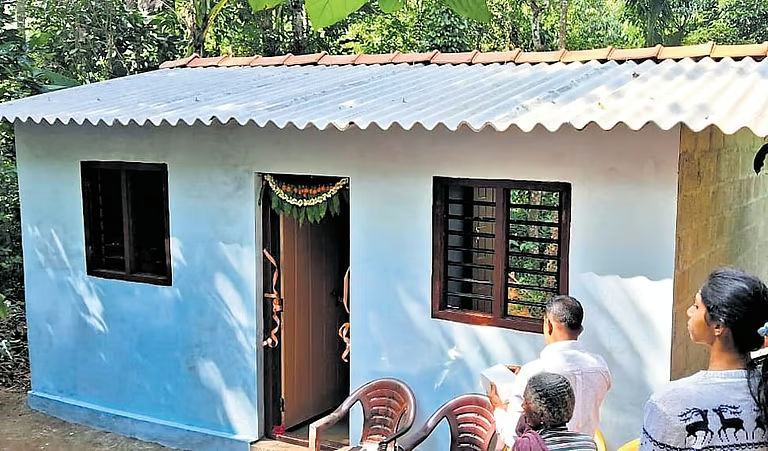
The renovated building of the Maharshi Valmiki Tribal Residential School at Nagarahole, constructed at a cost of ₹1.8 crore, was inaugurated on Friday by Kodagu District In-charge Minister N.S. Boseraju and Chief Minister’s Legal Advisor and MLA A.S. Ponnanna. The project was undertaken jointly by the Kodagu District Administration, Zilla Panchayat, and the Department of Welfare of Scheduled Castes and Scheduled Tribes.
After the inauguration, Minister Boseraju interacted with the students and enquired about their learning environment, food quality, and facilities. He asked whether they were receiving eggs, bananas, and “chikki” as per the weekly menu. When students replied that they had rice, sambar, and ragi balls for lunch, he further inquired about the type of sambar served. The students responded it was made of gram and vegetables, following which the minister advised them to study well and make the best use of government facilities.
Inspecting dormitories and storage rooms, Boseraju said that several deficiencies in the school had been addressed through this renovation, which included new classrooms, solar power installation, playground development, and construction of a protective railway barricade. He added that the Integrated Tribal Development Project (ITDP) would provide additional funds for pending works.
MLA A.S. Ponnanna said efforts were being made to bring tribal students into the mainstream through better infrastructure and learning support. He urged authorities to expedite the remaining works, such as the teachers’ quarters, playground facilities, and iron fencing along the railway boundary. He also appealed for the distribution of Forest Rights Certificates to unregularised tribal families in the Nagarahole region.
On the occasion, Minister Boseraju distributed sports materials to students. Several district and local officials were present.
source: http://www.thehansindia.com / The Hans India / Home> News> State> Karnataka> Bengaluru / by The Hans India / November 05th, 2025
Kodava Samaja, Mysuru, along with the Field Marshal Kodandera M. Cariappa Fans’ Association, Mysuru, celebrated the 127th birth anniversary of Field Marshal K.M. Cariappa.
The programme was organised in front of the statue of Field Marshal Cariappa at the Field Marshal K.M. Cariappa Circle (Metropole Circle) on Vinoba Road this morning.
Former MP Prathap Simha offered floral tributes to the statue and said that celebrating the 127th birth anniversary of Field Marshal Cariappa is a matter of great pride for society. His contributions and valour have earned him immense respect across the nation. Kodagu’s contribution to the country is unparalleled.
He added that no other land could produce patriots and warriors like those from Kodagu. “Patriotism has grown there as a tradition. Though the Kodava community is small, its service to the Armed Forces is immense. It is a privilege for our land to cherish the memory of a leader like Field Marshal Cariappa, born in such a tradition,” he said.
World War II, freedom struggle
Field Marshal Cariappa’s service during World War II and the freedom struggle was exemplary to the world. The rank of Field Marshal is the highest in the Indian Army and it is a matter of pride not only for the Kodava community but also for Karnataka.
“He may not have received the Bharat Ratna, but he was honoured with the rank of Field Marshal,” Simha remarked. He further noted that Cariappa, along with General Kodandera S. Thimayya, gave democratic India a strong shape and direction.
“Even today, the Kodava community has contributed more than 30 Lieutenant Colonels to the Indian Army, five captains to Indian hockey and over 60 players to the sport. “For this, the community must feel proud and continue to grow. As the community grows, so will the nation and patriotism,” he said.
Former MLA L. Nagendra noted that it was Field Marshal Cariappa who made the entire world turn its attention towards India.
“He must be remembered every single day. When his statue was to be installed at Metropole Circle, many obstacles arose, but all were overcome and today the statue stands tall, and this is a matter of immense pride. In the coming years, thousands from the community should gather together to celebrate Cariappa’s birth anniversary on a grand scale,” Nagendra said.
The event was attended by former Mayors M.J. Ravikumar & H.N. Srikantaiah, former Corporators Pramila Bharath & Maletira U. Subbaiah, Mysuru Kodava Samaja President Ponjanda A. Ganapathy, Kodava Samaja Cultural and Sports Club President Mukkatira C. Ashok and Field Marshal K.M. Cariappa Fans’ Association President Nayakanda Thimmaiah among others.
source: http://www.starofmysore.com / Star of Mysore / Home> News / January 28th, 2026
Kodava Samaja, Mysuru and Field Marshal K.M. Cariappa Fans Club, Mysuru, will celebrate the 127th birth anniversary of Field Marshal K.M. Cariappa at Field Marshal K.M. Cariappa Circle (Metropole Circle) in city on Jan. 28 at 8.30 am.
Mysuru-Kodagu MP Yaduveer Wadiyar, MLAs K. Harishgowda, G.T. Devegowda, T.S. Srivatsa and G.D. Harish Gowda, MLCs C.N. Manjegowda and K.Vivekananda, former MP Prathap Simha, former MLA L. Nagendra, former Mayors M.J. Ravikumar and H.N. Srikantaiah, former Corporators Maletira U. Subbaiah and Pramila Bharath will be the chief guests.
Kodava Samaja President Ponjanda A. Ganapathy, Kodava Samaja Cultural and Sports Club President Mukkatira C. Ashok, Field Marshal K.M. Cariappa Fans Club President Nayakanda Thimmaiah and others will be present on the occasion.
source: http://www.starofmysore.com / Star of Mysore / Home> In Briefs / January 27th, 2026
The blooming lavender to pink flowers at Thavarekere in Kushalnagar have become a captivating attraction, drawing travellers, tourists and locals alike. Nestled quietly among forest shrubs along the Highway, the lake has suddenly amplified its natural charm.
Typically adorned with lotus flowers, the lake is now blanketed in a striking expanse of lavender blossoms. This breathtaking transformation, stretching across the waters, offers a stunning visual spectacle. For the first time, such vibrant blooms have appeared here, leaving visitors both surprised and enchanted.
Residents of Kushalnagar recall that the lake was once abundant with lotus flowers, which earned it the name Thavarekere (Thavare means lotus in Kannada). However, over time, the unchecked inflow of sewage into the lake has allowed invasive water hyacinth — a free-floating perennial aquatic plant — to take over and now bloom in full.
The lake’s new-found allure is drawing crowds who pause along the roadside to soak in the surreal scenery. The surge in visitors has even prompted Police deployment to regulate traffic and maintain order in the area.
source: http://www.starofmysore.com / Star of Mysore / Home> News / June 30th, 202
The Jenu Kuruba community marched towards their ancestral land on May 5, 2025, a day they claim is now reserved forest land. Photo: Nikita Jain/Maktoob
Continuing with their demand for recognition and claims to their ancestral lands, different tribal communities in Karnataka’s Nagarahole took out a padyatra (march) demanding their rights, including the stoppage of the Tiger Safari that the community claims is illegal.
A small group of Adivasis from 52 haadis (tribal villages), led by the Nagarahole Adivasi Jamma Paale Hakku Sthapana Samiti (NAJHSS), walked over dozens of kilometres and covered 29 villages in Kodagu and Mysuru districts to assert their rights to their ancestral lands in the Nagarahole forests.
Speaking to Maktoob, J.A. Shivu, president of the Karadi Kallu Forest Rights Committee (FRC), said that the yatra was a way to raise awareness about the recognition and enforcement of their rights under the Forest Rights Act (FRA).
“There are many issues against which we conducted the yatra. One major reason was to raise awareness on the community rights claims. Another issue is the tiger safari that is being carried out on our ancestral lands without the consent of the Gram Sabhas, because there has been no recognition of community forest rights in any of the villages inside Nagarahole,” he said.
A small group of Adivasis from 52 haadis (tribal villages), led by the Nagarahole Adivasi Jamma Paale Hakku Sthapana Samiti (NAJHSS), walked over dozens of kilometres and covered 29 villages in Kodagu and Mysuru districts to assert their rights to their ancestral lands in the Nagarahole forests. Photo: Nikita Jain/Maktoob
NAJHSS had announced a historic awareness foot march regarding the Forest Rights Act, 2006, in the traditional lands of the Jenu Kuruba, Beta Kuruba, Yerava, and Paniya Adivasi communities residing in the Nagarahole region.
This foot march commenced on December 21, 2025, from Thitimathi Aiyrasuli village in Kodagu district and, passing through the villages of the Nalleri forest region, covered a distance of approximately 70 km and reached Bavali in H.D. Kote taluk of Mysuru district.
Along the route, Gram Sabhas were conducted in many villages under the Forest Rights Act, 2006. Awareness was created about the Act, and discussions were held regarding its non-implementation and violations in the forest areas of Nagarahole, declared as Rajiv Gandhi National Park and Tiger Reserve.
Tribal communities, primarily the Jenu Kuruba, in the Nagarahole Tiger Reserve are in a prolonged conflict with forest authorities, fighting for their ancestral land rights, demanding the implementation of the FRA, and protesting forced evictions and what they perceive as “colonial conservation” models that displace them for wildlife preservation.
Members of the Jenu Kuruba community inside their village area, which is located in Nagarahole Forest area. Photo: Nikita Jain/Maktoob
Maktoob had earlier reported how the Jenu Kuruba community marched back to their ancestral village in May 2025 and were facing threats of displacement again, as forest officials said claims for the land had earlier been rejected.
Since then, other communities facing similar situations have started demanding the same. The padyatra was an extension of this struggle.
Shivu explained that the Nagarahole Tiger Reserve was declared in 2007 without the consent of the community members.
“This is a larger issue. Neither any discussion nor public consultation happened, nor were any Gram Sabhas held for that. With the padyatra, resolutions were passed in more than 40 villages where all these issues were discussed,” Shivu added.
Jenu Kuruba families stay put at the Nagarahole Forest Reserve Area in what they say is their ancestral village. Photo taken on 5 May 2025. Photo: Nikita Jain/Maktoob
NAJHSS has also given the district administrations of Kodagu and Mysuru a week’s time to convene a public meeting to initiate action on their demands to assert their rights to their ancestral lands. The demands were made on January 3, after the conclusion of a 13-day-long march (padyatra) through the Nagarahole forests.
In a meeting with the Additional Deputy Commissioner of Mysuru, the protesting group demanded a meeting with the district collectors of Kodagu and Mysuru.
Another demand by the community is to convert old dilapidated buildings, which were part of a cancelled Taj Resorts project, and hand them over to the community members.
“The Gram Sabhas passed the resolution that those old dilapidated buildings which the Taj constructed will be taken over by the community and converted into an intergenerational learning centre. It will be a learning centre and an intergenerational learning centre for the Jenu Kuruba, Yerava, Paniya and Beta Kuruba communities,” J.K. Thimma, president of NAJHSS, told Maktoob.
Struggle for rights
On May 5, 2025, 52 families belonging to the Jenu Kuruba tribe marched towards their ancestral village, Karadikallu Attur Kolli, to reclaim their right to live on their land under the FRA.
The families still remain there. Beating harsh weather conditions, the community members have set up tents in a limited space. However, as the tussle between the community members and officials continues, the families are forced to endure these harsh conditions.
Shivu, whose family is also staying with the community members, said that many children and women have fallen sick due to changing weather conditions.
“While there have been no threats by the forest department as of now, the living situation is hard. It is very cold at the moment and a lot of children and women are falling sick. Before winter, there were also continuous rains,” he said.
Three tents have been set up inside the area, with forest officials forcefully tearing down a fourth tent on May 7, 2025, which had been set up for menstruating women’s use.
The community members also said that there are threats from forest watchers who come to check occasionally.
“We have not been able to construct our own houses, and the problem is that the entire Individual Forest Rights process has been put under a sort of status quo by the Karnataka High Court. But the Community Forest Rights Resource process has not even begun yet,” Shivu added.
The makeshift tents where the Jenu Kuruba community from Karadikal were staying for decades in Karnataka’s Nagarahole on May 5, 2025. The same day, they marched into the forests to what they claim is their ancestral land. Photo: Nikita Jain/Maktoob
The case is ongoing in the Karnataka High Court, where the former has ordered forest officials not to harass or attempt to remove the community members, while the community members have been ordered not to expand the area of habitation for now.
The Community Forest Rights (CFR) Resource Process is the legally mandated procedure under the Forest Rights Act, 2006, through which a Gram Sabha identifies, claims, verifies, and secures collective rights to protect, manage, and govern its traditionally used forest resources.
Located in the Mysuru and Kodagu districts of southern Karnataka, the Nagarhole Tiger Reserve is barely 40 km north of the Kerala border in Wayanad. It is also part of the Nilgiri Biosphere Reserve, India’s first, declared under UNESCO’s ‘Man and the Biosphere’ programme, which seeks to protect natural ecosystems along with their human communities.
The families were forcibly evicted in the mid-1980s, shortly before Nagarhole was declared a national park under the Wildlife Protection Act, 1972.
Forced into bonded labour
Community members who were children at the time of eviction told Maktoob that they were forced to earn a living in the coffee plantations of the Kodagu–Mysuru belt, located on the fringes of Nagarhole and producing more than 110,000 metric tonnes of coffee annually — more than a third of India’s total production.
Even now, many people remain in forced bonded labour, which has been abolished by law in India.
JK Putti, now in her 80s, was forced into bonded labour. Adamant about staying put, she said that her family has a right over this land and that they will not leave.
A young man walks towards the entry of Nagrahole forest area, where the Jenu Kuruba community claim their village was. Photo: Nikita Jain/Maktoob
“We have survived inside these plantations for wages as low as Re. 1 or Rs. 2. That is how difficult our lives have been. This time, we will stay here. We will take back our rights and those forest officials will have to move out. This is the land of my forefathers. They lived on this land. What rights do those officials have over this land?” she said.
She added that the communities belong to these forests, have nurtured the trees, and lived alongside animals.
“These outsiders who do not understand or belong to this land want us to leave. But we will sit here. We won’t leave. We used to eat vegetables, leaves, and mushrooms from the forest as food, but this forest department says that we are killing animals. We have been living here for generations. We grew up with these animals in this forest,” she said.
In the 1970s, Jenu Kuruba villages witnessed massive forced displacement. Shivu, whose ancestors were also displaced, estimates that about 3,400 families were forcibly evicted. At the time, thousands more Adivasis continued to live in dozens of hamlets within the Nagarhole Tiger Reserve, their presence in the region dating back centuries.
After people were displaced in the 1970s to build the Kabini reservoir and establish Bandipur National Park, many more were later forced to relocate. This included families from Karadikallu, as the area was successively declared a national park, a tiger reserve, and later a critical tiger habitat.
A large number of those displaced were Jenu Kurubas. They are among the 75 Adivasi communities officially classified as Particularly Vulnerable Tribal Groups (PVTGs), who face severe gaps in development and access to basic facilities.
“Some of our forefathers could not understand and were forced to leave, but we who were forced to work in these coffee plantations were stopped and restricted from collecting mushrooms or leaves. Now they say there is no place for elephants, bears, or tigers to survive in the forest, but our parents lived their lives under the shade of these trees,” Putti added.
Community members cooking after they marched and reached what they claim to be their ancestral village. Photo: Nikita Jain/Maktoob
Continued dissent
Shivu added that the right to return to their ancestral land is guaranteed under the FRA.
The fight for recognition, however, did not begin last year. In 2021 and again in 2023, all 52 families of Karadikallu applied for recognition of their Individual Forest Rights (IFR) under the FRA, 2006.
They sought legal rights over the land they had long used for living and farming. On October 28 and 29, 2024, officials from the state forest department, revenue department, and the local panchayat conducted a joint survey to verify the claims and record GPS coordinates for all 52 plots.
In January 2022, the Sub-Divisional Level Committee (SDLC), the second stage in the claims review process, rejected the claims of 44 residents, citing a lack of evidence.
The most recent rejection came after the current protest began. The SDLC and the District Level Committee (DLC), the third stage of review, held quick meetings in Madikeri on May 16 and 19. The SDLC met again on May 22 and rejected all forest rights claims from Karadikallu Attur Kolli Haadi, citing insufficient proof of long-term residence or cultivation.
Speaking to Maktoob, forest officials emphasised these factors, stating that the community is “illegally entering the forest area, despite their claims being rejected.”
However, Shivu asserted that the delays and rejections are a way to delegitimise the community. “During the survey, they found the remains of our village. Then on what basis are they rejecting our claims or even our identity?” he said.
Community leader Shivu sits atop a rock structure, which was a base for the houses that used to be inside the reserved area, showing that the area was indeed a village once. The same was mentioned in the survey. Photo taken on 5 May 2025. Photo: Nikita Jain/Maktoob
Failed conservation policies
The community’s struggle highlights a broader global pattern in which conservation policies are used to justify the displacement of Indigenous communities. Critics argue that while tribal peoples are evicted in the name of environmental protection, governments simultaneously promote tourism and approve large-scale development projects benefiting powerful corporations.
Under India’s right-wing Bharatiya Janata Party government, conservation zones have increasingly become sites of commercial expansion, raising concerns about environmental justice and Indigenous rights.
Speaking to Maktoob, Sharanya Naik — a member of the RITES Forum, part of the regional feminist network Asia Pacific Forum on Women, Law and Development (APWLD) — said that all governments have attempted to grab Adivasi land.
“It is not just about the current government. In fact, all governments have always had their eyes on Adivasi lands, forests, peoples, and territories for expanding their extractive economies. The model of development set in motion by Nehru and followed by successive governments, including the current BJP government led by Modi, is based on the extraction of land, forests, and territories that have been protected, nurtured, and worshipped by Adivasi communities,” she said.
Naik emphasised that whether through tourism-based conservation or mining-driven economic profiteering, “every government has displaced, dispossessed, disinherited, and dislocated Adivasi communities.”
Safari bus inside the Nagarahole Forest. One of the demands at the padyatra is to stop the tiger safari inside the Nagarahole Forest that the various tribal communities say is ‘illegal.’ Photo Taken 10 October 2025. Photo: Nikita Jain/Maktoob
Thimanna, who has been part of several movements to save tribal land in Nagarahole, including the fight against Taj Hotels, said that their struggle is only beginning.
“The forest department has imposed several projects on our lands — wildlife sanctuaries, protected areas, tiger reserves, national parks — all in the name of conservation. Our ancestral homes are being occupied in the name of forest conservation. We are not the occupiers; we are the original inhabitants. Through this, Adivasis will start reclaiming their ancestral lands — in Nagarahole, across the state, and across India,” he said.
India’s conservation framework has historically treated forests as wildlife-only spaces, often excluding Indigenous communities who have lived in and protected these landscapes for generations. While conservation aims to protect biodiversity, its implementation has frequently resulted in displacement, criminalisation, and denial of rights for tribal communities.
“Conservation is a euphemism for tourism expansion and profiteering by turning ‘forests and wildlife’ into commodities for entertainment and leisure. That is why, contrary to the Adivasi worldview where ‘forests, animals, and people are equals’, governments see people as a hindrance to their tourism-driven, extraction-based conservation models,” Naik added.
For now, the Nagarahole tribal communities have given a time frame for a meeting with officials. Failure to hold the meeting, they say, will only lead to further dissent.
Note: This story is part of the APWLD Feminist Media Fund for Alumni Grant.
source: http://www.maktoobmedia.com / MaktoobMedia.com / Home> Features> Topics / by Nikita Jain / January 20th, 2026
The hamlet of Kesarugattu is evoked with tender fidelity: dusty lanes, temple bells, the drawing of water from wells, gossip thick as humidity, and the invisible yet unbreakable lines of caste that arrange bodies and destinies.
Rising Sons
There is something compelling about Indian fiction that returns to the soil — its memory, its violence, and its stubborn hierarchies — placing ordinary lives against the tremors of national transformation. When such fiction is also shaped by a supple, idiomatic use of language, as in Kavery Nambisan, the result is especially resonant: “No fighting the British. We must ask them gently-gently to leave.” “If a robber enters your home, and you request him to leave, by gently-gently leading him to the door, will he go, leaving behind the bag he just filled with your provisions?” The prose carries the cadence and rhythm of Indian speech, anchoring the novel firmly in its linguistic and cultural terrain.
Kavery Nambisan’s Rising Sons, set in a small village near Mysuru between the 1920s and 1940s, is a quiet yet searing account of the making of modern India — not through the grand speeches of history, but through the fragile interiors of a family trapped between caste, patriarchy, shame, and awakening. At the centre is Devaraya, a Brahmin patriarch whose pursuit of wealth and respectability masks deep fragility. His carefully curated identity begins to fissure from the opening line, when he announces — half-proud, half-playful — that he has “two sons and one-and-a-half daughters.” The “half” is Chinni, the adopted daughter whose presence inside a caste-sanctified household is both an affront to orthodoxy and a reminder that affection in such worlds is always conditional. Nambisan builds her narrative on this foundational crack.
The hamlet of Kesarugattu is evoked with tender fidelity: dusty lanes, temple bells, the drawing of water from wells, gossip thick as humidity, and the invisible yet unbreakable lines of caste that arrange bodies and destinies. Colonial rule hums in the background, but the more immediate and intimate oppressor is caste itself. Ancestral dominance and the fear of social humiliation govern every gesture inside and outside Devaraya’s house. Working in a bank as a peon in Mysuru while running a modest money-lending shop back home, Devaraya embodies the dangerous intersection of caste pride and capitalist ambition. His public face projects ritual purity; his private life is riddled with moral compromise. In a paraphrased confrontation, his younger son Anna articulates the novel’s central fracture: you speak of purity, but conceal your own stains — what kind of honour demands lies? It is a quiet but devastating rebellion, marking the first collapse of the old order.
The revelation of Devaraya’s hidden past — one that undermines the very caste purity he venerates — shatters the world he has built. The family collapses under the weight of shame; one son disappears; Devaraya is disgraced and imprisoned; the village that once deferred to him turns away with vindictive satisfaction. Inside the house, silence becomes a weapon. In another paraphrased exchange, Gowru, his long-suffering wife, speaks with restrained fury accumulated over decades: a home built on fear cannot survive a single gust of truth. The line is quiet on the page but detonates through the moral architecture of the novel.
From the family’s ruins, a new consciousness emerges. Anna is drawn into the freedom struggle. His rebellion is both political and personal — a rejection of shame as a mechanism of control. In a moment that captures the novel’s fusion of private and national liberation, Anna tells his father that if the nation must free itself, individuals must first confront older chains than those imposed by the British. Chinni, meanwhile, becomes the emotional heart of the story. Experiencing progressive hearing loss, dismissed by society and bound by deep affection to Anna, she embodies the resilience of the marginalised. Her silence is not weakness; it is resistance.
One of the novel’s notable achievements is its portrayal of how colonial capitalism intersects with caste hierarchy. In a sharply staged scene, a village priest — the former custodian of ritual prestige — visits the lending shop to deposit his money, bargaining for interest with head bowed. Devaraya’s paraphrased reflection is telling: even gods have begun to bow before Mammon. With this, Nambisan captures an India shifting uneasily from spiritual hierarchy to monetary hierarchy, neither offering dignity to the powerless.
Nambisan writes with felicity and restraint. Some readers may find the pace measured, but the emotional intelligence and historical density more than compensate. At a time when conversations around caste are often flattened into slogans or denial, Rising Sons insists on remembering.
source: http://www.deccanherald.com / Deccan Herald / Home> Features> Books / by Gurucharan Gollerkeri / January 18th, 2026
WELCOME. If you like what you see "SUBSCRIBE via EMAIL" to receive FREE regular UPDATES.
Read More »