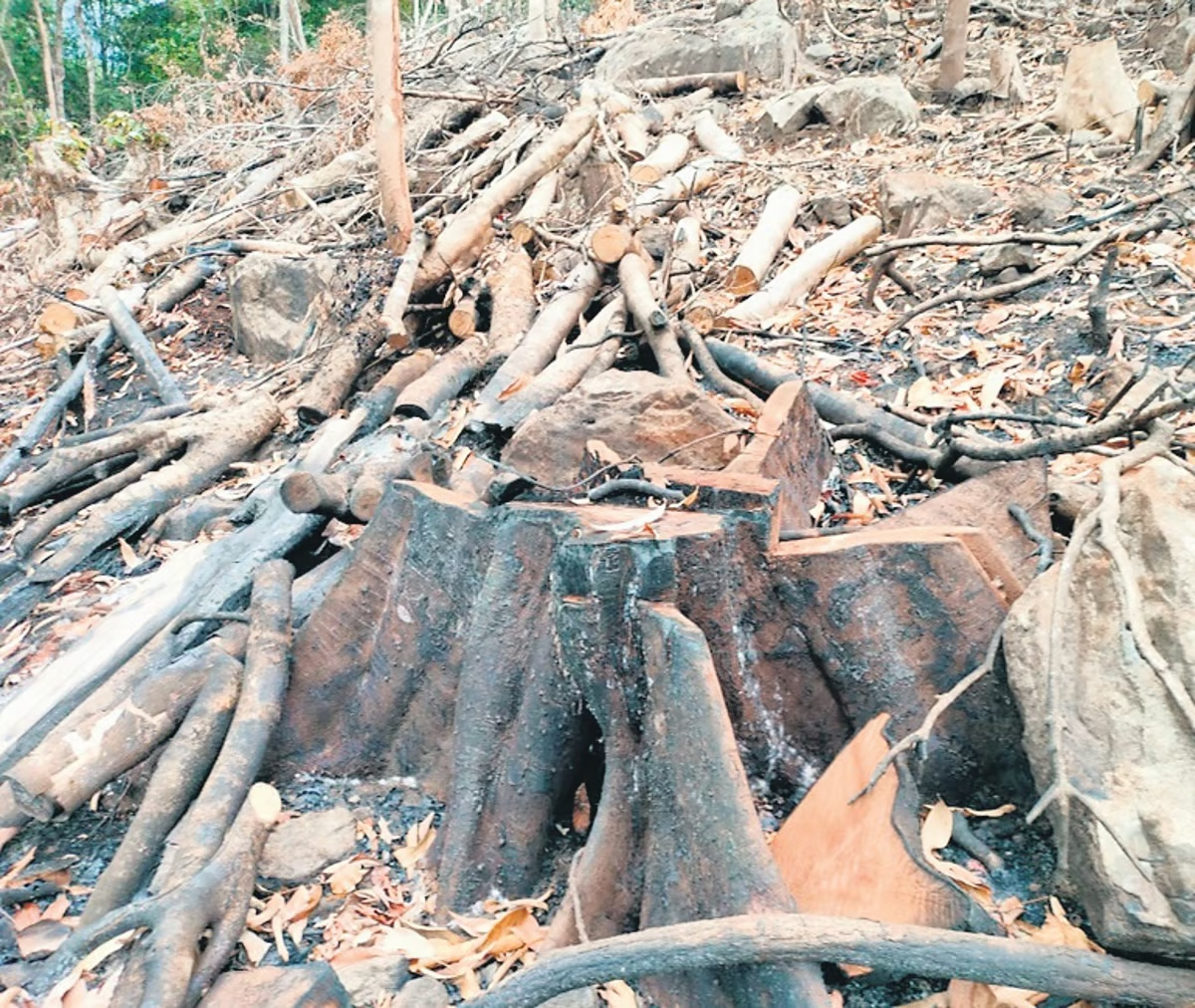
In a move to erase evidence, they burned the axed trees risking the spread of forest fire across the Talacauvery sanctuary region.
Trees axed inside Padinalkukadu Reserve Forest area Photo | Express
Madikeri :
Thousands of trees were illegally felled inside the reserve forest area close to Talacauvery sanctuary in Kodagu. The incident came to light after Kodagu Ekikarana Members highlighted the issue after visiting the spot. Suspecting involvement of foresters in the act, they have filed a complaint in this regard with the Virajpet MLA AS Ponnanna.
Located on the edge of Talacauvery Sanctuary, Mundrote Forest Range of Padinalkunadu Reserve Forest area is home to over 6,000 species of trees and plants. However, thousands of trees have been axed illegally inside the reserve forest area and three accused have been booked in the case.
In a move to erase evidence, they burned the axed trees risking the spread of forest fire across the Talacauvery sanctuary region.
When Kodagu Ekikarana Ranga forum members visited the spot, they found that over 5 acres of reserve forest land was allegedly cleared by the encroachers.
Virajpet DCF Jaganath shared that the department is still ascertaining if the chopping was carried out in the reserve forest area or at the private land touching the reserve forest area.
Nevertheless, FIR filed by the department states that the incident took place in the reserve forest area. “Stringent action will be taken against the culprits,” DCF added.
source: http://www.newindianexpress.com / The New Indian Express / Home> Karnataka / by Express News Service / May 11th, 2024
Tree surveys on private lands and coffee plantations in Kodagu District, initiated by the Forest Department following the directives from higher authorities, have faced opposition from farmers and coffee growers in the region.
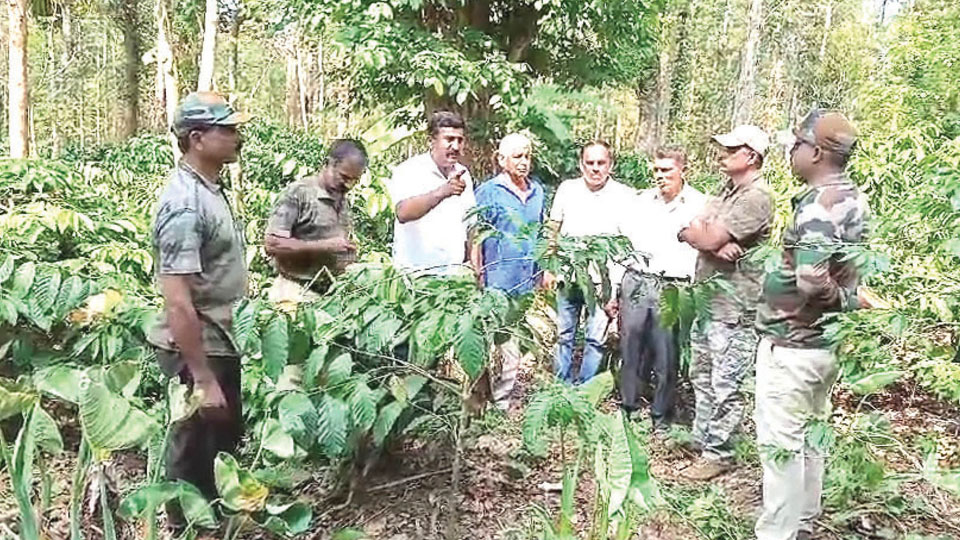
Recently, Forest Department officials visited certain coffee plantations in Valnoor and Tyagathur villages, informing villagers that they were there to conduct surveys of trees on private lands and plantations, citing regulations under Section 133 of the Karnataka Forest Rules, 1969.
Officials stated that they were acting upon orders from Additional Principal Chief Conservator of Forests (APCCF) for Forest Conservation and were surveying estates and lands in Valnoor and Tyagathur. However, farmers and plantation owners objected to this action and raised their concerns.
The villagers strongly reprimanded the Forest Department’s field staff for accompanying officials to document trees on private and Jamma tenure lands. They accused the Congress government of pursuing a policy of appeasement by authorising one-sided tree survey operations without prior notification to land-owners.
Expressing their discontent, they informed the officers that villagers have been safeguarding trees for generations, demonstrating greater competence in this regard compared to the Forest Department. They alleged that after conducting tree recording activities on private lands, the trees would be subsequently felled and sold to fund the guarantees announced by the Congress Government.
The villagers asserted that they would not allow tree-recording activities in the village under any circumstances. In response, Bhaskar, the Deputy Conservator of Forests (DCF) of the Madikeri Division, stated that according to Section 133 of the Karnataka Forest Rules, 1969, a directive was issued on Jan. 24 from the Central Office of the Forest Department to record and list trees growing on private lands.
“We have instructed officials to adhere to the prescribed procedure, and tree recording has been conducted in certain areas accordingly. However, objections have been raised by farmers in certain regions. Reports detailing the situation will be submitted to higher authorities,” he added.
“This is a Statewide survey, and it is being conducted across all districts. As it is currently summer, officials have commenced fire prevention activities. Concurrently, tree recording activities are also underway,” stated Jagannath, the DCF of Virajpet Division. He further mentioned that tree recording is being conducted on lands within Virajpet division and in Ponnampet.
source: http://www.starofmysore.com / Star of Mysore / Home> News / May 07th, 2024
India’s High Range Coffee Curing is poised to become the first farm verified by the Rainforest Alliance to ship EUDR–ready coffee beans to Europe later this month.
The coffee farm partnered with the Rainforest Alliance to meet the necessary compliance requirements of the regulation.
Established in 1995, High Range Coffee Curing is located in the Periyapatna and Kushalnagar Coorg districts among 142 hectares of tropical forests and is known for its quality beans.
The farm supplies coffee to leading global coffee brands, roasters and traders in India, including Nestle, Unileverr, E-Com Commodities, Olam, Continental Coffee, Louis Dreyfus Company, Vidya Coffee and Allanasons.
EUDR-Ready Coffee
Zaidan M Saly, director of High Range Coffee Curing stated, “Implementing EUDR [EU Deforestation Regulation] posed significant challenges for our team, but with the invaluable guidance from Rainforest Alliance representatives in our region, we overcame them and gained confidence in the process.
“Their expertise made the seemingly daunting task entirely feasible, facilitating a smooth and successful implementation, which now not only guarantees adherence to EUDR regulations but also sparked a revolution in our approach to traceability.”
Rainforest Alliance certification enables coffee and cocoa farmers to opt in for EUDR-aligned criteria.
This allows companies to source from these farms, track ingredients along their supply chains, and leverage farm data to demonstrate compliance with the regulation’s deforestation risk assessment and mitigation requirements by the deadline, at no additional cost.
‘Sustainable Practices’
Miguel Gamboa, coffee sector lead at the Rainforest Alliance stated, “The EUDR represents an important step forward to shift the global coffee sector towards more sustainable practices.
“Yet, many smallholder coffee farmers need support to align with the requirements, including traceability, deforestation risk mapping, local laws, and practical and technical guidance on key environmental practices.”
The Rainforest Alliance has urged the EU Commission not to dilute or delay the legislation or postpone its deadline in response to calls from some companies and governments.
It has also called on companies not to scale back purchases from smallholder coffee farmers, but rather support them in meeting the deadline of this legislation.
Gamboa added, “We are also piloting a deforestation risk assessment offering for companies buying non-certified coffee and cocoa, which we plan to roll out more widely later this year.
“With this offering, we aim to support more companies in their journey to compliance, but more importantly, to also reach non-certified farmers so their products can still be sold on the EU market.”
source: http://www.esmmagazine.com / ESM- European Supermarket Magazine / Home> Supply Chain / by Dayeeta Das (headline edited) / May 06th, 2024
This spike, amidst stable Arabica pricing, signals a boon for Indian growers, leveraging robusta’s affordability.
India’s Robusta Coffee Prices Hit Record High in Century-Old Industry (Photo Source: Pexels.com)
India’s coffee industry is experiencing a remarkable upswing with robusta coffee bean prices hitting an all-time high of Rs 10,080 per 50 kg bag, a historic milestone since the establishment of coffee estates in the Western Ghats region during the 1860s by the British. This is big news for Indian coffee growers who rely on the Robusta given its low-cost inputs.
In stark contrast to the traditionally stable pricing of Arabica coffee, renowned for its velvety shot layer, Robusta prices have remained relatively low, fluctuating between Rs 2,500 to Rs 3,500 per 50 kg bag for the past 15 years.
While export quantities witnessed a marginal decline of 2.5% at 3.88 lakh tonnes compared to 3.98 lakh tonnes in 2022-23, the Indian coffee sector reaped the benefits of soaring global robusta prices, which have reached a three-decade high due to supply disruptions in major producing countries like Vietnam and Brazil.
Commenting on this, Mr. M J Dinesh, Chairman of the Coffee Board says, “The change in the global temperature has impacted the shortage of coffee from Vietnam. The instant coffee market in India will gain from this; the same is gaining popularity too. Moreover, small coffee growers and laborers will reap the profit. They may witness an upsurge in their daily wages.”
The increase in robusta prices resulted in a 20% rise in per unit realization for Indian exporters, reaching ₹2.7 lakh per tonne during the 2023-24 period, up from ₹2.26 lakh in the previous fiscal year.
source: http://www.krishijagran.com / Krishi Jagran / Home> News / by Mrini Devnani / April 16th, 2024
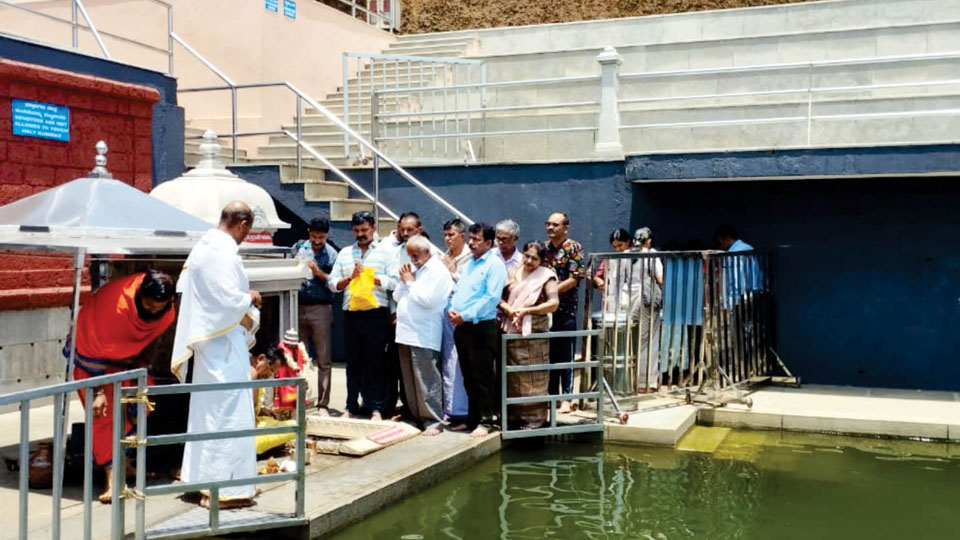
Following severe drought condition in the State including Kodagu district, special puja was performed at Sri Bhagandeshwara Temple and Talacauvery, the birth place of River Cauvery in the district today, praying for a good spell of rain, said M.B. Devaiah, President of Sri Kaaveramme Kodava Amma Kodava Hitarakshana Charitable Trust.
Devaiah said, “Mother Cauvery should show mercy on us to come out of the present drought situation. The devotees, who came from various parts of the State have offered puja at Talacauvery.”
By performing puja, we prayed for rainfall and as per the advise of tantris (priests) we did yelaneeru (tender coconut) abhisheka during the puja. All the devotees took part in the puja rituals. Following drought in the State, people, livestock and wildlife are facing severe water scarcity. Kodagu had last witnessed such a severe drought condition in the year 1924. In the later years, the district had witnessed copious rainfall contributing to better agrarian output.
Now, we have been witnessing severe drought, leading to drying up of rivers and other water bodies. The Governments should be blamed for the current situation, for taking up massive deforestation by cutting trees arbitrarily in the name of development works. The people, livestock and animals are feeling the pinch, crying for water, said Devaiah. Prominent leaders of Sri Kaaveramme Kodava Amma Kodava Hitarakshana Charitable Trust Manu Muddappa, M.K. Aiyanna, Nandakumar, Somaiah and others were present.
source: http://www.starofmysore.com / Star of Mysore / Home> News / April 03rd, 2024
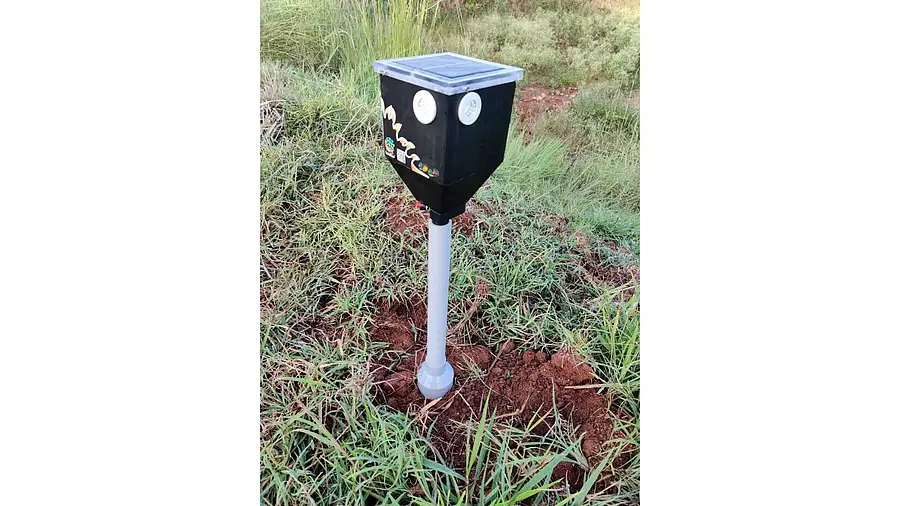
Each device features four LED lights. The lights are positioned in pairs, in such a way that from a distance they look like a pair of glowing eyes of a predator, founder S R Ayan said.
Parabraksh installed in a farm in Kanakapura.
A Bengaluren has designed a lighting system to help farmers protect their crops and livestock from wildlife, during the night. The innovative product does not harm the wild animals. Katidhan, a five-member startup located on New BEL Road, recently won an investment of Rs 1.5 crore on business reality show, Shark Tank India.
On the show, its founder S R Ayan said farmers in India lose 30-50% of their crops to wildlife. The conventional methods to keep wild animals out include installing electrical fences, planting crude bombs or spraying chemicals. Citing the dangers of such interventions, he said an elephant in Chikkamagaluru died due to electrocution by an electric fence last November.
Ayan says his product, Parabraksh, mitigates the human-animal conflict in a “humane way”. Animals are afraid of other animals and the lighting system is built around this behavioural psychology. “Each device features four LED lights. The lights are positioned in pairs, in such a way that from a distance they look like a pair of glowing eyes of a predator. This scares away the animal.”
The product flashes light in random patterns. Being an autonomous device, it switches on in the dark and switches off as daylight breaks. It runs on solar power but also features a USB charging port for backup.
“Four such lights are needed to protect a farm land of 1 hectare, one in each corner. You can mount them on bamboo sticks or steel poles. The height of the stick or pole will depend on the size of the animal you are targeting,” Ayan adds.
He claims Parabraksh is “over 95%” effective in repelling wild boar, nilgai, elephant, tiger, leopard, and the Himalayan bear. He shares case studies: When these lights were uninstalled from a farm in Tamil Nadu and sent for servicing, elephants returned. For a woman farmer in Maharashtra, crop losses due to wild boars have gone down by 25%. The income of a farmer in Odisha has doubled since elephant invasion stopped.
Ayan says the demand for Parabraksh was more than what his bootstrapped startup could meet, that’s why he decided to raise funds through investors.
It all started with a friend’s SOS call in 2017. “My friend was volunteering with a wildlife organisation in Ladakh. He said villagers were trying to kill the snow leopard that was attacking their livestock. He knew about my background in product design and robotics and asked if I could help,” the 33-yearold recalls.
After a pilot in Ladakh, Parabraksh hit the market in 2020. “Our first taker was a large coffee estate in Kodagu,” he says. About 1,100 units, Rs 9,500 apiece, have been sold since. A majority of the products have been sold to farming and social development collectives in Maharashtra.
“After the show, I am getting enquiries from Kanakapura, Kodagu and Hassan, which see regular elephant movement,” he says.
Monkey chaser
Sensor-based Kapikaat is another product by Katidhan, priced at Rs 5,000 and up. It emits loud sounds to repel monkeys during day time. “It is 70-75 % effective. We reckon that monkeys can get used to the source of the sound and ignore it,” says Ayan.
source: http://www.deccanherald.com / Deccan Herald / Home> India> Karnataka> Bengaluru / by Barkha Kumari / March 27th, 2024
Bird watching is one of the mediums to create awareness on environment conservation, said Dr. S.V. Narasimhan, a Birder and Author from Virajpet in Kodagu.
He was speaking after receiving felicitation at ‘A Day with Salim Ali’ event jointly organised by Mysore Science Theatre Festival Trust, Kutuhali, NCF (National Curriculum Framework) and SVYM (Swami Vivekananda Youth Movement) at Kiru Rangamandira here on Saturday.
“We Indians have always understood the importance of environment since we are worshippers of nature and see divinity in all living beings. Students should learn about nature and its conservation,” he said. A doctor by profession, Dr. Narasimhan is perhaps known to many for his passion for birds.
Bird-watcher N.R. Harsha said renowned Ornithologist Dr. Salim Ali had conducted a research on birds between November, 1939 – February, 1940 in Mysuru region and that the recent research had shown the presence of 419 species of birds in Mysuru region.
“Mysuru region has 191 local species and witnesses 129 different species of migratory birds in winter season. In addition, 53 variety of local migratory birds are also spotted in our region. Among the various species of birds found in the country, Mysuru contributes about 30.7 percent and Karnataka contributes 76 percent,” he noted.
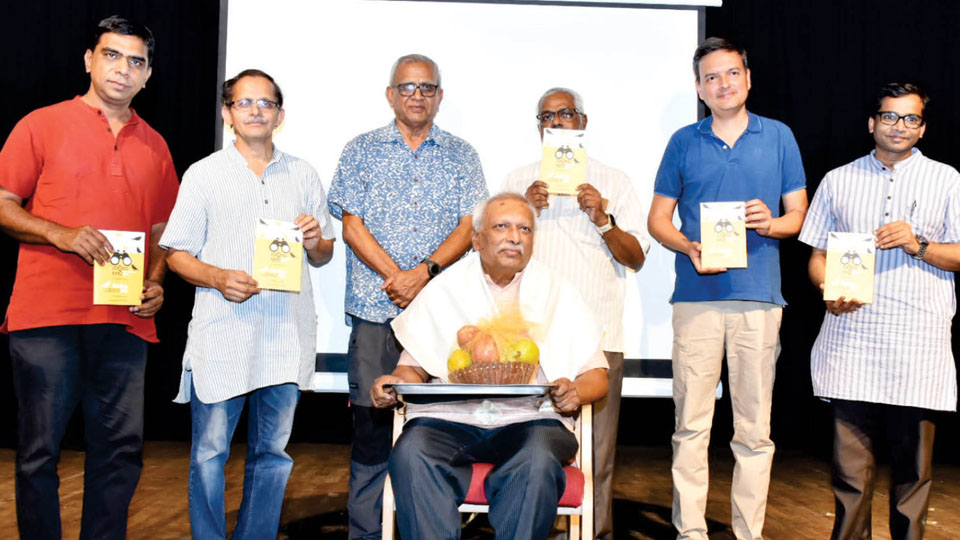
On the occasion, Kannada and English version of the book ‘Salim Ali – Wonder in the World of Birds’ (Salim Ali – Pakshi Lokada Beragu’) by Dr. M.C. Manohara/ Shashidhar Dongre were released. Artistes of Arivu Ranga staged a play while talks were delivered on ‘Salim Ali and Me’ by S. Subramanya, ‘Birds of Mysuru Region’ by N.R. Harsha and ‘Bringing Birds to People’ by Abhishek Krishnagopal.
Mysore Science Theatre Festival Trust Trustee Shashidhar Dongre, CFTRI Scientist (retd.) Kollegal Sharma, Suhail Khadar of NCF and Praveen of SVYM were present.
source: http://www.starofmysore.com / Star of Mysore / Home> News / March 25th, 2024
Price of robusta coffee has dropped due to supply shortage and global factors.
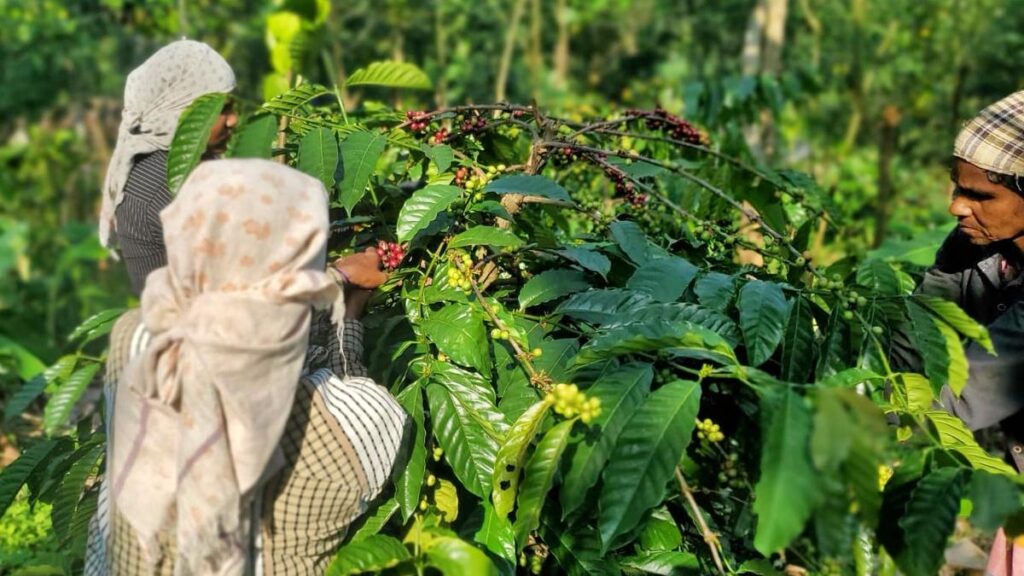
Farm workers harvesting coffee beans at a plantation in Wayanad district of Kerala. | Photo Credit: E.M. MANOJ
The robusta coffee farmers in south India are jubilant post-harvest with their produce fetching an all-time high price.
The farmgate price of raw robusta coffee berries touched a record ₹172 a kg in Wayanad market on Saturday, as against ₹115 a kg during the corresponding period last year. Meanwhile, spot price of robusta coffee beans stood at ₹315 a kg, up from ₹210 during the same period in 2023. The price was ₹80 and ₹145 a kg for raw berries and beans respectively in March 2022.
Though the harvest is almost complete, there has been a huge shortfall in the supply of coffee to the market this year, thereby contributing to the increase in coffee prices, says sources.
Multiple factors
“We expect a decline of 30% in the production of robusta this year owing to climatic vagaries, especially the scanty blossom shower in robusta growing regions last year,” sources said.
A sharp decline in production of robusta coffee — nearly 2 million bags — in Vietnam, a major Robusta coffee growing country, has also attributed to the increase in price, the sources added. Robusta coffee production in Indonesia too dipped sharply this year, the sources added.
Notably, the price of Arabica variety of coffee has dropped below the price of robusta coffee. The farmgate price of the Arabica variety coffee was ₹305 per kg on Saturday. Though the Arabica variety always fetched a premium price in the market, it is the robusta variety that is witnessing an increase due to its low availability for the first time.
Farmers suspect that the production may decline by 25% to 30% next year too owing to a dearth of backup showers in many robusta coffee growing areas in the country.
Wayanad in Kerala, which is the largest robusta coffee producing district in the country after Coorg in Karnataka, received a rainfall of 29.3 mm in the first week of January. Major parts of the district received no rain since then.
The January showers helped in the blossoming of robusta coffee plants, farmers say. But the absence of backup showers, a major factor in the formation of berries, is a concern.
According to Coffee Board of India, the total production of coffee in the country during the 2022-23 fiscal was 3,52,000 tonnes, including 2,52,000 tons of robusta coffee.
source: http://www.thehindu.com / The Hindu / Home> News> India> Kerala / by E M Manoj / March 24th, 2024
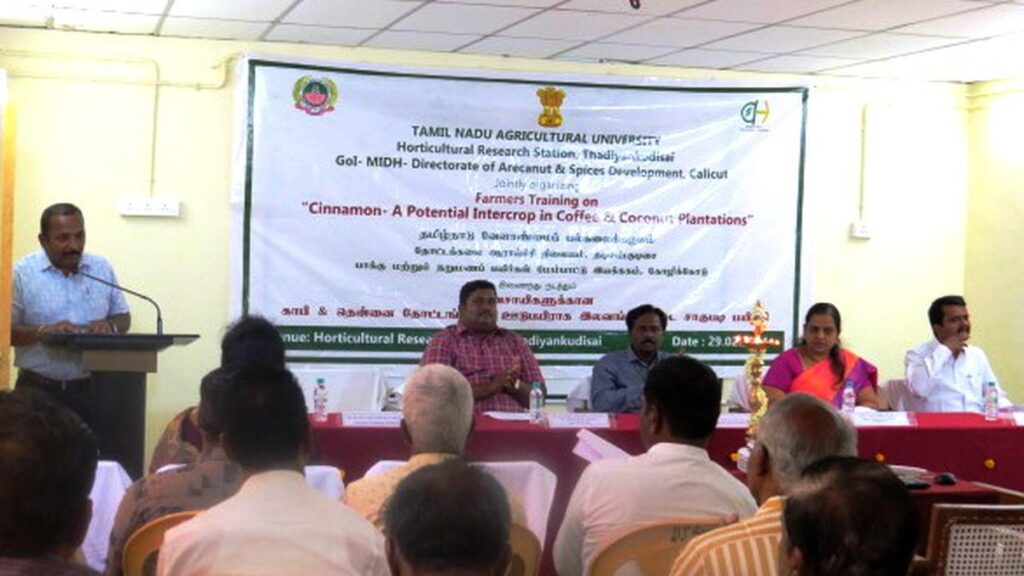
A conference on raising cinnamon under way at Horticultural Research Station, Thadiyankudisai, on the Kodaikanal hills. | Photo Credit: HANDOUT
India imports 30,000 tonnes of cassia and 1,200 tonnes of true cinnamon (Cinnamoum verum), a medicinally important tree species of subtropic regions, annually costing a foreign exchange of 850-1,000 crore rupees. With a view to tap the potential of true cinnamon cultivation as an intercrop in coffee plantations of lower Palani hills and coconut gardens on the foothills of western ghats, a one-day conference was organised at Horticultural Research Station, Thadiyankudisai on the Kodaiknal hill range, in Dindigul district under the Mission for Integrated Development of Horticulture (MIDH) scheme on February 29.
J.Rajangam, Dean, Horticultural College and Research Institute, Periyakulam, who inaugurated the conference, said India produced only 57 tonnes of cinnamon against 3.7 lakh tonnes of global production. Cinnamon can be raised as one of the remunerative companion crops of coffee to yield additional income for farmers. Advanced cultivars suitable for coconut and coffee growing tracts. He also pointed that, timely
adoption of improved techniques for bumper cropping and scope for export.
S.Senthil Kumaran, Assistant Director, Spices Board, Bodinayakkanur, said that though India exported cinnamon valued at Rs. 67.40 crore during 2022-23, the imports were valued at Rs.72.16 crore. He highlighted the scope of cinnamon cultivation and export promotional activities offered by the Spices Board of India.
M. Jayakumar, Deputy Director of Regional Coffee Research Station, Thandikudi, spoke on the importance of cinnamon in profitable coffee farming under multi-tier cropping system.
source: http://www.thehindu.com / The Hindu / Home> News> India> Tamil Nadu / by The Hindu Bureau / March 05th, 2024
MLAs want encroached lands to be leased to large holders and sanction land to small holders
Bengaluru:
Encroachment of Government land by small coffee growers in the coffee-growing regions of Kodagu was discussed in the Legislative Assembly yesterday, where Virajpet MLA A.S. Ponnanna appealed to the Government to permanently sanction the lands to their names as they are actively cultivating crops on those lands.
Participating in a discussion on the subject, Ponnanna said that small growers in Kodagu who are cultivating coffee and other crops in two to three acres of land are facing numerous problems.
“In certain areas, small coffee growers find themselves surrounded by large private plantations, with Government land in between that has been encroached upon. According to the law, land can be leased out for up to 25 acres. Large Government lands encroached upon by major growers should be leased out by the Government,” he said.
“However, small-scale growers, who only have two to three acres of land and have encroached upon small portions of Government land, require a permanent solution. The Government should sanction the encroached land in their names to provide them with a permanent relief about their holdings,” Ponnanna explained.
Earlier, Sakleshpur MLA ‘Cement’ Manju mentioned that during the tenure when R. Ashoka served as the Revenue Minister in the previous BJP Government, a decision was made to lease the encroached Government land to coffee growers for a duration of 30 years. Unfortunately, due to a change in Government, this decision was not put into action. Therefore, he urged the Government to resume the process of leasing the land for a period of 30 years.
Later, Madikeri MLA Dr. Mantar Gowda raised questions regarding why the BJP Government did not implement the leasing of land to coffee growers for 30 years. He emphasised the importance of discussing pending applications, particularly the 53rd and 57th applications, which have been awaiting decisions for 20-25 years.
He expressed satisfaction with leasing the land to Race Courses and Clubs for 30 years and wanted similar leasing to coffee growers to get permanent ownership by approving the 53rd and 57th applications. He cautioned that leasing land for 30 years could lead to future problems for the growers and suggested considering leasing the land for 99 years instead.
Intervening in the discussion, Speaker U.T. Khader said approval of land up to 3 acres for the poor could offer a permanent solution to the issue at hand.
At this point, Dr. Mantar Gowda’s father, A. Manju, who is also the JD(S) MLA from Arkalgud, intervened, questioning why the Government was hesitating to lease land to farmers while providing it for Race Courses, Resorts and Clubs.
“Why there is a delay in approving the land lease when it comes to farmers? The law prohibits leasing out land for more than 30 years. Can you take back encroached land from cultivators? It is not possible. I suggest leasing out the land to encroachers. This way, the Government would earn revenue and the lessees would benefit as well. They would also help conserve forests and contribute to the environment, he added.
Later, MLA A.S. Ponnanna spoke, urging to sanction the encroached land for small-scale coffee growers as well as to provide land for lease to large coffee growers.
What are 50th, 53rd and 57th applications?
The Bagar Hukum system, established by the State Revenue Department, requires applicants to submit Form 57 for the legalisation of agricultural land.
The Bagar Hukum scheme traces its origins back to 1980 when the Government allocated two acres of land to landless farmers for agricultural activities. However, the beneficiaries of this scheme did not receive the title deed for the land they cultivated.
Subsequently, applications were invited in the forms of Form 50 (1991), Form 53 (1999) and Form 57 (2018) under the Karnataka Land Revenue Act, 1964. The application window extended until April 2023, exclusively for those who have been engaged in cultivation for the past 15 years.
According to Madikeri MLA Dr. Mantar Gowda, who raised the issue in the Assembly, all the applications received in Form 50, Form 53 and Form 57 are pending since the last 25 years. If these applications are approved, growers can gain permanent ownership over the land.
source: http://www.starofmysore.com / Star of Mysore / Home> News / February 23rd, 2024
WELCOME. If you like what you see "SUBSCRIBE via EMAIL" to receive FREE regular UPDATES.
Read More »