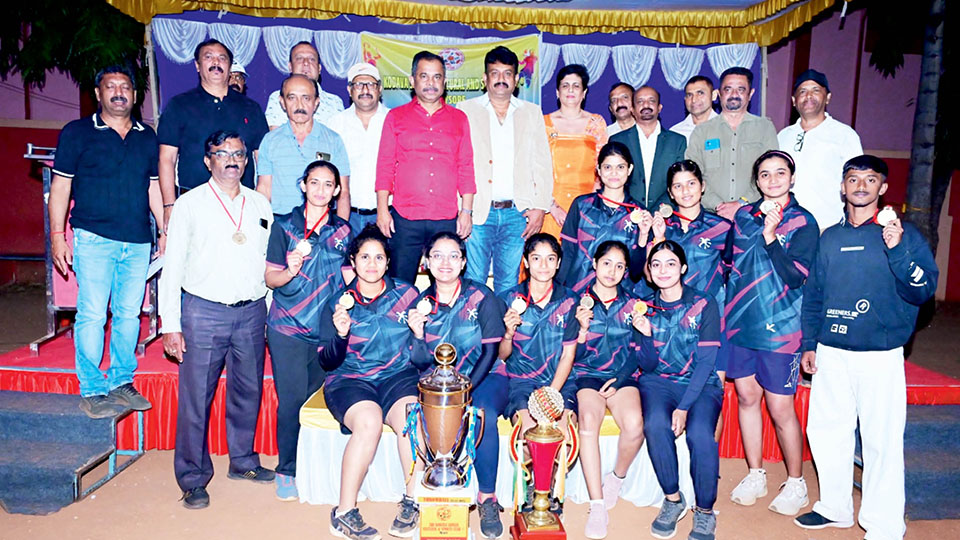
Picture shows the winning team with chief guest Jammada Preeth Aiyanna, Club Vice-President Machanda Prakash Beliappa, Club Special Invitee & Sponsor of the event Kuttimada D. Muthappa, Kodava Samaja Mysuru President Ponjanda Ganapathy, Sree Cauvery Educational Institutions Chairman Chottengada Chengappa, Club office-bearers and Directors.
The Annual Kodava Inter-Sangha Throwball Tournament for women, organised by Kodava Samaja Cultural and Sports Club, Mysuru, was inaugurated by city’s renowned Trekker and Kodava Vibhushana awardee Jammada Preeth Aiyanna.
Totally 9 teams participated and the winners were Sri Iguthappa Kshemabivirdhi Sangha, Hebbal.
source: http://www.starofmysore.com / Star of Mysore / Home> Sports / January 05th, 2026
A new species of damselfly, sporting vibrant sky-blue markings, has been discovered in the biodiversity hotspots of India’s Western Ghats. Named the Kodagu Shadowdamsel (Protosticta sooryaprakashi), this shade-loving insect was identified by a collaborative team of researchers who combined traditional field observations with modern DNA analysis to distinguish it from its closest relatives. The discovery highlights the hidden diversity remaining in the tropical forests of Karnataka.
The new species was identified during surveys along the banks of the Sampaje River in the Kodagu District and in the high-altitude forests of Agumbe. Researchers from institutions including Government Brennen College, Kannur; the Society for Odonate Studies, Kottayam; the National Centre for Biological Sciences, Bengaluru; and others initially noticed that these damselflies resembled a known species, Protosticta sanguinostigma. However, the team noticed that the new specimens were smaller, more delicate, and possessed distinct physical traits that did not match those in existing records. To confirm their suspicions, they utilised molecular analysis, sequencing the insects’ DNA to prove that the Kodagu Shadowdamsel was indeed a separate evolutionary lineage.
What sets Protosticta sooryaprakashi apart from its cousins is specific, unique physical characteristics. The males are distinguished by a prominent sky-blue marking on the prothorax—the neck-like segment behind the head—and a dark brown to black body, which differs from the crimson-colored thorax of its close relative. Under microscopic examination, the researchers found a peculiar feature: the tips of the male’s reproductive organ (the genital ligula) are shaped distinctly like a duck’s head, a trait not seen in other species of this group. In the wild, these damselflies were observed perching on shaded plants near streams, exhibiting a weaker, more fluttering flight than other damselflies in the region.
The species has been named in honour of the late Dr Sooryaprakash Shenoy, a renowned botanist who served as Head Scientist of the Botany Division at the Dr Shivaram Karanth Nisargadhama (biological park) in Pilikula, Karnataka. He was a researcher who dedicated his life to biodiversity conservation in the Western Ghats.
The researchers noted that finding such a distinct species in a relatively accessible area suggests that the Western Ghats, a global biodiversity hotspot, likely harbours many more cryptic or unknown species waiting to be discovered. They emphasised that protecting the shaded, riparian (river-based) habitats where the Kodagu Shadowdamsel thrives is essential for maintaining the ecological health of the region’s freshwater systems.
This article was written with the help of generative AI and edited by an editor at Research Matters.
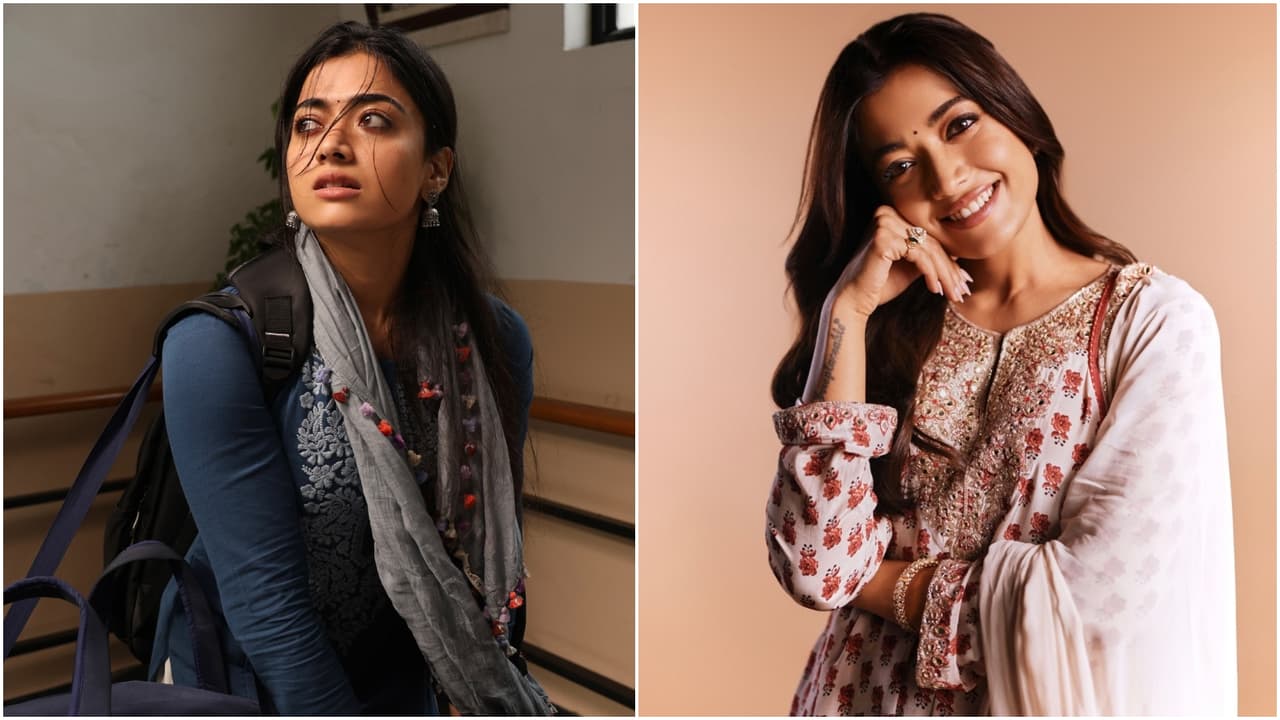
Rashmika Mandanna has added another remarkable achievement to her name by emerging as the highest taxpayer in Kodagu district, creating pride among locals and fans while proving her success goes far beyond the film industry.
From Kirik Party to National Stardom
Rashmika Mandanna, fondly called the “National Crush,” has come a long way since her breakthrough in the Kannada film Kirik Party. Today, she stands tall as one of India’s most successful actresses, making a strong impact in South cinema and Bollywood with consistent box office successes.
The Rise of a Box Office Queen
With multiple hit films across languages, Rashmika has earned the title of “Box Office Queen.” Her strong screen presence, versatility, and audience connect have made most of her films commercially successful, placing her among the most bankable stars in the Indian film industry today.
Pride of Kodagu District
Hailing from Virajpet in Kodagu district, Rashmika has become a source of immense pride for her hometown. Kodagu has produced several notable personalities, but Rashmika’s achievements have set her apart, elevating her status beyond cinema and making her a standout figure from the region.
Biggest Taxpayer in Kodagu
In a remarkable achievement, Rashmika Mandanna has emerged as the highest income taxpayer in Kodagu district. She has reportedly paid ₹4.69 crore in income tax for three quarters of the current financial year, securing the top position among all taxpayers in the district.
Marriage Buzz Continues
Apart from professional milestones, Rashmika is also in the news for personal reasons. Reports suggest she may soon marry actor Vijay Deverakonda, with rumors pointing to a February 26 wedding in Udaipur. However, no official confirmation has been made by either star yet.
source: http://www.newsable.asianetnews.com / Asianet News, English / Home> Entertainment / by Nancy Tiwari / January 07th, 2025
‘All necessary measures should be taken to curb stray dogs while ensuring animal welfare and the safety of citizens’.
The district administrations of Mandya and Kodagu held separate meetings on Tuesday to discuss measures to control the menace of stray dogs in their respective districts in the light of the Supreme Court’s recent directions.
In Mandya, Deputy Commissioner Kumar directed the urban local bodies to take up Animal Birth Control (ABC) and anti-rabies vaccination programmes effectively.
All necessary measures should be taken to curb stray dogs while ensuring animal welfare and the safety of citizens, he said and emphasised the need for collection of information on stray dogs in schools and colleges, hospitals, government offices, railway stations, and playgrounds.
He also directed the officials to identify suitable locations for sterilisation surgeries. Also, appropriate measures should be taken to manage shelters for stray dogs in collaboration with animal welfare organisations and the Department of Animal Husbandry.
The guidelines of the Supreme Court must be strictly followed in the management of stray dogs and the sterilisation operations, he said.
Citing the Supreme Court orders, Mr. Kumar said stray dogs should be removed from high-risk areas like educational institutions, bus stands, railway stations, and hospitals. He issued directions for round the clock security in stadiums to prevent stray dogs from the entering the premises.
Students should be made aware of rabies while free anti-rabies vaccination programme should be taken up for stray and pet dogs, he said.
He directed the officials to set up a helpline to receive complaints regarding stray dog issues, and a nodal officer must be appointed at the district level to take necessary action.
In Kodagu, Deputy Commissioner Venkat Raja said the local bodies like city municipal councils, town municipal councils, town panchayats, and gram panchayats should earmark at least one acre of land within their jurisdiction and construct a compound wall to facilitate the relocation of stray dogs.
He said measures should be taken to relocate the stray dogs and ensure their proper protection while appointing nodal officers to conduct regular inspections to monitor the control of stray dogs.
He said the government and private hospitals should maintain adequate stock of anti-rabies vaccines so that timely treatment is provided to dog-bite victims.
“Whenever cases of dog bites or attacks by animals are reported, the local body officials must be informed and the government and private hospitals should ensure timely emergency medical services and first aid,” he said.
While Madikeri city municipal council Commissioner H.R. Ramesh informed the meeting that one and a half acre of land on the outskirts of Madikeri has been earmarked for locating stray dogs, the Deputy Commissioner instructed officials concerned that land be similiarly earmarked even in Somwarpet, Kushalnagar, Ponnampet, and Gonikoppal limits.
Kodagu District Health and Family Welfare Officer Satish Kumar said that 4,872 cases of dog bites were reported in the district in 2024 and 4,217 cases between January to October in 2025.
source: http://www.thehindu.com / The Hindu / Home> News> India> Karnataka / by The Hindu Bureau / November 18th, 2025
Colorectal Cancer (CRC) is a common and deadly disease that affects the colon and rectum. It can cause bleeding, pain, weight loss and fatigue. It is often mistaken for piles and not diagnosed early enough. CRC can be prevented by screening and through healthy habits.
CRC is the seventh most common cancer in India, with over 27,000 new cases and 19,000 deaths in 2018. It affects both men and women, mostly after 50 years of age.
Causes
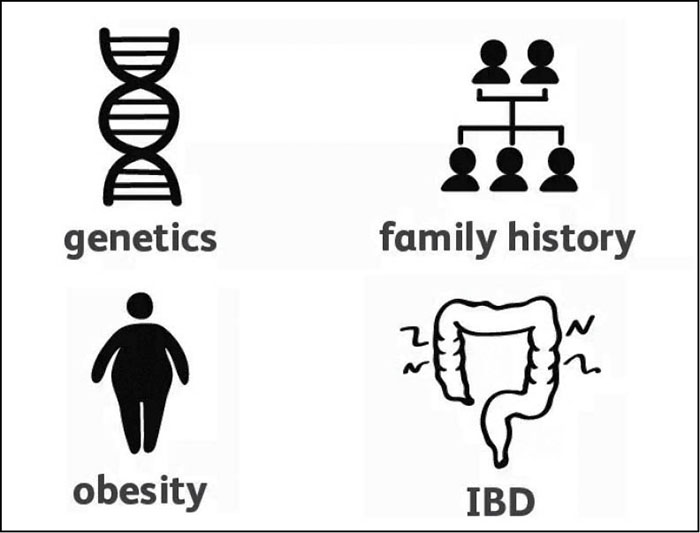
The exact cause of CRC is unknown, but some factors increase the risk:
Age: Older people are more likely to get CRC.
Diet: Eating too much red meat, processed meat and fat can raise the risk.
Obesity: Being overweight or obese can make CRC more likely.
Smoking: Smoking can damage the DNA of the colon and rectum cells.
Alcohol: Drinking alcohol can affect how the body works.
Inactivity: Not exercising can increase the risk.
Inflammatory Bowel Disease: Having long-term inflammation of the intestines, such as Crohn’s disease or ulcerative colitis.
Family history: Having a relative who had CRC or polyps can make CRC more likely.
Polyps: CRC usually starts from a benign growth called a polyp on the colon or rectum lining. The most common type of polyp that can turn into CRC is an adenoma.
Diagnosis, Screening & Staging
The best way to prevent CRC is to find and remove polyps before they become cancerous. This can be done by regular screening tests that check the colon and rectum for any problem.
Diagnostic and screening tests
Consult colorectal surgeon: This is the first and best step. A colorectal surgeon is a specialist who has extensive training and experience in diagnosing and treating CRC.
Colonoscopy & biopsy: This test uses a tube with a camera to look at and remove any polyps or tumours in the colon and rectum. It is usually done under sedation or general anaesthesia to make it comfortable for the patient.
Screening tests can lower CRC cases and deaths by removing precancerous polyps and finding early-stage tumours that are easier to treat.
Treatment
The treatment of CRC depends on many things, such as the type, grade, stage, location, and features of the tumour, as well as the patient’s health and choice. A team of colorectal experts is needed to ensure the best result. Each tumour is different and each patient is unique, hence an individualised treatment plan is chalked out by a robust multi-disciplinary team led by colorectal surgeons is vital.
A colorectal surgeon is a specialist who has extensive training and experience in performing surgery for CRC.
Treatment options
Surgery: This is the main treatment for most CRC cases. It involves removing the tumour, lymph nodes and some normal tissue around it. It can be done as open or laparoscopic and robotic methods. Minimal invasive techniques when carried out by specialists result in better patient satisfaction, early discharge, improved quality of life, lower blood loss, less pain, shorter hospital stay, faster recovery, lower risk of infection, lower risk of bleeding, lower risk of recurrence, lower risk of complications, etc.
Radiation therapy: This can be used before or after surgery to kill any cancer cells left behind. It works by using high-energy rays or particles to damage DNA. It can also help radiotherapy work better.
Chemotherapy: This is used for advanced or spread CRC that has reached other parts of the body. It works by using drugs that kill cancer cells or stop them from growing. It can also help radiotherapy work better.
Targeted therapy: This is by using drugs that target specific genes involved in CRC. They work by blocking or interfering with how these genes function. They can also help radiotherapy work better.
The five-year survival rate for CRC in India was around 50% in 2018. There is evidence that sub-specialisation in colorectal surgery improves outcomes.
By Dr. Nikhil Nanjappa, Consultant Surgical, Gastroenterologist & Colorectal Surgeon, Aceso BKG Health Care, Mysuru
source: http://www.starofmysore.com / Star of Mysore / Home> Feature Articles / by Dr. Nikhil Nanjappa / September 23rd, 2023
India earns about ₹15,000 crore in foreign exchange from coffee production, and the target is to reach ₹50,000 crore by 2047, says Coffee Board member T. Kishore Kumar. | Photo Credit: FILE PHOTO
With coffee enjoying a huge global demand, Coffee Board member T. Kishore Kumar emphasised the need for the cultivation of coffee alongside other crops in Sampaje, Karike, Peraje and Chembu regions of Kodagu district.
Farmers of Sampaje, Karike, Peraje, and Chembu regions, who mostly cultivate arecanut, rubber, and pepper, should consider taking up cultivation of coffee also alongside the existing crops, suggested Mr. Kishore Kumar while addressing the 72nd All India Co-operative Week held at Peraje Primary Agricultural Co-operative Soceity premises on Friday.
The 72nd All India Co-operative Week, organised jointly by Karnataka State Co-operative Federation, Kodagu District Co-operative Union, Kodagu District Co-operative Central Bank, and Co-operation Department at Peraju in Kodagu district, focused on promoting digitisation to enhance efficiency, accountability and transparency.
Mr. Kishore Kumar pointed out that the government was encouraging coffee cultivation by extending subsidies and incentives for the crop. India produces 3.60 lakh metric tonnes of coffee annually, of which 2.30 lakh metric tonnes are exported while the remaining is traded domestically, he said.
Karnataka accounts for about 60% to 65% of India’s annual coffee production, with Kodagu district alone contributing 30%-35% while the adjoining Chikmagaluru and Hassan districts contribute 25%-30%. Kerala, Tamil Nadu, and Andhra Pradesh together account for another 20%-30%, while the North Eastern States contributed about 10%-15%, he explained.
India earns about ₹15,000 crore in foreign exchange from coffee production, and the target is to reach ₹50,000 crore by 2047. He said the farmers can achieve this by reaching a production target of 7 lakh metric tonnes.
He emphasised that farmers should use drip irrigation and other methodologies to achieve high production at low cost.
With Karnataka’s coffee enjoying a huge demand, Mr. Kishore Kumar said there was a need to strengthen the co-operative sector so that loan facilities can be provided to the farmers and the economy can be strengthened.
Kodagu District Co-operative Central Bank President K P Ganapathy said there were a total of 288 co-operative societies operating in Kodagu district. Leaders of Kodagu district had established co-operatives for coffee, cardamom, honey and oranges.
Farmers receive easy loan facilities through co-operatives and must make proper use of them, he said while adding that the Co-operative Week provides an opportunity to discuss the strengths and shortcomings of the co-operative sector so that steps can be taken in the right direction.
During the co-operative week, a free health check-up camp was held. A market fair was also organized by members of Sanjeevini group, who sold vegetables and other items.
source: http://www.thehindu.com / The Hindu / Home> News> India> Karnataka / by The Hindu Bureau / November 14th, 2025
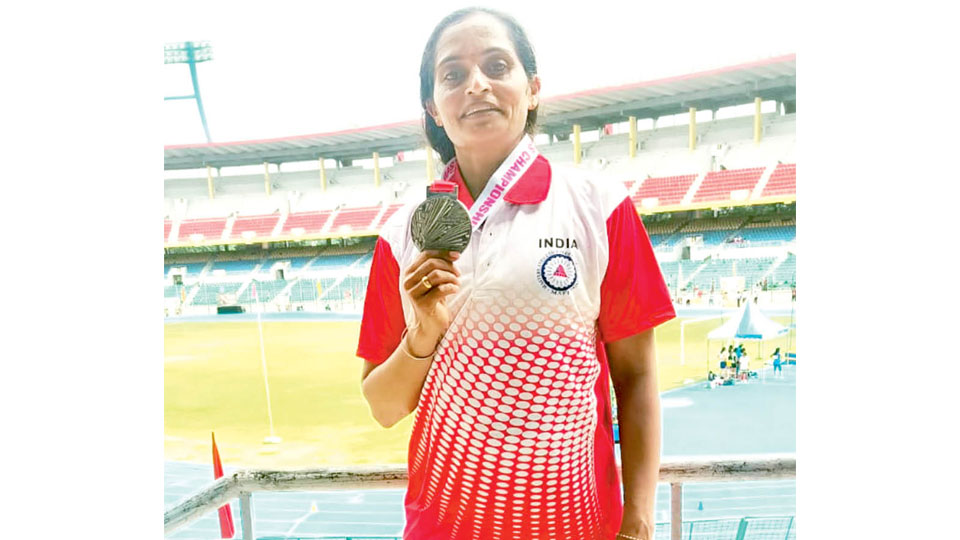
City-based Master Athlete Boppanda Kusuma Bheemaiah has won the silver medal in 800 mts run in 45-plus category at the 23rd Asian Masters Athletics Championship-2025 held at Jawaharlal Nehru Stadium in Chennai recently.
She has also qualified for the World Masters Athletics Championship to be held at Daegu in South Korea in the month of August, 2026.
source: http://www.starofmysore.com / Star of Mysore / Home> Sports / November 13th, 2025
Revenue Minister Krishna Byre Gowda, MLA Mantar Gowda and Deputy Commissioner Venkataraja during the ground breaking function for Praja Soudha taluk administration complex at Kushalnagar on Tuesday. | Photo Credit: SPECIAL ARRANGEMENT
Revenue Minister Krishna Byre Gowda on Tuesday said that ₹50 crore has been released for landslide-prevention works in Kodagu and that an additional ₹10 crore will be sanctioned soon.
He was speaking after performing the bhoomi puja for the construction of the new ‘Praja Soudha’ Taluk Administration building near the Polytechnic College in Kushalnagar. The project is estimated to cost ₹8.60 crore. Madikeri MLA Mantar Gowda was present.
The Minister said new tahsildars and village administration staff have been appointed to strengthen administrative functioning in five taluks of Kodagu district. The new Prajasaudha complex will house the tahsildar’s office, land records office, sub-registrar office, treasury and other key departments under one roof.
A large-scale ‘Darakhast Podi Abhiyana’ (land record correction drive) is currently underway across the State, he said. Under Annexure-1, surveys of government land are being taken up and officials are visiting households to collect data to update records. In Kodagu, 2,344 applications have been taken up under the programme, of which over 1,500 cases have already been disposed of, he informed.
The Minister stated that around 42 lakh land holdings in the State are still in the names of deceased persons. Under the ‘Pouthi Khata’ initiative, efforts are being made to transfer such holdings to legal heirs by directly reaching out to families.
Revenue village accountants (VAs) and inspectors are being provided laptops to ensure paperless service delivery through e-offices, he said.
Disposal of cases has also been expedited in tahsildar and Assistant Commissioner courts.
Speaking on the occasion, Mr. Mantar Gowda said work on the KSRTC depot in Kushalnagar is in progress and ₹46 crore has been sanctioned for the construction of the new taluk hospital. He expressed gratitude to Higher Education Minister Dr. M.C. Sudhakar for providing land for the ‘Praja Soudha’.
On the occasion, people’s representatives urged the Minister to establish a sub-division office, establish a taluk stadium, and upgrade the sub-registrar office in Kushalnagar.
Guarantee Implementation Authority president V.P. Shashidhar said the Praja Soudha project is the outcome of a decade-long struggle to secure taluk status for Kushalnagar.
Deputy Commissioner Venkat Raja, Superintedent of Police P.K. Ramarajan, Zilla Panchayat CEO Anand Prakash Meena, Additional Deputy Commissioner Aishwarya, and other officials were present.
source: http://www.thehindu.com / The Hindu / Home> News> India> Karnataka / by The Hindu Bureau / November 11th, 2025
The 123-page report notes over 1,000 landslides in Kodagu, Shivamogga, and Chikkamagaluru in the last 10 years, causing losses of about Rs 350 crore since 2014.
The retaining wall built on NH 275 after the 2018 natural disaster in Kodagu has developed cracks. (File Photo | Express)
Bengaluru :
There is over-tourism in Kodagu. This is one of the reasons for the rise in man-animal conflicts. Annually, around 1.3 million tourists visit Kodagu (also called the Scotland of India). This is beyond what the region can hold.
It has also reached saturation in plantations, making it climatologically vulnerable. There is thus a need to introduce e-passes in the region to restrict tourism, restore 500 hectares of forest land, and promote agroforestry.
This was one of the suggestions listed in the Report on Assessing the Carrying Capacity of the Western Ghats in Karnataka – September 2025 (Revised), prepared by the Karnataka Western Ghats Conservation Taskforce (KSWGCTF), which was recently submitted to the Chief Minister.
The report also noted that the Uttara Kannada region has become highly vulnerable to landslides. It has recorded 439 incidents in the last 10 years due to illegal mining and ecotourism pressure. There is thus a need for a complete ban on mining in ecosensitive areas, the creation of checkposts in Dandeli, Ankola, and Karwar, and an early warning system for landslides.
The 123-page report, a copy of which is with TNIE, noted that there have been over 1,000 landslide events in the last 10 years, particularly in Kodagu, Shivamogga, and Chikkamagaluru, leading to losses of around Rs 350 crore since 2014. It also pointed out an increase in the number of homestays and resorts in and around forests, which was one of the reasons for the rise in man-animal conflict. The other primary reason is the lack of coordination between district administrations, tourism, and forest departments.
The rapid expansion of roads, highways, tourism resorts, estate housing, and multiple hydropower projects in Chikkamagaluru and Shivamogga was also cited as a cause of conflict.
The report highlighted rising trekking pressure in Mullayanagiri and Kudremukh, where 193 landslides were recorded in the last five years. It suggested traffic regulation in Shivamogga, particularly for pilgrimages in Madeveshwaramalai, and stressed the need to immediately address hydropower conflicts.
Mohammed Tabrez Alam Shariff, KSWGCTF Chairman, said that in the last three years no new permissions were given for the construction or operation of new homestays and resorts, yet a rise in them has been observed. This clearly shows violations that now need to be addressed.
To streamline and regulate tourism and construction activities in the Western Ghats, a letter is being sent to the state government to include KSWGCTF as part of the State Wildlife Board. It has been noted that many projects cleared by forest clearance committees and the wildlife board are later opposed by people. Thus, there is a need to involve all stakeholders when referring projects to the Union government and the National Board for Wildlife, Shariff said.
Sources in the state forest department admitted that many projects tabled before the Wildlife Board or forest clearance committees are divided into smaller projects to avoid clearance from the National Board for Wildlife or public scrutiny. This needs to be regulated. The carrying capacity report will help bring in regulations, particularly when clearing green power, electricity, and infrastructure projects, as they have ripple effects elsewhere.
source: http://www.newindianexpress.com / The New Indian Express / Home> Karnataka / by Bosky Khanna / November 13th, 2025
The 24th Annual General Body Meeting of Sri Kaveri Kodava Association, Mysuru East, located in Vidyashankara Layout, Sathagalli, was held under the leadership of Association President, Kademada M. Belliappa recently.
The meeting took place at the Association’s Hall, situated within the premises of Kodagu Model School on Kaveri Road in Vidyashankara Layout, Mysuru.
Association Secretary P.A. Devaiah presented the annual report while Treasurer P.T. Charmanna placed the financial report.
The President explained the Association’s future plans and outlined the development blueprint for school functioning under the Association’s patronage.
C. Manu Subbaiah rendered the invocation. N. Sunil Muthappa compered. P. Padma Bopaiah proposed the vote of thanks.
source: http://www.starofmysore.com / Star of Mysore / Home> News / November 11th, 2025
WELCOME. If you like what you see "SUBSCRIBE via EMAIL" to receive FREE regular UPDATES.
Read More »