Tag Archives: Kodagu District

Making sense of rainfall changes in Karnataka’s coffee estates through old records

  • Climate change-induced weather events are impacting Karnataka’s coffee farms, testing the resilience of farmers.
  • Karnataka coffee farmers keep meticulous rainfall records that are helping individual and organisational attempts at studying climate change.
  • Farmers are trying to adapt to changes in rainfall patterns, first investing in sprinklers and now in coffee driers.

At his 38-acre coffee estate at 3,800 metres above sea level, overlooking the pristine Baba Budan giri (hill) in Chikmagalur district of Karnataka, I.S. Umeshchandra is working on creating a database of rainfall records in the region. Crowdsourced from fellow coffee farmers across the district, the exercise struck gold when a farmer shared a rainfall record from 1887.

“I was amazed to see it, though it is unverified. The verified ones date back to 1933,” he told Mongabay-India. His son Navneeth, a data analyst, is helping him crunch the numbers. Coffee farmers in Karnataka keep a record of rainfall in their estates, a practice dating back to colonial times.

A climate change report in 2014, Transitioning towards climate-resilient development in Karnataka, prepared by 26 experts, said that Karnataka would be hit harder by climate change than other states in the country. As rainfall patterns in the state change, the rainfall records of farmers are coming in handy for various individual and organisational attempts at understanding climate change, climate resilience and adaptation in Karnataka.
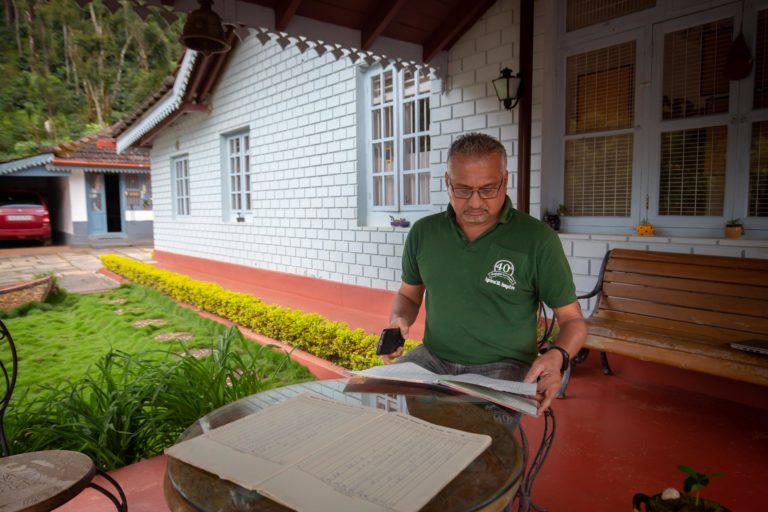
I.S. Umeshchandra with his rainfall records at his house. Photo by Abhishek N. Chinnappa.

In 2011, the College of Forestry in Kodagu district, India’s largest coffee-producing district, participated in an international project, Coffee Agroforestry Network (CAFNET) Project, to study the ecosystem services of agroforestry systems in the district. Rainfall patterns too were studied as a part of the project, where rainfall data of over 60 years from 116 coffee farms was sourced and analysed. The study pointed to a strong fluctuation in annual rainfall every 12 to 14 years and a reduction in the length of the rainy season by 14 days.

Umeshchandra (not associated with CAFNET) has observed some patterns from the initial analysis, though he has yet to find a strong one. “Fluctuations in annual rainfall are noticed every 10-12 years,” he shared. Records from 1887 show an average annual rainfall of 4826 mm (190 inches) in Chikmagalur, which suggests heavy rainfall is not new in this region, which receives an average annual rainfall of around 2500 mm (80-100 inches). “But heavy spells of rain for a few days as against it being spread out is making a difference,” he observed based on his experience.

Ramachandra K.S., a coffee farmer from Shanthalli in Somwarpet taluk of Kodagu, agrees. Flipping through the pages of his handwritten rainfall records dating back to the 1960s, he says there was over 5000 mm (200 inches) of average annual rainfall in 1960-1962, which fell to around 3800 mm (150 inches) in 1970. However, most farmers agree that the rainfall pattern has become unpredictable and daunting in the last five years because unpredictable rains make planning farming events difficult. They say they are constantly stressed.

J. Srinivasan, a professor at the Divecha Centre for Climate Change at the Indian Institute of Science (IISc), told Mongabay-India that these long-term rainfall records that the coffee farmers of the Malnad region of Karnataka (including Chikmagalur and Kodagu) keep are invaluable.

However, he said that the farmers need to compare their records with local IMD (India Meteorological Department) station records to verify them. “A single rain gauge cannot give accurate results,” he said, adding that the Malnad region, which is hilly, experiences microclimates and that one farmer’s rainfall records will be different from that of their neighbour’s.
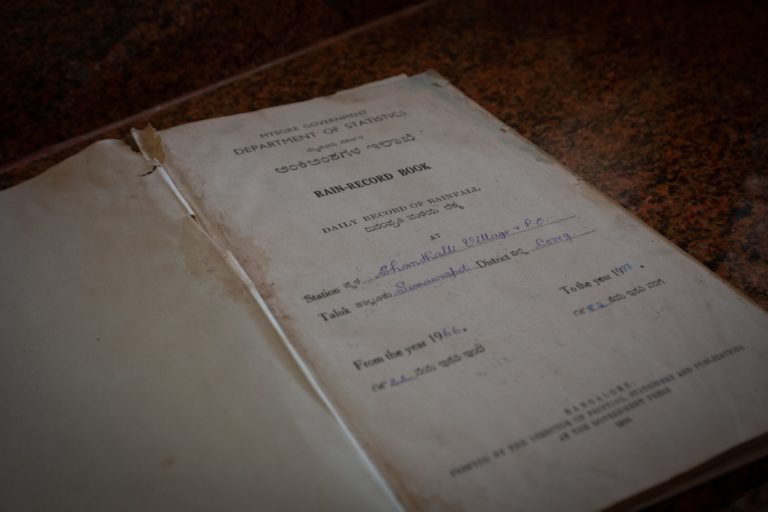
Ramachandra’s rainfall records. Photo by Abhishek N. Chinnappa.

More rains lead to landslides, infections and pests in plants

Chikmagalur has a special place in the coffee history of the country. Legend has it that a 17th-century Sufi saint Baba Budan secretly transported seven coffee cherries from Mocha in Yemen and planted them in front of his hermitage, which later came to be called Baba Budan giri (hills) in Chikmagalur, marking the origin of coffee cultivation in India.

From Umeshchandra’s estate situated on a slope, Baba Budan giri provides a breathtaking view. But these days, it fills him with dread. While erratic rainfall hasn’t affected the productivity of his estate adversely, he fears physical damage by way of landslides. More wet days and increased daily rains saturate the soil and can damage hills, leading to landslides. Studies have shown a correlation between extreme rainfall and landslide events.

At Attigundi village, about 13 km from Umeshchandra’s estate in Hosapura is his friend Kiran M.R’s 45-acre estate of Arabica coffee. He is focused on phasing out silver oak trees (Grevillea robusta) in his estate and planting more native ones. Karnataka is known for shade-grown coffee, and its agroforestry system encourages an abundance of native trees alongside the cash crop.
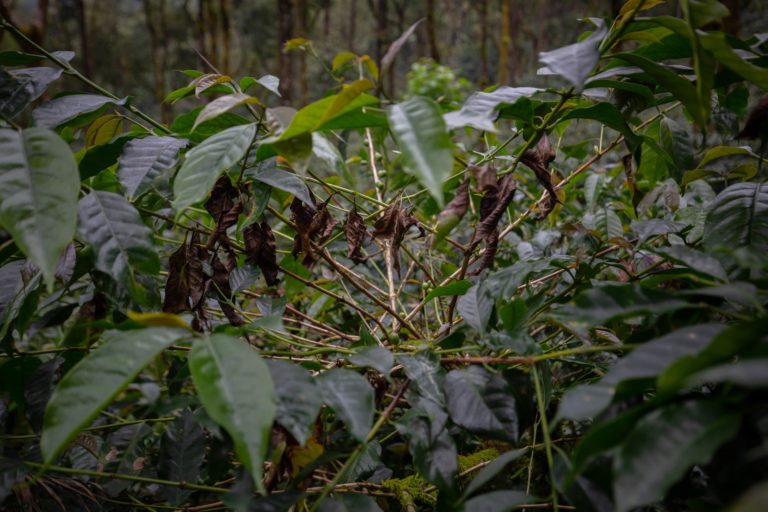
Leaf rust infestation on coffee plants. Photo by Abhishek N. Chinnappa.

Plantation economics and public policies, however, drove the farmers to opt for exotic shade trees like silver oak, which grows fast and can be easily traded as timber. Many farmers are switching back to native trees for various reasons, one of them being the leaf litter of silver oak lacks nutrients and doesn’t decompose as fast as native ones, said C.G. Kushalappa, dean of the College of Forestry.  There is also the realisation that a good canopy cover provided by native trees can prevent soil damage during extreme rainfall.

“This July, I got 101.6 mm (four inches) of rain every day for 20 days. Some places nearby recorded around 150-200 mm (6 to 8 inches). This was followed by 1000-1300 mm (40-50 inches) of rain in 10 days in June. “We used to get seven to 10 days of monsoon break in June-August which is crucial for coffee. But no such break in the last three to five years,” said Kiran.

More wet days and little sunshine — a perfect setting for pests and fungal infections — is bad news for coffee. Black rot fungus (coffee thread blight) or Koleroga and coffee white stem borer (Xylotrechus quadripes), a pest, are decimating Arabica plants that were once this coffee belt’s pride. Coffee leaf rust, another fungal disease, is also high among coffee, informs Kiran. “I faced 20-30 percent loss last year,” he said with dismay. He had to shell out Rs. 5000 an acre to remove the black rot infestation at his 60-acre farm in Magundi in Chikmagalur.

Robusta, as the name suggests, is more robust and pest resistant to an extent, said J.S. Nagaraj, joint director of Central Coffee Research Institute at Balehonnur in Chikmagalur. In the last 15 years, there has been a clear shift towards Robusta in Kodagu and Chikmagalur. “While it was 50-50 earlier, it is now 80 percent Robusta in Kodagu,” said Kushalappa. Labour shortage and the high cost of cultivation of Arabica have also tipped the scale in favour of Robusta.
Coffee farmer Kiran points to the infestation. Photo by Abhishek N. Chinnappa

Farmers devise ways to adapt

Coffee farmers here are constantly trying to adapt to a changing climate. “Coffee farming depends on two important rainfall events, blossom shower and backing shower,” explained farmer Jammada Ganesh Ayyanna of Kaikeri village in Gonikoppal in Kodagu. “Blossom showers in the summer months of February to March ensure the blossoming of coffee plants. This must be backed by the backing showers within two weeks for the cherries to set,” he said. In the last three decades, the changes in shower patterns began to affect largely rain-fed agriculture, prompting farmers to invest in irrigation by way of sprinklers. “More than 90 percent of farmers rely on sprinklers now,” Ayyanna told us.

While the northeast monsoon and cyclonic events had little effect on coffee farming in these parts earlier, isolated showers during coffee-picking months (December-February) are working against the industry. Showers during picking months make the cherries drop. The dropped cherries, called “cleanings”, are often picked and sold. While cleanings filled 100 bags (one bag is 50kg) at Ramachandra’s farm last year, Kiran had to let go of the cleanings due to rains. “The cleanings were damaged; damaged cherries don’t fetch a good price,” he said. Picked cherries need at least two months to dry, said Ramachandra.

“No rains and good sunshine are ideal.” Since that hasn’t been the case in the last few years, more farmers, mostly large landholders, have begun to invest in driers.
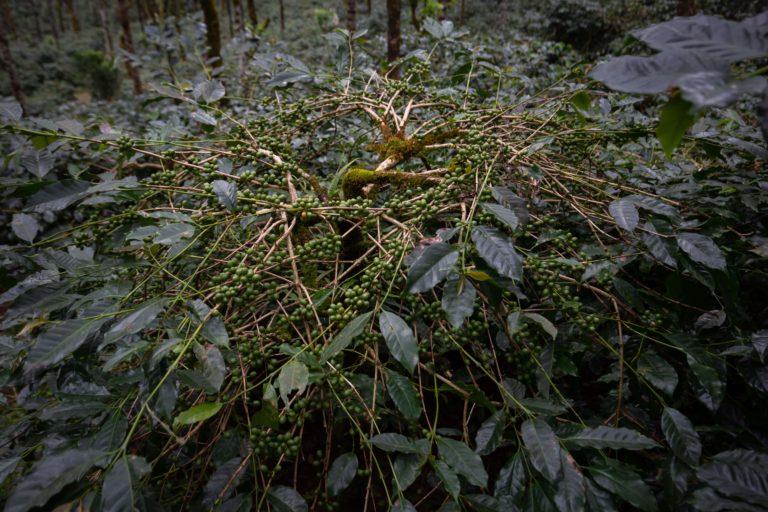
Coffee cherries at Kiran MR’s estate. Photo by Abhishek N. Chinnappa.

“I didn’t want to worry about unexpected rains,” said Gerrard Perreira from Coove Village in Mudigere taluk in Chikmagalur, who has 200 acres of Arabica and Robusta coffee. “For the coffee to dry properly, we need uninterrupted sunshine for a minimum of five days. But that’s hardly been the case in the last few years,” he said. He bought a drier eight years ago when signs of climate change had begun to show.

It has a 4000-litre capacity that can dry 35 bags of coffee at one time at an optimal temperature of 35-40 degrees Celsius for 18-22 hours. “The drying has to be uninterrupted. Since the power supply is unreliable, we use firewood. But a power generator for backup is a must,” he shared.

There are other advantages too. Using driers is more hygienic, quicker, and cuts labour costs, said farmers. Small and medium landholders, however, can’t afford the driers that cost about Rs 12-15 lakhs and are suggesting setting up community-owned driers. Kushalappa has his suspicions since cooperatives have not worked well in the region in the past. Coffee Board is now giving subsidies for driers, informed Nagaraj. “It is not affordable for everyone. But if climate change continues to affect coffee farming, driers are the future,” he said.

source: http://www.india.mongabay.com / Mongabay / Home> Mongabay Saves Climate / by Arathi Menon / December 01st, 2022
Coorg farmers are now growing coffee that is helping the environment

A unique eco-certification initiative in Kodagu’s famous coffee estates offers fresh hope for preserving native rainforests of the Western Ghats.

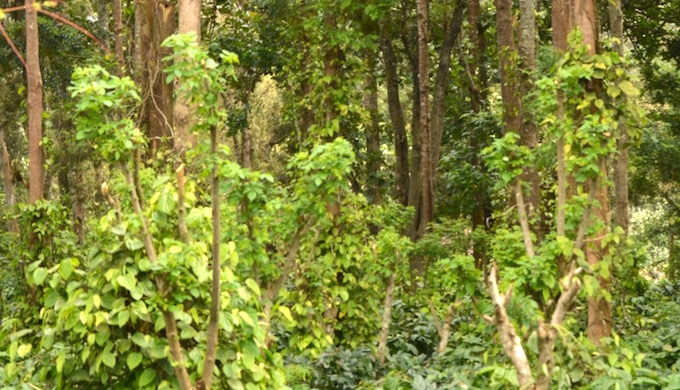
Growing coffee in the shade of evergreen trees in Kodagu. | Gopikrishna Warrier

There was a time in the not-too-distant past when coffee farmers in Kodagu district of Karnataka grew their plants only under the canopy of evergreen forests they had inherited. Now they prefer to grow it under the sun, which has serious implications for the Western Ghats and on the waters of the Kaveri River.

More and more farmers are now letting trees such as Dadup (Erythrina subumbrans), Arecanut (Areca catechu), Balanji (Acrocarpus fraxnifolius) and Jackfruit (Acrocarpus heterophyllus) die so that the canopy can be opened up and they can grow sun-loving coffee varieties that produce more berries and beans, resulting in higher returns.

Instead of the big trees, they are now planting exotic Silver Oaks (Grevillea robusta), whose pole-like trunk can be used as a support for the climbing pepper vines, which help boosting incomes. The proliferation of Silver Oaks has made it one of the more common trees in some parts of the area.

This transition has a larger ecosystem cost. Kodagu, earlier known as Coorg, is located on the western edge of the Mysore Plateau, at an average altitude of 800 metres, as it lifts up to the crest of the Western Ghats ridge (altitude above 1,500 m) and then falls sharply westwards into Kerala. The plateau mainly slopes eastwards, with the streams and rivers joining to form the Kaveri River, which is the lifeline for millions of people in Karnataka, Tamil Nadu and Puducherry.

With insufficient rains over the Western Ghats during this year’s southwest monsoon, there is a shortage of water in the reservoirs across the Kaveri in Karnataka. This has led to the flaring of the water-sharing dispute with the lower riparian state of Tamil Nadu in recent days.

While this acrimony continues, payment for ecosystem services measures are being worked out in Kodagu district so that coffee farmers protect the forests under which they grow their crop, thereby preserving the water flow into the Cauvery. These measures also help to maintain the climate resilience in the river’s catchment and command areas.

With the forest-like mixed-tree canopy in coffee plantations disappearing, the torrential rains of the southwest monsoon flows quickly down the streams, carrying valuable topsoil away and causing floods followed by long dry periods downstream.

Paying for ecosystem services

The Kodagu farmers are being encouraged through payment for ecosystem services, in the form of eco-certification, to continue with their traditional coffee cultivation under the shade of mixed species of trees. This will help strengthen the ecosystem services they receive from the unique landscape of Kodagu, and also strengthen similar services and climate resilience of all those relying on the waters of the Kaveri downstream.

The concept of eco-certified coffee, whose certification process ensures that coffee is grown under mixed-species trees, has gained popularity in the district in the past five years. Close to 900 coffee farmers have converted to eco-certified coffee. Even with a conservative estimate of 10 acre per farmer, this means nearly 10,000 acres of eco-certified coffee. In addition, with Tata Coffee getting all of its 13 estates eco-certified, Kodagu district has at least 20,000 acres under coffee cultivation that aims to minimise damage to the environment.

As an incentive for protecting the environment, the coffee farmers get a premium above the market price for their coffee beans. Coffee is the major agricultural produce from Kodagu, with 33% of the district landscape under its cultivation. About 38% of India’s coffee production comes from the district.

Ecologically, Kodagu district has been identified as a micro hotspot of biodiversity under the larger Western Ghats region. Rightly so, since the western crest of the mountainous district is in the direct path of the southwest monsoon. The dark clouds heavy with rain dump much water over the district. While the western edge of the district receives above 5,000 mm of rainfall on an average, it reduces to around 1,200 mm in the east. Most of the water feeds into the Kaveri.

According to a report by the College of Forestry at Ponnampet in Kodagu, natural forested ecosystems cover an area of 46% of the total area of the district. These include evergreen, semi evergreen, moist deciduous, dry deciduous and scrub forest types, and even the high-altitude shola-grassland ecosystem.

Traditionally, coffee is grown in the shade of these forests. Coffee estates in Kogadu have on an average 350 trees per hectare, compared with 270 in degraded groves and 640 trees per hectare in the nearby Brahagiri Wildlife Sanctuary, making these estates amongst the densest agro-forestry systems in the world.

“Very few landscapes across the world grow coffee in the way in which Kodagu does,” said C.G. Kushalappa, university head for forestry and environment sciences at the College of Forestry, Ponnampet in Kodagu. “We grow both Arabica and Robusta coffee under the shade of the trees. Our shade-grown Robusta fetch a premium price. When grown under the shade, the berries mature slowly and fill out better. They have good cupping (taste) quality.”

Coffee plants are increasing being cultivated under exotic Silver Oak trees. (Photo by S. Gopikrishna Warrier)

However, he needed scientific data to convince the coffee farmers and the district administration that there was strong ecosystem benefit in maintaining the traditional shade-growing methods. The opportunity for doing this research emerged when the College of Forestry was chosen as the lead institute in India to carry out the Coffee Agro-Forestry Network, or CAFNET study to understand the environmental services from this unique landscape.

Financed by the European Commission, the study was jointly conducted by the College of Forestry, the Coffee Board, the French Institute at Puducherry, CIRAD (the French national agricultural research system) and Bangor University from the United Kingdom between 2007 and 2011.

Rich local knowledge

The study noted that the multi-storeyed coffee agro-forestry system developed and sustained by the farmers based on their local knowledge is one of the most diverse production systems in the world. The traditional coffee agro-forestry system sustains diverse animal, bird, plant and microorganisms, and provide biodiversity, carbon sequestration and water-related ecosystem services. Since multiple crops such as pepper, mandarin oranges, vanilla and timber is also grown in these systems, they help provide resilience to farmers when they are hit by coffee price volatility.

The CAFNET report recommended that coffee farmers growing Arabica and Robusta under shade trees should be paid for the ecosystem services that their farms provide, so that they can protect biodiversity and therefore water in the Cauvery. Two methodologies for payment for ecosystem services suggested was eco-certification and geographical indications protection for Kodagu coffee.

Eco-certification of coffee farms in Kodagu started as a follow-up to this recommendation. Coffee farmer BB Thammaiah says his interest was piqued when students from the College of Forestry came to his farm to carry out biodiversity studies. “After the studies I was told about the uniqueness of the method in which I grow coffee, and I went in for eco-certification,” he said.

The two eco-certifications that have been popularly accepted are from the Rainforest Alliance and Utz. Coffee grower KK Naren in Kunda village near Ponnampet said the main benefit of the eco-certification process is that farmers are trained in good practices that have good environmental benefits and improve the working and living conditions for the workers.

“The economic benefit is not much,” he said. “It is more of training for us, which will be beneficial in the long run. The eco-certification process educates the coffee farmers about the environment.”

Importance of native trees

The most important lesson from the training relating to the eco-certification, according to Narenm was the understanding on the importance of native trees. “It is not that we didn’t know about native trees but we were not that keen on maintaining them,” he said. “The native trees do not give good financial returns, so we gave importance to silver oak.”

According to Naren, the Rainforest Alliance eco-certification process looks at whether native shade trees are present. The certifiers and auditors also look at labour management, whether the minimum labour wage is paid and the cleanliness around the labour quarters. They are very strict about not using child labour. “They also look at the way chemicals are used,” he said. “They are not saying no to chemicals but there are restrictions to some chemicals and the way the rest are used. They are keen that we should not use pesticides of chemicals near the rivers or tanks. They give importance to maintain local environment.”

Individual planters like Thammaiah and Naren got an opportunity, through the eco-certificaion process, to access the international market through a Swiss procurement agency that buys higher quality coffee. Both of them sell their eco-certified coffee to Ecom Gill, who procures the eco-certified produce for supply to Nespresso.

BB Thammaiah in his coffee farm where the plants are grown under the shade of native evergreen trees. (Photo by S. Gopikrishna Warrier)

For Tata Global Beverages Ltd and its production subsidiary Tata Coffee Ltd, the move to eco-certification of all of its 13 estates in Kodagu was an important step in the process to make its supply chain sustainable. According to Anurag Priyadarshi, global sustainability manager for Tata Global Beverages, one of the guiding principles that the group has adopted is to source sustainability. For this, all their estates in Kodagu have been eco-certified by Rainforest Alliance and Utz.

“Through the eco-certification process we are trying to ensure good management practices for the ecosystem, energy, water, waste, soil and agro-chemicals. We ensure the safety of the produce and also occupational health of the workers. Ultimately we want to prevent the impacts of climate change,” he said.

MB Ganapathy, head of plantations for Tata Coffee, said the company is aware about the fact that they are growing coffee in Kodagu, which is a biodiversity hotspot in the Western Ghats. “We have recognised this fact and that is the reason that our vision is to enhance the ecological wealth we have inherited. The eco-certification helps us safeguard the environment.”

Challenges remain

However, the rapid spread of the eco-certification process has also raised some hiccups which need to be overcome, states TR Shankar Raman, scientist at the Nature Conservation Foundation, whose organisation was involved with helping Rainforest Alliance with the certification in the initial years. The three points of concern, according to him, is the very rapid pace at which certification is being done; the relative absence of biologists and social scientists in the auditing process; and the dilution of conservation standards (like the requisite number of native species and canopy cover) in subsequent versions of the certification guidelines.

“While the rapid certification has more and more farmers being eco-certified, we hope the rigour of the process continues to be maintained, so that the end result of conserving the native vegetation is not compromised,” Raman observed.

With more farmers opting for eco-certification, there is a movement towards the protection of the traditional methods of coffee cultivation under the shade of mixed-tree species. For the process to strengthen the farmers should continue to get good economic benefit for their eco-certified produce.

According to Naren, if there is at least 10% more returns from the eco-certified coffee remains constant then there will be an incentive for the opting for opting for the process. At present the price at which procurement agencies such as Ecom Gill buy is linked to the international market price, plus a premium of Rs 60 to Rs 80 for a 50 kg bag of sun-dried cherries. The international prices fluctuate in relation to the local market prices, and as with the current situation can go below the domestic price.

However, Kushalappa says that in addition to the premium, there are other incentives and bonuses for producing good quality coffee beans. The average increase in price above the local market price was around 15% last year, which is well worth the effort.

If additional income for coffee farmers from eco-certification can help conserve unique agro-forestry ecosystem of Kodagu, then it will be the water flow into the Cauvery that would be conserved. Millions of people downstream, including the residents of Bengaluru and other parts of peninsular India, will thank the coffee farmers upstream for their drinking water and climate resilience.

This article first appeared on India Climate Dialogue.

source: http://www.scroll.in / Scroll.in / Home> Environmental Balance / by S Gopikrishna Warrier / September 17th, 2016

Harangi Reservoir in Kodagu to be beautified

Rs one crore proposal has been forwarded to the state to improve the musical fountain in the area alongside establishing a rain shelter – with nearly 500 seating capacity – across the fountain.   

Madikeri:

The Harangi Reservoir in Kodagu will soon witness beautification work to attract more tourists. The reservoir, meanwhile, wears a colourful look as the crest gates have now been equipped with LED lights.

Harangi Reservoir near Kushalnagar is one of the popular tourist destinations in the district and is visited by over two lakh tourists annually. A minimum entry fee of Rs 10 is being currently collected from the visitors. However, steps are now being taken to improve the reservoir to make it aesthetically appealing.

“The LED lights to the crest gates have been fixed using the Annual Maintenance Funds. More beautification works will commence shortly as several proposals have been readied for the development of the reservoir,” confirmed Chennakeshava, the system engineer of Harangi Reservoir.

Meanwhile, the newly appointed Executive Engineer, Puttaswamy confirmed, “Two proposals for the beautification of the reservoir premises have received approval and the work for the same will begin shortly.”

He explained that a Rs 98 lakh project has been approved to fix lighting across the reservoir area. “The garden, drainage gallery, crest gates and the surrounding areas of the dam will be fitted with improved lighting under the project,” he added.

Further, a chain link fencing will be installed across the musical fountain area in the reservoir “A conflict wild elephant had entered the reservoir premises a couple of times. To avoid this in future, Rs 90 lakh has been approved for the establishment of chain link fencing. The funds will also be used to equip the fountain with a diesel generator,” he explained.

Apart from the approved projects, Rs one crore proposal has been forwarded to the state to improve the musical fountain in the area alongside establishing a rain shelter – with nearly 500 seating capacity – across the fountain. 

source: http://www.newindianexpress.com / The New Indian Express / Home> States> Karnataka / by Prajna GR, Express News Service / August 25th, 2022                     

Kodagu will be an independent council: Subramanian Swamy

“Utharkand, Telangana, Haryana, Himachal Pradesh have become separate states after a long fight. Why should Kodagu not get an autonomous council?,” he questioned.

Subramanian Swamy addressing the gathering in Kodagu (Photo | ENS)

Madikeri :

“I will fight for your (Kodagu) separate existence within Karnataka state but with an autonomous council,” declared former minister and economist Subramanian Swamy in Kodagu. He was addressing the gathering at the 32nd Codava National Day celebration in Madikeri on Saturday. The event was hosted by Codava National Council (CNC).

Subramanian Swamy in his speech assured CNC about the organization’s goal of achieving geo-political autonomy through a legal battle. “Great injustice has been done to you (Kodagu/Kodavas). But keep fighting,” he added.  He assured to file a petition in the Supreme Court shortly to get Geo political autonomy status to Kodagu. He stated that he will seek support from his legal advisor Satya Sabarwal. “Utharkand, Telangana, Haryana, Himachal Pradesh have become separate states after a long fight. Why should Kodagu not get an autonomous council?,” he questioned. He assured that Kodagu will be an independent council by November next year.

Meanwhile, speaking with the media Swamy said, “The former minister Chidambaram has faced serious charges in many cases followed by Rahul Gandhi in the young India case. Prisons wait for them.”

He commented on the Modi regime and spoke, “I am not opposing Modi. But his policy of appeasing China is opposed by me. He should not allow the Chinese to occupy our territory. India should fight back. I also oppose some of the wrong economic policies of the present government. No one in BJP has the guts to question the wrong policies except me. Even the PM has failed to declare Ram Setu as a heritage spot despite several appeals by me.”

Virat Hindusthan Sangam national secretary Jagadish Shetty, Supreme Court advocate Satya Agarwal and CNC president NU Nachappa also spoke. Several resolutions including the demand for ST tag for the Kodavas were passed during the session.

source: http://www.newindianexpress.com / The New Indian Express / Home> States> Karnataka / by Express News Service / November 26th, 2022

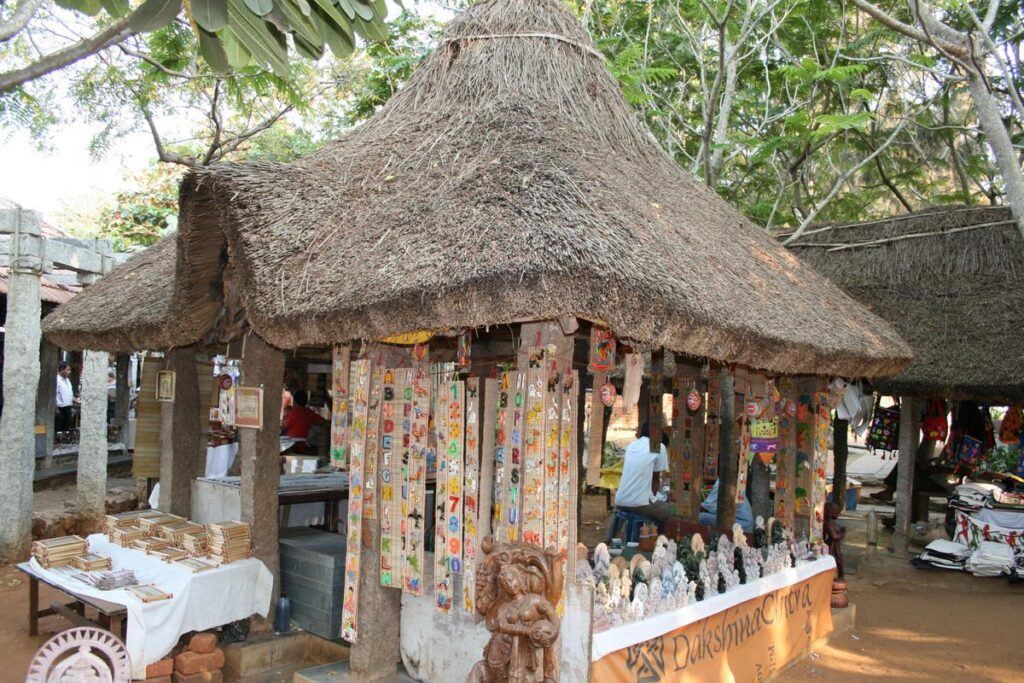
Tamil Nadu’s DakshinaChitra museum’s two new projects will showcase Calicut and Kodava architecture

The museum is buzzing with activities ranging from art exhibitions to music events.

Grounds teeming with young school children, tourists stopping by to admire artisan demonstrations, galleries filled with a cornucopia of artefacts from across the country — these are all familiar sights at DakshinaChitra, the living museum, that has been a constant on the Chennai cultural map since its inception in December 1996. But the pandemic decidedly forced the museum to pause its trajectory and plans for the third decade of the millennium.

Sharath Nambiar, director, DakshinaChitra is happy that the grounds are now slowly coming back to life. “For the first time since 2020, we have crossed pre-pandemic numbers in terms of visitors and footfall. Schools and colleges have resumed field trips and our expanse of over 10 acres is now brimming with energy and activity. We even have 22 artist stalls with live demonstrations and are looking to add more to the roster,” he says.

The museum had envisioned a Garden Show in 2020, but that did not pan out. “We have planned a grand showcase in January 2023, with a flower show, workshops, and prizes for the city’s best home gardens, bonsai, terrace and vegetable gardens, as well as ikebana and other techniques. Chennai should have a garden show like Ooty and Bengaluru,” says Nambiar.  

A lot is happening here. Over the past few weekends, musical ensembles have performed at the museum’s multiple venues, including juniors from the Sunshine Orchestra, supported by the AR Rahman Foundation and the KM Music Conservatory, and Madras Commune’s Follow the Sound that had audiences literally moving towards the music at different venues. The art galleries have focussed on Tamil heritage through November.

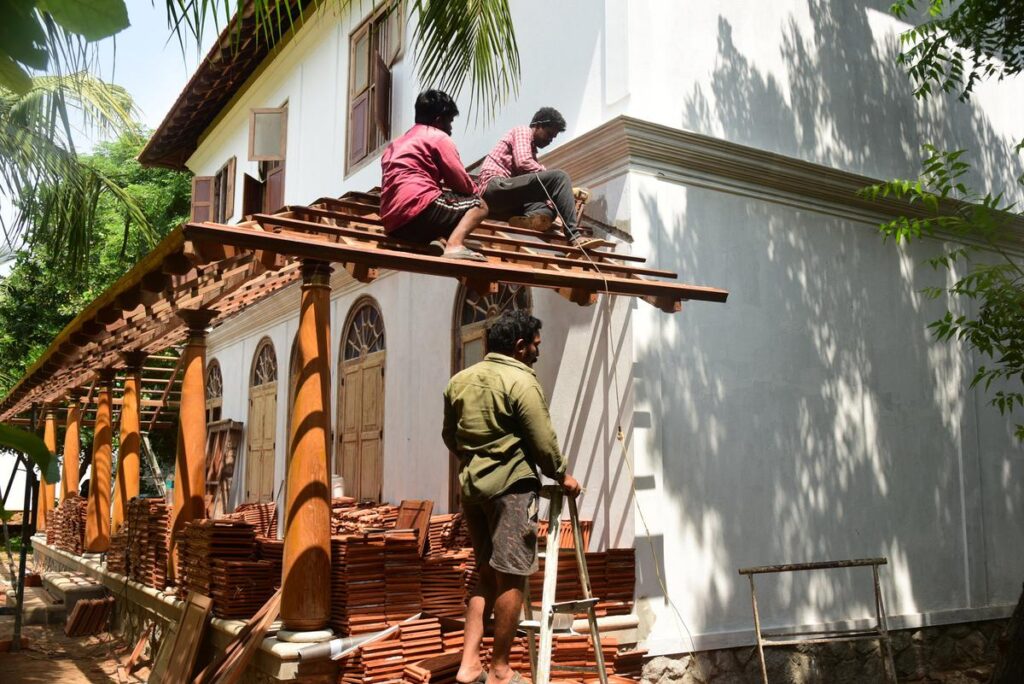
But the one project that has the museum buzzing with activity and anticipation is the construction of its Calicut House. “We started this project in March 2020, but then were forced to stop, since the movement of man and material was difficult during the pandemic. We resumed construction only this April, hoping to open its doors during summer 2023. The home belonged to a  Muslim family in Calicut,  and we had a team of 12 carpenters from Kerala, who carefully worked to reconstruct the home exactly as it was. We envision an exhibition around sustainability, using this Calicut house,” says Nambiar. The plan is to use the rear facade to install solar panels, use rain water harvesting apparatus, water conservation and  composting techniques, in the adjacent compound area, to sensitise, “our millennial audience to environmentally conscious processes that were a part of our heritage in different forms over decades. We worked with Benny Kuriakose and his team of architects as well as a team from Auroville to set this up,” adds Nambiar. 

Calicut house under construction | Photo Credit: Special Arrangement

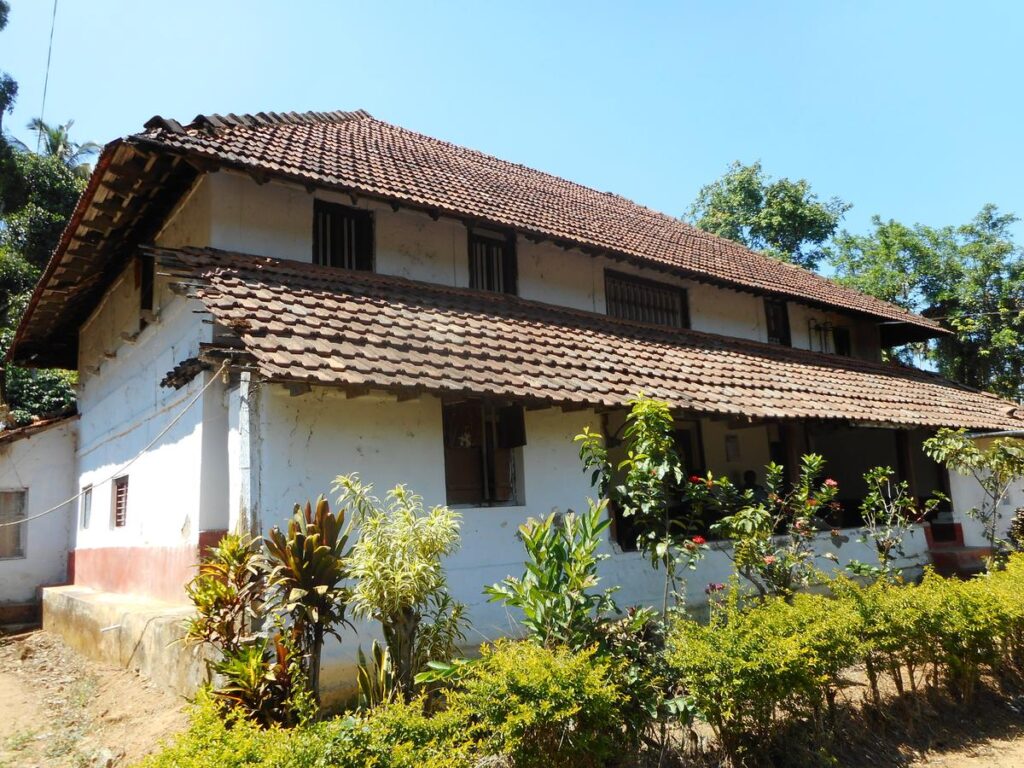
While the Calicut House is all but ready for the public, the Kodava House or Coorg House will be the latest addition to the living heritage space, “to focus on the Kodava community which came into focus with the book, The Vanishing Kodavas by Kaveri Ponappa, and this project will be bolstered by the presence of the Sandooka—The Living Museum of Kodava Culture , an interactive virtual museum expected to be formally launched in 2023 as well,” adds Nambiar.

The Coorg style house in its original location | Photo Credit: Special Arrangement

The Kodava House will showcase the way of life of the   community living in the Western Ghats of Karnataka. They have a deep connect with the land. The house to be reconstructed has been identified. “We have to carefully document the structure, then the parts are numbered, photographed, we have drawings to scale, then the home is painstakingly taken apart, using teams from the area who understand the materials and techniques. Then we slowly start the process of moving the parts to be assembled in the museum, in the exact same way.

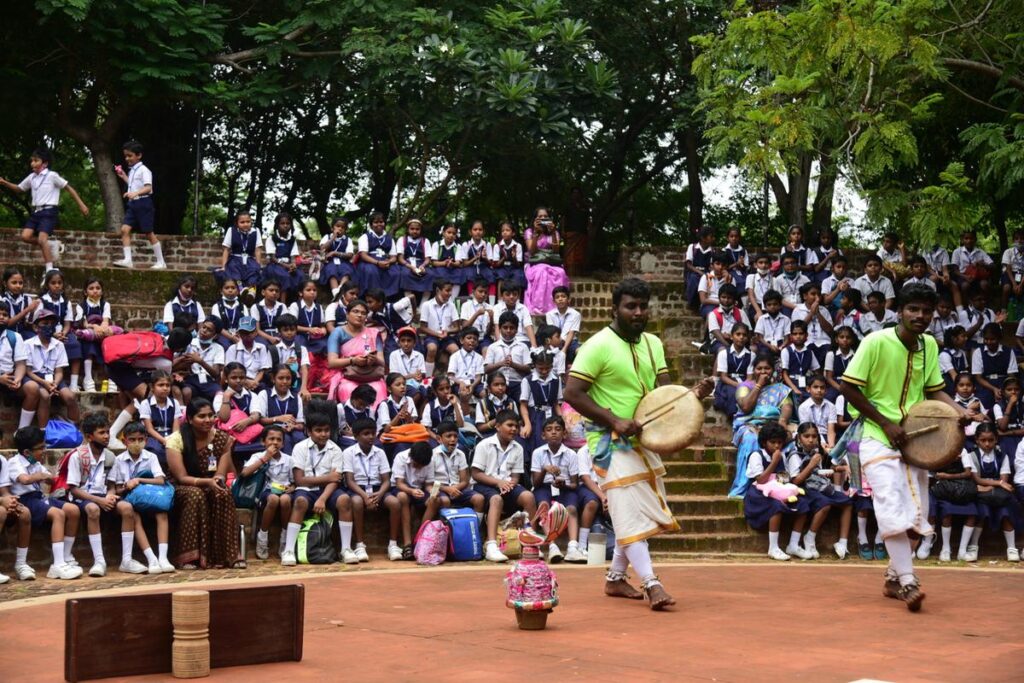
A tapattam performance | Photo Credit: Special Arrangement
Crafts Bazaar | Photo Credit: Special Arrangement

The process starts early 2023 and would take close to 16 months to complete,” concludes Nambiar, as the museum readies itself for a hectic Margazhi season packed with performances, as well as a December anniversary celebration replete with spirited folk performances and a unique exhibition showcasing the state of Arunachal Pradesh.

source: http://www.thehindu.com / The Hindu / Home> E Paper> Life & Style / by Anisha Menezes / November 24th, 2022

Nation’s Pride: Lt. Col. PS Ganapathi MVC The brave officer who sowed the seeds of peace in a war torn Sri Lanka

At the first glance it seems to be another piece of metal with the sign of a star embossed on it. The hardly visible recipient’s name along with the date it was received is engraved in a corner. To own this piece of metal is an irrepressible desire of every soldier who goes to war. That’s because it represents valor. It’s the ‘Maha Vir Chakra’, second highest gallantry award given to those who exhibit exemplary courage and valiance. It is the Indian equivalent of the ‘Distinguished Service Cross’ of the British. Since 1947, Only 218 braves of the mighty Indian Army have been the proud recipients of the Maha Vir Chakra. 6 among them have received the Maha Vir Chakra twice, also called the Maha Vir Chakra Bar. Considering this, only two from Karnataka, a state which has given some of the most valiant soldiers and officers to the Indian army, have been the illustrious recipients of this gallantry award.One is Squadron Leader Ajjamada B Devaiah famously known as the ‘Tiger of Sargodha’ and the other is Major (Later Lt. Colonel) P S Ganapathi. While the former was martyred in action during the 1965 war and was awarded the Maha Vir Chakra posthumously, the latter is a living example of unparalleled gallantry amongst us today.

Saga of a living memorial

Unlike the brave souls of Punjab, there have been no books published about this hero. He hasn’t given any interviews to TV channels or attended public events which are flashed all across the media. Almost nothing is known about him yet. He is relatively unknown even in his own hometown, Coorg, the land of the brave warriors. Shy of any kind of publicity and one who lives by the dictum ‘Safeguarding the nation is my duty alone’ is how Lt. Col. Puttichanda Somaiah Ganapathi has led his life throughout. Participating in public events is not at all a difficult task. However, Lt. Col.PS Ganapathi believes that safeguarding the honor of the esteemed medal is his paramount duty and is more valuable than any kind of publicity.

At 73 today, Lt. Col.Ganapathi might not have a large frame but his baritone voice, characteristic of military officers, hasn’t waned a bit. Lethargy that comes with age is alien to him. The agility of his mind is intact despite many years of retired life. Currently residing at ‘Sena Vihar’ in Bengaluru, Lt. Col.Ganapathi’s retired life is anything but idiosyncratic with lives of retired people who prefer a laidback existence.An effervescent man, unlike most people his age, he drives to his hometown in Coorg once every month on his own.His life in the concrete jungles of Bengaluru hasn’t sapped his love for farming one bit.His suave demeanor and absence of any signs of pretension for being the proud owner of a national gallantry award, is the true nature of this hero.

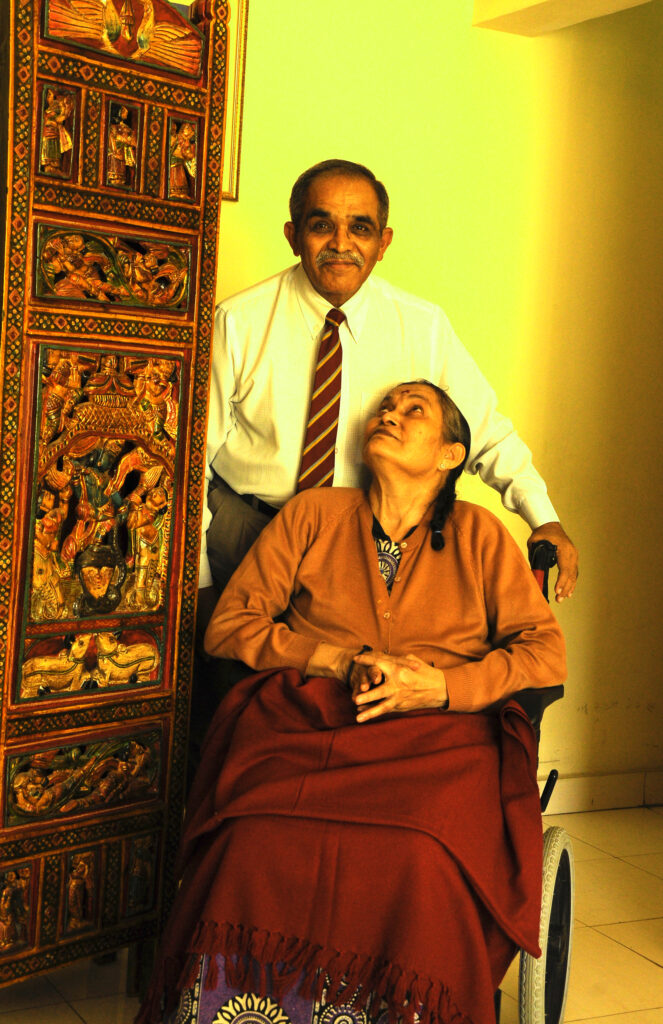
While seated at his home in the multistory apartment complex at the Army’s ‘Sena Vihar’, Lt. Col. Ganapathi began to narrate the stirring story behind his Maha Vir Chakra. He was soon joined by his wife on her wheelchair, with a cup of coffee in her hand. Although, she had heard her husband’s heroic tale umpteen times,her desire to keep listening to the saga made her tolend her ear once again. The showcase behind the Lt. Col. was decked with the upright photo which had captured the invaluable moment when he was presented the MVC by the President. Adjacent to it was the photo of his son, who departed untimely, adorned with a sandalwood garland. The enduring agony of the deceased son was apparent, albeit fleetingly,in the stern battle-hardened face of the Lt. Colonel.

As a worthy prelude to his tale of heroism, Lt. Col. Ganapathi began by recollecting his childhood.

Madikeri Central High school, 1952

After completing his primary education from Napoklu in Coorg, Ganapathi was admitted to the Central School at Madikeri for High school studies. This was the school from where towering personalities like Field Marshal Cariappa and General Thimmayya studied, played hockey and graduated. The Central School was famous all over Coorg for its quality English education, encouragement in sports and its discipline. While most kids ran towards the ‘Mens Compund’ Ground to play hockey as soon as the school bell rang, Ganapathi used to run to the school auditorium to gaze at the large portraits of FM Cariappa and Gen. Thimmayya which were hung on its walls. Years of gazing and drawing inspiration from them, sowed seeds of desire within Ganapathi to join the military and become a decorated officer like the two greats.As soon as he completed the ‘Seventh Form’, he began his preparations and started to spend a lot of time on the ground. He used to sit and listen to the stories of war and valor from retired soldiers in the town. Though many years had passed, the inspirational portraits from his school never ebbed from his mind.

Years later, after completing his college education, Ganapathi joined as a Forrester. While he was posted at Kolhapur in Maharashtra, he attempted to join the military. He failed. He attempted again in Bengaluru and failed yet again. But he did not give up and again attempted to join the military at Bengaluru. He succeeded in this attempt. Ganapathi’s ambition that blossomed at Central High schoolin Madikeri had now come true.He was deputed to the Officers Training Academy (OTA) at Chennai. After the successful training in Chennai, Ganapathi became an officer of the 14th Mahar Regiment.

Within a few days of joining the military, PS Ganapathi duly ingrained the military traits of discipline and diligence. Those portraits of Central High school had only become larger in his mind. He was selected for the Anti-Insurgency battalion formed to tackle the militancy spread in Nagaland and Mizoram. He worked in various areas in the North-East like Palampur, Gangtok, Nathu La, etc. He received further training for a few years in Belgaum. He was then deputed to Assam Rifles. During this period, Ganapathi has served in various regions, under different environments and had experienced adverse conditions from close quarters.

Colombo, 1987 July 29

That was an era during which rivers of blood was flowing all across Sri Lanka. India too bore the brunt of the bloody strife there. Lakhs of people from the affected areas from Sri Lanka sought refuge on the shores of Tamil Nadu daily. The Tamils of Sri Lanka had the sympathy of Indians. India was caught in a quandary over the dispute in Sri Lanka. On the one hand, the Lankan government was adamant on not granting any kind of special status to the Tamils there. The then Prime Minister Rajiv Gandhi, with the arbitration of the then CM of Tamil Nadu MG Ramachandran, invited LTTE’s Chief Prabhakaran to Delhi to deliberate on the Tamil issue. Indian Intelligence institutions had exerted considerable pressure on the LTTE chief. Soon after this, Rajiv Gandhi undertook a tour of Sri Lanka. However, the Tamils of Sri Lanka were displeased at the way their leader was purportedly treated in Delhi. On the very first day of his visit, a Sri Lankan soldier had attacked Rajiv Gandhi with a gun during the ceremonial Guard of Honor. Subsequently, Rajiv Gandhi and the then Sri Lankan President G R Jayavardhane conducted bilateral talks and signed a deal. As per the deal, the Sri Lankan government would recognize the Tamil aspirations and grant special status and privileges to them. India on its part had promised to send its military to Sri Lanka and undertake the task of persuading the Tamils to lay down their arms.

The world assumed that this historic deal would solve the century old dispute and put an end to the 3-decade old cycle of bloodletting in Sri Lanka. India’s initiative to solve the crisis was lauded the world over. It was deemed that the Intervention of India would change the situation in the island nation. Everyone believed that the fighting Tamils would lay down their arms and hoped that the lives of Tamils, who formed 20% of Sri Lanka’s population, would change for the better. Many even penned poems over the cause. Congress leaders in India started to sing paeans to Rajiv Gandhi and even declared that there was no difference between King Ashoka who sent saplings of the Bodhi tree to Sri Lanka and Indira Gandhi’s son Rajiv in their speeches.While all these events were happening, Tamils the world over had exercised a conspicuous silence which was ominous of the lull before astorm. The world had thought that a single treaty would resolve India’s refugee crisis, establish peace in Sri Lanka and assuage sorrows of the Tamils.

Tamilnadu, 1987 August

The Indian troops arrived in Sri Lanka with much zeal to fulfil the obligations of the peace accord. With the over-confidence brought by the success of signing the pact, Indian government sent over ten thousand Indian soldiers to Sri Lanka in the first week of August itself. All the three arms of Indian armed forces crossed the ocean into Sri Lanka. The India troops which consisted of The Sikh Regiment, Maratha Light Infantry, Mahar Regiment, along with battalions of 10th Para Commandos, Armored regiment with U-72 battle tanks, Gorkha and Rajputana battalions, soldiers of 4th mountain division, Chetak and Cheetah helicopters of the Air Force, several units of ‘Marcos’ commandos of the Indian Navy, landed at several places in Jaffna, Trincomalee, Batticaloa, Ampara, and Urumpirai with overweening confidence.

In a land that it did not belong to, in an environment that it was alien to, the Army did not have a faint idea about the war that was about to ensue. The only plan of action in mind was to establish peace. Hence there were no adequate preparations or efficient battle plans. Even the intelligence gathering was not robust enough. The maps of the area were woefully inadequate. In such circumstances, the truth of the grim scenario dawned on the Indian army. The LTTE had armed even the women and children with guns. The LTTE terrorists who had hidden capsules of cyanide, stunned the Indian soldiers. The troops which had arrived with the sole aim of establishing peace in the island, had its plan turn topsy-turvy in just a few days. The LTTE which had mastered the art of subversion, began to hoodwink the Indian Army. At several places, in a beguiling act of reciprocating to the peace accord, LTTE cadres surrendered old and rusted weapons to the Indian Army. A few days later, a leader of the LTTE committed suicide by consuming cyanide. This incident completely grounded any chances of establishing peace in the island nation. LTTE’s Chief Velupillai Prabhakaranused this as an opportunity to declare a direct war against the Indian troops. The war resulted in the martyrdom of 1138 brave Indian soldiers, the same soldiers who had come to the island with an idea of establishing peace. More than 3000 Indian soldiers were critically wounded. By the time the Indian government decided to recall its peace-keeping forces, the Army was decorated with 1 Param Vir Chakra (posthumously) and 6 Maha Vir Chakras. Among the six recipients of the MVCs was PS Ganapathi.

Trincomalee, 1987 July 30

(In first person) I was deputed from the Assam Rifles to the 8th Mahar Regiment. Pursuant to the orders of the government, the first batch of the peace-keeping force was airlifted from Tiruchirapalli to Jaffna on 30th July, 1987. I was in this batch. The dense jungles around Jaffna made me anticipate the struggles we would face in event of a military operation. I had a premonition of the same at the first glance of Jaffna. It did not take many days for my apprehensions to become true. This was because the LTTE waged a direct war against us. Within a few days of our landing, the LTTE attacked the Palali Airbase on the outskirts of Jaffna. The CRPF troops which were part of the peacekeeping force, were also attacked. The Jaffna Radio station was captured. Despite several counter-attacks by our forces, the LTTE did not capitulate easily. Jaffna was LTTE’s bastion and it was fighting to hold on to it at any cost. By this time, we understood that unless the LTTE loses Jaffna, its strength would not be depleted. But the Land mines buried unsuspectingly, suicide squads whose strategies were difficult to comprehend, disheveled all plans of our troops. The situation turned so grave that the then Chief of Army Staff Krishnaswamy Sundarji had to pay a visit to Sri Lanka in October 1987 and guide our troops in the peace keeping operations. The LTTE attacks were so dreadful and brutal that the Sri Lankan army abandoned and withdrew from areas which were the strongholds of LTTE. We were then clear that our next goal was Jaffna.

LTTE had assembled a strong army at a place called Maruthanamadam to defend Jaffna. Unless Maruthanamadam was cleared of the LTTE forces, the path to Jaffna would not be easy. We had to proceed towards Maruthanamadam from our station in Uduvil. Though our troops did not have exact information about this path, we were aware of the fact that LTTE cadres were present on the entire stretch. It was 6AM in the morning of August 11, 1987 when I was summoned by my Commanding Officer of the 8th Mahar Regiment Colonel BS Rathi. He informed me that he was entrusting the task of clearing Maruthanamadam from LTTE militants to me. Maruthanamadam was about 3 KMS from the place we were stationed. Without further delay, I along with 60 of my regiments’ soldiers proceeded towards Maruthanamadam. Our troops were adequately equipped with Medium Machine Guns, Hand grenades, personal weapons and few 106 RCL guns. As we reached Maruthanamadam, we faced heavy resistance. Those 3 KMS we traversed to Maruthanamadam that day is etched in my mind,just like a movie,even to this day.It was an uninhabited area, with kutcha roads.We neared Maruthanamadamaround 7AM. It was an atmosphere of stoic silence characteristic of a graveyard. Though we could see a few houses, no humans were visible. As we mulled over the scenario, a sudden barrage of gun fire fell upon us. We were stunned for a moment. While we deliberated our action, we realized that our estimation

that LTTE had modern weapons was indeed true. We also realized that the gun fire was emanating from within the houses there.Tackling the militants who are hiding inside such houses is a very dangerous operation. We had to overcome the danger at any cost. Lobbing grenades inside the houses through the windows was our only option. I then order my troops to lob 36 High Explosive grenades into the houses. Our soldiers blasted atleast 40-50 houses and destroyed the safe havens of the militants. Havildar Kaka Phule was grievously injured in the operation and attained martyrdom later. He was awarded the Vir Chakra for his courage.

Anaicottai, October 15, 1987

The success of the first operation had given lot of confidence for our troops. Jaffna was still in the hands of the LTTE. We had only advanced by a single step. With each step we took, the dangers only increased. Our next target was the town of Anaicottai. It was also called as Jaffna junction. The path to Jaffna would be easier only if we cleared this junction. LTTE agents were active throughout the path. The stretch was deserted with no signs of human activity. But in the silence that pervaded the area, temple bells used to ring all of sudden. It soon occurred to me as to why the Temple bells tolled when there were no one visible. I had realized at Maruthanamadam that the LTTE was a step ahead of us in gathering intelligence. The temple bells were used from far distances to convey to the LTTE cadres that the Indian Army was approaching Anaicottai. We proceeded with caution after we realized their modus operandi. We now only had enough arms and ammunitions to fight for 12 hours. We did not carry surplus arms as we had expected the 41st Brigade to arrive at Anaicottai by the evening of 16thOctober. As soon as we reached the Jaffna junction where four roads meet, we were attacked by the LTTE with their full might. We had to fight back hard and stop the enemies from advancing further. As the fighting ensued, the sun started to set and darkness had engulfed us. We would not retreat for any reason come what may.By nightfall, it started to rain and our adversaries were merely at a distance of 200 to 300 meters from us. While plain wetlands were behind us, scrub forests lay ahead of us.The ground beneath was sludgy. We were forced to consume rain water itself to quench our thirst.The incessant military operation since morning was taking its toll on our fatigued troops. Everyone ran the risk to slipping into deep sleep if anyone attempted to shut their eyes even for a moment.The gun fire from the enemies used to stop intermittently and start again all of a sudden. This continued throughout the night.I opined that we had to defeat them through the waiting game. I then sent the corresponding message to our headquarters. I received the communication that the 41st Brigade had departed from India and we should keep the enemy engaged until the Brigade arrives. We then received the message that a troop of 1st Maratha Light Infantry commanded by Colonel Oberai and armed with 81MM mortars would come to our rescue. As day and nights passed, we continued to fight the LTTE without as much as battling our eyelids. The putrid rainwater that had accumulated around continued to quench our thirst for days. The LTTE had come as close as 50 meters from us. We could not delay further and began our intense counter attack. Our soldiers fought valiantly like I had never witnessed before. By this time, the 8th Mahar regiment supplemented out efforts with their 81MM mortars and the 31st Light Regiment safeguarded us with their 120MM mortars and they fired upon the LTTE fiercely. While the battle raged on, I was forced to witness the deaths of several of my beloved boys. Unanticipatedly the LTTE fired a large explosive which landed close to me. The intensity of the blast was so deafening that my left ear started ringing. Decades after the war was over and even many years after my retirement, this was the only sound I heard in my left ear. The LTTE forces advanced further maybe after they realized our condition. During one of these nights I positioned myself in the Rifle trench and had my aim directed at the enemy. Despite the incessant and intense gun fire from their side, we did not fire a single shot. Silence from our side gave two soldiers of LTTE the confidence to walk towards our lines with the help of torch lights. I waited in my trench until they came very close to me. When I could see their face clearly, I fired upon them using my Sten machine carbine. Those two bullets I fired at that instant had a tremendous effect on the enemy’s psyche. LTTE’s courage had taken a beating.

The next day, a contingent of 15 soldiers led by Capt. Sunil Chandra arrived to deliver food and ammunitions to our troops. Capt. Sunil was a handsome young man but a tad impulsive, maybe owning to his young blood.While he was conversing with me in the rifle trench, Capt. Sunil got up to light a cigarette. I had forewarned him that lighting cigarettes could be dangerous. He must have taken a puff when his headsurfaced a few inches above the trench. A sniper bullet pierced through his scalp. Capt. Sunil Chandra breathed his last right in front of me. I took a headcount of my troops while lying in the trench itself. 11 of my brave boys had laid down their lives in the battle. I then could feel the heaviness in my heart. Finally on the morning of 19th October, 41st Brigade commanded by Brig. Manjit Singh arrived for our support. By then we had almost vanquished the enemy. A few of them had fled from their positions. For an operation that was supposed to last only 12 hours, we had fought relentlessly for 72 hours.

Uduvil, 25th January, 1988

Pursuant to the operations at Maruthanamadam and Anaicottai, Maj. Ganapathi was deputed to serve at the Army Headquarters at Uduvil. It was 8.30PM in the night of 25th of January. As usual, everyone in the camp were listening to news on the radio. A special bulletin was about to be broadcast. But none were aware of this and were eager to hear the news related to the Republic Day which was a day later.Then the announcement came on the radio that the ‘Indian Government had declared the Maha Vir Chakra for Maj. PS Ganapathi for exemplary courage demonstrated during the operations to clear Jaffna of LTTE militants and for the gallantry displayed during the operations to capture Maruthanamadam and Anaicottai’.

All his friends were elated and joyous. Congratulations poured in from his senior officers and staff. However,Ganapathi was reticent throughout. He neither felt proud for the award nor did he thank anyone.But he asked the only question that was haunting him. “You have bestowed the Maha Vir Chakra on me. But will it be possible to get back those 11 boys whom I lost?”

source: http://www.santoshthammaiah.wordpress.com / December 02nd, 2016

An Ex-Serviceman’s Journey to Kodagu

Land of Generals and War Widows

By Mandetira N. Subramani, President, VeKare Ex-Servicemen Trust, Mysore.

Most of the Ex-Servicemen of yore, who joined the British Indian Armed Forces during early 1940s, and participated in World War-II, are no more. However, there are still numerous widows of World War-II veterans, around 70 odd years of age, living in Mysore and Kodagu region, who narrate their helplessness and pathetic stories.

It was customary for men of yesteryears to marry a life partner who is younger to them by 10 to 15 years. It is quite but natural that most of such wives become widows and may live for 10 to 15 years, or even longer, after the demise of their husbands. Trends have changed. The present day men don’t mind marrying a life partner elder to him by 3-5 years and the educated ladies consider it as out of fashion and a mismatch to marry men who are 3 or 4 years elder to them.

Reverting to the subject of helplessness of widows of World War-II veterans, a gentleman barged into my office a few days ago with a complaint that his 76-year-old mother, living in a remote village called Kiggal, near Murnad, Kodagu (erstwhile Coorg), is not being granted defence family pension even after a lapse of 12 years after the demise of his father, due to some vague reasons projected by the Army’s EME Record Office, Secunderabad. The hapless widow happened to be one Mrs. Kaveriamma, widow of a World War-II veteran, Naib Subedar Ballachanda Nanjappa Ayyappa.

Mrs. Kaveriamma & late Nb Sub B.N. Ayyappa.

I, being not only an Ex-Serviceman myself but also a son of a World War-II veteran who served in the Corps of EME and died unsung and unheard 22 years ago, decided to help the Late Nb Sub Ballachanda N. Ayyappa’s widow Kaveri-amma with whatever little bit of knowledge and expertise I had gained during the course of taking up the cause of Ex-Servicemen and widows of Ex-Servicemen since the past 22 years after I quit the Armed Forces.

I believe in “seeing is believing.” Hence, I told late Naib Sub B.N. Ayyappa’s son, Ganapathy, that I wished to see his mother Kaveriamma personally, without doubting his (Ganapathy’s) version of the pathetic story of his mother. Without a second thought, Ganapathy informed me that his 76-year-old mother has been suffering from all sorts of old age ailments and that if I wished to see her, I would have to visit his ancestral Ballachanda House in Kiggal village in Coorg, which is well over 150 kms from Mysore. He also suggested that I could accompany him the following day itself to his village to see his mother. Though there was a clash of opinions between my mind and heart regarding his suggestion, I decided to listen to my heart, which is always weaker than the mind. The widow’s old age and ill health became a priority over my next day’s assignments and engagements all of which I had to abort.

It was indeed a huge expedition on the next day. It took almost nearly three-and-a-half- hours to reach the 100-year-old ancestral house of late Nb Sub Ayyappa in his village, which resembled a bit of British architecture. However, it took me waiting for nearly two hours to get the audience of the grand-old-lady, as she took time to wake up from her sleep, get ready and come out of her bedroom with the support of her son.

B.A. Kaveriamma, widow of late Nb Sub B.N. Ayyappa.

During the waiting period, in Kaveriamma’s house, I had to perforce spend my time speaking to an 87-year-grand-old gentleman, who was resting in his easy chair. I was amused when he kept showing extra attention and courtesies to me than what I really deserved. This grand-old-gentleman, however, kept firing some uncomfortable questions to me such as, when did I join the Armed Force? When did I quit? Why did I quit? What was the last rank held by me? What I have been doing after quitting the forces etc… etc… as if I were put in a witness box for some crime committed by joining the Armed Forces! If someone around my age had asked me those questions, I would have blown my trumpet about my life in the Armed Forces, my last rank held as equivalent to one of those one star or two stars rank etc. But, I held back, because, in my subconscious mind I saw something very special in him that made me to tell him only the truth, including the last rank held by me, that is, Sergeant in the Indian Air Force.

While answering all the questions fired at me by this grand-old-gentleman, I was also looking at the walls of the huge verandah to deter him from firing anymore questions. However, I found some old photographs of late Naib Sub Ayyappa’s father, who was a Sub-Inspector of Police during the British regime, hung on the wall. Among the numerable old photographs on the walls, I also noticed a certificate framed and hung in a remote corner, which I could not read because of the size of the certificate, and my failing eye sight. I was compelled to remove the framed certificate and read it just out of curiosity. To my surprise, it was a citation of a gallantry award, that is, “Mention in Dispatches” awarded to Flight Gunner Sgt. Ballachanda N. Medappa.

Ex-Warrant Officer B.N. Medappa, M-In-D

I became very curious and asked Ganapathy as to who this Flight Gunner was ? Ganapathy pointed out at the grand-old- gentleman who was sitting on the same easy chair busy reading a Kannada daily Mysooru Mitra and said, “he is my father Nb Sub Ayyappa’s younger brother Ex-Warrant Officer of the Indian Air Force.” I realised that he is really an ‘Ex-Air Warrior,’ a term commonly referred to all Ex-Air Force personnel of late. I too sometimes proudly call myself as an Ex-Air Warrior to my advantage but it proved to be otherwise all the time with my retired rank ‘Ex-Sergeant.’

In the meantime, the widow of Nb Sub Ayyappa managed to come up to the verandah with the support of her son. As per the customs of the Coorgs’, I touched her feet to seek her blessings, and took a few photographs of her from my worn camera. After speaking to her for a few minutes I casually told her that I would try to resolve her defence family pension issue, at which she nodded her head casually, without any anxiety or hope of receiving it in the near future. I understood that she was fed up of trying for her defence family pension for the past 12 years.

On our way back to Mysore from Coorg after having met the widow, my thoughts were more on the unassuming Ex-Air Warrior I met that day than the problem of the widow of World War- II veteran Ayyappa. I tried to make a guess as to how many such great war heroes were still living or dead, unheard and unsung, among the tiny Kodava Community besides the number of General Officers this tiny Coorg District has produced till date. I even started calling up all my fauji friends, as if there was an impending war.

All armed forces veterans who served three decades ago know that there was a separate Coorg regiment, which largely included people from non-Kodava backgrounds while the Kodavas themselves served in different other regiments; this is in keeping with the Army’s non-bias policy. Field Marshal Kodandera Cariappa of the Rajput regiment and General Kodandera Thimayya of the Kumaon regiment are the most distinguished Army men among the Kodavas. Other illustrious Kodavas from all ranks lead from the front in their own way, not only during wars but also in war-like situations and counter insurgencies.

Lt. Gen. Apparanda Aiyappa is best remembered for his contributions towards the Corps of Signals and towards Bharat Electronics Limited. There were several war heroes as well such as Nadikerianda Bheemaiah, a JCO who was the first among Coorgs to be awarded the Vir Chakra for conspicuous bravery in J&K Operations during 1947, and Air Marshal Cheppudira D. Subia, a daring fighter pilot, was awarded the Vir Chakra during 1950 for his courageous and relentless attacks on the enemy targets which has largely contributed to the successful capture of Garais in Jammu & Kashmir.

Squadron Leader Ajjamada B. Devayya (known as the ‘wings of fire’), a fighter pilot of rare acumen, was awarded the Maha Vir Chakra after the 1965 Indo-Pak War, posthumously. Lt. Col. Ganapathi Puttichanda Somaiah (then known as the ‘Major who kept his cool’) was awarded the Maha Vir Chakra for his conspicuous bravery of fighting against the militants under odd condition while deployed in Sri Lanka as part of Indian Peace Keeping Force.

Lt. Col. Anjaparavanda Ganapathy was decorated with Vir Chakra for his valour during the 1965 war. Maj. Gen. Kuppanda Nanjappa and Colonel Mandettira Ravi were decorated with Vir Chakra for their valiant display of courage and gallantry in the face of the enemy on land during the 1971 Indo-Pak war. Sqn. Ldr. Mandepanda Ganapathy was awarded Vir Chakra for shooting down one of the first Pakistani Sabre Jets, which intruded into Indian air space during the 1971 war.

Wg. Cdr. Ballachanda Karumbaya is another war hero to be decorated with the Vir Chakra for displaying his gallantry in the air during the 1971 war. The youngest among the above said war heroes is the then Capt. Baleyanda M. Cariappa to be decorated with Vir Chakra on 21st June 1999 for displaying repeated acts of valour, bold leadership, unparalleled courage, leading from the front and devotion beyond the call of duty in the face of the enemy.

Kodagu being one of the smallest districts across India, today boasts of the highest density of devoted, daring, dedicated, disciplined and duty-bound gentlemen soldier officers, with many adorning the highest echelons of the defence services in India.

At any given point of time, till 1980, the number of persons serving the forces far exceeded the proportion of any other set of people from any other region in India. The contribution of Coorg to the cause of the nation has been phenomenal and Armed Forces Martyrs from Kodagu District are innumerable.

The appended list of Army General Officers the tiny District of Kodagu [population 5 lakh and population of Kodavas is about 1.3 lakh] has produced over the last 65 years is testimony to the fact that the District is a cradle of mighty Generals:

1. Field Marshal Kodandera M. Cariappa, OBE; 2. General Kodandera S. Thimayya, DSO; 3. Lt. Gen. (Retd.) Apparanda C. Aiyappa PVSM, MBE; 4. Lt. Gen. (Retd.) Biddanda C. Nanda PVSM, AVSM, ADG; 5. Lt. Gen. (Retd.) Codanda N. Somanna PVSM; 6. Lt. Gen. (Retd.) Bittianda K. Bopanna PVSM, AVSM, VSM; 7. Lt. Gen. (Retd.) Ballachanda K. Chengappa; 8. Maj. Gen. (Retd.) Guddanda C. Somanna; 9. Maj. Gen. (Retd.) Kongetira M. Chengappa; 10. Maj. Gen. (Retd) Kotera C. Bheemaiah; 11. Maj. Gen. (Retd.) Codanda K. Karumbaya SM; 12. Maj. Gen. (Retd.) Cheppudira I. Jay Appachu AVSM; 13. Maj. Gen. (Retd.) Somaiyanda K. Kariappa AVSM, YSM; 14. Maj. Gen. (Retd.) Madaiyanda M. Belliappa AVSM, VSM; 15. Maj. Gen. (Retd.) Bovverianda M. Aiyanna; 16. Maj. Gen. (Retd.) Bachamanda A. Cariappa; 17. Maj. Gen. (Retd.) Moovera C. Nanjappa AVSM, VSM; 18. Maj. Gen. (Retd.) Kuppanda P. Nanjappa AVSM, VrC; 19. Maj. Gen. (Retd.) Kelapanda B. Swaraj; 20. Maj. Gen. Kodandera Arjun Muthanna; 21. Maj. Gen. Paruvangada M. Cariappa VSM.

Courtesy: Star of Mysore

source: http://www.ex-servicemen.in / Ex-Servicmen India / News>Views>Articles / by M N Subramani / October 19th, 2012

With 30-feet tall Ronaldo on their side, football enthusiasts in Kodagu demand ground and more

A 30-feet-tall cutout of footballer Christiano Ronaldo is welcoming visitors to Suntikoppa.

The effigy of footballer Christiano Ronaldo installed at Suntikoppa to express the passion towards football

Madikeri :

The FIFA World Cup fever is spreading fast across Kodagu even as a magnificent cutout of footballer Christiano Ronaldo has popped up at Suntikoppa in the district. Several youngsters from the district have also signed up for voluntary work in Qatar.

However, the sports enthusiasts in the district lamented the lack of facilities and put forth their demand for a well-equipped ground.

The Ronaldo cutout is 30-feet tall and welcomes all visitors to Suntikoppa. The effigy has been raised to express the passion for the sport.

“All football fans in Gaddehalla of Suntikoppa of Christiano Ronaldo contributed for the effigy and we have spent Rs 25,000 on the same,” shared Sahid Abbas, a member of Amity United Football Club of Gaddehalla.

“The district has very good football players who have participated in several state and national championships. Our club also hosts Football Fives floodlight championships annually to promote the game and support the players. However, there is an absolute lack of facility for the sport in the district,” he added.

Ismail Kandakere, a native of the district, is an avid footballer and holds the certificate of a referee from the Karnataka State Football Association. However, he too mentioned the lack of encouragement and support for the sport.

“The district has 22 clubs registered under the Kodagu Football Association, which is under the aegis of the Karnataka Football Association. But ironically, the district does not have a single football ground,” he said.

Kandakere further explained the need for an establishment of a training facility and a football academy in the district. “But the priority requirement is a well-equipped ground,” he added.

He also said that he learnt the game on his own by studying the FIFA rulebook.

“There are many talented players in the district who have the ability to become national players. But not everyone can spend money to train themselves outside. An establishment of ground and a training centre will help support hundreds of football enthusiasts in the district,” he said.

source: http://www.newindianexpress.com / The New Indian Express / Home> Sport> Football> FIFA World Cup / by Prajna GR, Express News Service / November 10th, 2022

700-Year-Old Shiva Temple Discovered Near Virajpet

Madikeri:

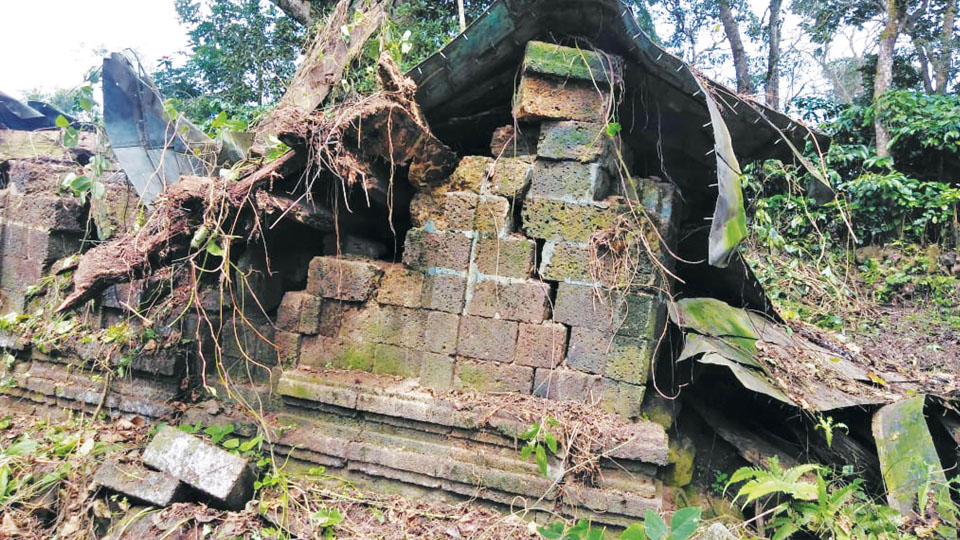
An ancient Shiva Temple, said to be about 700 years old, has been discovered at Bollumadu village in Virajpet taluk. The temple, found at a spot behind the Post Office on Kadanga Paraane is in a highly dilapidated state and is on the verge of total collapse.

The temple, said to be built using red stones, first came to be known to the villagers through Tantris in 2008. Subsequently, the villagers had cleaned up the spot by cutting down the trees around the temple. But as the temple was not accessible by road, no renovation works could be taken up and the temple remained in its dilapidated state.

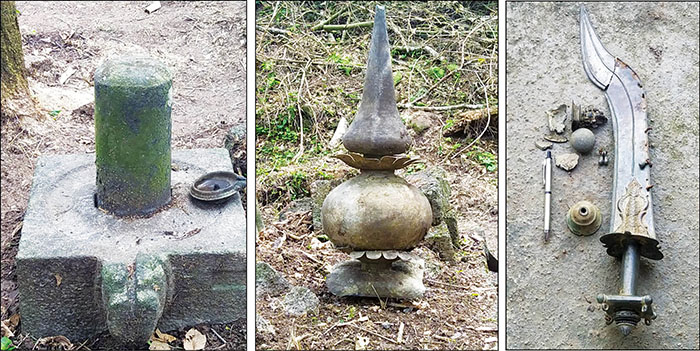
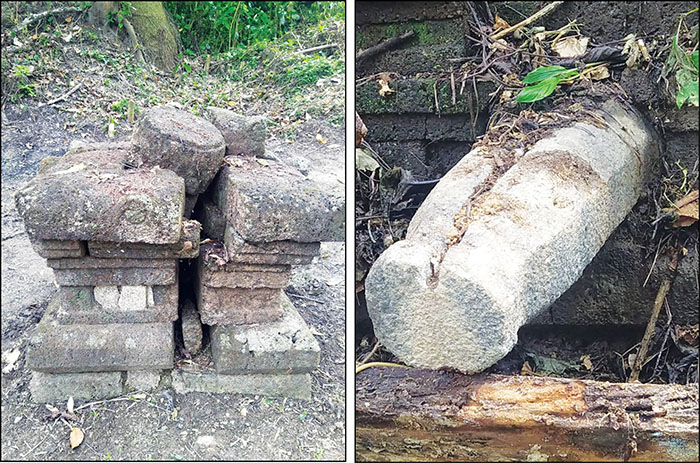
However, the temple exploration resumed two days ago with villagers again cleaning the vicinity by cutting down the bushes and other plants. During the exploration, a Shivalinga stone sculpture was found in the well of the temple premises. Also, the almighty’s Ayudha (weapon) ‘Kadtale’ and small Ganapathi idols have been discovered. This apart, the stone sculptured images of Tripata, Kumuda, Jagatti, Kanta, Pattika and Devakoshta Sopanas were found at the temple foundation. After the discovery of the ancient temple, Bollumada villagers contacted Nayakanda Prakash, who is staying at Mysuru, seeking his help for tracing the history of the ancient temple. Prakash is a former official of Archaeological Survey of India and had also served as a site supervisor at Ram Janmabhumi in Ayodhya, UP.

Prakash, who visited the spot, opined that the temple dedicated to Lord Shiva may be 600 to 700 years old and it may also be a contemporary of the times of the ancient Bhagamandala Temple.

Prakash, who collected some documents regarding the site, observed that an excavation was necessary to trace the complete history of the temple, according to Bollumadu Gram Panchayat President Matanda Arun.

Pointing out that the spot where the temple has been discovered is said to be a Pysari land, Matanda Arun said that a few families are residing in the vicinity of the newly discovered temple. Though the temple was discovered earlier, it could not be reached as there was no access and as such no one bothered to go there. Now a huge tree has fallen on the temple’s ‘Garbhagudi’ (Sanctum Sanctorum), destroying it.

Now, a villager has come forward to part with his land to make way for accessing the temple, Arun said adding that the Kodagu District Administration will be appealed to take up excavation of this centuries old temple.

source: http://www.starofmysore.com / Star of Mysore / Home> News / October 23rd, 2022

Field Marshal K.M. Cariappa Memorial Prog.

Kodagu, Mar. 10 (KBM& DM)

Nenapu-Namana, a programme to commemorate and pay tributes to Field Marshal K.M. Cariappa, was held at the Field Marshal’s birth place Shanivarasanthe in Somwarpet taluk of Kodagu district today.

The programme took place at Shanivarasanthe’s Government Middle School ground under the auspices of Field Marshal K.M. Cariappa Smarana Samithi.

Assembly Speaker K.G. Bopaiah unveiled a stone plaque. Madikeri MLA Appachu Ranjan presided. Renowned Cine Director Nagathihalli Chandrasekhar, High Court Public Prosecutor H.S. Chandramouli, MLC M.C. Nanaiah, former MLA B.B. Shivappa, former MLC S.G. Meda-ppa and others were present.

Earlier, the public and school children accompanied by folk and cultural troupes, marched in a colourful procession through the main roads of the town to reach the venue.

source: http://www.StarofMysore.com / General News / March 10th, 2012