Tag Archives: Chembebelluru

Tracing Kembatti traditions in Kodagu

In this legend, the three elder brothers living in Kannur send their remaining siblings into Kodagu and Wayanad.

An idol of Pannangalatamme. Credit:  Roshan Bopanna and Chenanda Rohan Ponnaiah

Kodagu folklore speaks of seven divine siblings — six gods and one goddess — who were from Kerala and settled in various parts of Kodagu and the adjacent districts in northern Kerala (Kannur and Wayanad).

In this legend, the three elder brothers living in Kannur send their remaining siblings into Kodagu and Wayanad. The three younger brothers (the eldest among them being Igguthappa) and the only sister enter Kodagu on foot. The sister is the best archer among them; she shoots arrows the farthest. She cooks food for them without using fire, instead relying on the hot sand on the banks of a river.

Igguthappa flings an arrow that lodges itself in the trunk of a mango tree. The sister takes the form of an egret and flies to that tree, near which she takes up residence. There, she fulfils her destiny. This is Pannangalatamme, the goddess of the Kodava-speaking Dalit community, the Kembattis.

The worship of Pannangalatamme and the celebration of her temple festival are central to the Kembatti identity today.

Festivities

Every year, during a two-day festival, members of the Kembatti community gather at the main temple of Pannangalatamme, which is near Kakkabe, a large village in Kodagu. The men dress in traditional wraparound tunics called kuppyas, often coloured red or white. There are also temples dedicated to Pannangalatamme in Beppunaad Armeri and a few other locations.
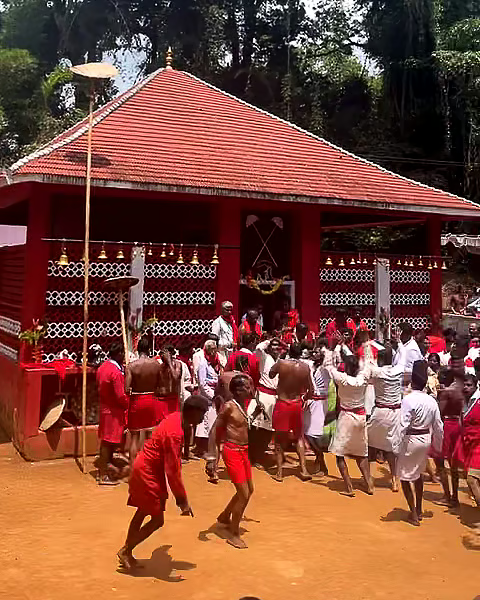
Devotees at the main shrine in Kakkabe Kodagu district. 

The kuppya is a long coat worn by the Kodavas and other natives of Kodagu. It is secured at the waist by a sash called a chele. In the past, the kuppya and chele came in various colours. These days, the kuppya is often black or white, and the chele is gold-embroidered and usually has a silver-covered dagger called the pichekaththi tucked into it.  

The Kembattis were also village musicians, playing the vaalaga, a double-reed wind instrument similar to the oboe, the shehnai, and the nadaswara, which lent its name to the popular folk music of the region.

The Kembattis also blew long brass horns called kombu and played with thaala cymbals. They were often accompanied by drummers called Medas, who otherwise worked with cane, making baskets and mats. Their large drums were of two types: pare and dhol. This motley band of musicians performed at Kodagu weddings, funerals, and temple festivals.

It is difficult to trace the historical timeline of these traditions and temples, which are rooted more in folklore than classical literature. The Kembatti community and the Igguthappa temple are referenced in nineteenth-century texts of the Haleri Rajas, who ruled Kodagu.

The legend of Igguthappa, Pannangalatamme, and their brothers is old and appears probably for the first time in print in the 1870 Gazetteer of Coorg.

In some villages such as Chembebelloor and Bilugunda, the Kodavas, the Kembattis, and others celebrate their annual village festival through various performances in groups, either in disguise or as musicians.

Author Dr Bodukuttada Radhika Kuttappa, who belongs to the community, notes that there are currently 51 Kembatti clan names. On the other hand, Dr M G Nagaraj claims in his 2017 book Kodagina Kembatti Samskriti that there are 97 Kembatti clans in existence. While Dr Radhika listed unique names, Dr Nagaraj counted unrelated clans, sharing the same name as separate entries for different villages. 

source: http://www.deccanherald.com / Deccan Herald / Home> India> Karnataka / by Mookonda Kushalappa / August 07th, 2025

When spirit of nature and animals comes alive

It narrates the ancestral connection with the elements of nature and recounts mythological tales.

Madikeri : 

Rhythmic and upbeat songs fill the air across the villages of South Kodagu during summer. Dressed in bright and colourful attire, villagers dance to the rhythm of nature and mythology while visiting each house – marking the celebration of the unique festival ‘Bodu Namme’ aka ‘Bedu Habba’. People dress as brightly coloured tigers in body paint and slush smeared hay, as bamboo horses and elephants… to an outsider, it seems like a mass fancy dress event.

However, this unique festival of the indigenous tribes of Kodagu is much more than fun and frolic. It narrates the ancestral connection with the elements of nature and recounts mythological tales.

Following the ‘Cauvery Theerthodbhava’ (gushing of river Cauvery at Talacauvery) festival in October, the ‘Bodu Namme’ is kindled at the Kunda Hills near Ponnampet in South Kodagu. Rituals are offered at the Ishwara Temple in the village, marking the beginning of the ‘Bodu’ festive season. Post the first ‘Bodu Namme’, several other villages in South Kodagu celebrate the festival after the Kodava New Year (in April) and each village narrates its rich folkloric culture. The festival is linked to the folklore of Ishwara and Bhadrakali.

There is a Kodava saying  – ‘Kundathl Bottl Nhenda Kudure, Paranamanil Alunja Kudre’ – that states that the horse (made of bamboo) that was raised in the Kunda Hills marking the beginning of ‘Bodu Namme’ will be sacrificed at Paranamani, ending the annual festivity. “At Paranamani, the festival is about the story of deity Ishwara and demon Basmasura. Three horses and two elephants made of bamboo collected from the sacred grove in the village are worshipped and later sacrificed,” explained Raghu Machaiah, a resident of Paranamani.

Mythological stories connected to each village are unique, he says. “The different costumes in which the villagers dress up during the festival depict the different forms of Lord Ishwara.” Another story links ‘Bodu Namme’ to the story of the deity Bhadrakali. “In the deity’s ferocious avatar, no one could calm her down. To appease her, devotees worship her in different attire. Tiger, hay costumes, cross-dressing by men of the village are ways to placate the goddess,” narrate Parvathi Chengappa and Kundranda Sannu Pemmaiah of Aimangala village.

Villages in South Kodagu –  Chembebelluru, Aimangala, Parana, Kavadi, Bilugunda, Nalvathoklu, Kutandhi, and Aarji – observe the festival. “Natives here are indigenous and Ishwara worshippers,” explained Parvathi. As was inevitable, modernity touched the tradition of outlandish dressing. Politicians, famous and infamous personalities, film actors, comedians, and mafia kingpins have found their way into the festival of appeasing Goddess Bhadrakali and Lord Ishwara. During the festival, people visit every home across the village to offer prayers and seek blessings.

Apart from the fascinating fusion of colours, the festival also stresses the protection of nature with many restrictions, including a ban on cutting trees during the celebrations. “The history of ‘Bodu Namme’ dates back to ancestral times, and the rituals and culture of this festival have stood the test of time. While it looks exciting, there is a religious aspect to the festival. In an era of rapid urbanisation, the festival unites villagers and speaks of love, trust and harmony,” opined Shashi Somaiah, a resident of Madikeri.

source: http://www.newindianexpress.com / The New Indian Express / Home> States> Karnataka / by Prajna GR, Express News Service / May 22nd, 2022