In this legend, the three elder brothers living in Kannur send their remaining siblings into Kodagu and Wayanad.

An idol of Pannangalatamme. Credit: Roshan Bopanna and Chenanda Rohan Ponnaiah
Kodagu folklore speaks of seven divine siblings — six gods and one goddess — who were from Kerala and settled in various parts of Kodagu and the adjacent districts in northern Kerala (Kannur and Wayanad).
In this legend, the three elder brothers living in Kannur send their remaining siblings into Kodagu and Wayanad. The three younger brothers (the eldest among them being Igguthappa) and the only sister enter Kodagu on foot. The sister is the best archer among them; she shoots arrows the farthest. She cooks food for them without using fire, instead relying on the hot sand on the banks of a river.
Igguthappa flings an arrow that lodges itself in the trunk of a mango tree. The sister takes the form of an egret and flies to that tree, near which she takes up residence. There, she fulfils her destiny. This is Pannangalatamme, the goddess of the Kodava-speaking Dalit community, the Kembattis.
The worship of Pannangalatamme and the celebration of her temple festival are central to the Kembatti identity today.
Festivities
Every year, during a two-day festival, members of the Kembatti community gather at the main temple of Pannangalatamme, which is near Kakkabe, a large village in Kodagu. The men dress in traditional wraparound tunics called kuppyas, often coloured red or white. There are also temples dedicated to Pannangalatamme in Beppunaad Armeri and a few other locations.
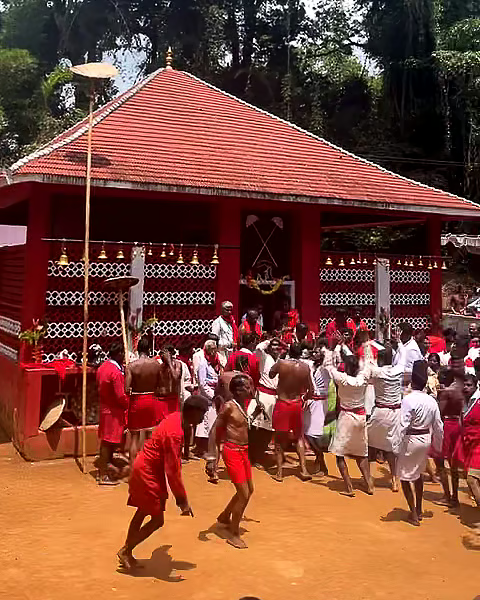
Devotees at the main shrine in Kakkabe Kodagu district.
The kuppya is a long coat worn by the Kodavas and other natives of Kodagu. It is secured at the waist by a sash called a chele. In the past, the kuppya and chele came in various colours. These days, the kuppya is often black or white, and the chele is gold-embroidered and usually has a silver-covered dagger called the pichekaththi tucked into it.
The Kembattis were also village musicians, playing the vaalaga, a double-reed wind instrument similar to the oboe, the shehnai, and the nadaswara, which lent its name to the popular folk music of the region.
The Kembattis also blew long brass horns called kombu and played with thaala cymbals. They were often accompanied by drummers called Medas, who otherwise worked with cane, making baskets and mats. Their large drums were of two types: pare and dhol. This motley band of musicians performed at Kodagu weddings, funerals, and temple festivals.
It is difficult to trace the historical timeline of these traditions and temples, which are rooted more in folklore than classical literature. The Kembatti community and the Igguthappa temple are referenced in nineteenth-century texts of the Haleri Rajas, who ruled Kodagu.
The legend of Igguthappa, Pannangalatamme, and their brothers is old and appears probably for the first time in print in the 1870 Gazetteer of Coorg.
In some villages such as Chembebelloor and Bilugunda, the Kodavas, the Kembattis, and others celebrate their annual village festival through various performances in groups, either in disguise or as musicians.
Author Dr Bodukuttada Radhika Kuttappa, who belongs to the community, notes that there are currently 51 Kembatti clan names. On the other hand, Dr M G Nagaraj claims in his 2017 book Kodagina Kembatti Samskriti that there are 97 Kembatti clans in existence. While Dr Radhika listed unique names, Dr Nagaraj counted unrelated clans, sharing the same name as separate entries for different villages.
source: http://www.deccanherald.com / Deccan Herald / Home> India> Karnataka / by Mookonda Kushalappa / August 07th, 2025